Sounds From A Town I Love (2001)
Woody Allen
USA
3 Min.
Long before young directors started professing their love for their hometowns through segment films, we have had directors whose relationship with their city has been more than a mere proposal. I mean, what would Fellini be without Rome, Scorsese without New York or Truffaut without Paris? And how can one ever forget to add the love affair between Manhattan and Woody Allen to that list? Sounds From A Town I Love (2001) was made as a part of the New York Concert that was held following the 9/11 attacks and presents us snippets from phone conversations of random individuals walking on the streets of the city. When the Academy decides to hand the life time achievement to Allen, they might very well go with this clip for the introduction because Sounds, in a way, helps to sum up the whole career of Woody Allen and, in particular, his style of script writing. The throw-them-all-you’ve-got attitude that is so consistently manifest across his filmography and also within each film is very evident in this short too. Most of the one liners work, big time, and some don’t. The camera tracks, in a way that seals the authorship of the film, along with the actors who deliver these lines the same way that Woody the actor himself would have done. Extremely neurotic and utterly funny at once, these characters are all blasts from the past for anyone who has relished the director’s films. The neighbourhood, which is the raison d’etre of this short, is quite familiar to all of us now and only adds to the nostalgic trip. And that introduction message by the director, where he promises his fans that he would make up for it if they felt that this short film was bad, just goes to show how his relationship with his audience has changed post-Deconstructing Harry (1997)
Block-notes Di Un Regista(1969) (aka Fellini: A Director’s Notebook)
Federico Fellini
Italian/English
“To me, the subway is like a catacomb which goes right through the bowels of Rome.”
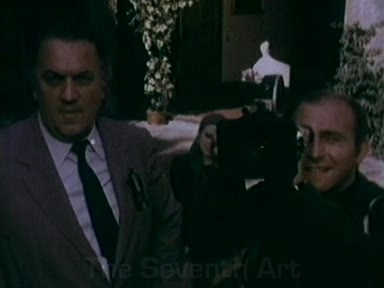
If there ever was something called personal cinema, it had to come in the form of Fellini’s masterpiece 8½ (1963). With 8½ had come a new kind of cinematic artist, standing in front of an unlimited canvas woven in time, dipping his hands in colours called memory, fantasy and magic, painting it without giving a damn about what a world would think about it. Placing himself at the centre of his fictional world, Fellini had indeed made it clear what the director of a film can do to it – as a manager, as an artist and as a personality himself. But to see that a film that he made half a dozen years later, Fellini: A Director’s Notebook (1969) that is as ambitious in its scope and as groundbreaking in its impact as 8½, is much less discussed is both surprising and disheartening especially considering the way Fellini transforms a mere, unappealing making-of-movie into something that is as profound and as personal as his acclaimed movies. Made as a part of a series titled NBC Experiment in Television (1967-71), A Director’s Notebook is a precursor to his next film Satyricon (1969) and traces the groundwork that Fellini laid before the shooting of this film.
A Director’s Notebook presents us Federico Fellini setting out in search of locations, sets and character inspirations for the period drama within modern day Rome. The narrator tells us that he is trying to affirm his belief that there is a strong link between the ancient and the modern and that the Rome of history text books is still alive and kicking. This idea forms the backbone for the hunt as Fellini hops from night-time streets of Rome to the countryside, from the city’s subways to world renowned monuments and from abandoned sets to active slaughterhouses. We meet a range of characters and also get to see them through Fellini’s eyes. Soon we start to sense what Mr. Fellini is arriving at. We see the Coliseum alongside defunct movie sets, we see images of Nero’s debauched army along side the street birds of Rome, and we see brave gladiators alongside butchers of slaughterhouses. Fellini, as usual, has fun transforming his situation as he wants. He seamlessly switches between images of the past and those happening now. We even get to see the iconic Marcello Mastroianni, whom Fellini likes to call a true Roman (“has all the virtues and all the faults of the ancient Romans”), and his subsequent conversations with Fellini beyond which the film really digs deep.
Throughout the film, Fellini sets up a channel between the two Roman civilizations – the present and the ancient – in a way that, primarily, serves as an inspiration for his next movie but also as a personal journey towards the director’s own roots. Be it the virtues – especially the warm and hospitable nature of the people – or the vices – the notorious debauchery of Nero and Caligula – Fellini seems to believe that the culture and the spirit has persisted through the years in the Romans. Towards the end of the A Director’s Notebook, Fellini even has the townsfolk who work at the slaughterhouse enact sequences from ancient Rome, complete with costumes and wreaths, in order to validate them for his next film (In the sequence’s hilarious end, one of the gladiator almost cries because he gets a scratch on his ear). In some ways, A Director’s Notebook is Fellini’s version of the wonderful Tarkovsky documentary Voyage in Time (1983), which too unfolds as a nostalgic trip set in Italy, wherein the director uses geography extensively to invoke memories and emotions. In one scene, Fellini and company travel in the subway train and we notice ancient Romans standing outside the train at many places, upon which the director himself notes that this must be a journey in time and not space.
A Director’s Notebook is to 8½ what Woody Allen’s Deconstructing Harry (1997) is to his Stardust Memories (1980). Allen’s admiration for Fellini has been largely overshadowed by the influence of Bergman on him. In fact, Allen’s career closely follows that of Fellini’s even though the philosophical questions that Allen revisits is that of the Swedish. Stardust Memories (which, in a way, happens to be Woody’s 8½th movie), like Fellini’s 8½, is all about the director. Both movies are exercises in narcissism as many have pointed out. In both, the director treats himself as if he is the centre of the universe while the world around seems to exploit him despite his turmoil. In Deconstructing Harry, Allen comes full circle and, once and for all, accepts the fact that it is he who has been exploitative and that he has to let go of his balancing act between his fictional world and the real world. Likewise, in A Director’s Notebook, Fellini studies his own self and, in an act of purging himself of the ego, reflects on how his relation has been with his actors and everyone else who has helped him gain the international reputation. Towards the end, when many actors and players try to impress the director with their skill set, Fellini tells us in the voice over:
“Yes, it might seem very cynical, very cruel. But no, I am very fond of all these characters who are always chasing after me, following me from one thing to another. They are all a little mad, I know that. They say they need me, but the truth is that I need them more.”
In one section in A Director’s Notebook, Fellini visits his long time friend and movie star Marcello Mastroianni to audition him for the leading role in his unfinished film The Journey of G. Mastorna. Fellini tries a lot – adding make up, setting up wigs, going for multiple takes – to somehow get a shade of the cellist Mastorna out of Mastroianni, but finally resigns. When he turns down Mastroianni telling him that he wasn’t into it at all, the actor quips back: “No Fellini, it’s because now you have no faith. It’s as if you are scared. If you could believe that I am Mastorna, I would automatically become Mastorna”. Throughout the movie, Fellini examines the cost that he has to pay for conforming to his reputation, the cost to that has to be paid for him to remain the Fellini that the world knows him as (Fellini is notorious for rarely using the same actor more than once), the cost for imitating oneself just for the heck of it. Fellini’s situation remains true for any filmmaker who tries to construct his fictional world the way he wants it, even at the cost of the real one – issues that both Woody Allen and his idol Bergman have explored time and again.
Fellini really pushes the boundaries of filmmaking over here. Unfolding as a tone poem in typical Markerian style, A Director’s Notebook soon goes on to blend documentary and fiction to create a truly personal form of expression that seems to be way ahead of its time. Far from the assured and fluid camera work of 8½ and rightly so, the cinematography in A Director’s Notebook is self-conscious, largely handheld, seemingly offhand and purely functional all the way. Closer to a series of essays than a complete film, the movie seems to be one of the earliest examples of the kind of cinema that would later be explored deeply by filmmakers such as Werner Herzog and Jean-Luc Godard. What part of the film was scripted, what was improvised and what was plainly documented will remain a mystery, but what matters is the unique concoction that the director achieves by this mixture. Stacking various levels of reality over one another like 8½, but also taking it further, this stunning little gem from Fellini may just be the golden key required to unlock all his films that were to follow.
A Director’s Notebook, true to its title, also serves as a nostalgia trip for both the director and fans of his work. There are throwbacks of his earlier films throughout A Director’s Notebook. When Fellini visits Mastroianni, the latter is in an interview where the reporters ask him inane questions, much reminiscent of the irritating paparazzi of La Dolce Vita (1960). Early in the film when Fellini is scouting for locations during the night, we cut to a little interview of his wife Giulietta Masina who recalls the (then) edited scene in The Nights of Cabiria (1957) where a strange man delivers goodies to the people living on the fringes of Rome. The hilarious audition section where we have all kinds of people, including a boy who claims he can whistle like a blackbird, a charlatan who seems to know painters more important than Raphael, a lady who thinks her music conveys the same thing as Fellini’s films and even a man whose life depends on his wig, seems straight out of 8½. Even the sequences in the film where the director hunts for life in the streets of Rome during the night time has a lot in common with the positively eerie and Lynchian atmosphere that he created in his segment Toby Dammit in the portmanteau film Spirits of the Dead (1968).
But even without the references, A Director’s Notebook remains an auteur’s work. Even if one doesn’t see any connections of this film to his other movies, one can say with conviction that it is a “Fellini movie”. No one other than the ringmaster called Fellini could have assembled the army of characters that appears at various places in the film. At one point in the film, Fellini takes a mini nostalgic trip where he recounts the people of his childhood watching a movie at the theatre, hinting at the kind of films he would be making henceforth. The clairvoyant who can talk to the people of the past, the professor who studies the connection between historical Rome and its present version and the crewmen who turn into Nero’s soldiers are all characters who have the Fellini tag stuck on their forehead. The lonely yet lyrical, dark yet alluring, beautiful yet decaying streets of Rome, the array of immensely human characters who keep flooding the screen with enthusiasm and women with exaggerated make-up and strikingly extreme expressions – now, where else can one see such images other than at Fellini’s circus?
Tabiat-e Bijan(1974) (aka Still Life)
Sohrab Shahid Saless
Persian
“It means that you’re retired now.”
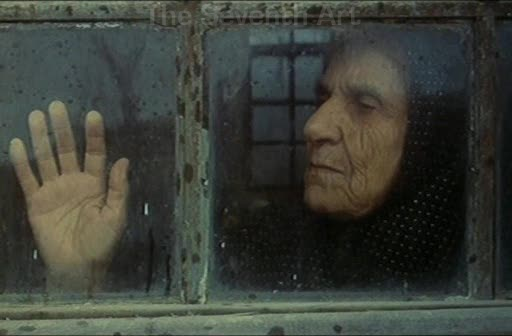
Sohrab Shahid Saless’ Still Life (1974) is, barring Kiarostami’s Homework (1989), the greatest Iranian film that I’ve seen. To see that even during the pre-revolution era, when the escapist cinema of Hollywood and its imitations were much more popular, such uncompromising and quality films were being made is both surprising and hope-instilling. Typically European in its form but uniquely Iranian in its content, Still Life is the kind of movie that contemporary contemplative cinema takes off from. Produced by a newly formed group called Kanun-e Sinemagaran-e Pishro (Centre for Avant-Garde Filmmakers), that also produced some of Mehrjui’s early features, the film was one of the many films that were discontented with the existing way of governance. Although never overtly political, Still Life not only manages to critique deeply the disparity that existed between villages and cities of the country during the Shah’s regime, but also remains one of the best works from the country till date. Let’s wait and see what the present-day Iran brings in reply to this masterwork.
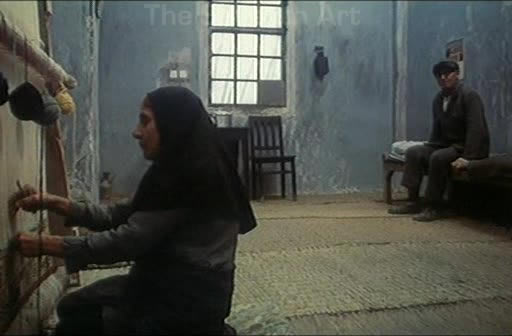
Still Life documents a period in the life of Mohammad Sardari (Bonyadi), a veteran employee of the railway services living in a rural part of the country and whose sole job is to close and open a railway crossing few times a day. He is waiting for a festival bonus from the department that is long pending. He is married and his wife (Zahra Yazdini) supplements his income by weaving carpets and carrying out minor tailoring jobs. We are only given such utterly quotidian details from his everyday life – he operates the railway gates in the morning, he rests at his accommodation near the crossing, he returns home for lunch, he goes back to operate the crossing for the evening train, he returns home for dinner and he sleeps – but that is all there is to Sardari. We are also given a few glimpses of his son who returns home for a day from the military service and a bunch of customers who exploit Sardari by underpaying him for the carpets his wife has woven. One day he receives a letter from the railway department that intimates him of his retirement from service. Sardari is unable to comprehend the meaning of the letter and starts to believe that he has been unreasonably given the sack. Heartbroken, he decides to go to the department headquarters located in the city and find out the reason.
Saless’ style is remarkable here. Almost throughout the entire film, he presents us long, uninterrupted extreme long shots of Sardari going about doing his routine at the railway crossing. Even when the old man is home, Saless and cinematographer Hushang Baharlu give us mostly medium and long shots that are filmed with the camera placed at the ground level, sometimes reminiscent of Ozu. In either case, Saless’ eye is that of an ethnological documentarian – interested in what his protagonist is doing, but never wanting more than that. The mise en scène is spare, stripped down to bare essentials, with a chunk of space between the characters and the camera. Even gestures, dialogues and movements are reduced to an absolute minimum. Watching the indoor scenes in Still Life is like gazing at an aquarium in which the fishes indifferently perform the same mundane activities over and over again. Halfway into the film one is acquainted with the routines of the old man and his wife. He comes home, rolls his cigarette, and starts smoking and she continues to stitch clothes and weave carpets. Even when their son returns home after a long time, conversations are perfunctory and the character functions are unhampered.
But what is singular about Still Life is the way it handles cinematic time. Saless, while letting us witness individual scenes unfold in real time – be it entire dinner sessions or railway transitions – without hindrance, shuffles the order of these scenes in a way that disregards chronology. In one scene in the film we see the couple’s son return home and in the next one, he is missing. And then he’s back in the subsequent one. Soon one notices that most of the scenes could have taken place in any arbitrary order in real time and each of those orders is essentially irrelevant, given the idea of the film. What’s the use of chronology when time repeats itself by going in cycles? In Jeanne Dielman (1976), Chantal Akerman used each day of the protagonist life’s to illustrate its microscopic deviation from the previous. She seemed to be essentially constructing a spiral out of Jeanne’s life – a structure that made her life seem to go in circles but which, in actuality, ends only in annihilation. Saless, on the other hand, treats time as some form of stray deadlock that could only be resolved by an alien intervention. Within this loop, all time is one and each day is virtually indistinguishable from the other.
In one scene that comes towards the end of the film, Sardari visits the railway headquarters to seek an explanation for the retirement notice. In the building, he notices a pair of officers scanning through old photographs reminiscing about the past and talking about plans for the weekend, And just there, Saless provides the most overt and powerful contrast between the life in rural and urban Iran. The officers with a lush past and a busy future stand directly in opposition to Sardari, whose past is almost non-extant and whose future promises nothing different. Still Life would definitely form an interesting companion piece to Antonioni’s Blowup (1966), which seems to resonate more and more with the years. Both Thomas (played by David Jennings) and Sardari are perfectly alienated creatures who pass through life without an iota of an idea about their place in the world. Only that their geographical locations are poles apart. Thomas is one of cinema’s many alienated urbanites trying to impart a meaning to their lives. On the other hand, Sardari is the rare villager who believes that life will go on as it is and who is nudged to action only when that belief is shattered. But in essence, both of them are individuals wallowing in their own world unable to snap out of it.
Even with all its serious themes, Still Life isn’t entirely humourless. There is a constant undercurrent of dark comedy throughout the film (In a masterstroke of black humour, Saless has Sardari regularly tune the alarm clock!), but, like all the other elements of the film, it remains extremely subtle and never thrusts itself upon us. Instead, Saless builds one stretch of time upon another, elevating the film from the territory of mere narrative cinema to the realm of the philosophical, the experiential and the contemplative. In the shattering last scene of the film, we see Sardari, who is now forced to accept the reality that he can no longer work at the railway crossing, vacating his quarters. After he loads the cart with his possessions, he decides to check the house one last time for any object he may have forgotten. As he stands in the middle of the now-empty house, gazing at the room of whose inanimate furniture he had become a part of through the years, Sardari notices the final remnant of his life at this place – a piece of mirror hanging on the wall. He reaches out to collect it and, in the process, looks at himself for the first time in the film. Mohammad Sardari has indeed become old.
Schastye(1934) (aka Happiness)
Aleksandr Medvedkin
Russian/French
“Go and find happiness.”
It is now generally accepted that if not for the efforts of another less talked about filmmaker Chris Marker, the world may not have come to know about his mentor Alexandr Medvedkin and his work. Standing somewhere between the films of Dovzhenko and those of Pudovkin, Medvedkin’s most famous movie Happiness (1934) offers a radically different perspective to the political and cinematic developments in Stalinist Russia. The discussions about Soviet cinema have been dominated by the films and theories of major figures like Eisenstein and Vertov, and perhaps rightly so, obscuring inevitably other stalwarts who may have been. Much less a theoretician than his contemporaries, Medvedkin produces a film that may never make it into classrooms. But one thing can’t be denied and that is the fact that Happiness is a film with a heart. Happiness does work very well as a stand alone piece, but the fact that it is a culmination of a larger and a nobler mission makes it all the more special.
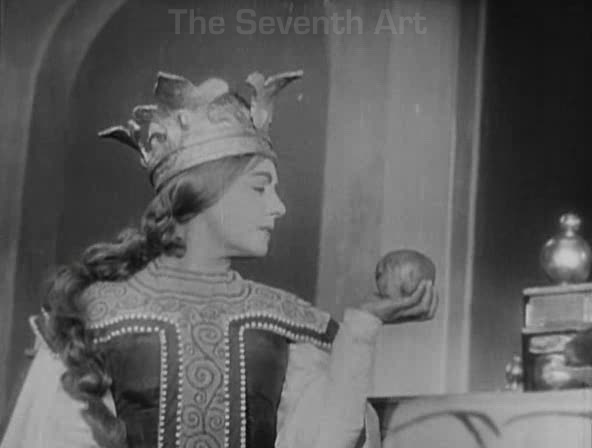
Happiness follows the life of a poor Soviet farmer Khmyr (Piotr Zinoviev) and his “horse-wife” Anna (Elena Egorova) before and after the October Revolution. During the Tsar’s rule, we see Khmyr struggling for existence and envying his wealthy neighbour Foka, who also happens to be the loan shark of the village. So he goes in search of happiness and gets it in the form of a sum of money. He buys a horse for farming but the animal goes on a strike. He manages to harvest by substituting Anna for his horse and gathers a rich output. His celebrations don’t last long as Foka and the Church figures are quick to grab it back from him. He contemplates suicide, but the Church prevents him from doing this “sin”. Now, it decides to punish him by whipping him but not allowing him to die. Years pass by and the country is now in the hands of the communists. The collective farming system has been implemented. Anna seems to have adapted to the system and seems to be doing exceptionally well, becoming the breadwinner of the family. Khmyr, on the other hand, lazes around, making one blunder after the other, desperately tries to become an honest farmer. But the disinvested Foka plans revenge.
Happiness would seem like a very directionless film, if one does not take a look at Medvedkin’s modus operandi outside of the film. Medvedkin was one of the founders of the famous Cine Train of Bolshevik Russia that aimed to travel into the hinterlands of Russia, document the lives of peasants and workers and show it back to them in order to make them understand their strengths and weaknesses. The country had just entered the Bolshevik regime and the common folk, it seems, found it difficult to adapt to most of the improvement measures. Medvedkin and group understood this problem and used the cinema as a medium of introspection to illustrate the situation clearly to the people. Be it public service messages like the importance of hygiene (as in the film Watch Your Health), critical documents about absenteeism, inefficiency and negligence (as in Journal Number 4 and The Conveyor Belt) or queries for betterment of living and working conditions (How Do You Live Comrade Miner?), the Cine Train seems to have never hesitated in putting everything that is right and everything that is questionable about a system on the same plane. And that is very true about Happiness too.
Joseph Stalin banned the movie apparently because he thought that Happiness was mocking his collective farming system – the Kolkhoz – but spared Medvedkin knowing his service for the state. But surely, what Medvedkin was doing was neither a satire on the state of affairs nor a propaganda movie that the Soviet cinema was famous for. What he was presenting was merely an honest view of the newly born farming system, without any form of prejudice or support. For this, Medvedkin pays equal attention to both the positive and the negative ramifications of the collective farming. Through a largely objective eye – a common eye called cinema – Medvedkin makes a transparent reading of the Kolkhoz, its strong points and its limitations. If Stalin is pleased by Medvedkin’s attack on the exploitative and irrational nature of the church in the Tsar’s regime, he would be turned off by the vignettes of the Kolkhoz, where there are a bunch of goons waiting to ruin it all for themselves. If he would be laughing at the director’s depiction of the Tsarist army as a bunch of men wearing the same grumpy plastic masks, he would be annoyed by the possibly individualistic upshot of the film. But by no means is Medvedkin taking a centrist stance, for his stance is that of the people. As confirmed by Happiness, his interest is not the upholding of a political ideology, but a desire for people to have better lives.
“Every man is seeking happiness. Some see it in wealth, but the Russian peasant who struggled in poverty dreamt of it in his own way. Anton Pavlovich Chekhov noted in his diary: “What is a Russian peasant’s dream? If I were tsar, I’d steal 100 roubles and run away!” A Russian proverb says that the peasant’s reply is: “If I were tsar I’d eat the fat of the bacon and I’d go to sleep.” What an idea of happiness! Just having a piece of bread, not being hungry, having a horse, a barn, having a few possessions, a sack of wheat… Such an idea of happiness, so little, but linked to the age-old harshness of a Russian peasant’s life, that’s the basis of my comedy Happiness. I tried to show the tragedy of such a man, and the effort he makes to find his ideal life. His dreams couldn’t be very elaborate, of course, they were on his own scale, but in his own way he was looking for happiness. And in this film I tried to tell a story that’s funny, sad and tragic, the story of a peasant like him, Khmyr, for whom nothing goes right. His life is a struggle, just as his grandfather’s and great-grandfather’s had been, just as his father’s had been. And, totally unexpected to him, at the end of the film he finds that there are others who care about him, friends, neighbours, the government too. And in a collective farm he comes close to happiness. That’s the story of the film. Throughout my life the film train has been a wealth of ideas and themes. It made me love themes linked to the people, it made me love the life of the people, their dreams, hopes, joys and pain.”
As he says above, Medvedkin fascination lies with the people of his country. Instead of making his film into a moral tale about the truth about happiness, he is content is depicting the struggles, aspirations and triumphs of a common man – a simple man whom he has seen throughout his life in the Cine Train. That is why, I believe, it is not fair to call Happiness as a politically charged film even though it provides a good indication of the politics of Russia at that time. His Khmyr is not an icon of satire or propaganda, but of the Russian peasant himself. Khmyr is like Chaplin’s Tramp, not fitting easily into preformatted social structures, only that Khmyr is not the happy-go-lucky type like his American twin. Medvedkin seems to be of the opinion that, however strong and simple a system is, there will always be anomalies who will take time to settle down. This idea is reinforced by his other films The Story of Tit (1933) and Stop Thief! (1931), where too we have lazy or incompetent peasants trying to malinger and wriggle their way out of duties at the Kolkhoz.
In Chris Marker’s brilliant film The Train Rolls On (1971), he recounts the rise and fall of the Cine Train, employing meditative voiceovers, stock photographs and interviews of Medvedkin himself. The Train Rolls On starts (and ends) with the image of a moving train, denoting at once the beginning of this film, the beginning of cinema and the beginning of revolutionary cinema heralded by the Cine Train. Marker, not without a tinge of sadness, documents the activities of the Train, from its inception to its death, and attempts to bring to light how revolutionary the vision of the group was. In the interviews, Medvedkin recalls the experience of traveling in the train, stopping at villages, carrying out the mission’s objective and working against all odds to give to people what he had taken from them. Marker’s work is a documentation of a (lost) documentation of history, of revolution and of change. Marker tells us that although most of the Cine Train’s work has gone into oblivion, the spirit of the undertaking has lived on. As he puts it: “The biggest mistake one could make would be to believe that [the Train] had come to a halt”.
What is perhaps most unique about the Cine Train is its conviction that cinema is a medium that is of the people, for the people and by the people. That it can indeed bring a change in the lives of common people. That it is the only art which can create a revolution for good. This view is remarkably similar to Medvedkin’s contemporary and fellow Russian Dziga Vertov’s Kino Pravda theory. Nikolaï Izvolov, who headed the restoration of Happiness, narrates the strange phenomenon that Medvedkin and Vertov shared. Even though both lived in Moscow and were even next door neighbours for some time, they seem to have never met each other officially. And just before they had an opportunity to work together in the 50s, Vertov passed away. One only wonders what course cinema would have taken if they had joined hands. Herzog’s belief that cinema is the art form of the illiterates seems so true when watching the films of these pioneers. Somehow, it feels like cinema has moved backwards from where it started. One should at least be glad that their followers – the Dziga Vertov Group (Godard et al) and the Alexandr Medvedkin Group (Marker et al) – have tried to sustain the vision of their mentors, if not achieving the desired results.
In Happiness, Medvedkin sets up a hilarious contrast between Khmyr and his wife Anna by reversing the conventional notions of masculine and feminine. As Khmyr goes out in search of “happiness”, Anna grabs him by the collar and kisses him goodbye. She defends him against Foka’s exploitation. She steals a horse from thieves and rescues Khmyr from execution. She drives a tractor and runs the house. Heck, she even carries the horse down from the top of their hut! Medvedkin almost always frames her above the feeble Khmyr producing an amusing effect. Sergei Eisenstein called Medvedkin a “Bolshevik Chaplin”. Although I’m sure many will be surprised by that statement since the slapstick in Happiness seems to have aged a bit (but only as much as many of its American counterparts), there is much dark humour in Happiness to make up for that. I haven’t seen any Russian comedy of this period, except Pudovkin’s magnificent Chess Fever (1925), so I am not sure how this film stands out as a comedy among its contemporaries. But where the success of Happiness (and Medvedkin’s work in general) really lies, in hindsight, is in the fact that it offers us an alternate prism to view a country’s cinema, which has been reduced by text books to mere political messages and then a few cutting techniques.





 The Seventh Art