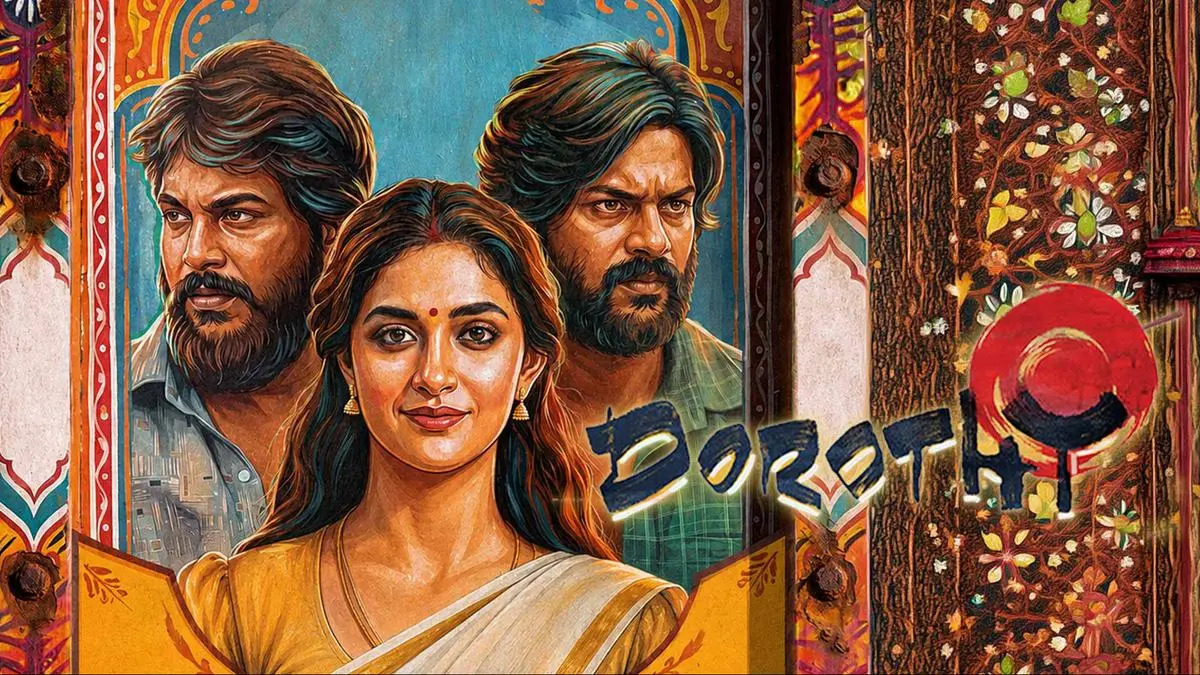
[Spoilers, spoilers everywhere]
This is not a review of Dorothy. There’s been a profusion of insightful commentary already on Karthik Subbaraj’s 10th film, less than a week after its wide release. I don’t want to go through the motions of describing the plot, which concerns the evolving relationship between Karthi (Rishikanth) and Subbu (Sananth) from childhood on. What’s presented below is a set of thoughts and propositions on and around Dorothy. Do not read further until you’ve watched the film.
- What (else) can a filmmaker do with the Madurai film, that genre of Tamil films set in the most mythologized town of on-screen Tamil Nadu? Every twenty years or so, Tamil cinema experiences a renaissance of what have been termed “nativity pictures” — films set in the Tamil hinterland offering an escape/refuge from the threat of globalization and ethnic dilution. Very broadly: the 1960s wave of the Madurai film revolved around feudal distress and the disintegration of the joint family; the 1980s batch — spearheaded by the contributions of Superstar Rajinikanth and music director Ilaiyaraaja, two figures crucial to Dorothy’s political undertaking — constituted odes to righteous masculinity; the 2000s vintage was animated by a gritty realism, offering violent interrogations into crime, caste honour and male camaraderie. Dorothy is, above all, a reckoning with this cinematic history.
- Exceptions and evolution notwithstanding, women have had a marginal role in the Madurai film, serving variously as objects subject to sexual interest, masculine disciplining and suffering or degradation. Dorothy inherits this legacy, presenting a world that is violently opposed to the incursion of femininity into domains not deemed its own. It proposes that the only way the woman can enter the Madurai film on her own terms is through the body of a man. Subbu’s transition into a woman happens in the belly of the beast, in the inner rooms of his family house that is a sanctuary of caste and male pride. If Subbu’s transformation is an irruption from within, his sister-in-law, Dorothy (Keerthi Suresh), represents an irruption from without, a spectral, fantasy projection that appears in the house unanticipated just as it disappears into it.
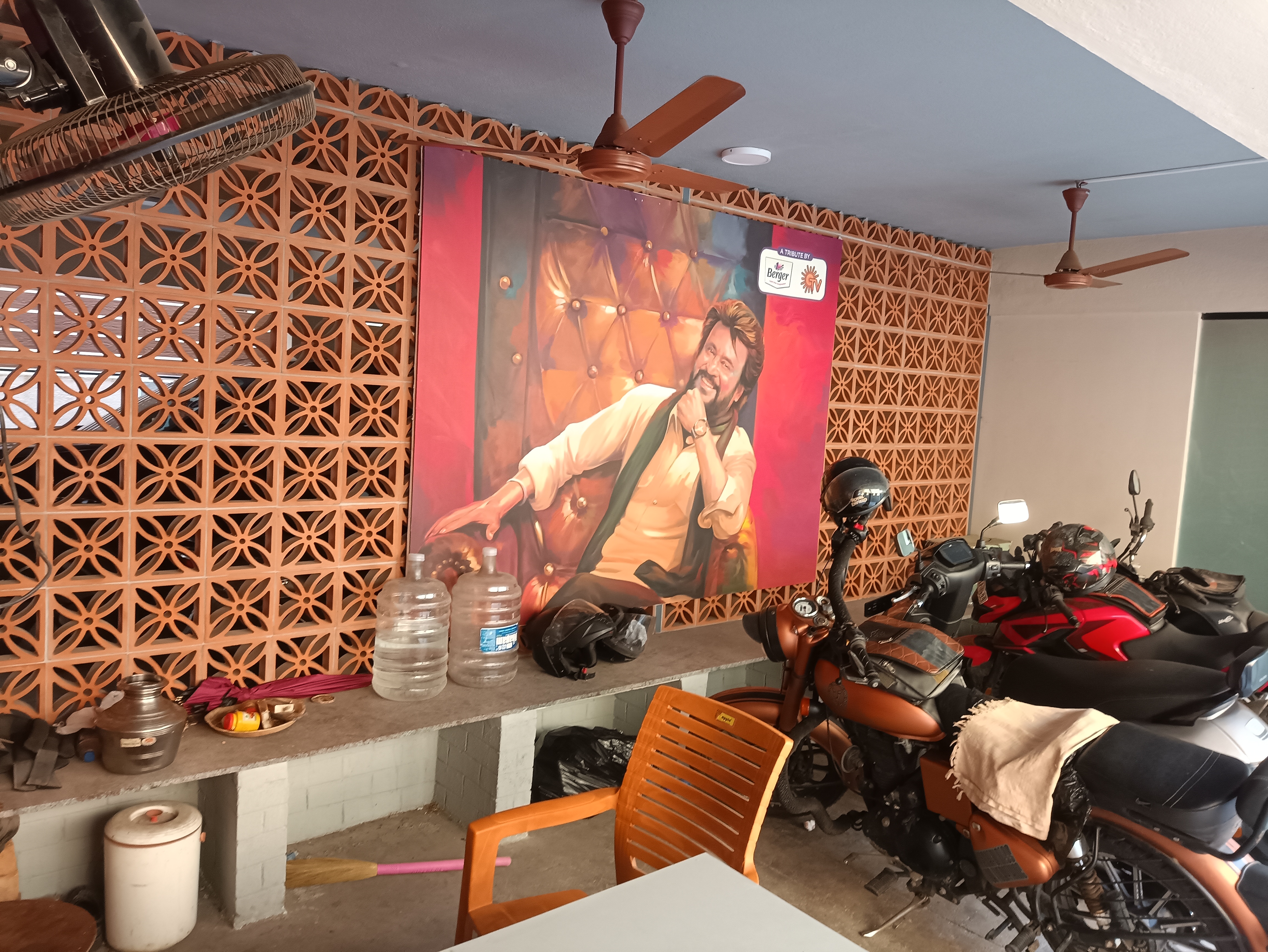
- Karthik Subbaraj is an avowed devotee of Rajinikanth. The entrance to his office in Chennai is adorned with a large painting of the Superstar, and his film Petta (2019) is a veritable fan tribute. Rishikanth’s uncanny similarity in looks and charisma to the Rajinikanth of the 1980s (but also Shankar Nag) allows the director to invent his own version of the Superstar, one that he can bend to his own ends in a way he can’t with the real one. This second, “cinematic” body (and star text) that accompanies Karthi enables Dorothy to revise the history of the 1980s Madurai film, to reimagine it on different political coordinates.
- The other lead, Sananth, has two bodies too. In the first half of Dorothy, his Subbu is the typical young man of the Madurai film, engaged in violent rituals and public displays of masculinity. His transition into a woman mid-film is scattered with grace notes (how lovely is that sprint away from his house!), but it can also feel a little exaggerated, caricatural, performed. On the other hand, it raises the question: why is it that Subbu’s masculine life in the first half comes across as “natural”, while seen from Subbu’s reality, it is precisely that which is a gender performance? Or more broadly, why does brash, macho performance on Indian screens seem like “the default” for male actors while it is as stylized, constructed and removed from reality as anything other acting mode?
- Dorothy has been faulted for its implausible plot developments and character psychology. Fair game, but it’s a common lament throughout Karthik Subbaraj’s 10-film career. (It is instructive how consistently his detractors, including me, fault his films more or less on the same terms.) I’m certain that considerations like believability, plausibility, and even some form of realism are very important to Karthik Subbaraj as a writer. But he always gravitates towards types with believable traits than real characters with well-rounded psychology. For instance, Subbu’s father Whistle Veeraiya (Muthu Kumar) is a villain from a Spaghetti Western, a Tarantino-like cartoon. Where a real casteist patriarch would observe the restraint necessary for the maintenance of the feudal order, Veeraiya kills off the last chance he has of re-establishing his household. Clearly, this isn’t a “character” in the true sense. What animates Karthik Subbaraj is instead the expressive potential of his types, their criss-crossing motivations, and the giddy plotting that relates them to one another in ingenious ways. In painting terms, it’s all about the underdrawing and local colour, not optical illusion.
- As both writer and director, Karthik Subbaraj loves structural games, and Dorothy abounds in them: doubling, symmetry, inversions, mirroring, role reversals. This is a film that begins in stark monochrome and ends in an explosion of colours. The first half, where a woman is trapped in a cis-normative world, gives way to the second, where a straight man finds himself caught in a trans-dominant world. Subbu and Karthi are parts of the same being, with the former leading the latter throughout the film, with the full confidence that Karthi will eventually catch up. And when he does, it’s fireworks. The closest equivalent that I can think of for what Dorothy does with the structure of an established popular film format is Nagraj Manjule’s Sairat (2016), whose stark (and starkly different) second-half subverts the “pop-cinema primer” that the first half offers.
- Dorothy isn’t just a film scored by Ilaiyaraaja as much as one born under the sign of Ilaiyaraaja — that ubiquitous voice of the Madurai film. The film’s songs are magnificent, as is the score, particularly the “Do Anything” piece, first heard on screen in Veedu (1988) as a paean to middle-class aspirations, repurposed here into a stirring anthem for forbidden desire. Ilaiyaraaja’s score here triangulates between the epic, the sentimental and the comical, and I did feel there was too much Ilaiyaraaja in some parts of the film. But on the whole, the music works wonders. For example, the emotion in the scene where a transitioned Subbu meets Karthi’s mother is born of the slight tension between the melodrama of the material and the epic quality of the score. When both registers coincide, as they do during a long death scene, the music-image marriage is less felicitous. But it’s Ilaiyaraaja’s extra-textual presence that is more pertinent here. Ilaiyaraaja, who enjoys a demigod status among Tamils across the political spectrum, serves as a common ground from which people of all persuasions can engage with the film. A more modern composer could conceivably have extracted different, possibly richer undertones from the film. But the moral-spiritual-cultural authority Ilaiyaraaja possesses helps to reconfigure Dorothy’s politics in traditionalist terms and integrate the film into the Tamil cinema canon.
- The relatively easy passage that Ilaiyaraaja’s presence offers into Dorothy’s furthest reaches is echoed by a difficult and disturbing narrative strategy. It’s that the film offers a great deal of space for characters to register their disgust with Subbu’s femininity. Representatives of the Tamil transgender community have welcomed Dorothy, but also pointed out its re-iteration of hurtful slurs, wondering if they couldn’t have been censored or editorialized. I’m in two minds about this. I’m certainly not a fan of works decrying oppression by portraying it in full force and allowing viewers to share the voyeuristic pleasure of the oppressors. (The film’s 1990s setting is moot — Dorothy is a 2026 work addressing a 2026 audience through 2026 political lens.) On the other hand, the device has indisputable advantages: it acknowledges/preempts the reaction of a section of the audience, helps them be ahead of the characters, and quickly find a footing in the film, which then carries them along to where it wants to go. Karthi’s evolving attitude to Subbu becomes the vehicle for this moral trafficking. I suspect that muting injurious language would breach this strategy and impose a distance between the viewers’ beliefs and that of the film too early. On the other hand, I also wonder if a film seeking to offer trans viewers their place in Tamil cinema needed to create so much space for those hostile to their existence. In this, Dorothy is perhaps a transitional work in Tamil cinema that will allow future filmmakers to engineer popular narratives where cis viewers will be able to identify with trans characters without the psychological cushion of their own kind.
- The conservative pushback against Dorothy right after its release was something of a surprise to me. When I watched the film at a private screening back in May, I expected the strongest backlash to come from the liberal quarters. Dorothy is clearly not au fait when it comes to international debates around queer representation. Karthik Subbaraj is not a sophisticate who has all his politics harmonized and up to speed. (Chances are that you won’t get satisfactory answers from him on transgender bathrooms, women’s sports, access to Hormone Replacement Therapy or gender support plans in high schools) His liberalism is more intuitive and experiential, and perhaps more secure for that reason. Iraivi (2016) was undone by its sermonizing and sanctimony, of which there is relatively less in Dorothy. The mid-film twist, where Subbu becomes a woman, could be criticized for its sensationalism. But unlike films such as Plan B (2021) or Dominic and the Ladies’ Purse (2025), Dorothy commits fully to the transition, giving Subbu half the film to enjoy a range of experiences and actualize her true self.
- I want to conclude by stating the obvious: Dorothy is a popular film. And any popular film is a delicate dance between the conventions of the genre, the expectations of the audience and the possibilities/limitations of the star image. Retro (2025) was too cavalier about the latter and was punished at the box office. In contrast, with non-star actors, Dorothy is free from having to deal with this component. Still, it is incredible how it threads a very, very fine needle. Pitching the narrative an inch to the left could have alienated large sections of the audience, an inch to the right would have compromised its integrity and vision. In the last decade, Pa. Ranjith and co. shook up Tamil cinema by bringing a new kind of politics into it. Emerging from the opposite bank — from the movie-crazed cohort of Naalaya Iyakkunar — Karthik Subbaraj brings Tamil cinema into politics, and seals the union with a kiss.


Leave a comment