[The following text was published in Pardo, the official daily of the Locarno Film Festival.]
In his debut documentary Alps (2021), Naël Khleifi followed the maraudeurs: French activists who defy border patrol to rescue refugees stranded in the mountains after crossing the frontier from Italy into France. “[This milieu] offered a different way of speaking about the migrant crisis,” noted the filmmaker and cinematographer in an interview. In his follow-up, a fiction feature, Khleifi deepens his reflection on the subject of illegal immigration but from a different point of view.
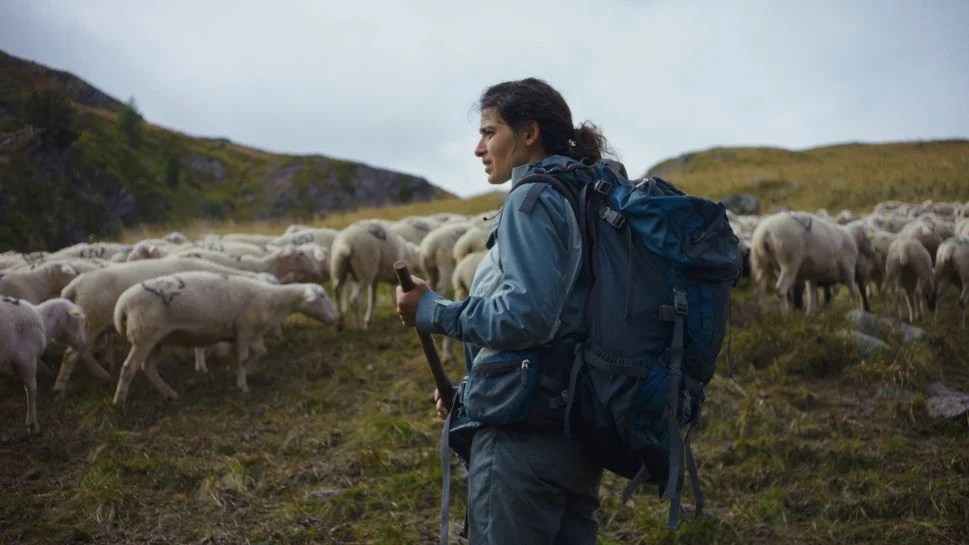
Rather than political activists, at the heart of Summer Meadow (L’estive) is a melancholic young shepherdess named Hana (Manal Issa). Hired by a farm for the summer grazing period, Hana lives in a mountain cabin near the Italian border. We learn that she moved to France at the age of 13, after her family fled a war in Lebanon. Inexperienced and initially alone at the farm, Hana is eventually joined by a French co-worker and cabinmate (Sybille Bataille) who helps her learn the ropes.
With a keen documentary eye, Khleifi’s meditative film follows the two women as they perform their daily routine, drawing remarkable visual energy from the large-scale movement of sheep across the alpine slopes. Hana tends to the animals the best she can, but not without occasional bungling. As an Arab woman, she is a rank outsider to this line of work and knows that she will likely be measured by her mistakes.
But beyond those apprehensions about job security, something seems to be eating Hana, her anxious eyes constantly scanning the majestic landscape. The cabin radio beams news about an immigrant killed trying to cross the adjacent mountains. Over a call, Hana asks her mother not to forward her videos of Palestinian suffering. “We arrived in France yesterday,” her mother retorts, exaggerating but sincere, “and you’ve already forgotten where you’re from.”
Hana certainly hasn’t forgotten her roots. If anything, she is all too conscious of them, torn between the need to assimilate quietly and a deep concern for refugees like herself. Her knotty feelings crystallise later in the film, in an extraordinarily gentle scene where she comes face to face with a young Moroccan in search of freedom.
Born to a Belgian mother and a Palestinian father – the renowned filmmaker Michel Khleifi, whose Order of the Day played in competition at Locarno in 1993 – Naël Khleifi shares something of Hana’s dual cultural heritage. Through her searching, conflicted perspective, his film evokes a harsh, complex political reality with grace and sensitivity.


Leave a comment