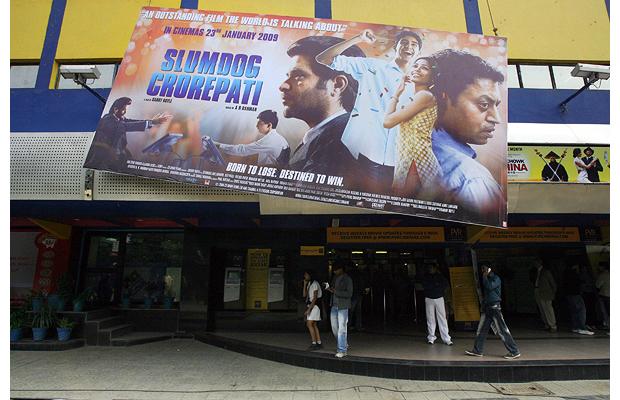
There has been a lot of question raised about the recognition Slumdog Millionaire is getting across the world. And things have been made worse as people with no connection to cinema whatsoever have started capitalizing on the situation. Let’s set the latter aside as it speaks for itself. There are claims that it is because an Englishman directed the film that it has gone to such heights and had the same been done by an Indian, it would have been crushed. I say – Obviously. To be recognized, you have to be seen first. And bringing wide visibility to your work by itself is job half done. The gripe that such a film by an Indian filmmaker would have gone unnoticed is more of a scar on the Indian scenario than the West’s.
The content in films like Slumdog Millionaire and Smile Pinki is very much Indian and is clearly not out of reach of our filmmakers. Indian film industry, too, is not short of great technicians and it could easily pull off similar films by itself. The only and the largest concern is that of the big $. The reason that good films are not being recognized in India seems to be that distributors are not willing to take risks or even pay heed to independent ventures. The term “promoting a film” has been used extensively by the media and its importance never explained. Moreover, the films being promoted are mainstream biggies that already have huge banners behind them. On the other hand, the independent and low-budget ventures keep suffering from under-promotion This situation isn’t going to improve unless some angel pours in money like crazy, which is as likely as a coin landing on its edge. But what can be done is promotion via the hard way. One has to give a push to worthy works regularly so that it is lapped up by the rest of the world.
One thing that could help filmmakers to pitch their work to the world is a film festival. No, wrong – a slew of film festivals organized at various levels of governance. This could be done using a hierarchical setup installed across the country. Something like the TV reality shows of today. Filmmakers get to submit their films at city-level film fests. Winners of each city get a chance for exhibition at the state level. The state level winners could then compete against each other at the national level and finally, the national winner could be made the official representative of the country that year. This would not only be a democratic choice but also one that encompasses a large section of films. When sufficient momentum has been gained from the previous wins, a film would evidently get larger attention. Even the ones that lose out would have been seen by a huge audience at the end of it all. Of course, the country’s film board would have to contribute a lot here. But if the filmmakers themselves could assemble some sort of “unconference” (that wouldn’t cost much would it?), the film development board has to just take care of the higher levels.
And most importantly, a really revered international film festival – a centralized national deal – should be set up. This one should not only advertise the above formed cream of the films from the country but also should prompt international filmmakers to showcase their films. Of course, it can’t be made at the extravagant levels of the Oscars or Cannes and needn’t be too. It could, however, earn a name for itself with its selection of films and the awards it hands out. Once this is done, the films would be automatically taken up for exhibition by other festivals across the world. And when a film is promoted across most reputed film festivals of the world, the Oscars would not hesitate to take note. Why not? What is the Oscar but a grand culmination of extravagant chain of promotions?
There is a big problem here. I may sound like advocating that we have to work towards the Oscars. No. The Oscars are being widely recognized as the greatest recognition in film world, whereas they are anything but that. The Oscars are as vital as they are being considered, but not for the same reason. The Oscar is not as much important as a consequence of good filmmaking as it is as a cause. Look what happens once the Oscars are announced. The box office results soar. Slumdog Millionaire is back to the top 5 this week at the US box office. The DVD market would now be flooded with the winning films. Even the films that were snubbed by the Oscars, but given nominations would have a chance of making it big a la the Shawshank phenomenon. Distribution of obscured films will become fluid. And if this cascade continues, independent movies would be picked up even before the Award season and given a fair chance (True to their name, Fox Searchlight Pictures found Slumdog in the dumps and have created history now). Multiplexes will be used for the real reason they should be. And if the government is ready to push further, they could pass an ordinance where major multiplexes could be asked to allot one show per day to some of these award-winning films. This would significantly reduce the problem of distribution and film availability.
But then, cinema is not an essential service and all the above could be an exercise in futility. But one should also remember that cinema is a huge revenue winner and if proper platform is set up for international collaboration, this would only increase manifold. For the good or otherwise, Slumdog Millionaire has become a landmark film in global cinema and has created a climate apt for cross over filmmaking. This is perhaps the most opportune moment for the country’s cinema to resurrect itself and truly find its voice. However, our filmmakers have to be careful about the most natural pitfall that evolves. They should not look forward to cater to an international audience now but to the local one, however with a keen eye on quality. Only then, we would be able to create a unique identity for our cinema on the map of the world.
Quarter hour into Delhi 6, I found myself sitting dispassionately with a hand on my forehead. The last thing I wanted to see after all the hullabaloo over Slumdog Millionaire was a film extolling our culture. The pleasantries among the characters had nearly sealed off the fate of the film as far as I was concerned. And Waheeda Rehman wasn’t helping with her repetitive “Ab main chain se so sakti hoon” (I can rest in peace now) act. It was almost as if Rakeysh Omprakash Mehra was selling nostalgia to the NRIs. As if he was making a film about “our great culture” and never taking it as a platform As if he was trying to make the green card holders break down into tears and say “This is MY country after all. These are MY people”. You know… the usual stuff one feels till the pop corn runs out (Damn, Culture sells). But, to my relief and amazement, Delhi 6 recovers from 0 for 3 wickets to making a decent total.
Delhi 6 revolves around…Heck, chuck it. This would probably result in a census report. Let me just say that there are more people in the film than the number of shots. So we have Roshan Mehra (Abhishek Bachchan) who comes to India to take home his granny (Waheeda Rehman). The first half of the film shows us vignettes from the family called Delhi told through the typically patronizing expat eye (but not Roshan Mehra’s). These people spend their time watching unrequited love among Rama and Bharata, but fight with their own brothers. They adore Rama’s marital fidelity, yet go after married women. They are moved when Rama eats food cooked by a socially outcast character yet ostracize and demonize Jalebi, a so-called lower caste woman. They worship Hanuman but are dirt scared of a wild monkey on the prowl, which reveals itself as the focal point of the plot.
There is some good writing at work here. It is as if we have practically isolated our mythology from our everyday lives and deemed it strongly as strictly fictional. Where the characters in Rang De Basanti (2006) found their history more relevant now than ever, here they see otherwise. I’m sure that two of the sequences are going to receive much flak. The first one being the “Dil Gira Dafatan” song, which captures the quintessential dream. Purists may even be prompted to do a Freudian analysis as the images run the ganut of Roshan’s experiences. You have Jalebi vendors and cycle-rickshaws ruling the streets of New York. You have Americans celebrating the birth of a calf and shaking a leg at Hindu processions. You even have the monkey man, having been promoted to King Kong status, romancing on the Empire State Building. The second sequence is a bizarre conversation between Roshan and his grandfather (played by his real life father!) which does seem tasteless for different reasons. But no one can blame them for being out of place, for I believe that this kind of a film warrants such treatment. It is indeed a good move to show disjoint sequences from a society when you are encompassing extremely large issues and not dealing with a smaller struggle amidst larger ones. If a tighter plot would have been used, it would most definitely have been a failure and would seem like the film was biting more than it could chew.
Sonam Kapoor is a bad decision and I felt Soha Ali Khan could have done better. In hindsight, the character of a typically NRI-incriminating modern Indian woman seems tailor-made for Soha. As funny as it sounds, Abhishek Bachchan saves the day. All the potentially fatal reaction shots are redeemed by Abhishek’s unexpected expressions. He plays it low key an never goes into the overwhelming-love-for-home-country mode and cleverly becomes the visitor alone. Though that is a credit to the script, Abhishek manages well to never gain attention (even if it is a consequence of a weakness). All this is until the 115th minute of the film (trust me, I saw my watch here). Then both the Mehras go berserk. There is a fakir in the film who keeps showing everyone a mirror and goes on about the godliness in oneself. This is a good move that could have driven home the point, never looking tacked up too. And at this explosive plot junction (the 115th minute), Abhishek takes up the role of the savior (yes, the pseudo-Indian who refuses to stay passive), he points the mirror to all and “explains” them the truth of life. This is salvaged to some extent by the supporting cast, but the final quarter hour proves fatal. This time, it is the bumpkin Gobar (the talented Atul Kulkarni) who elaborates to all the sane ones how big Abhishek’s role is in changing the lives of the people. And the massacre of the script follows.
Delhi 6 doesn’t suffer from very many problems per se. It is just that it is irregular. Sequences of sheer brilliance are promptly followed by ordinary ones. Fabulous use of soundtrack is interspersed with the stereotypical utilization of music. Rather than calling these weaknesses, I would like to call them glitches. Sporadic, yet affecting the holistic quality of the film. Delhi 6 presents an open ending and fades to black with the most powerful of all quotes in Hindi cinema that I have heard in recent years – “I returned home”. Just see how profound this line is when you discover for yourself what it means. This line would easily substitute for the last 20 minutes of the film. Let’s hope that the director’s cut (if there ever is one) rectifies the mistake.
Delhi 6 is exceedingly well shot. Mehra uses extreme close-ups and deep focus to the point that you can see blemishes on the actors’ faces. In spite of the detached view that the script offers, Mehra’s camera becomes one among the characters. It does not impose on us the bittersweet and condescending opinions that Abhishek’s character may have. See how he desensitizes controversial statements on the news channels by framing the television set along with the news footage. Not only does this offer a space for audience to analyze their own actions but also plays out as a timely satire on the worst thing on Indian television now. The only quibble is that Mehra does not let the images speak for themselves. I would love to show the same mirror that the fakir uses in the film and show it to Mr. Rakeysh Mehra, or his film rather. And tell him “Look, how your film speaks for itself, why try to adulterate it by your obligation to deliver a social message?”
It’s that time of the year again! Yet another year where the whole world is ridiculing the Academy Awards aka The Oscars, yet looking forward to it (to ridicule it of course!). With each film site/blog on earth trying to crack the ever controversial results, I too decided to give it a shot. Originally, I just wanted to cast my vote among the nominees. But hey, a prediction is a win-win situation. If you get them right, a pat for yourself and if not, you get to curse the Academy! Of course, the nominee list itself is ultra-absurd and carefully leaves out the really good films. Here it goes anyway.
Emotions are soaring high for this harmless and lightweight contender among the residents. And the path to the Oscar doesn’t disagree. This one has got odds of 99 to 1. That 1 is for The Curious Case of Benjamin Button that may just be the darkest horse ever.
My Vote:The Reader (2008): Anthony Minghella, Sydney Pollack, Donna Gigliotti, Redmond Morris
This is an easy choice for me. Not just that the other nominees don’t hold a candle to this one, but The Reader is made in the tradition of finest contemporary films from Europe and its value is going to just escalate with the years. A film that grows on you in the truest sense of the word.
Academy’s Vote: Mickey Rourke for The Wrestler (2008)
Oh, it looks like this is a three way race between our horses Rourke, Penn and Jenkins. Oh no, our first horse has fallen. It is Jenkins and it looks like it is going to be a photo finish…. No, no wait. Look at Rourke The Ram Robinson go… Blazing away as if on steroids. He’s taken it and how!
Penn has got the award in 2003 and the Academy will not hesitate from giving it whole heartedly to Rourke.
Sean Penn may be Frank Capra of the actors, but what Rourke‘s got here is a Citizen Kane. There wasn’t and will never be any performance like this from him. The Wrestler is a great example of what Method Acting could do to a film and there isn’t anyone else who could be cast so effectively. Go Randy Go!
Academy’s Vote: Melissa Leo for Frozen River (2008)
This category mirrors the previous one closely with the last three actresses coming in big time (and the Brangelina pair being the filler noms). Kate Winslet seems to be the absolute favorite everywhere. And Meryl Streep would be here even if she had played the lead in Rambo 5. But I have a gut feeling that the Academy will snub the last two again to make up for their mistake that they did with Gena Rowlands
Both Streep’s and Winslet’s acting enhance the written characters, but Leo’s performance defines it. Like Rourke, Ms. Leo has pulled off something very unique and probably once is a life time. I would have given an arm for Meryl Streep’s win until I saw Frozen River.
Right from the day Ledger passed away, there has been an onus placed on the Academy. But luckily for them, Ledger comes up with this. Strange that the Academy took it for granted that in a Batman film the villains are always supporting actors. Why do they notice only the unstoppable force and not the immovable object?!
It would be a crime or a plea for insanity if I vote otherwise. All the other actors in this category, who had done great work actually, had it coming. Downey Jr. plays a very tough character that works on multiple levels of self-consciousness, but The Joker is untamed savagery.
Best Performance by an Actress in a Supporting Role
No, no. She’s not the token black person. Her performance comes as a surprise, both on and off the screen. Her role could have been called badly cast for she was pitted against three established actors. But she shows otherwise.
For me, this boiled down to Ms. Davis and Ms. Cruz. I would have blindly given it to the latter if not for the feeling that she has done this kind of charming act somewhere before, many times.
Danny Boyle has reinvented something as far as the West is concerned. They never could come to terms with Bollywood until Slumdog Millionaire showed up to appease them. Mr. Fincher could have posed some threat, but he fails himself. And so does Van Sant.
Another sitter of a choice. Stephen Daldry’s direction is uncompromising and his mise-en-scene, meticulously controlled. His immense confidence on his actors and script are one for the arthouses. Take a bow Mr. Daldry. You have to be satisfied with my vote alone though.
Best Writing, Screenplay Written Directly for the Screen
WALL•E (2008): Andrew Stanton, Pete Docter, Jim Reardon
Academy’s Vote: In Bruges (2008): Martin McDonagh
I may have just gone against my better side of the brain. Though WALL•E is the kind of material that Academy considers its 2001, the film turns spoof-like and a tad restless. Not that the committee considers all that, but WALL•E already has a lock and would have to let go of this one.
My Vote: In Bruges (2008): Martin McDonagh
In Bruges is my favorite fiction of the year and its script would show why. Awe-striking use of the material at hand, McDonagh should have been nominated for the director category too. Genre-bending and genre-blending isn’t restricted to French films and Tarantino alone, says McDonagh
Best Writing, Screenplay Based on Material Previously Produced or Published
Sober, neat and beautifully rendered script stands out among the five and is going to become one of the most respected films of the decade. Characters are written without prejudices, interaction between the film and the audience remains pristine, never once incriminating or loving its central characters. Top Notch.
There is no stopping Slumdog Millionaire. Mantle’s camera is “energetic” and seems to intensify the visuals of the film, though it never determines it. This would seem like a easy choice for the committee.
I would have loved to see Kaminski for Indiana Jones 4 here in the list. Watching The Dark Knight is an experience and Wally Pfister is a prime reason. The tag of an action film will hurt him in the awards ceremony, but the truth is that he has pulled off something humongous and something sweeping that can’t just be covered up.
This is a close call between Slumdog Millionaire and The Dark Knight, but the Oscar committee would not want to increase the ire of the Batman franchise fans and would give this category to it.
Slumdog Millionaire does well, but The Dark Knight’s editing literally zips the film from a 4 hour drag to what it is. Making the audience restless in every sense of the word, The Dark Knight’s Editing hits the nail on the forehead.
This one is essentially a competition between the first three nominees. Changeling has been done before numerous times. The Dark Knight doesn’t show out its fantastic art work. And The Curious Case of Benjamin Button visibly makes emphatic statements as far as its production design is concerned. Sweeney Todd (2007), had a similar footing and it went all the way.
The Dark Knight’s vision of a nihilistic world is extremely well designed. Gotham City is crafted to perfection, but the film otherwise takes place indoors or in utter blackness. The Curious Case of Benjamin Button wins by a micro margin here with its mystical brown and progressively empty spaces in the film.
Academy’s Vote: The Duchess (2008): Michael O’Connor
Hold on. I have not seen the film per se, but heck, here is a costume drama arriving after a long time and the Academy will not forget to pounce on it. It looks like this one has a lock and I go with the mass opinion.
This may be a case of Emperor and his New Clothes (no, pun unintentional) like Van Sant’s films themselves, but Milk’s costume is deliberately sober and simple like the film. There are no special costumes designed to highlight Harvey but makes him one of the very many people of the world. For once, a costume design that conforms to the film’s theme.
The Academy has two choices – to award either the Rick Baker kind of extravagance or to surprise all with the low-key but formidable make up used in the first nominee. The fact that they did not nominate the first installment in the Hellboy series makes me suspicious.
I may have voted for The Curious Case of Benjamin Button if not for the intervention of CG that prevents clear classification. Hellboy II: The Golden Army takes extreme pains to present us a world full of unimaginable creatures that should not go unnoticed.
Best Achievement in Music Written for Motion Pictures, Original Score
Slumdog Millionaire isn’t like anything Hollywood has ever heard before. Luhrmann teased them with it, but Boyle floods them. If they loved Slumdog Millionaire to death, it is largely due to the emphatic soundtrack that stands tall among mellower tunes.
My Vote: Take a guess!
Best Achievement in Music Written for Motion Pictures, Original Song
WALL•E (2008): Peter Gabriel, Thomas Newman(”Down to Earth”)
Academy’s Vote: A.R. Rahman, Gulzar(”Jai Ho”)
Finally a Masala song to which the westerners have shamelessly let their legs loose. If one loved the film, one would doubly love the fascinatingly-ludicrous end credits pepped up by the fizzy voice of Sukhwinder Singh.
My Vote: A.R. Rahman, Maya Arulpragasam(”O Saya”)
This is essentially choosing one out of two songs for me and O Saya is magical on screen. I would have loved to see The Wrestler and Gran Torino over here, but the votes wouldn’t have changed.
WALL•E (2008): Tom Myers, Michael Semanick, Ben Burtt
Wanted (2008): Chris Jenkins, Frank A. Montaño, Petr Forejt
Academy’s Vote:WALL•E (2008): Tom Myers, Michael Semanick, Ben Burtt
Another close call between WALL•E and Slumdog Millionaire as both of them rely heavily on the environment in the film. WALL•E wins by a margin because the whole of its first half is communicated almost only by sounds and the Oscar people would not hesitate to convert their “aaws” and “oohs” into an award.
My Vote:WALL•E (2008): Tom Myers, Michael Semanick, Ben Burtt
It’s a real joy watching a film that builds its atmosphere on silence, grunts and only a couple of syllables – “Eeeevaaaaa”. The first half of the film is up there with the greatest of silent films and its sound design is extends the possibilities.
Slumdog Millionaire may lose out to The Dark Knight in the Editing category, but this one would be a revenge of sorts. This is one dark horse of a category where it seems like anyone could win without a surprise.
The sounds in the film zip back and forth in time and space like the movie itself and Sayers uses clever sound bridges to extract jolts and jumps from the audience to the maximum. This would be one award that the movie really deserves.
This is the pacifier for what is going to be one of the biggest snubs of recent years. The CG team here blurs the line between, acting, make-up and animation seamlessly and the others have to nod.
This is serious LOL stuff. In a year with a dozen superhero films, only 3 nominees? And what ever happened to Speed Racer? The Curious Case of Benjamin Button has to satisfy itself with one of the minor awards, for which it has done darn well.
I feel bad for Kung Fu Panda. It had wanted so much and did it with all sincerity. But Pixar make it seem like they are in a different genre altogether.
Only seen two films here. I liked Vals Im Bashir very much. But Revanche – what a sleeper of a film! Never thought this one would make it here and turn out so good. A film that I would like to compare with The Reader. This one stays with you long after the end credits roll. That is if you are game for it.
Best Documentary, Features
The Betrayal – Nerakhoon (2008): Ellen Kuras, Thavisouk Phrasavath
It would seem like the Academy would not award another eco-friendly documentary and give it to the unstoppable Man On Wire. But going by the reputation and long overdue recognition of Herzog (who was promoting the film at the Oscar meet), the Oscar may just go to Encounters at the End of the World.
I’ve seen only a couple of films here too. But an easy choice nevertheless. Encounters at the End of the World is my favorite film (along with In Bruges)of all those in the list and perhaps of the year too. There is no way I can stop myself from voting for and recommending this film. It’s a relentless and shattering exploration of human instincts that just wouldn’t leave you alone.
Watch this space for the results and comments on those! By the way, there is another set of awards being given away a day before The Oscars – The Independent Spirit Award. If you are a person who takes awards as recommendations, watch out for that one.
That’s it from the Road to the Oscars (RTTO) series from me. Hope we have a great year for cinema ahead.
Best Foreign Language Film: Okuribito (2008)(Japan)
Best Animated Feature: WALL•E (2008): Andrew Stanton
Best Documentary feature: Man On Wire (2008): James Marsh, Simon Chinn
Best Documentary Short: Smile Pinki (2008) – Megan Mylan
Best Animated Short: Maison en petits cubes, La (2008) – Kunio Katô
Best Live Action Short: Spielzeugland (2007) – Jochen Alexander Freydank
Endnote: The Academy has been pretty safe afterall! Except for the odd snubs like Waltz with Bashir and Martin McDonagh, it has played considerably safe and comforming to the previous award ceremonies. Strange to see Asians all over the Kodak theater – more than the amount they were seen in the films of 2007. Whatever. Let’s hope there are some really good and worthy films next year.
Austria is presently the defending champion of the Best Foreign film Oscar following its dream run last year with The Counterfeiters. However, the inclusion of its contender this year, Götz Spielmann’s Revanche, has come as quite a big surprise. With the film pipping heavy-weight contenders like Italy’s (2008) and Romania’s Gomorra Rest is Silence (2008) , it does make me inquisitive as to why the Academy preferred this one. Now that I’ve seen the film, the curiosity still persists.
I’m not going to give away the plot here although I’m going to mention some interesting points in the film. But don’t worry. This is a film that doesn’t have spoilers, for it derives its glory, ironically, not from concealment of plot points.Revanche kicks off with an array of seemingly disparate sequences involving more than half a dozen individuals. We are forced to think that this is going to be one of those hyperlink films that deal with interconnected lives. But in a Hitchcockian twist to the story Spielmann kills off the central plot and steers the film, literally, into a completely new environment. He shifts a seemingly event-driven film into one that balances character and their actions very delicately.
Spielmann’s camera is reminiscent of the damn good contemporary films from countries like Germany and Romania. It takes up the position of a non-human character in each scene and captures the mise-en-scene with great detail. In most of the scenes, it is situated at a shady corner of a room, the end of a corridor or among the trees of a park. There are no unnecessary pans, hand held sequences or even drastic zooms. To use a cliché, it merely observes. A sizeable distance is maintained while documenting the characters and their actions. But what effect does all this produce? One could say that it provides us drama in its purest form.
Clearly, there is considerable drama in the character’s own lives. The ever-baffling twists of fate, luck and destiny by themselves provide enough fodder to keep one astonished. Spielmann cleverly retains it and never tries to externally dramatize it by employing soundtrack (there isn’t one at all in the film), spectacular camera movements or even by extremities of the character’s actions (although the parallel editing in the first half hour does impose itself on us). The bank robbery, that could easily have been made the central piece, lasts less a minute! Also, Spielmann never delves into the characters psychology for even a moment. He never claims to explore their motivations and intentions. Why doesAlexwork at the farm at all? Why does Susanne visit the old man? Why doesAlex throw away the gun? Spielmann never intends to answer these questions though me makes all of it completely workable. Each of the characters here could be made into a complete melodramatic film. The old man, Alex, Tamara, Susanne andRobert are easy candidates for in-depth psychoanalysis. But Spielmann eschews from making even one.
Furthermore, Spielmann doesn’t even rely on the twists in the plot for attention. The audience can easily guess out what an action is going to result in much before it is revealed. When Alex pins the picture on the wall of his room, we know immediately that it is going to give him away. Spielmann deliberately does that. Consider the moment Alex comes to know that Susanne has found out his secret. There are no wide eyes or Vertigo shots over here! There is a long pause where Spielmann focuses on Alex’s face. That is all. Alex has assimilated what this means and what its consequences are going to be. That is the stuffRevanche is made of. The twists aren’t as important as the actions that they result in or those that precede them. And it is indeed these “actions” alone that help us piece together the characters’ motivations.
Interestingly, there are extended shots of Alex chopping the wood and his grandfather playing the accordion. What begins like an establishing technique goes on to become something more vital. The wood chopping becomes more than Alex’s work. It becomes a gesture by itself. It seems as if it is his interaction with the hermetic world. And same is the case with his grandfather. Both these characters are in complete loneliness even though they live together. They seldom talk and carry on with their “gestures” even if there is no one to receive them. There is something elusive in the presence of these actions. At times the wood-cutting seems like a token of atonement and at others, it seems like a representation of building resentment. In an case, it falls in resonance with the execution of the whole movie – Actions taking the place of words, gestures taking the place of dramatic cues.
Daldry’s Oscar contender The Reader(2008) mentions how European literature thrives on secrets to drive its characters’ lives. That how persons in power are the ones in possession of great secrets. Many a time, concealment of truth is the prime way to domination. Revanche is exactly that. Alex is pretty helpless and possibly a pawn of fate till the second half of the film. Once he knows that he is in possession of an exclusive piece of information, he is able to control his fate and of others. Susanne is very much an instrument controlled by Alex. And so is Robert. Note how the single secret can create or destroy vantage points. Objectively speaking, Alex is the one guilty of a crime. But the concealment of truth makes it look like Robert is the one. Alex is the one who is vulnerable to law. But because he has used his knowledge to suit his plan, it seems as ifSusanne is going to be the victim if everything comes to light. And this is the “Revenge” of the title – revenge without a single (well, one!) bullet fired.
Revanche opens with a shot of a placid lake followed by a startling fall of an object into it. There are ripples and then back to an unperturbed state. But what is buried into it now will be an object of tension for ever. This sequence is whatRevanchemirrors in the rest of the film. What the intrusion of the third personAlex into the peaceful life of a countryside couple has resulted in. The issues may be buried and done with amicably. But its consequences, the tension thatSusanne is thrown into and the fear that Robert is nudged into will echo for eternity.
I’m not sure if the Academy really consideredRevanche as a contender or did they just use it as filler. It neither has the political grounding or the moral righteousness or even the emphatic statements that it looks for. PerhapsWaltz with Bashiralready has the Oscar it in its kitty.
We always have that “one foreign film” to top it all, don’t we? Continuing the tradition of extraordinary films like The Lives of Others (2006), 4 Months, 3 Weeks and 2 Days (2007), this year we have an Israeli flick Waltz with Bashir. Already a winner of the Golden Globe for the best foreign film of the year, the film is all set to make it big at theAcademy Awards late next month. Director Folman dedicated the Golden Globe to all the babies that were born during the production of the film and desired that when they watched the film in the future, they should think of the film as an ancient video game. And indeed, Waltz with Bashir is a sincere attempt to come to terms with the mistakes of the past.
Waltz with Bashir takes place 20 years after the “purging” operations of the Israeli army in Lebanon. Ron is one of the soldiers in the war who is leading a peaceful life as a filmmaker now. One gloomy night, after he hears about the strange dream that haunts his friend, Ron decides to dig up his past. This takes him to various places across the globe as he gradually recovers his memories of the fateful war. There is considerable romance in the events of the war, with Apocalypse Now – like celebrations of destruction. Men come, men go; No one recognizes the other completely, but each one has a story to tell. Each one has a version of the war. We are presented many POVs as Ron continues inquiring his role in the war. He isn’t happy about what he is discovering. But the thirst for truth keeps him going.
Waltz with Bashir presents a great paradox now. One that all of us carry with us in one form or the other. One that uniquely characterizes the human intelligence. A paradox of memory. When you want to forget something, your mind does not let you. It keeps coming back to haunt you until you confront it for good. And when you want to remember something desperately, the same memory starts playing tricks with you. It cooks up some mutated form of the past combining elements of truth and fantasy. Ron seems happy with his filmmaking business until the inevitable shadow called past catches up with him. He realizes the need to remember. But no one lets him – neither his own mind nor his friends’. Early on, Ron’s psychologist friend tells him of a memory experiment where people were found to accept small deviations from reality as reality itself. Similarly, everyone seems to have settled into some form of comfortable reality in order to barely escape from the horrors of the past and yet remember their years in the war. Unwilling to strike a balance between the need to document and the need to forget, Ron decides that he has to know what happened and not speculate.
It is but natural to be reminded of the previous year’s fantastic film Persepolis, for both employ animation to address issues of very high importance. Persepolis, using its childlike animation effectively along with its monochrome, presented one girl’s quest for identity and her abstraction of the ever-changing world. Marjane’s fantasies of a fairy-tale childhood are slowly corrupt by the knowledge of the harsh realities of the war-torn world. The ever-unsafe world prevents her from carrying on with her illusions of undisturbed happiness. Waltz with Bashir, on the other hand, is an account of one man’s struggle to recollect the past. It sort of reverses the structure of Persepolis and presents us a man who attempts to recall reality exactly as it happened. Ron does not want to concoct a “safe version” of reality that remains tough enough to reflect truth but comfortable enough to be complacent about what happened. In essence, Waltz with Bashir asks us to confront reality– without any pretense and escapism – and get over with it once and for all. And this, in my opinion, is the film’s greatest success.
One can’t entirely say that the film does not take sides. True, it is told from an Israeli point of view and yet comments on the atrocities done towards the Palestine refugees in Lebanon, but the Lebanese evangelists won’t be happy with the depiction of the massacre. However, this can not be considered a blatant caricaturing of them. Waltz with Bashir takes just a single event from the war – the refugee camp massacres at Sabra and Shatila – and questions the appropriateness of that event alone. Yes, it does take a stand there and it does condemn the way things unfolded on that dreadful day. But that’s about it. It does not extrapolate the incident to judge the present political policies of either country or even question the motives of the war that it depicts. It is as if the film isolates the lone event in order to denote the sheer enormity of it all and to show how such unwarranted acts of violence have a deep impact on the psyche of an individual and of a nation.
I can’t complain on the technical grounds either. The animated characters are deliberately out of sync with their environment, which gives the film a kind of surrealism that is in tone with Ron’s recurring dream. The dubbing is spontaneous with even mistakes finding their way into the film. The narrative proceeds non-linearly never once going over the head. But these are just the secondary reasons that make the film stand apart. In an age which is plagued by over-sensitivity towards issues such as racism, communalism and war, films such as Waltz with Bashir (and the surprise winner Gran Torino (2008) appeal for an acceptance of these issues as it is and to deal with them without much fuss. And that is a reason enough for me to cast my vote for Waltz with Bashir.
The Buzz: Nominated in the Best Documentary category
The Run: Won the Audience Award and the Grand Jury Prize (Documentary) at the Sundance Film Festival, BAFTA for Outstanding British Film
Audience On Wire
The much talked about documentary Man on Wire is about a man who breaks into rooftops of tall structures only to perform his ropewalking act on them. Specifically, it shows us Philippe Petit’s attempts to fulfill his cherished dream of walking between the twin towers of the World Trade Center on a wire. The film cuts to and fro between three time lines – Philip’s biographical history and his induction into this “crime”, hours before the actual event that is to occur, and the present year at the studio – and provides a seamless documentation of one of the most shocking moments in history.
Mr. Marsh, the director, crosscuts facts presented as interviews with fictionalized forms of the same, shot in B&W. Man on Wire carries the tagline “The artistic crime of the century”. And in retrospect, each word of the tagline seems to resonate loudly. “Artistic” because of the discoveries it can make – of one’s own unlimited physical and mental strength and of one’s own limitations. “Crime” because how it all happened. More than the event itself, the preparations of the event are so dramatic that they can pass of as sequences from a top-notch heist film. And the last word of the tagline is a subtle tribute to the famous twin structure that the new century could never retain. Interestingly, the film never laments about the destroyed structure and sticks to what happened with Philippe alone. And that is a move of great confidence.
As such, Man on Wire makes a great watch primarily because of the content it provides. There are pretty decent insights too into Philippe’s mind with respect to the death-defying act he performs. But I guess, even though it is lovingly directed, it may not go on to win the Oscar. True, that it throws a shiver down the spine but not more than the event itself. And kids, do not attempt this at home!
The Buzz: Nominated in the Best Leading Actor category
The Run: Won the NBR Spotlight Award
Overstaying The Welcome
The Visitor released in 2007 but Richard Jenkins is nominated for this year’s Oscars, making it a close race between three great performances. He may lose out, but not without this massive fight. His timid performance reminds one immediately of Gene Hackman’s in The Conversation (1974, not to mention the penchant for the musical instruments) and this perhaps may make the voters a bit skeptic.
The visitor follows an aging professor whose wife has just passed away. He seems to be the perfect loner. He teaches world politics and affairs, but is soon going to learn what he truly knows. He writes books on his subject and can never take credits for something he hasn’t done. He tries to learn the piano, in vain. Things turn for good when he discovers an African couple staying in his apartment located in another city. What begins as a sympathetic gesture by the professor turns into a deeper relation and goes on to become thick friendship. There is some great writing at work here and that doesn’t take away the credits from the production design team. As the film nears its end, one begins to question thoroughly who the title refers to after all. The Visitor is a film that knows its cultural identity and, along with Gran Torino (2008) and Frozen River (2008), is the kind of film that should define contemporary American cinema.
Save the last 20 minutes or so, The Visitor is decidedly an achievement of great proportions. The climactic portion of the film, so very unfortunately, takes side and tries to gain sympathy for its characters. What it did with its quiet brilliance, in the larger part of the film, is put under threat with this needless change of tone. The question it handles is a very sensitive one – not only bound by individualistic morals but by the rules of the law, economy and society. Sadly, The Visitor tries to simplify it all.
Bala’s Naan Kadavul is a stupendous failure. Its script is darn predictable. It is nothing more than a reworking of the damsel in distress template. Most of its characters are caricatures and exaggerated for dramatic effect. The final monologue is way over the top. Its shot compositions are weak and inconsistent. It glorifies violence. Its way too melodramatic for its own good. Rudran’s mother is a cardboard and her character, overdone. And so is the character of Thandavan. It uses music way too generously to corrupt its atmosphere. Its editing is way too jagged and at times too liberal. Don’t even get me started on the logical flaws.
Phew! Now that all that’s off my chest, let’s talk about the film.
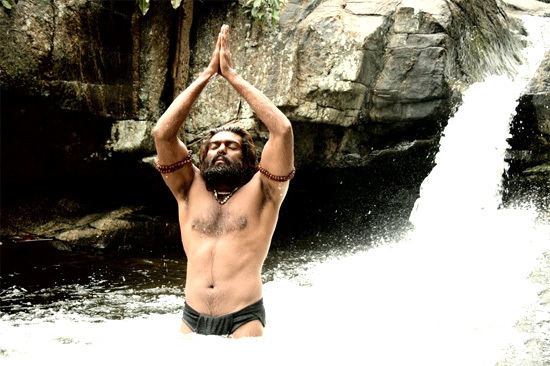
Bala’s films have become like the Cricket World cup. They come out with much hype and after years of wait. What we have here is a director who has “grown out” of the industry. Rather than going with the flow of things, we have a director here who seems to pave his own way. Very few directors have managed to become independent of the market demand in Tamil film industry, leave alone with such a minuscule filmography. This is one of the very few directors who get a louder cheer than the lead actor of the film during the title credits. Let’s face it, which director, even with the remotest idea of what sells and what doesn’t, would have the guts to open a film in an alien land, with a Hindi title song? Or to follow it up with an extended Sanskrit track? Or to use considerable amounts of lines in Hindi and Sanskrit? Heck, who else would have a lead character who roams around in his loincloth and speaks sparing and barely legible lines? Welcome to Bala’s world.
Naan Kadavul is pretty much faulty with its techniques. Arthur Wilson’s cinematography is weak and shows glaringly in the indoor scenes. His two-shots betray the scene and show complacency. See, you build up tension with the scripted scene and why do you want to drive home the content by losing the atmosphere? Not to mention the scenes in the beggar lair. The whole camerawork is politically incorrect, as in Sethu (1999) too. You never look at the characters like that. Wilson’s camera is always curious. It tilts, it pans and it tracks. There’s no problem with that at all, but the grammar it uses isn’t right. It keeps looking down upon its characters. And also hurting the film is the slew of reaction shots that Bala uses. This technique, fortunately for Bala, proves itself to be a double edged sword in the film. You see, a reaction shot in a scene of drama is a sign of weakness. It is as if the director is showing us the gravity of the situation without letting the audience comprehend it. And Naan Kadavul is filled up with many of these. Interestingly, it is the reaction shot that makes a comedy scene work. More than the comic line or gesture, the reaction from “the victim” is what highlights it. Naan Kadavul is filled with those too. Take the scene where Hamsavali advices Rudran to go back to his family. This could have been one sick lecture, but see how Bala’s reaction shots distort the tone of the scene from melodrama to comedy. Sadly, the former type stands out too. However, the handhelds work well outdoors and, I feel, could have been used throughout the film. And so are the close-ups. It’s been a long time since we saw a director confident enough to use the close-ups. Bala closes in and his actors deliver.
Take the editing of the film too. Bala either cuts way too early for comfort or way too late for continuity. There are some absurd filler shots that are a sore. And some shots that should have been given a second or two more. Consider the scene where Rudran is on the terrace waking up the whole neighbourhood. We are shown a shot of the members of the family sitting together downstairs. They are shattered and helpless. There is a perfect distance achieved by the camera. And what happens? Bala cuts away. This shot could have made much more impact than the buckets of tears. Again, take the scene where the second beggar group is performing at the police station. We see a constable stationed outside, timidly trying to take a look at what is happening. This is great satire. But how many of us noticed it. This is not our problem as Bala refuses to show that for more than half a second. What happens essentially is that the cutting betrays good cinematography and vice versa.
Thirdly and most importantly, the use of background score undermines the quality of the film big time. With all due respects to Ilayaraja (whose score would shine as a standalone piece), I would say that the excessive use of emotional cues is a shot in the arm for Naan Kadavul. You see, the moment you have a violin in your film, you throw it away to the dogs. That is because, by the property of their sounds, violins are very evocative instruments. Bala’s scenes have enough raw power by themselves to convey the depth of the situation. He uses excessive amounts of highlighting score that tries to tell you what to feel eventually making the scenes mediocre. Consider the scenes of Rudran’s return home or the separation of the beggar kids by the thugs. There is already much happening and pop comes the background score to distract us. There is enough drama in all his scenes, aided by good performances. Why over-determine what you want to say? Bala is a director who has as much confidence as does the title of the film, but not (yet) on his audience. He should have believed that his audience would understand the emotional gravity that he felt, without resorting to such poor tricks. Bala is a director who has never shirked from showing raw emotions. So why shirk from hiding it when necessary? Luckily, Bala’s films so far have compensated for the form with their content, more or less. So I’ll just stop there with a hope that all this will be completely corrected in his forthcoming films.
There have always been two facets, taboos rather, that have plagued cinema world over – sex and violence. Their depiction on screen has been much debated over and their use much researched and their responsibilities, studied. The world is slowly opening up to the former, but the latter still remains a hot issue. Popular cinema, however, still treats them as it did decades ago. The use and the meaning it conveys have never been questioned by pop filmmakers of the world, leave alone the Indian ones. Indian cinema has always shown gratuitous amounts of violence on screen and seemed to have no problems with that. But ALL the violence it shows is based on a single moral premise – good over evil – that we all have been hypnotized with. I don’t mean the idea of good winning over its rival but the definition of good and bad itself. Films as graphic as Thevar Magan (1992) to ones as mellow asJaane Tu… Ya Jaane Na (2008) have firmly set their foot on this premise as far as their use of graphic violence is considered. And Bala’s film here, is no different. See how he creates the platform for violence by making his villain despicable. He imparts alarming one-dimensionality to Thandavan and resorts to shocking the audience with graphic torture. In essence, like the very many Indian films, he the sets audience’s mentality to consider violence as a optimum solution to the problem. And the ensuing violence arrives readily justified and as a consolation to the restless audience.
The term “glorifying violence” has been used by reviewers very loosely. They seem to consider any film that shows considerable amounts of it as glorifying violence. If that is so, all the popular films from the country would be glorifying violence. Does Naan Kadavul glorify violence? Of course, it does. But not in a very different way from the other films of today. But does it have an impact? Bala sets up the situation for accepting violence, but would one actually go on to be influenced? No. You see, by the virtue of the character that the script provides, the film provides us an instant alienation from Rudran. Though it makes the audience support his actions, it never would instigate them to follow suit. Naan Kadavul, like almost all pop films, presents itself in a whole new world and consequently cuts off any of its justification of its actions in the real one. And the audience never carries on its support out of the theatre (as much as it does for its morals). So even though the film (and all films that have a stunt sequence) glorifies violence, it never can offer this as a solution to social problems. As a result, the film isn’t a glorification of violence as much as it is of our strong morals.
To get a measure, consider Jaane Tu… Ya Jaane Na. This is a film that is much closer to our world. All the violence shown in the film is a single punch. Now, the film presents Jai as a character who is brought up against violence. He sticks to it for a large part of the film even though Aditi’s one-dimensional boyfriend provokes. And finally when the film reaches its match point – Wham! Jai punches him to prove his manhood and his love. The audience applauds. And since the film mirrors, to an extent, our world and behaviour, the audience reassures itself that violence is a good solution. It would very well take with itself subconsciously the idea that violence is a token of manhood and a good way of dealing with one’s insecurities. Now, compare this with Bala’s film. It oozes with gore and the gore is washed away from our minds once the end credits roll. This is what the world the director builds can do to the film and its responsibilities. This is Bala’s world. He is not interested in normal people. He is interested in the outcast and the outlawed. All the people he deals with are “strange ones”. Look how the “normal” people are indifferent in the temple scenes as they go on with their routine lives. There is much drama happening in the beggar crowd which they seem indifferent to. There is a Jai and an Aditi walking somewhere in that world surrounding the one that Bala’s interested in. And his success is his conviction that what interests him will interest us too.
[Video: Trailer of Naan Kadavul]
In Indian cinema, there is interestingly an addition to the two member “taboo” set above – that dreaded thing called religion. Our films have always alluded to it, touched it, gone around but have never once confronted it. The films that did deal with it extensively turned out to be one-sided duds like Velu Prabhakar’s films or Ramanarayanan’s. No film has explored how deep religion is linked to each one of our words and gestures. Hell, no film has even examined what religion means to the common man. Dasavatharam (2008) teased us with the possibilities, but stopped there. This is the biggest taboo of them all. Our Gods are a part of or daily talk. We make fun of them and we enjoy humourous anecdotes framed around them. We even spoof our gods never once hurting anyone’s feelings. But when it comes to serious discussion, on film or otherwise, we have never strayed away from our comfort levels. Our ideas about God are so complex that we never want to understand them. Instead, we stay in a safe zone but raise our voices when someone doesn’t. In our cinema, no director has ever approached the subject with honesty and without self-consciousness. That brings us to the strongest point and the raison d’etre of Naan Kadavul.
Naan Kadavul is essentially a mystic rehash of Bala’s own Nandha (2001), but one done with more maturity and confidence. Look how Bala directly “confronts” the issue. This “confrontation” can be very tricky. One has to both make ideas clear and direct and at the same time never stuff them down your throat or be dreadfully didactic. Case in point, Chimbudevan’s Arai En 305-il Kadavul (2008) – an honest but one-sided film that could pass off as a “Sunday school lesson”. Though similar in its ideas about God to Naan Kadavul, it spoon feeds its ideas never knowing when it crossed its boundaries. Take Naan Kadavul. Look at its characters. All of them are like us. They talk about Gods, they make fun of them. For them Gods are no greater than film stars and vice versa. Hell, they are even dressed as Gods but never once take that seriously. For these people, Gods are just another way of livelihood. They beg at places of worship and consider those their “markets”. Oh, but they do believe in Him. Only that they don’t know why. One of the “saints” at the temple quips when another rebukes Murugan for praying regularly “Let him, Why spoil the belief he has?” This is the kind of instinct that these guys have. Not very different from ours, I should say. These are the people who could very well represent a large part our society.
And then there is the contradicting arm of the movie – the character of Rudran. Bala could have easily redone the rational-man-delivering-the-radical-ideologies act, but that would have been one fatal blow to the film. Instead, he chooses a strange man who claims he is God. This instantly makes us repudiate his statements and even ridicule it. As a result, the didactic monologues are avoided and even turned into subtle expressions of Bala’s ideas (The film is called Naan Kadavul and not Naam Kadavul!). Bala is perhaps suggesting this is how every man should be. Every man for himself. Possible, but he never thrusts that idea on us like Arai En 305-il Kadavul.
The beggar people very well know that they need to make their own lives. Yet, they resort to God as a means of reassurance and security. Sort of Plan-B. What makes Rudran different from the beggar crowd is that he knows that weakness and acknowledges it too, but never calling himself an atheist or a revolutionary. In essence, the film does not make the audience hostile using a “normal” man questioning them, but one that makes it think. “Think” because Bala tantalizes us by not giving but by taking the ideas away from us. And this is how he confronts the delicate theme – through his audience.
One thing that was running throughout my mind when watching Naan Kadavul was the Slumdog Millionaire debate. No other film recently has generated so much conversations and arguments as Slumdog Millionaire. It has been accused of “pandering to the western fantasies” and “exposing the underbelly of the nation”. Looks at what Bala’s done here. Not better for sure. Even the cheerfulness, hope and escapist mood of Slumdog Millionaire is lost. Naan Kadavul wallows in misery. But it is hilarious and we laugh at all the jokes it makes. Let’s take a look at what evolves.
Naan Kadavul presents three worlds. The first one is the isolated world of its protagonists – one each for Rudran and the beggar team. The second is the world that surrounds them – the “society” in the film. And finally and most importantly, the audience that is on the other side of the screen. See how the behaviour of the three worlds is. Rudran is self-contained. The second world, the one that is around him, is scared of him. There is great satire here too. The police chase away the “saints” that they know are phony. But when a new one comes in, they are scared. They are unable to come to terms that this one is fake too even if their brain says so. He isn’t, but what if he is? They interrogate him with reverence. We know this is us – throwing in the towel when something seems to transcend reason and more importantly, succumbing to mass hysteria. On the other hand, the audience laughs at these two worlds. Only because it is where it is – the other side of the camera.
Again, the beggar-inhabitants of the first one are self-sufficient. They are occupied with their own work. They cook up their own jokes and celebrate them among themselves. It is a completely different world with its inhabitants challenged in one way or the other. Werner Herzog’s absurdist classic Even Dwarfs Started Small (1970) comes to mind. Bala presents these inhabitants as norms and not anomalies. The difference is brought in only due to the audience’s perception. We see them as a different group. We indulge them knowing that we are “here” and not “there”. The second world is totally oblivious to the first one. They completely ignore the first one and carry on with their lives. They seldom hold a relationship to the first world and when they do, it is only exploitative in nature. And finally, the alienated audience that observes (not without the subjectivity imposed by the cinematic elements) these worlds from a distance. We laugh at the not-so-funny-otherwise jokes made in the first world. We condescend on these characters. We patronize them. We feel good about it. But once we are out of the cinema halls, we step into the shoes of the second world. We have our own hectic lives to worry about. So does that mean Naan Kadavul panders to the needs of the upper and middle class for those three hours?
Yes, Naan Kadavul is exploitative, but not unlike every other film. Why! Pop cinema by itself is exploitative, for that matter. Happiness, for it, comes only at the expense of misery looming in it somewhere and from the reassurance and distance the film offers the audience. I don’t mean that we should exonerate such films. What I am saying is that one should not zero in on a single film just because it is being celebrated. What we have to go against is the culture that has been aiding to the rise of such cinema. But hey, those are complex functions of everything that has ever been related to a culture and are a part of a larger debate. And for our part, we need to be less sensitive about these issues I guess (I don’t mean irreverence). These things happen. So what? How long do we want to see perfect creatures leading perfect lives that we can only dream of? Not anymore, says Bala.
Verdict:
P.S: If a film can generate elaborate discussion, why not talk about it? I strongly recommend this movie.
[Edit]: I’ll be posting worthy articles on the film whenever I come across. Here is one from The Hindu today. Interesting, though I disagree at places. Mr. Srivathsan doesn’t find the film to be exploitative or manipulative. Here, I must clarify why I feel the film is exploitative. It doesn’t exploit its characters as much as it does the audience. It offers us distance and hence elicits from us a patronizing look on its characters. Ald this is the same way most exploitative films work. If Slumdog Millionaire was exploitative, it is in the same way. But that doesn’t mean the problem is with us. Essentially what is happening is that the filmmaker exploits both the characters and our gaze of them. And the artifice lies in showing them to be happy and self-sufficient. The exploitation would be seen through if the characters were portrayed to be regretting their situation
The Buzz: Nominated in the Best Original Screenplay category
The Run: Won the Golden Globe for Best Actress (Comedy or Musical)
Let's Put A Smile On That Face!
Mike Leigh’s Happy-Go-Lucky is about a teacher. This is just about the surety that one can bring in when describing its central character, Pauline aka Poppy. Narrated in a seemingly coherent string of episodes, Happy-Go-Lucky unfolds as much as it conceals. Poppy is a character we could easily meet life – easy to ridicule and easier to pass judgments on. Sally Hawkins should have replaced Jolie in the big list.
Mike Leigh does not give us easy answers and predictable characters. Look at how complex the character Poppy is. She is a teacher but is always seen learning things. She looks naïve but seems to know more than what shows. She is irritating to the core. Yet she seems to mean good. She tries to bring happiness in people’s lives, but not the momentarily gratifying one. God knows what she wants. But all this is not a result of bad writing, mind you. Leigh never allows anyone, neither the audience nor his own characters, to judge Poppy. The characters’ privacy is never jeopardized and they constantly dodge analysis. One is unable to even come to a conclusion like “Poppy is…” or “She likes…”. I can only repeat the strange man that Poppy seems to empathize with: “She is, she is, she is, she is, she is, she is,…. You know?” But what is sure is that Happy-Go-Lucky is rooted firmly in contemporary reality like a very few films. And it does this without ever beating its chest out.
And then there is Eddie Marsan. This bloke should have been given one of those Oscar nods. He matches Poppy’s intensity and brings such unbridled energy into the most mundane of conversations that you start looking forward to these driving classes yourself. The blink-and-you’ll-miss lines are all damn funny, all in the British way, but after a point seem to staged and more than spontaneous. But one thing, I would never want to meet a Poppy in my life!
It’s finally here. The first issue of Indian Auteur is out following the announcement of The Delhi Manifesto last month. My wishes to the whole team behind the effort. Let’s read, spread the word, participate and make it happen…




 The Seventh Art