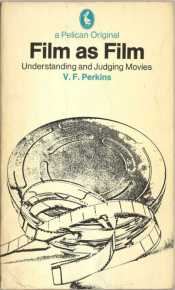
Film As Film: Understanding And Judging Movies Victor F. Perkins Penguin, 1972
V. F. Perkins’ Film As Film is like that invisible little kid in the last bench who stuns the class one day. The smallest of all the books in the pile on my shelf, Film As Film nevertheless offers insights and information that perhaps the others, put together, can’t. Divided into nine chapters, the book discusses broadly about the history of film criticism, importance of form in movie making, criteria for assessment of narrative cinema, issues about authorship of a film and the need for judgment of films. Written with an intention to view films independently as films and not as a mishmash of other art forms, Perkins’ book, to a large extent, shows that “cinematizing” a piece of literature is far from “visualizing” it. Using examples from popular Hollywood cinema, especially those of Preminger, Hitchcock and Nick Ray, he elucidates the role of a director and the importance of mise en scène n a film, without ever making it look like a class textbook.
Perhaps the most surprising of all the chapters, “Technology and Technique”, takes up a subject often ignored by historians and theorists. Perkins illustrates how a study of history of cinema entails a study of not only the history of photography, but also that of projection. He examines how the invention of photography brought in realist concerns (with reality being a unique property of the photographic image) into the already popular projection techniques – from the Magic Lantern to the Kinetoscope. He proposes an interesting argument, emphasizing that cinema existed even before the invention of the camera, whose properties were merely absorbed into the existing techniques. Furthermore, Perkins explores how the advancement in film technology gave directors a wider range of choices and hence provided a better measure of the talent of the filmmaker. Consequently, he argues that technology has never been a huge limiting factor as far as the maker’s vision is concerned, although it made sure that clarity need not imply crudity.
There is another impressive section called “Direction and Authorship”, where Perkins speaks about the collaborative nature of cinema and the role of the director amidst various dissenting voices and thought processes. He cites various examples where the creativity of the director is brutally marred by the norms of the production house and also those where the final product shines much more than one would have expected from the talent of its director. Perkins’ point is not to discredit the director or to prove that it doesn’t belong only to him, but that one must concern himself only with the coherence of the finished film and not with the means used to achieve it. He says: “Provided that a film has its own unity, it seems unimportant whether the unity was evolved through cooperation and compromise within the production team or conceived by one man and imposed on his collaborators.”. He insists that a freedom from the studio system does not necessarily warrant quality and conversely, a director working under the obligations of a contract need not sacrifice his personal vision and style, however alien the content is.
But the USP of the book is clearly the first few chapters where Perkins analyzes the development of film criticism and the dichotomy that subsequently developed between those who insisted that films exploit unique cinematic qualities and those who believed in the capturing of reality without the artist’s abstraction. Though, initially, I found myself supporting the early theories of Rotha and Eisenstein, Perkins manages to convince how most of these orthodox theories were, actually, pulling a potential art form into some sort of scientific practice. It’s amusing to see how divergent these two schools were. One championed cinema that moved closer to reality and the other praised films that moved as away from it. One placed artist as the centre of creation whereas the other, the world. Kracauer’s quote perhaps sums up the entire atmosphere: “…the intrusion of Art into film thwarts cinema’s intrinsic properties”. Perkins distances himself from both the theories and even holds the orthodox one with a bit of contempt.
The second part of the book mainly concerns itself with the understanding and judging of films, based on certain criteria that Perkins suggests. And this is where I found myself a bit disappointed by the otherwise masterful book. Perkins suggests two principal elements when judging narrative cinema – coherence and credibility. The issue of coherence in cinema’s narrative pattern is quite an intuitive one and one wouldn’t at all object to Perkins’ claims. But, additionally, he argues that films must, first and foremost, be true to the world they construct and its actions within them must first be befitting of the reality of that world, strictly obeying causality and rationality. Perkins’ theory limits itself to mainstream narrative cinema and clearly disallows symbols for the sake of symbols, self-reflexivity, Brechtian disengagement and many other modernist principles. Further, it proves weak when trying to judge a bad film. The theory devises a sufficient condition for films to be good but not really a necessary one.
However, Perkins vindicates himself in the excellent last chapter titled “The Limits of Criticism”. He neatly illustrates the drawbacks of the theory and clarifies that it must primarily be used for testifying why a film is good rather than why one is bad (“Within the positive criteria suggested, a critical argument which demonstrates coherence must, other things being equal, take precedence over one which does not.”). This is quite evident from Perkins’ attitude that clearly stands against critics imposing a structure on the filmmakers. One could even say that he considers criticism to be slightly subservient to filmmaking. He seems to be of the opinion that film criticism only enriches itself with movies that push the envelope and can successfully judge only the films that are conventional enough to fall within its established norms. He even mentions at one point that film theory is not the theory of film making but of film criticism. In essence, Film as Film becomes a book that urges one to enjoy a good film for the right reasons, but not one that allows the readers to berate bad films, even for the right reasons. There is nothing more to ask for, especially if you are one who wants to love cinema for what it is and not how it could have been.
La Jetée (1962) (aka The Pier)
Chris Marker
French
“Since humanity had survived, it could not refuse to its own past the means of its own survival.“
Who would have thought that one could make a sci-fi masterpiece in just 27 minutes? Well, I didn’t. I was wrong. La Jetée (1962) has left behind it, a legacy that many filmmakers have attempted to inherit, time and again, through the years. Its vision of the future of the world and its inhabitants – a sunless earth, cold expressionless faces and almost machine like emotional states – and the possibilities of experiment with cinematic and real time, that it has opened up, have become almost a standard template for sci-fi movies. If only a certain movie monument wasn’t made six years later, La Jetée, hands down, would stand out as the greatest sci-fi film ever made. The surprising fact is that the script of the film wasn’t adapted from some visionary short story, but one written loosely and directly for the screen by Chris Marker, the director, himself. And further, the script is just a minor contributor to the film’s success. Here is the thing: The word has been destroyed by the ominous nuclear war and humans are forced to stay underground. The “victors” of the war are trying to find a way to contact the past and the future of mankind to prevent the imminent annihilation of the human race. One of the lab rats for this is The Man (Davos Hanich), who retains vivid memories of his childhood and carries with himself, puzzles from the troubled past.
The very nature of the plot, like the slick ones that play with time and its properties, is potent enough to lock its audience into eternal conversations about the science behind it and the implications that it presents. Scientifically, the basic issues of time travel – like the law of conservation of energy and mass-energy equivalent – are revived. At an emotional level, questions about the inner tension of The Man and about his (and ‘his’) perceptions during the “confrontation” come into the picture. Furthermore, the woman’s untroubled indulgence with the man, who not only lacks a past and a future, but lives an interrupted present, raises concern about the woman’s own identity. Is she one of the guinea pigs too? Is she the specimen of another similar experiment? Or is she one of “them”? Marker leaves such questions unanswered, for his concern is not the drama “of the moment”. Actually, Marker doesn’t even rely upon the convolutions of plot and time to make the film seem significant. As a matter of fact, Marker unravels the proceedings of the film in a lucid and patient manner in his soundtrack, where the narrator explains every action that takes place, till the last detail. Marker could have easily diverted his audience’s attention into a process of untangling the plot by having the narrator conceal some of the facts. But by providing complete information about what happens, Marker utilizes that attention to persuade the audience to recognize how it all happens. We process the aural data simultaneously without any effort as we also begin to note the significance of individual images and the relationship between them.
There is a remarkable scene in La Jetée where The Woman points at a cross-section of the tree trunk to denote her age. The Man jokingly (and self-referentially) points at a region outside the periphery of the trunk suggesting that he is from the future. This scene isn’t just an isolated homage to Vertigo (1958), but one of the many indicators that La Jetée is, in fact, laid on the very themes of Hitchcock’s film. Plainly, both films could well be seen as subjective accounts of treatments of psychological inhibitions – acrophobia and depression. In Vertigo, Scottie is a man who has lost his beloved (and whose face hypnotizes him for some reason) in an accident and is determined to reanimate her back to life, no matter what it takes. The Man, here, is no different from Scottie. The Woman could well be dead too (as he, also, suggests at one point). The Man’s tools for this “ritual” of resurrection are his memories and experiences, because of which he too, like Scottie, is nudged into the vicious cycle (rather, the Vertigo spiral) of resurrection and loss. In another extended sequence in La Jetée, The Man and The Woman visit a museum where stuffed animals are kept as exhibits. The range of animals there – giraffes, elephants and rhinos – make it seem more like a zoo than a hunter’s exhibition. The couple watches them with utmost fascination. Marker photographs the animals and the couple as if they were on the opposite sides of a mirror. There is great contradiction at work here. Are these live animals trapped in a time frame that is outside their own or are these really dead creatures resurrected back to life by some passionate enthusiast? Either way, they only reinforce that The Man and The Woman are, in fact, one of them.
Surely, La Jetée’s glorious triumph is a consequence of three brilliant artistic choices by Marker. The first of them is the use of black and white imagery for his film (Note that Vertigo had already been made in colour four years before this film). For The Man, the past, the present and the future are essentially the three sides of a Penrose triangle – one leading to the other endlessly. Although he can make clear distinctions between the states he is in, he can’t possibly determine his future, his past or even his definite physical location in any given stage. Marker exploits the homogeneity of the monochrome to denote the plasticity and interchangeability of The Man’s memory and experience and the film’s narrative chronology. Incidentally, in his tour to the past, The Man is fascinated by a shop filled with plastics, ceramics and other fibrous materials – another token of the ever malleable world around and within him. Secondly of interest is Marker’s choice of employing voiceover instead of providing conversational dialogues to his protagonists. Surely, Marker is far removed from the concerns of momentary suspense and immediate gratification. Instead of developing an atmosphere for each scene, he creates a tone for the whole film. Alternating his musical score between expressionistic chorus and chilling, low-key drumbeats, Marker hijacks us away from the search for petty dramatic confrontations into the bleak one for a seemingly elusive resolution. Not surprisingly, the whole narration is in the present tense, as if pitching a story to the producer, for neither can Marker place it in the future since that would betray the tenets of realistic storytelling nor can he locate the tale in the past, thus guaranteeing a resolution. Incidentally, the film doesn’t close with “The End”.
But it is Marker’s use of still images for his narration, almost entirely throughout, that is the masterstroke. He could have used muted motion clips, but that would have added no vitality to the themes of the film. The Man is forced to go back to his past, even after all those traumatizing events of the world. Predictably, his memory is fragmented, much like the images of the film. He synthesizes his “past” from his subsequent experiences, passionate fantasies and remaining shards of memory. His memory seems to document, eventually, not how the events were, but how he wants to believe they were. Marker uses an array of match cuts to emphasize the dependence of The Man’s memory and vision of past on the present state of his mind and of the world. In a critical scene in the film, The Man and The Woman visit a museum where they observe stone sculptures with missing heads or other parts of their bodies. Just then, an apparently tormented face in the sculptures is juxtaposed with The Man’s own distressed countenance. Are these the just figures of ancient art or are these “products” of the mutilated bodies of the war that The Man witnesses? Most of Marker’s images are spontaneous, with each of them seeming like a freeze-frame ending for intense moments. Each of these images seems like straight out of a dark comic book, with tension and horror oozing out of each pixel. Each one carries with it a past and a future that is as troubling as The Man’s own. Interestingly there is one single shot where motion photography is employed. The Woman, after assuming various poses during sleep, opens her eyes gradually. This is, perhaps, the only time where The Man really feels alive, witnessing movement, hence freedom and hence life. The only moment of escape from his physical existence in a world trapped under the surface of the earth – a world where people don’t live, they exist, a world where they don’t die, they expire.
“When I came home I saw myself in the mirror and thought: we’re alike. Don’t misunderstand me, you’re much prettier, but we are alike in a way. I think I could turn myself into you, if I made a real effort.“
Ingmar Bergman’s Persona (1966) isn’t like anything I’ve seen of his other works – perhaps the first time I’ll replace the word ‘meticulous’ with ‘avant-garde’ when describing his films. The film follows two women – Elisabet Vogler (the luminous Liv Ullman), an actress who has deliberately pushed herself into a shell of silence and Sister Alma (Bibi Andersson), her young nurse – on an isolated island where each others’ desires, fears, agonies and memories unfold. Although fraught with elements apt for traditional character analyses, including the famous character switch trick that scriptwriters love, Persona manages to avoid the trap that the Bergman has partly set for himself through his previous films. Suitably imbibing elements of the modernist mode of cinema championed by the New Wave, Bergman creates a confounding work that is as rich in its implications and as cinematic in its execution as his previous films.
Bergman frequently crosscuts between images of natural landscapes and those of the characters’ faces. Bergman presents a simple analogy between the faces of landscape and landscapes of the human face. These landscapes keep changing the film as the film progresses, much like the very many faces the characters assume. Bergman seems to underscore that we are all actors in a way, taking up one face or the other throughout our lives. Although by profession it is only Elisabet who is an actor, Alma, too, turns out to be one in the film. Alma and Elisabet are like two mirrors placed in front of each other. Elisabet is an actor who has assumed another role – that of a silent spectator of the world. She watches Alma as if she were a movie character and psychoanalyzes her once she gets to know her past. She may even be feeding on Alma for her next role. Alma, on the other hand, feels closer to Elisabet, yet acts like a film character herself. She too tries to pull down Elisabet’s new-found mask, in an attempt to expose the fakery of her being. But all such textual inferences sum up to nothing, for, as the first few frames of the film suggests, Persona is more self-referential than referential (In a fascinating shot, the camera photographs Elisabet photographing the camera!).
This perplexing shift of Bergman into the modernist trend (along with his notorious comments on Godard) presents a whole new dimension to the film. Alma and Elisabet may very well represent the whole of traditional cinema and the modernist wave respectively. Bergman drops enough clues to this. Early on, Alma tells the doctor that she may not be able to “cope up” with the tough nut Elisabet. She laments aloud when she is alone. On the other hand, Elisabet is sober and detached (Later, the doctor tells her: “Your hideout isn’t watertight. Life seeps in everything. You’re forced to react.”). When Alma turns on the radio to listen to an exaggerated melodrama, she laughs. Elisabet is visibly affected by the violence of the outer world whereas Alma is disturbed by her inner world, much like the two cinemas they stand for. Bergman presents them as the two definitive – and necessary – halves of cinema with a “can’t life with, can’t live without” relationship with each other.
Furthermore, they act as the audiences of the respective cinemas as well. Elisabet watches Alma dispassionately, never reacting even to the most dramatic gestures and words of the latter. She seems completely devoid of external emotions. She alienates both herself from Alma and Alma from her. Alma, however, complements Elisabet with her excessive sentimentality and expressiveness. Contrary to Elisabet, she tries to involve herself with Elisabet and even expects her to react to her misery. Alma’s need for an emotional response is indeed adversarial to Elisabet’s intellectual reply. This complementarity is more than just literary. Bergman often cuts from one character to the other in a pattern that establishes them as mirror images, obeying eye-line matches. The characters wear opposite coloured clothes. Bergman frames his shots in such a way that one of the characters superimposes over the other as if obtaining a hybrid. In a notable scene, Alma threatens Elisabet with a bowl of boiling water, upon which the latter reacts with the only words she ever speaks in the film. Alma, like many who disapprove of the modernists’ self-indulgence, even tries to expose Elisabet’s “pretentiousness” (“You’re acting healthy. You do it so well everyone believes you. Everyone except me, because I know how rotten you are.” she says).
Not everyone thinks that Bergman’s self-reflexive endeavor is a success. Robert Kolker presents a dissenting view of Persona in his book, The Altering Eye:
“In any given sequence, once Bergman begins to concentrate on the interaction of the two women, the devices used to create distance disappear, and we are invited to partake of immediate emotion and psychological mysteries. The characters’ fears and agonies and Bergman’s fascination with them overtake any desire he might have to examine the way they are created. His desire to communicate the perverse pleasures of emotional confrontation outweighs his need to confront the intellect by denying narrative desire and its fulfillment.”
But, this narrative instability, I think, is precisely the intention of Persona. Bergman extends the interplay of his characters on to the audience as he places them in the shoes of Elisabet and Alma, in tandem. He first engages us emotionally and tempts us to do the conventional character analysis in every sequence and suddenly, by exposing the material nature of film or having an extremely perplexing sequence, pushes us into the modernist mode, thus distancing us. Ironically, the screen burns midway in the movie (as if someone has poured boiling water on it) to chop off any emotional connection that it may have built. Neither does Bergman embrace the modernist style completely, nor does he indulge himself in literary analyses or excessive sentimentality, perhaps because he believes both of them to be vital, as he stresses in the film.
But, such a reading (or any particular reading for that matter) of the film may be downright speculative, however concrete the evidences are. But that is because the film itself is both elusive and tantalizing at the same time. Persona presents us an easily digestible narrative but one that is also extremely difficult to penetrate. Bergman puts us in a limbo wherein we are neither allowed a clear view of the characters’ psyche nor are we made capable of realizing that what we see is just a two-dimensional entity. Persona may be a grand confusion of filmmaking styles, but it is also a film that attempts to absorb the best of both worlds, illustrate the drawbacks of traditional and modern cinema, examine the role of the artist (Elisabet apparently stops speaking during a performance of Elektra – a tale of revenge – and continues to do so even when the world burns) and, most importantly, study the relationship between cinema and its audience through the ages.
L’année Dernière À Marienbad (1961) (aka Last Year At Marienbad)
Alain Resnais
French
“The grounds of that mansion were rather in the French style, without trees, flowers, or any plants at all. Gravel, stone, marble, rectilinear, formal, devoid of mystery. At first glance, it seemed impossible to get lost in them, along the straight paths, between the immutable statues, granite slabs, where you were, even now, losing yourself forever, in the still night, alone with me.“
Right from its title, Last Year at Marienbad (1961) spells ambiguity. Neither does the film refer to a place called Marienbad, nor is it sure if the events that the protagonists, X the man (Giorgio Albertazzi) and A the lady (Delphine Sevrig), talk about took place the previous year. Last Year at Marienbad takes place in an ornate French chateau and unfolds as a conversation between X and A – a very repetitive one at that (at least, that is how it looks like!). X insists that he had met A last year when she promised that they would elope if only he waited for a year. But that’s about all the information that the film provides us. We hear X and A carrying on the same conversation, in one tone or the other, for the rest of the film. We see them moving about the chateau, gazing at the mannequin-like guests who seem to be able to speak and shut up according to the whims of X and A. Resnais superimposes every possible permutation of the characters’ forms, – past, present, memories, fantasies and possibilities – appearances – in black, in white – and locations – the chateau, the garden, the room and the bar – to produce a one-of-a-kind work that turns the very tenets of narrative cinema that is builds on.
Perhaps the biggest breakthrough for Last Year at Marienbad is that it obviates the need for reality to make a film. A film, however surreal or convoluted, unravels from the viewpoint of an objective and omniscient narrator, presenting its details as truths and situating its characters in a fixed place and time. Even if it tries to dig into the psyche or the subconsciousness of its protagonists, it first establishes them as real entities in the real world and then dissolves into the other. On the other hand, Last Year at Marienbad is a cinematic materialization of the process of reminiscence. It takes place entirely in the minds of its protagonist. Any attempt from our side to bind the protagonists that we see to a tangible and unchanging reality invariably fails. That’s because what we see aren’t the protagonists, but their perception of themselves. If they wear black, it’s because that’s how they see themselves at that particular time and place. If they irrationally switch to white dresses, it is just in order to piece together fragments of their memory in a more convincing manner. In fact, we never even see the man and woman in the first place. The beautiful actors we see on the screen may just be what the characters want to project themselves as – much like our relationship with our movie stars.
Last Year at Marienbad is a study of how the human memory works. Resnais presents memory as a tool to retrieve the past. The fainter it becomes, the more possibilities it presents. When we are forced to confront it, we try to synthesize the remaining bits and pieces, blending what was with what would have been, into a coherent experience with unmarred chronology and logic. More painful that past is, more comfortable is the version synthesized – A version that is sore enough to recall those dreadful incidents, but safe enough to repudiate their consequences. The authoritative man in Marienbad consistently forces the lady to confront her past. She cooks up a rendering that eschews responsibilities. He intrudes into her edition to thrust his own. Resnais’ eternal breaking of basic editing rules here turns out to be more than a gimmick or a Brechtian technique (which is achieved because of the nature of the film itself). Because what we see on screen is a juxtaposition of two perceptions, they do not share the same cinematic space and, consequently, need not necessarily obey the rules of continuity and eye-line matches.
Resnais accentuates his film with images of mirrors – at times distorted – throughout. He supplements this practice by making Marienbad self-referential at times. The guests at the chateau try to guess out the mechanism behind the card game, which is as logic-defying as the film itself. X delivers monologues that could well be about the film itself (“Conversation flowed in a void, apparently meaningless, or at any rate, not meant to mean anything. A phrase hung in midair, as though frozen, though doubtless taken up again later. No matter. The same conversations were always repeated, by the same colorless voices.”, for one). What Resnais achieves through this combination is a series of mise-en-abymes – both literal and visual – that mirror the very nature of the human percept. Being stuck in this abysmal fractal, both the characters and the audience try to break out of it. The lady tries to evade this “forced recollection” and hence escape her past. On the other hand, we, the audience, instinctively attempt to piece together the decidedly subjective elements into some form of “truth”. This is one reason why Marienbad is a very unique film. Where, in the other films, we try to get into the mind of the characters, in Last Year at Marienbad, we try to come out of it. In other words, “conventional” cinema locates its characters in space and time and asks us to derive and construct their world around them. Marienbad presents us their world in totality and just asks us to locate the characters.
One thing that is conclusive is that Resnais uses the chateau as a visual manifestation of the human memory. He uses parallel, rigid and clearly defined structures for the interiors of the chateau. The hedgerows in the garden are pruned to perfection and show symmetry and clarity of position and shape. Resnais’ geometry spells determination and factuality and is anything but ambiguous, like the black and white of the film. The man, who persuades the woman to walk with him through the ominous corridors and staircases of the each other’s memories, mentions at one point: “At first glance, it seemed impossible to get lost in them along the straight paths”. Unfortunately, it is only the inanimate that are static. The humans in the chateau, their relation to their surroundings, their actions, their mentality and their appearances keep changing. Like an attempt at the recollection of a distant memory, the mise-en-scene of a sequence regularly changes, filtering out the unnecessary, checking out possibilities, trying to get the perfect match of image, sound and sensation. Perhaps the term “stream of consciousness” suits Marienbad more than any other film.
To borrow a quote from the Kubrick page at Senses of Cinema: “Rare is the artist who can suffuse his work with so much ambiguity and still intrigue”. Resnais bows. Marienbad is a complex film, probably as complex as they get. It plays around with the character’s perceptions of themselves, the audience’s perception of their film stars, their perception of cinema and cinema’s perception of itself. Loads could be written about the film from very many angles and with very many theories. I’m sure there are a thousand “readings” of the film about what exactly happened, but I feel such interpretative exercises would just go against the purpose of the film. Rather than raising the obvious question “why is this film like this?”, Last Year at Marienbad proposes another: “Why were films not like this?”. This is one film that one can safely call meaningless, because Marienbad is not a document bound by the rules of the physical world, but a sensory experience that transcends temporal and spatial barriers. And experiences needn’t always have a meaning.
Los Olvidados (1950) (aka The Young And The Damned)
Luis Buñuel
Spanish
“Watch out, here’s the mangy dog. Look, he’s coming. That’s it. I’m falling into the black hole. I’m alone. Alone! As always, boy, as always… “
If there is a synonym for “iconoclasm” in cinema, it might well be Luis Buñuel. It’s almost as if it is a need for him to go against conventions and established practices, – social, cultural and cinematic – pick out their weak points and hit them so hard that their absurdities are exposed. I’m far from being qualified to make general statements (including the above) about Buñuel, but the few films I’ve watched of him provide a more than clear picture about his role as a cinema pioneer and a social critic. In the legendary debut work Un Chien Andalou (1929), Buñuel and Sali present us a plethora of images – ones that would be termed “Lynchian” nowadays – that refuse temporal and spatial continuity on which popular cinema thrived on at that time. Apart from a filmmaker’s impulse to break stereotypes, what Un Chien Andalou showed us was the way we looked at movies and the elements of cinema that we had taken for granted. The conventional viewer, who tries to assemble the images into some form of theme or narrative, would invariably fail.
Buñuel’s follow up to the first authoritative surrealist film, L’Âge D’or (1930) also shattered conventions, but of a different kind. Apart from employing an experimental structure of the script, Luis Buñuel lashes out at the ultra-prudish morals of the hypocritical aristocracy and our own obsession with sex. Fraught with perplexing and often teasing images, L’Âge D’or confirmed Buñuel’s position as an auteur and more importantly, as a genuine firebrand. His definitive comeback film, which he made in Mexico after years of puzzling silence, Los Olvidados (1950) is no less unorthodox. After turning Hollywood and Expressionist form of filmmaking inside out in his first two features, it looks like Buñuel had deliberately waited for the next big film movement to establish itself. With Neo-realism rising to power after the war, backed by many critics and theorists, it was but a opportune moment for enter the scenario and create chaos.
Los Olvidados opens with the following lines:
“Almost every capital, like New York, Paris, London, hides behind its wealth, poverty-stricken homes where poorly-fed children, deprived of health or school, are doomed to criminality. Society tries to provide a cure. Success for its efforts remains very limited. The future is not bound to the present: The day will come when children rights are respected. Mexico, large modern city, is no exception to the rule. This film shows the real life. It’s not optimistic. The solution to this problem is left to the forces of progress.”
Following this declaration of depiction of reality, Buñuel cuts to the streets where we see a bunch of noisy kids playing. The setting is apt for another neorealist feature – kids on the streets, the scorching heat and images of massive reconstruction. Los Olvidados follows the life of Pedro, a street urchin and the other children of the locality he spends his time with – Jaibo, the eldest of the lot who ultimately shapes Pedro’s life, Ojitos aka Small Eyes, a lost kid from the country side and Julian, the only “responsible” person in the gang. The film’s content proceeds from being raw, to cruel, to immoral, to misanthropic and culminates in traumatizing despair.
The older people in Los Olvidados are either sick, perverted, physically challenged or drunk. And the young are no good. But their worlds are not, by any stretch of imagination, mutually exclusive. The youth abstain from responsibility and abuse their agility and power. They could easily be labeled Les Enfants Terrible and Mexico, no country for old men. However, there are no angels in Buñuel’s land. The hypocritical seniors, on the other hand, judge them in plurality. They carry on with their old traditions and spend time cheating each other and cursing the younger ones (The blind Don Carmelo, the first victim of the brats’ “ultraviolence”, supplements his street music with his witch-doctor act). The only neutral elements of the film – the police and the judiciary, possibly representing the bourgeoisie – spend time philosophizing about poverty and the urgent need to eradicate it. This isn’t just a generation gap. What we have here is two competing and almost internecine worlds that refuse to conform.
Buñuel applies magnanimous amounts of violence – both simulated and otherwise – to the already unnerving realism of Mexico streets that is sure to make stomachs churn, especially now that CG has made us numb to everyday violence. But Buñuel’s violence is all the more unsettling, than say A Clockwork Orange (1971), because imminence of its possibility. Kubrick’s mystical and often anti-realistic setting prevents the barbarism of the Droogs to seep into the present and the film itself is, at its best, prophetic. Buñuel, on the other hand, exploits the neo-realist premise to situate the events in the tangible present and, as the opening statement of the film says, universalize the hypothesis. The fact that the victims are the violence are the physically challenged, the “morally” good and children makes it exceptionally scandalous to bourgeois sensibilities. Coexisting with the neorealist wave was film-noir craze where (also) the grey heroes never hesitated to pull the trigger unwarrantably. But even there, the victims themselves were like the protagonists – always carrying with them a fair reason to get killed – thus causing no harm to the existing moral framework.
But Buñuel’s world isn’t an appeasing aquarium which can be gazed at from a safe distance. He gets close to the characters, much more than the neo-realists, even giving us glimpses of their dreams but always eschewing psychoanalysis. Nor does he have one-to-one relation between images and their meaning. The chickens that appear throughout the movie may be a symbol that stands for some deeper meaning or a token for entry into the surreal from the real or plainly, a chicken. Like the eye-slitter of Un Chien Andalou or the cow in the bedroom gag of L’Âge D’or, Buñuel shocks us with one inexplicable image after the other, eventually pushing us to a “zone of no reasoning”, after which one just has to accept the reality that he gives us without questions. “This film shows the real life” says the title monologue. “Reality” here is tricky. It is Buñuel’s reality. He is happy to indulge himself into reality that is not just skin deep. And this is where Buñuel departs from and slays Neorealism.
The children in the classic Neo-realist films were sympathetic and often pawns of fate or power plays. Buñuel’s Pedro is also a product of his environment and the prejudices against him. But that does not mean all of Buñuel’s kids are sympathy-magnets. Most of them are, in fact, instigators of social disturbances that the “neo-realist kids” are subjected to. Buñuel breaks away from that “objective gaze” of the Italian pioneers and takes us on a tour into the subconscious world of his protagonists. Moreover, Buñuel questions the moral integrity of its protagonists, or rather does away with that concern completely (Buñuel apparently wanted to put an orchestra as the backdrop to some major scenes which would have broken another tenet of the Italians). But all this subversiveness isn’t just a product of a desperate need to break rules. What Buñuel does here is, like he did in his first two movies, that he exposes the inherent flaws of a cinema movement. In other words, Los Olvidados is a critique of a way of filmmaking written in the form of a film. Buñuel takes up neo-realism in order to explode it from within and boy, does he succeed! In one of the greatest shots in film history, Pedro, in his reformatory, throws an egg at the soberly observing camera. – An in-your-face advice given by the director asking the neo-realists to cease the nonparticipation and do something about it all. Buñuel has driven the final nail into the coffin of Neo-realism.


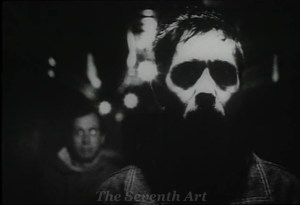 Who would have thought that one could make a sci-fi masterpiece in just 27 minutes? Well, I didn’t. I was wrong. La Jetée (1962) has left behind it, a legacy that many filmmakers have attempted to inherit, time and again, through the years. Its vision of the future of the world and its inhabitants – a sunless earth, cold expressionless faces and almost machine like emotional states – and the possibilities of experiment with cinematic and real time, that it has opened up, have become almost a standard template for sci-fi movies. If only a certain movie monument wasn’t made six years later, La Jetée, hands down, would stand out as the greatest sci-fi film ever made. The surprising fact is that the script of the film wasn’t adapted from some visionary short story, but one written loosely and directly for the screen by Chris Marker, the director, himself. And further, the script is just a minor contributor to the film’s success. Here is the thing: The word has been destroyed by the ominous nuclear war and humans are forced to stay underground. The “victors” of the war are trying to find a way to contact the past and the future of mankind to prevent the imminent annihilation of the human race. One of the lab rats for this is The Man (Davos Hanich), who retains vivid memories of his childhood and carries with himself, puzzles from the troubled past.
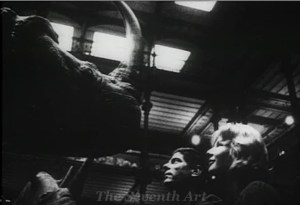 There is a remarkable scene in La Jetée where The Woman points at a cross-section of the tree trunk to denote her age. The Man jokingly (and self-referentially) points at a region outside the periphery of the trunk suggesting that he is from the future. This scene isn’t just an isolated homage to Vertigo (1958), but one of the many indicators that La Jetée is, in fact, laid on the very themes of Hitchcock’s film. Plainly, both films could well be seen as subjective accounts of treatments of psychological inhibitions – acrophobia and depression. In Vertigo, Scottie is a man who has lost his beloved (and whose face hypnotizes him for some reason) in an accident and is determined to reanimate her back to life, no matter what it takes. The Man, here, is no different from Scottie. The Woman could well be dead too (as he, also, suggests at one point). The Man’s tools for this “ritual” of resurrection are his memories and experiences, because of which he too, like Scottie, is nudged into the vicious cycle (rather, the Vertigo spiral) of resurrection and loss. In another extended sequence in La Jetée, The Man and The Woman visit a museum where stuffed animals are kept as exhibits. The range of animals there – giraffes, elephants and rhinos – make it seem more like a zoo than a hunter’s exhibition. The couple watches them with utmost fascination. Marker photographs the animals and the couple as if they were on the opposite sides of a mirror. There is great contradiction at work here. Are these live animals trapped in a time frame that is outside their own or are these really dead creatures resurrected back to life by some passionate enthusiast? Either way, they only reinforce that The Man and The Woman are, in fact, one of them.
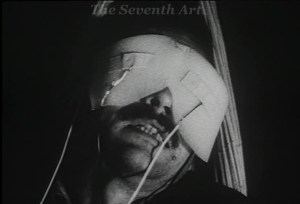 But it is Marker’s use of still images for his narration, almost entirely throughout, that is the masterstroke. He could have used muted motion clips, but that would have added no vitality to the themes of the film. The Man is forced to go back to his past, even after all those traumatizing events of the world. Predictably, his memory is fragmented, much like the images of the film. He synthesizes his “past” from his subsequent experiences, passionate fantasies and remaining shards of memory. His memory seems to document, eventually, not how the events were, but how he wants to believe they were. Marker uses an array of match cuts to emphasize the dependence of The Man’s memory and vision of past on the present state of his mind and of the world. In a critical scene in the film, The Man and The Woman visit a museum where they observe stone sculptures with missing heads or other parts of their bodies. Just then, an apparently tormented face in the sculptures is juxtaposed with The Man’s own distressed countenance. Are these the just figures of ancient art or are these “products” of the mutilated bodies of the war that The Man witnesses? Most of Marker’s images are spontaneous, with each of them seeming like a freeze-frame ending for intense moments. Each of these images seems like straight out of a dark comic book, with tension and horror oozing out of each pixel. Each one carries with it a past and a future that is as troubling as The Man’s own. Interestingly there is one single shot where motion photography is employed. The Woman, after assuming various poses during sleep, opens her eyes gradually. This is, perhaps, the only time where The Man really feels alive, witnessing movement, hence freedom and hence life. The only moment of escape from his physical existence in a world trapped under the surface of the earth – a world where people don’t live, they exist, a world where they don’t die, they expire.
 Ingmar Bergman’s Persona (1966) isn’t like anything I’ve seen of his other works – perhaps the first time I’ll replace the word ‘meticulous’ with ‘avant-garde’ when describing his films. The film follows two women – Elisabet Vogler (the luminous Liv Ullman), an actress who has deliberately pushed herself into a shell of silence and Sister Alma (Bibi Andersson), her young nurse – on an isolated island where each others’ desires, fears, agonies and memories unfold. Although fraught with elements apt for traditional character analyses, including the famous character switch trick that scriptwriters love, Persona manages to avoid the trap that the Bergman has partly set for himself through his previous films. Suitably imbibing elements of the modernist mode of cinema championed by the New Wave, Bergman creates a confounding work that is as rich in its implications and as cinematic in its execution as his previous films.
 Furthermore, they act as the audiences of the respective cinemas as well. Elisabet watches Alma dispassionately, never reacting even to the most dramatic gestures and words of the latter. She seems completely devoid of external emotions. She alienates both herself from Alma and Alma from her. Alma, however, complements Elisabet with her excessive sentimentality and expressiveness. Contrary to Elisabet, she tries to involve herself with Elisabet and even expects her to react to her misery. Alma’s need for an emotional response is indeed adversarial to Elisabet’s intellectual reply. This complementarity is more than just literary. Bergman often cuts from one character to the other in a pattern that establishes them as mirror images, obeying eye-line matches. The characters wear opposite coloured clothes. Bergman frames his shots in such a way that one of the characters superimposes over the other as if obtaining a hybrid. In a notable scene, Alma threatens Elisabet with a bowl of boiling water, upon which the latter reacts with the only words she ever speaks in the film. Alma, like many who disapprove of the modernists’ self-indulgence, even tries to expose Elisabet’s “pretentiousness” (“You’re acting healthy. You do it so well everyone believes you. Everyone except me, because I know how rotten you are.” she says).
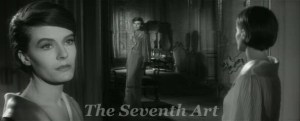 Right from its title, Last Year at Marienbad (1961) spells ambiguity. Neither does the film refer to a place called Marienbad, nor is it sure if the events that the protagonists, X the man (Giorgio Albertazzi) and A the lady (Delphine Sevrig), talk about took place the previous year. Last Year at Marienbad takes place in an ornate French chateau and unfolds as a conversation between X and A – a very repetitive one at that (at least, that is how it looks like!). X insists that he had met A last year when she promised that they would elope if only he waited for a year. But that’s about all the information that the film provides us. We hear X and A carrying on the same conversation, in one tone or the other, for the rest of the film. We see them moving about the chateau, gazing at the mannequin-like guests who seem to be able to speak and shut up according to the whims of X and A. Resnais superimposes every possible permutation of the characters’ forms, – past, present, memories, fantasies and possibilities – appearances – in black, in white – and locations – the chateau, the garden, the room and the bar – to produce a one-of-a-kind work that turns the very tenets of narrative cinema that is builds on.
 One thing that is conclusive is that Resnais uses the chateau as a visual manifestation of the human memory. He uses parallel, rigid and clearly defined structures for the interiors of the chateau. The hedgerows in the garden are pruned to perfection and show symmetry and clarity of position and shape. Resnais’ geometry spells determination and factuality and is anything but ambiguous, like the black and white of the film. The man, who persuades the woman to walk with him through the ominous corridors and staircases of the each other’s memories, mentions at one point: “At first glance, it seemed impossible to get lost in them along the straight paths”. Unfortunately, it is only the inanimate that are static. The humans in the chateau, their relation to their surroundings, their actions, their mentality and their appearances keep changing. Like an attempt at the recollection of a distant memory, the mise-en-scene of a sequence regularly changes, filtering out the unnecessary, checking out possibilities, trying to get the perfect match of image, sound and sensation. Perhaps the term “stream of consciousness” suits Marienbad more than any other film.
 If there is a synonym for “iconoclasm” in cinema, it might well be Luis Buñuel. It’s almost as if it is a need for him to go against conventions and established practices, – social, cultural and cinematic – pick out their weak points and hit them so hard that their absurdities are exposed. I’m far from being qualified to make general statements (including the above) about Buñuel, but the few films I’ve watched of him provide a more than clear picture about his role as a cinema pioneer and a social critic. In the legendary debut work Un Chien Andalou (1929), Buñuel and Sali present us a plethora of images – ones that would be termed “Lynchian” nowadays – that refuse temporal and spatial continuity on which popular cinema thrived on at that time. Apart from a filmmaker’s impulse to break stereotypes, what Un Chien Andalou showed us was the way we looked at movies and the elements of cinema that we had taken for granted. The conventional viewer, who tries to assemble the images into some form of theme or narrative, would invariably fail.
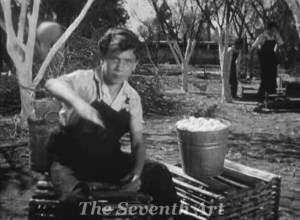 The children in the classic Neo-realist films were sympathetic and often pawns of fate or power plays. Buñuel’s Pedro is also a product of his environment and the prejudices against him. But that does not mean all of Buñuel’s kids are sympathy-magnets. Most of them are, in fact, instigators of social disturbances that the “neo-realist kids” are subjected to. Buñuel breaks away from that “objective gaze” of the Italian pioneers and takes us on a tour into the subconscious world of his protagonists. Moreover, Buñuel questions the moral integrity of its protagonists, or rather does away with that concern completely (Buñuel apparently wanted to put an orchestra as the backdrop to some major scenes which would have broken another tenet of the Italians). But all this subversiveness isn’t just a product of a desperate need to break rules. What Buñuel does here is, like he did in his first two movies, that he exposes the inherent flaws of a cinema movement. In other words, Los Olvidados is a critique of a way of filmmaking written in the form of a film. Buñuel takes up neo-realism in order to explode it from within and boy, does he succeed! In one of the greatest shots in film history, Pedro, in his reformatory, throws an egg at the soberly observing camera. – An in-your-face advice given by the director asking the neo-realists to cease the nonparticipation and do something about it all. Buñuel has driven the final nail into the coffin of Neo-realism.
 The Seventh Art