
Triumph of the Will (1935)

The Fall of Berlin (1949)

The Ghost Writer (2010)
July 31, 2010
Triumph of the Will (1935)
The Fall of Berlin (1949)
The Ghost Writer (2010)
July 24, 2010
Walang Alaala Ang Mga Paru-paro (2009) (Butterflies Have No Memories)
Lav Diaz
Tagalog/English
 The director’s cut of Butterflies Have No Memories (2009) is something of a misnomer. For one, Diaz had to shoot and cut the film so that it didn’t run for a minute more than the one-hour mark. As a result, it feels as if Diaz had one eye on his film and the other on his watch. There are shots that are abruptly drained off their life and some that feel perfunctory. But the film also seems to mark a turning point in Diaz’s outlook towards the Filipino people. Perhaps for the first time, Diaz portrays the common folk (and perhaps a particular social class) as being almost completely responsible for their misery. In Butterflies, an ex-Chief Security Officer at the mines, Mang Pedring (Dante Perez), blames the mining company, which has withdrawn production after protests by the church and activist organizations, for the economic abyss he and his friends are living in. But it is also starkly pointed out to us that, while they were getting benefited by the mining company, these folks did nothing to set up alternate ways of business and earning and, as a result, find themselves foolishly hoping for a past to return, even when such a regression is harmful it is to the collective living on the island. Mang misguidedly plans to reverse time and reinstall the factory by kidnapping the daughter of the owner of the mining company (Lois Goff), who has returned to the island after several years and who calls Mang her second-father. What Mang tries to do overrides personal memory and disregards the fact that it is he who has lived like a moth, inside a cocoon. As, in the final shot, Mang and his friends stand wearing those Morione masks (which bring in the ideas of guilt, remembrance, conscience and redemption – so key to the film), they realize that they’ve gone way too far back in time than they would have liked – right into the moral morass of Ancient Rome.
[Capsule added to The Films of Lav Diaz]
July 18, 2010

A Summer At Pa's
(Image Courtesy: Radio Sargam)
Udaan, one of this year’s entries at Cannes in the Un Certain Regard section, is a coming-of-age tale set in the heartland of India and tells the story of seventeen year old Rohan Singh (Rajat Barmecha) who is expelled from his boarding school in Shimla, along with three of his friends, and is forced to return to his hometown of Jamshedpur to his estranged father, Bhairav Singh (Ronit Roy). He discovers that he has to put up with not only the tyrannical ways of his father but also with his six year old step brother Arjun (Aayan Boradia) who is treated no better than Rohan by their father. Bhairav makes Rohan work out every day. He gets him admitted to an engineering college and instructs him to work in his steel factory. It is clear that it is not just the steel he wants to temper. Rohan regretfully abides, wearing the bland white jacket over his snarky one-liner T-shirts. More interested in the ambiguity of poetry than the precision of engineering drawing, Rohan starts bunking classes, winding up at the river bank to write. Naturally, writing becomes the tool for him to express himself, apart from other methods like shouting into a deserted basement at the dam and reciting largely improvised stories to patients and staff at the local hospital, where his brother is admitted for a few days.
Rohan is portrayed by debutant Rajat Barmecha. Barmecha plays Rohan straight, without the usual film vocabulary actors succumb to, and he is the greatest success for the film. With their long lashes, his eyes suggest everything from desire to rebellion. As Rohan, he appears to be the kind of person who seems to be willing to listen to your problems and the kind of person who hopes that you listen to his. With his “feminine” countenance (a feature that his father derides heavily in the film and the reason I predict that he won’t make it big in Bollywood), he’s also the person you believe won’t be parading his chutzpah or doing something alarmingly foolish. In short, he appears to be a person whom everyone will trust. Ironically, he lies to his father whenever he is in potential trouble (In a well realized arc, he later chooses to tell the truth to his father, not out of guilt, but because he knows that he knows his father well enough and that he can handle the consequences). He would probably have gotten away from his father and his rigid laws if it wasn’t for Arjun, whom he seems to view as a younger, not-yet-scathed version of himself. Predictably, he becomes Arjun’s surrogate father (and mother too, if we are to consider his oft mentioned femininity in the film). Meanwhile, Bhairav’s brother Jimmy (Ram Kapoor), who does not have children of his own, becomes Rohan’s surrogate father and the latter, his surrogate son. Each of the three otherwise unrelated characters is connected to the others via the beastly persona of Bhairav. These are all familiar writing tricks, of course, but first-time director Motwane treats the text with skillfulness of a semi-veteran.
You know that a coming-of-age film is on the right track when it starts with the protagonist jumping over the walls of his hostel into the city streets. In fact, Udaan strictly adheres to the path laid out by the genre, carefully working out culture-specific variations and steering clear of conventional pitfalls of the nation’s industrial cinema. The latter was possible perhaps because the film draws inspiration more from the west’s treatment of the genre than from the melodramatic traditions of Bollywood (more on this later). There seems to be an influence of virtually every landmark coming-of-age film in Udaan. Rohan and his college friends, high on booze, deliberately pick on a group of mooks at a pool hall – a scene that seems directly out of Scorsese’s Mean Streets (1973, the appropriation doesn’t seem like homage or pastiche for it is employed in a very similar fashion for very similar effects. One might also recall that Anurag Kashyap, who has co-written and produced this film, had already harnessed Keitel’s LSD trip in his reworking of Devdas, which Motwane co-wrote). Rohan’s and younger brother Arjun’s having to put up with an authoritarian father they barely know has echoes of The Return (2003), but where, in the latter film, the father is a mythical, metaphorical figure looming over the kids like a phantom, Bhairav is an everyman grounded in reality (One of Rohan’s friends tells that every father in the city is like Bhairav). The teenagers driving like crazy through the city streets at night, too, might have been from Nick Ray. But it is The 400 Blows (1959) that Udaan seems to want to emulate the most. Right from Rohan’s breakout from the regressive boarding school, to the motif of running and up to the final freeze frame on his face (albeit on a less ambivalent note), Udaan smells of Truffaut’s masterpiece (There’s a fleeting, pretty stunning image of Rohan’s face, framed head on with harsh light from above, which recalls young Doinel’s). And that’s besides the fact that this is Vikramaditya Motwane’s debut film and might be highly autobiographical.
Udaan’s embracing of these films, especially The 400 Blows, and the tropes of the genre as treated by the west is of note because it is what defines the interesting politics of the film. Udaan is, at its centre, a war against tradition in all its shapes and sizes. Bhairav is the symbol of tradition and conservatism in the film. He acts like his father did and metes out the same kind of punishment to his kids as his father had to him. With his dark glasses, trimmed moustache and perpetually disgruntled look, he is the quintessential patriarch guarding the passage between tradition and modernity. He has married thrice, works out extensively everyday, drinks every night, smokes throughout, doesn’t hesitate to use his belt on his six year old, ridicules his first son’s feminine looks and is probably also proud of this skewed sense of masculinity of his. He admires the famed industrialists and other icons of Jamshedpur and literally prostrates before them. He calls his brother Chotu (“little one”, which he sure isn’t) and insists that the kids address him as “sir”. His brother Jimmy is the counterbalancing force to Bhairav in the film. He is a man who had chosen the road less traveled (and supposedly failed). He is a progressive man who believes that Rohan should do what he wants to. It is Jimmy who paid any heed to what Rohan’s mother felt her son should become. Bhairav, on the other hand, is disgusted by Jimmy’s impotence and obesity (he would have anyway called Jimmy impotent, given his definition of what being masculine is). The two vastly different father figures, resulting from a schism within the family, are the choices provided to Rohan, who similarly has to choose between industrial work and poetry. Obviously, he chooses to emulate Jimmy, and in a predictably rebellious manner.
[Udaan (2010) Trailer]
Along the film, Rohan repudiates everything that is traditional and everything that binds him to his biological father. He shatters the rickety old car of his father with a crowbar, he discards the familial watch that Bhairav gives him on his eighteenth birthday (a familiar cliché in Indian cinema) and he even punches his father right on the face. Towards the end, he manages to make his father chase him unsuccessfully, once and for all, after having run behind him everyday. He will perhaps become everything his father isn’t (which is exactly what the latter tries to prevent). There is also a conspicuous absence of women in the film. Motwane and Kashyap avoid the pitfall of succumbing to the view that all women are victims of tradition. There are two women who are alluded to in the film – Rohan’s deceased mother who wanted her son to be a writer and his friend’s mother who chastises her son for having thrown out his abusive father out of the house – who, too, reflect the dichotomy between modernity and tradition that Jimmy and Bhairav respectively represent. Moreover, Rohan being a very liberal person like his mother (whom he seems to have a lot of love for) and his wanting to break away from Bhairav’s patriarchy puts the film onto an oedipal course as well, which is not very alien to the narrative at hand. One reason why Udaan is one of the few truly liberal films out there is because it carefully avoids, through its script choices, subscribing to that awful pseudo-liberal axiom that you can follow your dream no matter who you are. By locating the protagonist in a regressive middle class setup (which is beset by the problems caused by the recession) and eventually shifting him into a more progressive, flexible middle class, Udaan comes across as an honest, non-exploitative bourgeois film. Of course, it does not mobilize this trajectory for more overtly political purposes (Rohan father is a steel industrialist in Jamshedpur while his friend’s parents live in Singur. This tempting premise is left unexplored), but that’s probably because the film chooses to work completely within the genre.
This liberal support of the individual, free of all traditional baggage, is what makes Udaan a very “western” film (“western” in the same way Kurosawa was) and it is perhaps what makes the film very offbeat with respect to Bollywood cinema as well. Where the typical film would have portrayed Bhairav as an ogre on the outside and a child within (he would probably have confessed his love for his son to a friend or would have spread a blanket over Rohan while he’s asleep!), Udaan retains him as a threatening force. There’s no gentle giant act that Bhairav is made to undergo. But that does not mean that he is merely a concept or a one-dimensional monster. What makes him very human is the fact that he seems to know that he’s acting it all out. He’s a man blinded by tradition no doubt, but seems to be aware of that limitation. He tells Rohan that he didn’t have much to say to him when he visited his school. Even when he apologizes to his kids (before he distracts them from reflection), he does so within the limits of dignity allowed by his “character”. The triumph of writing lies in its belief that it need not “prove” that Bhairav is a human being. He just is and Ronit Roy plays him with the same kind of conviction. This consciousness of one’s limitations and the choice to be what one is also goes down well with the basic libertarian idea, which the film espouses, of a man making up his own destiny (which is very frequently mutated to condemn crimes of all kinds).
Udaan’s one more connection to The 400 Blows must be noted. While Truffaut’s work tried to break away from a tradition and the moral squalor that it seems to have brought, it simultaneously represented a move away from the traditions of cinema, with its technical radicalism and its inclination to make cinema author-centric. It was a battle being fought against the tradition (of quality) on multiple levels, virtually kicking off the New Wave. Udaan, on the other hand, has its feet planted firmly on the genre. Motwane is not a strict modernist like Truffaut was. Even if he is opposed to tradition and might be using cinema as a medium of personal expression, he does not go to the extent of taking up genre-blending or self-reflexivity. Sure, it does break away from the conventional story telling methods of the national cinema, but it does so only to adopt conventions of a different cinema. The aesthetics of the film – sunrays scattered by tree leaves piercing the camera lens, faces gazing towards infinity from the edge of the frame, cute symbolism, characters dragged softly into and out of the shallow focus and guitar riffs trying to create the blues – virtually cry out “Sundance!”. Some of the lines feel very scripted (a shortcoming that is commented on within the film and nearly overcome by making the protagonist a writer). But there are stretches in Udaan that are also directed with considerable finesse. There is much restraint in the score. Where a lesser film would have tried to cover up the silence with piano pieces, Udaan dares to leave it as it is. In the film’s most striking moment, Rohan relaxes on a cot after having dragged his heavy trunk upstairs. There’s no music. Almost no sound. Just the anxious face of a teenager back from an arduous journey and ready to embark on a longer and more important one. The shot lasts a few seconds. You wish it went on – the shot and the journey.
Rating: 

July 10, 2010
Tie Xi Qu: West Of The Tracks (2003)
Wang Bing
Mandarin
“We have to leave sooner or later anyway. Can’t hold back the tides of progress.”
 I’d so far thought that it was Jia’s The World (2004) that truly summed up the state of the third world in the first decade of the new century. While I’ve not changed my opinion entirely, Wang Bing’s phenomenal DV work Tie Xi Qu: West of the Tracks (2003) forces me to. Epic in scope and size, West of the Tracks is divided into three films subtitled Rust, Remnants and Rails. Between 1999 and 2001, when China had embarked on a mission of mass privatization of the country, Bing lived and shot this film in the district of Shenyang located in the city of Tie Xi in northeastern China where smelting and electrical industries were to be closed down. These industries were purportedly established by the Japanese to help them produce ammunitions for the war, but were nationalized after Japanese retreat. Although these factories were doing well till about the eighties, the profits started waning by the mid-nineties (due to bad management, some workers say) and, by the end of the decade, the factories had filed for bankruptcy resulting in mass layoffs and appalling cuts in pay of the workers. The film is a Herculean effort by a single man, who is credited as the producer, director, cinematographer and the editor of the film (which is ironical considering that this is the kind of film that tries to efface authorship). Bing apparently shot several hundred hours of footage for this film and edited it secretly and illegally in a TV studio. The result is one of the greatest films of the decade.
Rust, the longest of the three parts of this monumental work, opens with extended tracking shots photographed from a train that succinctly sum up the nine-hour film that is to follow. The snow-tainted lens of the handheld camera tells us the attitude of the filmmaker towards his subject – that of a empathetic and trustworthy observer who will place himself amidst the people he will be documenting – and the train, which comes to a halt after trudging through the snow-clad premises of the Shenyang smelting complex, itself becomes a fitting metaphor for the underproducing factories that will soon come to a full stop. In Rust, Bing chronicles the everyday life of the workers at the copper, iron and zinc smelting factories of Shenyang and through it, the failure of a utopian socialist dream. A large part of this section gives us workers going about doing their routine – unloading the metal ores, refining them, operating the blast furnaces and processing the extracted metals – and relaxing at the break rooms where they play chess and mahjong, involve in verbal fights and talk cynically about the state of the factory. This technique is crucial for the film since it is this very technique that aids the film to abstain from making any overt political statement and helps us empathize with the workers’ plight and way of life. It is this experiential mode of identification that justifies the running length of the film too. Had Bing cut down the film to a more viewer-friendly runtime, the product would have been a more analytical and agenda-driven film rather than a humanistic work that it is.
 It is in these decidedly mundane sequences that we witness how inhuman the work at the factories is. The communist dream of the glorious worker seems a mere propaganda when one observes what happens at these industries. We are told that the lead content in the factories’ atmosphere is hundred times the allowable limit. The workers later go to a hospital to rid their bodies off the poison that they have taken in from the factory. The machines have literally infested their lives. The workers have become functional accessories required to keep the machines running, literally and figuratively (This personal sacrifice asked of people for a supposedly greater good – a motto that seemed common only to totalitarian socialist regimes – manifests in even more objectionable terms in the second part of the film), but they would have to almost kneel begging for pension before the government. The toughest part in this whole ordeal seems to be to come to terms with the fact that the faith that the workers had towards their government turned out to be an act of naïveté. Rust is the least narrative of the three segments and it is indeed tough to get hold of a perspective through which you can assess the happenings. In fact, the only probable protagonist of this section is, like Tsai’s cinema hall, the industrial complex itself. The complex, through its days of glory and disgrace, appears to denote the death of a civilization – from being a place full of people and public baths to a cold, deserted wasteland. After the industry is shut down, one of the workers, ransacking the now-empty break rooms, finds the identity card of a worker among the debris. We do not get to know the name on the card. We needn’t. It’s the condition of all the industry workers at Shenyang.
The three hour long second segment of the film, Remnants, takes place in the residential complex that houses the family of the workers at the Shenyang factories. Bing employs the same identification technique as in the previous film, following a large number of people living in the area and getting us accustomed to the way of life in the place. The first hour mostly deals with a bunch of teenagers knocking about the township during Valentine’s Day without any apparent work or education to care about. Some of these directionless youth take to violence and turn hoodlums for petty sums of money. It is in this infinitely rich segment that the film opens up numerous avenues for analysis of class, crime, justice and human rights. Like the Shenyang industries, the residential complex is to be torn down as per orders and is to be replaced by privately constructed and owned chain of apartments. Some of the residents, who realize the power of the institution they are up against, decide to dismantle their own houses (like the workers who take the industries apart), sell off whatever scrap metal that remains and move into the criminally unfair amount of compensatory space they are being allocated elsewhere. In that regard, the dilapidating neighbourhood that they live in becomes highly expressionistic and indicative of the moral and psychological downfall they are experiencing.
 The more gutsy ones, on the other hand, decide to stay put and force the private organization and the government to give them their due. The latter retaliates by cutting off the town’s supply of water and electricity. The people, again, try to obviate the need for electricity by harnessing daylight as much as possible. Like the gestures of these people, Wang Bing’s film is also an act of resistance, of documenting what remains unheeded and unsaid and of rethinking accepted notions of progress and development. His refusal to stay with the people who don’t leave instead of those who move on clearly exemplifies his stand. What we see in this second segment is the same kind of human rights violation that takes place in every developing country around the world, be it due to the Three Gorges project in China or the Narmada project in India. There are only a few films such as Jia Zhang-ke’s Still Life (2006), Yu Yan’s and Yifan Li’s Before the Flood (2007) and Simantini Dhuru’s and Anand Patwardhan’s Narmada Diary (1995) that act as voices of resistance amidst the cries of national glory and pride. The important thing to recognize is that these voices exist and need to be heard. One old man in Bing’s film, who is on the verge of throwing in the towel, tells us that we “can’t hold back the tide of progress”. One might call the statement cynical or practical, but the point is that an attempt should be made, even if in vain, to hold the tide back so that there are no more such tides.
The third segment of the film is called Rails and charts the final months at work of the employees of the Shenyang Railway system that manages shipments into and out of the district. This section could be seen as a conglomeration of the first two in the sense that it deals with both the workplace and the residential space of the workers. It is also in this segment that Wang Bing gives the film the semblance of a narrative and boils his character set down to two people – Old Du, a coal gleaner working in the railways with the cooperation of the workers who run the trains, and his son Du Yang. The driving force of this segment is the arrest of Old Du by the railway authorities which causes Yang to break down from his passive state. In the film’s most affecting sequence, Bing photographs Yang in his house on the day following his father’s arrest. Yang shows us a bunch of family photographs, talks about his mother who has left him alone and, just when the clock strikes ten and a melodious tune plays, starts crying. It’s a divine moment in filmmaking. Not once does Bing use non-diegetic music in the film but just at the moment when Yang stands on the verge of a breakdown, the clocks chips in with its heartwarming music (Bing reflexively pans to reveal the source of music, as if vindicating himself!). Earlier, Old Yu tells us: “There aren’t many people who would be willing to live the way we do”. It’s a devastating statement that shows how deep the social ladder descends.
 The film’s critical stance against the feverish rate of privatization of industries and public spaces might make Bing seem like a staunch leftist, a leftover Maoist of sorts. But a close look at the film, especially its first part, reveals that Wang Bing is only championing human rights, regardless of what ideology it entails. He is critical of the rapid privatization, but he is also reflecting on the failed socialist dream of the nation. Songs full of empty Maoist rhetoric abound the soundscape (all diegetic, of course) humorously counterpointing the utopian vision of the Cultural Revolution with the systematic corporitization of the country by the same party. As seen in Rails, Mao and Lenin have becomes mere names to be bandied about in conversations. Even in his subsequent film, Fengming: A Chinese Memoir (2007), his interest lies in exploring how the hunt for the rightists of the “black clique” (Maoist counterpart of the red hunt in the United States) resulted in the oppression of individuals, even those who worked for the party, and the confiscation of their basic rights. This passing of national dreams and political visions into the realm of speculation and wishful thinking is one of the numerous thematic connections that Bing’s films share with those of Jia Zhang-ke. In fact, echoes from West of the Tracks can be found in all of Jia’s works – from the impact of the Cultural Revolution in Platform (2000), through the wayward youth of Unknown Pleasures (2002), the ever increasing class rift in a globalized world in Still Life (2006) to the disintegration of the socialist dream in 24 City (2008, the film that starkly resembles Rust). Although these two artists have worked on similar themes, they have, however, done so in their own idiosyncratic ways, with wondrous results
As such, West of the Tracks (and Fengming: A Chinese Memoir more so) does not have a premeditated aesthetic that imposes an external meaning on the reality of the film. The cinematography and editing are almost purely functional and there is barely a cut or a reframing that suggests personal authorship. The film seems to lie so close to the end of that Bazinian asymptote to reality, that it opens up possibilities to read life as art, even if the filmmaker does not intend to create such a meaning. One might say that the naked men who walk around on screen are suggestive of the workers’ identity being stripped down to nothing, but it is only their workplace routine. One might say that the workers are dwarfed and marginalized by the humongous machines they are working on, but it’s just a material truth. One might say that the wife swapping story that the workers share in good jest has considerable parallels in their national politics, but it is just small talk that they indulge in. Same is the case for the trains that often switch tracks. What West of the Tracks does is to create that essential distance between reality and art to give us (pardon the pun) a better picture of ourselves, to create poetry from everyday activities, to aestheticize life. But more importantly, the film makes a strong case for DV filmmaking. Bing’s cinematography is entirely handheld and he prefers to shoot from amidst the workers and from their eye level. Only Digital Video could have provided this material flexibility for Bing. He religiously performs the role of a historian, capturing passages that would otherwise be relegated to the level of footnotes. He neither exploits the grief of the people he’s filming to create his art nor does he try to analyze their situation and make an overarching statement. He merely lives among them, staying in the sidelines with humility and standing witness to the downward spiral they are thrust into. This way, Bing’s film makes a strong case for cinema itself, taking it closer to what it out to be and what it was devised for – to capture and save reality from destruction, negligence and falsification.
July 3, 2010
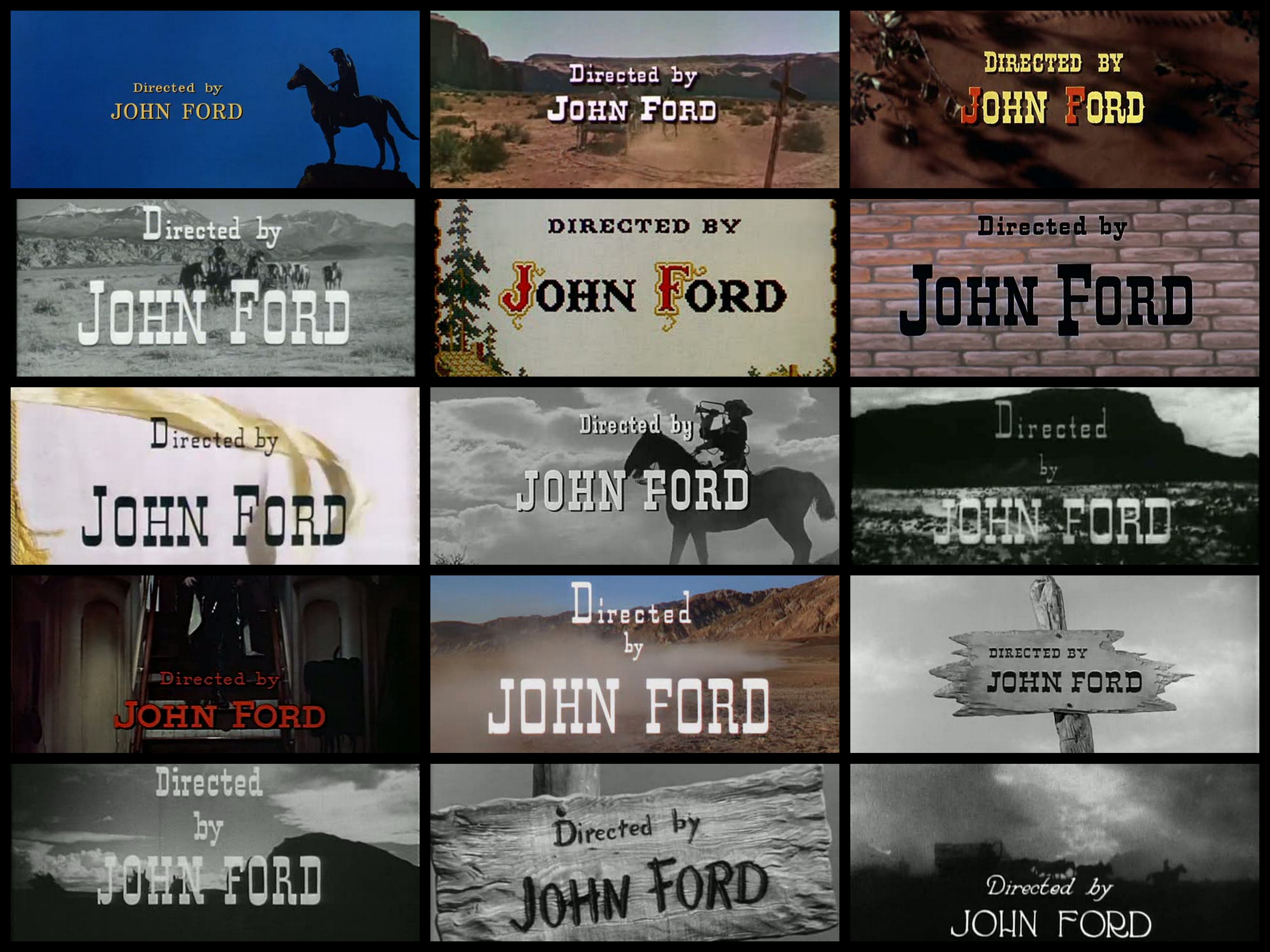
Fort Apache (1948)
 Fort Apache (1948), first of the director’s cavalry trilogy, marks a stark shift in tone and attitude for Ford. It is from this film onwards that Ford’s view of the west becomes progressively unromantic. For one, the central protagonist, Colonel Thursday (Henry Fonda), is gradually alienated from us. His actions seem increasingly misguided and the only force of sanity comes in the form of captain York (John Wayne) who acts as our mouthpiece in the film. Colonel Thursday is a prisoner of his own position in the army. He’s the first of Ford’s many men to show loyalty to external ideologies than to his conscience (“Tell them they’re not talking to me, but to the United States government” says Thursday). These men abandon what is essentially human for some vaguely defined concepts of glory and martyrdom (One can imagine how much Ford would have admired Stanley Kubrick’s first masterpiece). These are also invariably the men who believe in establishing hierarchies and locking people into rigidly defined categories that could systematically be manipulated and deployed (Ford’s reaction to such men would move from fascination to ambivalence to utter contempt, as is evident in his last Western). Consequently, the film, like most of Ford’s subsequent works, is full of petty rituals – ball room dances (compare this mechanical waltz with the divine dance sequence in The Grapes of Wrath), coldly worded field orders, automated salutations and bookish sentences. Ford would take a decade and a half to convert the cynicism of this film to a monumental tragedy.
3 Godfathers (1948)
 To borrow Manny Farber’s terminology, 3 Godfathers (1948) is a very powerful termite that gradually grows into a giant white elephant (Compare John Wayne’s blue moon laughter in the first scene with his laboured theatrics towards the end). Yet another remake of a story filmed multiple times before, 3 Godfathers is the kind of movie that can pass off as a Sunday school lesson. Technically, Ford is at the top of his game here, walking through the film with ease, conjuring up one larger-than-life image after the other. But the film feels more like a showcase of Ford’s directorial skills than a coherent work driven by a vision. One also gets the feeling that Ford made this film more as an obligation and as a tribute to his one-time collaborator Harry Carey Sr. who starred in the film Three Godfathers (1916), which Ford himself remade three years later. Hence, the film seems more like a launching vehicle for Harry Carey Jr. that Ford was able to slip in between his cavalry trilogy. Complaints aside, it should also be noted how Ford manages to leave his fingerprints all over the film. At least, the first half hour is a complete throwback to Ford’s prewar Westerns. Glorious landscapes all over and even more glorious men cutting through them, mutually respecting lawmen and bandits of very high moral standards and the psychological tug-of-war they indulge in – one would think that the film just can’t go wrong from here. Sadly, it does. The last half hour is Ford sleepwalking though his material.
She Wore A Yellow Ribbon (1949)
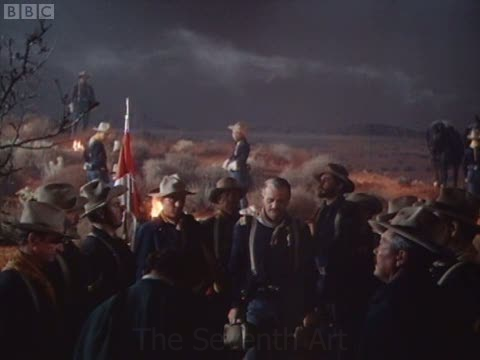 She Wore A Yellow Ribbon (1949) is the best film in the director’s cavalry trilogy and, with the probable exception of The Quiet Man (1952), has to be his most personal work as well. Here we have John Wayne playing the old Captain Brittles, who’s just about John Ford’s age, ready to retire from the army in a few days. Like Ford, he’s a man who throws his weight around just to show how rough and demanding he is and within, he is a child. He’s like Colonel Thursday of Fort Apache on the outside (“I’m ordering you to volunteer” he says – a phrase that would recur in Ford’s later films) and Colonel Marlowe of The Horse Soldiers on the inside. Like Kane of High Noon (1952), he’s a man who feels responsible for the lives of his men even though he’ll become a complete stranger to them in a few hours. Moreover, the film is also about ageing, about giving up one’s game. Captain Brittles is a man who’s seen enough bloodshed in his life. His fervent wish is to save his men from sure death rather than to achieve glory or exhibit heroism (“Old men should stop wars” he says to the old Indian chief who wants to stay indifferent). One can’t help but think Ford might have intended this film to be a swansong of some sort. The most significant scenes in the film are shot at (artificial, accentuated) twilight that so directly registers the dread of being left alone. Brittles speaking to his deceased wife at her grave might be more than a sign of affection. It might be of desperation.
Rio Grande (1950)
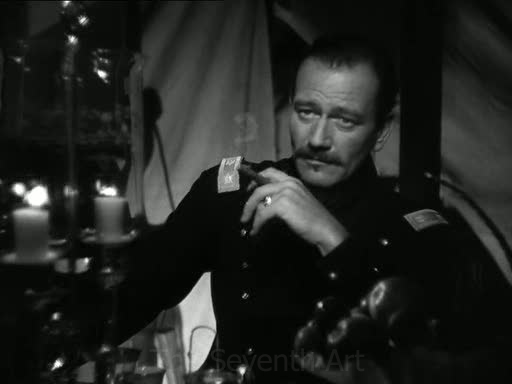 The extremely eloquent and moving Rio Grande (1950) is evidently a thematic extension of the previous couple of films in the trilogy. If professional authority blinded Colonel Thursday of conscience and protected Captain Brittles from baring it, it prevents Colonel Kirby Yorke (John Wayne, perhaps reprising his role from Fort Apache) from bonding with his son. But there is also a sense of inevitability that permeates Rio Grande. Colonel York burns down his wife’s nursery as a part of his duty and pays the price for it. He also stays aloof from his son for he is his supervising officer. He keeps demoralizing his son and tries to siphon off any pride that the boy may have in his new profession. The question here is if one could really break such a barrier, giving in to emotionality or humanism. This idea of free will being overridden by man-made hierarchies echoes throughout in the film. Soldiers exhibit comradeship and honor among themselves whereas they stand stiff and unresponsive while dealing with higher officials (“I refuse to answer sir… respectfully” goes the reply, as it would elsewhere in Ford’s films). Rio Grande is gloriously lit and photographed and each of its images looks like a painting, a moment frozen in time. In this film too, it appears as if Ford is expressing something that is utmost personal in purely generic terms. And Wayne brings such honesty to the character that, when he comes in all white, for once, with a bouquet in his hand, you wish the film ends right there.
Wagon Master (1950)
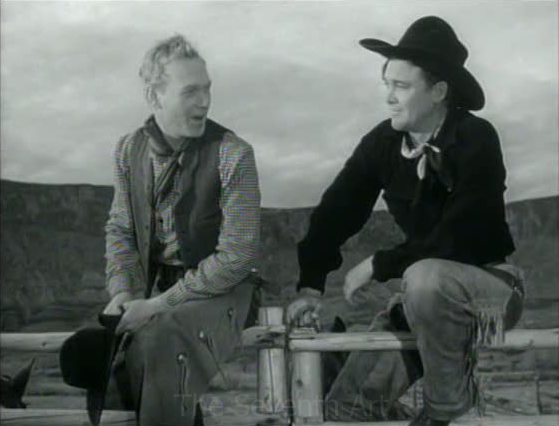 Wagon Master is what one might call a “minor Ford” (shot in black and white with no stars), but that doesn’t do any justice to this superb Western. Less a story and more a journey, the film follows a pair of ranchers (Ben Johnson and Harry Carey Jr.) who agree to escort a community of Mormons on their way to establish a new settlement. The crew on the road entirely consists of people relegated to live on the fringes of the society, the latter being just an arbitrary, prejudiced crowd anyway in most of Ford’s westerns. Ford’s most optimistic film, Wagon Master can be seen as the director’s vision of an ideal West – a place where all races and religions can coexist peacefully, a place where real joy comes from not amassing wealth, but by building a healthy and closely-knit community and a place where the only gold to be found is in the fertility of the soil. Ford counterpoints this vision of utopia by introducing the Cleggs family (which is sort of carried over from My Darling Clementine) that embodies everything that is lamentable about the frontier – racism, hooliganism and intolerance. Watching Wagon Master, one gets the feeling that Ford would have made some very great films (as if he hasn’t already!) had he taken to documentaries. Ford builds the film upon moments of commonplace magic, dwelling considerably on the everyday activities of the Mormons and upon shots of people travelling, moving ahead against nature’s odds and exhibiting a sheer desire to live.
The Searchers (1956)
 Everything significant about The Searchers (1956) is off-screen, in its untold passages, unfilmed spaces and undiscussed possibilities. It is as if Ford was commenting upon the genre, and on his own brand of cinema, without ever breaking it down, as if he was repudiating the racist falsities hitherto bestowed upon the Indians by showing how much the white community shares those traits with them and as if normalizing the “demonic” acts of the Natives by presenting them as justified if done by the whites. The Searchers is a film with a mass of unresolvable tensions at the core, each of which threatens to take the film apart. “He’s got to kill me”, says Ethan (John Wayne) about Scar (Henry Brandon). He knows as much about Scar as he does about himself. What are Scar and Ethan are but the same person born on either side of the frontier? Both are old timers who prefer revenge over justice and who believe that each of them has complete justification to kill the other. When they look at each other in the eye, what they are staring at is, in fact, the abyss within each of them. It’s not just Ethan and Martin who are the titular searchers, it is Scar too. That’s why The Searchers is, at heart, a tragedy. Somehow, Ethan seems to know his condition and that his choice of an artificial racist ideology over his conscience (unlike Martin) has done him more harm than good. Consequently, the journey, like the film itself, becomes a quest to define, once and for all, what Ethan is.
The Horse Soldiers (1959)
 The Horse Soldiers (1959) is set during the American Civil War and unfolds primarily from the point of view of Colonel Marlowe (John Wayne), an officer in the union army who plans to blow up a key railway line to disrupt supplies to the Confederate forces. Locating the story within civil war helps Ford to comment on the war without taking sides, unlike the earlier films. Also in Colonel Marlowe’s cavalry is surgeon Kendall (William Holden), whose mere presence irritates Marlowe to no end, and a prisoner Miss Hunter (Constance Towers). As in My Darling Clementine, the Fordian male bonding is between a doctor and an army man. Hunter sees the doctor’s profession as one that saves lives and the army man’s as one that kills. Marlowe, on the other hand, considers doctors as parasites who want people to be sick and, perhaps, his kind as those who want then to be healthy. It is only towards the end of the film that Marlowe comes to realize that his grief of losing his wife after a failed operation is no more sorrowful than the doctor’s angst of not being able to save a patient who has come to him for help. This sense of empathizing with the ‘other’ forms the backbone of the morally complex work that is The Horse Soldiers. When the confederate army is, actually, made of school kids and old men, it’s hard not to see the futility of a war that is fought just for the sake of wiping out one side.
Sergeant Rutledge (1960)
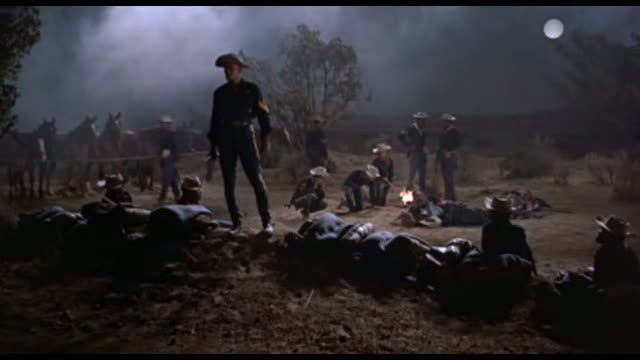 If The Horse Soldiers was Ford empathizing with the Tories and Cheyenne Autumn would be him empathizing with the Native Americans, Sergeant Rutledge (1960) is Ford making amends for the under-representation of the African-Americans in his Westerns (This near total absence of African-Americans is startling given that Ford has made more than one film dealing with the Civil War). Basically a courtroom drama uniformed as a Western, but also historically particularized, Sergeant Rutledge is Ford tackling the issue of racism head on. The film unfolds piecewise, moving from one incomplete perspective to another while keeping the truth at an arm’s distance, so that the audience is never completely allowed to vindicate and sympathize with protagonist Rutledge (Woody Strode, ironically given the 4th place in the title credits!). It is interesting to imagine how the audience would have reacted to this kind of a narrative structure in the pre-PC era in which the film was made, especially given that the central drama involves a young black man and a white adolescent woman – arguably the most scandalizing combination of them all. Despite the fact that the film has some pointed writing (“What does it all add up to, sir?” Rutledge asks an edgy Tom Cantrell (Jeffery Hunter), who is not entirely free of racial prejudices and acts himself as one might be led to believe, coldly exposing the latter’s disbelief in him), Sergeant Rutledge suffers from Ford’s heavy-handed direction. Ford attempts earnestly to develop a mythical African-American hero in Rutledge, but the effort seems more like calculated posturing than genuine legend building.
Two Rode Together (1961)
 Two Rode Together (1961) could be seen as an unequivocally liberalist reworking of The Searchers that resolves the irreconcilable tensions of the earlier film and takes a clear cut political stand. One could say that this is the film The Searchers would have been had there been no man called Ethan Edwards. Ford makes this clear by resorting to a plot that resembles that of the previous work (There is much intertextuality in the film, with characters, actors and lines being directly borrowed from the previous film) and commenting very strongly on the racist tendency espoused by some people of the white community at the frontier. A white boy who was captured and raised by Indians is traded back for some weapons by corrupt antihero sheriff Guthrie “Guth” MacCabe (James Stewart). The white community is asked to identify the boy and claim him back. The scenario has all the uneasy trappings of a slave market and that may just be the point of the film. And the sharp character arc that Guthrie undergoes could well apply for the whole of Ford’s cinema. Despite its occasional flourishes of melodrama, there is much left unanswered in the film and its take on mob mentality, fear of miscegenation and domestic racism leaves one very agitated. And yes, Two Rode Together has the greatest dialogues in all of Ford’s Westerns that are delivered with such panache that the film feels almost Hawksian. The conversation between Stewart and Widmark at the riverbank, spanning several minutes, is a sheer joy to watch.
How The West Was Won (1962)
 An omnibus film directed by John Ford, Henry Hathaway and George Marshall and starring just about every living actor that you would associate with Westerns, How The West Was Won (1962) is the kind of film that cries out: “Look at me. I’m epic. Worship me”. Indeed. Made for Cinerama and shot in such spectacular fashion (that it might have well set the trend for present day epic cinema), I can imagine how viscerally enthralling it would have been to see it in its original projection. John Ford apparently directed the segment on civil war that comes halfway into the film. With the trappings of an episode from late Kurosawa, Ford’s segment is an uninspired piece of filmmaking starring John Wayne, who could easily have been replaced by a John Wayne impersonator here. The film, likewise, could have been titled “How the Western Was Won” for the work seems more like a reverent pastiche of great Westerns through the ages than a conglomeration of myths about the Wild West. Conservative to the point of being laughable (and this might have really turned off Ford, given the kind of films he was making at that time), the film has two well made segments that hold it together. The first is the charming interlude involving Gregory Peck and Debbie Raynolds which is actually a romance dressed up as a Western. The second redeeming section is the strikingly directed final half hour, which plays out in a High Noon-esque, traditional fashion that infuses the film with a spirit that is missing in the first two hours.
The Man Who Shot Liberty Valance (1962)
 The proper place for John Ford’s greatest Western, The Man Who Shot Liberty Valance (1962), is not among Ford’s other westerns but among films like The Diary of a Country Priest (1951), Ordet (1955) and Winter Light (1962), for it is a spiritual work of the highest order. By the time the film ends, you almost get the feeling that all that you saw was a pair of eyes piercing the pristine screen. In the film, Ford examines what essentially comprise the soul the Western – Law and Morality – through three different embodiments of these entities – the good legal Ransom (James Stewart), the bad illegal Valance (Lee Marvin) and the good illegal Doniphon (John Wayne, a Farber termite, delivers the performance of a lifetime). The Fordian dialectic between tradition and modernity is at its most intense here, with Ransom’s civilization making way for Doniphon’s way of the gun. The Man Who Shot Liberty Valance is a textbook for genre filmmakers on how to light, stage, shoot and cut a film. Every second of the film, you feel you are there, in the midst of the action, living with the characters. The film is like a stretched rubber band, ready to snap any moment, with every character pulling the film’s moral center towards himself/herself. A tragedy of monumental proportions (It is from this film that The Dark Knight (2008) borrows heavily from), The Man Who Shot Liberty Valance is perhaps the one film that Ford should be remembered by. “When the legend becomes a fact, print the legend” says a newsman in the film. His voice might just be of John Ford.
Cheyenne Autumn (1964)
 Cheyenne Autumn (1964) has widely been labeled as Ford’s official apology letter to the Native Americans for having usually cast them as bloodthirsty savages. If one follows all of Ford’s Westerns from The Searchers onwards, one would see that the film is also a logical conclusion of a trajectory. Cheyenne Autumn is a highly liberalist film, but it does not present a primitivist’s view of the Native Americans. Sure, it portrays them as a proud and peace-loving race, but Ford is more interested in treating them as a group of individuals who may or may not conform to stereotypes and perceived cultural truisms (“He is your blood, but he is not you” says the new clan leader). Actually, Ford endorses individualism more than ever in this film. He underscores the need for individual decision making and the need to act according to conscience. Elegiac in tone, as if mourning national and cinematic mistakes of the past, the film is almost entirely defined by its harsh, godforsaken landscapes. The central comical segment with Stewart as Earp should be disregarded for that’s how the director’s cut of this film would have turned out to be, even if it serves both as a throwback to pre-war Ford and as a hilarious critique of the racist tendency commonplace at the frontier townships. From Americans hiding in a hut from an Indian onslaught in Straight Shooting to Indians being imprisoned in a barn by the Americans in Cheyenne Autumn, Ford’s Westerns, spanning nearly half a century, seal the filmmaker’s position as a chronicler of both the history of America and the history of American cinema. Rife with, well, Fordian compositions, Cheyenne Autumn is a fitting, if not the ideal, farewell to Westerns for Ford and to Ford for Westerns.
 The Seventh Art