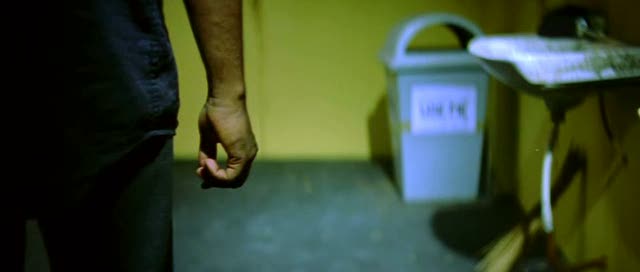
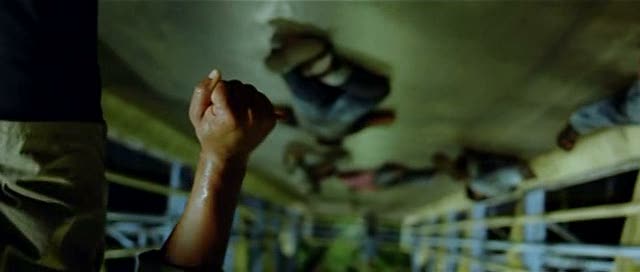
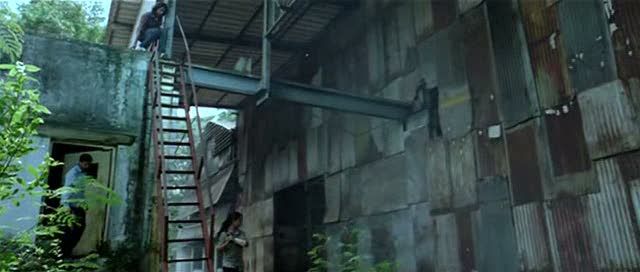
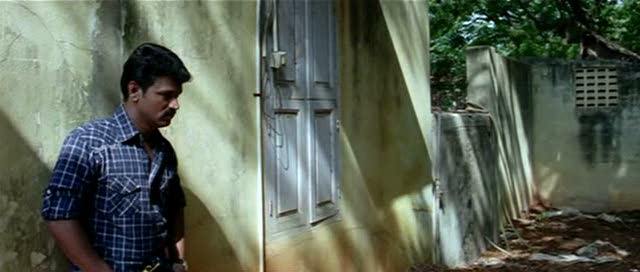
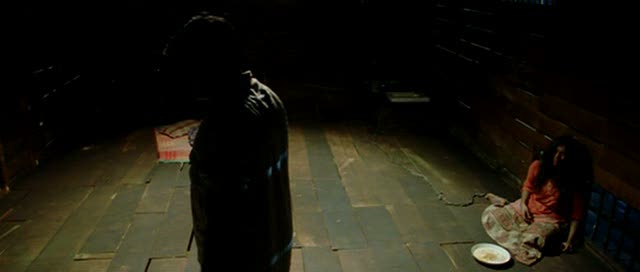
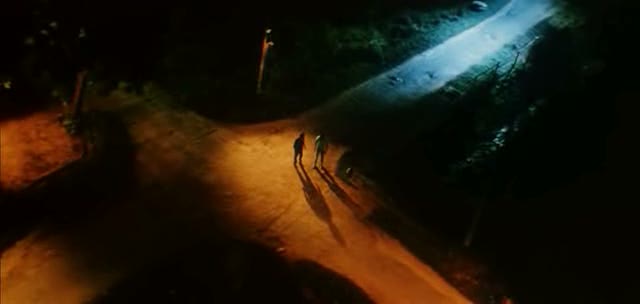
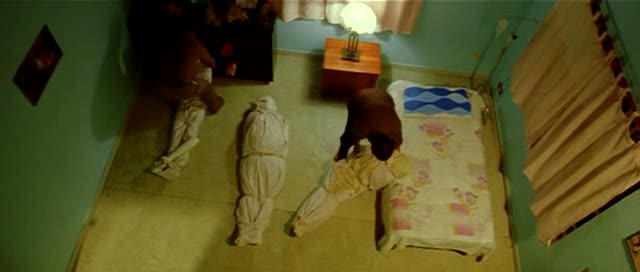
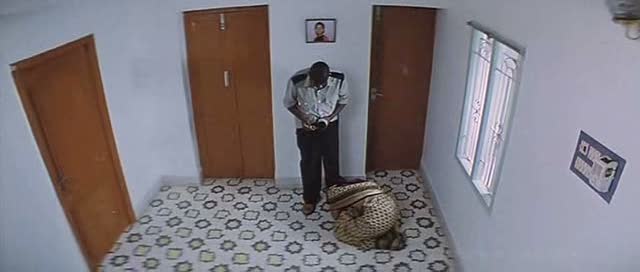
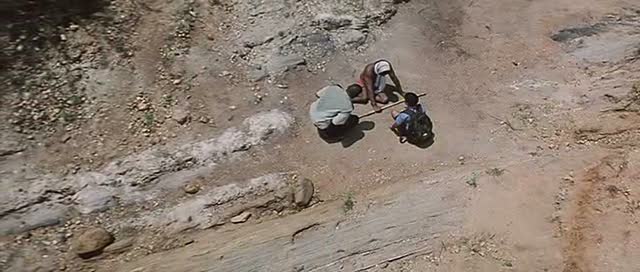
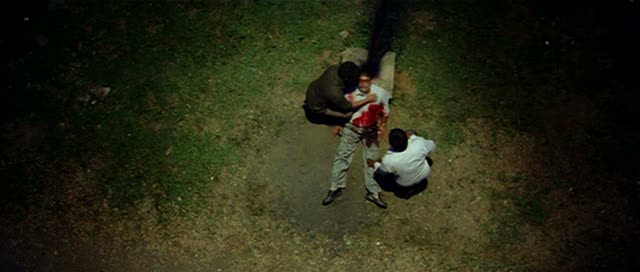
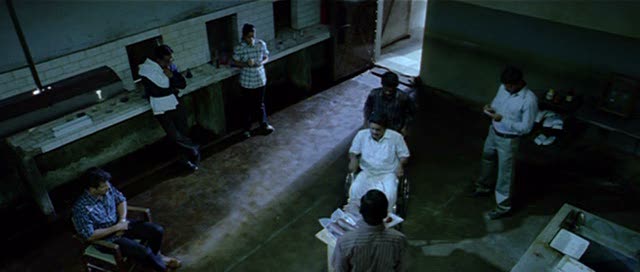
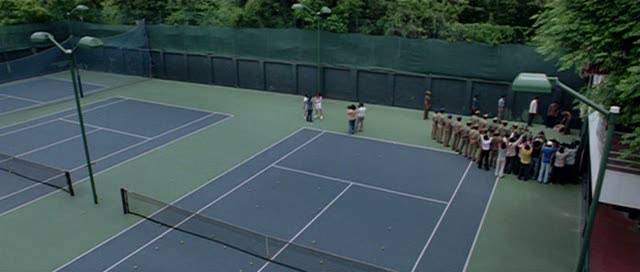
— Mysskin’s cinema is physical. The fight scenes in his films occupy the extreme ends of a spectrum. They are either divided into the simplest of images – where the cause and effect of an action occupy different shots and we rarely see two bodies in interaction – or are presented in their entirely, prioritizing spatial continuity over fragmentation and highlighting corporeality of an action over its meaning. The frames are chopped; characters’ heads cut off. In his world of action, hands and feet are all that matter. (Severing body parts is not an unusual act in this universe). People don’t have time for patient phone calls. They keep running, falling and scuffling. So does the camera, which crouches when they crouch, which lurches when they lurch, which sits back when they sit and which trembles from afar when they do. Mysskin is impatient with two shots and his restless, gently swaying camera converts these expository moments into a survey of the set, a documentation of an ensemble performance.
— These films are tightly plotted, very convoluted affairs; their solution always at an arm’s length. Instead of the clutter clearing up, it keeps growing knottier and knottier until cutting through is the only way out. These resolutions, themselves, come across as cathartic experiences. Characters barely know the trajectories of others and how they interfere with their own. Like mice in a maze, they keep holding on to their version of truth until they get the view from above. It is this partial concealment/ignorance of information through which the movies attain tragic proportions. Mysskin’s men make grave choices and often the wrong one. They try to vindicate themselves, only to hurt themselves over and over and descend deeper into guilt that is predicated on an equivalence that recognizes one’s own condition in another. They suffer, and come out as better men. Their redemption is possible because they suffer. Mysskin’s pictures, likewise, are at their best when under generic constraints. Mysskin is at his most liberated when tethered.
— The men and women in these films find themselves in similar situations time and time again. Despite all their actions and choices, they seem to come back to where they started from. It is of little surprise that much of the acting in these movies consists of repeated gestures and words. Be it pacing up and down a hall, where we see them oscillating about like a human pendulum, or fighting a gang of armed men, each of whom comes forward individually – like ascending notes in a motif – for a showdown, invoking comparison to both the martial arts and dance choreography. Likewise, we see them getting stuck in language loops – repeated words and phrases – until they attain a rhythm that reveals more than the words themselves do. This inclination for repetition informs Mysskin’s aesthetic as well, with some loopy, shrill, Bernard Herrmann-esque score (at least one of his lead men recalls Scottie Ferguson) and a number of repeating compositions.
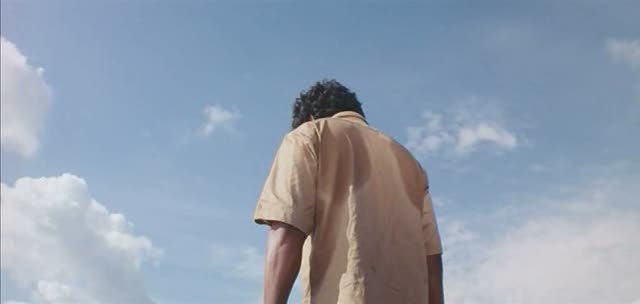
— Mysskin is one of the few filmmakers in the country who can take melodrama head on without falling back. He is not a minimalist trying to sap out the excess from it, but a director working on a grand canvas, blowing up the form. Much like John Ford, with whom he shares an affinity for the sky and the heroes who adorn it, Mysskin uses music to enrich the gravity of a situation than substituting for it, to multiply emotions rather than adding them; instinctive rather than instructive, expressionistic rather than expressive. Mysskin earns his violins. At times, the deployment is incongruous (and prescient) with what we are seeing, but, in retrospect, is overwhelming. Like Ford, he has this uncanny ability to elevate commonplace gestures and glances to mythical levels. A Western by Mysskin wouldn’t really be a surprise, given how his own filmmaking instincts and themes derive from Westerns, by way of Samurai movies: codes of honor, responsibility towards one’s men.
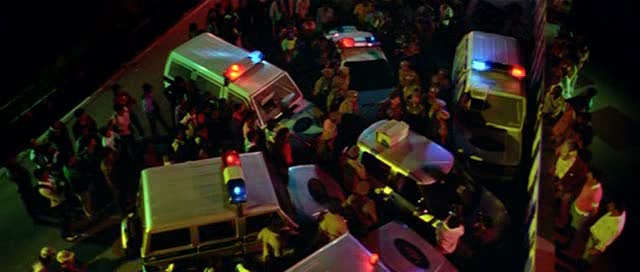
— Although God is never quite absent from the films’ worlds, His silence becomes too threatening. There is a myriad of God’s eye compositions that seem to witness all sorts of activities with equanimity, without judgment. It is perhaps the worlds themselves that have fallen and it is probably up to the people who live in it to sort it all out. Mysskin’s camera that keeps descending from the sky onto the ground, then, signals a universe where man has to take up the responsibility of God, in His silence. This goes well along with Mysskin’s deep-rooted distrust of institutionalized justice and his muddled yet ultimately silly plea for vigilantism. (He is much more comfortable and intriguing when dealing with metaphysical ideas than sociopolitical particulars). The men in his films never seem to be able to fit into rigid establishments and find law and justice to be concepts often diverging from each other.
Mani Kaul is undoubtedly the Indian filmmaker who, along with Kumar Shahani, has succeeded in radically overhauling the relationship of image to form, of speech to narrative, with the objective of creating a ‘purely cinematic object’ that is above all visual and formal. He was born Rabindranath Kaul in Jodhpur in Rajasthan in 1942 into a family hailing from Kashmir. His uncle was the well-known actor-director Mahesh Kaul. Mani joined the Film and Television Institute of India (FTII), Pune initially as an acting student but then switched over to the direction course at the institute. He graduated from the FTII in 1966. Mani’s first film Uski Roti (1969) was one of the key films of the ‘New Indian Cinema’ or the Indian New Wave. The film created shock waves when it was released as viewers did not know what quite to make of it due to its complete departure from all Indian Cinema earlier in terms of technique, form and narrative. The film is ‘adapted’ from a short story by renowned Hindi author Mohan Rakesh and is widely regarded as the first formal experiment in Indian Cinema. While the original story used conventional stereotypes for its characters and situations, the film creates an internal yet distanced kind of feel reminiscent of the the great French Filmmaker, Robert Bresson. The film was financed by the Film Finance Corporation (FFC) responsible for initiating the New Indian Cinema with Bhuvan Shome (1969) and Uski Roti. It was violently attacked in the popular press for dispensing with standard cinematic norms and equally defended by India’s aesthetically sensitive intelligentsia. [Image & Bio Courtesy: Mubi]
I guess Mani Kaul could be called, with qualifications of course, the invisible man of Indian cinema. The home audience might find his films too ‘European’, too alien, and too cryptic, and might prefer instead the realist-humanist works of an artist like Ray. Foreign viewers, on the other hand, might complain that they are too culturally-rooted, too alien and too cryptic, and instead opt for a ‘universal’ filmmaker like Ray. Indeed, neither Kaul nor his pictures make any claim to ‘universality’. They are, undoubtedly, steeped in Indian classical art forms like how the Nouvelle Vague films were, with respect to the European classical tradition. Many of these films are adapted from literary works in Hindi, have a profound relationship with Hindustani music and exhibit an influence of representational forms from the country. In fact, his cinema, if not much else, is about these very forms, both in terms of subject matter and their construction. These films, to varying degrees, are literature (The Cloud Door), painting (Duvidha), architecture (Satah Se Uthata Aadmi), poetry (Siddheshwari) and music (Dhrupad). Right from his early documentary Forms and Design (1968), which sets up an opposition between functional forms of industrial age and decorative ones from Indian tradition, Kaul makes it, more or less, apparent that is he is interested in the possibilities of a form itself more than the question if it can convey a preconceived thesis. Like Godard, Kaul starts with the image and works his way into the text, if any.
Perhaps it is classical music, and specific strains of it, that exhibits strongest affinity with Kaul’s cinema. The director has mentioned that the trait that attracts him to it the most is that there are elements that just don’t fit into a system, notes that slip away and could find themselves elsewhere in the composition, Similarly, Kaul, admittedly, edits his films like composing music, moving a shot along the timeline, beyond logic, meaning or chronology, till it finds its right place, in terms of mood, rhythm or whatever parameter the director has in mind. (“And I know that when the shot finds its place, it has a quality of holding you. The position is its meaning”). He has, time and again, spoken elaborately on the systematization of fine art by European Renaissance and the need to find out alternate modes of expression free from its constraints. Convergence, be it in the perspective compositions of painting, the three-act structure of literature, or the climaxing of motifs in music, has always been an area of concern and investigation for him. (He admiresHum Aapke Hain Kaun (1994) for its insistence on spending a quarter hour fretting about a pair of shoes, at the expense of plot). Consequently, fragmentation becomes the central organizing principle of his aesthetic. Like Robert Bresson, one of his greatest influences, Kaul prefers filming parts of the body – hands, feet and head – and positions his actors such that they are facing away from the camera or are in profile, thereby disregarding the convention that the face is the centre of one’s body. (Kaul’s sketches, in that sense, are direct antithesis to the portraits of Renaissance). Accordingly, because the face is tied to the notion of a unique identity, Kaul’s actors are stripped off all natural expression and behaviour and de-identified. Many of his shots are ‘flat’, without any depth cues or perspectival lines. (He traces this to ‘perspectiveless’ Mughal miniature paintings and cites Cézanne as another major influence). None of the characters are Enlightenment heroes having a firm hold on their world. The narratives are decentered and distributed across multiple perspectives.
This resistance to convergence principles of Renaissance has also led him to radically reformulate his relationship to the spaces he films. He believes that filmic and social spaces have been conventionally divided into ‘the sacred’ – the perfect realization of an ideal, carefully framed and chiseled, with all the undesired elements out – and ‘the profane’ – accidental intrusions, random fluctuations and irreligious interruptions; that the moment a filmmaker looks through the viewfinder, he ‘appropriates’ the hitherto ‘neutral’ space to compose based a set of principles, polishes it and turns it into a ‘sacred’ space. Kaul, on the other hand, has increasingly been resistant to ‘perfecting’ an image or space, instead treating space as something neutral and unclassifiable in itself and concentrating on the tone, feeling and emotion of a shot. (This is also what Godard does in his latest work, where spaces and images of all kind are given equal importance). In his later films, he has asked his cameraman not to look through the viewfinder while filming. (This does not mean that one shoots blindly. The director has elaborated in his writings on how this could be practically implemented. “What needs to be determined by the director and the cameraman is the act of making the shot: attention being that aspect of time that deeply colours the emergent feeling in a shot”). He has, admittedly, been open to intrusions and one can see stray elements, like cat mews appearing unexpectedly, in some of his shots. Likewise, none of his “stories” converge, or even have a linear progression, and, in fact, keep diffusing and opening up new possibilities.
[There are numerous features not covered in this post. The entries will be added if and when I see those missing films. All short films are omitted here.]
Uski Roti (A Day’s Bread, 1969)
Made when he was 25, Mani Kaul’s first feature Uski Roti (1969) is what one might call a poetic film about waiting. Kaul takes a simple premise for the film – a woman who goes to the highway everyday to give lunch to her husband, whom she, oddly enough, addresses using his full name – and strips it down to its skeleton, diverting our attention from what is represented to how it is represented. (Kaul likens this process to a painter emphasizing his brush strokes). Bresson’s influence is palpable in many aspects of filmmaking here: the delayed editing of shots that parenthesizes action, the de-dramatization of scenario, the atonal, unaccented line delivery by actors without forced expressions, the emphasis on objects rather than concepts, the numerous shots of hands and faces that have a grace of their own and, of course, the central, suffering woman. (There is even a direct homage to Pickpocket (1959)). Additionally, Kaul’s own training in short documentaries seems to have made its mark here, given how keen the film is on documenting purely physical activities such kneading dough, which becomes the central gesture. (This would be elaborated upon in the short A Historical Sketch Of IndianWomen (1975)). Utilizing plethora of Ghatak-influenced wide angle shots, in high-contrast monochrome (if only the film had used European film stock, Pedro Costa would applaud), a hyperreal sound mix and a highly idiosyncratic grammar (horizontal asymmetry, characters facing away from camera, no reaction shots), Kaul makes an arresting if not totally underivative debut.
Duvidha (In Two Minds, 1973)
Kaul’s most acclaimed film Duvidha (1973) opens with a rather flat, Godardian image of a woman in a red saree standing in front of a white wall, staring determinedly into the camera, as high-pitched Rajasthani ethnic vocals grace the audio. Like the frozen image of Truffaut’s juvenile delinquent, it suggests a predicament addressed to the audience. Based a folk tale, Duvidha speaks of a love that is beyond time and space. The presence of the ghost, which falls in love with the new bride, is not an exotic delicacy served to us but a given. And so is the ‘story’, which is read out verbatim to us by the narrator, freeing the film from the burden of storytelling, so to speak, instead allowing it to experiment with the imagery. Employing a number of photographs, freeze frames, jump cuts and replays, which illustrate the film’s central notion of temporal and geographical dislocation (and save on the budget) and manipulating time like an accordion player, Kaul weaves a narrative where the past, the present and the future are always in conversation. (The ghost is simply referred to as ‘Bhoot’ (ghost), which is, of course, the word for ‘past’ as well). The predicament of the title, then, involves a choice between the spiritual and the material, the bride’s past and future, her childhood and adulthood, her freedom and honour and her love and security. Bewitchingly shot like a Dovzhenko film (and composed like Cézanne‘s still lifes), and impressively designed, with a simple yet striking interplay of red and white, Duvidha builds on both Kaul’s feminist leanings and highly personalized aesthetic.
Satah Se Uthata Aadmi (Arising From The Surface, 1980)
Satah Se Uthata Aadmi (1980)begins with a shot of a serene lakeside landscape being abruptly shut off from view by a closing window, following which camera gradually withdraws deeper into the eerily empty rooms of a dilapidating house where the central character of the film – a poet – resides. This notion of the artist being far removed from reality, and retreating further into himself, resonates throughout the film. Based on the deeply personal texts of Gajanan Mukthibodh, Satah Se Uthata Aadmi presents a world where the revolution has failed, idealism has died out in the name of practicality and the role of intellectuals and artists has been vehemently questioned. Rekindling the question of theory versus practice, the film attempts to examine if residing is certain social frameworks to make a living amounts to a sellout of oneself. (Like Godard-Truffaut, Ghatak-Ray, does Kaul have anyone in mind?). This fragmented, post-socialist state of society that the film depicts – through its vignettes of urban Indian individuals – is reflected in the Malick-like disunited voiceover which spans three characters and which conversely, unites the narrative together. A remarkably sustained tone poem, with brooding surreal passages (including a hypnotic documentary sequence inside a factory and an unabashedly allegorical finale) and minor experiments (sections from Muktibodh’s texts displayed on screen), reminiscent of Godard’s work of the 90s, rife with strong verticals and perspective compositions (which is odd, given Kaul’s resistance to it), Satah Se Uthata Aadmi is both Kaul’s most stringent and most affecting work.
Dhrupad (1982)
Dhrupad (1982) finds Kaul studying the eponymous classical music form, specifically the Dagarvani variation of it practiced by the Dagar family, with whom the director has close associations with. Apparently, the music the film examines is one without any form of notation since, reportedly, many of the tones don’t fit into existing notational systems and the transmission of tradition is done purely orally. (The vocal performances that we hear exhibit such malleability of human voice that one is convinced that no instrument can aspire to emulate its timbre). This trait of not conforming to the systematized models of Renaissance is of special interest to Kaul, who has long been aware of the need to discover non-reductive, discursive modes of expression. Likewise, Dhrupad, like many of the director’s pictures, eludes categorization or compartmentalization. Part historical study, part religious documentation of performances, part experiment with cinematic time (the sublime shot that spans a sunrise invokes contemporary ‘landscape filmmakers’ like Benning) and part exercise in thematically conglomerating classical Indian art forms – music, sculpture, architecture, painting and cinema – the self-referential film gives a vivid picture of what makes Dhrupad so striking, with its numerous mise en abymes and fractals. Like in the films of Resnais, with whom Kaul shares an affinity for ‘fragmentation’, the camera glides through the Mughal style corridors and courtyards, in which the veteran artistes of the Dagar family perform and teach – while the soundtrack takes off on its own – evoking a sense of history that is living and breathing.
Mati Manas (The Mind Of Clay, 1985)
Commissioned by NFDC and the handicrafts division of Ministry of Textiles, Mani Kaul’s Mati Manas centers on potters and terra cotta artisans located in and around Rajasthan and unfolds as a fictionalized version of Kaul’s journey into the region as an outsider and a documentary filmmaker. We have documentary passages that elaborately detail the art and business of terra cotta making and the way of life that revolves around it interspersed with sections where we see the in-movie documentary crew shuttling between museums showcasing earthenware from the Indus Valley civilization, excavation sites and various potter villages while narrating to us the various myths, legends and folk tales of the region that reveal how mud/earth has become, for these artisans, an element inextricable from imagination and practice and has gone on to develop maternal associations with its capacity to nurture, shelter and produce. Suffused with Cezanne-like still life and images of potters at work, especially the weary, skillful hands that lovingly, spontaneously shape raw earth into little, wondrous artifacts, Mati Manas comes across as a tribute to the dignity and grace of human labour. Perhaps more importantly, Kaul’s return-to-zero film unveils a society where people’s relationship to art is still habitual and tactile, a pre-reflective, non-reductive, phenomenological way of experiencing art that stands in opposition to modern, appropriative, optical approaches – a split that is reflected in the chasm between how ancient pottery is exhibited in museums and sketched in textbooks as icons of heritage and triumph of archaeology and how it might have been perceived by people of its time.
Siddheshwari (1989)
With Siddheshwari (1989), Kaul turns the typical artist-profile film (produced by Films Division) on its head. Not only does it eschew straightforward documentation of the titular singer’s artistry, but it almost completely does away with basic biographical details to arrive at something more exhilarating and revelatory. Instead of presenting music, the film presents the idea and experience of music. A bona fide avant-garde feature that amalgamates multiple timelines, geographies, realities and narrative modes, Siddheshwari brings together various art forms like literature (the chapterized film opens with a table of contents!), music (shifts in ragas, reflected in the filmmaking with hue and rhythm changes) and theatre (both in its production design and its emphasis on role-playing throughout). The camera is perpetually moving – dollies and cranes galore – as if reading an ancient scroll and acts like a force of time that moves Siddheshwari Devi through landscapes and times. The soundtrack, similarly, is a dense network of speech, whispers, vocal and instrumental music ad recited poetry. Siddheswari Devi is portrayed by a number of women, including some who enact her biography, some who depict her sensorial experiences and Devi herself. (This is only one of the reasons I’m reminded of Hou’s ThePuppetmaster (1994)). One of them is Mita Vasisht, whom we see at an archive, at the end, watching tapes of Devi singing, possibly to prepare herself for the role. Like The Taste of Cherry (1997), fiction and reality bid adieu, with Kaul restoring things back to their original places, as though returning what he borrowed to create his greatest work.
Nazar (The Gaze, 1989)
Adapted from Fyodor Dostoevsky’s short story, Nazar (1989) bears natural resemblance to Robert Bresson’s shining adaptation of the same, A Gentle Creature (1969) in its characteristically stylized direction of actors and the sacrificing drama for rhythm, mood and an intensity of observation. Kaul replaces the generally bright interiors of Bresson’s version of the couple’s high-rise housing, which cordons them off from the rest of the world and which is emphasized continuously in the film, with a low-lit (barely any artificial light) semi-dungeon marked dominated by black-blue and brown shades, suggestive of the moral malaise that marks both the psyche of the male character and the space the pair lives in. The ever-wandering camera hovers over characters who appear to be stationed in space – with barely any movement – as if frozen in time. Kaul’s ultra-minimal chamber drama, too, starts off with the suicide of a woman (Kaul’s daughter Shambhavi, an avant-garde filmmaker herself), although it is only alluded to by her husband (noted director Shekhar Kapur), who tries to recollect to us what might have moved her to commit this act. Kapur’s stream-of-consciousness delivery of lines is exceptionally fragmented, as if he’s trying to wrestle information from deep recesses of ‘actual and ’‘convenient’ memories. This narrative within the narrative is the man’s way of vindicating himself; of blinding himself to the fact that ‘ownership’ is what that mattered to him all along and that he is, like the antiques that he sells, a man stuck in time.
Naukar Ki Kameez (The Servant’s Shirt, 1999)
Naukar Ki Kameez (1999), as it appears, is a ‘conventional’ narrative film, by the director’s standards, with that generally-revered ‘naturalistic’ acting and speech, its relatively generous use of musical score and a general willingness to present a string of events, if not a plot. However, it is also one of Kaul’s most experimental features (Kaul couldn’t ideally be classified as an experimental filmmaker) and employs a fragmented narrative structure (which keeps spreading out to new directions) with constant chronological jumps back and forth, an absurd, magic realist tone (which reveals a tenderness towards his characters and his geography) and a potpourri of filmmaking modes (including canned laughter of sitcoms and internal monologues of low-end TV dramas). Set at the fag end of the 60s, Naukar Ki Kameez, which centers on a lower-middle class clerk, Santu, in a government office, and his wife, for most part, is a simple metaphorical tale of upward class mobility and its psychological and social impediments. Santu is a bundle of contradictions; he is conscious of class divisions and the need for revolution and yet harbours hope for social-climbing, he recognizes the need to respect the other, yet casually oppresses his wife, whom he genuinely loves as well. Like Aravindan’s Oridathu (1986), it gives us a nation with an identity crisis: one caught between extreme Westernization and dreams of a revolution – between tradition and modernity – posing a question to itself: To wear or to tear?
Een Aaps Regenjas (A Monkey’s Raincoat, 2005)
More fascinating than the fact that A Monkey’s Raincoat (2005) revitalizes the age-old question of purpose of art and its relationship to the real world is that low-end handheld DV, which the film is shot on, helps put nearly all of Kaul’s theoretical principles and inclinations into practice: the idea of not looking through the viewfinder while shooting, the rejection of the dichotomy between “sacred” and “profane” spaces, the notion of camera as an extension of one’s body and movement and a deep-seated interest in the experience of filming over filming itself. Adopting a loose, instinctive and continuous mode of shooting, Kaul inquisitively records an assortment of young painters at work at two places – Biennale, Venice and at their residency in Amsterdam, Netherlands – often interacting with them as he works. We see that Amsterdam is something of a dream destination for budding artists, a melting pot of cultures, where they can at least hope to find an audience. Though never taking potshots at art or its reception, Kaul’s film gently mocks an art scene where artists seem to be fond of ‘playing’ artists, with a set of personalized eccentricities and self-imposed clichés. As he samples their creations, he wonders in the voiceover if there is any purpose to art at all, given that it has been able to solve not one of the world’s problems. Kaul realizes that the question is moot and questions if art for humans is what a raincoat if for monkey: it might not stop the rain but at least it helps you to recognize it and shield yourself from it.
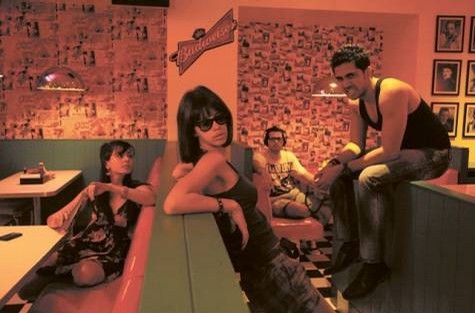
Bejoy Nambiar’s Shaitan (2011) deliberately starts off on the wrong foot, presenting a hackneyed bunch of carefree upper class youth inducting one more into the gang, with a scene that seems more like endorsement than condemnation. (This is the sole scene when the five leads are their most comfortable, with a slack, indulgent, food-in-the-mouth kind of acting epitomized by Brad Pitt). It is only when we follow them all over Mumbai as they indulge in all sorts of puckish activities including casual robbery and midnight races that we realize that our identification is being severed and a critical distance developed. And it is only when the pack rams into a scooter that it realizes that a whole world exists underneath its (literally: under their car’s tyres). Speaking in collective terms here is justified, since not one role in the film is a character; all are types, with minute variants at best. The film itself makes no claims otherwise. (In a way, it is a final girl flick, full of caricatures, without any external threat). Ostensibly a film wanting to examine mob mentality – the gang, bevies of reporters, religious masses – and tyrannical impulses within us – the leader of the gang, the various law enforcers and their activities – Shaitan finds its bunny-ear-donning child-adult protagonists, who are initially blind to notions of class and religion, gradually being pushed out of their comfort zones into a minority and attempting to blend into larger groups for survival. (You have kidnappers thrashing kidnapers, police chasing police and rich kids with a money crunch!) The film is defined by its major ellipses which swing between smart telescoping of action (e.g. the suspension of the officer) and incompetent shorthand (the news channels, which have usurped the role of the narrator in Hindi cinema off late). But it is the bravura action sequence at the lodge, with its off-kilter, everything-is-allowed, anything-goes, Hollywood movie brat-like aesthetic that takes the rest of the film’s banal TV and ad inspired stylistic to a whole new level. Nambiar, it seems to me, is a natural when directing music videos and this sublime, provocative, magical scene, which cross cuts between slo-mo bullet rains and the gang dropping from rooftops in fluttering black purdahs like fallen angels onto a truck full of feathers, alone is worth sitting till and beyond it. Also includes an in-joke among Kashyapians involving Rajat Barmecha and a wordless subplot (if not the ultimate ignoring of the gang’s original crime) dealing with a miffed couple that might impress Nambiar’s south side mentor.
Jaume Collet-Serra’s Unknown (2011) is the kind of movie that typifies straightforward PG-13 Hollywood thriller – star-driven, homogenized visuals with a strong primary color scheme (with a dominance of metallic blue, as usual), elaborate set pieces that could be moved around within the film, a pulsating score that vies with the boisterous sound design, with allegros of action separated by adagios of emotion, unapologetic about its generic nature with a plot detailed enough to claim seriousness and sketchy enough to avoid offending anyone and, of course, the solitary cuss word. Liam Neeson, who looks aptly like an ex-secret agent coming out of retirement, with his haggard appearance, wrinkled skin and receding hairline, is an American professor whose identity is stolen during his trip to a bio-conference in Berlin. With the rug of reality pulled off his feet, he must find a way to get back into the original social order with the help of a gorgeous working class sidekick (Diane Kruger), who knows all the seedy localities in the city, and an ex-Stasi officer (Bruno Ganz, also serving as the home star), who believes that Germans are very forgetful about history. Unknown channels wrong-man thrillers such as North by Northwest (1959), as well as Polanski’s Frantic (1988), but strips them of their psychosexual dimension, presenting a work that is solely concerned with mechanics of the genre and craft of the profession (the central car chase is sort of inspired, with its heady interleaving of vertical, horizontal and deep-space movements). The bunch of passages that pique your interest (the ostentatious scene at the museum, the confrontation between Langella and Ganz, both of whose best-known roles are infamous historical characters) are also the ones entirely superfluous.


















 The Seventh Art