There are three sets of letters written in Gandhi to Hitler (2011) – from Gandhi to Hitler just after the Blitzkrieg, from Hitler to his people just before his death and between a jingoist Indian army officer (Aman Verma) wandering war-torn European countryside and his Gandhian wife back home – none of which are ever read. This is only one of the hundred methods by which the film engages in there-are-no-winners-in-war philosophizing and attempts to establish a ‘universality’ of grief and suffering. The picture is an amalgam of wish fulfillments: a chance for the writer-director to remake both Saving Private Ryan (1998) and Downfall (2004), for the home audience to see their own WW2 movie and for Raghuvir Yadav (Adolf Hitler) to be paired with Neha Dhupia (Eva Braun). Only Mohandas Gandhi gets a raw deal, existing solely as a mirror image of the German chancellor. (This vehement contrast informs the organization and style of the first section of the movie: Hitler snaking through in his bunker cut to Gandhi walking through the corridors of his Ashram, the Führer belittling the officers around him with Gandhi preaching to his followers, the gradual disintegration of the Reich with the fortification of Gandhian movement). This split is also established within the third narrative track centering on the officer (and his Gandhian wife) leading group of Indian soldiers (under S. C. Bose, who sided with the German army), consisting of men of various religious persuasions. Not just the structure, but every shot in Gandhi to Hitler exists to present an idea, to illustrate a convenient thesis, while the direction, acting, editing and photography go into auto-pilot. But the film’s boldest move – which, I’m sure, reviewers would relish picking on – is to have an all-Indian cast, speaking Hindi throughout: a virtue born out of necessity that’s also a rebuttal of conventional wisdom about realistic storytelling, which is fixated on appearance, plausibility and imitation.
The scene below, from Budd Boetticher’s seminal Western Seven Men From Now (1956), admittedly the finest the director has ever filmed, pretty much exemplifies what I consider divine filmmaking.
Check how the actors are directed and how they perform. There is no attempt to ‘express’ feelings or emotions. This is classical acting (miles away from the indulgent Method) where the burden of performance is transferred from physical behaviour of individuals to a pregnant, anxious network of glances. These skewed glances, directed sideways or off-screen, simultaneously perform the task of evoking necessary emotions as well as creating meaning through their association with whom they are directed at.
Check how the actors are positioned and framed. Each of the setups – the close-ups and the two shots – finds its proper place and generates its own tension. The two shots, even though partly the result of a necessity, consist of either Gail Russell and Randalph Scott sitting besides each other or Lee Marvin and Walter Reed, the former perched just behind and above the latter, and forebodes relationships that would become significant from here on.
Check how the whole conversation is edited. Each shot both carries the burden of the previous and prefigures what is to follow. Each one is cut just as a glance is cast and carried to a finish: long enough to register whom it is addressed to and what it means and short enough to avoid ramming down the idea or emotion down our throats. The audience’s gaze, likewise, is transferred from one actor to another in the same fluid movement, with precise vanishing points, as the chain of glances.
It would be a little helpful to know the textual background of the scene in appreciating it better. Ben Stride, an ex-Sheriff in search of a holdup gang, falls in love with Annie Greer (Russell), the wife of farmer John Greer (Reed), who is on his way to California. Bill Masters (Marvin) is a bounty hunter eyeing the money that the bank robbers possess. Stride, Masters and Greer are all antitheses to each other. The righteous, hardboiled and gentlemanly Stride is in sharp contrast to the lewd, trigger-happy and similarly lonesome, yearning Masters – one of the characteristic Boetticher-Kennedy characters of the old West with a classic morality – who scorns at the meek, soft-spoken and ‘unmanly’ nature of outsider Greer.
Consider the segment from 2’28” to 2’52”. (Although such breakdown rarely recapitulates the richness of watching the scene first hand, first time, it is interesting to examine why it works the way it works). It is made up of 5 shots – all close-ups – beginning with Masters reporting in detail how beautiful Greer’s wife is, as he stares into her eyes. Cut to Annie, visibly uncomfortable at the description, glances at her husband sitting on her right and off-screen, hinting him, with a gentle rightward tilt of her head, to intervene. Cut to a distressed John, who quickly ‘delegates’ Annie’s request to Stride, possibly the only person capable of countering Masters in this situation. Stride, though never critical of John’s timidity, is never approving of it either. A true blue Man of the West, he expects a man to speak up for his wife and, consequently, rejects John’s request, resolutely staring back at him. Cut back to John, his lowered gaze realizing what is asked of him, his gritting teeth revealing his inability to do it.
There is nothing in the script that demands such an execution. (There are a million ways to botch up the scene, not least by including great “actors”). True that the writing – and Burt Kennedy’s debut script is as terrific as they come – sets up the characters and their relationships elaborately, but it is this confluence of remarkable performances, cinematography, editing and direction lays bare the entire dynamics of the scenario with a handful of shots with ruthless precision. It is in scenes such as these – the ones between the pages and lines of a script – where Film comes to life. Standing on the shoulders of its script, the film reaches places that the former possibly can’t. To steal from Bazin, it is a question of building a secondary work with the script as foundation. In no sense is the film “comparable” to the script or “worthy” of it. It is a new aesthetic creation, the script, so to speak, multiplied by the cinema.
We Can’t Go Home Again (1976)
Nicholas Ray
English
Nicholas Ray’s We Can’t Go Home Again, ostensibly the director’s most personal and complex film, was made by the director and his students during his stint as a film professor at State University of New York, Binghamton, under abysmal financial conditions (which is also what the film is about). Ray kept editing the film for almost a decade and the final version never saw the light of the day. The second cut, which dates to 1976, is as far from the studio pictures made by the filmmaker as it can be. We are far from the eye-popping days of ultra-widescreen, for one, with its 4:3 ratio. Instead of the frame becoming an infinite canvas in front of us, it keeps diminishing, sharing screen space with a bunch of similar frames. (The film was shot on a number of formats, projected on a single screen, which was then recorded on 35mm). This splintering of the visual field, the generally pathetic sound and the entire filming method highly befits both the ideological fragmentation of Ray’s radicalized students and the progressive mental and physical breakdown of Ray himself (who appears to play a slightly fictionalized version of himself). This sharing of screen space by multiple smaller frames, like a cubist painting, seems to suggest the amorphous worldview of the misguided youngsters – types from an era – who see the equally vacillating Ray as some sort of secondary father figure, one away from home. The one-eyed Ray, as if throwing light on the politics of his films, seemingly advises them, without condescension, that no ideological position must blind them of the human elements that make up the system, that an eye for an eye makes the whole world blind.
An enormous void has been created in world cinema landscape with the passing of Mani Kaul, one of the greatest Indian filmmakers. The least we could do is to cherish his works, spread the word and discuss about them and keep his grand legacy alive.
Here are some writings by and interviews of Mani Kaul. A heartfelt thank you to everyone who helped bring these pieces on to the internet.
Writings
“Communication” (Part of a symposium on THE CINEMA SITUATION, with Kumar Shahani, Adoor Gopalakrishnan, Shyam Benegal and Dileep Padgaonkar, 1977)
Tarang (1984) (Wages and Profit)
Kumar Shahani
Hindi
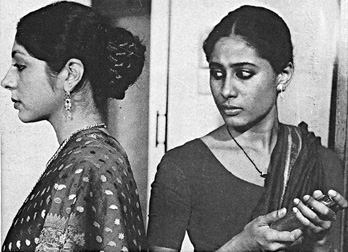
Kumar Shahani’s Tarang (1984) is located startlingly far from the intense stylization and abstraction of his previous feature Maya Darpan (1972), with its conventional, accessible, (overly?) fleshed out and faithfully realized story, generous score (including songs!), impressive cast and naturalistic acting. Taking off from the template narrative of class struggle, Tarang tells the tale of an internally fragmented family of industrialists and the equally divided body of workers at his factory, the link between them being the upwardly mobile wife of a dead worker (Smita Patil) who begins an affair with the manager of the factory (Amol Palekar). A staunch Marxist, Shahani examines the class struggle on multiple fronts: in the writing that nearly recites the labour theory of value, in the densely layered soundtrack where various voices vie for power and the casting, where the star value of the actors is in conflict with the characters they play. In fact, Tarang is presented as a film within a film and we are regularly shown that Patil and Palekar are famous actors who are playing these characters. Shahani realizes that his film is born of the same system that it rails against (Reporter: What do you think of this? Policeman: The crime or the film? Reporter: What’s the difference anyway?) and foresees the impossibility of any satisfactory resolution to the conflict. Like the films of Eisenstein, who no doubt influenced Shahani as is evident crowd scenes at the factory, there is so much happening – much power struggle – in the frames of the film, as it is in the deeply metaphorical text.
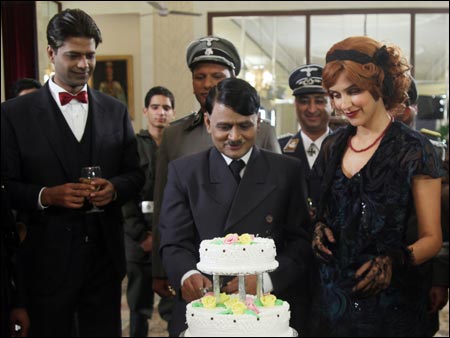 There are three sets of letters written in Gandhi to Hitler (2011) – from Gandhi to Hitler just after the Blitzkrieg, from Hitler to his people just before his death and between a jingoist Indian army officer (Aman Verma) wandering war-torn European countryside and his Gandhian wife back home – none of which are ever read. This is only one of the hundred methods by which the film engages in there-are-no-winners-in-war philosophizing and attempts to establish a ‘universality’ of grief and suffering. The picture is an amalgam of wish fulfillments: a chance for the writer-director to remake both Saving Private Ryan (1998) and Downfall (2004), for the home audience to see their own WW2 movie and for Raghuvir Yadav (Adolf Hitler) to be paired with Neha Dhupia (Eva Braun). Only Mohandas Gandhi gets a raw deal, existing solely as a mirror image of the German chancellor. (This vehement contrast informs the organization and style of the first section of the movie: Hitler snaking through in his bunker cut to Gandhi walking through the corridors of his Ashram, the Führer belittling the officers around him with Gandhi preaching to his followers, the gradual disintegration of the Reich with the fortification of Gandhian movement). This split is also established within the third narrative track centering on the officer (and his Gandhian wife) leading group of Indian soldiers (under S. C. Bose, who sided with the German army), consisting of men of various religious persuasions. Not just the structure, but every shot in Gandhi to Hitler exists to present an idea, to illustrate a convenient thesis, while the direction, acting, editing and photography go into auto-pilot. But the film’s boldest move – which, I’m sure, reviewers would relish picking on – is to have an all-Indian cast, speaking Hindi throughout: a virtue born out of necessity that’s also a rebuttal of conventional wisdom about realistic storytelling, which is fixated on appearance, plausibility and imitation.