May 2020
Monthly Archive
May 29, 2020

Jerry Lewis’s romantic comedy Three on a Couch (1966) works off a rather outrageous premise. Chris (Lewis) is an artist who has won a year-long residency in France. He wants to marry his girlfriend Liz (Janet Leigh) and move with her to Paris. But Liz, a psychoanalyst, can’t leave her practice because she’s not making progress with three of her patients who depend on her. Each of these three girls—of a uniformly doll-like beauty, differentiated by accents and hairstyles—has turned into a man-hater following a heartbreak. Liz is helpless and Chris is becoming increasingly morose. Chris’ best friend, the obstetrician Ben (James Best), gives him an idea: seduce the three girls so they can be cured of their misandry and Liz can leave for Paris. Playing three different men with characteristics tailored to each girl, Chris goes about making them fall for him.
As the title indicates, psychoanalysis here is euphemism for sexual intercourse. When Liz penetrates the minds of her patients, her office is lit in saturated, psychedelic colours, like some seedy den of sin conceived by Frank Tashlin. One of the girls, a sportive type, keeps moving her legs, through which the camera moves at one point. Psychoanalysis being a substitute for sex, the three girls are in an unstated romantic relation with Liz. The comedy therefore derives from one man’s attempt to win back his girlfriend from the seductions of other women by seducing away these women. Underpinning the humour is the rather retrograde notion that lesbians simply need a good dick to be cured.


Well, that’s the text. But there’s something else going on underneath, against the flow, reversing the text even. We are told that Chris was once Liz’s patient. During the credits, we see him enter her office with the appearance of a hermit, but we don’t exactly know what his problem was. Given how Liz exclusively works with issues of sexuality, we might suppose Chris too is tormented on that front. In the first scene, Chris goes to the French consulate to claim his residency and reward. He is an artist—one of Hollywood’s euphemisms for a gay man. Posing for the photo-op, he kisses the French diplomat, who tells him that it wasn’t necessary. “For $10000, you’re lucky it wasn’t on the lips”, says Chris.
When we first see Ben, he’s trying to convince Liz to go with Chris to Paris. “Any girl that won’t have babies is anti-business” is the reason this obstetrician gives. Shortly after, he arrives at a bar to talk to Chris. The whole scene plays out like the first meeting of two lovers who have long separated. This conversation, as all of Ben’s scenes in the film, is loaded with innuendo that suggest that his relation to Chris, “his best friend”, is more than platonic. He lays out the plan to Chris: “If I were a girl who hated men and wanted someone to talk me out of it, I wouldn’t go to another girl, I’d go to Cary Grant”. “Man is the cause, man is the cure”, he says, prompting Chris to play the “bohemian” lover to the three girls. Chris likes the idea, but demurs. Ben reminds him of their college days. “You seem awfully happy about this”, notes Chris, to which Ben replies, “Well, it’s good for my business”.
As the plan is afoot, Ben visits Chris in his apartment. The exchange between them strips away all context, accommodating any supposition:
Ben: “What are you so sad about?”
Chris: “What am I looking so sad about? Suppose Elizabeth finds out.”
Ben: “How is she gonna find out?”
Chris: “That’s what I’m worried about.”
Ben: “In a city as big as L.A.? It’ll never happen.”
Chris: “In a city as big as L.A. That’s when it does happen.”
Just then, Liz rings the bell. Chris opens fumblingly, and Ben prepares to leave the apartment right away for no reason. The couple sits on the couch as Liz starts recounting how her patients are showing signs of cure, not knowing that Chris is behind all this. Now, Jerry Lewis’ sequencing tends to be rather austere, not particularly marked by camera movements. During conversation scenes, he avoids shot/reverse shot constructions, instead drawing the viewer into the space through axial cuts from medium two-shots to tighter solo shots. But here, he allows himself a flourish. The camera arcs from behind the sofa where the couple are sitting and goes at the diametrically opposite point, reversing the actors’ on-screen positions. The reversal is equally thematic, for Chris is as much a pawn in Ben’s plan as Liz is in his.

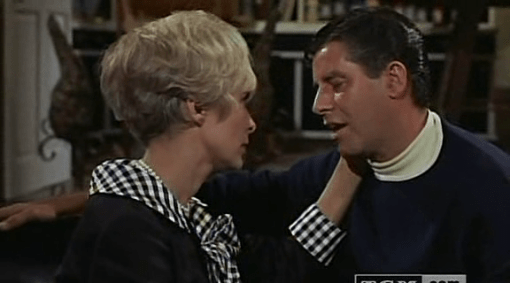
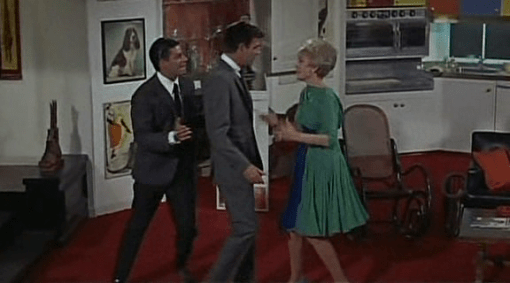
Notwithstanding the tacked-on happy ending, one against-the-grain reading of the plot illustrates its symmetry: Chris thinks he’s winning back Liz by seducing the girls, but it might well be Ben who’s trying to win back Chris by urging him to carry out this hopeless plan. So we can’t always say who’s controlling whom; at several points, the three characters move in a way that swaps their positions in the frame.
Ben’s romance is barely veiled. In a ballroom scene, as Chris necks Liz during a slow dance, Lewis cuts to Ben’s reaction, a wholly uncomfortable insert held for too long. Ben forces an awkward, pained smile. As the couple dances, Ben gets up from the seat to encourage Chris to continue dancing, as though he needed that encouragement. In a later scene, Ben and Chris leave a party hall into a private room. Lewis makes an ambiguous cut to Liz discussing with her secretary about how pretty something looks; “a natural romance”, adds the secretary. (The entire party scene—constructed around a Kafkaesque elevator that’s always there but never accessible—is small masterpiece of screen comedy, dialled-up with uncharacteristically tight, claustrophobic compositions that cry for a release.)



In his extraordinary Rock Hudson’s Home Movies (1992), which played this week at the Filmmuseum München retrospective online, Mark Rappaport picks out moments from Hudson’s films that surreptitiously relay information about the actor’s homosexuality, revelations often mitigated by a safely heterosexual plot context. The filmmaker extracts these lines and gestures out of their context to build his case that Hudson’s homosexuality was there to see for anyone who cared to pay close attention. This hacking of the texts, this decontextualization, frustrating from an academic point of view, is very much the point of the film, which forges a young admirer’s private fantasy in the vein of Hollywood Babylon from public documents. Rappaport’s explosive work throws light on the complex workings of the Hollywood movie, where several extra-textual narratives intermingle to pin down an ever-slippery network of meanings.
Someone watching Three on a Couch with no knowledge of the actors’ private lives may similarly suppose that Jerry Lewis and James Best were queer, and that this detail was being sublimated in a story about heterosexual supremacy. The scenes between them have a touch of camp, but Lewis’ performance and characterization are especially striking.


A Lewis operation is generally room-wrecking, his physicality dominating every other element of the aesthetic. Here, on the other hand, he is largely withdrawn. He doesn’t begin with the Lewis persona right away. He starts off, in fact, as a rather obnoxious figure, throwing tantrums and blackmailing Liz when she refuses to go with him to Paris. In his scenes with Liz, he is often photographed from the back, not unlike how Cary Grant is filmed in Hitchcock’s Suspicion (1941), the lack of our access to his facial reactions making him seem even more sinister. There are no reverse shots, and his inward-looking body language clearly spells a repressed character.
What’s Ben’s seduction plan for Chris if not an opportunity for him to perform heterosexual romances with women without ever personally investing in it, just like what Rock Hudson and other queer stars of Hollywood always did in their movies? It even offers Chris a chance to cross-dress as a character named Heather. Sexually speaking, the Jerry Lewis persona oscillates between a childish pre- or asexuality and blustering ultra-masculinity. Here, Ben’s plan decomposes Chris’ relatively complex personality into three simple archetypes: Ringo the alpha man of the west, Warren the sportive urban male and Rutherford the gay mamma’s boy. Once this decomposition is in place, all three archetypes are subjected to the Jerry treatment; in a montage of funny courting scenes (chopped up into single gags so as to put Jerry back into his comfort zone), we see how each of these men fails in the sole characteristic he is supposed to uphold.
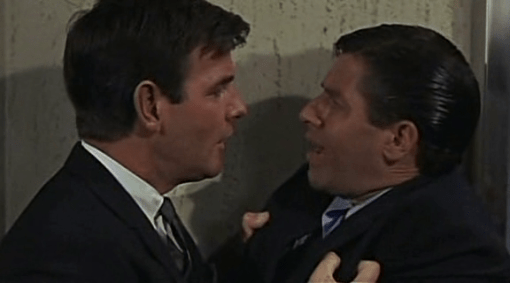

So I suspect Three on a Couch is to Lewis what Punch-Drunk Love (2002) is to Adam Sandler: a deconstruction, a look at what likes on the other side of his screen persona, defined equally by arrested development. But the more fundamental question of whether it’s legitimate for heterosexual actors like Lewis and Best to play gay characters playing heterosexual characters is a Gordian knot I can’t yet undo.
This kind of in-joking—whether imposed or willed—is not uncommon in the work of queer actors like Grant, Hudson and Montgomery Clift. And unlike, say, Indian male movie stars, who operate in a firmly heterosexual framework that can only allow their drag roles and performed queerness to be read as jokes, Lewis and Best are working in Hollywood of 1966, whose historical and cultural context won’t let viewers brush aside the significations of these ‘crossovers’. Which is to say, Three on a Couch may have been a cultural relic even in its time, like all Jerry Lewis films.

May 26, 2020
Posted by Just Another Film Buff under
All Posts,
Books,
Hollywood,
Translations | Tags:
El Dorado,
Ford Apache,
Hatari,
Howard Hawks,
John Ford,
John Wayne,
Luc Moullet,
Politique des acteurs,
Reap the Wild Wind,
Red River,
Rio Bravo,
Rio Grande,
Seven Sinners,
She Wore A Yellow Ribbon,
Stagecoach,
The Man Who Shot Liberty Valance,
The Quiet Man,
The Searchers,
The Shootist,
The Wings of Eagles,
Translation |
Leave a Comment
[From Luc Moullet’s Politique des acteurs (1993, Cahiers du cinéma). See Table of Contents]
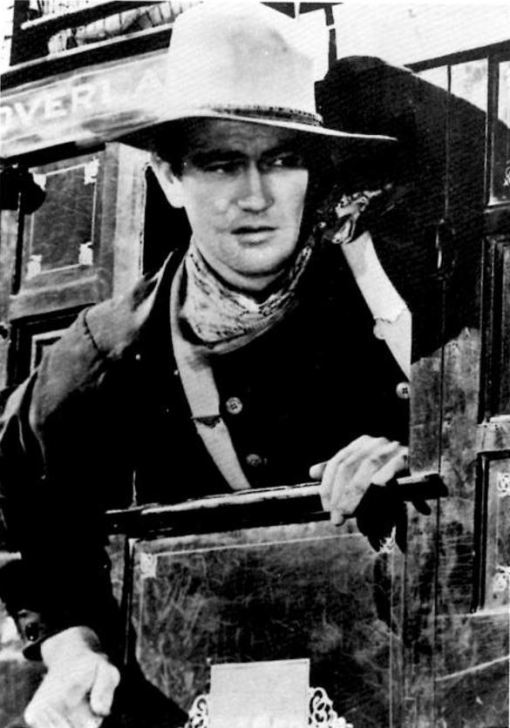
The first real appearance (Stagecoach, 1938)
Stagecoach (1938) is distinct in its sobriety and simplicity. There are effects but they aren’t visible. They are perfectly integrated into the continuity of editing. It’s the ideal stylistic exercise for film schools to take note of.
Even so, John Ford went for a flashy effect—just one—which is completely incongruent with the rest of film. It occurs in the first shot John Wayne appears in. Here is the film that will rescue him from oblivion and make him world famous. And how is he introduced? Firstly, notice that we see him eighteen minutes after the film has begun. A delayed entrance that is quite useful and well-planned: we have already heard much about Ringo Kid in the preceding conversation. This delay could seem normal: after all, Wayne’s is only the second name in the credits behind Claire Trevor, and as we have seen, it’s a good strategy to delay the entrance of the second protagonist.
But what an entrance! Everything has been smooth so far. Suddenly, without any narrative reason, there is a tight shot of the unknown Wayne all by himself, with the tracking camera culminating in a closeup, and the Monument Valley in the background, overlaid on a thunderous score. All this for a gentleman who stops the stagecoach with a hand signal, not for a holdup but simply to use the public service: to alert the driver…
We can’t think of a better beginning for a mythification. What’s curious is that it’s for a square almost unknown to the big studios, a handsome, scrappy giant, a sharpshooter trapped in Z movies of Republic Pictures where he had made forty mid-length features in six years. Ford seems to have wanted to create a star, his star, since they were to make fifteen films together in twenty-five years. The most faithful duo in the history of cinema. Amazing intuition, when none of the earlier films helped foresee Wayne’s abilities.
Ford places Wayne in the shadows—mythicizing darkness—as much as possible, while his partner Claire Trevor is frequently in full light in the preceding shot. One wonders if this doesn’t reflect a certain lack of confidence of Ford in the dramatic capabilities of his new protégé. Testimonies confirm this: Ford had asked Wayne to emote as little as possible, to stay impassive. Whatever the case, even if it was necessitated by fortuitous reasons, the mythification is no less present, and will continue to shape Wayne’s future work in a very perverse way.
At the end of the film, Wayne kills two villains within a few seconds. We don’t have time to see anything. As Wayne joins Claire Trevor, he is seen from behind. It’s only when he is very far in the background that he turns and lets us see his face.
(more…)
May 23, 2020
[From my column on studio-era Hollywood films for Firstpost]
Warner Brothers was arguably the most interesting film production house of the 1930s, certainly at least from a political and social point of view. Like other studios, it knew how to harness the Depression-era audience’s desire to escape the doom and gloom around them by offering cheerful backstage musicals. But Warner also proved itself willing and capable of registering the harsh reality that this audience lived in. The studio’s tendency to both profit from the general resentment and to assuage it with uplifting messages of hope and courage may have its roots in the political leanings of its chief Jack Warner, a heavyweight supporter of Franklin D. Roosevelt who is said to have gotten his wartime directives straight from the White House.
Heroes for Sale (1933) was produced by First National Pictures, a subsidiary of Warner Brothers’ that mostly handled the studio’s second-tier products. There were few stars in these films and the budgets were relatively low, which allowed them to be bold in their choice of plot and setting. While in a Warner Bros. picture, tragic stories would regularly be attenuated with a tacked-on happy ending, the First National films didn’t need to sugarcoat their bitter vision. Heroes for Sale was made just after Roosevelt swore in as the 32nd president of the United States. As though symptomatic of this particular time, the film embodies both a discontentment with the preceding Hoover administration and a hope for the new one, the duality manifesting as an incongruity between plot and character.
Injured in combat during the war, Tom Holmes (Richard Barthelmess) returns home to discover that the military accolades he deserves have been given to his army peer Roger (Gordon Westcott). Not wishing to rock the boat, Tom takes up a modest clerical job at the bank run by Roger’s father, only to be crippled by, and sacked for, a morphine addiction he acquired at a German POW hospital. After rehabilitation, Tom starts a family and successfully runs a laundry in Chicago, but finds himself unwittingly caught up in a riot following a wave of automation and job loss. Returning from an imprisonment of five years, he learns he is on a list of suspected communists, and is forced to wander the country as a drifter without a home, a family or a job.
The script, by Robert Lord and Wilson Mizner (an opium addict himself), has a stark anti-establishment bent. Throughout the film, we witness authority being abused to crush the little man that Tom represents: a commander who sends his soldiers on an impossible mission, a banker who misappropriates people’s money, businessmen who sack their employees without second thought, police who fire at protestors, law that accords disproportional punishment to white- and blue-collar crimes, enforcers chasing vagabonds from their camps. Heroes for Sale is punctuated by images drawn from real events of the preceding years, such as urban breadlines, the veterans’ march to Washington and the ensuing firing. At the end, Tom tells Roger, both hobos on the run now: “You started way up high and I started pretty low. And we end up here in the rain, together.”
While the grim analysis above remains faithful to the reality of the Great Depression, the reaction to it suggested by Heroes for Sale is one of stoic acceptance. All through his ordeals, Tom refuses revolts against his lot, nor does he switch over to the wrong side of the law. As a result, the account of his constant exile from society—army, rehabilitation centre, prison, endless wandering as a vagrant—scans like a modern-day Book of Job, where Christian forbearance, charity and an unquestioning faith in powers that be are presented as the noblest possible response to relentless suffering. This answer is justified by the failure of the anti-automation riot Tom tries to prevent, as well as by the presence of the inventor Max (Robert Barrat), a caricatural communist who is simply a disgruntled capitalist at heart.
This call for patience is wholly in line with the studio’s support for the new regime and the promises of the New Deal. In fact, the film devolves into an unveiled propaganda for Roosevelt towards the end. “It takes more than one sock in the jaw to lick 120 million people”, says Tom to Roger, explicitly referring to the new president’s inaugural address. The economy, and with it the morale of the nation, will rise again is the message. After one hour of attacking one American institution after another, here’s a turnabout, an unfounded appeal for trust. Trust in institutions, especially the banking establishments that had lost public legitimacy after the stock market collapse, was what the Warner brothers would have liked too; their existence depended on it: Goldman Sachs was on advisory board of the studio and had co-financed its purchase of First National Pictures.
Director William A. Wellman’s style is notoriously hard to pin down; his personal vision of the world, even more so. There is little formal or thematic consistency across his body of work, except perhaps a certain taste for gritty realism expressed in particular details of action, gesture and setting. Any line of moral, political or philosophical thought one can discern in one film will invariably be contradicted in another. As critic David Phelps puts it, “the films have no metaphysics but physics.” As a result, critical consensus on his work still remains unresolved, his status as a major American filmmaker open to question. Manny Farber was a great admirer of the textures in his films, asserting that “when Wellman finishes with a service station or the wooden stairs in front of an ancient saloon, there’s no reason for any movie realist to handle the subject again.” In contrast, Andrew Sarris declared that, with Wellman, “objectivity is the last refuge for mediocrity.”
Be that as it may, Wellman brings a lean muscularity to Heroes for Sale, which possesses a novelistic sprawl without ever turning laboured or precious. The film hurtles from one genre, one setting to another, making vast leaps in time that are all the more striking in that they are executed with straight cuts without transitions. Wellman’s characteristic camera movements expand and contract spaces with considerable effectiveness. He tracks across the laundry floor twice to show the wrecking impact of automation on the employees. Wellman steers clear of sentimentalism despite the thoroughly melodramatic construction of the scenario. A comparison with his collaboration with David O. Selznick, a high-strung sentimentalist, a few months before in The Conquerors (1932) reveals on how light-footed Heroes for Sale actually is.
There’s something about Wellman’s style that makes it free of value judgments about what is being depicted. To be sure, scenes can provoke the desired emotion in the viewer, but only in so far as the script needs it. Many episodes in Wellman’s work seem to unfold in the passive voice, displacing interest from the characters on to the action they are embedded in. The riot sequence in Heroes for Sale is a good example. The strikers wreck the laundry and hurl stones at the police, who fire back. The camera pushes through the fighting mass to pick up Tom’s wife, who has come to look for him. A barely perceptible blow to her jaw knocks her down dead. Since the previous shot shows both the rioters and the police wielding batons, we are not sure who is delivered the blow. Wellman’s staging and editing of the action takes no sides, shifting the emphasis from assigning responsibility to describing results. A riot took place, blows were exchanged, a woman was killed.
[Originally published at Firstpost]
May 16, 2020
Posted by Just Another Film Buff under
All Posts,
Cinema of India,
Cinema of Italy,
Cinema of Romania,
Review | Tags:
A Rifle and a Bag,
Arya Rothe,
Cristina Hanes,
Isabella Rinaldi,
Naxal movement in film,
NoCut Film Collective,
Visions du Réel |
Leave a Comment

Somi wears a broad smile. She’s in her late twenties—or early thirties, she doesn’t know—and pregnant with her second child. “I think it’s a girl”, she tells her husband Sukhram, five years her junior. Somi cooks, washes their clothes and takes care of their first child, while Sukhram is about the house doing nondescript work. They have a pet parrot and raise poultry in their plot of land. It might be the picture of a modest but ordinary family, except for the fact that both Somi and Sukhram are renegades from the Naxal movement who surrendered to the Indian state, got an amnesty, and were resettled under the country’s rehabilitation policy for ex-Naxals. Their “second-life”, in a colony in rural Maharashtra comprising of refugees like themselves, is the subject of a compelling new documentary titled A Rifle and a Bag, which screened online at the Visions du Réel film festival last week.
In long, fixed shots, the opening passage of the film gives us a sense of the couple’s everyday reality: scenes from domestic life, Somi’s visit to the pregnancy clinic, the couple’s conversation about their to-be-born second child. These images of quotidian life are, however, soon punctured as we learn about Somi’s past as a Naxal commander, the deadly reprisals the couple have risked in their surrender, their lingering feeling of deracination. Somi’s role as a wife and a mother is in stark contrast with her older role as a Naxal higher-up. But Somi makes no remark about this conventional distribution of labour, content instead to secure a future for her children.
A large part of A Rifle and a Bag presents the couple’s interaction with the Indian state and civil society on a day-to-day basis as part of their rehabilitation. Somi runs from pillar to post to unsuccessfully obtain a caste certificate for Sukhram, who can’t safely go back home to Chhatisgarh to get one. Without this certificate, they can’t admit their son into a school. The film develops around the central irony that Somi and Sukhram, of a tribal origin, have to identify themselves in terms the Indian state understands. The state and the civil society, though, aren’t malevolent forces. In fact, the officers, teachers and doctors whom we only hear interacting with Somi could hardly be more understanding and sympathetic. It’s the system they help function, faceless just like them, that holds Somi and Sukhram like a vice.
Earlier in the film, a self-congratulatory meeting organized by the local Rotary chapter, and blessed by the army, reinforces the new-fangled national identity of the ex-Naxals, pointing out that Naxalism is truly a national problem, affects as it does twenty-two states. Somi and Sukhram manage to find a place for their son at the boarding school, however briefly. In a scene at the school that puts too fine a point on it, the children are made to perform morning prayers, taught violently patriotic slogans and are, quite plainly, indoctrinated into the nationalist ideology. Somi, on the other hand, hardly has any national consciousness. Asked why she joined the Naxals, she says she wanted to get back at the local landlord who let the police harass her kin.
Through these contrasts, A Rifle and a Bag brings to surface the losses involved in the family’s integration into society. In their new colony, Somi and Sukhram don’t get a land to farm on—their primary occupation—but simply a plot large enough for a house. They are not only alienated from the world around their settlement, which still associates them with Naxalism, but also their relatives in Naxal-dominated areas. That we seldom see them outside their house or within a community only exacerbates the impression of their isolation. Owing to their situation, they can only send their child to a boarding school, where the boy acquires a body of knowledge vastly different from their own, in a language not their own. In a poignant exchange towards the end, Somi recounts her Naxal background to her son, as though restoring his ties to the family history, against the narrative he will soon be taught.
Not surprisingly, Somi appears to persistently doubt whether they have made right decision in surrendering, whether their new life is indeed better. To be sure, her family is objectively “making progress”. There’s a new bike, there are new clothes, the poultry makes way for cattle. Their colony has electricity and there’s cable television at home—material comforts contrasted with her past life in the jungle. But we never fully know why Somi or Sukhram left the Naxal organization, or what they are hoping for through their rehabilitation. Somi continues to maintain that the ideology behind the movement is righteous, even though its ways may be wrong. It’s to the film’s success that its loyalty lies with Somi’s unavowed incertitude than with any ideological certainties.
A Rifle and a Bag was produced and directed by Cristina Hanes, Isabella Rinaldi, and Arya Rothe, a trio known as the NoCut Film Collective. They adapt a non-interventional style—familiar in international documentary practice—in which Somi and Sukhram play themselves, their reality fictionalized just enough to constitute the narrative structure. They punctuate the film with repeated compositions—the house gate, Somi across an office desk, the changing phases of the moon—to impart a sense of place. This restrained form, marked by large ellipses, nevertheless makes space for considerable feeling, allowing us to recognize the tragedy behind Somi’s perennial smile.
[First published at Silverscreen]
May 10, 2020
[From my column on studio-era Hollywood films for Firstpost]

One of Paramount Pictures’ most prestigious assets was director Josef von Sternberg, a Viennese émigré most known for his seven-film collaboration with iconic actress Marlene Dietrich, who had moved to the States following the success of their first film together, The Blue Angel (1930). The sixth entry in the cycle, The Scarlet Empress, is a loose biography of Catherine the Great of Russia. The arrival of the talkies in the late 1920s had given fresh impetus to studios to remake their silent epics in sound. The year before had seen Garbo play Christina of Sweden in the commercial hit Queen Christina (1933) and Paramount themselves had released Cleopatra (1934), starring Claudette Colbert, a month before to considerable success. But nothing, not even Sternberg’s earlier films with Dietrich, anticipates the stylistic aggression of The Scarlet Empress, a box-office bomb.
Sternberg’s film follows a fairly linear trajectory. Ordained to be married to the Grand Duke Peter of Russia (Sam Jaffe), Catherine (Dietrich) travels from her hometown in Prussia to Russia, accompanied by the handsome Count Alexei (John Lodge). Catherine falls in love with the count, who has described Peter to her in lofty terms. Having reached Russia, Catherine is subject to a series of rude awakenings: Peter is a sinister idiot who devises torture toys, his aunt the current Empress Elizabeth (Louise Dresser) is a cold, cruel ruler who only wants Catherine to produce a male heir to her throne and Alexei appears to be a perennial skirt-chaser. Hardened by her betrayal, Catherine shields herself from the world, weaponizing her sexuality and waiting for the right moment to seize power.
It’s a rather intimate, psychoanalytical retelling of Catherine’s story that casts her private romantic problems as the motor of History. It locates the dissolution of her humanity in a wrenching scene in which she discovers that Alexei is also the illicit lover of Elizabeth. Later in the film, after taking over Elizabeth’s private chamber, Catherine restages this primal scene as a form of therapy, this time forcing Alexei into her old role in order to make him recognize the harm he’s done. Catherine’s ascension is conditioned by her private disappointments—the dissolution of her Prussian identity, her unhappy marriage, her heartbreak with Alexei and the her being reduced to an heir-producing machine. “We women are too much creatures of the heart”, remarks Elizabeth, lamenting the burden of the crown. It’s Catherine’s predicament too, one which she turns to her advantage.
Nothing in the synopsis above obliges Scarlet Empress to be the film that it is. In the hands of another equally-capable director, this might have been a sober, moving tragedy about thrust-upon greatness. But Sternberg was a sophisticated stylist and he conceives the film in an idiosyncratic form that derives from gothic, baroque and expressionistic tendencies in western art and architecture. Every detail of the film—sets, costume, lighting, dialogue, acting, music—is distorted to a grotesque degree having little to do with reality, leave alone history. Sternberg’s genre-bending treatment of the narrative applies horror movie tropes to a historical psychodrama, resulting in a very campy, very exotic aesthetic comparable to what Sergei Eisenstein would devise years later for his Ivan the Terrible films.
Sternberg’s primary means of breaking away from realism is through a ‘encumbered’ mise en scène, a deep physical space saturated with decorative objects all pointing to the unfathomable cruelty of the Russian royalty: a decadent palace housing gargoyle like sculptures, thrones attached to busts of withered old men clutching their faces in grief, clocks and toys depicting sexual deviancy and human torture, expansive clothes that seem like medieval torture instruments themselves, a skeleton leaning over a dining table, tableware and even food that spell out anguish and pain. (It is a curious irony that the contemporary face of evil, seizing power in Germany as Sternberg’s film was being made, glorified an aesthetic that was the polar opposite of the one pictured here.) The human characters are thus lost in layers and layers of clothing and décor, trapped in an ethos of terror they have little agency over. Catherine is doomed, physically and morally, to the same fate as her predecessors.
Nothing is left to accident in Sternberg’s film. Every visual, every gesture and every word planned in advance — Catherine playing with a suspended rope, falling on a haystack and tucking straws into her mouth for Alexei to remove, Alexei bowing his head in sorrow after Catherine asks him to perform an elaborate ritual, Catherine wrapping the tip of Peter’s threatening sword with a piece of her dress, a high official humiliatingly dropping a diamond in a priest’s plate — everything carrying specific meaning. Working with cinematographer Bert Glennon for the fifth time, Sternberg develops a rather complex lighting pattern that favours certain image planes over others (a similar scheme will be developed in India later by Guru Dutt and V. K. Murthy). This produces a film of great visual allure as well as ambiguity.
The chief source of ambiguity, though, stems from Sternberg’s bold mixing of tones. The Scarlet Empress is both a tragedy about Catherine’s sealed fate as well as risqué comedy about her sexual conquests. The challenge the film poses is that it never clearly distinguishes these two elements of the film. The duality of innocence and evil is introduced in the film’s first scene, in which a young, bedridden Catherine clutches her doll as her governor reads her tales of notorious Russian tyrants. The calamity facing Catherine registers clearly all through the narrative, reaching its peak in a gorgeously expressive wedding scene in which the bride Catherine’s halting breath threatens to blow out the candle she holds before her veil. Cutting to a soaring choral score, Sternberg films Catherine and Alexei in increasingly tight closeups, freezing them in their despair and helplessness via a characteristic top lighting.
On the other hand, the film suspends us in an attitude of uneasy humour about Catherine’s destiny. This strategy primarily manifests in the figure of Marlene Dietrich, an icon of screen irony. The viewer never once believes in the innocence of Christina even back in Prussia as a young maiden. Dietrich plays up the plain country girl stereotype, feigning wide-eyed naïveté and real love. Starting from this, The Scarlet Empress effects a progressive ‘defeminization’ of Catherine, her billowing white frock slowly giving way to military furs and finally to a dazzling white uniform with coat and trousers. Catherine’s rise to power thus coincides with a merging of the character with the Dietrich persona. The actor conveys Catherine’s sexual maturity with tremendous humour and wit. The joke on paper (that Catherine the Great slept with the whole Russian army) is taken through all its variations by Dietrich’s actorly intelligence, her manner of introducing wholly gratuitous but suggestive sentence breaks (“And your duties… Dmitri?”) and her typical way of sizing up men around her.
All of this excess somehow passed through the newly introduced Motion Picture Production Code. Part of it has to do with the film’s way of having its royal cake and eating it. A biographical picture situated in a different time and country (Russia, no less) perhaps gave the film immunity from the censors. The sadism, cruelty and debauchery could always be defended by appeal to a dubious historical accuracy. Whatever the case, it’s a wonder that Sternberg managed to go as far as he did, especially at a point where the country was reeling from the aftermath of the Great Depression. Film history is all the richer for it.
[Originally published at Firstpost]
May 8, 2020
Posted by Just Another Film Buff under
All Posts,
Cinema of Switzerland,
Roundup | Tags:
A Machine to Live In,
Days of Cannibalism,
Intimate Distances,
NA China,
Non Western,
Purple Sea,
Pyrale,
Some Kind of Heaven,
The Marriage Project,
Unusual Summer,
Visions du Réel |
Leave a Comment

In addition to the historical upheavals it has already produced, it would seem that the COVID-19 pandemic has also forced us to renegotiate our understanding of the real and its many opposites. It’s then bitterly appropriate that the Visions du Réel film festival, which seeks to showcase newer perspectives in international documentary practice, is among the first film events to go completely online following the restrictions imposed by the outbreak.
The epochal nature of this shift cannot be overstated. Film festivals are spaces that do more than bring audiences in contact with films and filmmakers. They connect audiences to themselves, to the reality of the place around them, to its economic and social machinery. That Visions du Réel, which traditionally takes place every year in April in Nyons, Switzerland, is no more anchored to a geographical location, and is instead accessible to viewers from around the world, themselves severed from their immediate reality, is some kind of a metaphor for the times we live in.
This dialectic between indoors and outdoors isn’t new, it’s intrinsic to film experience. The darkened hall of the movie theatre is an escape from reality that promises a return to reality in newer forms. It’s a flight away from community that’s predicated on communal participation. Speaking of his dislike for watching films at home, the French critic Roland Barthes wrote, “not enough of a public, not enough anonymity”. As audience, we are trained to overlook this contradiction, to not even recognize it as such. The current confinement, on the other hand, obliges us to take note of it by forbidding our access to the social dimension of moviegoing.
Speaking to this historical moment, numerous works at the 51st edition of Visions du Réel exhibit a yearning for the social. Many unfold in self-contained worlds with no exit to external reality. Public spaces, random encounters and a desire for community pervade this year’s offering. It’s less that the films, made before the outbreak, were prescient, than that the ongoing crisis has alerted us to a fundamental loss, sharpening our sensitivity to these tendencies, which will only be strengthened in the coming months.
Among the finest films at the festival, the medium-length feature Pyrale, made by Roxanne Gaucherand, is the one that most resembles the prevalent state of the world. On a basic level, the film is an intimate documentary about a box tree moth infestation plaguing certain areas of the Drôme department in France. The way the filmmaker photographs these millions of butterflies, rife with sensual shadows and backlighting, imparts the work the texture of science fiction. Superimposed on this composite is a story of burgeoning desire, in which a teenage girl discovers her love for a friend just when two are bound to be separated. With great feeling for the region, Gaucherand paints a moody, melancholy picture evoking the end of the world, where romantic longing comes across as a force of redemption.
In Unusual Summer (Kamal Aljafari), the urge to reach out to others takes the form of CCTV tapes that the filmmaker’s father left behind after his death in 2015. The tapes are from the summer of 2006 and were used record the parking spot outside his home to see who’s been breaking the car window. Despite the dramatic promises of the CCTV aesthetic and the location of the house in a crime-ridden area, what we get in this film are quotidian incidents, sightings of neighbours passing by. This transformation of private surveillance footage into a session of window-watching and people-spotting produces a sense of community and forges a relation of inheritance between the filmmaker and his father, the only two people to have seen these tapes.
A pressing feeling for connection equally runs under the placid surface of Intimate Distances (Phillip Warnell), an uneven but thought-provoking documentary about public spaces and the anonymous exchanges they facilitate. Casting director Martha Wollner walks up and down a block in Brooklyn looking for a young actor to play the role of a criminal. While we hear her conversations through mic she wears, she and her interlocutors are filmed from such a distance that they are often dissolved into the urban landscape. What surprises us is the willingness with which the people Wollner speaks to open themselves up to her. In its contrapuntal construction, the film throws light on how the anonymity that cities enforce is also the source of potential intimacy.
The city, its design and its influence on its inhabitants is the subject of the erudite and formally-complex A Machine to Live In (Yoni Goldstein and Meredith Zielke). The location in question is Brasilia, the artificially created capital of Brazil that was designed according to modernist principles in the 1950s. Machine sees this city as an otherworldly geography unfit for human life, but also allowing the possibilities of imagining utopias, catholic cultists, freemasons, biker gangs, and Esperanto evangelists all finding a home within Brasilia’s orbit. Employing diverse modes of exposition and crisp digital photography, the filmmakers develop a visually-striking portrait of a city that has come to resemble a religious monument in itself, demanding awestruck worship and constant maintenance by people who can’t afford to live here.
The notion of a city built from nothing is also invoked by Some Kind of Heaven (Lance Oppenheim), an exploration of life in The Villages, a massive retirement community in Florida planned in the eighties. We see how the elderly are able to reinvent themselves in this place and discover newer reservoirs of inspiration, and this prompts us to question the values of the culture they have moved away from. While the film opts for a less productive, human interest angle, the question of what constitutes a community remains on its periphery, inviting us to ponder on whether a group of people with no historical ties can live in isolation from the wider world without existential repercussions.
In The Marriage Project (Atieh Attarzadeh, Hesam Eslami), on the contrary, it’s the wider world that imposes itself on a secluded populace. The community in question is a psychiatric centre in Tehran, whose director has undertaken a radical project to allow certain patients to marry each other. He believes this can help address their social and sexual needs, without running against Islamic law—a proposal his subordinates object to. We see how the discourses of religion, mental health and love wrestle with each other to exert influence on the minds and bodies of the patients. The filmmaker frames this potent and moving examination through details of her private life, trying to make sense of her own failed marriage in the process.
Other films at the festival grapple with the wider world in more direct ways, prying open the anxieties fostered by modern political and social life. Among the most provocative works of the festival is the hour-long Purple Sea (Amel Alzakout, Khaled Abdulwahed), comprising of video footage the filmmaker made after the boat carrying her from Syria sank near the Hellenic coast. Overlaid on the barely legible images of bodies immersed in water is a dispassionate voiceover of the filmmaker’s thoughts that she had while trying to stay afloat. Purple Sea is something of a freak work of documentary, a near-death experience that asserts the existence of those we see here in fragments as more than statistics on immigration debates. It’s a film that’s easier to appreciate than to watch.
Days of Cannibalism (Teboho Edkins) and NA China (Marie Voignier) are complementary works that reflect on the frictions occasioned by global relocation of populations. Edkins’ film unfolds as a Western about immigrant Chinese traders setting up wholesale stores in rural Lesotho. The traders are successful, but their transactional relation to the cattle they are investing in goes against the sentiments of the predominantly agrarian local population, the latter embodying a much more relaxed attitude to money. Voignier’s film supplies a reverse shot, centring on African businesswomen trying to set up shop in Guangzhou. The women scour wholesale markets and pick out quality pieces that could be exported back home, their challenge to find something of value registering as an effort to live authentically. Both films are open-ended and invite the viewer to independently consider the questions they raise.
The clash of cultures manifests on a more personal scale in Sing Me a Song (Thomas Balmès) and Non Western (Laura Plancarte). In the former, a young boy ordained for monkhood at a monastery in rural Bhutan falls in love with an escort in Thimphu, thanks to the invasive power of the internet. Foregrounding its fictional mechanism, the film functions both as a cautionary tale about the dangers of modernity and a Buddhist parable about temptation. The stakes are much higher in Non Western where Nanci, a white woman, is torn between her modern self-image as an independent academic and her role as a wife to a conservative North Cheyenne patriarch, Thaddeus. Despite itself, the film tips our sympathy towards Nanci, with Thaddeus coming across as little more than a slacker hiding behind excuses of tradition and deracination. An intriguing if opaque look, nonetheless, at interpersonal relations being inflected by American’s primal historical trauma.
Many of the features at this year’s Vision du Réel share the conviction that films can make fruitful interventions into reality. All of them believe that they can help us better understand the world we live in. At a time when the virus is wreaking an epistemological havoc, undoing our certainties and forcing newer insights every day, this belief can perhaps serve as our lodestar in approaching films as viewers. We are all the richer, then, for the perspectives into reality these films have to offer.
[Originally published at Firstpost]
 The Seventh Art