June 2020
Monthly Archive
June 30, 2020
Posted by Just Another Film Buff under
All Posts,
Books,
Hollywood,
Translations | Tags:
Arsenic and Old Lace,
Blonde Venus,
Bringing Up Baby,
Cary Grant,
Charade,
His Girl Friday,
I Was A Male War Bride,
Luc Moullet,
Monkey Business,
North by Northwest,
Notorious,
Once Upon a Honeymoon,
Only Angels Have Wings,
Politique des acteurs,
Suspicion,
Sylvia Scarlett,
The Awful Truth,
To Catch a Thief,
Translation |
Leave a Comment
[From Luc Moullet’s Politique des acteurs (1993, Cahiers du cinéma). See Table of Contents]
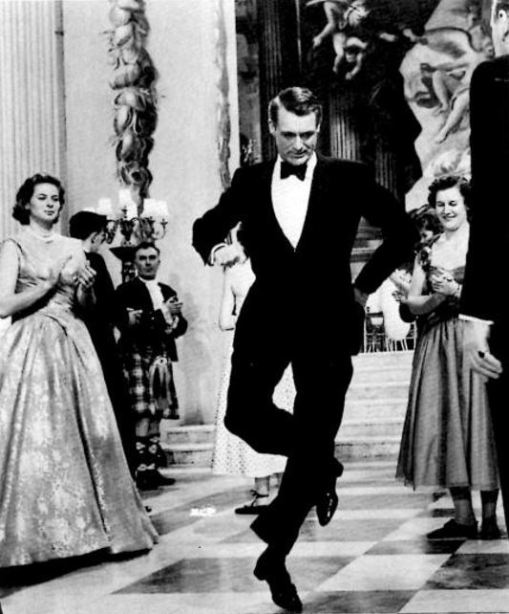
Each of the four limbs follows one or two different directions (Indiscreet, 1958)
Cary Grant is in the same boat as Cooper or Wayne: his first films, made for the same company—Paramount, as it happens—during the thirties, offer us a rather aseptic, standardized actor. We have the slightly caricatured proof of that in his role in Blonde Venus (Sternberg, 1932), where he plays opposite Marlene Dietrich as her wealthy seducer and impresario. Despite his brief scenes, we get to see him in the attire of a horseman, a yachtsman, and in several other expensive costumes. The husband, Herbert Marshall, and, especially, Marlene Dietrich get numerous medium shots. Not Grant, who is more of an image, a silhouette. Sternberg’s contribution to the film somewhat surpasses Paramount’s standards. With Cary Grant, Sternberg seems to have wanted to replicate the Gary Cooper of Morocco: the same short sentences, the same emphasis on the nose. Choosing Cary as a first name in 1932 was perhaps not an innocent choice. Grant appears much older than his age of twenty-eight. It’s perhaps the only time in his career that he has a massive appearance. With his large, immobile face, he resembles Sternberg’s future actors like Mature or Mitchum rather than Cooper. He moves very little. He delivers a blow to an adversary the first time we see him. He is entirely a Sternbergian man, having little to do with Grant’s personality of the years to follow.
Sylvia Scarlett (1935), his second excursion from Paramount, gifts us a real actor. The film revolves around a young woman (Katharine Hepburn) who is obliged to dress up as a man in order to help her fugitive father. Grant plays a curious character, an Englishman like himself (while he would be an American in the great majority of his films) of an indefinite status: a conman, he begins by shamefully exploiting the father and the “daughter” before helping and protecting them. He generally plays leading men in other films, but here, he vanishes towards the end, letting Katharine Hepburn marry Brian Aherne. But this isn’t exactly a disappearance, since Hepburn wears Grant’s black jacket and closely imitates his behaviour in the train, seen in the film’s very first scene.
There is a key to better understand, to differently understand Sylvia Scarlett and Grant’s entire body of work. At the beginning of this book, I intended to abstain from talking about the private life of the artists. I hope the reader will forgive me if I contradict this principle. I promise not do so again. But this infraction of critical ethics appears indispensable to me. Grant was married five times, for quite short periods of time. This added to his legend as a handsome seducer. But the recent biography by Charles Higham and Roy Moseley [1] indicates that Grant was bisexual, and that his heterosexual relations were generally, let’s say, less happy than the others. Since the book was not mired in any controversy, we could trust its authors. This explains the brevity of his marriages, and perhaps even Grant’s delayed paternity (at sixty-two years). The many marriages served, if not as a cover, at least as tryouts with varying degrees of success. These particularities were hushed up by gossip columnists. For if it was known that the greatest seducer of women was closeted, the whole Hollywood scaffolding could likely collapse, and the squealers with it.
I probably don’t even have to apologize for this reference to private life. For it fortunately makes up for another, more or less unconscious reference to a fake private life: if we were blind to Cary Grant’s ambiguity, it was because his image as an eternal skirt-chaser distracted us from the reality on screen, and prohibited us from thinking even for a moment of this ambiguity.
(more…)
June 27, 2020
[For its 45th “anniversary”, I wrote the following article on the Internal Emergency as seen by the short films produced by the state-owned Films Division of India]

It’s obvious today to anyone who watches them that the documentaries and newsreels produced by the Films Division of India (FD) conceal as much as they reveal. Set up as India’s official film production unit under the Ministry of Information & Broadcasting (MIB) in 1948, FD had for mission to inform the people of a new democracy about what their government is doing for them, and what the government in turn expects from them as responsible citizens. In short, propaganda. Even so, as Peter Sutoris illuminates in his book Visions of Development (2016), the various organs involved in the making of the films had a margin of creative autonomy that helped usher in some degree of artistry.
This was especially the case after the protean artist Jean Bhownagary took charge of the organization when Indira Gandhi was heading the MIB. FD works of the late sixties and the early seventies are among the most innovative films ever created in the country. When the Emergency was declared on 25th June 1975, however, FD was forced back into its straitjacket and its resources marshalled to defend the clampdown and to sing praise of the PM and her Twenty Point Programme. To be sure, apolitical work such as documentaries on art and culture were still produced, but the films made during 1975-77 that did deal with the political situation had to toe the official line more strictly than ever.
While a straight-up hagiography like The Prime Minister (1976), which follows the dear leader’s everyday routine, still has currency in our political discourse, many FD films about the Emergency remain odd historical curios. One recurring theme was the futility of violence and militant protest. In shorts such as Kidhar Ja Rahe Ho (1975) and Kaisa Andhera (1975), decontextualized, stock images of violence are cut to a Hindi-movie-like song expressing dismay at the damage to public property being caused. In Maa Ki Pukar (1975), an errant young man is convinced by his mother, who bears a resemblance to the PM, that violence isn’t the solution to the nation’s problems.
But propaganda wasn’t limited to purveyors of kitsch alone. Even original voices like S. N. S. Sastry were recruited into smoke and mirrors exercises. In a characteristic fashion, We Have Promises To Keep (1975) mixes approving street interviews, old-style documentary and violent contrasts to develop an impressionistic picture of a country where forces of order are at war with those of anarchy. Though not without some irreverent ambiguity (the film opens with a shot of a skull cut to one of Indira Gandhi’s eyes), Promises offers robust proof that the avant-garde can be put in service of pretty much any ideology.
The career of one particular filmmaker encapsulates the complex, conflicted public response to the Emergency. Sukhdev was a fierce independent who kept his distance from FD, finding real artistic footing in the organization only after Bhownagary took over. In their righteous anger and their rejection of all-knowing voiceovers, Sukhdev’s earliest films, such as And Miles to Go… (1965) and India ’67 (1967), are a far cry from the patronizing, didactic quality of the typical FD production. The years that followed, however, saw the filmmaker taking increasingly pro-government stances. For instance, in Voice of the People and A Few More Questions (both 1974), Sukhdev interviewed common people across social strata about their opinion on the impending all-India railway strike. Focusing on its potentially catastrophic effects rather than the demands driving it, these films present the strike as a selfish action of a few at the cost of many.
Compared to Sukhdev’s first films, Thunder of Freedom (1976) represents a volte-face both ideologically and stylistically. Though made of interviews of people opining on the political situation, the film is held together by the filmmaker’s authoritative voiceover, which interprets public unrest as an abuse of freedom. It walks us through the benefits of the Emergency using the same ‘before’ and ‘after’ model of the FD factory that Sukhdev’s early works violently rejected. With few exceptions, subjects talk to us about the welfare of slum resettlements, crackdown on profiteering and worker exploitation, quality control in ration shops, increased industrial productivity, and vast improvements in women’s safety and civic sense. All those interviewed express a concern that these changes might be reversed once the Emergency is removed.
One of Sukhdev’s last films, After the Silence (1976), presents arguably his most compelling case for the state’s iron fist. Politics remains out of the picture for the most part, the film probing into the horrific effects of legal and illegal bonded labour. The filmmaker is typically brash, even offensive, as he gathers testimonies from rural women sold into Delhi’s brothels, but the film retains a poetic, polemical force thanks to its stark photography and humanist conviction. Having established the urgency of problem, Sukhdev describes how the government has been able to abolish this practice and save thousands from unspeakable misery. It’s a wrenching film, disturbing in its methods but also empathetic in its exploration of intersectional poverty. It also demonstrates that Sukhdev’s relation to the state was more complex than it appears, that people were always at the focal point of his work.
A publication titled “White Paper on the Misuse of Mass Media During the Internal Emergency”, published under the new JP government in 1977, details the way the preceding regime abused the media, including FD, to glorify the Emergency and stoke a personality cult around its leader. This included commissioning a four-hour documentary on Indira Gandhi for an exorbitant sum of 11.9 lakh rupees. The document also hints at the special favours Sukhdev enjoyed, receiving projects directly from the MIB, without having to go through FD. At the same time, he wasn’t indispensable to the state, as no individual is. The MIB rejected one of his films, and he wouldn’t get any commissions from the JP government, which saw him as a collaborator in the Emergency.
An FD film made under the new government indirectly reveals what was, historically speaking, at stake during those 20 months. Directed by Sai Paranjpye, Freedom from Fear (1977) is a powerful account of the horrors of the Emergency: stories of torture, detention and disappearance, accounts of journalistic resistance and statements by students who had no choice but to become politicized. Unsurprisingly, the film promotes the new government as a champion of free speech that not only allows artists and reporters to criticize the state, but even offers a space on national television for the opposition to express itself. The film ends on an uplifting note, with images of children at school cut to a voiceover reading “Where the mind is without fear”.
What is most curious about the film is that we barely see images from the Emergency itself. When it wants to show public unrest, it employs footage from before the period, drawn from the FD archives as usual, like that of the railway strike of 1974—footage that, ironically, Sukhdev had shot. This absence suggests that the Emergency is really a black hole in our cinematic historiography, which makes the oral testimonies in Paranjpye’s film, stilted and preciously few in number though they are, all the more valuable.
[Originally published at Firstpost]
June 20, 2020
[The following is a translation of a chapter from Serge Toubiana’s memoirs Les fantômes du souvenir (“The Ghosts of Memory”, 2016, Grasset)]
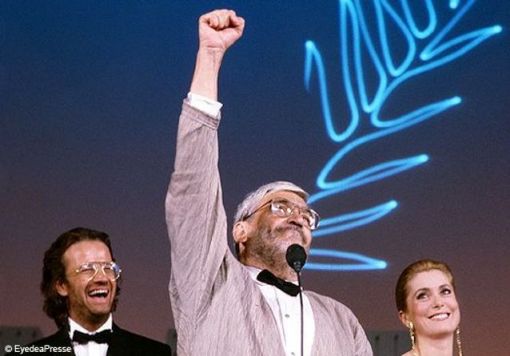
Anxious to know if Maurice was suffering, Sylvie Pialat called the doctor. The prognosis was that he’d possibly not last the weekend. We three had a meeting of sorts to decide whether or not to increase the morphine dosage. That very evening, just before midnight, Maurice Pialat died in his bed. He was in the sky-blue shirt that Emmanuèle and I had gifted him on 25 December 2002 during the Christmas meal we were invited to. Sky-blue suited him well, Maurice seemed at peace after a long illness.
Shortly before Maurice’s death, Sylvie did the right thing by inviting all those who mattered in his personal and professional life one after the other. She wanted everyone to have a memory of Maurice, without the regret of not having seen him one last time. But he wasn’t capable anymore of recognizing the person sitting next to his bed. The only one whose voice and presence he recognized by instinct was Gérard Depardieu. Whenever he entered the bedroom, the actor had the gift and energy to banter and make himself heard. Maurice’s face would then light up with a faint smile. The two men loved each other deeply, there was an obvious and natural complicity between them that Maurice had with no one else, except of course Sylvie.
An intense atmosphere reigned all through the night of 10-11 January, suffused with remembrance and shared affection. Death brought together those who were present physically. At one point, I had to take little Antoine in my arms and grip him tightly because his body trembled as he cried. I was able to calm him after several long minutes. He slowly pulled himself together and received his friends from the neighbourhood. The children soon started playing and running around, but ensured they went to see Maurice on his deathbed from time to time.
Around 1 AM, Sylvie asked me to take care of the funeral services. I’d never done that. On the telephone, a man asked me pointed questions that I was unable to answer. Something like: “How many people should the vault accommodate? Two or three? Should the service be religious or not?” “Hmm… a little religious but not too much!”, I mumbled. Behind me, Sylvie, Daniel Toscan du Plantier and Isabelle Huppert burst out laughing. Daniel Toscan du Plantier came up with the right answer quickly: “Antoine is too young; I think a vault for two will do!”
(more…)
June 13, 2020
[From my column on studio-era Hollywood films for Firstpost]

With the American economy recovering under the New Deal and workers getting back to the factories, it would seem that a more fundamental anxiety about the industrial age resurfaced in Hollywood cinema. Fordist production of the previous decades had vitiated the skilled workforce, reducing the factory employee to a tiny cog in the production machinery—an awareness that was heightened by the brief favour socialism enjoyed in the country in the late 1930s. Chaplin’s Modern Times (1936) responded most famously to this alienation of the worker by satirizing the principles of industrial management. The Paramount production Reaching for the Sun (1941) takes a less jovial route, exploring the theme within the framework of romantic comedy and marital drama.
Adapted from Wessel Smitter’s novel F.O.B. Detroit (1938), Reaching for the Sun follows Russ (Joel McCrea), a backwoods clam-digger who moves to Detroit to work in a car factory so he can afford an outboard motor for his boat. He plans to get back to the countryside as soon as he purchases the motor, but just as his roommate and colleague Bennie (Eddie Bracken) warns, he falls in love, marries and has a child in the city before he knows it. Obliged to toil at the factory to support his family, but also facing the opposition of his wife Rita (Ellen Drew) who wants to continue living in the city, Russ finds his dream of moving back to the woods slipping away from him.
Russ is first presented an innocent idealist living in harmony with nature, untouched by the harsh realities of industrial life. He lives for his clams, whistles at birds and deer. There’s not a resentful bone in his body: when he sees another clam-digger making a bigger haul with his motor boat, he simply tilts his head, as though to say “lucky man!”. McCrea’s towering stature bestows a rich dialectical quality to the character. Despite his lumberjack-like build, Russ is a gentle giant who gets knocked down repeatedly by Herman (Albert Dekker), his romantic rival at the factory. He keeps his hands close to his body even when he’s agitated. When he punches through a door in a rare fit of rage, it’s an evidently clumsy blow, made against his natural instinct.
Rita, in total contrast, is a world-wise city girl, a waitress and a taxi dancer who ribs Russ’ Southern-boy courteousness (“What will you have, or is that too personal?”). She has no abiding relation to nature: she doesn’t want to move to the countryside and falls into a brook the only time Russ takes her there. When they relocate to a new house, Rita points to a sorry excuse for a tree, telling Russ she picked this spot because she knows how much he loves nature: “The man said in the spring it has leaves and everything.” Just beyond this tree is a construction crane moving about its limb ominously.
The central theme of Smitter’s book, reprised as a secondary motif in the film, is modern man’s enslavement by his own inventions. “A machine geared to a man is one thing. A man geared to a machine is something else.”, writes the author. When we first see Russ in the film, he wedges out a truck stuck in the mud using a pair of logs. But the initial temptation of an outboard motor gradually brings him in contact with bigger and bigger machines. His first fight with Herman is with bare fists, the second with crowbars and pliers, and his final battle takes place through gigantic machines the two men operate. In the latter skirmish, Russ and Herman are barely visible, having become ghosts in the machines.
The film’s primary focus, however, is the machine that modern life as a whole is. Director William Wellman and scriptwriter Leslie River displace the immediate socio-industrial thrust of Smitter’s story on to an existential plane. Their Russ is a Thoreau-like figure wanting to live away from community in self-sufficiency, but who is caught in the rigmarole of social life, his personality gradually hollowed out by everyday grind. When Rita blasts him for obsessing over his outboard motor, he pensively tells Bennie that, without it, “I’ll be like everyone else”.
The machine thus comes to represent the life Russ dreams of, the identity he tries to hold on to. But, like the car in Ritwik Ghatak’s Ajantrik (1958), it is also a physical entity that supplants Russ’ human relations. Just after he purchases the motor, Russ carries it gently like a baby wrapped in rags. He addresses it with a “she” and nurtures dreams for it. In a humorous scene, he and Bennie try to get the motor started in their boarding house, just as two bumbling men would handle an abandoned baby. The machine competes with both Rita and Russ’ real baby for his attention and resources; at one point, it lies next to him on his marital bed, after Rita and her baby have left the house.
A contemporary New York Times review regretted such a comic treatment of the subject, criticizing the way the film strips away the socio-political import of the book. While this may be a fair objection, it should also be noted that the light touch of the film does not imply frivolity of intention. Producer and director Wellman, who retired early from filmmaking to spend more time with his family, often made pictures about characters who had to make hard choices between professional and personal lives. He recognizes the modern apprehension at the heart of the story. His success lies in finding a form that registers this hefty idea without letting it overwhelm the narrative.
A number of scenes in his film function on a register that is neither wholly comic or dramatic, an ambivalence that works in its favour. In a reconciliatory exchange, Rita inquires how important she is for Russ. Russ tells what she wants to hear, but when she asks “more than the outboard motor?”, he goes silent in a manner that’s both poignant and funny. In another sequence, Russ and Bennie attend a class for to-be-fathers where they are to learn how to handle newborns. It’s a broadly comic scene about changing gender roles, but Russ’ reaction to the idea of washing a baby’s bottom, a mixture of fear and worry, is the opposite of what such a comic scene demands. Towards the end, just after Rita has left with the baby, Russ receives a laudatory certificate from the class for being the best father—an ironic moment that’s tragic even if Rita and the baby were with him.
This heartfelt angst about the costs of domestic life is complex and unresolvable, all the more why the film’s ending seems so ridiculously contrived. Where Smitter’s novel leaves Russ hopelessly crippled after an industrial accident, he not only gets artificial legs in the film, but is able to move to the countryside with Rita and the baby. While there’s little reason to suspect that Wellman, known for his obstinacy and independent spirit, had to compromise, the postcard picturesqueness with which this tacked-on happy ending is filmed — Rita tossing a steak and singing a folk tune in the country house—can’t possibly be taken at face value. Considering that Wellman shows a large banner at the car factory reading “Quality First” (and not “Safety First”) just after Russ’ accident, we may suppose self-parody at work. It may be that a country on the brink of a great war simply needed to believe in such happy endings.
[Originally published at Firstpost]
June 7, 2020
[Disclaimer: I know the filmmaker Arun Karthick on Facebook. In principle, I don’t write about films by people I’m acquainted with. But since Nasir had a worldwide screening on YouTube as part of the We Are One festival, I thought it okay to write about it. Take it with a pinch of salt all the same.]

Arun Karthick’s Nasir is built on a series of refusals. As a non-Muslim filmmaker telling the story of a poor Muslim man, Arun seems to have felt that the only way he can negotiate this dilemma is by refusing to give in to objectifying characterizations of Muslims typical of a whole lot of non-Muslim cinema. So very little about Nasir (Koumarane Valavane) marks him as a Muslim in the viewer’s eyes. He doesn’t wear a kurta, doesn’t have a skullcap and doesn’t shave his moustache. We never see him eat meat or biryani. He doesn’t live in a Muslim ghetto, his impoverished neighbourhood accommodating poor of all stripes. His speech is plain, largely untouched either by Dakhni Urdu or the prevalent Kongu accent of Tamil. His household isn’t teeming with children; in fact, Nasir doesn’t have a child of his own, and he takes care of an orphaned, developmentally challenged teenager at home. This considered refusal of artificiality must not be confused with authenticity.
This extends to the dramatic construction as well. Right at the outset, we learn that poor Nasir needs money: he has an ailing mother and a memorial ceremony is around the corner. It’s the most melodramatic of all premises. But the film refuses to take Nasir through a parade of frustrations, disappointments and humiliations. The drama is constantly deferred, relegated to the margins, until late into the film. The filmmaker is mostly content in observing Nasir’s workaday over 24 hours, starting from his morning routine until his walk back home from work late in the evening. Nasir works at a clothing outlet, and the film captures his interaction with colleagues, customers, his boss and his family at length, interspersing it with pensive moments of Nasir smoking beedi.
Nasir is a relic from another time, something of a poet adrift in a commercial world. He listens to music on a tape recorder, writes loving letters to his wife who’s away from home for just three days. Like his poetry, his understated but distinctly innocent romanticism are at odds with a universe of short-term relationships and teenage affairs. His long letter to his wife—doubling as an elaborate expository device read out as voiceover—is interrupted thrice by instances of violence. But Nasir is out of pace with the world in other ways as well. As an unmarked Muslim unbound by his community and uninvolved in debates surrounding Islam, he mentally lives in a time and place in which he could survive behind the general anonymity of the city and the marketplace.
Echoing this isolation, the film hems close to Nasir’s perspective of things. The viewer experiences only what the protagonist experiences. Nasir is the centre of the cosmos on whose margins tumultuous things unfold, things that he keeps at bay unwittingly or not: signs of anti-Muslim sentiment and political mobilization in the city. A shorter sequence at his shop transposes Nasir’s condition temporarily onto a female co-worker. As the men at the outlet discuss porn, sex and adultery, the camera leaves Nasir to follow the young woman around the store as she tries unsuccessfully to ignore this ostensibly uncomfortable discussion.
Nasir’s observational approach isn’t new, and it plants itself firmly in the Hubert Bals-sponsored tradition of meditative fiction filmmaking. The film starts out with extreme close-ups of scenes from Nasir’s household, partially blocked or obscured images offered through layers of fabric or grills so that the viewer squints to perceive what’s happening. This formal scheme loosens up as Nasir sets out for the day, the scenes at the clothing shop serving both as visual and comic relief. The filmmaker often fixates on minute details of décor, setting or actors’ bodies, with one afternoon sequence around Nasir’s nap turning into an abstract vision of a state between dream and waking life. While this fetishization of the ordinary remains eccentric and tasteful for most part, it sometimes tips over into the exotic, such as when we see Nasir’s prayer at the mosque—a rare sign of his Islamic affiliation—at great, almost voyeuristic detail that goes against the general principle of the film.
On the other hand, the film’s treatment of the city of Coimbatore in Tamil Nadu, where the story is set, is quite refreshing. My recent memory of the city on screen is in the noxious Suttu Pidikka Utharavu (2018), where it’s a contested town filled with treacherous North Indian immigrants and Muslims to be strictly policed and surveyed from apartment rooftops. In Nasir, in contrast, we witness the city almost exclusively from the eye level on the street.
To be sure, the film does not purport to offer an objective, value-neutral glimpse of the city. For instance, we hardly see any political or film posters on its walls, or hear Dravidian political rhetoric—sights and sounds that are integral to public experience in Tamil Nadu. And the same could be said of the deep-seated caste and ethnic fault lines of the city. In Nasir, it would seem that these details have been supplanted by a pan-national communal discourse: Jamaats and Mahasabhas announce themselves on the walls as Nasir walks from his neighbourhood to the larger city—sequences whose lengths seem determined by the soundbites from mosques or BJP speeches we hear on the soundtrack. And a vaguely suspicious North Indian presence is still felt on the narrative periphery, most notably in the ubiquity of Ganesha idols during the Ganesha festival, which here becomes an occasion for Hindu assertion and mob violence.
Even so, Nasir does a good job of capturing the unique visual culture of the state, the sensory overload it imposes on the public, vying for its attention akin to the shop worker who calls out to potential customers: flashy private vehicles at a mofussil bus depot, serpentine chains of stores selling the same wares, coloured decorations cutting across roads like wires, etc. More importantly, it touches on the fragile cosmopolitanism of the city, easily upset by politically-motivated communal polarization.
Critics have hailed Nasir for its reserve, its abstinence from grandstanding, its relegation of the political to its margins and its refusal to give a message. While some of it is true, I think this profoundly mischaracterizes the film. For one, the rejection of messaging is new only as far as one compares it to mainstream Indian cinema, a comparison with little possible ground. Nasir is as far from mainstream Indian cinema as it is from Hollywood; its lineage is different and specific. Considered in light of other Rotterdam-funded films of the past two decades, its minimization of the political and its refusal to preach is wholly in line with that tradition.
Moreover, it isn’t to the film credit to say that it focuses on some fuzzy humanism, keeping the political and the communal out of its scope. Nasir’s indifference is a virtue only as far as there’s the threat of political and religious violence about him. The marginalization of the political is part of the film’s emotive substructure and not some independent artistic choice outside of its desire to follow Nasir’s life. One collapses without the other. Finally, it seems plain as day to me that Nasir has a message and one it wishes to convey ardently. It isn’t an ambiguous film by any measure, and there are no dozen ways of reading it. It isn’t any less message-oriented than many liberal-minded mainstream pictures, and to acknowledge that doesn’t take anything away from the film’s accomplishment.
[Spoiler alert]
Which brings me to the film’s ending. As Nasir walks home at night, reciting the letter to his wife on the voiceover, a Hindu mob confronts and kills him. Where arthouse filmmaking would typically omit this graphic event, presenting vignettes of its aftermath alone, Arun chooses to depict the violence. The camera unhinges from the tripod, frenetically following the men pouncing on Nasir. The shaky camera abstracts the lynching such that that the mass of men is reduced to an indistinct blob of low-def colours, with a face or a snatch of dialogue emerging from time to time to pin down the meaning of the event.
It is a bold choice that finds a novel (and morally defensible) midpoint between the iniquity of representing such violence and potential perversion (not to mention the aesthetic staleness) involved in artfully eliding the event. But I do wonder whether it isn’t a superfluous ending that could’ve been done away with altogether. I understand that it’s intended to inscribe homicidal violence within the everyday experience of the poor Indian Muslim. But I also think that it topples the affair by suggesting that the travails of Indian Muslims could only make sense within the optic of murderous communal violence. In other words, the low-key struggles born of structural problems—lack of state support, the dearth of economic opportunities, the obligation to ply one’s trade under neutral names, the pressure to move to the Gulf, the intersectional violence on women and the disabled—that are the focus of the most part of the film risk being relativized by what is evidently a coup de théâtre. It reduces the admirable qualities of the film to the setup for a dramatic punchline.
 The Seventh Art