[The following is a translation of a set of letters between Raymond Bellour and Marie Redonnet on Satyajit Ray’s Days and Nights in the Forest (1970), originally written in 1993 and published in Bellour’s Pensées du cinéma (2016, P.O.L.)]
It’s always strange to walk out of a film with another person when we don’t know them well enough to be sure (a dangerous certainty) that they are thinking what you’re thinking. Especially when the film surprised you, took unexpected turns that you felt you followed well, and you don’t know if the other person, who might not have the same relation to cinema, reacted to the film in a similar way, or will at least use similar words to describe it.
Here, on the other hand, was a certainty, still a silent one: we liked the film. Terribly so: it left us speechless for a while, but we knew we’d have time to discuss it in the evening (a civilized ritual around the 8PM screening: have the dinner after the film in order to work on it slowly, privately, like an event that you don’t want to overload with other things, or digest at the wrong time).
Like all memories, of course, it later becomes something of a dream (I have always admired, with perhaps an excessive mistrust, those who are able to recount old conversations as if they had recorded them: are they so different from me, or do they implicitly embrace a mixture of truth and fiction? Or maybe they take notes immediately. But in that case, etc. etc.) I remember latching on to some references to articulate my surprise, to rationalize my amazement: this Satyajit Ray, who couldn’t apparently be more different, made me think, at least in his setup, of Rohmer (this was suggested to me by a friend of mine who loved the film and urged me to go see it right away), of early Fellini (I Vitelloni, for example), or even of Hawks (the fate of groups, the games of men and women, the transition from light to serious, the logic of plot reversals: the miraculous balance of “classical” cinema, modern though it is). In short, it’s still about the Rules of the Game between ethics and aesthetics (now that I’m writing (to you), I recall that Ray had assisted Renoir on The River).
I perhaps told you this, we thought it was really extraordinary that we could prepare for this transformation, that we could retain all the trivial elements of this story, as though suspended in a fishing net, in order to fully make use of them, in the form of a viewer memory, when the story veers, first slowly and then suddenly (that’s where the dexterity, the miracle lies), into the tragic, assuming a sweeping density by endowing its four merry men with a touch of fate.
We didn’t need to recount the film to each other at that point because we had just walked out of it, but we have to play that (minimal) game here. It’s not wholly true though: we did recount it in way, in order to pinpoint the moments in the film that had struck us and to arrive, unwittingly, at what had transfixed us.
So I’ll recall the crux here: four friends leave Calcutta to spend some time in the countryside. Two of them, familiar actors in Ray’s films, look like respectable executives; the third is a famous sportsman (he’s the only one with a backstory, presented through a really unexpected flashback that occurs during their journey, in the middle of their banter, signalling the future course of the film: his girlfriend has left him brutally following a mediocre, incriminating letter from him.); the fourth is the joker of the gang. They move into a forest guest house after bribing its watchman. There’s another house nearby, and the men get to know the family living there: father, daughter, daughter-in-law and her young boy. There are also women of the village, Duli being one of them. The film tells the story of these four bachelors who are out seeking adventure, going around these women towards whom their desire remains vague, only to turn concrete before their imminent departure: Sekhar, the jester, doesn’t get anyone; the sportsman Hari is committed to Duli; Asim to the daughter, Aparna; and Sanjoy to Jaya, the daughter-in-law (I checked these names in Charles Tesson’s book on Ray).
We were hardly interested in Hari, I think, except in order to notice what was extreme about the beautiful native (Duli) who sells herself, who is of a sensuality at once raw and perverse, mastered and uncontrolled, but very autonomous in any case, during the love scene in the forest, the only scene of lovemaking, of which the hero ends up being the victim (after the young woman leaves, he is assaulted by a villager whom he had unjustly accused of theft: the villager had observed the scene, which thus becomes more intense)
But the impression left by the scene fed into what we were constantly thinking about: that here was an extraordinary film on men and women, extraordinary because of the stance taken by a man to show the superiority of women when it comes to intelligence and behaviour in romantic relations.
We soon arrived at the great scene between Asim and Aparna, which could appear to be the most beautiful moment in the film. The groundwork for it is laid by two previous scenes thanks to which the film takes a turn and speeds ahead: a memory game in the forest in which Aparna crushes everyone, Asim in particular, the only one who puts up a fight; and a visit to the local fair, during which the group splits into three couples, with the sensual counterpoint of traditional dances to go with it—it’s audacious of Ray to film these female bodies so modestly and so sensually, to show them in harmony with the couples trying to find their feet.
We were amazed by how Aparna’s character, quite enigmatic so far, somewhat charming but sarcastic and rather removed, bursts out with a contained violence towards a half-flirtatious, half-romantic and mostly childish man, to whom she nevertheless imparts a consistency because she confides to him: her ability to memorize everything since early childhood, her brother who killed himself three years ago seemingly without reason, her mother who set herself on fire when Aparna was twelve. All this to explain her distance, her inability to enter the game of explicit seduction and her marked singularity (I thought so later, I think so now: is this Ray’s romanticism, an idealism that bestows the woman with an extra bit of aura and depth? Or as we originally thought: the naivete and vulgarity of men with their simplistic, dull desire—or, at least, the image they give of that—which rejects not only what is singular in a woman’s desire, but also the identity proper to a mutual desire, its only chance of being shared.)
But we hadn’t yet come to the scene that became, for us, the scene—that’s why we wanted to see the film together the next day, to freely write a few pages each to prolong the memory of what we discussed that evening, before, during and after the sad result of the elections (I’m looking at this obscene image on channel 2 again, enough to singlehandedly condemn television, which can never be cinema: between Madelin and Longuet, presentable forty and fifty somethings passably done up, stands a pulpy student of twenty-three years, fleshy lips and long hair, supposedly representing French youth and especially showing the desire they may have for her).
I think it was I who stopped suddenly at the scene that was hiding beneath what we had discussed before, like how one stops before an evidence: I told you that we’d just witnessed one of the most violent scenes of desire that cinema has ever offered. Until this scene, Jaya seemed, in contrast to her sister-in-law, a rather simple character: a sociable, cheerful woman (we have just learnt of the suicide of her husband from Aparna, but our attention doesn’t shift to her). Jaya returns home with Sanjoy from the fair to which he had accompanied her; she offers him coffee; they are alone in the house, where Ray has set up a muted but very charged lighting scheme that tightens the space. Jaya goes into her bedroom for a moment (there’s a fluctuation of memory here stemming from one of those loose ends characteristic of great mises en scène) and comes out of it transformed, covered with jewellery bought with Sanjoy at the fair. She offers herself with an absolute immodesty that reinforces what she recounts: the death of her husband, widowhood, the wife’s desire expected to vanish with her husband’s death. Sanjoy listens to her in silence, terrified. He is unable to take a single step towards her or make even one of the gestures he evidently imagined and looked forward to; he can only clam up. The more Jaya’s desire saturates the space the more thoroughly Ray’s sequencing withdraws into itself, so as to suddenly limit the whole world to what is happening—or rather, what is not happening—between this man and this woman.
That is where we began to feel differently. I was with Sanjoy, lost, understanding of his terror, projecting something of myself onto the character without knowing where each of us was, caught in a vague no man’s land. I told you how, when confronted with certain bodies, bodies that are too strange but whose strangeness is fascinating, a kind of imaginary madness opens up; I guess everyone has his own, which he recognizes the day it happens (this is amplified for me here by the evident otherness of the Indian woman that Jaya embodies so strongly: heavy, somewhat fleshy body of a glowing sensuality that doesn’t coincide really with the material body and induces a disorder, a dissociation between seeing and touching, or even between two modes of seeing, two modes of touching, which we’d prefer keeping apart). You seemed surprised by this male thing; and you spoke to me about the woman. You told me (I couldn’t think of it that way): a woman can offer herself like that only in order to want to not be taken. She remains in her mourning, which she bears tragically, which she exhibits, to the point of obscenity. This excess she indulges in is what protects her; this excess in which the other is nothing, can’t project himself into, for she desires him in a dead man’s place, as though to prove to him that he has no place there. Writing to you, I wonder if it’s this very intuition that Sanjoy has, considering that his terror mounts to such a degree: the fear of being denied, like the fear among women, as they say, when they can’t tolerate a pure, immediate physical desire. The harrowing magic of the scene, which we must see again to know more about, at least on the means of producing such a shock, could be in not letting either the man or the woman, who are trying to talk to about it like us, decide whether there’s a shade of comprehension or an opacity in what surfaces and dramatically stops between a man and a woman, whether either of them is aware of the horror they provoke in the other or whether these two horrors simply coexist in a space that has become, either way, unbearable.
[The following is a translation of an article by critic and filmmaker Pascale Bodet published in Trafic 95 (September 2015). I’m immensely grateful to Mr. Samuel Bréan for finding me a copy of the article and to Ms. Bodet for her permission and generous support.]
Let’s begin with two dreamlike, unsettling fictional films made by Amit Dutta at the Film and Television Institute of India at Pune, the film school he was trained at: Kramasha (To Be Continued, 2007, 22’) and Aadmi Ki Aurat Aur Anya Kahaniyan (The Man’s Woman and Other Stories, 2009, 78’)[1].
Here’s one of the three stories in Aadmi Ki Aurat Aur Anya Kahaniyan. Married man Jainath is obsessed with the tattoo of his wife Krishna Bai, who has her own name tattooed on the hand. Jainath wants to cut his wife’s hand off. He wanders around with his friend who jokes (“Till the wrist, or till the shoulder?”), then incites Jainath to scrape the tattoo with a blade, then to attack it with sulphuric acid. In this tale, there are no good spirits to suggest tattooing both names—Krishna Bai’s and Jainath’s—on the same hand. The friend makes increasingly evil suggestions until the moment where Krishna Bai’s name appears, not just on her hand, but on the marital pillow. Noticing this new inscription, we understand that Jainath has let go of his evil spirit (who withdraws out of bitterness) to become his own good spirit. Jainath has another obsession now: he loves his wife; he forces her into embroidery. Independently of its sonic and visual (35mm) beauty, of the charm of its sound effects and of the tropical, diurnal, nocturnal dampness, I remember that the character of the friend/evil spirit renders this tale at once more prosaic (two friends wander about, talk, meet again and separate) and more fantastic (the friend is the evil double of an already malevolent hero).
Now, can we review the viability of cinema as an instrument for the search of truth? Money and human relationships always intervene in filmmaking but technology minimizes their necessity, giving more space and time to the inner journey. Filmmaking becomes more personal, almost intimate. It happens outside the purview of an audience, at least a real audience. No money to be earned, nor much fame. Then what is the reward left to the filmmaker? The answer for me could be: ‘the process’*. The possibility now to live one’s film more profoundly and intimately than ever. The kind of subject one chooses, the reading, learning and thoughts one lives through the making of a film become the most important reason for making it. Cinema becomes a way of searching and learning through culture, history, music, beauty, and eventually truth (?).
*In Kashmir Saivism, some scriptures have the concept of prakriya denoting a prescribed practice (of ritual or meditation), which is the same as the highest knowledge; the path therein is one with the destination. [2]
Within the first five minutes of Land of the Pharaohs (1955), a widescreen turkey directed and produced by Howard Hawks for Warner Brothers, the original audience must’ve gotten what they paid for: several thousand extras marshalled into a spectacular victory parade through the Egyptian desert. Teeming crowds are amassed on the sidelines and instructed to wave awkwardly at the passing army that, clad in multicolour uniforms, consists of soldiers supplied by the Egyptian military. I can imagine Harry Warner, or some other honcho at the studio, walking out of the preview after five minutes, assured that the money spent can be seen up there.
If the parade and its reception vaguely resemble Nazi rallies, they are intended to be. The man leading the parade is the pharaoh Khufu. He’s just returning from a war campaign that has won him vast amounts of treasures and slaves. The pharaoh, a voiceover tells us, lusts after riches and power. In the ideology Hollywood sells (but doesn’t itself believe), this means only one thing: Khufu is going to bite the dust. Hollywood filmmakers were adept at condemning vice while harnessing its spectacular possibilities to the fullest. So the next hundred minutes of Land of the Pharaohs details the wrongheadedness of Khufu’s pursuit even as it invites us to marvel at the wonderful result of his sin: the Great Pyramid of Giza he builds for his burial. This duality also dovetails with the production’s obligation to promote Egyptian tourism while upholding Christian admonition against pagan pageantry.
But it isn’t Khufu who is the artist figure of the film. That would be the slave architect Vashtar (James Robertson Justice), recruited to design an inviolable labyrinth around Khufu’s future tomb. It isn’t clear what tribe Vashtar and his kinfolk belong to, but they serve as stand-ins for the film’s Western audience, covertly commenting on the barbaric practices of pharaonic faith and law. Vashtar is righteous, willing to sacrifice his own life for the freedom of his people. He bargains with the pharaoh, using his expertise to carry out his social vision. He is the filmmaker equivalent to the studio executive Khufu, who does little more than exploit his artists and workers to death in his quest to immortalize himself.
Khufu is played by British thespian Jack Hawkins. Like Rex Harrison later in Cleopatra (1963), this stage actor, with his stately line delivery and swaggering gait, brings gravitas and finesse to a two-dimensional role. He is absent for considerable stretches of the narrative, which only enhances the impression of his importance. There’s an impressive little gesture he does to get the prostrating crowd back on its feet. However, I am with Luc Moullet in wondering how it might have been with John Wayne in the role. Wayne, who was busy playing Genghis Khan at the time, would at least have bought something of the ridiculous and the sublime to the rather staid proceedings.
Being a Hawks film, the romance between men overshadows the heterosexual ones emphasized by the script. The object of the pharaoh’s affection is his chief priest Hamar (a demure Alexis Minotis) who goes to the grave with his ruler at the end. When the jewellery-loving pharaoh returns home in the first scene, his fondness for women is on public display, while he reserves his affection for Hamar for his private chamber. He comes out of the shower bare-chested, eats a plum, and reminisces about his youthful days with Hamar. The conversation is interrupted by the queen, who has come to urge her husband to spend more time at home. Women, as is not unusual in Hawks, spell trouble: Khufu’s first queen discourages him from war, his second queen discourages him from peace.
Watching the film, I was reminded of Straub-Huillet’s Too Soon, Too Late (1981), the second half of which takes place in the fields and streets of Egypt as well. I’m fond of Serge Daney’s article on the latter film, which makes a distinction between acupuncturist-filmmakers and meteorologist-filmmakers. Where the acupuncturist Straubs, through trial and error, attempt to feel out the only morally defensible choice of lenses and camera placement in each of their shots, Hawks the meteorologist always goes for the widest possible angle from the farthest possible distance, so as to pack the greatest number of extras within the wide frame. At times, like the Straubs, he films extended panoramas to expand the space and multiply its spectacular possibilities. It’s a proto-fascist idea—of reducing people to specks on a hagiographic canvas—that results in a number of awe-inducing compositions.
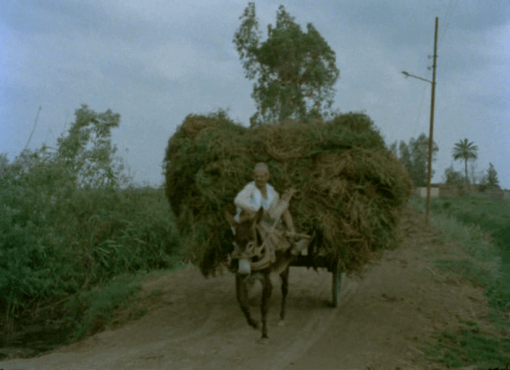
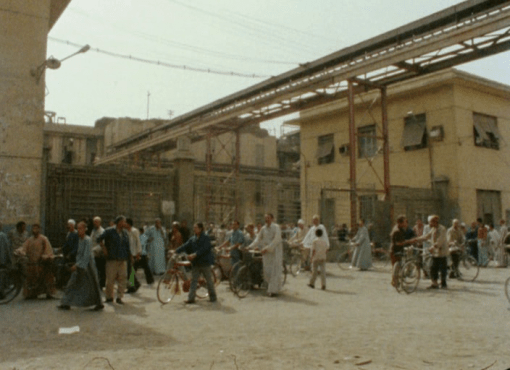
Finally, while the Straubs are looking to capture something of the real present—the winds sweeping Egyptian fields, the gaze of the workers trickling out of a factory—Hawks’ film exudes Hollywood fakery on every level. The dialogue is heavily dubbed, with dilated, accented voices replacing the original. “They sang songs of their faith and of their joy”, tells the voiceover, even as we see thousands of men and women, who may have never been before a film camera, reluctantly march past, barely trying not to stare at it. The irony of an American super-production hiring Egyptians as dispensable extras to build a turgid monument in CinemaScope is, no doubt, lost on the film. But, hey, they got paid.
[The following is a translation of an ‘ad review’ by Serge Daney published in Libération on 13 May 1982 andreprinted in Daney’s Ciné Journal Vol. 1 (1998, Cahiers du cinéma)]
May 1982. There’s always the temptation to put advertisements under the scanner of film criticism.
—
The scene takes place in a shop. There’s the saleswoman and there’s a client. What’s being sold? Rolls of fabric arranged in base cabinets or wrapped over an asexual mannequin placed on an old-fashioned sales counter? It’s not very clear. Everything melts into a fuzzy, pastel-coloured set: mauve, pink, green. The two women are in sober clothing. The saleswoman is modern, glowing, with sparkling eyes: she could feature on a leftist political poster. The client is a posh, snooty, idle bourgeois woman: she’s the kind that starts dancing abruptly in American musicals. At least twenty years separate the women. The shop window overlooks an abstract, scarcely-populated street. A pensive, bearded man passes by. The action begins.
Could I help you? (a revolving tracking shot, straight out of Universal-period Sirk, accompanies the client towards the counter).
I’d like to see that one… show me everything actually (the client is very mobile; she begins a kind of seduction dance in front of the saleswoman, who never leaves the counter).
Each one has its own scent… The pink one: rose; the mauve one (close-up of the saleswoman):lavender; the green one: vetiver, I’d say (adds the client dreamily) … Let me see the mauve one under the light (she goes off screen from right).
2-ply, ma’am! (the saleswoman raises her voice from afar)
And what sizes do they come in? (Wide shot of the shop showing the saleswoman behind the counter, over the shoulder of the client, who is mincing in the foreground)[1].
Just one! (close-up once again). That should easily be enough. (Embarrassed).
Hmm! (pauses). Oh! I really don’t know which one to pick. Couldn’t you give me a sample from each? (The acting here is very good: a sudden cutaway shows the slouched body of the client from a three-quarter back profile, as if this body were saying, “I can’t take it anymore, I give up, I leave it to you” and falling apart dangerously only to pull itself together during the movement that brings the client back, beaming and childlike, towards the counter).
Certainly, with pleasure. (Close-up of the saleswoman who trots out these words with gleaming eyes, stressing on the word “pleasure”).
All this lasts thirty seconds and thirteen shots. The reader must’ve understood what I’m talking about. It’s about a commercial and it’s about pleasure. The object being sold isn’t silk or batik, but elegant rolls of Trèfle brand toilet paper. A final shot, the fourteenth, shows the multicoloured rolls as a voiceover coos: “Trèfle in four scents: a very fine collection”. There are so many reasons to love and analyse this anal, and hardly banal, commercial that I won’t resist the pleasure of listing two or three of them for cine-telephiles.
Selling toilet paper as though it were a collection of rare and priceless fabric is one idea. Imagining a shop that sells just that is a second (rather dreamlike) idea. To have two women play the scene is a third one. “Normal” sanitary ads generally begin with a dreadful observation about filth in order to construct the ideal of a miraculous cleanliness (one recalls the terrible Mr. Clean). It’s the opposite here. It’s because the whole scene is drenched in the cleanliness of a pastel-coloured dream that the evocation of filth assumes its entire weight. And that it’s a confrontation between two women introduces an undeniably perverse dimension.
This small masterpiece of classical shot sequencing could help introduce our film school students to things as serious as the shot and the countershot, the cutaway and the depth of field. It’s the entire tradition of American comedy that comes alive before our eyes, by way of the obvious reference to Jacques Demy. From McCarey to Cukor. The impossibility of showing certain (lowly) things compelled the American filmmakers to invent a very cunning mise en scène. The dirtier the idea, the cleaner their shot sequencing. It’s the same case here.
For this little film on the pleasure of wiping yourself clearly deals with the unspeakable. The RFP (Régie française de publicité [French advertising board]) wasn’t mistaken either. From what I’ve heard, they may have censored the film. A flushing sound was supposed to accompany the shot where the unrolled roll becomes a kind of umbilical cord between the two women. The RFP didn’t want this noise. Nor this desire.
And yet, the voiceover of the fourteenth shot tries pointlessly to make us memorize the expression “Trèfle in four scents”. But the damage has already been done: it’s the penultimate shot, the thirteenth, with the mysterious “Certainly, with pleasure” that remains in memory. At this precise moment, the saleswoman conveys another message, a message that no product can make us forget, something along these lines: I can satisfy your choice, whatever it may be. Your demands will always fall short of what I can offer you. And that is the real message of the commercial, of all commercials.
Footnote:
[1] Translator’s Note: A couple of details in the article are incorrect. Here, for instance, Daney describes the reverse view of what is actually seen in the ad. Two lines later, he ascribes the client’s movements to the saleswoman. I have corrected the text accordingly.







 The Seventh Art