February 2022
Monthly Archive
February 23, 2022
Posted by Just Another Film Buff under
All Posts,
Bollywood,
Review | Tags:
Ananya Pandey,
Ayesha Devitre,
Deepika Padukone,
Dhairya Karwa,
Gehraiyaan,
Naseeruddin Shah,
Shakun Batra,
Siddhant Chaturvedi,
Sumit Roy,
Yash Sahai |
1 Comment

Lips don’t touch when you say Gehraiyaan (“Depths”), the title of Shakun Batra’s third film. But they are always sealed in this story of cheating, subterfuge and long-kept secrets. Deepika Padukone plays Alisha, a yoga instructor living with adman-turned-aspiring-writer Karan (Dhairya Karwa). She is estranged from her father (Naseeruddin Shah), whom she holds responsible for her mother’s suicide. She meets her affluent cousin Tia (Ananya Pandey), who is in town to meet her social climbing fiancé Zain (Siddhant Chaturvedi), a property developer beholden to her money. The four set sail on a yacht to Tia’s swanky beach house outside the city. Tia and Karan are long-time friends, and in their shared feeling of being outsiders, Zain and Alisha fall for each other and begin an affair. Matters are complicated as Karan proposes marriage to Alisha and as Zain gets into financial issues, finding himself increasingly dependent on Tia’s wealth. The narrative proceeds like milk on a low flame.
Besides its plot-level similarities to Match Point (2005) or even Cassandra’s Dream (2007), there is possibly another reason why the film recalls Woody Allen. Gehraiyaan is written like a Greek tragedy in the way it moves ahead with a sense of inevitability. I can think of no event in the film that could been removed without bringing the whole edifice down. Like Oedipus, Alisha thinks she is breaking out of her preordained fate by making choices, but all of it only seems to lead her to the ultimate punishment of forbidden knowledge. (She believes she is unlucky in life, but it is precisely a stroke of luck that saves her from death.) It is, however, not a divine law that she transgresses by her actions. If Woody Allen’s universe is a morally neutral place where goodness is a pose, justice a matter of chance, the world of Gehraiyaan is ruled by a moral law governing the family, which revisits the characters in tautological forms and holds terrible sway over their lives. In the most touching moment of the film, Alisha’s father looks at a pair of bloody scissors that Alisha, her world shattered, has used to try and cut herself with. He grits his teeth and quietly withdraws into his room. It’s that he has seen this before.
Gehraiyaan is about the inheritance of malady, and its tight writing sets up a domino chain of personal choices that wreck other people’s lives: Alisha’s mother’s mistake estranges her husband, whose aloofness upsets Alisha, who, not wanting to end up like her mother, forces the issue with her fiancé. Differently put: Tia’s father’s mistake estranges his wife, whose inability to trust carries over to Tia, who, not wanting to end up like her mother, forces the issue with her fiancé. It is uncanny how Alisha’s self-image, her idea of where she is in life, is poised on her perception of her parents’ relationship — a self-image that could have been completely different had she read the relationship differently. In spite of the social bubble that they live in, the characters of Gehraiyaan are anchored, imprisoned in their personal past. Because of the film’s artful dodging, I was first led to believe that the writers are giving Alisha the same raw deal that they gave Ratna Pathak Shah’s character in Batra’s earlier work Kapoor & Sons (2016), a sense that she is ascribing her misery to her partner’s lack of material progress. Thankfully, this turns out to be not (entirely) true.
Gehraiyaan attests to a marked leap in Shakun Batra’s directorial capabilities, and I get the feeling that he aspires to an invisible style that can adapt itself to different kinds of material. The director’s hand that was a little too palpable in Kapoor & Sons retreats into the background in the new film. There is, to be sure, the Woody Allen-like treatment to bickering characters, with the Steadicam trailing behind actors walking in and out of room. But for the most part, the film displays the anonymous slickness that characterizes the work of several Hollywood auteurs. On the other hand, it is also clear now what kind of situations that get Batra’s juices flowing: sequences turning around withheld information set in partitioned spaces, of which there are multiple in Gehraiyaan. The night-time set-piece on the yacht with Alisha and Zain is superbly directed; despite the literal quality of its lyrics, the score is genuinely ambiguous and Padukone perfectly conveys the drowsy sickliness that hits the stomach following a revelation like that. This scene alone is a calling card to Hollywood.
Another unusual aspect of Gehraiyaan is how much of its story is actually conveyed by actors talking to each other. Where a more traditional filmmaker might have staged the episodes from the characters’ past as flashbacks, Batra has them delivered to us largely in words. So we have Tia telling Zain about Alisha’s father, Alisha telling Zain about Tia’s relation to Karan, Zain telling Alisha of his abusive father, and so on. This disregard for the golden principle of “show, don’t tell” has two effects. It brings the characters closer to one another, and not just the ones talking. But more importantly, it allows the film to remain with just these handful of characters for almost its full runtime. What struck me about Gehraiyaan is how little excursion it makes away from its central figures. We don’t see Tia’s father, her mother only appears in video calls, Alisha’s mother is unseen except in Lynne Ramsay-like flash inserts and Karan’s parents barely register. Scenes are centred, instead, on interactions between any two of the four protagonists (the film is a repository of two-shots). The result of this economy is that the world is whittled down to these figures, the movie turning into a kind of chamber drama scattered across the city.
Which city, though? Gehraiyaan is nominally set in Mumbai, but it is starkly different from the Mumbai we usually see on screen. This was already the case with the de-Coonoored Coonoor of Kapoor & Sons, but it appears that Batra doesn’t even want to use the city for local colour here. The bulk of his new film takes place in private (or privatized) spaces: apartments, holiday homes, upscale restaurants, hotel rooms, yachts, corporate offices. Except for a carefully curated section of the Marine Drive, there are no crowded public spaces, and public transport is limited to taxis at best: no teeming locals, no quaint BEST rides as you’d see in a Mani Ratnam movie. The sight of unwashed masses is kept out of the frame just like intense tints are kept out of the sober, matte colours of the visual palette. The most jarring shot in the film is perhaps the one where we see Zain stop at a corner store carrying a flashy hoarding. Even the Indian tricolour on top of Zain’s yacht seems out of place.
So would an American flag for that matter, for these people don’t seem to belong to any particular place. Gehraiyaan produces the impression that it could have taken place anywhere in the world (and I don’t mean this as a put-down). It seems like a deliberate decision on Batra’s part to de-familiarize the city, to renew its iconography. His solution is to turn it into a kind of Los Angeles outside of Los Angeles. Its title notwithstanding, Gehraiyaan is a film of surfaces, its imagery of Mumbai closer to David Hockney’s LA than anything closer home: pools and skylines, glass and reflection. It is a work that would be at home in Thom Andersen’s Los Angeles Plays Itself (2003).
Despite the cloistered quality of its narrative, despite the characters’ writerly laments that they feel stuck, the feeling I got from Gehraiyaan is a sense of openness. A large part of it has to do with the film’s extremely wide aspect ratio (2.39:1), which is able to fit not only Zain’s rented yacht, but also Padukone’s long legs, which determine the composition in many shots. The skyline, the sea, the beach, the yacht all establish Gehraiyaan as a strongly horizontal film and redouble the sense that it is an LA movie superimposed on Mumbai, like Tia’s accent which, to my ears, straddles Valleyspeak and South Bombay talk.
Given Zain is a property developer, it is understandable that the film has an interest in horizontality. Gehraiyaan may be a middling movie about relationships, but it is a very good movie about real estate. Even within the privileged cocoon of the story, there are finer class stratifications: Tia the rich, Zain the arriviste, middle class Alisha and the bohemian Karan. But more crucially, their relationships are all mediated by private property. “I need some fucking space,” Karan cries out, but it is more than just mental space. He and Alisha live in a tastefully decorated (and tastefully dishevelled) 2-BHK (or 3?), but they are trying to move to a new apartment — a fact that Alisha sheepishly tells Tia when the latter comes slumming. To write his novel, Karan moves into Tia’s beach house in Alibaug, which Tia lets Zain mortgage following business trouble. Zain sets up a studio for Alisha, using it as address for a shell company. Relationships in this film sour because real estate deals sour. No money, no honey. There you have it: Gehraiyaan, Marxist movie.
February 22, 2022
[The following is a translation of Luc Moullet’s short monograph Luis Buñuel (1957), the fifth volume in the series Les Grands Créateurs du Cinéma, published bimonthly by the Club du Livre de Cinéma in Brussels. I’m extremely grateful to Samuel Bréan for finding me a copy of this rare volume.]

Contradiction is the root of all movement and vitality; it is only in so far as something has a contradiction within it that it moves, has an urge and activity.
– Hegel
In our time, in our era of blockbusters and epic films, Luis Buñuel’s work and career stand out. While the vast majority of important filmmakers choose to marry art and commerce, with varying degrees of success, Buñuel confines himself to low-budget ventures, just like Roberto Rossellini. He thus enjoys a great deal of freedom: producers’ interference is limited to the choice of subject, which is generally very banal, and to the development of the script. The filmmaker imposes the expression of a highly distinct personality on such weak material. El río y la muerte (The River and the Death) was completed in fourteen days; technically it is superior to many French films, and in terms of quality, it has nothing to envy most of Buñuel’s great works. Like a novelist, the maker of L’Âge d’Or and El (This Strange Passion) works for his own pleasure; that is why the most mediocre of his offspring, the most industrial of his films, still bear his mark. This is a kind of miracle that cinema is not familiar with.
The Surrealist Experiment
One of the main constants in Buñuel’s work has often been explained using his Spanish origin. I’m referring to his taste for cruelty and violence, which also throw light on the inclinations of his personality. He was born at the dawn of this century, on 22 February 1900, in a small town in Aragon, Calanda, located on the edge of the famous Sierra de Teruel. After spending ten years at a Jesuit school, he left his provincial bourgeois parents for the University of Madrid, where he studied science, particularly neurology: physiological phenomena had always captivated him, as had the life of animals. But the Castilian capital attracted him towards less studious pursuits. He enjoyed idleness and led a merry and dissipated life. This is how he became friends with two of the greatest creators of twentieth-century Spain, Federico García Lorca, the poet, and Salvador Dali, the painter, who were then young unruly students. Buñuel’s films retain some of Lorca’s tragic lyricism and, above all, Dalí’s phantasmagoria.

Un Chien Andalou (1929)
Our young man was soon to be found in Paris, where he worked as a scientific attaché. But he was interested in many other things. Dali, who lived on the banks of the Seine, introduced him to the Surrealist Movement, in which Buñuel discovered an equivalent to his taste for the unusual. Cinema seemed to him to be the best means of expression, one that allows one to show the most amazing aspects of reality. After a first script, written from a surrealist perspective, which he could never shoot for lack of means, he took technical lessons, a trial run for Un Chien Andalou (1928). This small, fifteen-minute silent film made a great impression at the time and is still the biggest hit at film clubs today. The story, written by Dali and Buñuel, doesn’t follow any logical rule; underlying the main plot, a love story, are a series of extraordinary visuals of the purest surrealist tradition: the enormous living room piano stained with the blood of rotting donkeys, to which two seminarians are attached. The virtuosity, the unbridled inventiveness belonged as much to Buñuel as to Dali. And yet the director parted ways with his friend, whom he accused of seeking scandal for the sake of scandal. The next film, L’Âge d’Or (1930), which Buñuel made for a patron, continued the experiments of Un Chien Andalou while respecting factual logic more closely. This time, the scandal was huge: the precision and realism highlighted the filmmaker’s multiple attacks on society and religion, which he said impeded the power of love. Buñuel went from surrealism to documentary with Land Without Bread (1932), a poignant account of the region in Spain called Las Hurdes, one of the most backward and poorest parts of Europe after the Grésivaudan, Slovakia and Haute-Provence. Buñuel went ahead with the same talent, the same critical eye towards modern civilisation, whose most ignoble aspects he unveiled. At first sight, the rigour and honesty of the work contrasted with the fanatic Manichaeism of L’Âge d’Or: but in many beautiful visuals (the donkey devoured by flies, the portrait of idiots), there is that astonishing sensitivity partly inherited from his contact with surrealism.
But the time of patrons and small productions that one could finance oneself was soon over. For fifteen years, Luis Buñuel worked in cinema without making any films. This period of silence was important in its own right: faced with life and its difficulties, the maker of Land Without Bread evolved markedly; with maturity, he moved from revolt to reflection. That is how he was able to resume a body of work that was thought to be prematurely finished: recent films such as Los Olvidados or El are even considered to be of a much higher quality than those of the surrealist period. In charge of dubbing films in Paris, Madrid — where he moved on to production — and Hollywood, a bureaucrat, then a speaker in the United States, Buñuel finally left Los Angeles in 1947 for Mexico City with a very ambitious project in the bag: The House of Bernarda Alba, based on Lorca’s play, which he didn’t finally shoot.
(more…)
February 21, 2022

Director Karthik Subbaraj is movie crazy. Like many Tamil filmmakers, he is drawn to intertextuality, but has a temperament that doesn’t allow it to get out of hand in the way it might in a Venkat Prabhu film. It shouldn’t be surprising then that he has cast actor Vikram and his son Dhruv as father and son going at each other in his new work titled Mahaan. It’s an enticing setup: a sparkling Vikram creates a suitable springboard for Dhruv, whose first two ill-fated films came from the cottage industry of Arjun Reddy remakes; performing bits from his father’s classic films, Dhruv reminds us, even if negatively, that talent isn’t inherited.
Vikram plays Gandhi, a middle-aged professor suffocated by his name and the high-minded ideals of his freedom-fighter father. Following the advice of a Randian mendicant (Ramachandran Durairaj), he decides to live out his desires in the company of bar owner Satya (Bobby Simha) and seedy politician Gnanam (Vettai Muthukumar). This betrayal of Gandhian values outrages his wife Nachi (Simran, in a poorly written role), who walks off from his life with their son Dada (Akshath Das). Nursing resentment at this alcohol-driven dissolution of his family, an older Dada (Dhruv) becomes a teetotalling cop to wipe out his wasteful father’s liquor empire.
Like a number of other screenwriters, Karthik Subbaraj is attracted to character pairs, symmetry, mirroring, reversals of roles. This was already obvious in Jigarthanda (2014), whose clever underlying concept had a filmmaker and a gangster trade places. Mahaan abounds with these structural games, which is indeed what sustain the film. The screenplay is divided into clear halves, with Dhruv Vikram making an appearance at the midpoint — a smart ploy that allows his father to shield him for over an hour and lends the film a new lease of energy.
The first half unfolds like a game of rummy; that is to say, through a series of coincidences and lucky accidents. Having cut loose from his regimented life, Gandhi meets business partners Satya and Gnanam (there is some play around their names which respectively mean “truth” and “knowledge”), who, it turns out, are childhood acquaintances. It is hard to buy that this 40-year-old repressed man can so easily ease into one vice after another, but like a round of cards, that is exactly the hand we are dealt. Vikram is fantastic as Gandhi, and despite such radical distortions his character is subjected to, he gives a sense of a coherent person buried beneath all the gaudy shirts and ridiculous coiffure.
As Gandhi keeps leveling up (down) like a debauched game character, Satya has a religious epiphany that makes him gradually distance himself from Gandhi’s dreams of an empire (ba-dum-tsh). This double transition is conveyed through a montage in which images of Satya becoming a born-again Christian are intercut with Gandhi multiplying his murders: a reversal of the Godfather principle. By the end of the film, the two swap places, with Satya reaping the bitter rewards of Gandhi’s bad company.
The second half, in contrast, is a game of chess, where Gandhi’s perfect hand comes undone by his son’s meticulous scheming. If Gandhi’s journey was that of the id unleashed, Dada’s is the return of the superego. A mirror image of his idealistic grandfather, Dada watches over his father even as a child, ferreting out his petty secrets and telling on him. Gandhi and Dada take turns playing father and son, looking out for each other despite their best judgment. They are both introduced (and later developed) through sequences of stylized violence, Dada’s legal killings somewhat amped up to make us wince. Confusing determination with rigidity, though, Dhruv is less than fantastic; it is hard to make out if he is taking a phone call or getting ready to do crunches.
More pairings and reversals: there are two heroes, two friends, two sons, two wives, two weddings, two separations, two telescoped flashbacks to childhood, two scenes of violence in picturesque landscapes. We are in tic territory when even secondary characters seem to have secondary romances going on. Gandhi loses a son figure in the second half, recalling the way he saved one in the first. With age, he grows his hair long as his wife shortens hers. Dada’s revenge on his father is elaborated like a bloody closure to the traumatic scene of his childhood.
These patterns are alluring, and they give solid form to the film’s argument that people who kill for ideology are as vicious, if not more, as people who kill for money, limited as the latter are by their appetite or conscience. But Karthik Subbaraj contrives his screenplay further for these elements to fall in place. A major set-piece in the second half, set in a police bunker designed like an avant-garde theatre set, finds Gandhi and Dada pointing a gun at each other, a cunning image that the whole sequence (and film) seems to be imagined around. But everything in the set-piece before and after this shot shares none of its zing: Dada is elaborately re-established as a sociopath while Gandhi swings from self-effacing helplessness to super-heroic surety and back.
Mahaan is powered by its transitional bits rather than its big scenes, which invariably fall flat. There are three sequences featuring Gandhi and Satya at various stages of their friendship and life. The second of these is poignant, although perhaps redundant, but the other two are quite trying, especially the final one that is set up to resolve another symmetric dilemma: Dada lives if Satya dies and vice versa. An inexplicable scene between Gandhi and his wife Nachi is shoehorned late into the film in order to satisfy the logic of what is to follow.
On the other hand, Mahaan’s tedious passages are also frequently intertwined with its finer qualities. Gandhi’s first fight scene — and I suspect this is where many viewers will take leave of the film — is set in a scenic location surrounded by mountains. As a heavy tries to kill his son with a hammer, Satya cries out in prayer at a crucifix in the distance. Gandhi stops the hammer just as it is about to go down. It’s a rank Tamil movie cliché, but the way it is shot, with Gandhi’s arm jutting out of the sky as if it were the hand of God, shifts the scene’s focus to Satya’s revelation. Unbelievable though the ensuing fight is, there is something in the combination of the locale, Gandhi’s flashy clothes and the pseudo-single shot filmmaking that holds it all together.
As a director, Karthik Subbaraj can often be weird; not weird enough to be creative like Shankar, just weird enough to stick out. He loves his intercutting: the early scene of escalating hysteria where Nachi walks off on Gandhi is finely separated across two groups of actors. The gratuitous quarter hour at the end is split between three spaces and two timelines — a demanding device for the viewer to process. Another effect of modern Tamil films trying to pack 200-minutes worth of narrative into 150: action and dialogue overlapping; we would see items being exchanged across shots while or before we hear about them, as when Gandhi wears his new glasses before we learn that they’re a birthday gift.
Karthik Subbaraj can ask us to make impossible leaps of faith in following Gandhi’s descent into the dumps, but he can also be overly logical in covering his trail, with countless inserts and exchanges whose sole purpose is to cement story gaps. There are fetish images here, like Gandhi with a Tommy gun, but also purely odd ones like Gandhi discarding a movie ticket in the shower drain or a politician literally jumping in joy after having his visitors thrown out. Now that Jai Bhim (2021) has shown us that décor details could be adjusted weeks after a film’s release, Karthik Subbaraj may even consider adding a few more Gandhi photos or crosses in the background.
February 11, 2022

The first few minutes of Gurvinder Singh’s Adh Chanani Raat (“Crescent Moon”), which premiered at the Harbour section of IFFR, are of such economy and precision that they set up the lead character with great clarity: arriving at a small-town railway station in Punjab, Modan (Jatinder Mauhar) tells a rickshaw puller that he has always paid only 10 rupees — and not 150 as the man demands — for the ride to his village. Deciding to walk instead, he finds himself giving directions to a passing SUV: he delivers it fumblingly, albeit with a feigned authority that makes it evident that we have here a man who thinks he belongs in these parts, but has been long evicted from them by time.
There is a reason why time feels out of joint for him: he is returning after fifteen years of prison time for murder. When Modan arrives home to his aged mother (Dharminder Kaur), the prodigal son takes some time to absorb the situation, to come to terms with the fact that things aren’t the same anymore. The landlords who killed his father have taken over the village, pushing his family to the outskirts. Worse, his own brothers are working with the landlords now and have built a mansion from the new money. Simmering with rage at this double betrayal, Modal wanders the village at night, ending at the local watering hole where, by way of gossip, drunk old men bring us up to speed on the family rivalry.
When good sense returns, Modan decides to build life anew: he breaks with his brothers to reconnect with an old friend Ruldu (Samuel John), a man without an ounce of ill will towards him. Modan begins to work on Ruldu’s sugarcane fields and, with the help of his friend, restores the ancestral the property from which his family was evicted. He reinstates his mother in this house that she had been made to leave six years ago. Soon after, wishing to start a family, Modan marries Sukhi (Mauli Singh), a young widow with a child.
A home, however, can’t be collected and this dream assemblage of Modan’s strains at its seams: uprooted from her other sons, mother feels somewhat restless at this new-old place; she doesn’t exactly get along well with Sukhi and wanders away from home. Sukhi has her own personal baggage that she is not ready to share with new husband. Waking up next to a toddler doesn’t, moreover, seem to be the image of domestic bliss that Modan had imagined for himself. Ruldu’s aggressive neighbours encroach his land, provoking the two friends to fight back. Modan’s younger brother, too, has run-ins with the landlords and comes over to his elder sibling’s side. All through, there is a constant threat that Modan might regress into the past.
Inspired by from Gurdial Singh’s novel of the same name (1996), Adh Chanani Raat is resolutely fixed on Modan, his figure, his world, his violence. Except for an unexpected flashback where we see Modan killing a man in revenge, the landlords he seethes against are barely seen, so much so that they could represent a metaphysical threat; indeed, when Modan creates a ruckus around the landlords’ bungalow towards the film’s end, he looks up at the sky as though he were challenging gods rather than men. But the entities that are on the margins of Modan’s universe offer a more telling commentary, an alternative to its model of retributive masculinity: Ruldu’s reticent young son, the beseeching voice of the landlords’ mother that echoes Modan’s mother, Sukhi’s child who may yet be saved from this cycle of revenge.
Yet this privileging of Modan’s perspective also disadvantages the film in some ways. One the one hand, the narrative intends us to view him as a victim of the landlords’ chicanery and his belligerence as noble resistance to them. But because the antagonists have no presence in the film, this implied injustice doesn’t register as well as it should. I think the script forces the matter further by having Modan spontaneously instigate a violent confrontation whose bloody outcome comes across less like tragic fall than mere machismo that was asking for it: play stupid games, win stupid prizes.
Jatinder Mauhar, six feet tall, plays Modan as a hulking creature ready to combust at any moment. There is little history in his performance, little sense that this man has spent 15 years in a cell, and I think this is what the script expects of him: a character so consumed by revenge that even time hasn’t muffled the indignation. Gurvinder devotes long shots of him just walking, which gives us an inkling of his blind determination, but it is a shot of him uncharacteristically coming home with a bag of groceries that expresses his essential unpreparedness for what he desires.
Like Gurvinder’s previous films, Adh Chanani Raat continues to present a Punjab that the rest of us rarely get to see: people as they are, proud, kind, arrogant, dignified. Shots of Modan sneaking out from his brother’s oversized mansion on a used motorbike, with prayers blaring out from a gurdwara nearby, or the long sequence of him rediscovering his childhood home — made of a slowly panning camera reminiscent of Mani Kaul — give a hint of the work’s lived-in texture.
On the contrary, the film doesn’t clearly establish the geography of its story; the relation between the brother’s mansion (supposedly on the “outskirts”), the ancestral home (in the village? town?), the landlord’s bungalow and Ruldu’s cane fields is never evident, which means Modan’s constant peregrinations between these locations are even more disorienting; this, despite the fact that Ruldu offers Modan a charming tour of the transformations in the village, its growing inequality, its realigned power relations and its material problems.
Lastly, I had the impression that Gurvinder would rather have made Adh Chanani Raat on celluloid, where the camera movements could have been put to better effect. As it is, the film has the look of a ‘90s telefilm shot on analog video, especially the night scenes that appear somewhat diffuse or bleached out. It also takes some shine off the actors’ performances.
February 11, 2022

The star-crossed lovers of Indian cinema may declare that their romance is divine, but it isn’t every day that they actually become the playthings of gods. Seeing the world through each other’s eyes, whispering tender secrets in each other’s ears, retaining one another’s memory, expressing emotion in lofty proclamations — Rahat Mahajan’s debut feature Meghdoot (“The Cloud Messenger”), in competition at the recently concluded IFFR, takes these ideals of Hindi movie love at face value and gives them a weight by encoding them in Indian mythology.
The year is 1995 and the setting is a mixed-gender boarding school nestled in the mountains of Himachal Pradesh. Quiet yet mischievous, Jaivardhan (Ritvik Tyagi) is instantly smitten by new student Tarini (Ahalya Shetty), victim of visions. This adolescent romance is, however, framed by a faux-Orphean legend where yaksha lovers Jaivardhana and Tarini are separated by the jealous, ten-headed king Dashanana — this story told intermittently in a mixed style that draws elements from traditional dance forms of Kerala. As the film progresses, the two strands cross paths, interpenetrate each other to a point that it is not possible to tell the text from subtext anymore.
Life at the convent is presented mostly through caricatured professors seemingly out of Another Brick in the Wall, but these jarring bits soon recede into the background, for Mahajan’s film isn’t all that interested in the banalities of campus life. It is a work at once rooted in a specific milieu and slightly unmoored from it. If it uses the rectilinearity of the school’s colonial architecture to stately effect, its tracking shots and shallow-focus cinematography detach the protagonists from these environs, which become increasingly alien to them.
Meghdoot is not Rockford. While it is patently a coming-of-age tale, the film doesn’t refract this experience through the prism of male sexuality or view it with nostalgic indulgence. None of Jaivardhan or Tarika’s peers are individualized, which means that we are spared a lot of colourful frat talk. The film’s strength instead lies in identifying completely with its young leads, who experience their union literally as a matter of life and death.
The mythical narrative, for its part, is impressively produced, with the performers arranged in precise tableaux vivants in a muralled palace and the story recounted by a Kudiyattam narrator in magnificent Carnatic vocals. However, I found the whole idea chafing in the way it uses Kudiyattam/Theyyam primarily for its spectacular potential rather than for what it is as a form. Now, I know next to nothing about Kudiyattam/Theyyam and I am not a purist; an artist has all the right to pick and choose elements from one form to adapt it to another. But in their use of sound elements external to these forms — hums, dramatic strings — and their repetitive if immersive forward tracking shots, these passages register too much as a forceful upsell of Indian mythology, closer to the assured commodification of music videos than the tentative heterogeneity of artistic experiments. (Mahajan reportedly has a background in visual marketing of Bollywood productions.)
But my bigger reservation was with the film’s construction. Evidently, Meghdoot seeks to provide thematic heft to its central love story by framing it through legend. But the parallels are so closely established, all the symbols so clearly mapped out, that the narrative becomes overdetermined by the myth. Watching the film, I was reminded of Christian Petzold’s Undine (2020), another water-obsessed work that employs an enveloping fable to impart mystery to the clinical relations of a present-day love story.
Mystery, though, is regrettably absent in Meghdoot, where everything is rationalized to a point that the viewer is left with a gradually self-solving puzzle. Instead of the myth infusing everyday life with a sense of the eternal and the inexplicable, the uncanny is made familiar by the literal-minded intercutting. Late into the film, Jaivardhan stares at a photograph made by Tarini. The film ensures that it cuts to the reverse angle and shows what exactly is present in the photo. This kind of instant gratification, I’m afraid, permeates the film, where the viewer is rewarded for practically no work.
It is undeniable that the multi-hyphenate Mahajan thinks cinematically. The assured repetition of compositions and sounds—canteen, dorm, bathroom, stairs, swimming pool, trumpet calls, electrical arcs—the division of dialogue across spaces with actors striking poses as they declaim impossible lines of dialogue, the leisurely pace despite the brisk editing pattern, the composition of points-of-view shots and the sporadic attention to telling documentary detail all point to a filmmaker with a native literacy in the medium.
Meghdoot also reveals an excellent direction of inexperienced actors in demanding roles. Ritvik Tyagi hurtles through the frame in a very physical performance, his rookie earnestness completely convincing. In contrast to her mythical counterpart, Ahalya Shetty’s droopy-eyed Tarini is taller than her partner, a piquant difference that is emphasized in the many mid-shots they stand together in. Her stature and broad shoulders also make it easier to spot her in a group shot, of which there are numerous in the film. The only misstep may be the role of Mr. Sapru (Raj Zutshi), a visiting photography teacher, whose serious tone and deliberate, self-important diction are exacerbated by a slew of didactic, overexplanatory lines.
But these fine qualities make me wish that the film didn’t have to play as safe as it does, to be so ready to please. For a story about the hereafter and the beyond, Meghdoot is unfortunately too much of this world.
[Edit: I learn now that the traditional dance form is in fact Kudiyattam (and not Theyyam, as previously mentioned in the review), with the film borrowing elements of Theyyam for some of the figures. I’ve corrected this in the text.]
February 10, 2022

He doesn’t imitate Amitabh Bachchan, he plays him. So insists Firoz Khan, also known as Junior Amitabh Bachchan, one of the three celebrity impersonators at the centre of Geetika Narang Abbasi’s documentary Urf (A.K.A), currently playing at the International Film Festival Rotterdam (IFFR). Through a series of talking head interviews with Firoz, “Junior Dev Anand” Kishor Bhanusali and “Junior Shah Rukh Khan” Prashant Walde, the film offers us a glimpse into the world of what are known as “tribute artists,” lookalikes who play stars on stage, television and in films. Interwoven with these interviews are vignettes from the production, promotion and release of Amir Salman Shahrukh (2016), a minor movie starring lookalikes of three major Bollywood stars.
By means of relaxed exchanges in domestic settings, Urf examines the outlook of its subjects (and their family) towards their profession. Firoz “Bachchan” Khan emphasizes that physical likeness to a star is only part of the requirement; the bulk of it, he says, involves research, practice and hard work. Indeed, many of the artists we see in the film make up for what they lack in resemblance with a conscientiousness and charm that is impressive. Kishor believes that his mimicry of Dev Anand has a signature of its own that would inspire neophytes more than the star’s persona itself. Prashant is just happy if he could make people laugh, no matter in derision or delight.
Despite this touch of pride, their self-image proves rather conflicted. The three artists we see in the film are united in their desire to break away from being typecast and strike out on their own. All three appear to be on different stages of the same journey: Kishor, the most senior of the trio, has long transitioned into a busy career in light music. The middle-aged Firoz is now a regular on TV shows where he does not have to play Bachchan anymore. Prashant, for his part, seems at a crossroads, still trying to find his voice. The older men regard their earlier fascination with impersonation as youthful indiscretion. In their testimony is a sense that the work of a lookalike comes with an expiry date, that at some point the need to find one’s own identity takes precedence.
Underlying this ambivalence is a change in the nature of stardom and celebrity. In a mixture of wistfulness and self-deception, Kishor and Firoz view themselves as the last of their kind. The latter offers a striking diagnosis of why there are increasingly fewer impersonators in Bombay: it is that there are scarcely any stars with their own styles anymore, absorbed as actors today are into an anonymous naturalist manner. And then, says Firoz, celebrity isn’t as scarce as it used to be. Technological advance, including multiplication of distribution channels, has meant that stars can be seen by fans any time they want, rendering the vicarious thrill of impersonators redundant.
Unusual though its subject is, Urf is a work that comes in the line of documentaries looking at various facets of the lives of impersonators. Premiering in the same IFFR fourteen years ago, The Reinactors (2008) trained its attention on the community of lookalikes and cosplayers dotting the Hollywood Walk of Fame. Just About Famous (2015) normalized the practice, portraying these artists as consummate professionals serving a concrete cultural function. Perhaps the best of these documentaries, Bronx Obama (2014), spirals out from the private life of the president’s lookalike to explore America’s class and racial relations.
If celebrity impersonators in these earlier films were presented as social outcasts hustling to make ends meet, the individual we see in Urf can only be described as solidly middle class. We accompany Kishor on a visit to his spacious new apartment in a high rise, but professional doldrums aside, even Prashant seems financially better off than most of the hopefuls that make up the fringe of the Bombay film industry. At one level, their relative success marks them out as exceptions in a niche if competitive field, but it also reflects a vast demand for lookalikes that persists in spite of the pejorative associations the profession carries.
We see signs of this flourishing secondary market all through Abbasi’s film. The impersonators are featured performers in weddings and corporate events, play body doubles to their stars in commercials and get top billing in parodies and B-grade knockoffs of popular movies. Urf relates this parallel economy to the insatiable thirst for celebrity that Bollywood inspires or, more often than not, manufactures. Ardent fans from all across the country assemble outside Shah Rukh Khan’s home to catch a glimpse of their idol, declaring with a zealot’s faith that “he will come.” Some of this adoration rubs off on his lookalike, Prashant, who is constantly asked for photographs by admirers who wouldn’t stand a chance of getting as close to the original.
These reflections notwithstanding, Abbasi’s film is a modest proposal. Unlike The Reinactors or Bronx Obama, it does not hazard wider socio-political arguments. There is certainly something to be said about the paradox that the work of these impersonators is devalued as being unoriginal by an industry that thrives on formulas and remakes. But Urf is not the place for theoretical considerations. Abbasi’s film instead lets the human-interest stories take centre stage. It does not address the lookalike artists as a community. Its success, on the contrary, lies in individualizing them, in letting them recount their journeys and aspirations without undercutting them. Far from the freaks of primetime television, they come across as decent, reasonable people providing for their families while trying to keep the inner flame alive.
[First published at Firstpost]
February 10, 2022
Posted by Just Another Film Buff under
All Posts,
Cinema of India,
Review | Tags:
Hawk's Muffin,
Jayanarayan Thulasidas,
Ketaki Narayan,
Krishnendu Kalesh,
Mano Jose,
Nina Kurup,
Nithin George,
Prappeda,
Rajesh Madhavan,
Sreekanth Pangapattu |
Leave a Comment

Sci-fi movies often trade in scenarios that are set in a distant future, but which are largely determined by the conditions of the present. It is not just that the worlds imagined by these works are invariably limited by the possibilities of today—quickly rendering them quaint or antique with the passage of time. It is that many of them, by design, seek to clarify the present moment by isolating and exaggerating its most prominent aspects. The health crisis of the past two years has brought out many of the fault lines underpinning modern civilization with blinding clarity, making it easier for artists to extend them in creative speculation.
The current pandemic hovers in the background of Prappeda (“Hawk’s Muffin”), a feverishly active science-fiction feature in Malayalam made by Krishnendu Kalesh, playing now at the International Film Festival Rotterdam (IFFR). We don’t, however, witness any images of the present, which is invoked solely through an on-screen transcript of a conversation between a military pilot, assigned with the dispatch of ‘antidotes’ following a virus outbreak, and his command base. After the drop, the pilot is rewarded a vast stretch of land and instructed to go into hiding “until last man standing.”
What follows is a story set some hundred years after this murky operation. The land, now a dense rubber estate, is occupied by the descendants of the pilot: his grandson (Sreekanth Pangapattu), the senile patriarch of the clan who is also the narrator of the film, the old man’s middle-aged daughter (Nina Kurup) who has stopped speaking after a mysterious encounter in her youth, and granddaughter Ruby (Ketaki Narayan), a sensitive young woman who looks after her mother. The old man has relegated the management of the estate to hired hands Xavier (Jayanarayan Thulasidas, also the film’s producer), a military renegade who keeps outsiders at bay, and Shepherd (Mano Jose), a priest-cum-retainer intended to rein in the unruly Xavier.
This feudal order of things is challenged when a local policeman Thumpan (Nithin George) enters the premise, claiming to be an heir of the pilot and demanding a share in the estate. Roaming the woods, meanwhile, Ruby discovers an alien being that has crash-landed (Rajesh Madhavan). The creature, seemingly out of a movie by Guillermo Del Toro who is thanked in the credits, has an endearing air about him: his extremely frail frame, beady eyes, silly hair and jerky gestures are put to comical use, multiplied by jump cuts and time lapse shots. He performs a dance, gifts Ruby precious stones and takes her to a hidden niche near a majestic waterfall. A fairy tale romance ensues; the alien helps Ruby see the world anew, she takes him in her protection.
As the synopsis suggests, Prappeda unfolds partly like a children’s fable, partly like a political allegory. The film opens with a faux-newsreel about a mythical amphibian that will help the world’s elites in their domination of the planet. The continued influence of this elite is announced by helicopters constantly flying over the estate and by mysterious bots invading the premises following Thumpan’s “contamination.” The inhabitants of the manor, like the residents of M. Night Shyamalan’s The Village (2004), have no contact with the outside world and believe everything that this implied nexus wants them to believe.
The film is saturated with these weighty assertions and mythical notations, but pursuing them may not lead one any further than a set of conspiracy theories. Where Prappeda succeeds is not in the quality of its ideas, but in its constant attempts at formal invention. A cinephile-turned-filmmaker, Krishnendu Kalesh adopts a heterogenous style reflective of the name of his production company: Hybrid Tellers.
He employs a host of narrative modes with roots both in mainstream cinema and art film: musical numbers alternate with naturalist drama, silent cinema pastiches with impressive special effects, melodramatic episodes with abstract passages. Low-key drones are interwoven on the soundtrack with an emphatic, staccato score made of violins and percussions. The taciturn Ruby can speak, but her words are conveyed to us through intertitles and on-screen texts, which share the work of exposition with voiceover and dialogue. There is no sense that the filmmaker perceives a hierarchy between these modes, which co-exist without harming the film’s fundamental tone.
Prappeda has the stylistic brashness that one expects from debut works, and thankfully so. It trots out one power move after another, which succeed more often than not: a remarkable shot of Ruby discovering the fallen alien floods the frame with the blinding white of a parachute; a crack appearing on a wall is cut to an intertitle supplying building instructions; when Ruby and her friend discover photo negatives in the attic, the sequence suddenly atomizes into a series of photograms; a text on screen identifies a popular song playing on the soundtrack.
Besides Del Toro, the credits also thank Georges Méliès, Andrei Tarkovsky and Hayao Miyazaki all of whose influences are tangible here. There are repeated invocations of silent cinema, in particular, in the use of intertitles, sped-up footage and changing aspect ratios. Ruby observes a fight between two men, scored to slapstick music, through a Nickelodeon-like opening in the wall, as a projector hums on the soundtrack. This combination of dystopia and film history, seen recently in Norbert Pfaffenbichler’s 2551.01 (2021), imparts an unusual texture to the film, even when the two are not always perfectly integrated.
The production design, likewise, mixes markers of different eras such that we are never sure what time period we are in. The archaic rubs shoulders with the futuristic in Prappeda: candles and sewing machines find a place alongside electronic gadgets and modern weaponry. The sylvan setting, the earthen colour palette of browns and greens, the expressionist wall design incorporating creepers suggest a distant past, while CGI robots, war machines and synthetic noises hint at a far future. This lack of specificity, it must be added, plays to the film’s advantage.
Prappeda does not seek emotional involvement from the viewer as much as a visceral response. This is, after all, a film where the narrator vanishes midway in a blink-and-you-miss moment of stupidity. The meek and caring Ruby is offered as a provisional point of identification, only for this connection to be severed after a tragic event. The story is shrouded in mystery, and an explanatory montage towards the end only complicates the affair. What Prappeda instead provides is the pleasure of fabrication, a vision born of an adolescent daydream. Chances are slim that you will see a shot of a woman delivering a baby as she is parasailing over the clouds in another film any time soon.
[First published at News9]
February 9, 2022
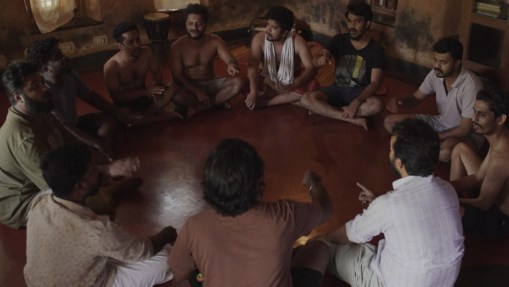
An auditorium is filmed in perfect symmetry from behind a fence as the sun rises over the building. A few men unload musical instruments from a van, parked slightly off-centre such that it tastefully disturbs the shot’s symmetry. The vehicle exits the frame a while later, revealing a dozen individuals at the gate of the imposing structure. The group, we will learn, is a theatre company invited to put up a play at the annual function of a residential association somewhere in small-town Kerala. They have arrived rather early to the venue; they believe they need the time for practice and preparation.
The troupe, called Little Earth School of Theatre, is the subject of Chavittu (“Stomp”), an outstanding new film by Sajas and Shinos Rahman that premieres at the International Film Festival Rotterdam (IFFR) this week. The Rahman brothers’ third feature is a boundary-bending formalist work that, for the most part, showcases the troupe’s preparations for their upcoming performance. Shot by Mukesh Muraleedharan (Uyare, Varane Avashyamund), Chavittu is dominated by a static, wide-shot aesthetic that loosens up as the film progresses.
We see the company’s rehearsal in considerable detail, their work on gesture, movement, voice and cadence. The nature of play they are putting up, on the other hand, remains sketchy and elusive. We gather that it has to do with money, coins specifically, and there is talk of revolution. There are dramatic confrontations and belligerent assertions. A hint of political lampooning is tangible, as are public service messages. But the directors are careful not to distract us with too much literary material. What we are left with are pieces of a puzzle whose final form is never clear.
Attention is devoted, instead, to the formal elements of the performance. The dance, seemingly a traditional form, involves stomping energetically to oral music made of emphatic scatting. Clenched fists, stern looks and occasional pirouettes feature saliently, while oversized coins, backless chairs, empty frames and long pipes serve as props. The musical sections are interspersed with equally physical narrative bits. The actors’ gestures here are very stylized, perhaps conforming to the form’s conventions. There is some improvisation, but directorial intervention mostly pertains to where a new song should begin or an old one should end. What is patent is that a performer in this company needs to have a supreme sense of rhythm.
These extended passages of theatrical rehearsal are periodically intercut with the auditorium being readied for the evening: props, accessories and backdrops being designed, chairs laid out, food arranged. In a surrealist touch that is at odds with the obsessive materialism of the rest of the film, we see these preparations “spill over” into the surrounding rural scenery: men wandering the landscape seated on each other’s shoulders, playing shadow volleyball, or performing short mime-like actions for the camera.
Much of the critical conversation around Chavittu is bound to revolve around what it doesn’t do. It is plain that the film avoids the temptations of dramatic development; there is hardly any story here to speak of in the first place. But what truly sets it apart is its refusal to offer any sense of interiority to the people we see on screen, who are not as much characters as much as presences. There is no evocation of their state of mind, no references to their private lives. We barely hear their names. These are not individuals that we are dealing with, but a body of consummate professionals.
It is likely that this omission of the troupe’s emotional life, this lack of individuation will be held against the film, but it is precisely what makes it so modern, so bracing. Chavittu is a procedural work intently focused on the physicality of its subjects, who are filmed in various states of undress, in a mixture of mid- and long shots, natural and artificial light. Unlike in a conventional documentary, this scrupulous attention to detail isn’t complemented with interviews or explanatory voiceover.
The sensuality that the film radiates comes not through dramatic or formal devices, but from the raw presence of young, athletic bodies populating the frame. For a bulk of its runtime, Chavittu showcases bare-chested men wearing shorts or lungis working together in close proximity, immersed in performance, not unlike the half-naked legionnaires in Claire Denis’ Beau Travail (1996). But in light of the codes of South Indian masculinity, this exhibition doesn’t scan as homoerotic sublimation or suggest the possibility of gay panic. In fact, despite the cohesion that occurs over song and dance, the company hardly feels like a community. What we have here is a group which is bound by nothing else than the activity they undertake together.
The first attempts at discursivity, at accommodating an expositional framework, occurs about an hour into the film, after the sun sets and the annual day function begins. Prominent members of the residents’ association and dignitaries from the town deliver back-scratching opening addresses to a family audience. One elderly executive of the organizing committee rails against the death of Malayalam cinema and literature. Shortly afterwards, achievers of the community are recognized: a local Youtube star, a Facebook poet, an entrance exam hopeful. These felicitations are followed by a series of amateur performances by residents— Thiruvathirakali, a Carnatic kriti, an English number—which take precedence over the troupe’s play, scheduled after dinner.
We are clearly in the presence of a self-indulgent middle class—an anthropological group with a separate set of gestures and rituals, as the film demonstrates—that has lofty ideas about its own role as protectors of culture, even as it preserves a hierarchical notion of the arts. But it is to the Chavittu’s success that this bit of satire doesn’t come across as mean or blunt as it sounds on paper. Even the character of an ex-secretary of the association, a vain old man serving as intrusive coming relief, acquires a touch of grace by the end of the film.
Chavittu avoids devolving into caricature here thanks to the directors’ decision to cut between these amateur shows and the members of the theatre company waiting for their turn backstage. These actors don’t provide any reaction to the performances on stage, refusing us the convenience of second-hand judgment. They are instead absorbed in last minute preparations, refining moves or working over props. For the only time in the film, they are seen in isolation, as individuals getting into particular roles. One actor shaves his feet, another one dresses up as a woman, making us aware of a gendered distribution of roles for the first time.
This contrast between a committed theatre troupe working with focus and discipline and the family audience at the annual day function that just wants to have fun has definite parallels with the filmmaking process. It is notable that, except for the director and the screenwriter, there are no clear division of roles within the company. There is certainly no sense of hierarchy, no rank pulling, that prevents the members from lending a hand in other preparatory tasks. In this regard, it is apt that Chavittu ends on the audience, on us, with an image that embodies a mix of melancholy and hope.
[First published at News9]
 The Seventh Art