January 2023
Monthly Archive
January 31, 2023

[First part: A Letter to Lijo Jose Pellissery]
A second viewing of Lijo Jose Pellissery’s Nanpakal Nerathu Mayakkam confirms it as one of the highest achievements in Indian filmmaking and among the great spiritual works of the cinema. More than a film that respects its audience, it is one that intimates us of the mysteries beyond the everyday. I still cannot wrap my head around its existence and believe/hope that its innermost secrets will continue to elude me.
Nanpakal is certainly an exploration of religious hypocrisy, but not with the derision and anger that it usually goes with. In my first viewing, I was moved to think of Luis Buñuel because of the peripatetic nature of the story, the absurd humour and the focus on group dynamic. But a more pertinent point of reference is the cinema of Roberto Rossellini, in which “there’s but one step from scandal to miracle” (Alain Bergala).
Set ostensibly around the month of Margazhi/Christmas time, Nanpakal is playing with both Hindu and Christian mythology, specifically the notions of reincarnation and resurrection, complete with a “noli me tangere” moment. James-as-Sundaram is a revenant whose return only occasions disbelief and suspicion among the devout. (The soundtrack plays “Paartha Nyabagam Illayo” from Puthiya Paravai (1964), another tale of a revenant.) Like Rossellini’s The Miracle (1948), in which a simple shepherdess takes a passing vagabond for St. Joseph and becomes pregnant, inviting the ridicule of her upright Catholic community, Nanpakal reflects on the impossibility of true belief. Or rather, on the tragedy that miracles can appear only in the form of heresy or delusion.
Part of why it may be hard to see that a miracle does indeed occur in Nanpakal is that the film doesn’t signal its shift into a meta-fictional mode as openly as, say, Certified Copy (2010) or Fauna (2020). We are introduced to James in the first act of the film as a control freak, and his transformation into Sundaram, a man who is capable of letting go, is not supported by rational explanation. And cinematic structures don’t allow for viewer identification over such radical discontinuities of consciousness (which is the reason films about multiverses like Everything Everywhere All at Once (2022) cannot transcend fundamental emotional limitations). As a result, it is not James, but his unchanging co-passengers who offer us a stable if sceptical guiding perspective through the remainder of the film. (I wonder how the film would have played had James and Sundaram been portrayed by two different actors.)
Yet I think a more rewarding if demanding way to watch Nanpakal is remain with James/Sundaram, to believe. That is the only way to get a sense of the Christ-like tragedy he is put through. What does it mean for James to walk away from his wife Sally (Ramya Suvi) and enter the bedroom of another woman, to be placed in a situation of infidelity? A chastening punishment? Purification through sin? To be turned into everything you hate sounds less like a miracle than a curse, but it is also a calling, a Damascene conversion through unlikely grace.
But there is another marital triangle in Nanpakal. We are told that the original Sundaram, whom we glimpse out of focus at the end of the film, disappeared in the holy town of Pazhani two years ago, creating a breach in the fabric of his community. In James-Sundaram’s familiarity with the place and its people, we see how closely the man was integrated into the life of the village. It is hinted vaguely that Sundaram’s wife Poovally (an excellent Ramya Pandian) has now been ‘promised’ to his brother (Namo Narayana) and that she is/was suspected of infidelity—an accusation refuted by the faithful dog that guards her and the household. Even though she speaks little, Poovally gets the most moving moments of the film. In Sundaram’s magical reappearance lies both a hope and a vindication for her, a closure for a grieving community.
Sundaram’s visually-impaired mother is the only one who has the power of recognizing the miracle, of believing in Sundaram’s return; rather, she seems to have never had a doubt. She serves as the film’s Greek chorus, laughing when others are distressed, crying when others are relieved. If her privileged perspective mimics that of the impossible, ideal viewer of the film, Poovally and Sally offer more intriguing, transitional points of view, between mother’s iron-clad faith and the disbelieving crowd, receptive to doubt and amenable to revision. Suspended in confusion, they accept their altered circumstances wordlessly, letting those around them decide the course of action on their behalf.
It is however through the patience and willing passivity of the two women that the miracle is consummated, that everyone manages to find a way out of their situation. Little happens, in contrast, when men take things into their own hands. The pilgrims and villagers eventually get out of the crisis just as they got into it, that is to say, through the arbitrary workings of transcendent will. “The Rossellinian character is touched by grace when he is least expecting it,” notes Bergala. “The real miracle for Rossellini,” he continues “is that which happens necessarily outside of deliberate choice, conscious thought and even faith.” This is true of Nanpakal too.
Unlike Jallikattu (2019) and Churuli (2021), the two earlier works that Pellissery developed with writer S. Hareesh, Nanpakal is sparse on dramatic incident, which means that there are fewer literary themes and moral lessons to be drawn. Instead, the film harks back persistently to cinematic spectatorship even as it draws on painterly and theatrical traditions. Nanpakal is the cinephile movie par excellence, and watching it as an irate viewer sandwiched between noisy, distracted people, as I did the second time, was an uncanny experience. Rejecting his real community (which happens to be that of theatre), James yearns to belong to another that won’t have him. And what is cinephilia if not the illicit thrill of being in places, seeing and listening to things that weren’t intended for you?
I don’t think any other film has ever quite captured the violently destabilizing feeling of stepping out of the dark of the movie theatre as Nanpakal does in its final moments, when Sundaram dissociates from his role to become James again and the entire pilgrim group trickles out of the village in ruminative silence like a stunned audience. The penultimate shot where James is alone in the bus, solemnly looking out to the village—and at us—so startlingly captures (and in Nanpakal’s case foreshadows) the experience of a perceptive spectator returning home after a particularly overwhelming viewing experience.
I did not have trouble with the film’s pervasive audio citation the second time around, and I think the film’s soundtrack is beautifully mixed in the way it drifts in and out of our conscious attention. All the syrupy scores, the cynical soundbites from M.R. Radha and the advertisements of the 90s combine to hold us in a state of fugue, and Nanpakal deploys them for sudden swings in mood, tone and texture. At several points, Pellissery’s film flits wildly from sad to funny, from absurd to touching, accessing emotional terrains I have rarely experienced in Indian cinema. A supremely spiritual work will stand the test of time.
January 25, 2023

Dear Lijo,
Like many other viewers, I’ve been an admirer of your tendency to make a film against the grain of the previous one; the way you swapped the fevered cutting of Angamaly Diaries with the long-shot aesthetic of Ee.Ma.Yau, whose scathing social portraiture devolved into the harrowing metaphysical nightmare of Jallikattu, sustained and upended by Churuli. The word I’m thinking of is perversity, that bent of mind which allows you to employ a macho, vein-popping style to meditate on masculinity, to use the event of death to reflect on a community’s self-sustaining reactions to death.
I should’ve therefore already expected a curveball walking into Nanpakal Nerathu Mayakkam, especially given its ‘U’ certification; but nothing prepared me to be blown down by the tenderness of your new film. I’m not sure how to describe the anti-climactic gut punch that watching Nanpakal was. It was perhaps like the muscular reflex you feel when you try to pick up a bottle full of water and discover that it is empty and light, or when you expect a step at the end of a steep staircase only to have your foot land on level surface.
Your story, developed into a scenario by S. Hareesh, is comically simple: on their way back from the Velankanni church in Tamil Nadu, a group of Malayali pilgrims fall asleep on the bus. When he wakes up, James (Mammootty) gets off the bus in the middle of nowhere, walks into a house in a Tamil village nearby, and fully assumes the assumes the role of Sundaram, a man long gone. The dark comedy that ensues involves the pilgrim party’s bumbling attempts at getting James/Sundaram back onto the bus.
Your film revolves around a miracle, but it’s equally miraculous that it exists: a Malayalam movie that develops mostly in Tamil. Or is it a Tamil movie that features Malayalam actors and dialogue? Doesn’t matter, you don’t seem to have patience for language chauvinism and if Nanpakal has anything to say on the matter, it may be that Malayalis are wannabe Tamils or that Tamils are hallucinating Malayalis stuck in time.
And the height of perversity is to win the cooperation of a star the stature of Mammootty and strip him of all aura, dissolve him into the image. I’m referring not just to Mammootty’s brutally casual entry in profile, rubbing pain balm on his wife’s knee (!), or his utterly unremarkable costume and hair. I’m talking about the way you lock him into the master shot, refuse to give him close-ups, minimize him with landscape and architecture, block his body with décor elements, drown his voice in ambient music, film him from the back, at a distance, among the crowd or in the shadows. Half of Nanpakal is, after all, about Mammootty vanishing, leaving the frame.
I would call Mammootty daring, broadminded for choosing to do your film, but that would not do justice to the statistical improbability of what you two have pulled off. Stars participating in auteur projects are rare enough, but I’m hard put to recall a film that has treated its main star so offhandedly or subject him to such aesthetic violence (Even internationally, such glorious cross-connections of the seventies as Jane Fonda in Godard’s Tout Va Bien or Jack Nicholson in Antonioni’s The Passenger seem impossible to imagine today.) Not only have you made real what sounds like an implausible concept project, but also answered such pointless cinephile hypotheticals as “How would Mammootty do a Sivaji Ganesan movie?”
Yet what you offer us is an extremely modern work that benefits from an extremely modern performance. Like Mohan Lal in Drishyam, Mammootty here plays a middle-aged man who wills his way into a starring role as an act of existential negation, an attempt at escape from his life through performance—a metatextual resonance that would have been lost had your film featured a lesser star. You place Mammootty in an overwhelmingly melodramatic soundscape, contrasting the actor’s underplaying with the expressionist acting the music suggests, distancing us from his emotions only to have him wallop us in a climactic moment of dissociation from his role.
But there’s so much more happening on the formal level. Unlike your previous films, you narrate Nanpakal largely through master shots, filmed with a static camera, without building scenes through tighter setups and thus keeping the emotional temperature of your film in control. (A pair of cavorting canines get a pan shot that your star doesn’t.) A strong rectilinearity marks both your visual composition and the way you position your actors in the frame and have them move across it. Your arresting manner of composing in deep space, using all the picture planes, means that there is always something interestingly off-key happening in the foreground or the background for us to linger on: a seasoned parotta master at work, a foreboding lorry at the back, elderly ladies laughing at a private joke or an amorous couple bickering over a mysterious object.
I’m familiar with your serialized style, where actors engage in similar actions one after the other or do one action incrementally, such as when Muthu, Sundaram’s teenage daughter, changes clothes amid bursts of temper (what a magnificent sequence!). But never have I ever seen so much dramatic negative space or so much action thrust offscreen in a star-led film. It is one thing to construct your film symmetrically, or have visual parallels as between a lateral shot of a bus cutting through a corn field and an overhead view of milk washing down the drain. But it is something else when the movie suspends the story to have the star wander across a picturesque village for minutes on end or slip into his afternoon reverie in a montage of loosely related, densely scored, out-of-focus shots. (Nasir did it too, but it didn’t have Mammootty.)
Most of all, I was struck by your insistence on the Z-axis of the image. From the first to the last shot of the film, you have actors and objects relentlessly heading straight towards the camera or away from it. This frontal composition of movement strikes me as deliciously quaint—like echoes from silent comedy calling out to be bookended by irises—in the way they eliminate dramatic diagonals from your film almost completely. (The few shots that are composed along the diagonal are as ravishing as any in Adoor Gopalakrishnan’s work.)
I want to ask you if this emphasis on the Z-axis has a religious dimension, but it certainly serves here to heighten the theatricality of your film. Theatre is, of course, the central theme of your work, which elegantly introduces its three acts with three sequences of collective slumber. The world is indeed a stage, but Nanpakal’s reflexivity became most evident to me in the big scene where Mammootty finally gets to chew scenery. As he continuously asks the villagers if he truly doesn’t belong there, as though finding himself in an old Tamil potboiler, the villagers gather around and in front of him in silence that recalls both street theatre and old-timey film staging.
Redoubling the theatricality is your film’s unremitting sound design, which is filled wall-to-wall with song and dialogue excerpts from classical Tamil cinema, rendering Nanpakal almost a found-footage work in terms of audio. I wish to felicitate you especially on this aspect. Your voracious sampling of archival sound is a testament to the Malayali love for Tamil music, but it also goes directly against the nostalgic button-pushing that so much of Tamil cinema intertextuality has become. Pointedly, your audio largely consists of works from before your growing-up years, sound bites that are not always easy to recall. Instead of finding common ground with the viewers through shared cultural consumption, you seem to be confronting us with an uncanny soundscape that is neither ear candy nor entirely alien.
I confess that I was exhausted by the sound palette at a few places, and there were moments where it embraces the prevalent Tamil cinema practice of ironic commentary. But for the most part, it offers us a total, inescapable sound atmosphere that the characters inhabit, to which they mime or against which they act. A good deal of the sound samples, I will add, is appropriately maudlin, melodramatic. But given you open the film with images of faith at the Velankanni church mixed with shots of religious knickknacks sold around the premise, it seems that kitsch for you is inextricable from belief.
Belief seems to be an important aspect of your work, but not so much, it seems to me, of your personal life. If I were to guess based on your films, you probably aren’t very religious, notwithstanding the Biblical imagery you mobilize. I would’ve invoked Luis Buñuel, but your attitude to religion seems much too ambivalent for radical subversion. I find it interesting, even so, that in Nanpakal you place a group of pilgrims in a situation that obliges them to disbelieve, suspend their faith. The only character who is able to believe without doubt is Sundaram’s blind mother, a TV addict living in the world of sounds. (Talk about perversity! John 20:29.)
To be fascinated by belief without believing oneself is the plight of many a modern artist. And I can’t help but feel that your film gives a certain form to this tension. Without belabouring the point, you offer us a “movie-movie” that creates a space where disbelief can morph into belief (and vice versa); it is telling that the agnostic James turns devout when he becomes Sundaram. This permeability feels crucial to your film; unfolding between dream and waking life, along state borders, it deals with liminal faiths, liminal languages, liminal mind-states and liminal places. Likewise, the time period of the film isn’t very clear, the sound bites spanning fifty years, and this sedimentation of timelines hints at the time machines that movies are.
Seeing may not be believing in Nanpakal, but it is in cinema. Just as the Velankanni church attracts common people of all religious persuasions, movies reflect our indomitable need for transcendent belief, allowing us to lower our rational incredulousness and accept the bizarre, the far-fetched and the inconceivable. In offering the possibility of belief, of return to innocence, cinema trumps reality.
I have a personal reason to thank you for your tremendous film. The last several movies I had seen in the theatres—widely acclaimed projects to boot—had been uniformly uninspiring, whereas I found myself liking those I saw on streaming. I had begun to think that the theatrical medium was somehow affecting my capacity to enjoy films. But Nanpakal has shown me that the fault was indeed in the stars and not in myself. At a time when movies are determined to bludgeon us into submission, your film sharpens our sensibilities. All of Nanpakal’s choices, the theatrical space of action, the frontality and the rectilinearity of composition, the self-reflexivity of the story send our gaze back at us, asking us to consider our spectatorship as we are watching your film. It is a work that invites a conversation, one that takes little and gives back much more.
Your film comes a week after Tamil filmmakers organized a meet to congratulate themselves for their radicalism, to marvel at default setting. Nanpakal will not make a fraction of the money their films make—heck, it will likely be out of theatres this Friday—but in a single stroke, it makes all their pontifications sound like empty hand-wringing.
So thank you, really.
Just Another Film Buff
PS: Your film, I hear, is titled Like an Afternoon Dream in English, but given its theme, might it be more fitting to call it Matinee Madness?
[Read Part 2 here]
January 1, 2023
Posted by Just Another Film Buff under
All Posts,
Cinema of Australia,
Cinema of Austria,
Cinema of Canada,
Cinema of China,
Cinema of France,
Cinema of Germany,
Cinema of India,
Cinema of Iran,
Cinema of Russia,
Cinema of Switzerland,
Cinema of the USA,
Lists | Tags:
A German Party,
Alexander Markov,
Chavittu,
Crimes of the Future,
David Cronenberg,
David Easteal,
Footnote,
Jan Baumgartner,
Maryam Tafakory,
Matter Out of Place,
Maxime Martinot,
Nazarbazi,
Nikolaus Geyrhalter,
Olho Animal,
Red Africa,
Sajas Rahman,
Shinos Rahman,
Simon Brückner,
Stomp,
The DNA of Dignity,
The Plains,
Zhengfan Yang |
[6] Comments

2022 witnessed the demise of several towering figures of cinematic modernism, none more iconic than Jean-Luc Godard. With their passing, it really feels like the end of a chapter in the story of film, one in which cinema was the privileged artform to interrogate history and the world. But their death also registers as strangely liberating in a way, like a clearing in the woods produced by fallen trees that allows us a new, privileged view. Let us hope that the work of these giants will continue to guide filmmakers and critics in their thought and practice.
In August this year, I was lucky to attend the 75th Locarno Film Festival, my first fest outside India. Basking in the gorgeous summertime scenery of Ticino and soaking up the equally sumptuous Douglas Sirk retrospective was an experience to remember, but I’m most grateful for the chance to get to know some terrific people from around the globe, among them cinephiles, curators and critics I’d known online for years but had never met. I’m truly grateful for their insight and company. Mistake: not reaching out to Luc Moullet when I was in Paris after the festival.
In a year that saw the world return to some semblance of normalcy,[citation needed] my own moviegoing habits seemed to have changed for good. The Locarno festival notwithstanding, I went to the theatres, I think, no more than four times this year (Vikram, Ponniyin Selvan: I, Kantara (all 2022) and the 50th anniversary re-release of The Godfather (1972)), which is four more than the last year. Ominous signs. That said, I was fortunate to watch three silent films on 35mm with mesmerizing live piano accompaniment at a King Vidor retrospective at the Jérôme Seydoux-Pathé Foundation in Paris in September: The Sky Pilot (1921), Wine of Youth (1924) and The Crowd (1928), the latter screening a highlight of my cinephile life.
Although I saw more films this year than any other in my memory, I didn’t watch as many new productions as I normally would, especially from India. Despite the absurd overvaluation it has been subject to in the West, I haven’t see a finer action movie in the recent past than RRR, which felt like a masterclass on how to imbue action with emotional-moral stakes, the missing soul of so many contemporary blockbusters. For all its saturated spectacle, RRR is a minimal film in the way it weaves the fewest of narrative elements in different combinations to emphatic, expressive ends. Gehraaiyaan was a compelling piece of slick, professional filmmaking, as was Jalsa. I’ve always admired the streak of self-sabotage in the career of Gautam Menon, and his superb gangster epic Vendhu Thanindhathu Kaadu harnesses that impulse productively, channelling it through screenwriter Jeyamohan’s touching, tragic vision.
A good part of my viewing this year consisted of a dive into Iranian cinema, which, I can say for certain now, is my single favourite national cinema. Among the 200-odd auteur and genre films (from native as well as expatriate Iranian directors) that I watched, there was very little that I disliked, scores of great works and at least two dozen masterpieces. I hope to publish a list soon. In the meantime, check out Another Screen‘s formidable programme dedicated to Iranian/Iranian-origin women filmmakers, which ends on the 4th of January.
Other personal discoveries this year were the films of Costa-Gavras (Picks: Family Business (1986) and Music Box (1989)), the mid-tier features of Boris Barnet (on whose Lyana (1955) I wrote a text for the amazing Outskirts magazine) and the astounding, hyper-caffeinated anime of Masaaki Yuasa (essay coming up). Without further ado, my favourite films of 2022:
1. Matter Out of Place (Nikolaus Geyrhalter, Austria)
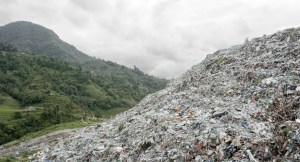 If researchers a few hundred years from now were to try and understand how humankind lived in the year 2022 AD, they would do well to turn to Geyrhalter’s spellbinding Matter Out of Place, an expansive survey of foreign objects littering the remotest nooks of the earth. Filmed in a dozen locations on different continents, the film traces the planetary movement of human-generated waste, the great paradoxes shaping its production and the massive efforts needed to manage its proliferation. Garbage doesn’t just cover the landscape in Geyrhalter’s film, it becomes the landscape. With cheeky visual rhymes, astute sound design, proto-Lubitschian humour and a subtly psychoanalytic approach to the physical world, Matter unearths the repressed material unconscious underlying the enticements of consumer society and international tourism. But the film offers no easy answers, presenting instead a universe whose horrors and beauties are inextricably linked, one which evokes awe and terror at humanity’s godlike capacity to create and destroy. In its firm belief that the secrets of the world reveal themselves to the questioning camera eye, Geyrhalter’s work possesses a spiritual dimension directly sdescending from the writings of André Bazin, and his new film elevates the sight of rubbish into a religious epiphany.
2. Crimes of the Future (David Cronenberg, Canada)
 Somewhere in the dematerialized wastelands of Cosmopolis (2012), overrun now by the vacuous celebrity culture of Maps to the Stars (2014), lives Saul Tenser, an “artist of the inner landscape” who grows new organs that are surgically removed by his partner Caprice during their feted public performances. Saul is a conservative in denial of the rapid transformation the human body is undergoing—a Clint Eastwood of the New Flesh—who would rather excise his new organs than embrace his true, deviant self. As governments and corporates look to quell the insurrection triggered by a cult of anti-Luddite ecoterrorists who sabotage not technology but the human body, Saul must decide whether to remain at the mercy of the algorithms or take the evolutionary leap. The most rewarding way to approach Cronenberg’s stellar, career-capping new work is to take it not as an allegory of current political debates, but literally. In Crimes of the Future, the body is indeed the final frontier, the last repository of all meaning, the sole means to spiritual edification or revolutionary change—a truism already in our Age of the Body. Filled wall-to-wall with dad jokes and dumb exposition, Cronenberg’s silly, sublime, supremely stylish treatise on corporeal capitalism is the most thought-provoking film since Pain and Gain (2013).
3. A German Party (Simon Brückner, Germany)
 Politics is dirty, and electoral politics doubly so. Few filmmakers possess the curiosity, intellectual mettle and good faith—leave alone the necessary access—to examine the unglamorous negotiations and compromises that are fundamental to the democratic process. Made over three years, Simon Brückner’s magnificent fly-on-the-wall documentary about the workings of the far-right German outfit Alternative für Deutschland (AfD) immerses us into the party’s operations, ranging from cool deliberations of executive meetings to high-temperature grassroots confrontations. The result is a markedly composite picture that offers a sense of the heterogeneity of an organization popularly considered an ideological monolith. Over six illuminating chapters, A German Party presents a political body fully caught up in the dialectical process of self-definition, an organization trying to identify itself through differentiation. The need for the AfD to go mainstream, to form alliances and influence policy runs up against the image that it has built for itself, namely that it represents a force outside the establishment. The most intriguing suggestion of Brückner’s film may be that rightward shift of the party, far from signalling the formation of a coherent ideology, may actually be the fruit of a lack of clear identity. Whether the AfD is the elephant in the room or a paper tiger, A German Party leaves it to the viewer to judge.
4. Stomp (Sajas & Shinos Rahman, India)
 The Rahman brothers’ boundary-smashing formalist work is nominally a documentary about a theatre group named the Little Earth School of Theatre. For the most part, the film showcases the troupe’s preparations for an upcoming performance at the annual function of a middle-class housing association in Kerala. We see the company’s rehearsal in considerable detail, their work on gesture, movement, voice and cadence, but the nature of their play is sketchy and elusive, like pieces of a puzzle that never fit. Rejecting literary and psychological explanations, Chavittu subverts the conventional artist profile, supplying no commentary on the meaning or significance of the rehearsal and complicating it with absurd interludes. What the filmmakers offer instead is a bracing procedural work intently focused on the physicality of its subjects, emptied of emotional life and operating together as a consummate professional unit. The sensuality that the film radiates comes not through dramatic or formal devices, but from the raw presence of young, athletic bodies populating the frame. Even when it places this performance within a satirical, self-reflexive social context, the film remains gentle, focused on the troupe’s single-minded artistry in the face of indifference and marginalization. Chavittu is all grace.
5. Nazarbazi (Maryam Tafakory, Iran-UK)
 The problem with film censorship, as Judith Williamson pointed out, isn’t that it rids movies of objectionable matter, but that it makes everything else seem dirty. Drawing images and sounds from almost a hundred Iranian films made since the 1979 revolution, overlaying them with evocative fragments of citations and original text, Maryam Tafakory’s ambitious, enrapturing video collage Nazarbazi illuminates how the Islamic regime’s censorship codes, specifically its restriction on showing men and women touching each other on screen, displaced this repressed sexuality onto other sensations, objects and aesthetic elements. An astonishing example of film criticism as an artwork in itself, Tafakory’s exhilarating, tactile montage locates the erotics of cinematic art in fluttering fabric, clinking bangles, slashed wrists, breaking glass, aromatic food, sweeping camera movements and, of course, the play of glances. Supressed desire finds a way to manifest not just in filmmakers’ cunning paraphrase of taboo actions, but simply in the ontology of the medium; sensuality in cinema is revealed not just as what artists express, but as what they can’t help but express, thanks to the inherent voluptuousness of moving bodies, caressing textures and resonating sounds. Watching Iranian films after Nazarbazi, you might find yourself asking the same question as Diane Keaton in Love and Death (1975): can we not talk about sex so much?
6. Footnote (Zhengfan Yang, USA-China)
 Terror floats in the air in Footnote, not just due to the pandemic, but also because the film’s soundtrack consists entirely of police radio communication from Chicago city. The incoming complaints are by turns petty and serious, ranging from minor disagreements with neighbours to drive-by shootings, and officers are tasked with everything from delivering a lost pet home to checking on isolated senior citizens. Seemingly gathered over a year, these excerpts reveal an extremely busy, probably understaffed police force grappling with the tensions of a diverse, multicultural city. The image, meanwhile, comprises wide-angle shots of open spaces filmed from a higher vantage point— intersections, highways, beaches, parking lots, rooftops—almost always featuring ant-like, solitary human figures animating the frame. Thanks to the thrillingly dialectical relation that Footnote sets up between sound and image, these calming panoramas become vehicles of anxiety, with human bodies turning into agents of both biological and criminal threat. Widening the chasm between the home and the world, the radio chatter colours the images with a feeling of alienation and paranoia. In the way the airwaves convert ordinary window views into something akin to CCTV footage, pregnant with dramatic incident, Footnote might be tapping into a fundamental psychological condition of life in America. Also, the finest Hitchcock remake in ages?
7. The Plains (David Easteal, Australia)
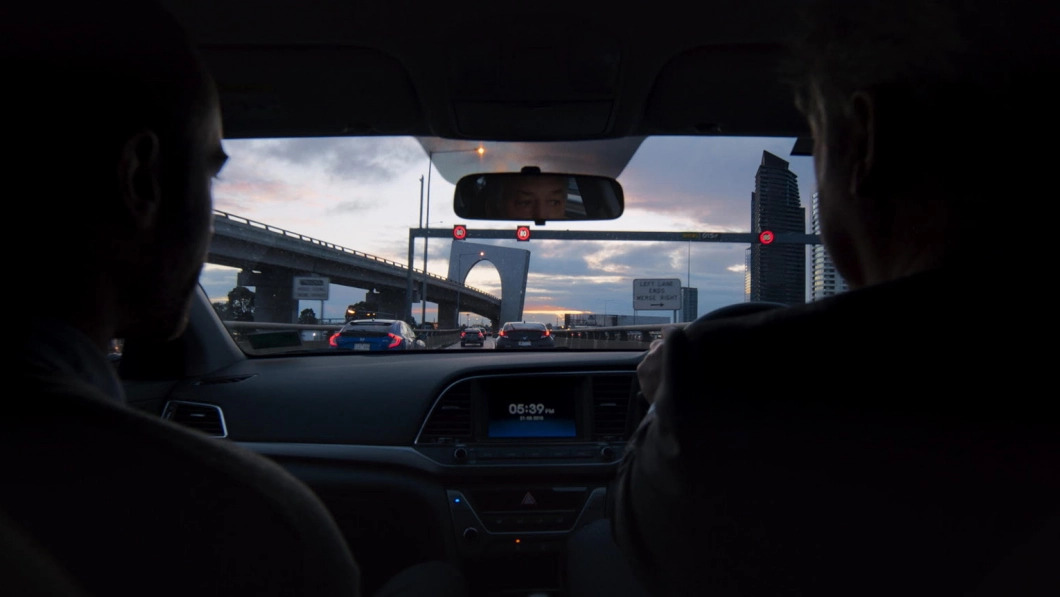
 The Plains channels the spirit of Jeanne Dielman into Andrew Rakowski, a middle-aged lawyer who leaves office every evening just past 5 P.M. to drive home to suburban Melbourne. Easteal’s cyclical road movie formalizes this routine, filming Andrew’s commute over eleven different days of the year with a fixed camera from the back seat of his car. On some days, Andrew offers a lift to his colleague David (Easteal himself), probing the reticent young man on his private life while also generously talking about his own: relatives, career, romance, wealth, mental health. Literally compartmentalizing work and life, the commute creates a transitional zone where Andrew can view each as an escape from the grind of the other. It provides a moment of unwinding, freedom from roleplay that both life and work demand. Yet, for all the me-time the drive home affords, there is an eerie silence whenever Andrew isn’t chatting away or the radio isn’t on, as though this non-place, non-time were forcing him to reflect on Important Things. Despite the apparent sameness, every day brings small deviations that threaten Andrew’s reassuring routine, all accumulating into a powerful meditation on aging and the passing of time, a view of life’s parade from the wheel of his car.
8. Red Africa (Alexander Markov, Russia)
 Rivalling the best work of Sergei Loznitsa, Alexander Markov’s resplendent found-footage project samples propaganda and reportage films that the USSR made during the Cold War to strengthen its ties with newly liberated African states. In this gorgeous Sovcolor assemblage, we see Soviet Premiers and African heads of state visit each other amidst ceremony and pomp, exhibitions showcase the latest in Soviet culture and technology to the African public and students use the knowledge they have gained in Moscow for the betterment of their countries, whose exported resources return as value-added products from behind the Iron Curtain. It’s a poignant glimpse into a nascent utopia, a world that could have been, which hides as much as it reveals. With cunning visual associations, Red Africa recasts decolonisation as a formal process that concealed fundamental continuities between the departing Western powers and the Eastern hegemon. Uplifting notions of bilateral ties between Africa and the USSR are belied by the strictly unilateral flow of influence and ideology. In its attempts at creating a new world order, Markov’s sharp film demonstrates, the Soviet Union espoused anti-colonial struggles in fraught areas of the globe even as it held sway over its diverse republics—a tragic irony made apparent when the chickens came home to roost in 1991.
9. The DNA of Dignity (Jan Baumgartner, Switzerland)
 Jan Baumgartner’s moving, loosely fictionalized documentary The DNA of Dignity follows the patient, heroic work of individuals and organizations involved in identifying victims buried in mass graves during the Yugoslav wars. Along with bones, volunteers retrieve articles of clothing, toiletries and other knickknacks, all hinting at stories to be told of those they have outlived. With witnesses passing away each year and new structures waiting to be erected over these burial sites, the excavations are truly a race against time, fighting both political amnesia and nature’s complicity in the oblivion. In their quest to rescue war victims from anonymity, forensic scientists assemble excavated bones into skeletons, carry out DNA tests to ascertain identities and hand over the remains to grieving families, who haven’t had closure despite the end of the war and who confess to no longer being able to enjoy landscape without being reminded of what it hides. Baumgartner’s film obscures political and institutional details to focus on the scientific process, offering a fascinating, inspiring picture of the how the abstractions of science eventually coalesce into human stories. Its success lies in finding the right tone and distance necessary for a subject as grave and delicate.
10. Animal Eye (Maxime Martinot, France-Portugal)
 Martinot’s funny, free-spirited, quietly radical Animal Eye features a 30-year-old Breton filmmaker discussing his next project with his producer in Lisbon. He isn’t very articulate, but knows that the film will be an “autobiographic animal diary” about his dog Boy. “Films are filled with humans,” he says, “all liars.” Animals, in contrast, are not aware of the camera—or don’t care about it—and as chaotic beings of “pure present,” they evade the signifying operations of the image, emptying it of meaning and intention. As the muddled filmmaker slowly “hands over” the project to his smart, wry producer, the film’s central theme crystallizes: in neither owing anything to imagemakers nor expecting anything from them, the filmed animal offers a way out of the crippling egocentrism of artistic creation. In being just an image, the filmed animal becomes a just image. Animal Eye takes the first tentative steps towards the faint understanding that a “cinema of animals” shouldn’t consist of simply filming the world from their eyes, but filming as them, whatever that might entail. Chaining together clips of dogs from across movie history—subject to sadistic torture, sentimentalism and signification, locked out of the human realm—Martinot’s film embodies a rousing rallying cry on behalf of a “deanthropocentrized” cinema. In its own modest way, Animal Eye marks a milestone in anti-speciesist filmmaking.
Special Mention: Saturn Bowling (Patricia Mazuy, France)
Favourite Films of
2021 • 2020 • 2019 • 2015 • 2014 • 2013 • 2012 • 2011 • 2010 • 2009




 The Seventh Art