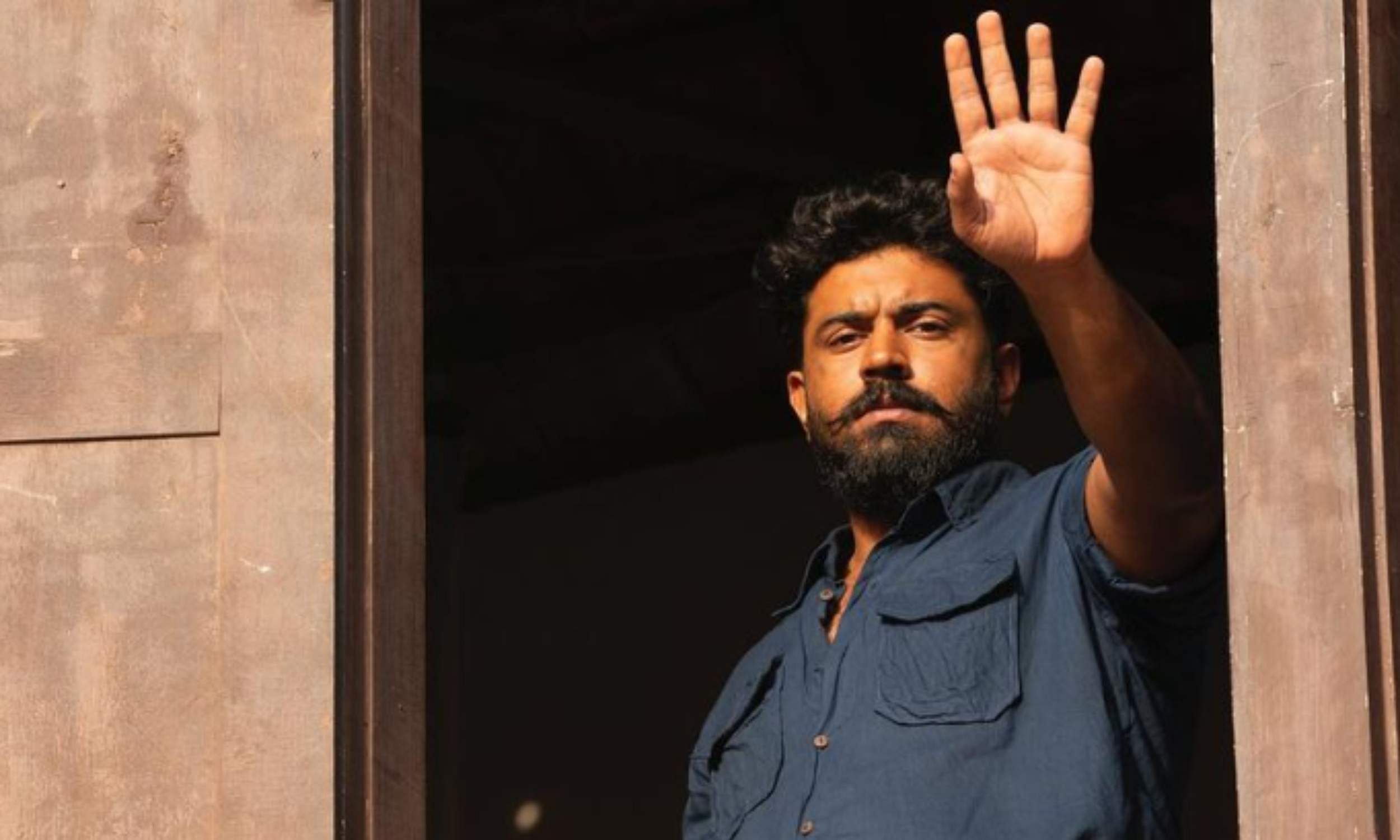
“Don’t use your powers to feed your perversions,” police officer Suresh Menon (Gautam V. Menon) tells off his subordinate Raghavendar (Chetan), who has stripped his detainees in an effort to extract vital information. It’s probably too telling a comment, for Viduthalai Part 1 (“Freedom”) offers director Vetrimaaran one more occasion to anthologize his fantasies of sadistic, retributive and occasionally poetic violence. Set in the 1980s, the film follows the efforts of the police in eradicating armed rebellion in a mineral-rich corner of rural Tamil Nadu in order to make way for mining corporations to set up shop. Newly appointed as a driver to a unit working deep in the forest, constable Kumaresan (Soori) runs up against his superior Raghavendar after he develops affection for the local population, who support the rebellion and distrust the law enforcers.
Manifesting variously in allegorical (2011’s Aadukalam), legal (2016’s Visaranai) and historical (2018’s Vada Chennai and 2019’s Asuran) forms, violence has been the idee fixe, the central subject of Vetrimaaran’s body of work. Yet, barring perhaps Visaranai, his films have proven themselves increasingly unwilling to transform it artistically, to relate the viewer to on-screen violence in any other terms than voyeuristic.
The problem is that Vetrimaaran is so committed to a form of seamy, immersive realism that the only way he can depict violence is in terms of its real-world plausibility; the primary effect he aims at is moral outrage. The problem is also that Vetrimaaran has now been overtaken by hacks who have perfected his original method and rendered it highly conventional. You can’t help but laugh or wince when the police in Viduthalai wrest away adults from a hut to leave behind a crying infant. Or when Raghavendar, having stripped a group of women, asks his deputy for chilli powder, kindling the sordid parts of our imagination. With Viduthalai, Vetrimaaran may have voluntarily turned himself into a meme.
Like Asuran, Viduthalai applies a jittery editing to the most basic of conversation scenes, never lingering on the actors for more than a couple of seconds. When, for instance, protagonist Kumaresan and his sweetheart Tamizharasi (Bhavani Sre) are talking at a shrine in the woods, the camera keeps switching perspectives, suggesting inexistent threats. This CCTV-adjacent aesthetic is generalized in Viduthalai, which, while nominally told in Kumaresan’s epistolary voiceover, keeps shifting perspectives for the sake of furnishing additional narrative information. The film treats its actors like non-professionals, rarely providing them close-ups or extended shots outside of kitschy montage songs, because Vetrimaaran seeks to neutralize their performance with heavy dubbing — the same kind of asynchronous mush that made Asuranso jarring — which undermines his otherwise realist approach.
The longer shots in the film, on the other hand, are devoted to passages of extreme physicality. We see Soori running in from deep inside the frame, out of breath, or doing squat walks as part of punishment in unbroken shots. It is plain by now that Vetrimaaran is excited at the prospect of choreographing such convincing scenes of exertion and torture, compared to the simple, mundane presence of bodies talking to one another. It’s as though Vetrimaaran the filmmaker is bored to death by Vetrimaaran the screenwriter, who can’t help but insert political lectures into the mouths of characters or flatter us with snappy, jargon-laden insider talk among top-level police officers.
A number of things nonetheless ensure Viduthalai is never less than absorbing. The inspired casting, for one; to see a tragic hero in the perennial comic Soori not only imparts a dialectical streak to the protagonist, it also affords Vetrimaaran to work out a nurturing, vastly different kind of masculinity than the avenging, star-driven model of Asuran. Flabbier than usual, the middle-aged Soori can hardly pass for a rookie cop, but his naivete and professional disenchantment are never in question. It’s touching to see his unprepared body slip on rocks, jump across rooftops or trudge through a difficult, rocky terrain — a terrain that is transformed into a garden through the power of his love. Despite his omnipresence in Tamil cinema these days, Gautam Menon is excellent as a ruthless officer who is persuaded that winning hearts and minds is the first step to defeating terror (although his character undergoes an inexplicable corruption that gives mixed signals which are never resolved).
Among the most articulate, committed filmmakers of his generation, Vetrimaaran takes obvious pleasure in elucidating ideological processes shaping his narrative. To this end, we have the superintendent of police, played by cinematographer Rajeev Menon (the third director in the cast after Gautam Menon and Tamizh, who plays another policeman), expounding on political strategies such as party-led protests that act as democratic safety valves against armed insurgency, poster campaigns to instil hope in doubtful investors or having decoy militants surrender in a ploy for the police to take moral high ground. If these details don’t make you laugh, they are bound to leave you impressed — just like the flashy, one-shot train wreck that opens the film.
The most compelling aspect of Viduthalai is, however, its final (and only) set-piece which intercuts between the aforesaid scene of Raghavendar humiliating the women and an ununiformed, unarmed Kumaresan running through a maze-like town chasing the rebel leader Perumal (Vijay Sethupathi, who appears after an hour into the film). The sequence intriguingly casts Kumaresan’s courage as a product of desperation, an act of “fleeing forward.” The scene is also rather surprising in the manner in which it pits Kumaresan’s romance not against his allegiance to the police force, as we are led to expect, but against his newfound sympathy for Perumal. In doing so, it approximates the paradox of identification that Visaranai posed insofar as we are caught between a desire to see the cops succeed in capturing Perumal and a profound hatred for them for what they are doing to the captive women.
Viduthalai is, to be sure, an improvement over the slapdash production that was Asuran. It certainly isn’t made with an eye on the box-office, and if it does bomb, which is a likely development, Vetrimaaran would still go to bed a happy man. But the film doesn’t seem to me like an inflection point in his career, for it doesn’t evolve Vetrimaaran’s style as much as harden it, set it in stone. And that’s too unfortunate for a filmmaker who has just begun.
[Part of Curator’s Corner, a section dedicated to showcasing work of emerging and marginal filmmakers. See here for details.]
In this edition of Curator’s Corner, I’m happy to bring to your attention Searcher (2022), a short film by New Delhi-based independent filmmaker, Divya Sachar. A graduate from the first batch of the television department of the FTII, Divya was convinced early on — thanks to the intense experience at the institute of watching films from around the world, especially those of Ingmar Bergman — that she didn’t want to just find a place in the Bombay movie industry. Her diploma project, titled The Dead (2004), is an intimate, localized adaptation of James Joyce’s eponymous short story.
While working in the field of advertising, Divya made her first film for the Public Service Broadcasting Trust. It was called A Short Film About… (2008), and as that title indicates, it was about a subject around which an awkward silence reigns: breasts. In this half-hour documentary, several teenagers and young women talk about their breasts and how they impact their everyday lives, their relationships and their view of themselves. Woven alongside these highly articulate interviews are clips from popular movies and music videos, a personal voiceover by the filmmaker and an assortment of punning images that evoke the film’s subject.
While insightful and ripe for academic analysis, A Short Film About… derives its value in sticking close to the participants’ lived experience and not theorizing it on our behalf. The testimonies are remarkably candid and grounded in everyday life. Structured in a simple, snappy rhythm, the work defuses a great, perhaps universal taboo with warmth and humour. “It usually makes for good community viewing because it’s quite a funny film,” says the filmmaker, “and laughing alone isn’t as much fun as being among a group of gigglers.”
A Short Film About… is explicitly about the body image, but it is also in some ways about the cinematic image; a film as much about human sight as it is about breasts, which, the interviews reveal, occupy an uneasy space between the private and the public — objects to be concealed but inevitably subject to visual scrutiny. Throughout the film, Divya varies the framing pattern, now photographing the participants chest-up, now in close-up. These variations have the effect of making us aware of our own gaze and reflexively grapple with the problems of filming the female body.
Divya made her next film after a break of over a decade, induced by an undiagnosed health condition. Searcher, a play on Divya’s family name, is framed as a self-interrogation. After an opening title card invokes the neuroscientific basis for the existence of inter-generational trauma, the filmmaker informs us that she was diagnosed with schizophrenia a few years before. The film that follows is an attempt to understand her condition through the story of her grandmother, who migrated to India from present-day Pakistan during the Partition, only to lead a short-lived life of drudgery and suffering.
At the centre of Searcher is a house, an ancestral property, where the filmmaker’s grandmother once lived. The residence looks at once occupied and abandoned; where the thickly furnished interiors give a sense of inhabited space — an impression reinforced by muffled sounds of cooking and chatting — shots of wilting plants, discarded furniture, peeling paint and rusting locks suggest a forlorn site, a haunted bungalow even. The multiplication of mirrors and reflective surfaces, on which we periodically glimpse the filmmaker, amplify the feeling of inwardness, of the filmmaker being locked in.
As the house is surveyed in a mix of roving and static shots, a dialogue ensues between the filmmaker and the jamun tree adjoining the property. The tree narrates the harsh life experiences of the filmmaker’s grandmother. At one point, when the camera encircles a chakki (a traditional grindstone), we are shown Margaret Bourke-White’s photographs of the horrors of the Partition while the soundtrack plays ethnomusicologist Alan Lomax’s field recording of Old Alabama, sung by African-American prisoners. Adding to the implied tyranny of this domestic rigour is a traumatic incident in which, the tree tells us, grandmother was thrown out of the house in a state of undress by her husband.
Grandmother, we are informed, died shortly before the filmmaker was born, making the tree a kind of stand-in for the old lady, a reincarnation; Divya films the tree in tilt shots the same way she films her grandmother in photographs. Searcher articulates the inheritance of malaise across these three figures, invoking the filmmaker’s mental illness in direct relation to her grandmother’s trauma as well as to the blight that the jamun tree is suffering. Each one thus takes on the quality of a metaphor for the other: the Partition is recast as the schizophrenia of a nation torn apart, while the filmmaker views her own condition in terms of the inescapability of the grind of life.
Searcher is a looser, less regimented film than A Short Film About… Its shot composition is more intuitive and the sound mix — with high-volume music and ambient noise sharply cutting into the voiceover — deliberately abrasive. “One aspect of my approach to sound was to be completely unsentimental,” says Divya. “In contrast to dissolves, straight cuts are unsentimental.” What Searcher sacrifices in expositional and structural clarity compared A Short Film About…, it gains in emotional density. It’s a lyrical, reflective work that dwells on surfaces and textures, shadows and forms, the spaces between objects and the inchoate feelings they conjure.
A poetic diary film that is also an oblique ghost story, Searcher hints at apparitions and revenants. The camera has a markedly physical quality, only to be suddenly disembodied by the sight of the filmmaker holding another camera. In the final minutes, we see Divya editing the film seated at a desk in the house. Cut to solemn notes from a harmonium, the image evokes a propitiative ritual, a kind of rapprochement that allows the filmmaker to come to terms with the lineage of her pain. “The idea was to show the process of my recovery,” remarks Divya. “Making the film was therapeutic for me, as was the spiritual intervention of my guru.”
Searcher is not yet available for viewing online, but residents of New Delhi can catch a screening at Studio Safdar on 15 April 2023 as part of reFrame’s G-Fest, with the filmmaker in attendance. Divya hopes that the film can find a wider audience very soon.
Bio
Divya Sachar is a Delhi-based filmmaker, photographer and writer. She completed her Masters in English Literature from Delhi University and postgraduate specialization in Television Direction from the Film and TV Institute of India, Pune. Her first directorial work A Short Film About… received critical acclaim and aired on national television. Her second film Searcher has traveled to festivals such as Prismatic Ground, New York, and International Documentary and Short Film Festival of Kerala. She also writes on films and the visual arts, and has taught screenwriting and direction at Bennett University, Greater Noida. Divya‘s photography and creative nonfiction have been published by Fall Line Press. She is currently working on her first photobook.
Indian cinema was in spotlight at the recently concluded International Film Festival Rotterdam, with over thirty titles presented at the two-week event. The majority of these were part of a special non-competitive section titled “The Shape of Things to Come?”, curated by Stefan Borsos, that sought to explore the following question: “Is the institutional success of right-wing Hindu-nationalist groups and the persecution of dissenting voices a sign for the shape of things to come – and not only in India?”
The formally eclectic program showcased a mix of acclaimed fiction features, documentaries, experimental YouTube videos and Bollywood productions, alongside a lecture and a panel discussion. The political ascent of Hindutva was the dominant theme of the curation, with a number of films delving into the ideological and operational aspects of the Bharatiya Janata Party, the Rashtriya Swayamsevak Sangh and the Vishwa Hindu Parishad. Many of the works dealt with particular events—demolition of the Babri Masjid, Godhra riots, anti-CAA protests, COVID-19 lockdown—while some others evoked the atmosphere of fear, intolerance and disillusionment prevalent at different times and places in the country in the last thirty years. A notable subset of films trained their lens on the phenomenon of radicalization and the role that digital media has played in exacerbating it.
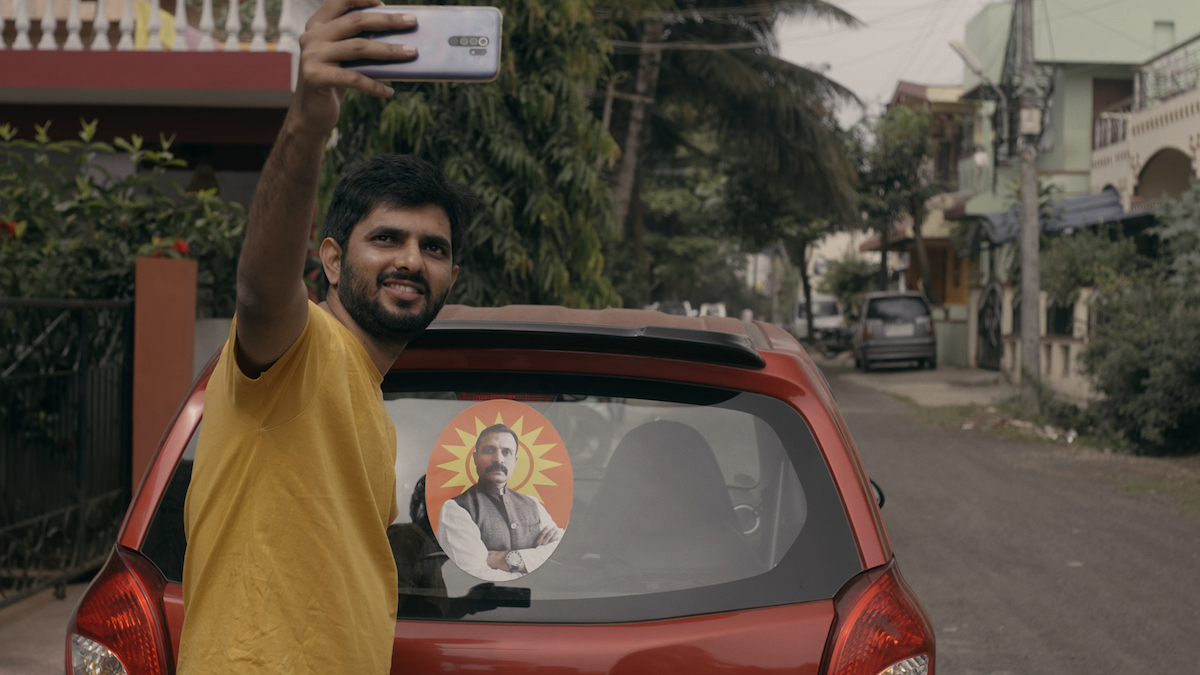
Harshad Nalawade’s smart, sympathetic drama Follower confronts the issue of radicalization head on, but remaps it along linguistic lines, bypassing the conservative-liberal dichotomy typical of culture wars. The film takes place in the border town of Belgaum, which, an infographic at the beginning apprises us, has long been a bone of contention between Kannada and Marathi chauvinists. Raghu is an activist at an online media outlet affiliated with a Marathi political party. When his inflammatory posts result in tragedy, we are taken in back in time to understand how a decent, kind young man came to be an internet thug.
The younger Raghu is close friends with Sachin, a successful Kannadiga YouTuber from a perceivably more affluent family, and with Parveen, a single mother whom he has feelings for. Seemingly immune to language wars, the three friends converse in a mixture of tongues and are at ease with their differences. Yet, at various moments, Raghu is shown his place by those that around him, made to feel like an outsider in his own home. These everyday frustrations and untimely mishaps snowball into a psychic assault on Raghu, persuading him to see himself as a victim. Follower touchingly illustrates the corrosive power of political narratives, capable of corrupting the deepest of bonds.
Anurag Kashyap’s short film, Four Slippers (“Chaar Chappalein”) affirms Follower’s diagnosis, but its subject is the personal cost of radicalization. Written by Varun Grover, the film is divided into four chapters wittily modelled on the four ashramas of Hindu life. In the first episode, set in Varanasi in the 1970s, a boy named Rajat is caught fantasizing in class and humiliated by a sadistic schoolmaster. This brutal repression marks the young man for good, catapulting him into a life of progressive social and emotional isolation that comes to an ironic end some twenty years from now.
Despite its coolly analytical approach that obliges the viewer to observe Rajat rather than identify with him, Four Slippers manages to convey the tragedy of a sensitive individual lost to hatred and communal polarization. Rajat’s trajectory, from a young lad who stutteringly sings Kishore Kumar’s “O Saathi Re” to a crush to a lonely man who spends his days online abusing people disagreeing with him, tells the story of an increasing alienation from the world. It is a sad portrait of a gradual inner exile that puts a finger on a very contemporary malaise.
Both Follower and Four Slippers view social media as an indispensable way station on the journey to political extremism. How has the telecom revolution of the past decade changed the shape of Indian democracy? Avijit Mukul Kishore’s short documentary An Election Diary considers this question against the backdrop of the 2019 general elections. Confining itself to the suburban constituency of Phulpur in Allahabad, the film examines the efforts of the BJP in both reaching out to voters through targeted campaigns and bringing them to the booth on election day.
Made as part of a research project for the University of Göttingen, An Election Diary furnishes no voiceover commentary, nor does it place its material within a national context. What we get instead is a highly local mixture of street interviews, kitschy YouTube clips and revealing IT-cell meetings. The cadres, organized into niche social-media units responsible for particular tasks, discuss the strategy of using smartphones to rally voters. Their campaign consistently foregrounds the personality of Narendra Modi, whose shining image is used to gloss over infrastructural issues affecting the constituency. In this scheme of things, digital media becomes a veritable simulacrum replacing reality.
Smartphones and social media, on the other hand, enjoy only a marginal presence in Varun Chopra’s Holy Cowboys. Set in the environs of Vapi in Gujarat, Chopra’s loosely fictionalized documentary keeps its ears to the ground in its attempt to trace a classic pathway to radicalization. Gopal, a teenager who works at a packaging plant, comes across a calf feeding on the kind of plastic bags he produces at work. In genuine concern, he brings the stray animal to a cow shelter run by a Hindu volunteer organization. He becomes a regular visitor to this place and is soon caught up in the outfit’s vigilante operations.
Narrated like a coming-of-age tale with moody music, Holy Cowboys devotes significant time to Gopal’s interactions with his teenage peers. We don’t get to know what the boy thinks of the organization’s activities, but it is apparent that his attraction to it originates from the camaraderie and the sense of community it offers—an empowerment sorely missing in his daily life. In shining a light on the weaponization of compassion, Chopra’s film agrees with Follower and Four Slippers that forces of radicalization feed on deep-seated human issues, offering hatred as a coping mechanism. Illness masquerading as cure.
What struck me first watching Thuramukham, a large-scale period picture about docker struggle in coastal Kerala, is how abstract and timeless it feels. Rajeev Ravi’s fourth feature is certainly set in a specific location and era—the area of Mattanchery in Cochin during the forties and the fifties—but it isn’t until a good while that these particulars come to the fore. Where Rajeev’s previous films establish time and place in their opening minutes, Thuramukham immerses us into a fable-like world that feels untouched by history. When the camera descends into an anonymous settlement of huts in the first shot — one of the film’s many convergences with Bala’s Paradesi (2013) — it’s not even clear if it’s a real space.
Living in this netherworld—a cinematographer’s paradise, with its candlelit rooms and nocturnal action—are dockhands who fight every day for chapas, work permits tossed at them by exploiting contractors, and spend what remains of their wages on alcohol and gambling. Part of Thuramukham traces the evolution of this lumpen mass into a proletariat fighting for its rights, developed through the characters of brothers Moidu (Nivin Pauly) and Hamza (Arjun Ashokan). This vast, generation-spanning narrative arc gives the film an epic sweep comparable to that of Anurag Kashyap’s Gangs of Wasseypur (2012), on which Rajeev was cinematographer.
The sprawl of the film has another possible source. Rajeev Ravi is a filmmaker with a weakness for classic literature. He gravitates towards stories of individuals swept along by the forces of time. His characters are often passive witnesses of history who, by choice or circumstance, become its protagonists. Thuramukham, written by Gopan Chithambaran and dipping in and out of Russian literature, fissures the leading character of Kammattipaadam (2016) into the figures of Moidu and Hamza, men whose nihilism or passivity renders them victims of history, only to fuse them again in their choice to act.
The monumentality of Thuramukham is only part of the story. What really nuances this testosterone-driven saga, and why I find the film to be a significant departure from Rajeev’s earlier work, is the way it relentlessly balances the epic with the intimate. The world of Thuramukham is very distinctly divided into domestic and public spheres, which respectively translate to feminine and masculine domains of action. Politics is the means by which men look out for one another, while women find solace in each other through shared suffering and mutual care.
The lack of feminine agency in Rajeev’s films has been noted, and I can’t help but feel that Thuramukham is working out an answer to that reproach. At first glance, the film only adds fuel to the fire. Confined to their homes, the women nurture, love and suffer in silence as men get out there to take control of their fates. But, for once, we also see the havoc the men wreak by their actions or inaction. The film reserves its most evocative closeups for its leading women, the terrific Poornima Indrajith and Nimisha Sajayan, whose faces bear the brunt of men’s follies.
So the film responds to the exclusion of women from public sphere by revalorizing the domestic sphere. For one, its political story is couched within an intricate filial narrative in which the class consciousness of the prodigal son coincides with his coming home while that of his brother coincides with his leaving home for the streets. It is also substantial that, unlike its predecessors, Thuramukham ends on the closeup of a woman, one who has been forced to leave her household and mourn in public.
[Part of Curator’s Corner, a section dedicated to showcasing work of emerging and marginal filmmakers. See here for details.]
For film lovers fairly active on Facebook, cinephile extraordinaire Mehdi Jahan perhaps needs no introduction. His evocative posts, often screenshots of superpositions and dissolves used in films but also lyrical texts drawing comparisons across the history of cinema, attest to a voracious, formidably wide-ranging viewing habit. Although I knew Mehdi had made several films himself, I hadn’t come around to seeing them. And ever since the idea for this curatorial section of the site came up, I was certain that I wanted Mehdi to be the filmmaker to inaugurate it. So I’m very happy and proud to present his work to the readers of this blog.
Currently based in his hometown of Guwahati, Assam, in North-eastern India, Mehdi makes works that weave family stories, historical events, folktales and film history into a melancholy, highly romantic tapestry of personal reflections. Episodes such as the Partition, Sino-Indian war of 1962, the Assamese insurgency of the 1990s constitute recurring narrative elements, but they are refracted through the life experience of his friends and family directly affected by the events. The resulting films are poetic meditations on the violence of time, offering both fantasies of a lost idyll and testimonies to a fractured present.
Mehdi’s debut film Jyoti and Joymoti (2017) opens with a list of five crucial events from Assamese cultural and political history, but these combine freely in the film’s Chinese-box structure in which each story gives birth to the next: a wounded insurgent, an old woman who tends to him, her husband who runs a border canteen, the flautist he observes from the window, and finally the flautist’s long-absent lover. These nested stories take us back in time, overlaying different periods and film-historical fantasies in disregard of conventional logic, but in a manner faithful to the workings of memory. Mehdi attributes this digressive organization to his love for Latin American literature, but also the influence of his paternal grandparents’ oral practice of Sufi storytelling—a syncretic tradition now on the wane.
That Mehdi is more interested in the process of storytelling than the stories themselves is apparent from any of his films, which largely take shape through the words of their characters. Each of the stories of Jyoti and Joymoti is introduced by a preceding narrator, while Can They Hear Our Songs? (2022) unfolds as nightmares recounted by its two protagonists. The Home My Mother Never Found (2021) relies on unsent letters written by the filmmaker’s mother, who also narrates He Used to Bring Me Apples (2019). “The storyteller is as much a part of events he describes as those involved in them,” remarks Mehdi. “People celebrate rulers and warriors for fighting for their ideas, but it is the storyteller who preserves their stories.”
Despite their deep realism of time and space, Mehdi’s films are not naturalistic. If anything, in their markedly stylized dialogue and performances, they have a deliberate anti-naturalistic bent. Layering memories, dreams, fantasies and legends, they instead attempt to capture a total reality that encompasses the inner lives and felt experience of the characters. This slippage between time periods and levels of reality is an extension of how the filmmaker perceives his personal and cultural history. Mehdi recollects: “When I was a kid, my grandfather used to tell me stories about the Sino-Indian war; my parents used to tell me stories about the insurgency. In my mind, it’s all a muddle. Now I can’t make out which story took place when. That is how I relate to the entire history of Assam. It’s all one single story.”
Taken together, Mehdi’s films comprise a cinema of separations and longings, of men who have left the scene and women who hold fort waiting for them. The filmmaker ascribes this dynamic to growing up under the influence of his mother, his father having to constantly be away on account of his job. His films privilege the perspective of resilient women—women who have taken a vow, who resist coercion, who have unwavering faith in their love but yet stand on their own—all inheriting from the prototypical personality of the seventeenth century Ahom princess Joymoti, who refused to reveal her husband’s whereabouts even under torture. “Joymoti is a crucial figure in Assamese history and is remembered as this great woman who sacrificed her life for her husband and her nation,” says the filmmaker, “but no one remembers who she was as a woman.”
He Used to Bring Me Apples features Mehdi’s mother as Ayesha, a middle-aged woman whose husband, played by the filmmaker’s father, left many decades ago to join the insurgency, never to return. In his absence, Ayesha has taken over the responsibility of overseeing their village, now gripped by an epidemic of a dubious origin. As she remembers scenes from her childhood and youth, the past and present come to occupy the same time and place. In the process, scars from Assam’s own political history are reactivated as invisible machinations threaten the villagers with eviction from their land.
If their engagement with politics and history is unequivocal, Mehdi’s films are nevertheless pointedly inward-looking, contemplative. They are not calls to action, but testaments to loss. The sentiment underpinning them isn’t triumphalism, but a doomed romanticism. Notwithstanding striking notes of heel-digging defiance, their dominant emotions are yearning, nostalgia, anxiety and sorrow. In that, Mehdi’s films are contiguous, entirely of a piece, with his posts on Facebook as a cinephile.
The history of cinema does, of course, play a part in the films, whether in the silent passages of Jyoti and Joymoti or the Dreyer-like interrogation scenes of Can They Hear Our Songs? While his impressionistic influences are tangible in his approach to nature and memory, Mehdi avoids citation or pastiche, instead treating quaint technical devices like intertitles and dissolves as useful tools still conducive to original expression. History is unkind to lovers in his films, but cinema has the power to unite them across time and space. Characters rarely see each other in the eye, and the editing performs the work of integrating their glances. The two protagonists of Can They Hear Our Songs? never meet, but each of their nightmares resolves the other through a kind of solidarity brought about by cinematic means.
Does an extreme awareness of the richness of the history of cinema hinder creativity? Is there an anxiety of influence that comes with cinephilia? “I don’t think so.” responds Mehdi. “I really like what Jacques Rivette said about every film resembling twenty other films. I think it’s very true; I try to embrace it. I love the concept of dérive, this constant drifting across images that seemingly have no connection to one another. I think of films like that.”
Bio
Mehdi Jahan is a filmmaker, visual artist, and teacher based in Guwahati (Assam), India. His films have been screened and exhibited at several places internationally and nationally, as part of film festivals and exhibitions, such as The Millennium Workshop (New York) , Garage Museum of Contemporary Art (as part of Moscow International Experimental Film Festival), FILMADRID, Bogoshorts (Bogota Short Film Festival), Camara Lucida – Encuentros Cinematograficos (Cuenca, Ecuador), MUTA Festival (Peru), Pan-Cinema Experimental (Curitiba, Brazil), Ribalta Experimental Film Festival (Vignola, Italy), Simultan Festival (Timisoara, Romania), Signs Film Festival (Kerala, India), etc. He has taught film studies, direction, and screenwriting at several institutes, including Satyajit Ray Film and Television Institute, Kolkata, Seamedu Media School, Pune, and Guwahati University.




 The Seventh Art