November 2025
Monthly Archive
November 26, 2025
[An edited version of the following text was originally published in Pardo, the Locarno Film Festival’s official daily magazine.]

In December 1978, the Entermedia Theatre in East Village, Manhattan, was host to a three-day celebration of writer William S. Burroughs and his vision of the space age. Titled Nova Convention, the event brought together a range of avant-garde artists and thinkers who responded to Burroughs’ work through readings, conversations and performances. The then-64-year-old writer was a central presence himself, dressed in grey suit and a green fedora hat, reciting various unpublished pieces with his distinctive nasal twang.
A student at the New York University, Howard Brookner filmed the convention as part of his ongoing documentation of Burroughs’ life. Much of this material remained unseen until 2012, when Brookner’s archive was rediscovered in Europe and the USA, and subsequently restored through the efforts of his nephew, the filmmaker Aaron Brookner. In Nova ’78, the younger Brookner and co-director Rodrigo Areias offer a kaleidoscopic reconstruction of the event, liberally mixing on-stage performances with intimate behind-the-scenes footage, interviews with friends and other everyday vignettes.
Each number is emblematic of the freewheeling nature of the convention: Philip Glass producing hypnotic loops on a synthesizer, Merce Cunningham dancing to a baritone vocal piece by John Cage, Patti Smith offering to reimburse disappointed viewers before shredding her guitar, Frank Zappa reading the ‘talking asshole’’ bit from Naked Lunch (1959), or Laurie Anderson performing her song “From the Air”, assisted by Bobby Bielecki’s electronic effects.
Armed with a zoom lens, Brookner’s nimble camera floats around the artists and the audience, now capturing Burroughs lost in thought, now filming street scenes around the theatre. Inspired by the writer’s style, Nova ’78 juxtaposes starkly disparate material, such that actual poetry often rubs shoulders with poetry of a more mundane kind, one that grasps life in motion. Emerging from the film is an image of Burroughs as a fiercely independent, politically committed figure, opposed to every stripe of fundamentalism and authoritarian control.
Above all, Nova ’78 provides a precious glimpse into a creative community untouched by the logic of technocracy and corporatization. The convention isn’t any ‘gig’, and the artists and thinkers gathered here register as real individuals with eccentricities, not self-styled brands in thrall to showbiz mandates. The ease and spontaneity with which they participate in the event, and the unaffected warmth and respect with which they speak of Burroughs, attest to a high degree of personal integrity as well as a sense of genuine camaraderie. In that, Nova ’78 truly feels like a time machine.
November 21, 2025
[An edited version of the following text was originally published in Pardo, the Locarno Film Festival’s official daily magazine.]

Time seems to stand still in the village of Ribeira Funda, tucked between the boundless ocean and the majestic mountains on the island of São Nicolau in Cape Verde. The moss-laden rocks, dilapidated stone houses, jagged pathways that comprise its expressionistic scenery appear to have existed since time immemorial.
Haunting this eternal landscape is old man Quirino, at once a king and a castaway, who leads a self-sufficient life in one of these houses, with a rooster for company. Signs of history soon surface — a radio bringing news from elsewhere, batteries, razor blades, cigarettes — cutting down this mythical figure to human scale. On the voiceover, Quirino recounts his memory of Ribeira Funda, once a thriving agricultural land, now drought-stricken and deserted.
The old man, we learn, has continued to live in this ghost village decades after its original inhabitants abandoned it for greener pastures. But now his faculties are failing him, and he must prepare for the great voyage beyond.
In his second feature The New Man, Carlos Yuri Ceuninck adeptly blends historical fact, lived experience and personal memory, crafting an ambitious, contemplative work that ventures beyond simple documentary portraiture. Part a sociological sketch, part a philosophical parable, Ceuninck’s film interweaves intimate observational vignettes, breathtaking landscape photography and a polyphonic voiceover in a way that both explains its subject and endows him with an irreducible mystery.
The New Man stands in interesting conversation with Wang Bing’s Man with No Name (2010), another absorbing record of a recluse at the edge of civilization. But where Wang remains a strict chronicler of the present, Ceuninck introduces what seem like visions from the past and the hereafter. Unfolding on a metaphysical stage lit by the celestial bodies and the scored to the churning seas, The New Man seamlessly melds myth, dreams and reality, illustrating that even a single, unremarkable life embodies the drama of the cosmos.
Ceuninck keeps pace with Querino’s quotidian rhythms, developing his film in long shots with little dramatic action, relieved regularly by glimpses of young boys playing, dancing or working the fields. Are these images from Querino’s own youth? Or are they part of the many legends that surround the village?
Querino’s sense of self is evidently bound to his memories of growing up in Ribeira Funda, but we also perceive that the land has an identity only insofar as its inhabitants bestow it with meaning. “There were many storytellers here,” Querino laments, “but death came, and it spared nothing and no one.” The New Man thus registers as an elegy, not for the man or his land, but for the intangible ties that bind them together. Death is on Querino’s mind as he too prepares to leave the village, but something far more significant will have died before his mortal end.
November 16, 2025
[An edited version of the following text was originally published in Pardo, the Locarno Film Festival’s official daily magazine.]
“My whole trouble was that at no point was I able to lose my administrative and critical faculties,” remarks Judas in Paul Claudel’s short story The Death of Judas (1933). Claudel’s bracingly revisionist account makes a case for the twelfth apostle, recasting him as a sardonic, inquiring man who saw through the intellectual obfuscations of the miracles and the cowardice of his fellow disciples. This Judas celebrates his philosophical freedom even in death, suspended from a tree, unbound by the constraints of the cross that consumed his master.
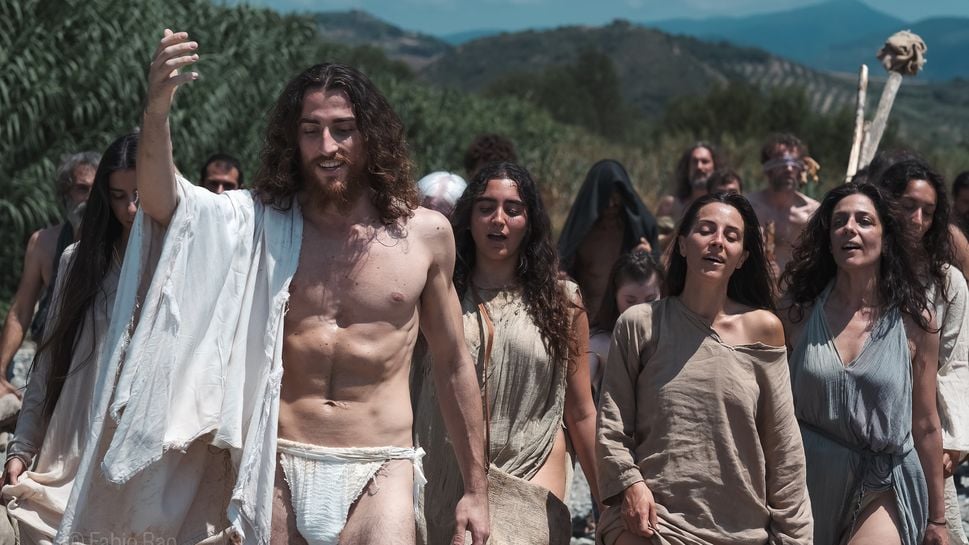
Taking over the baton from Claudel, writer-director Giulio Base gives the devil its due in Judas’ Gospel, fully humanizing the treacherous figure and dramatizing his tussle with reason and faith. In Base’s retelling, born under a cursed star, Judas endures a harrowing childhood in a brothel. Wielding a bloody dagger, he rises to power and fortune, only to give it all away when Jesus (Vincenzo Galluzzo) summons him. Wise in the ways of the world, Judas is moved not so much by the Prophet’s supposed miracles, but by His simplicity and capacity for grace.
Base presents Jesus as a radical egalitarian, a proto-hippie whose following comprises men and women alike, without authority or hierarchy. With a forgiving smile, He condones the libertine goings-on in the group, which He leads from place to place over three years. In a subversion of the injunction against idolatry, Jesus is visible, front and centre, throughout the film, anchoring the image with His radiant presence. Even so, we don’t hear His voice except at choice moments, as when He beckons Judas or eulogizes Joseph at his funeral.
Judas, on the other hand, is simply a cloaked figure whose face never once shown to us. Yet it is his lucid, layered monologue that propels the narrative. Drawing us into an entirely subjective space, this voiceover (delivered by the gravel baritone of Giancarlo Giannini) accompanies us through the maze of Judas’ mind, his confusions about Jesus’ plans for him, his sense of superiority over his unlettered peers, and his messiah complex undone by his human failings.
As one’s image complements the other’s voice, Jesus and Judas become inextricable entities bound by prophesy. “Everything in the world exists thanks to its opposite,” Judas notes, implying that his treachery and Jesus’ ascension are mandates of the same divine will. Judas’ labyrinthine reasoning brings him to the conclusion that he was the only apostle faithful enough to carry out the betrayal, yet he succumbs to human logic at the moment of Crucifixion. Thematically and formally thought-provoking, Base’s film unveils Judas in all his fascinating contradictions. Ecce homo.
November 11, 2025
[An edited version of the following text was originally published in Pardo, the Locarno Film Festival’s official daily magazine.]
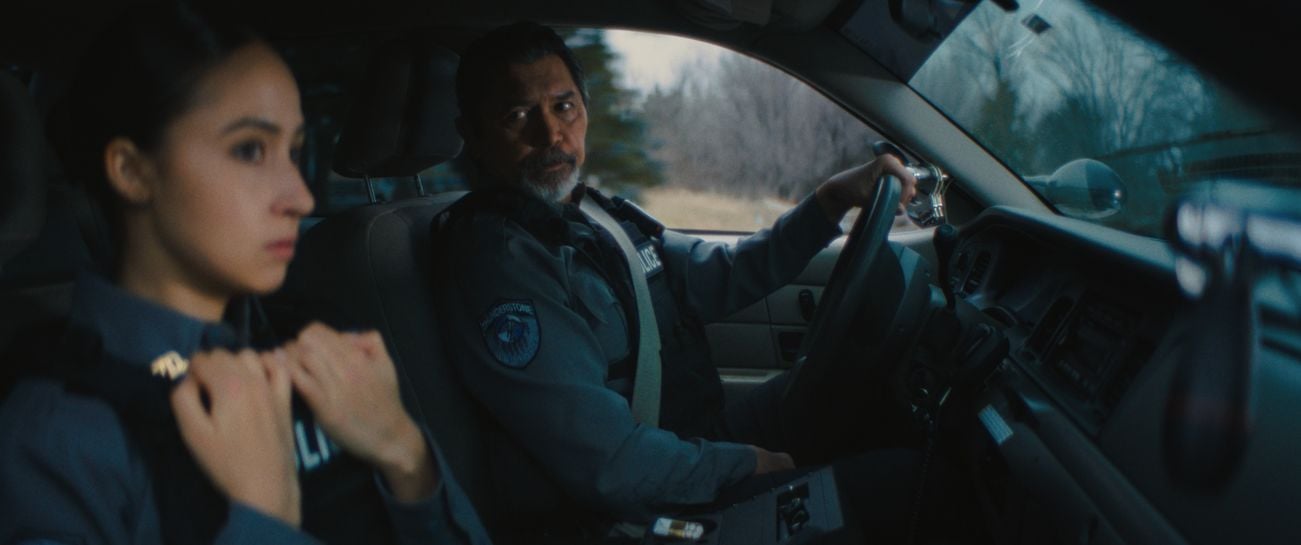
“We are all squatters here, Toto”, quips officer Teddy Sharpe (Lou Diamond Phillips) to his rookie beat partner Sandra Scala (Dana Namerode). A half-Filipino working for the tribal police in Thunderstone indigenous reservation, Teddy is an ethnic outsider. But as someone who has grown up among the Native Indian community, he is intimately familiar with the ways of the reservation, now under the sway of drug cartels and warring gangs. “We have our laws and punishment, the streets have theirs”, goes another of Teddy’s nuggets to Sandra.
In Keep Quiet, Vincent Grashaw (Bang Bang, Locarno Film Festival 2024) offers a gritty, long–fused crime drama that puts the conventions of the genre at the service of a complex sociological reality. The reservation, in Zach Montague’s close-grained screenplay, is host to competing moral codes and regimes of authority: indigenous gangs who fashion themselves as a brotherhood above American law, the district police who only view them as anti-social elements to be clamped down, and the tribal police who perform an interstitial peacekeeping role.
At the centre of this vortex is Teddy, who uses his official power to curb delinquency in the reservation, but who is also mindful of the larger needs of the community. Having possibly wronged the community in the past, he is desperate to keep children away from both the streets and the law. But when Richie (Elisha Pratt), a reckless ex-convict, returns to the reservation with vengeful motivations, Teddy’s hopes of stemming the cycle of crime and violence are severely tested.
Shot by Brandon Waddell with an acute feeling for shadows, Keep Quiet offers a shining example of lean, no-frills genre filmmaking: invisible craft deployed to draw us into a believable, realistic world. Despite the richly detailed backstories to the characters, Grashaw succeeds in imparting immediacy and momentum to the narrative, never allowing the film to wallow in psychology. In that, he is aided by convincing performers such as Namerode and Pratt, who bring to life, with admirable economy, individuals fighting their own demons.
But the beating heart of the film is Phillips, who distils classical Hollywood models of middle-aged masculinity into Teddy: wise, sardonic, measured in action and word, with occasional touches of irascibility that only reveals an impatience with empty niceties. His moral sense is derived from a spontaneous, practical intelligence rather than theory or self-analysis. Yet he can be lucid when necessary, evoking a knotty, painful past with razor-sharp clarity and concision. Phillip’s Teddy is John Wayne and James Stewart rolled into one.
November 6, 2025
[An edited version of the following text was originally published in Pardo, the Locarno Film Festival’s official daily magazine.]

It only takes a few seconds into Ancestral Visions of the Future to perceive that it is a markedly different work from Lemohang Mosese’s two breakout features from 2019: the epistolary essay Mother, I Am Suffocating. This Is My Last Film About You. and the community portrait This Is Not a Burial, It’s a Resurrection. To be sure, there is a remarkable continuity of thematic concerns across the three films by this Lesotho-born, Berlin-based artist, chiefly the fraught political and religious history of his home country, its spiritual amnesia and its desolate present mired in crime and violence.
But while Mosese’s earlier outings were framed through designated points of view — an unnamed letter writer in Mother and a diegetic storyteller in Resurrection — the new work is direct in its address and features a first-person voiceover by the filmmaker himself. Dense and florid, this voiceover lends the film the texture of a highly stylised poetic memoir. We learn, for instance, that Mosese’s mother always fought for a better life, dreaming of a comfortable home for her children and “stubbornly refusing to greet the hand of permanence”.
Yet Visions ventures beyond the confessional mode, unfurling alternatingly as a personal essay about the filmmaker’s native country and as a fragmentary fiction involving symbolic characters. Prominent among these is Sobo (Sobo Bernard), a healer-puppeteer who preserves the nation’s pre-colonial consciousness, and Manthabiseng (Siphiwe Nzima), a wandering woman who stands up to the ominous gangland cars that zip through the streets and leave bloodshed in their wake. Through these characters, Mosese constructs a layered assessment of his homeland, marked both by an appreciation for its bygone splendours and a profound disillusionment with its current-day perversions.
This ambivalence is echoed by Mosese’s own feelings as an artist in exile, someone whose work revolves around questions of memory and identity, yet whose own identity remains in flux. Steering clear of nostalgia, Visions refuses to separate fond recollections of the past from their material reality. At one point, for example, Mosese speaks of falling in love as a child with cinema in a hall that also reeked of human waste.
Evocative of the words in the voiceover, but never merely illustrative, the imagery of Visions weaves together impressionistic documentary footage with surreal, Sergei Parajanov-like tableaux. The film’s slightly oblique visual organisation expands the oral descriptions while also opening up secondary associations between sound and image. The resulting work hovers entrancingly between the familiar and the strange, reality and myth, fact and metaphor.
 The Seventh Art