[The following text was published in Pardo, the official daily of the Locarno Film Festival.]
In his film work, the German video artist Nicolaas Schmidt conducts experiments in temporal dilation, contrasting subjective and objective experiences of time passing. His mid-length featurette FIRST TIME [The Time for All but Sunset – VIOLET], which received a Special Mention at Locarno in 2021, largely comprises two boys exchanging furtive glances in a metro train circling Hamburg. The inexorability of the setting sun outside the window and the indifferent bustle of people boarding and alighting seem starkly at odds with the boys’ almost telepathic intimacy.
Schmidt’s debut feature applies the themes and strategies of FIRST TIME to the cherished European practice of going to the beach in summer. Parodying a moviegoing ritual, September Afternoon begins with an ice cream commercial from the ’80s, whose pranks and frequently sexual visual gags promise more fun times by the seaside to come. But the narrative that follows incorporates the routine pleasures showcased in the commercial only to subvert them with dark emotional undercurrents.
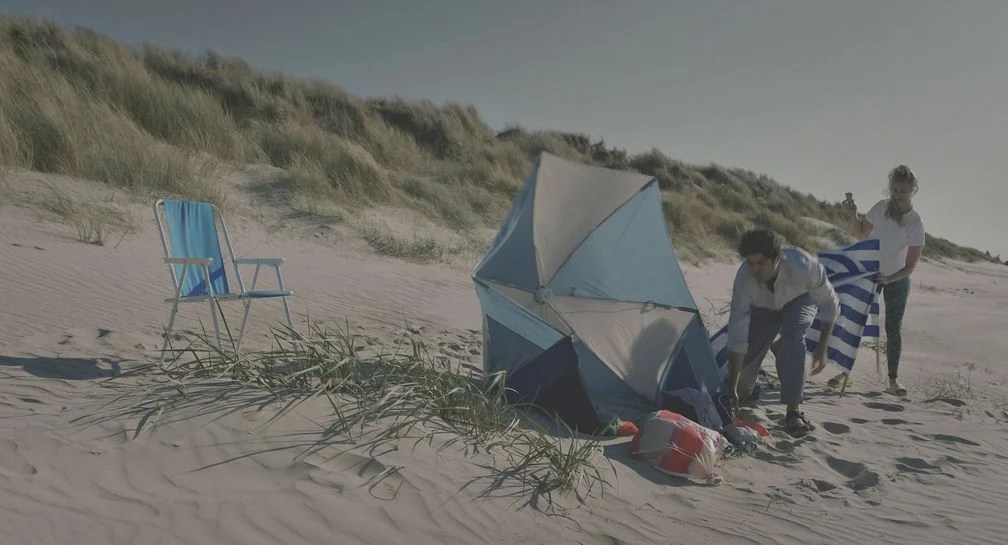
A couple (played by Amin Motallebzadeh and Katharina Grossmann) prepares to go to the beach with their daughter and a neighbour, unbothered that it’s overcast, windy and slightly cold outside. They pack their bag with the essentials: sunscreen, towels, beach tennis paddles, snacks, sunglasses. Once at the beach, they engage in familiar coastal leisure rituals: collecting shells, building sandcastles, and walking along the waterfront.
For most of this dialogue-free film, a piece of lounge music plays on the soundtrack, ever growing in intensity, and so insistent on its own easy-goingness that it ends up becoming sinister. Equally insistent: the man vainly trying to pitch a sunshade against the battering wind, and the neighbour attempting to eat an ice cream even as she keeps getting sand in her mouth. These drawn-out vignettes, straight from a silent comedy, eventually give way to apocalyptic visions that catapult the film into a symbolic realm.
Described by Schmidt as a “post-postmodern persistence parable” and a “contemporary cosmic catastrophe”, September Afternoon measures the enticements of consumer capitalism against the intractable facts of material reality. Its characters, like the boys of FIRST TIME, cling to an internal sense of time – where eternal summer reigns – that is out of step with the world outside. Alternating formalist passages with drawn-out mundane actions, Schmidt fashions an idiosyncratic, abstract comedy where everyday frustrations are but a nap away from supernatural cataclysms.


Leave a Reply