The two defining currents of Tamil cinema of the past decade — the engaged, politically aware films of the Pa. Ranjith school and the playful, movie-aware work of the Naalaya Iyakkunar gang — collide head on in Karthik Subbaraj’s Jigarthanda DoubleX (2023), a spiritual sequel to the director’s second feature Jigarthanda (2014). Where the earlier film, arguably its maker’s finest, was a heady celebration of the supremacy of cinematic mythmaking over that of the gun barrel, DoubleX is a much more solemn, spiritually tortured assertion of the importance of cinematic demystification.

As a filmmaker, Karthik Subbaraj calls to mind those expert craftsmen who keep snipping away at a chunk of folded paper without giving us an idea of where they are going with it, only to unfold it at the end and have us marvel the intricacy of the design and the necessity of every redundant seeming gesture. He begins with pet ideas and images — in this case, again, the primacy of the camera over the gun — and then weaves a convoluted plot over them outwards, allowing the audience to arrive at their beating heart in the middle of a film. Showy? Absolutely. And DoubleX doubles down on the showiness. Every shot is an event – sometimes tiringly so, as in the many ritual shootouts organized in a movie theatre — and dramatic logic makes way for a logic of the spectacle.

Coerced by a cop to kill a ruthless, Clint Eastwood-loving henchman named Caesar (Raghava Lawrence, spitting image of a young Rajinikanth), prisoner Raydas (SJ Suryah) masquerades as a filmmaker to woo his vain target into a celluloid dream and slay him. Raydas and Caesar embark on a movie project together, but they soon find their fiction overwhelmed by reality. Faced with the genocide of a mountainous tribe by those in power, both filmmaker and subject must choose to leave fiction for reality. Rather, transform their fiction into reality.

As the synopsis suggests, the film goes all over the place, and then some, and part of the fun and the frustration is in observing Karthik Subbaraj make straight-faced connections between elements that have no right to be together. His previous film Mahaan (2022) — built around the idea of real-life father and son playing a slippery morality game on screen — was in comparison a lean operation, balancing its two central elements with relative ease. DoubleX, in contrast, is unwieldy — weighed down by seriousness where Jigarthanda was shrewdly unserious and light-footed — overstuffed with dramatic developments, all of which, to be sure, is fleshed out with the director’s characteristic taste for symmetries, repetitions and reversals. A wannabe cop, Raydas ends up as a criminal, pretends to be a filmmaker, only to become a real filmmaker exposing the cops; a petty criminal, Caesar aspires to be a movie star, only to turn into a real hero, who becomes a screen legend. And so on.

After Mahaan, Karthik Subbaraj seems to have grown more comfortable propelling his narrative through characters that aren’t conventionally likeable. For a good while, DoubleX is a veritable parade of inglorious bastards, our identification never resting securely with any of them. But despite Karthik Subbaraj’s self-absorbed cinephilia, there’s a naïve idealism at the heart of his films that keeps them from hip cynicism. Part of the idealism comes from the subaltern political assertion, now domesticated thanks to the work of Ranjith and Mari Selvaraj, that DoubleX borrows and gives a unique spin to: cinema cannot defeat oppression, but it can stand witness to it; art cannot fight malevolent power, but it can influence individuals to change the nature of that power.

DoubleX is Karthik Subbaraj’s first film to release in theatres in many years (Mahaan went straight to streaming), so it is perhaps understandable that he turns it into a sentimental ode to the collective movie experience. The notion that a theatre audience can be outraged by images of oppression and moved to action (a lasting legacy of Shankar’s cinema, where cable news and social media become the keepers of public conscience) is so corny and old-fashioned that it is thoroughly impressive in its sincerity. DoubleX presents it almost as a necessary myth for truth to flourish.

It is curious that we get Martin Scorsese’s Killers of the Flower Moon (2023) and DoubleX within the span of a month. Very different pictures, but both tackle fraught political subjects with an often stifling piety (although Karthik Subbaraj is capable of inserting an absolutely juvenile punchline in a cop’s mouth in the film’s most harrowing scene), expose cinema’s tendency to “print the legend,” yet refuse to stop at this demystification in order to lay the foundations for truth. The worst rogues in DoubleX use cinema as a medium for political propaganda, but it is also put at the service of justice. The camera is neutral, it is those who wield it that make it good or evil. That, perhaps, is the ultimate myth.
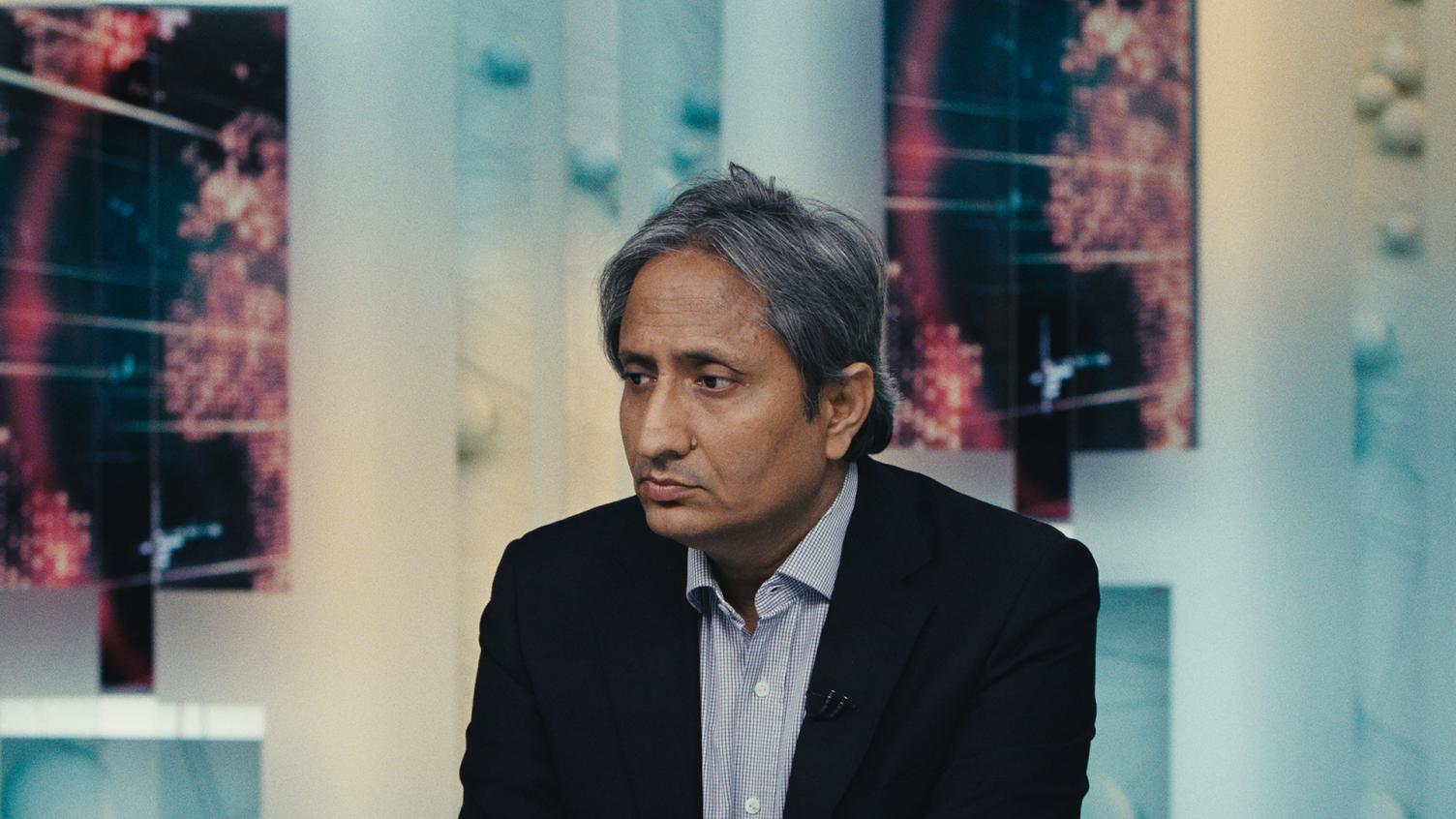
Early in While We Watched, Vinay Shukla’s intimate documentary on the life and work of the acclaimed Indian journalist Ravish Kumar, we see the newsman receiving compliments from a fan at a petrol station. As Ravish takes leave of his discontent admirer, a faint smile crosses his face, only to dissolve into his trademark frown when his car leaves the station. The smiles will be fleeting all through Shukla’s film, much like the short-lived victories and brief moments of joy that the journalist experiences at home and his newsroom. For the most part, we witness Ravish drained, slouched in a chair, his hair dishevelled, his face buried in his palms or the crook of his elbow.

Long affiliated with the New Delhi Television (NDTV) before its hostile takeover by billionaire Gautam Adani in December 2022, Ravish Kumar came to be perceived as one of the last bastions of independent journalism in a media climate increasingly in thrall to the Narendra Modi-led Indian government. Structured around half-a-dozen key events from 2018-19 — including the attempted murder of student activist Umar Khalid, the attack on security personnel in Pulwama, Kashmir, and the General Election 2019 — While We Watched weaves a robust cause-and-effect narrative that offers a study in contrasts: we witness how Ravish’s sardonic, reasoned language in discussing these hot-button issues stands out against the strident demagoguery of his counterparts on other TV channels.

It isn’t a battle of equals by any means. Stacked against Ravish are not just vicious troll armies and powerful media houses attacking him covertly or otherwise, but also a malevolent state that grinds down dissident organizations by means of defamation lawsuits and income-tax raids. At one point in the film, a major scoop about an instance of cow vigilantism is thwarted by selective disruptions of the broadcast. Ravish’s phone buzzes with calls from bullies with the choicest invective and his physical safety is threatened, resulting in a police officer being assigned to escort him.

Ravish responds to such orchestrated harassment with a resigned smile, and notwithstanding his ordeal, he remains very much accessible to those reaching out to him. While We Watched is certainly a tribute to the journalist’s conviction and persistence, but Shukla isn’t interested in telling a triumphalist tale. The film is shot through with a melancholy reflective of Ravish himself, who registers less as an unflappable crusader demolishing ill-informed opponents (though he does get a moment or two of that) than a solitary romantic whose heart beats for a lost cause.

While We Watched places significant emphasis on Ravish’s perennial loneliness. The hawk-nosed journalist is largely seen in profile in tight closeups, severed, as it were, from the world around him. He is withdrawn into himself, even when he is at gatherings and parties, his face and body never ceasing to relay his disappointment and world-weariness. As other television channels grow in popularity and revenue, resignations and farewell parties multiply at Ravish’s office, his trusted colleagues moving on to greener pastures.

This solitude is redoubled by the format of Ravish’s prime-time show on NDTV which, as the fan at the petrol station points out, relies on the star-anchor’s persuasive monologues rather than the sensational panel discussions seen on other news channels. Is Ravish simply jaded and too much in love with his own voice to have invitees on his show? Or is it that he resists the faux-neutrality of such pseudo-debates that turn every story into an occasion for communal polarization? The film doesn’t tell us. But what is sure is that Ravish finds himself increasingly isolated from his peer group, with sporadic gestures of solidarity coming from fledgling journalists and college students. At regular intervals, we see him read his own words off a teleprompter, as though he is walled in by them, with no other voice coming in support.

In its unwavering focus on Ravish to the exclusion of other anchors working alongside him, While We Watched risks overstating his predicament and minimizing the role of NDTV as an institution with its own policies and imperatives. Even so, the film succeeds in giving a sense of what it takes to be a national journalist in India today, of the price to be paid in remaining upright in a world all too willing to bend down. Watching Ravish soldier on despite workplace attrition and dwindling spectatorship, continuing to gather information from conscientious reporters and disgruntled youth, we come to recognize the value of speaking truth as a worthy goal in itself, beyond its mediatic reach and capacity for influence. As Ravish put it in his now-famous speech at the Magsaysay award ceremony that bookends the film: “Not all battles are fought for victory. Some are fought simply to tell the world that someone was there on the battlefield.”


[First published in Sight and Sound]

[The following text was written for the catalogue of the International Film Festival Rotterdam 2023, where the filmmaker was in focus.]

The oeuvre of master animator Yuasa Masaaki is so thoroughly heterogenous that it is hard to discern what makes it an oeuvre in the first place. With works that cut across formats, lengths, genres, animation techniques and target demographics, with avowed international influences that range from Disney and Dali to Tex Avery and Jackie Chan, not to mention Carl Lewis and MC Hammer, Yuasa is nothing if not artistically promiscuous.

From the nervous contours of Mind Game (2004) and Ping Pong: The Animation (2014), to the flat colour fields of The Tatami Galaxy (2010) and Night Is Short, Walk on Girl (2017), to the more sophisticated modelling of Ride Your Wave (2019) and Inu-oh (2021), Yuasa has constantly modified his style to match his source material, whether adaptations or original scripts. Throughout his career, the filmmaker has donned multiple hats, variously serving as scriptwriter, storyboard artist, key animator, director and showrunner on his productions and those of others.

Starting out as an animator on the popular television series Chibi Maruko-chan (1990–1992) and Crayon Shin-chan (1992–present), Yuasa made his wildly original feature debut with Mind Game, an unbridled phantasmagorical trip that already contained the seeds of what was to follow. An existential parable about a maladjusted, over-anxious young man coming out of his shell to discover free will and complete freedom, the film begins with a sojourn in the afterlife and ends in a dash out of a dying whale’s belly. This smorgasbord of incredible events and animation styles proved too potent for the box-office, prompting Yuasa to return to television production for the next thirteen years.

After over two decades of freelancing with various studios, including a detour into crowd-funding with Kick-Heart (2013), Yuasa established his own company Science SARU with co-founder Eunyoung Choi in 2013. The venture gave the filmmaker a creative flexibility and control that inaugurated a new, prolific phase in his career, yielding five feature films and four television series under his direction within a span of five years. This included commercial hits such as Netflix’s Devilman: Crybaby (2018) and the critically-acclaimed Lu Over the Wall (2017), which won the Cristal Award at the Annecy Film Festival.

Yuasa, who strives to create a more sustainable working environment at Science SARU, away from Japan’s culture of overwork, is attracted to stories where it’s all play and no work; rather, where play becomes work. His films are fascinated with athletic prowess, productivity and professional competitiveness, but these qualities are employed to caution against selfishness, against the mindset of winning by any means. They don’t valorise losers as much as losing itself, insofar as it can teach the value of other people’s happiness. Littered with clubs and fraternities, Yuasa’s work is a veritable anthology of characters from rival clans who come together to solve collective problems, appealing to compassion and consideration for others.

It isn’t a question of submitting individual will to common morality. Coursing through Yuasa’s films is a tension between the need to be oneself and the wish to find acceptance in the community. The filmmaker has spoken in interviews about his experience as a lonely, ungregarious youth in high school, trying to fit in but being rejected by his peers. Despite the idiosyncrasy of his work, Yuasa has also expressed a desire to find a more mainstream audience. Creativity is important, he learnt with the founding of Science SARU, but so are the clients and the market—a lesson made transparent in the indispensable business expertise of Kanamori in Keep Your Hands Off Eizouken! (2020).

More often than not, the tension is resolved in favour of individualism, against conformism. Coexistence between different communities becomes possible only through the agency of “in-between” creatures who belong to neither. Sometimes these liminal identities address our real world, through characters that are multi-ethnic hafu, non-binary or gender-neutral, but frequently they are glorious concoctions of different species, corporeal collages that expand the possibilities of being. Yuasa’s universe is one in which identities are in constant flux, undergoing perpetual transformation.

This philosophical transgression goes hand in hand with a concerted formal transgression. With its psychedelic explosion of primary colours, its radical simplification of solid forms to a swirl of abstract patterns, its violent contortions of physical features, its aggressive mixture of reality and fantasy, its enmeshing of different timelines, its unabashed subjectivity, Yuasa’s style is of a hallucinatory maximalism that always threatens—and sometimes manages—to overwhelm a given work. In its blithe disregard for realism, the canons of anime beauty and the mandates of Kawaii or cuteness, the aesthetics of Yuasa’s work may be seen as constituting a challenge to an extremely codified culture where everything has its designated place.

Yuasa’s films derive their manic energy partly from filmmaker’s obsession with capturing the particularities of movement. Either the objects within the frame are in motion, with the ‘camera’ typically hovering over them, or the frame itself is, this combined restlessness throwing the rare moments of stillness into stark relief. From the freeform swing of Lu Over the Wall and the casual waltz of Ride Your Wave to the indescribable physical rituals of Mind Game and Night Is Short, Walk on Girl, dance sequences feature prominently in Yuasa’s films, allowing the characters break free from their modest frames and develop wobbly limbs or supernatural bodies.

Infectious though these emphatic flourishes are, it is in his more delicate touches that Yuasa proves to be a consummate filmmaker. In the insertion of seemingly unrelated images (such as a bug washed away in beer in The Tatami Galaxy or a butterfly in the middle of an intense match in Ping Pong the Animation), in the numerous close-ups of precise actions (preparations of food or characters sensing textures), in the gentle reframing that shifts focus to hands and feet during a conversation, Yuasa allows the audience to imbibe a precise mood without literal explanation.

Yuasa’s work is at its most rewarding when he channels his feverish imagination into material grounded in real world experience. Projects like Ride Your Wave and Japan Sinks: 2020 (2020) may sacrifice a little of the unbridled expressivity of their predecessors, but they gain in emotional resonance and thematic depth. The filmmaker’s expressionistic approach to landscape is subtler in these films, which preserve the integrity of represented space despite expansive flights of fantasy. Yet neither of these two works devolves into sentimentality, the charming absurdities of Ride Your Wave and the ingenious tonal complexity of Japan Sinks: 2020 complicating our relation to the story. Considered alongside the brash, convention-smashing Inu-oh, they reveal a protean filmmaker at the peak of his powers.

[Other catalogue entries]

52 Seconds (2017, Prathap Joseph) | A House in Jerusalem (2023, Muayad Alayan) | A Knock on the Door (2023, Ranjan Palit) | Aftersun (2023, Charlotte Wells) | All India Rank (2023, Varun Grover) | All Was Good (2022, Teresa Braggs) | Almost Entirely a Slight Disaster (2023, Umut Subasi) | Als uw gat maar lacht (2023, Dick Verdult) | An Election Diary (2023, Avijit Mukul Kishore) | Bajrangi Bhaijaan (2015, Kabir Khan) | Beyond the Fences of Lâlehzâr (2023, Amen Feizabadi) | Blind Willow, Sleeping Woman (2023, Pierre Földes) | Come pecore in mezzo ai lupi (2023, Lyda Patitucci) | Demigod, the Legend Begins (2022, Chris Huang Wen-chang) | Encountered on Saffron Agenda? (2009, Shubhradeep Chakravorty) | Family (2023, Don Palathara) | Final Solution (2004, Rakesh Sharma) | Firaaq (2008, Nandita Das) | Follower (2023, Harshad Nalawade) | Four Slippers (2023, Anurag Kashyap) | Holy Cowboys (2021, Varun Chopra) | How to Find Happiness (2022, Nagasaki Shunichi) | I Am Offended (2015, Jaideep Varma) | I Love You, Beksman (2022, Percival Intalan) | I morti rimangono con la bocca aperta (2022, Fabrizio Ferraro) | Ih Hi Ko (2020, Utkarsh Raut) | Il Boemo (2023, Petr Václav) | Inu-Oh (2021, Masaaki Yuasa) | Japan Sinks 2020: Theatrical Edition (2020, Masaaki Yuasa) | Kali of Emergency (2016, Ashish Avikunthak) | Kamli (2022, Sarmad Sultan Khoosat) | Karparaa (2023, Vignesh Kumulai) | Keep Your Hands Off Eizouken! (2020, Masaaki Yuasa) | Kira & El Gin (2022, Marwan Hamed) | La Sudestada (2023, Daniel Casabé, Edgardo Dieleke) | La Tour (2022, Guillaume Nicloux) | Lonely Castle in the Mirror (2022, Hara Keiichi) | Lords of Lockdown (2022, Mihir Fadnavis) | Love in the Time of Malaria (1992, Sanjiv Shah) | Mascotte (2023, Remy van Heugten) | Mayday! May day! Mayday! (2022, Yonri Soesanto Revolt) | Night Is Short, Walk On Girl (2017, Masaaki Yuasa) | No Bears (2022, Jafar Panahi) | Nostalgia (2022, Mario Martone) | Paco (2023, Tim Carlier) | Pamfir (2022, Dmytro Sukholytkyy-Sobchuk) | Pett Kata Shaw (2022, Nuhash Humayun) | Power (2023, Mátyás Prikler) | Primeira Idade (2023, Alexander David) | Ram Ke Naam (1992, Anand Patwardhan) | Represa (2023, Diego Hoefel) | Ride Your Wave (2019, Masaaki Yuasa) | SAGAL: Snake and Scorpion (2022, Lee Dongwoo) | Saint Omer (2022, Alice Diop) | Sameer (2017, Dakxinkumar Bajrange) | Slowly Nowhere (2023, Damir Čučić) | Stanya Kahn  (Talk) | The Blue Caftan (2022, Maryam Touzani) | The Men in the Tree (2002, Lalit Vachani) | The Tatami Galaxy (2010, Masaaki Yuasa) | Un Petit Frère (2022, Léonor Serraille) | When the Waves Are Gone (2022, Lav Diaz) | Which Colour? (2023, Shahrukhkhan Chavada) | Yuasa Masaaki (Talk)

[Part of Curator’s Corner, a section dedicated to showcasing work of emerging and marginal filmmakers.]

Delhi-based Supriya Suri has made four films, short and long, that could hardly be more unlike each other: an experimental profile of a celebrated filmmaker, a fictional character study of small-time urban criminals, an expositional documentary about a film personality and a diaristic feature about a family pilgrimage. Taken together, they attest to a constantly self-reinventing creativity trying out various subject matters, styles and modes of expression. Professionally trained in film direction, Supriya segued early into film criticism and curation before making works of her own. “I never saw filmmaking as a journey,” she says. “Making one film was the ultimate goal, and I put a lot of pressure on myself to get it right. For the longest time, I didn’t get into direction.”

Supriya’s two documentary featurettes comprise a study in contrasts. Commissioned by the now-defunct Films Division, her debut Maestro, a Portrait (2013) is an oblique, non-biographical profile of Bengali filmmaker Buddhadeb Dasgupta that synthesizes vastly disparate material—poetry, paintings, classical music, film excerpts and archival footage—in its attempt to arrive at deeper insights into its subject. Eschewing exposition or direct interviews, the film presents a silent Dasgupta striking solemn poses in different environments while a cluster of voices reads out heterogenous texts in English, Bengali and even Portuguese.

In a more radical departure, Maestro refuses to demarcate Dasgupta’s words and images from those by others that are cited; for instance, excerpts from the films of Dadasaheb Phalke, Luis Buñuel and Satyajit Ray are seamlessly woven with ones from the Bengali auteur’s works. What we get in effect is a mosaic of cinematic and literary references in dialogue with Dasgupta’s cinema, arranged into themes of memory, dream and myth—a stream of images and texts that flow into and out of Dasgupta’s films. In its rejection of authorities and hierarchies of information, Maestro registers as an unusual, ambitious study that assumes some degree of familiarity with the subject.

Aruna Vasudev – Mother of Asian Cinema (2021), on the other hand, crafts a relatively more conventional portrait of the eponymous film critic and programmer. Through talking-head interviews, archival material and voiceover, we come to learn about an enterprising individual who significantly contributed to giving Asian cinema an identity as Asian cinema. Quickly covering Vasudev’s years as a student and an apprentice filmmaker abroad, the film devotes more attention to the magazine Cinemaya, the organization NETPAC and the film festival Cinefan, all of which she co-founded with a view to foster and promote Asian cinema.

“I was making a short film in which she played herself,” Supriya recalls. “But I realized that she was old and had started forgetting things.” Supriya, thus, abandoned the short film for the documentary with a view to preserve Vasudev’s stories and experiences. The testimonies in Mother of Asian Cinema capture a sense of Vasudev’s outgoing, friendly personality as well as her astounding capacity to forge lasting links across the globe. At the end, we see Supriya herself in front of the camera, recounting Vasudev’s influence on her own journey and, in some respect, tracing her professional lineage—a theme that finds echo in Supriya’s most recent work, the mid-length feature We Shall Meet Yet Again (2022).

At the centre of the short film Boys from Hinterland (2019) are two men on a bike; poker-faced, clad in black leather and almost comically representative of a strain of brash Haryanvi masculinity. They mug pedestrians and other commuters in a series of orchestrated robberies, only to blow their loot on booze. In lateral tracking shots, we see them cruise the vast, desolate highways around the national capital, high-rise buildings in the background furnishing silent commentary. Yet it is neither sociological portraiture nor genre thrill that Supriya is after. Ostensibly inspired by Robert Bresson, Boys from Hinterland strives to capture the feeling of drifting under the open skies, finding existential freedom if only in criminal behaviour.

Produced by Supriya herself, We Shall Meet Yet Again documents her journey with her mother and grandmother to pilgrimage sites in Northern India. For the most part, the film unfurls like generational road movie around their trip to Haridwar, Hrishikesh and Kashi. The three women revisit the places where they once lived and meet local priests to help them trace their lineage using bahis, pilgrim registers maintained through the centuries and updated whenever a birth or a death occurred in the pilgrim’s family. Between these visits, we witness the women in conversation in guest houses and in trains, speaking reverently of the river Ganga or philosophizing about the ephemerality of life. “I would tell them the beginning, middle and end of a given scene, and they would fill up the rest,” explains the filmmaker. “It was a very improvised process of shooting.”

If We Shall Meet Yet Again presents three generations of women, it doesn’t, however, place emphasis on their differences. There are certainly superficial distinctions: the filmmaker converses in Hindi with her mother, who uses Punjabi with her mother. Serial shots underscore the hair, attire and footwear of the three women. But absent is the kind of friction and clash of worldviews typical of intergenerational narratives. The reticent Supriya hardly speaks in the film, and mother doesn’t seem to have much to disagree with grandmother either. If anything, commonalities—such as a shared interest in spiritual literature and ancestry information—bring out continuities between the three women.

The apparent unity is compounded by the fact that the film offers us no privileged perspective; no voiceovers, texts or instructive moments that tell us how we should interpret the events we see. Even the film’s autobiographical dimension is obscured to the viewer who is unaware that it features the filmmaker and her real family. This absence of a discursive framework keeps us at a distance from the women’s words and experiences, but it also empties the film of an egocentrism that lends it an unassuming, self-effacing quality.

Even so, the film takes matrilineage as its central theme, if only to examine its otherness within Hindu social and religious contexts. Firstly, the notion of women undertaking a pilgrimage by train, all by themselves, runs counter to both road movie conventions and the reality of Indian public transport. But the fact that the ladies successfully trace their lineage or conduct shradh rituals, traditionally male prerogatives, on the ghats of the Ganga attests to changing times and mores.

Times are indeed changing; grandmother’s son (the filmmaker’s uncle), we learn, is planning to emigrate, leaving her alone in the house and under the sole care of her daughter, who lives separately in the same city. Supriya’s film eventually becomes a record of this delicate bond between mother and daughter, who are filmed in two shots side-by-side on the train, often re-enacting fictionalized exchanges. What emerges from this portrait of maternal inheritance isn’t nostalgia or family pride, but a muted sense of patriarchy’s failings. “I’ve always regretted not knowing my paternal grandparents well enough,” Supriya recalls. “So the film was also an excuse to spend more time with my naani.

We Shall Meet Yet Again is currently looking for a distributor.


Bio

Supriya studied film direction with Egide Scholarship at Conservatoire Libre du Cinéma Français in Paris, France. She started her career as the founding member of Cinedarbaar in India in 2009. With her organisation, she has been involved in curatorial practices, film criticism and educational programmes, and has organised several film festivals across India. She co-founded and wrote for a film magazine Indian Auteur and ran a cinema gallery 13BCD in New Delhi. As a film curator, she was nominated by the U.S government for the IVLP to talk about Indian films in the USA. She also runs her production company Maison Su that focuses on international co-production projects. She was a jury member for Cineaste International Film Festival, India, in 2021. She was recently invited by META Cinema Forum, 2022 in Dubai as a speaker on Asian Cinema. She was also on the jury of 28th Kolkata International Film Festival, 2022, for Asian Select category awards.

Contact

info@maisonsuentertainment.com

Filmography

  • Maestro, a Portrait — A Film on Buddhadeb Dasgupta, 2013, 52 min., digital
  • Boys From Hinterland, 2019, 14 min., digital
  • Aruna Vasudev — Mother of Asian Cinema, 2021, 65 min., digital
  • Main Tenu Phir Milangi (We Shall Meet Yet Again), 2022, 65 min., digital

Showcase

Maestro, a Portrait (2013)

Boys From Hinterland (2019), password: hinterland@watchnow

https://vimeo.com/703848579

Aruna Vasudev — Mother of Asian Cinema (2021), password: vasudev@2021

My ballot for the 2022 Sight and Sound critics’ poll for the greatest films of all time:

La Jetée (1962, Chris Marker)
Histoire(s) du Cinéma (1988-98, Jean-Luc Godard)
The Cameraman’s Revenge (1912, Ladislaw Starewicz)
Sátántangó (1994, Béla Tarr)
The Gold Rush (1925, Charles Chaplin)
To Be or Not to Be (1942, Ernst Lubitsch)
The Up! Series (1964-ongoing, Michael Apted, Paul Almond)
The Crowd (1928, King Vidor)
Berlin: Symphony of a Metropolis (1927, Walther Ruttmann)
Homework (1989, Abbas Kiarostami)

[Part of Curator’s Corner, a section dedicated to showcasing work of emerging and marginal filmmakers. See here for details.]

Shishir Jha is a filmmaker from Darbhanga, Bihar, who lives and works in Mumbai. An alumnus of the National Institute of Design, Shishir began making short films to teach himself particular aspects of moviemaking while also holding a job in the advertising industry. He has recently made his debut feature Dharti Latar Re Horo (Tortoise Under the Earth, 2022), a meditative docu-fiction set in an adivasi region of Central India plagued by the ecological repercussions of unchecked mining. While Tortoise Under the Earth is still seeking distribution, viewers can get a good sense of Shishir’s work from two of his short films, The East Wind (2016) and Te Amo (2016), both presented below along with a classroom project, Goodbye and Other Stories (2018).

A monodrama set in a mountainous stretch of Maharashtra, The East Wind centres on an unnamed middle-aged man seemingly mourning the disappearance of his wife. The film, however, only hints at this premise, refusing to spell it out except as visual clues: photographs of the man and his now-absent family, a dream-like tracking shot suggesting a journey away from the protagonist, who gazes yearningly at the photos or off-screen. Images of the man cooking his sorry meal or fetching water from across the valley, and of clothes left unattended to, signal a breach in the routine without putting too strong an emphasis on it. The wind blows, ushering in the first rains. Life goes on.

Ostensibly influenced by Béla Tarr, The East Wind demonstrates Shishir’s taste for elliptical, contemplative storytelling that privileges mood, atmosphere and landscape over character development or narrative detailing. The film doesn’t narrate a story as much as dwell on a state of mind — a kind of static portraiture that characterizes the filmmaker’s other work as well. Even so, it helps that he has a professional actor in Robin Das, whose weather-beaten face and downcast body become the primary expressive vehicle of the film. Shishir has subsequently worked predominantly with non-professionals, which certainly stretches their capabilities even as the films gain in documentary authenticity.

In 2016, Shishir participated in a workshop by Abbas Kiarostami at the EICTV film school in Cuba. Scouting neighbouring villages with an interpreter for possible subjects for a short film, he found an elderly couple living on the ground floor of a housing complex in Pueblo Textil, Bauta. On Kiarostami’s advice, he spent time getting to know them, observing their environment and shooting them in their routine while proposing to them small situations to improvise on. “I don’t speak Spanish, and I developed something intuitively based on my impression of their interactions,” says Shishir.

The result was the film Te Amo, a charming picture of old-age togetherness, routine pleasures and the banality of a contended life, unfolding on a lazy summer afternoon. Arcadio and Nelsa, the couple, have obvious charisma and their endearing chattiness and enthusiastic participation draw Te Amo far away from the laconism of The East Wind. “I discovered the power of language to express emotions for the first time,” says the filmmaker. “I realized that this was magic.” The film was well-received at the workshop and garnered Kiarostami’s appreciation. “The experience gave me confidence that I can make a film anywhere,” adds the filmmaker.

Speaking of his first feature film, Shishir notes that Tortoise Under the Earth was an extension of Te Amo: “With the same approach, I wanted to tell a longer story.” At the time, he was reading Paul Olaf Bodding’s work on Santhali folklore and Hansda Sowvendra Shekhar’s short story collection The Adivasi Will Not Dance (2015). Inspired equally by the play of myth and nature in the films of Apichatpong Weerasethakul, Shishir set out to the district of East Singhbhum in Jharkhand, exploring the area with the help of the activist Jeetrai Hansda. “I realised that Bodding’s Santhal is far away from today’s Santhals,” he says in an interview, ”there are new problems, new possibilities and new issues.” Instead of forcing his experience into a pre-determined narrative framework, Shishir spent his months simply gathering images and sounds from the region.

It wasn’t until he came across Jagarnath and Mugli Baskey that he found his human-interest story. A middle-aged couple who have lost their daughter to unstated causes, Jagarnath and Mugli live by themselves in a spacious house in the village. Like in Te Amo, Shishir recreated their everyday interactions as fiction, partly conceived by the protagonists themselves, giving us a picture of a loving couple living in harmony with the nature around them. Mugli speaks to flowers and sings songs of lament; Jagarnath talks to a bird and buys bangles for his wife. Woven through these domestic scenes are images from an annual festival in which Jagarnath plays percussions and a village fair where the couple have themselves photographed at a makeshift studio.

This soft, rarefied drama of rural idyll is, however, interrupted by environmental threat. We learn that the region has been poisoned by rapacious Uranium mining, the footprint of which hasn’t ceased to expand. True to the understated nature of Tortoise, this invasion first appears as noise — a distant thud of the machines — before we see its material consequences in the form of water poisoning and forced eviction. Jagarnath tries to sensitize the youth of the area, who seem playful and somewhat indifferent to their collective plight, showing little desire for action. Jagarnath is, on the other hand, determined that he will not leave his home. In a beautiful night-time sequence, he stares straight at the headlights of an ominous off-screen vehicle — heels dug into the ground, fists clenched — offering an uplifting note of defiance.

Tortoise Under the Earth is above all a humanist portrait of Jagarnath and Mugli. Shishir does not regard his film as a work of activism. The politics of Uranium mining, says the filmmaker, is not something that he was expressly seeking to address. But having spent time with the couple as their guest, it was something he couldn’t avoid, so much was it a part of their identity and existence. In that respect, Tortoise serves to register that, for people like Jagarnath and Mugli, the business of living is inextricable from their struggles against erasure.


Bio

Shishir Jha is a Mumbai-based filmmaker born in Bihar, India in 1988. He graduated from the National Institute of Design (NID), Ahmedabad, with a bachelor’s degree in Film & Video Communication Design. He received a Diploma in Filmmaking at the workshop of the late Abbas Kiarostami at EICTV (Escuela Internacional de Cine y TV) in Cuba in 2016. He has made several short films, and Tortoise Under the Earth is his first feature film.

Contact

rumrainroad[at]gmail[dot]com | Instagram | Twitter

Filmography

  • Meghna, 2009, 2 min., digital
  • Guddi, 2011, 5 min., digital
  • The East Wind, 2015, 15 min., digital
  • Segment in Shuruaat Ka Interval, 2014, 5 min., digital
  • Te amo, 2016, 18 min., digital
  • Goodbye & Other Stories, 2018, 18 min., digital
  • Dharti Latar Re Horo (Tortoise Under the Earth), 2022, 97 min., digital

Showcase

The East Wind (2015)

Te amo (2016)

Goodbye & Other Stories (2018), password: humara123


I’m very pleased to announce that my second book, Nainsukh, the Film, has been published by the Museum Rietberg Zürich, under its Artibus Asiae imprint, marking its first ever film-related publication. The book is a monographic exploration of Nainsukh (2010), a semi-biographical film on the eponymous eighteenth-century miniature painter, produced by Eberhard Fischer and directed by Amit Dutta.

Partly an art-historical survey of the development of Pahari painting in Northern India and partly a stylistic, thematic and film-historical investigation into Nainsukh, this compact volume is exquisitely designed and illustrated with hundreds of gorgeous paintings, film stills and photographs from the production. It is a companion piece of sorts to my first book, Modernism by Other Means: The Films of Amit Dutta (2021, Lightcube). Why don’t you pick up both?!


Description

Nainsukh of Guler was an eighteenth-century miniature painter from the hills of Northern India. With his patron, the prince Balwant Singh of Jasrota, this master artist created some of the most refined, delicate works of Indian painting, which seem to have been, in the words of art historian B.N. Goswamy, not painted as much as breathed upon paper.

In 2010, Swiss art historian Eberhard Fischer produced a film titled Nainsukh, an experimental biopic based on Goswamy’s writings on the Guler master. Directed by Amit Dutta, this art-historically rigorous, formally playful screen biography brought the painter’s works to life, offering vivid reimaginations of the circumstances of their making.

Nainsukh, the Film: Still Lives, Moving Images delves into this enchanting, singular work located at the confluence of art and film history. With detailed contextual information, the book accompanies the reader through the world of Nainsukh, illuminating the themes, style and genealogy of one of the most sublime cinematic creations of the twenty-first century.


Links

Museum Rietberg Shop (international shipping)

Amazon India (India only)

[Part of Curator’s Corner, a section dedicated to showcasing work of emerging and marginal filmmakers. See here for details.]

Formally trained in cinematography, 28-year-old Agrima (aka Ajrul) is an independent filmmaker from Karnal, Haryana, in Northern India. Besides smaller exercise films, Agrima has made two shorts so far — 2019’s Jee Ka Janjaal: The Prominence of the Unseen and 2021’s Cocrunda 0.5mg (TV iv OTT) — both of which seem to me to be concentrated explorations of feelings of disgust and repulsion; the bibhatsa rasa as Indian aesthetic theory has it. They are both highly subjective works reflecting psychological states dominated by these sentiments. Disorder, decrepit rooms, dead and decaying animals, leftover food, bodily emanations, diseases, caustic colours, high-strung sound effects are some of the prominent elements of the films.

Agrima recalls having watched Emir Kusturica’s Underground (1995) and Black Cat, White Cat (1998) as a child. “I remember I was really fascinated by how deeply chaotic it was,” she adds. Viewing theatrical and film adaptations of Ghashiram Kotwal and Oedipus Rex one after the other while a student of English literature in New Delhi initiated her into a more formal understanding of the two mediums. Further influences came in the form of John Carpenter’s They Live (1988), Harmony Korine’s Gummo (1997), Pankaj Advani’s Urf Professor (2001) and, most importantly, Sion Sono’s Love Exposure (2008).

The seven-minute Jee Ka Janjaal was a direction assignment at film school. “I was still inexperienced to instruct a crew,” says Agrima. “So I ended up doing almost everything myself.” The film begins like a parody of true-crime TV shows, with the camera hovering over a disorderly, nearly unlivable hostel room – a veritable compendium of aforesaid elements. The protagonist (Snigdha) is seated deflated on the floor, surrounded by lizards, a lit cigarette dangling from her mouth. She is sweaty, her breath short and rapid, like that of a reptile. Shortly after, a mute “lizard man” (Varshney) creeps over her on a couch, running his hands under her clothes, causing her to throw up. Unable to confront him, she watches the man defile a doll and suddenly finds herself afflicted with mysterious skin lesions. Her trip to the hospital, however, proves even more traumatic.

Jee Ka Janjaal is ostensibly a personal work born of a sense of vulnerability. “At film school, I was for the longest time feeling isolated,” notes Agrima. “I also had some strife with how things were going on at the school. So I isolated myself. After living alone for a long time with just lizards in my room, I somehow came up with this afternoon reverie of a girl who was thinking of disgust in terms of body fluids, men, sexual activity and all of those things.” A sense of loathing pervades Jee Ka Janjaal, but it is primarily located in male bodies—the lizard man, the doctor’s bobbing Adam’s apple, the compounder’s unusual features—which gives a pointedly sexual dimension to the protagonist’s revulsion.

Cocrunda, in that regard, exercises greater control over its material, sublimating the feeling of repulsion in bodily humour. The threat of contamination is generalized, scattered across characters in this film, which features two oddball schoolteachers and their preteen vlogger daughter named Ozu (G. Maa Hei). In fact, this home-movie turned psychedelic-comedy opens with an exogenous menace. After Romanchitt (V. Armaan), the dubious newspaper guy, gives brash, unsolicited feedback on Ozu’s recent video, we see him lick the day’s edition and toss it into Ozu’s home. This original, biological and psychological invasion of the household gives rise to a series of others: a cockroach that slithers up the kitchen table, the pills that Mother keeps swallowing, the marundas, or sweet rice balls, that Father chomps down despite his diabetes and finally the TV news that suffuses the air with manufactured emergencies.

As her parents go through their routine in a drug-fuelled haze, Ozu films them with her phone camera, turning her life into the film we are watching. Ozu herself is on medication for her mood swings, which may partly explain the distorted nature of the events we see in the film, shot from up close in a warped perspective. A standoff eventually ensues between the three family members, each blackmailing the other with withdrawal of their preferred poison. “Everybody in the film is my family, except for the little girl,” says Agrima. “This is the second time I’ve shot this film. I shot the first version with a niece of mine. She abandoned the film after three days because of the cockroaches. So I had to audition for the role of the girl.”

Queasy-making and possibly anxiety-inducing, Cocrunda obliquely taps into the amorphous dread of life under lockdown in its evocation of different kinds of contamination: viral infection, food poisoning, drug overdose, invasive surgery, media manipulation and the danger of a young girl ‘exposing’ herself to the world through her videos. Instead of locating this dread in particular objects and people, Cocrunda displaces it from one tactile image to the next, thanks to an unnerving chain of subconscious associations: a dead rat, Romanchitt licking the newspaper, Father turning the pages of the said newspaper by licking his fingers; Mother using a pest repellent to protect Ozu, who crushes her tablets to make them look like the pest repellent, which in turn comes to look like cocaine; Father eating marundas, an organ extraction that resembles pest control, Father eating parathas and so on. Given that several of these images involve oral ingestion of some kind, Cocrunda has the power to induce a visceral response in the viewer. Judge for yourself!


Bio

Agrima, 28, is an independent short film director, a trained cinematographer and a mixed-media visual artist from Karnal, Haryana. She has done her Masters of English Literature course from Miranda House, Delhi University, and a Post-Graduate Diploma in Film and Digital Cinematography from Satyajit Ray Film and Television Institute, Kolkata. Having fashioned her sensibilities through a diverse range of media, her approach to filmmaking is utterly interdisciplinary. Her formal preoccupations with language, literature and cinema, her spiritual connections to what is considered ‘trash’ for most archives and her phenomeno-political understanding of the world are important to her filmmaking.

Contact

agrima1445[at]gmail[dot]com | Instagram

Filmography

  • (it)Selfie, 2018, 4 min., digital
  • Tumi Keno Chole Gele Debanjan, 2018, 2 min., digital
  • Jee ka Janjaal: The Prominence of the Unseen, 2019, 7 min., digital
  • Cocrunda 0.5mg (TV iv OTT), 2021, 10 min., digital
  • Chronicles of Kanchan and Yunga, 2022, 2:06 min., film

Showcase

Cocrunda 0.5mg (TV iv OTT) (2021)

Jee ka Janjaal: The Prominence of the Unseen (2019)

Filipino auteur Lav Diaz’s reputation as the maker of extremely long, austere films in black-and-white may have unfortunately clouded the degree to which his work remains intellectually and emotionally accessible. While it is true that Diaz privileges a detached, master-shot aesthetic, with little camera movement and musical score, he remains a filmmaker firmly committed to clear narrative lines and character motivations. Despite his unmistakable personal style, his films consistently grapple with established film genres, freely adapting conventions from crime movies, melodramas, sci-fi, political thrillers and even musicals.

Diaz’s latest opus When the Waves Are Gone (Kapag Wala Nang Mga Alon), which premiered at the Venice Film Festival last year, borrows equally from film noir and the Western, recounting the fated encounter of two violent men with a score to settle. Wracked with guilt over his involvement in the government’s murderous anti-drug campaign, top cop Hermes Papauran (John Lloyd Cruz, in his fifth feature with Diaz), begins to lose grip on his well-being and family life. His body develops severe psoriasis, prompting him to head for the salubrious coastal clime of his native village. In Hermes’ autoimmune disorder, Diaz finds an apt metaphor for a system determined to attack the very thing it is supposed to protect. Yet it is an unnerving, puritanical association that views physical illness as the offshoot of moral rot.

Released from prison, meanwhile, ex-sergeant Supremo Macabantay (Diaz’s regular collaborator Ronnie Lazaro) sets out to hunt down Hermes, who was once his protégé at the police academy and who had him arrested for corruption. As is often the case in Diaz’s films, this antagonist proves the more interesting character. A political assassin who is also an evangelist, Supremo commands the best passages of the film, such as the darkly humorous episodes where he coerces a boatman to jump overboard for baptism or when he brings a young sex worker to his hotel room, only to have her kneel and pray.

For the most part, Waves interweaves their stories, with Hermes and Supremo biding their time at their respective hideouts before their eventual high noon, which arrives in the shape of a ritual showdown by the sea. Alternating between towns and villages, indoors and outdoors, the film combines significant narrative ellipses with expansive slabs of real-time action, all helping impart a dynamic rhythm to the proceedings.

Waves is of a piece with Diaz’s permanent examination of his country’s embattled moral conscience, but the address is more direct than ever, the tone more despondent. The result is a passionate (if somewhat melodramatic) philippic against a nation that seems doomed to cycles of enslavement and oppression.


[First published in Sight&Sound]

Premiering at the 45th Cinéma du Réel in Paris, Maxime Martinot’s short essay The Film You Are About to See (Le Film Que Vous Allez Voir) offers a brilliant investigation into the ways in which cinema exhibition and spectatorship are mediated by paratexts within and outside the films. Repurposing a range of verbal material intended to set context for viewing — disclaimers, introductory warnings, fourth-wall breaking intertitles, notices from theatre management — the film examines the fraught, slippery nature of the relationship between text and image in cinema. In doing so, it also throws light on contemporary institutional outlook towards problematic works from film history.

The texts that Martinot gathers greatly vary in their tone, style and function. A number of them are pre-emptive disclaimers about the films not being representative of the real world (“merely an ancient fable”), forestalling perceived slight to such institutions as the police, the Red Cross and the Catholic church. A few extend the language of publicity, hard-selling the provocations of the film or preparing the audience for the experience to follow (“not a detective genre movie”). Yet others instruct the projectionist to keep an eye out for spectators pirating the film, while one intertitle registers a feeble protest against the censors: “In its original version, the film ended here, but the censorship demanded an optimistic ending as you are about to see.”

Systematically interspersed with these title cards are thirty-two excerpts from across the history of moving images, from Jules Janssen’s Passage de Vénus (1874) to Angus MacLane’s Lightyear (2022). Arranged more or less in chronology, these images often have a dialectical relationship to the intertitles, which, for their part, are presented in a reverse-chronological order, culminating in slides preceding magic lantern shows in the seventeenth century. This historical regression of the title cards goes not only against their anticipatory function and forward thrust within their respective films, but also against the increasingly slick, sophisticated images on display.

The Film You Are About to See cogently demonstrates the extent to which such title cards serve to fix the meaning and affect of the images, and to counter, as Roland Barthes put it, “the terror of uncertain signs.” Taken together, these paratexts attempt to tame the image and protect the audience, cautioning them about the kinds of violence that the images could subject them to: nausea, dizziness, motion sickness, temptation to vice, even moral outrage. One intertitle reproduces a notice that a theatre in Oklahoma had put up to alert the viewers of Lightyear about “scenes of gender ideology,” assuring them that a same-sex kiss will be fast-forwarded as soon as it appears on screen.

In this regard, the counter-chronological arrangement of intertitles and filmic excerpts also evokes regressing cultural attitudes to potentially disturbing films, the atavistic fear of the power of images. The disclaimers we see in the film have a striking resemblance to modern-day trigger warnings that seek to shield viewers from presumed psychic assaults. However, in its savvy assembly of ambiguous movie clips, Martinot’s film suggests that this is an ultimately futile enterprise, for images will always find a way to escape domestication and remain polysemous in the face of texts that seek to pin them down. In this and its fixation on the perverse detail, The Film You Are About to See comes across as a quintessential work about cinephilia, that illicit passion for smuggling personal significance into curated, tamed images.