Bollywood


Ishqiya

Once Upon A Time In The North 
(Image courtesy: NDTV)

Thanks to debutant filmmaker Abhishek Chaubey (who shares the writing credits of Kaminey (2009)), I’ve been able to watch a film that is absolutely unprovocative, after a long time. As the end credits rolled, I walked out of the cinema hall trying to recollect what felt like a distant memory, like the story of a film that a friend had recited when you were half asleep. Chaubey’s Ishqiya (2010) is a film that exists in some kind of a cinematic void, with only barebones of a relationship with its predecessors. Chances are that you’ll be pleasantly surprised if you thought the film would stink and disappointed if you expected too much from it. I fear that even if I toss a coin to find my stance regarding the film, it would land on its edge. What can you really say about a film that’s got a set of aesthetics tangible enough to arouse interest and uneven enough to restore your smugness, characters quirky enough to hold your attention and set pieces inefficient enough to allow you to not give a damn about them and a knowledge of cinema that’s impressive enough to tease us with the film’s choices and unambitious enough to not go all the way? Ishqiya is a film that seems to have landed, with considerable luck, smack dab in the eye of a cyclone whereby the film neither attracts nor repels, but just sits, like Bill Murray, in a vacuum. OK, this is getting too abstract.

Khalujaan (Naseeruddin Shah) and his nephew, Babban (Arshad Warsi), are two small time crooks who hit the road after getting their hands on a hefty sum of money. With nowhere to run for cover, they, somehow, land up in a village near the city of Gorakhpur where they find refuge at the residence of an old acquaintance, hoping to cross the national border into Nepal. After putting up with some dodging by their hostess, Krishna (Vidya Balan), they come to know that the man they have come here seeking has been long dead. By a tragic turn of events and the inevitable need to proceed to the second act, the money they’ve been carrying around gets pinched just as the duo get tracked down by the true owner of the money. With one last chance given, the pair, working on a plan charted out by Krishna, decide to kidnap a big shot in the city and make enough money to pay back the stolen sum and to settle down for life. But then, both of them eat the forbidden fruit as they fall for Eve – Krishna – who, in turn, does not give a clear indication to either one of them.  To get a clearer sense of the film’s script, take Mani Ratnam’s Thiruda Thiruda (1993, co-written by Ram Gopal Varma, whose film Rann, incidentally, opens this week and ) and strip down all its grand set pieces, action genre elements and ensemble cast. Bland? Yes.

The central conceit of Ishqiya seems to be that of a Western. The literally explosive opening sets the tone for the tale that’s going to unfold in this outwardly serene yet war-torn land. Speaking of war-torn lands, there are far too few shots of the landscape of the village which is really sad, for what’s a Western without the Wild West?! Apart from this basic glitch, you have broad syntax of the Western more or less intact. There are the typical outsiders – two of them, in this case – who enter a completely alien townscape and find themselves trapped in the local gang wars. These are perfect “road people” that we are talking about. Then there’s Vishal Bhardwaj’s Ennio Morricone-esque score that does a whole lot of good to the film. There’s even an ending where the triumphant “lone rangers” ride off into the sunset. But the fatal blow to this attempt at a wonderful transposition of a foreign genre into an indigenous landscape is dealt by the largely inept development of the protagonists. Let’s make no mistake about this. The Western genre has always been, primarily, about morality, about the need to hold a moral ground in an amoral and hostile environment and about the validity of one’s own moral standing (The Good, The Bad and The Ugly (1966) – it’s all taken apart, right in the title!), thanks to which they retain a timeless, philosophical quality. Ishqiya, unfortunately, turns a blind eye to this requirement.

The lead characters here, on the other hand, are presented with no formidable moral choices at all. If I remember correct, there are exactly two points in the film where Khalujaan has to make a moral decision (the same goes for Babban, who isn’t much different, although we are led to believe otherwise, early in the film). The first is when he is asked to take part in a kidnapping and the second, when he is asked by Babban to kill Krishna. In both cases, Chaubey cuts away too quickly, sacrificing quality drama to carry forward the plot. This moral imbalance is only furthered by the presence of the most important and well rounded character in the film, Krishna, who, thank heavens, for once, does not advertise her moral universe using monologues or outbursts. She constructs her own moral fabric wherein she does not make a fuss about kidnapping a man to get what she wants. Here’s a married woman who does not mind seducing two men simultaneously as long as it helps her purpose (It’s not for nothing that her name is Krishna). She doesn’t flinch one bit to knock off her beloved husband just because he had ditched her earlier. So we have the all-powerful Krishna, who can go any length to get what she wants, on one side of the see-saw and the pair of charlatans, who are ready to even lick boots for survival, on the other. Right there, the moral tension is lost and film turns away from being character-driven, which is how it starts out as, to, sadly, being plot-driven.

[Ishqiya Trailer]

There’s really no problem with that except when you don’t provide any emotional anchor to root for a character (I’m going old school just because the mode of discourse Ishqiya adopts is generic). What happens here, as a result, is that we are only indifferent to the very many actions and gestures unfolding on screen. Consider the sequence where Krishna holds the duo hostages for one last time. This moment is followed by the duo tricking Krishna and getting the pistol back from her. Genre grammar tells us that dramatic tension should be cranked up when at least one of the parties is in power. No. We just don’t give a damn and wait for the next plot point. We don’t feel anything when Babban slaps Krishnaa following this. Why? May be because we never really sided with any of these characters. Only Naseeruddin Shah, with his characteristic quirks and improvisation, adds some flavor to Khalujaan. But even his character is presented with no real challenge in the script and, instead, is made to move along with the plot. Neither are our sentiments with the pivotal Krishna, who is but another instance of the militant brand of feminists “New Bollywood” cinema has been endorsing for some time now. In an attempt to break away from the stereotype of the divine, chaste female who sacrifices herself for her man, these films have resorted to the opposite end of the spectrum where the woman is the ultimate destroyer, which, I think, is equally questionable.

There is something very strange and intriguing, not necessarily bad, about all these characters in Ishqiya. Take the two crooks, Khalujaan and Babban, who, although played by stars, aren’t really heroes or even brave men. All they desire is to survive and, if possible, get the girl (Heck, they start their journey from the grave they have dug for themselves!). They do not wish to outwit the owner of the money they’ve stolen from. They don’t attempt to exploit the gang war for their benefit or for anyone’s (These are not Yojimbos!). They don’t carry out the kidnapping successfully. Why, they even require the help of a bumbling police force and an old woman to pull off the final stunt. These are truly flawed characters. All this takes these characters away from genre cinema, which Ishqiya seems to gleefully build upon, towards realism. In fact, call it the irony of Bollywood cinema, these characters seem so multi-dimensional when they are supposed to play cardboards. Even Krishna’s husband, who is allotted not more than ten screen minutes, feels true to life (and is, sadly, played ‘realistically’!). It is as if these real-life characters have been nudged into a genre movie after being given a brief and asked to improvise their way out of it (opposite of what Tarantino generally does). This does sound really interesting, but it never really amounts to anything. The actual triumph, in fact, comes in the form of a minor character – the owner of the stolen money – who is, probably, the only character who knows where he is and, thankfully, gets to close the film.

The first half hour is perhaps when the film is at its finest, with the relationship between characters being established using well choreographed compositions, and where the feminist stance of the film is at its most commendable. Early on, when both the audience and the two men are struggling to understand what kind of a person Krishna is, she is, fittingly, photographed almost exclusively behind bars, through doorways and within closed structures, as if she’s dodging analysis. We are even led to believe that she is like Meera, but it turns out that she’s far from a woman who pines for her man who’s gone away (This Meera doesn’t mind two more men meanwhile!). And at the end of the film, she’s seen out in the vast open walking peacefully with these two men, with nothing to hide. However, this attention to composition isn’t always consistent and the film, for most of its runtime, loses track of its own aesthetics. This kind of tapering off of intensity is visible within separate set pieces of the film too. What start out as a gritty genre pieces end up nowhere. The kidnap set piece, to cite one example, begins with standard thriller procedures but, eventually, moves towards deadpan comedy wherein it’s the common public that carries out the kidnap. This kind of attempt to work from within and, then, out of genre templates may have been intentional on part of Chaubey, but it doesn’t exactly give a whack. It doesn’t really hurt the film either. The film, somehow, seems to neutralize itself. Go stare at it if you want.

 
Rating: Whatever

Kaminey

Ingloriouf Baftardf
(Image courtesy: India-server.com)

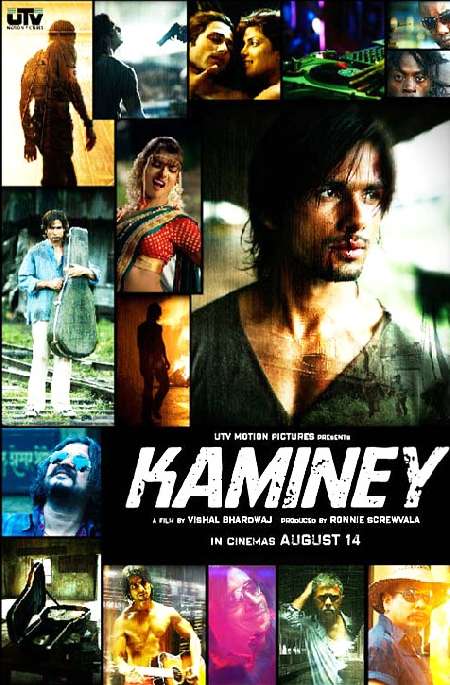
The protagonist of Vishal Bhardwaj’s Kaminey (2009) tells during the beginning of the movie: “We are never screwed by the paths that we take, but by those which we don’t”. And at the end of the film, this is exactly what must be told of Kaminey too. The idea behind Kaminey is inarguably great – so great that each one of us who hears it would be tempted to elaborate on it, make our own version of it and provide a whole new dimension to it. The sad thing is that that is precisely what has happened. With much hype behind it, Kaminey has proved to be yet another idea wasted, but is sure to have its own takers claiming everything, from Shahid’s six pack abs to its pretty neat soundtrack, as a reason to celebrate it as a masterpiece. Cinema is often called a “collaborative art” and Kaminey serves to prove that the real challenge is not to produce art, but to derive it out of collaboration. What would make for a more interesting movie than Kaminey would be a film about its making, for it is surely going to be funny seeing too many people trying to incorporate their own vision into the film, leaving the director helpless.

(Possible spoilers)

Here is the plot for those who would like to know what the film is about. I’m pruning down a lot of details which Bhardwaj seems to have retained for the sake of filling the runtime of the film. Guddu and Charlie (both played by Shahid Kapur) are twins. Guddu is working in an NGO, spreading awareness about HIV/AIDS and is in love with Sweety (Priyanka Chopra). Sweety is pregnant with Guddu’s child and is the sister of Bhope (Amol Gupte), a fundamentalist politician who is now hell bent on getting rid of Guddu to stabilize his position in the party. Charlie, on the other hand, is a gambler and a small time crook. He dreams of having his own horse-race booking company and hopes to grab hold of lady luck by whatever way he can. His villain is Tashi (Tenzing Nima), a high-profile gangster with international connections whose “goods” fall into the hands of Charlie. There are also some two dozen characters who enter the screen now and then, laugh manically, get shot and get forgotten. And yes, their paths cross, things (are made to) happen and they live happily ever after.

Kaminey is written by four people and it shows. Remember the game we used to play where each one of us took turns to add one line to take the story forward? Now remove all the fun from that and voila, you have the script of Kaminey. This proverbial broth absorbs a specific character from each one of its cooks, but doesn’t have one of its own. Nor does it present memorable characters in it. May be Bhardwaj was trying to create a Pulp Fiction (1994) of sorts, but the result is far from it. His characters are quirky for the sake being quirky. May be their names do allude to some movie classics, but you almost hear them crying out: “Hey there, I’m a offbeat and kinky character. Please love me and imitate me”. Neither are they employed as abstractions to make large scale statements about the world as in “arthouse cinema”, nor are they distorted and caricatured to pay homage and refer to film history as in Pulp Fiction and nor are they used to summarize the spirit of the age. They are not even real people living in all three dimensions. Characters come and characters go. Peripheral characters have their own limelight and die without a trace.

Let me try to clarify what I mean by summarizing what “each script” of Kaminey wants to be and what it turns out to be. The first of these was the potential USP of the film. Kaminey is full of Bolly references. Two brothers, who love each other, growing up on either side of the law, a larger than life baddie who vacations in exotic locales while giving orders to pull the trigger elsewhere and even a climax where almost all the characters in the film start firing at each other, while the bad bro turns martyr to save his sibling – we’ve seen them all before. What Kaminey seems to be trying is to pay tribute to and give a reboot to this Masala Noir genre while attempting to retain the sensibilities of today’s generation. But such a film ought not to take itself seriously. Instead it has to go for the laughs, all the way. This is where the second thread of Kaminey intervenes. One might argue that Bhardwaj was trying to give a slick production like Raghavan’s superb Johnny Gaddaar (2007), but characters in such films, I believe, should never be psychoanalyzed. Look at each character in Gaddaar. What do they all want? Simple. Money. Each of them is a mere placeholder, a mere entity that is driven along by the plot, its uncertainties and well, its fate. Kaminey, on the other hand, earnestly elaborates on the characters’ motivations and dreams, trying to make us empathize with them. It even presents extended Freudian sequences for this “purpose”.

[Kaminey Trailer]

Kaminey is then a character-driven film, you say? Let’s take the case of Guddu and Sweety – the two characters that the writers may claims as having depth. Apart from their one night-stand, we are given about three short scenes that are supposed to illustrate their relationship. The first of this is a perfunctory “chemistry scene”. The second one, which turns up just after the fiasco at their marriage ceremony, seems like just another ploy to siphon sympathy. And wait till you hear what the laughable basis of their romance is, in the third scene which takes place in a train. And finally, the most annoying of all the contributions is what makes the already out of control film seem overreaching and pretentious. With a tacked up message that blows up to full scale during the final shootout and cooked up observations that would make Thomas Friedman scratch his head, Kaminey shows signs of a naughty liberal chuckling his way through. Kaminey is not four films packed into one, but one film torn apart into four. Even if it had stuck to one of those paths, Bhardwaj would have had a pretty decent bullet point in his resumé.

Everything seems to come in pairs in Kaminey. There are pairs of brothers everywhere in the film. I would have even loved if the rapper-gangsta from Bombay to Bangkok (2007) showed up in Kaminey to claim that Tashi was his half-brother! But seriously, Kaminey never capitalizes upon this opportunity anywhere in the film. Let me just tell you about a couple of points in the film where I thought it could have taken the “other path” and salvaged itself to an extent. The first is at the intermission point, where Guddu and Charlie are confronted by wrong sets of goons. There was scope both for some awesome comedy and awesome suspense there. Not by the regular identity-confusion gag (and if the film’s vision was strong, that too), but by some subversion of conventions and morals. Instead, the film opts for some slapdash rush towards the climax, which is the second time I felt that the film could somewhat reset itself towards the destination it wanted. When more than a dozen characters are present on your canvas for a single scene, it’s very easy to mash it all up and that is exactly what happens. But this could have proved to be gold if only Bhardwaj had decided to stick to the true purpose of the film.

I may be just playing the troll over here, but surely, none of the scenes hold together. Each version of the film’s script seems to pull down the other, taking the film into a zone of utter indecisiveness. Kaminey, unfortunately, does not even have the surface gloss of Dev D (2009). Using ill-focused, largely handheld shots, Kaminey betrays both its history and quality. One can’t even comment on the technical aspects of the film, for the script leaves them without a direction. So it remains a mystery whether the excessive number of close-ups did good to the film or whether Bhardwaj’s device of revealing the past towards the end was apt, for the film does not seem to know what is good for it at all. All that is amusing in the film is the way Shahid Kapur makes lisping sound funny (lisping is new, stammering is out of date, you know). As for Vishal Bhardwaj, it is only good that he now returns to his personal and honest way of storytelling, for god sake, having a say on the final script. I risked Swine Flu by going to this movie and I say I deserve a medal.


Verdict:


“Whenever I hear the word ‘culture’, I bring out my checkbook”

 – Jeremy Prokosch, Contempt (1963) 


Culture Soup For The NRI Soul     (pic: Rediff)

Culture Soup For The NRI Soul (pic: Rediff)

Quarter hour into Delhi 6, I found myself sitting dispassionately with a hand on my forehead. The last thing I wanted to see after all the hullabaloo over Slumdog Millionaire was a film extolling our culture. The pleasantries among the characters had nearly sealed off the fate of the film as far as I was concerned. And Waheeda Rehman wasn’t helping with her repetitive “Ab main chain se so sakti hoon” (I can rest in peace now) act. It was almost as if Rakeysh Omprakash Mehra was selling nostalgia to the NRIs. As if he was making a film about “our great culture” and never taking it as a platform As if he was trying to make the green card holders break down into tears and say “This is MY country after all. These are MY people”. You know… the usual stuff one feels till the pop corn runs out (Damn, Culture sells). But, to my relief and amazement, Delhi 6 recovers from 0 for 3 wickets to making a decent total. 

Delhi 6 revolves around…Heck, chuck it. This would probably result in a census report. Let me just say that there are more people in the film than the number of shots.  So we have Roshan Mehra (Abhishek Bachchan) who comes to India to take home his granny (Waheeda Rehman). The first half of the film shows us vignettes from the family called Delhi told through the typically patronizing expat eye (but not Roshan Mehra’s). These people spend their time watching unrequited love among Rama and Bharata, but fight with their own brothers. They adore Rama’s marital fidelity, yet go after married women. They are moved when Rama eats food cooked by a socially outcast character yet ostracize and demonize Jalebi, a so-called lower caste woman. They worship Hanuman but are dirt scared of a wild monkey on the prowl, which reveals itself as the focal point of the plot. 

There is some good writing at work here. It is as if we have practically isolated our mythology from our everyday lives and deemed it strongly as strictly fictional. Where the characters in Rang De Basanti (2006) found their history more relevant now than ever, here they see otherwise.  I’m sure that two of the sequences are going to receive much flak. The first one being the “Dil Gira Dafatan” song, which captures the quintessential dream. Purists may even be prompted to do a Freudian analysis as the images run the ganut of Roshan’s experiences. You have Jalebi vendors and cycle-rickshaws ruling the streets of New York. You have Americans celebrating the birth of a calf and shaking a leg at Hindu processions. You even have the monkey man, having been promoted to King Kong status, romancing on the Empire State Building. The second sequence is a bizarre conversation between Roshan and his grandfather (played by his real life father!) which does seem tasteless for different reasons. But no one can blame them for being out of place, for I believe that this kind of a film warrants such treatment. It is indeed a good move to show disjoint sequences from a society when you are encompassing extremely large issues and not dealing with a smaller struggle amidst larger ones. If a tighter plot would have been used, it would most definitely have been a failure and would seem like the film was biting more than it could chew. 

Sonam Kapoor is a bad decision and I felt Soha Ali Khan could have done better. In hindsight, the character of a typically NRI-incriminating modern Indian woman seems tailor-made for Soha. As funny as it sounds, Abhishek Bachchan saves the day. All the potentially fatal reaction shots are redeemed by Abhishek’s unexpected expressions. He plays it low key an never goes into the overwhelming-love-for-home-country mode and cleverly becomes the visitor alone. Though that is a credit to the script, Abhishek manages well to never gain attention (even if it is a consequence of a weakness). All this is until the 115th minute of the film (trust me, I saw my watch here). Then both the Mehras go berserk. There is a fakir in the film who keeps showing everyone a mirror and goes on about the godliness in oneself. This is a good move that could have driven home the point, never looking tacked up too. And at this explosive plot junction (the 115th minute), Abhishek takes up the role of the savior (yes, the pseudo-Indian who refuses to stay passive), he points the mirror to all and “explains” them the truth of life. This is salvaged to some extent by the supporting cast, but the final quarter hour proves fatal. This time, it is the bumpkin Gobar (the talented Atul Kulkarni) who elaborates to all the sane ones how big Abhishek’s role is in changing the lives of the people. And the massacre of the script follows. 

Delhi 6 doesn’t suffer from very many problems per se. It is just that it is irregular. Sequences of sheer brilliance are promptly followed by ordinary ones. Fabulous use of soundtrack is interspersed with the stereotypical utilization of music. Rather than calling these weaknesses, I would like to call them glitches. Sporadic, yet affecting the holistic quality of the film. Delhi 6 presents an open ending and fades to black with the most powerful of all quotes in Hindi cinema that I have heard in recent years – “I returned home”. Just see how profound this line is when you discover for yourself what it means. This line would easily substitute for the last 20 minutes of the film. Let’s hope that the director’s cut (if there ever is one) rectifies the mistake. 

Delhi 6 is exceedingly well shot. Mehra uses extreme close-ups and deep focus to the point that you can see blemishes on the actors’ faces. In spite of the detached view that the script offers, Mehra’s camera becomes one among the characters. It does not impose on us the bittersweet and condescending opinions that Abhishek’s character may have.  See how he desensitizes controversial statements on the news channels by framing the television set along with the news footage. Not only does this offer a space for audience to analyze their own actions but also plays out as a timely satire on the worst thing on Indian television now. The only quibble is that Mehra does not let the images speak for themselves. I would love to show the same mirror that the fakir uses in the film and show it to Mr. Rakeysh Mehra, or his film rather. And tell him “Look, how your film speaks for itself, why try to adulterate it by your obligation to deliver a social message?


Verdict: 


Shaken, Not Stirred

Dev D: Shaken, Not Stirred (pic: Sify)

Anurag Kashyap’s Dev D begins with a special thanks to Danny Boyle. Poor Danny Boyle has been tormented for some time now for supposedly attempting to expose the “underbelly” of the nation. But if the people are fair and they are able to see what Mr. Kashyap is attempting here, Slumdog Millionaire is going to look like It’s a Wonderful Life (1946)! But wait, Anurag Kashyap isn’t a foreigner and so Dev D is just a film, right? Dev D has already created much hoopla thanks to the bizarre promos, “Emosional Athyachar” and Kashyap’s own blog. With one universally praised and one universally panned film behind it, Dev D is more or less a litmus test faor the director. 

The classic Devdas story is a ready made platform for endless psycho-analysis and study of social framework of the age. How does the revamped version fare? Quite well to start with I must say. The original tale relied on the notions of platonic love whereas Dev D is all about physical love. Devdas is a coward who succumbs to social prejudices and carries over the guilt through out his whole life without a chance for atonement. He drinks in order to forget his cowardice. Dev D, on the other hand, isn’t hampered by the social norms. As a matter of fact, none of the characters in the film are. Even Dev’s father Satyapal has thoughts of Dev’s betrothal with Paro (totally opposed to the original story). Dev’s only inhibition is himself – his bloated opinion of himself and his excessive narcissism – a point that Kashyap reinforces regularly. Caste becomes a lame excuse and a sheath to hide from one’s own insecurities. In fact, the society is completely devoid of control on the character’s decisions unlike the book. Dev drinks to hide from the guilt of his hasty decision. This alone, in my opinion, is where the script scores. 

Dev is played to near perfection by Abhay Deol, thanks to Anurag Kashyap who managed to elicit an impressive performance even from John Abraham in No Smoking (2007). His performance is quiet and confident. Consider the scene where he listens to the servant maid Sunil. Mr. Deol does not widen his eyes or show signs of shock. He keeps shaking his feet till he gets uncomfortable. And then, bam! This one scene can show how far this guy can go. Paro’s character (Mahie Gill) isn’t as much revamped as Dev’s although she is no more the sacrificial damsel who lives physically and mentally with different men. And Chanda’s (Kalki Koechlin) isn’t either. She is still the hooker with the heart of gold. And the writing further suffers in the end stages of the film. The script tells us that Dev has finally realized his mistake and turned over a new leaf. But how? A lucky escape from an accident can work for an anti-drinking campaign (which could well have made its way into the film), but not for one’s guilt. There’s more, but I’ll stop, for cinema isn’t just about the characters

Dev D is produced by UTV Spotboy and is presented in three parts – one dedicated to each of the characters. The first section titled Paro is the brightest of them all and is shot almost entirely in rural Punjab. The second one is called Chandra and grazes over various locations of the country. And till the end of this section, the form of the film remains conventional and Mr. Kashyap’s weaknesses lie open. The second part is the weakest of the three in the film and he goes over the top with his ideologies. It is only at and after the end of this part that Mr. Kashyap feels completely at home. He now can happily use his “tools” – the bleak production design, gothic soundtrack (a pretty snazzy one at that) and the Wong Kar Wai colour palette that we have seen in No Smoking. Mr. Kashyap maintains the audience’s distance from the characters with the help of their actions and behaviour. He never asks/expects/allows the audience to empathize or sympathize with the protagonists (even if he intended to in some scenes in the first couple of sections). And that serves as one of the very few strong points in the film I could struggle to come up with.

[Video: Emosional Athyachar, The best part of Dev D]

In engineering parlance, there is a word “library”. It refers to a set of already developed subsystems that is utilized for the design of custom systems. These entities are taken by faith and are employed without questions in the super-design. What Mr. Kashyap has got here is an engineering marvel and mind you, that is not exactly a compliment. He generously uses the groundbreaking technique from Scorsese’s Mean Streets (1973) to generate the same kind of atmosphere. There is the A Clockwork Orange (1971) written all over in the way he designs his indoors in the film. His use of soundtrack that conflicts with the imagery is a regular trend in world cinema. And mind you, these are not signals of plagiarism or of homage but of considerable knowledge of world cinema – Knowledge that has been obtained by one of the biggest cinephiles of our country. Unfortunately that is the biggest problem for Dev D. 

I believe there are three facets of creation – science, engineering and art. Science is purely a product of the brain. A supplier of perpetual innovation. Directors like (early) Spielberg and George Lucas are great technicians. They make up for the one-dimensionality of their scripts with their sweeping visuals and methods. Art is something that is very personal and one that should come from deep within. Scorsese and Cassavetes aren’t what they are just because they shot on the streets or because they took the camera in their hands. What they portrayed on screen was an extension of their own personalities. And in between these two lies the clever device called Engineering. Assembling the innovations provided by scientists to “assemble” a customized product. And that is why Mr. Kashyap comes out as an engineer at the end of Dev D. 

So what does Mr. Kashyap want to “design” here? Well, from what we get from it, it looks like Mr. Kashyap is making a broad commentary on our obsession with sex. That every gesture and action oozes with what has been considered a taboo for long. Of course, there is considerable inspiration from L’Âge d’or (1930) here. And perhaps even from the subtle undertones of Dr. Strangelove (1964). But neither does Mr. Kashyap drive home his point explicitly like the former film, nor does he tease the audience with whatever they make out of it as in the latter. The gestures and innuendos that he presents are forced and inserted out of place. Consider the scene where Paro, in a fit of rage, starts out on the hand pump. Now, obviously, there is no reason for the inane sequence to be there other than to reinforce the obvious (which the audience easily did get). Or the numerous sign boards presented as double entendres. The camera sacrifices a pretty good conversation or comedy in order to accommodate Kashyap’s “subtle” allusions. So do his metaphors. The whole film, as a result, seems like carefully engineered and assembled to look like an allegory. Only that it is neither subtle nor effective. 


Verdict: 


“I don’t care if it’s a lie, as long as it’s entertaining.”

-Rashomon (1950)

I thought there was much discussion going on about the depiction of slums in Slumdog Millionaire. I was wrong. There is much more than that. Much more than what is necessary. I spent the whole evening reading blogs of people in the US about the film. Blogs because I wanted to know what the audience thought about the film and not the critics. US because it looks like USA is being pulled into every other argument nowadays (including the British film Slumdog Millionaire). And almost everyone mentioned how they loved the film because it shows true love and not because of the slums. Well, all I can tell you that the love story wouldn’t have been loved if there were no slums in the film.

Michael Walford)

City of God (2002) (pic courtesy: Michael Walford)

I adore City of God (2002). I can of course exhibit escapism and say that I loved it because of the narrative slickness and how well it was shot and so on. But the reality is obviously far from that. I loved it because of its violence. Because of its incessantly shocking images. Because of the sheer hopelessness it provides us. Hold on, before you label me as a sadistic psychopath, I’ll clarify my intentions.  Poverty, violence and misery are things that instantly repel us in real life but interestingly fascinate us when we see it in cinema. Why? Because of the security of course. These are things that both tantalize us and drive us away. Call it guilty pleasure. One wants to be in it all, soak in it and get high in a strange sense. At the same time, snap out of it when it hurts his/her personal interests. The solution? Cinema. 

The cinema, substitutes for our gaze a world that corresponds to our desires” runs the famous Bazin quote. Indeed. It creates the safe distance between the viewer and the world that aids the resolution of the above mentioned conflict. The same safe distance that tourists of India find when they “empathize” with all the poverty they see it at first glance. In our case, the distance that Boyle safely assumes while filming. So why does it hurt us now? Because we all know in one measure or the other that this isn’t exactly what is happening out here. We are appalled that the west thinks that this is the “truth”. Hell, it is crazy. Read this headline from The Guardian:

Danny Boyle’s BAFTA-nominated crowd –pleaser shows how blind Bollywood producers are to the reality of India

Rolling on the floor laughing? Yes, because we have been here, done that and know it isn’t so at all. Now, in the same vein, if I had been a resident of Rio, I’ll probably be cursing Meirelles and the fans of City of God for assuaging their lowly needs by harnessing what isn’t true at all.  

Take the case of our own films like Page 3 (2005) or Fashion (2008). I’m sure a large part of the Indian audience felt that that was all there is in the respective industries. But the people who are actually in these industries would be infuriated by the unwarranted sensationalism that Bhandarkar has capitalized upon. Any claims of the film’s firm footing on reality would be repudiated by them, naturally. However, these stereotypical situations that the film shows us do happen in those industries (or they wouldn’t have made it into the film at all). Sure, these are issues that plague the film and fashion world. But in no way, does it provide a clear picture of the industry. 

There is an inherent laziness in the audience and critics about films that are “about” something. There is so much to see in this world and it is only wise to spend a minuscule time to each of them. As a result, we accept whatever thrown at us that is about something totally arcane to us as reality. We settle into a comfortable position and mould the ideas we see into easy stereotypes for future use. This is not just the case of the west and Slumdog Millionaire. This is the general tendency for all of us, isn’t it? I still have one dimensional ideas about the politics of Poland or the situation in Africa. Heck, what do we all think of the holocaust? Do we even bother to think about what were the other facets of it? Is that a mistake? May be. But may be not. There is no obligation for one to delve into everything and know actually what is really happening out there. This particularly is true when it comes to escapist cinema. 

Altfg)

Slumdog Millionaire (2008) (pic courtesy: Altfg)

And like Page 3 and Fashion, Slumdog does not completely betray reality. It does present images that are true and are really happening out there. Note the word “images”. Images that are consequences of momentary gazes. Images that present too shallow a depiction of reality to be taken seriously. Anything that is deeply rooted in reality can be only by a person who has been so personally affected by it that it becomes a part of his thought process (a la The 400 Blows). So, even if Boyle was deeply affected by what he saw, he cannot do justice to it so soon. Hence, what he presents here is nothing but images that have fascinated him. Images that he knows that would instantly attract the audience. Images that he uses to present his Bollywood-like love story. Yes, he just “uses” these images. No claims of depiction of reality can be made here, for the focus of the film isn’t that at all (even if he intended to). 

Now you may ask what’s with the cheesy title of the post?  I want to know if anyone found it as defamatory act that slanders Mr. Bachchan or Mr. Fincher. Of course not, everyone knows its plain silly. One that acts as a marriage of two worlds to produce a laughable (hopefully enjoyable!) effect. And this isn’t far from what Mr. Boyle has done. And I feel nothing especially wrong in that. The same is the case with films like Borat (2006). It might have been outrageous in Kazakhstan. But the Americans found it clearly funny as they found something that appealed to them (namely the East’s view of the US and their own laughable facets). Where Borat was unanimously deemed as a film intended just for harmless fun, Slumdog is being slammed despite it being one.   

Film critic Gautaman Bhaskaran notes in his review of the film:

“What is far more objectionable to me than this is the demeaning portrayal of India. Poverty is celebrated: destitution, squalor, beggar mafia and prostitution stare at us from the frames — magnified to distortion, glorified silly and used as tools of titillation to please the smug white world. Is this not what the developed West wants to see of India: its underbelly of crime and corruption that appears all black, dark and depressing with little grey or goodness.”

Now, I do hear that the film is appealing to the occidental audience because India is at the focal point of world economy. And that Slumdog is essentially a pacifier for the west to not get worked up on the country’s development. Mr. Bhaskaran says that this (misery, poverty) is what the west wants to see of India. I don’t know about the workings of the western mind, but I’m sure this is the case for all of us. I mean, how many times have we laughed at the mockery of the Chinese accent? How many times have we cringed at the epidemics of Africa and felt sympathy for it? Hell, how comfortable we have been whenever we call the western countries racially intolerant? So is this all that we want to see of the west? But well, these are issues about the darker side of the human psyche itself that we never want to delve into (our own “underbelly” if you please!).  

So, the film would still have worked if it were set among the slums of South America or among the settlements of Africa, right?  Yes, may be. But not as much as it would have worked in Mumbai. Because Mumbai alone has the three essential ingredients of the film – the repulsively attractive ingredient (poverty), the “change” ingredient (Mumbai’s changing face in the context of globalization) and Bollywood. As I said in my review (“It is a story that could possibly happen to anyone anywhere in the world – one of destiny and fate. So, why Mumbai? Well, Mumbai makes the possible probable.” )

And to close the circle, I comeback to the omnipotent opening quote. Everything that is there to Slumdog Millionaire, and to escapist entertainment in general, is summed up here. To use a oft-used cliché, Slumdog Millionaire is a mess. And what a glorious mess it is!

Jaane Tu Ya Jaane NaNo, this is not a review of Nagesh Kukunoor’s box office bomb Bombay To Bangkok (2007) but of debutant director Abbas Tyrewala’s Jaane Tu Ya Jaane Na. Even before the film had got completed, the director had called it a typical Bollywood love story complete with its own quota of songs, fights and even the quintessential over-the-top airport climax. With that kind of a statement from a man who has some very successful scripts behind him, you can’t help but expect the film’s USP to be something completely fresh.
(Spoilers Ahead, yeah right!)

Jai (Imran Khan as a peace loving, meek yet mature guy) and Aditi (Genelia D’Souza in a zealous role) are two very close friends and are part of a small gang of youngsters who have their own share of pubbing, partying, cussing and fooling around. After their college gets over, they try to hook each other up with an apt partner. After they manage to find partners that they think are ideal, they slowly understand that this is not what they desired for. It is not soon when they realize that they have been with their best match all this time. As they struggle to reveal their love to each other, Aditi gets ready to leave for the USA. It is up to Jai to stop her at the airport and reveal his true love to her. Sounds familiar?

(End of already known spoilers)

The film’s almost effortless progress reminds us of the deluge of Korean rom-coms and the screwball comedies of the Clark Gable era. But that just shows how the international cultures have seeped into our own. Right from the generous dose of swearwords to the now-hackneyed dance floors, the movie would look totally outlandish for the village and town dwellers. The best part about the screenplay is that you know you have seen it all a thousand times, but are still attracted towards the film for some reason. That is where the director scores.

What separates Jaane Tu Ya Jaane Na from its predecessors is its grey treatment of characters, actions and emotions. There are no extraordinary monologues, fights, melodrama or reactions in the film. Unlike the bickering leads of yesteryear, Jai and Aditi realize each others’ persona and are mature enough to not quarrel with them for that. There is not one false note in the characterization of the cast and their relationships, with the possible exception of Sushant, Aditi’s fiancé, who is handled with a pinch of coldness. Parents who have closed in on the so-called generation gap, a brother who is more sensible than he looks, a protagonist who thinks everything has a non-violent solution, the characters ring true and are omnipresent in the cities. Be it the sibling relationship between Aditi and Amit or the miserable one between Meghna’s parents, there is honesty written all over.

Abbas Tyrewala seems to know that his target audience is miniscule and is unperturbed by that. He has deliberately let some things go over the head of the audience outside his reach and does not care about that. He is quite sure that the young metropolitan crowd, at whom the film is aimed at, will find a page out of their own lives in the film. This confidence is, perhaps, the director’s biggest success in the film. Imran Khan manages well with his small set of expressions and is overpowered by the more experienced Genelia who seems tailored for the role. Arbaaz and Sohail Khan steal the show in the few scenes they are in and the same can be said about veterans Paresh Rawal and Nasseeruddin Shah.

So when do you know it’s love? You do not realize the importance of a commonplace object until it becomes not-so-common. The film handles the same issue handled in Mani Ratnam’s successful flick Alaipayuthey (2000), but gives a totally urban look to the concept. What is more interesting than the film itself is the question that what a confident and clear writer and director, such as Abbas Tyrewala, is going to do in the future where not only would he have the funds to experiment, but also the opportunity to reach a universal crowd. Guess only time will tell. As for now, enjoy this fresh lease of energy amidst stale and pretentious multi-starrers while it lasts in theatres.

Verdict:

Q: How many TV Today Network employees does it take to screw in a light bulb?
A: Nineteen. 2 guys to announce the problem and postpone it to a special show. 2 to host the special show. 3 experts to talk about problems without light bulbs. 3 experts to talk about problems with screwing in a light bulb. 1 guy to announce an SMS poll about morality of screwing in light bulbs. 4 other reporters to bring in public opinions in various cities. 2 guys to host a special segment called “Bollywood and light bulbs”. 1 guy to extend it to another segment titled “Khabardar, ye apka aakhri bulb ho sakta hai” (Beware, This might be your last bulb). 1 techician to actually do it.

Just tune into Headlines Today nowadays and you are sure to find a program that talks about Aamir Khan’s blog and the supposed cold war that is growing in Bollywood. For the uninitiated, here are a few points the channel managed to drag up.

Incident 1: Shahrukh teases Aamir about his habit of not attending award ceremonies in India (The reason we find is that Aamir is skeptical about their authenticity. Well, who’s not).

Incident 2: Aamir slams Bhansali’s ‘Black’ calling it “manipulative and cold”. He pointed out that the performances were over the top. Apparently, he did not expect a child to be treated roughly in a film.

Incident 3: Amitabh takes incident 2 very personal and says that the performances were indeed over the top- of Aamir head (ooh…hot). Aamir later clarifies his respect for Amitabh.

Incident 4: Aamir writes a blog about a dog named Shahrukh that resides in his house.

Incident 5: Amitabh points out that Shahrukh’s TV show “Panchvi Pass…” has mustered a very small audience compared to KBC and suggests Shahrukh to change the format of the game.

Incident 6: Aamir writes a song “Pappu can’t dance” in his nephew’s debut film “Jaane Tu Ya Jaane Na” and gives an offhand comment related to Salman Khan (Yes, a new character!) and the song.

Nobody can judge the moral correctness of these incidents, especially the media. A news medium is judged by its objective reporting of issues despite clashes with their policies. Knowing that, it is but frustrating to see a news network pin the blame on Aamir Khan for the whole “cold war” that has sprout up in this “war of the words”. It’s none other that Headlines Today/Aj Tak (India’s best news channels, hmmm…) that has crafted these otherwise independent events into one hell of a battle.

I read Aamir’s post and found it quite funny and well written and whoa, below it were 4000 responses (How I wish I was Aamir!). Aamir has managed to keep the post as lucid as possible and clear of all possible controversies. Hey, not so fast. Our secret weapon, TV Today can spin gold out of hay. And thus we have frequent (read 24 hours a day) shows that point out the “Unbearable Blasphemy” about King Khan and Big-B again and again to instigate the already temperamental Indian audience. New interpretations started coming for the “Pappu can’t dance” song (even before its official release) and the channel tried to somehow fit in Salman into each and every word of the song (Yes, you are right. a special 1 hour show for that too, repeated a dozen times). They even stooped down to the level that they made a song mocking Aamir and his personal life. No offense intended (not really), the song was sickeningly cheap and hard on ears, not to mention the childishly made video made from footage.

This is a free country, they say which means that every one has not only the freedom to express their opinions freely but also the right to (authentic) information. News channels such as HT not only misinterpret and mispresent casual and harmless commens (which would otherwise be solved over a simple phone call), but also provide twisted and biased information to polarise the public. Sharp news for sharp people indeed.

P.S.: Don’t be surprised if HT manages to put this blog on air and hosts a special show (yes, repeated half-a-dozen times) called “Harmful influence of Aamir’s blog on youth of India”!

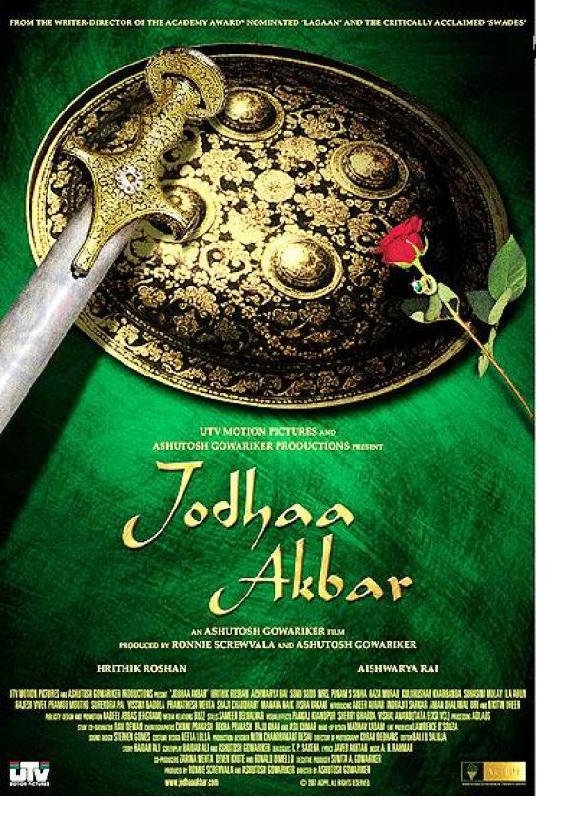
The wait is over. Huge start to the project, lots of opposition from historians, religious controversies, strenuous shoot, massacre at the editing table…It has finally seen the light of the day. And how? Released on the Valentine’s day, the theme of the day blends with the theme of the movie. After having seen how inconsistent Ashutosh Gowariker’s pacing can be in Swades, I started the movie with, I must confess, low expectations. At the end, I had got more than I thought I would.

The theme of Jodhaa Akbar, as one might be tempted to think, is not of Akbar’s ambitions and heritage. Rather, it’s about his softer side that made him fall in love with a totally alien princess and the consequent changes in his political outlook. People tend to equate length to boredom. Gowariker has known this truly and woven a script with Haider Ali that never sags for most part of the movie. Lots of convoluted subplots that are characteristic of the Mughal era definitely aid the movie’s pacing. Special mention should be made to the lyrics and dialogues that not only keep Hindi and Urdu in their native form, but also are made accessible to the common man.

Cinematography for a historic film, obviously needs to be grand and Kiiran Deohans takes care of that. He manages to capture the might of war as well as the strained relationship between the lead pair with utmost care. Gowariker has borrowed cinematic tools from Kurosawa and has used it well especially early on in the movie. However, the editing of the movie leaves a lot to be desired. The editing not only avoids us from sinking into some scenes but also fails in covering up some weak shots especially the fencing scenes. A R Rahman has already delivered the album of the year with Khwaja Mere Khwaja and Inn Lamho Ke Daman Mein being the picks of the album.

Hrithik Roshan, the Leonardo DiCaprio of Bollywood breathes life into Jalaluddin Mohammad and has matured from a being lover boy into a semi-veteran who can play characters with panache. This person is going to be “up there” in the years to come. Aishwarya Rai may not have equaled Hrithik but definitely has done what she was asked to do. The chemistry between these two carries the movie providing both comic relief and script pace. Sonu Sood too has done a wonderful job.

The movie has its own shortcomings with a “too-cinematic” last 20 minutes and weak stunt choreography. Probably the better versions are out there on the cutting table! Jodhaa Akbar is definitely no Mughal-e-Azam, but it does manage to capture the attention of the new millennium.

Verdict:

I usually tune into the channels that play the new movie trailers. Invariably, I would think – “Hey, hold-on. This one looks like a rip off from <Hollywood movie name>. Upon the movie’s release, I would have confirmed that. Johnny Gaddaar didn’t look like an exception. The trailer started off like a heist movie and looked and felt so hollywoodish. I just couldn’t spot the original. After a long time, yesterday, I sat down to watch a Bollywood flick. The next two and a half hours was a power ride I didn’t expect.

Newbie Sriram Raghavan sure looks like he knows his world cinema. He draws a lot of inspiration in the technical aspects from a lot of directors. From Jean Luc Godard’s jump cuts to Stanley Kubrick’s match cuts, from Quentin Tarantino’s use of room space to Soderbergh’s style, from David Lynch’s editing to Alejandro Inarittu’s lighting, the film reminds you of everything. But Raghavan has got his basics right: ” Get the content right, form follows”. With this in mind, he has made such gripping a script, that it makes you wonder if this is the best Bollywood thriller of recent times.

The movie stars off like a regular gang-heist-gone-awry flick with much (intentional) predictability. What follows is told in such a riveting fashion that it feels like something that Bollywood has never tasted before. All the leads have done justice to their roles with no overplay. This proves one thing to Bollywood – you don’t need stars when you have such taut characterization. Sriram Raghavan says NO to all essential Bollywood elements- the item number, revenge, duet songs in exotic locations that come out of thin air and a dozen others. Carefully avoiding sentimentality that plagues even what-could-have-been-great Bollywood thrillers like Humraaz, Raghavan handles emotions without cloying us. I wonder why he chose Shankar-Ehsaan-Loy for the music. He could have used less expensive music directors.

Raghavan pays homage to all the stalwarts of the thriller genre throughout the movie. From James Hadley Chase’s books to Bachchan’s Parwana and Dev Anand’s Johnny Mera Naam. There are numerous references to other directors as well. With a few more scripts like this and a style of his own, Sriram Raghavan can proudly call himself a leading member of the “Indian New Wave”.

In summary, Johnny Gaddaar is a one-man film that is a huge relief from the regular ‘thriller’ films that are made on the constraints of market sales and star values. It has set a new standard for other aspiring directors. Let’s hope it is broken soon !

Verdict:

« Previous Page