Books


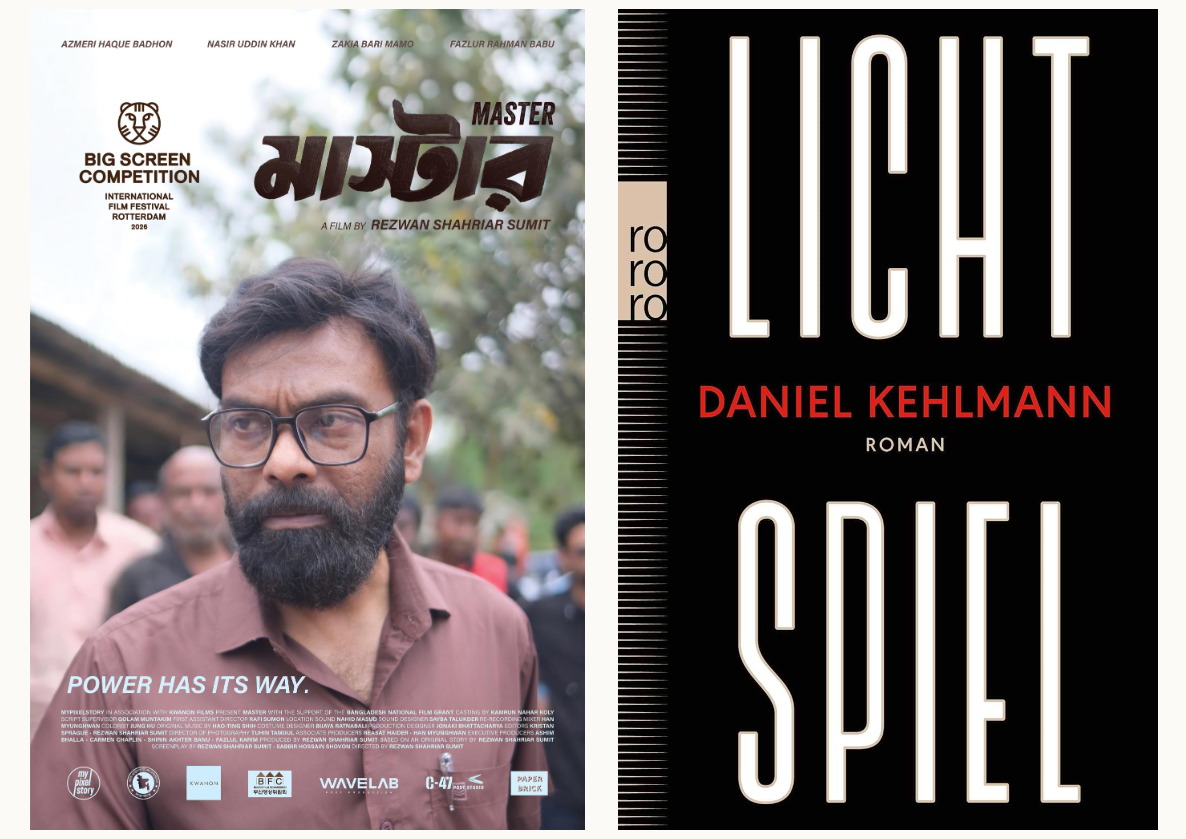
A film about a politician, a novel about a filmmaker. Two works that dissect the nature of power with precision and nuance: Bangladeshi filmmaker Rezwan Shahriar Sumit’s second feature, Master (2026), winner of the Big Screen Competition at the International Film Festival Rotterdam, and Daniel Kehlmann’s 2023 German novel Lichtspiel (also available in English translation as The Director), longlisted for the International Booker Prize 2026.

Master centres on Jahir (Nasir Uddin Khan), a high-school history teacher who runs for the office of the Chairman in Mohangunj, rural Bangladesh. An idealist loved by one and all, Jahir campaigns for the protection of the forests and improvement of living conditions in Mohangunj. His idealism is matched by political acumen, on ample display when, right after winning the election, Jahir visits the rival candidate in a spectacular gesture of bridge-building.

As Chairman, Jahir sets about solving local problems while managing to keep the opportunistic designs of his businessman friends at bay. But soon, the UNO (Upazila Nirbahi Officer, played by Badhon) of his sub-district, a bureaucrat adjacent to Jahir in power and responsible for land acquisition in the area, proposes a plan for the development of a 5-star hotel in Mohangunj. The project, she says, would not only boost tourism, but will also protect the pristine forests that Jahir has been campaigning for. Only hurdle: it would require the clearance of an illegal slum in Mohanjung, whose population forms Jahir’s core electorate.

Jahir feels beholden to the UNO, who, in addition to supporting his campaign promises, also helps with the arrest of a hired thug threatening his life. What the UNO expects from him, in return, is nothing more than inaction, to keep his underlings in check while the slum is cleared by authorities. With great finesse and good faith, Master charts the gradual corruption of Jahir’s ideals. Jahir doesn’t become so much a terrible person drunk on power as someone who convinces himself that what he does is indeed what he wants to do.

Sumit’s nuanced saga of moral loss finds resonance in Kehlmann’s riveting novel. Mixing concrete biographical details with invention and speculation, Lichtspiel recounts the life of renowned German filmmaker Georg Wilhelm Pabst, known at home as “the Red Pabst” for his left-leaning films from the Weimar era such as the Greta Garbo starrer The Joyless Street (1925) and the controversial Brecht adaptation The Threepenny Opera (1931).

Lichtspiel begins in Hollywood in the 1930s, where Pabst’s career has prematurely ended following a box-office disaster. Confused about his future, the director sets out to Austria, with his wife Trude and son Jakob, to meet his bedridden mother, but finds himself stranded in the country after war breaks out. Here, the Pabsts lead a sorry existence under the yoke of Jerzabek, the coarse caretaker their country house who now calls the shots, having become a minor party member after the annexation of Austria. Lifeline arrives in the form of Kuno Krämer, a mid-level functionary responsible for bringing Pabst back into the German movie industry. Following Krämer’s ‘invitation’, Pabst visits Goebbels in Berlin, and it’s not long before he is directing an imposed, albeit apolitical, film project in Munich.

Paracelsus (1943, G.W. Pabst)

Pabst encounters Nazi power at various levels of the society, in various forms of sophistication and at various degrees of remove from the political centre: in the naked cruelty of the working-class Jerzabek, the slimy, white-collar persuasion of Kuno Krämer, the dangerous vanity of Leni Riefenstahl, whom Pabst is assigned to help out with Tiefland (1954), and of course, Goebbels himself. Kehlmann fleshes out these characters with a great deal of wit and humour, never letting us forget that they all relish their power to send their interlocutor to the camps at the snap of a finger.

Kehlmann bestows the narrative with such unrelenting inner necessity that Pabst’s journey into the heart of darkness feels inevitable, that it becomes hard to determine just at what point the director loses his moral bearings. Why did Pabst agree to make films in the Third Reich? Did he really have a choice? After all, his decisions were all made under duress, under the real threat of arrest and deportation. Pabst is defined not so much by his actions as his continuous accommodation to radically altered circumstances.

Throughout his time in the Reich, Pabst holds onto the belief that this nightmare will blow over and that normal life will resume. But it doesn’t perhaps matter what Pabst believed in; that he participated in the rituals of the fascist machinery, that his arm involuntarily went up in response to Nazi salutes, that his lips uttered the accompanying words, even though he never subscribed to any of this sham, is damning enough. What Pabst undergoes during his years in Germany isn’t just an inner exile – a retreat into an unsullied sanctum sanctorum beyond reproach – but a numbing of his moral consciousness, the formation of a self-protective belief that the iniquities around him would be the same even without his participation.

With stunning clarity, Lichtspiel reveals that civilization yields to barbarism precisely because it is civilization. A wryly funny chapter finds a captive English writer named Rupert Wooster (a stand-in for P.G. Wodehouse, who made broadcasts from Berlin radio in exchange for limited freedom as a German detainee) at the gala premiere of Pabst’s Paracelsus (1943) in Salzburg. When Krämer tells the author that they are on the same side, Wooster is outraged. He stands up in protest, preparing to exit the theatre, but takes his seat again because leaving would inconvenience others seated in the row.

Kehlmann lays bare people’s capacity not just for forgetting, but active self-deception when faced with moral quandaries. In his novel, Pabst spends the last phase of his life ruing a lost masterpiece in The Molander Case (1945), whose negatives he loses on a train to Vienna. Adapted from what Pabst judges to be a terrible novel by regime darling Alfred Karrasch, The Molander Case represents for him a difference in degree, an artistic elevation of dubious source material that sets him philosophically apart and rescues him from collaboration. That it remained lost perhaps only reinforced this self-mythology.

Master (2026)

Unlike the filmmaker Pabst, Jahir in Master is in the very business of compromise, saddled as he is with the hard task of finding common ground between competing aspirations and ideals. Sumit’s film remarkably lays out the bargains and quid pro quos involved in day-to-day political decision-making, the ethical tussles involved in solving the most minor of squabbles. Although a tough and cynical work, it doesn’t take the easy way out by demonizing its protagonist. Rather, it unveils his corruption as the very nature of the game.

Master does an equally commendable job of portraying the domestic life of its protagonist, who is incrementally lost to the family as he becomes a public figure. Jahir’s wife Jharna (Zakia Bari Mamo) acts as his conscience keeper, just as Trude does with Pabst, witnessing him succumbing to seemingly harmless enticements of power. After Jahir wins the election, their modest home turns into a veritable public space, with Jharna obliged to ply tea and snacks to everyone who drops by. Trude, on the other hand, experiences her own version of self-censorship when she unwillingly takes part in a Nazi women’s reading club, an echo chamber in which the faintest expression of dissident taste can trigger catastrophic reactions. Over the years, she loses her wits watching Pabst become increasingly self-absorbed to the point of narcissism, preoccupied with nothing more than the completion of his films.

Sumit’s film adopts a pared-back, realist style, observing its characters from up close, but maintaining a degree of objectivity. Lichtspiel, in contrast, presents a highly subjective narrative that unfolds entirely through the perspectives of half-a-dozen characters. There is no authorial comment or editorialization to be found here, very little ambience-setting flab; Kehlmann steps out of the characters’ heads only to describe concrete facts that the characters themselves can perceive. If Master offers a fine-grained character study of novelistic heft, Kehlmann’s novel registers as eminently cinematic, brimming as it does with sharply observed actions and gestures that reveal character and power relations: hands placed on shoulders and elbows, expressing love or threat, glances returned and avoided, telling silences and repetitions in speech, Pabst constantly rubbing his temples, Riefenstahl the actress repeating her movements with robotic precision in every take… It’s a work that cries out for a screen adaptation.

I’m very pleased to announce that my second book, Nainsukh, the Film, has been published by the Museum Rietberg Zürich, under its Artibus Asiae imprint, marking its first ever film-related publication. The book is a monographic exploration of Nainsukh (2010), a semi-biographical film on the eponymous eighteenth-century miniature painter, produced by Eberhard Fischer and directed by Amit Dutta.

Partly an art-historical survey of the development of Pahari painting in Northern India and partly a stylistic, thematic and film-historical investigation into Nainsukh, this compact volume is exquisitely designed and illustrated with hundreds of gorgeous paintings, film stills and photographs from the production. It is a companion piece of sorts to my first book, Modernism by Other Means: The Films of Amit Dutta (2021, Lightcube). Why don’t you pick up both?!


Description

Nainsukh of Guler was an eighteenth-century miniature painter from the hills of Northern India. With his patron, the prince Balwant Singh of Jasrota, this master artist created some of the most refined, delicate works of Indian painting, which seem to have been, in the words of art historian B.N. Goswamy, not painted as much as breathed upon paper.

In 2010, Swiss art historian Eberhard Fischer produced a film titled Nainsukh, an experimental biopic based on Goswamy’s writings on the Guler master. Directed by Amit Dutta, this art-historically rigorous, formally playful screen biography brought the painter’s works to life, offering vivid reimaginations of the circumstances of their making.

Nainsukh, the Film: Still Lives, Moving Images delves into this enchanting, singular work located at the confluence of art and film history. With detailed contextual information, the book accompanies the reader through the world of Nainsukh, illuminating the themes, style and genealogy of one of the most sublime cinematic creations of the twenty-first century.


Links

Museum Rietberg Shop (international shipping)

Amazon India (India only)

[From Luc Moullet’s book with Emmanuel Burdeau and Jean Narboni, Notre Alpin Quotidien (2009, Capricci). See Table of Contents]

In the introduction to the collection of your articles, Piges choisies (from Griffith to Ellroy), you state that your best critical texts are the most recent ones, but that for your films the evolution has not been the same: your best period would cover the years 1976-1989, from Anatomy of a Relationship to Les Sièges de l’Alcazar.

I don’t know. Whether my critical writing is good or not is not very important, at least not as important as it is for my films. The quality of my writing has undoubtedly improved over time; for films I don’t know. Those from 1976-1989 are generally held in higher esteem. And I don’t think there has been a step forward since those years. It’s rather up to you to tell me! I don’t care that much, but well… it’s a feeling. Filmmakers whose work extends over a long period of time often experience a setback at the end of their careers.

In a text from the special issue of Cahiers on John Ford, “The Slide of the Admiral,” you suggest on the contrary that the last shot of his last film, Seven Women, is his most beautiful.

Ford is atypical; Americans generally flag at the end: Hawks, Hitchcock, Nicholas Ray, Anthony Mann, Griffith and many others. There is longevity, circumstances…

Piges choisies also reproduces your unorthodox answer to the Libération survey “Why do you film?”: “To make big bucks, to go on big trips and to meet pretty girls.”

If there is a questionnaire, there necessarily has to be a winner. I wanted to have the best answer. I received a lot of phone calls; my answer made a lot of readers laugh. I think I won. At the time—1987—I was an ascetic figure; I was almost seen as another Straub. I am still seen today as an unadulterated filmmaker who does not compromise. Jansenist, even.

It’s true that I don’t make many complacent films. In order to depress my interlocutors, I often have fun saying that I was forced to make a film to put food on the table. “Ah my poor fellow! What is it called? – Origins of a Meal.” So my reputation for integrity also has a playful side.

I think the answer would have been even funnier had it been given by Straub or Bresson. I had phoned Bresson to suggest it, but he took it badly.

My answer, moreover, corresponds to reality, or at least to certain aspects of reality. It was not for nothing, for example, that my first films always had two actresses in the lead roles. I was single, my chances were multiplied by two. I have to admit that it was a very bad calculation.

Did you put them in competition with each other?

I didn’t go that far, but two chances are better than one, or zero.

When you were writing at Cahiers, Rohmer once made this strange remark, which you also recall in Piges choisies: “Moullet, I know why you love Buñuel. It’s because you’re both slackers.”

This is the most beautiful compliment I have ever received. Rohmer put me in the same boat as Buñuel, without kissing up to him for all that, since he presented his comparison as a kind of insult. He didn’t realize the compliment he was paying me, I thought. I don’t know if he would repeat the compliment today, even if his appreciation of Buñuel has become more positive.

“Slacker” in what sense? The rejection of rhetoric, mannerism, everything that makes cinema?

A certain zero degree, once again. That’s what Rohmer meant, in a sense. Buñuel didn’t have a visual structure like Murnau or Eisenstein. He is therefore a slacker. And so am I…

Do you consider yourself a slacker?

Of course. That is, in any case, the evolution of cinema. In the silent era, everything was structured around the frame. With talkies, filmmaking became more subtle, more composite, less determined on the level of pictorial construction. The composition of a discreet whole, chiselled in the manner of Murnau’s genius, became outdated. Those who want to make films like Eisenstein today are, moreover, admen, or very retrograde directors.

(more…)

[From Luc Moullet’s book with Emmanuel Burdeau and Jean Narboni, Notre Alpin Quotidien (2009, Capricci). See Table of Contents]

Brigitte and Brigitte (1966)

There are no hard-and-fast rules, only useful guidelines. Every law must be bent, that’s the only obligation—and that’s precisely what can be great in cinema. Nine times out of ten, what is taught in film schools today is in fact the opposite of what was taught sixty years ago.

Two illustrations as a preamble and a warning:

  • It was once forbidden to move directly from a wide shot to a close-up. This rule is palpable in a film I like very much, Children of Paradise: it systematically uses an annoying—and seemingly forced—gradation between the shot sizes. Today, however, the transition from the wide shot to the close-up works magnificently, provided it is well managed, even if some filmmakers abuse it, starting with Sergio Leone.
  • The 180-degree rule prohibits crossing the shot-reverse shot line so that the viewer isn’t disoriented. But the truth is that it all depends on the actor. With Jeanne Moreau, Brigitte Bardot or John Wayne, you can blithely cross the 180-degree line, because the actor is known and well placed, like a pillar: he or she serves as a visual reference. It is much more difficult with beginners whom no one knows, lack as they do a stable facial reference in the frame.

Like a majority of the technical rules in use, this is also a strictly western law. The Japanese constantly break the shot-reverse shot line; for them the problem does not arise. Imagine: had Japan won the war, that would have been the end of 180 degrees!

This is true of almost all laws: they are dependent on history or geography. None of them is indisputable or eternal. You just have to be aware of the risk you are taking when you decide to apply them. Or not apply them! Conscious of this risk, I have chosen to include in the vade mecum that follows the objections that have been made or that could be made to me. Also those that will be made, no doubt.


Production, Generalities

The plumber principle (choose a title starting with A or B)

Open the phone book, all plumbers have a shop name that starts with A. They all sit at the top of the directory. Being at the top of catalogues is important, because festival catalogues play a big role. All catalogues for that matter. You can’t always do it, but it is recommended, especially for short films. Maybe there will soon be a rush of short films starting with AAA, as with plumbers.

I can already hear the first objection. My first short, Un steack trop cuit (1960), is not exactly at the top of the alphabet: an error of youth, sorry. As for the following ones, Ma première brasse (1981), Essai d’ouverture (1988), Le Ventre de l’Amérique, Le Système Zsygmondy (2000) etc., they are a bit all over; that’s because, with time, I’ve become surer of myself.

(more…)

[From Luc Moullet’s book with Emmanuel Burdeau and Jean Narboni, Notre Alpin Quotidien (2009, Capricci). See Table of Contents]

Just as tales—which we’ll come back to later, since the genre isn’t foreign to your cinema—begin in French with “Il était une fois…” (once upon a time…), we’d like to begin with “Il était un Foix…,” In 1994, you made a short film that bears this name, a small town in the Pyrenees. Foix is a film representative of your work; it is built on a geographical principle that you are fond of: to sketch a nearly exhaustive portrait of a place, to wander across it and survey it in all directions until its spatial, comic, dramatic and aesthetic possibilities are exhausted. But in general, you film familiar places, places that you have known and loved for a long time. In Foix, it is the opposite, and that is also why we wanted to start there: you present a completely ugly city, its ugliness accentuated by the laconic irony of a tourist-style voice-over. Foix is therefore a film against something, a negative portrait. It is the exception to one of the rules of your work, a contradiction within a work that has no shortage of them. How did the film come to be?

It must have been 17 September 1973, shortly after Allende’s fall. I was walking in the Pyrenees with my wife. When we stayed the night in Foix, we both had the feeling that we had discovered the most backward town in France. For the next twenty years, I travelled around the country to gather several proofs of this stellar backwardness. I didn’t do just that for twenty years, but I did that. I could see that, yes, this town was the champion in this regard. The script had time to mature: more than twenty years of work for a thirteen-minute short film.

Invited by Toulouse for a conference, I made a detour to see Foix again. It was a painful experience. From Toulouse, I wanted to go up to the Montagne Noire, where I hadn’t been before. I had to leave early, at seven o’clock. At the station, I stumbled on the new pavements, which are a bit slanted. I hurt my foot very badly. I travelled for 30 kilometres with a huge abscess on my toe. The right, I think. I delivered my lecture and then I went to the hospital the next morning to have the abscess removed. In the afternoon, I went to Foix. Because of my foot, I could scout it only slowly. The town was almost in the same state that I had left it twenty years earlier. It was really typical, very impressive. I don’t think it’s possible to go this far into degeneration. It’s quite a nice town in itself: there’s a chateau, it’s well situated. But you can sense that there has been no real town planning. It’s a complete mess.

Based on the photos that I had taken, I submitted a project to the CNC [National Centre for Cinema] for support with the short film. In photos with cars, I scratched out the two digits pertaining to Ariège region. Worried about a leak, I rechristened the project Vesoul. I added that the film would not be shot there, without specifying where. I thought that the people at the CNC would be keen to know where I would shoot, and that they would give me the money to find out. That’s what happened. We got the grant. We did a combined shoot, which is very cost-effective: I shot Toujours plus, which ended in Toulouse, and in the evening, we went to Foix to shoot Foix. The shoot went on for about three days. There was only one minor problem: Toujours plus being a TV film, we shot at twenty-five frames; but my sound engineer continued to record at twenty-five frames for Foix, instead of twenty-four, the normal frame rate for a cinema film.

Many people and institutions are thanked in the credits. Did the production actually involve them, or was it out of caution?

Not out of caution. It was to make the viewer laugh. I asked the town hall and the police for some little things so that I could put them in the credits. “I thank the town of Foix very much…” That’s funny.

Did the city respond?

Not directly, except on the day the film was shown on TV. The town hall phoned the production manager, who acted as a buffer. They couldn’t say anything, I hadn’t asked them for money. The town hall had done only one thing: turn on the little geysers on the ground—these “watering limbs” that make the water come out thirty centimetres from the ground—which only work in summer, whereas the shooting took place in winter.

Was the idea of the fake tourist documentary there from the outset?

The idea was inspired by Georges Franju’s Hôtel des Invalides, a film commissioned by the army that made everyone laugh. Well, almost everyone… As it was a short film, Foix was practically written down to the last detail. It’s tiring to draw up a complete découpage for a feature film. On the contrary, for a short documentary, it’s fun to do it, and it pleases the producer, who incidentally hadn’t invested a lot of money, since there was money from the Centre for Cinema. In these towns, everyone is happy when you come to shoot. No one comes to shoot in Foix. One day, I filmed in Toulouse, in the largest supermarket in the world. There were ninety-four counters. I was warmly received; at the end, we were even offered champagne. It’s rather in Paris that one can feel unwelcome. Everybody comes to shoot there; people are suspicious, they have had it up to here.

Did you go back to Foix?

I saw the city from the train. I’ve bought a Ray-Ban since then, so I might try to go back there. My face has changed a bit, I’ve lost hair. I should stop by the town someday.

(more…)

[The following is a translation of Luc Moullet’s book with Emmanuel Burdeau and Jean Narboni, Notre Alpin Quotidien (“Our Daily Alpinist”, 2009, Capricci). The images are my addition; the original volume contains none.]

Maps and Habitats

Every Law Must Be Bent (Vade Mecum)

Heights and Chances

[The following is a translation of Luc Moullet’s short monograph Luis Buñuel (1957), the fifth volume in the series Les Grands Créateurs du Cinéma, published bimonthly by the Club du Livre de Cinéma in Brussels. I’m extremely grateful to Samuel Bréan for finding me a copy of this rare volume.]


Contradiction is the root of all movement and vitality; it is only in so far as something has a contradiction within it that it moves, has an urge and activity.

– Hegel

In our time, in our era of blockbusters and epic films, Luis Buñuel’s work and career stand out. While the vast majority of important filmmakers choose to marry art and commerce, with varying degrees of success, Buñuel confines himself to low-budget ventures, just like Roberto Rossellini. He thus enjoys a great deal of freedom: producers’ interference is limited to the choice of subject, which is generally very banal, and to the development of the script. The filmmaker imposes the expression of a highly distinct personality on such weak material. El río y la muerte (The River and the Death) was completed in fourteen days; technically it is superior to many French films, and in terms of quality, it has nothing to envy most of Buñuel’s great works. Like a novelist, the maker of L’Âge d’Or and El (This Strange Passion) works for his own pleasure; that is why the most mediocre of his offspring, the most industrial of his films, still bear his mark. This is a kind of miracle that cinema is not familiar with.


The Surrealist Experiment

One of the main constants in Buñuel’s work has often been explained using his Spanish origin. I’m referring to his taste for cruelty and violence, which also throw light on the inclinations of his personality. He was born at the dawn of this century, on 22 February 1900, in a small town in Aragon, Calanda, located on the edge of the famous Sierra de Teruel. After spending ten years at a Jesuit school, he left his provincial bourgeois parents for the University of Madrid, where he studied science, particularly neurology: physiological phenomena had always captivated him, as had the life of animals. But the Castilian capital attracted him towards less studious pursuits. He enjoyed idleness and led a merry and dissipated life. This is how he became friends with two of the greatest creators of twentieth-century Spain, Federico García Lorca, the poet, and Salvador Dali, the painter, who were then young unruly students. Buñuel’s films retain some of Lorca’s tragic lyricism and, above all, Dalí’s phantasmagoria.

Un Chien Andalou (1929)

Our young man was soon to be found in Paris, where he worked as a scientific attaché. But he was interested in many other things. Dali, who lived on the banks of the Seine, introduced him to the Surrealist Movement, in which Buñuel discovered an equivalent to his taste for the unusual. Cinema seemed to him to be the best means of expression, one that allows one to show the most amazing aspects of reality. After a first script, written from a surrealist perspective, which he could never shoot for lack of means, he took technical lessons, a trial run for Un Chien Andalou (1928). This small, fifteen-minute silent film made a great impression at the time and is still the biggest hit at film clubs today. The story, written by Dali and Buñuel, doesn’t follow any logical rule; underlying the main plot, a love story, are a series of extraordinary visuals of the purest surrealist tradition: the enormous living room piano stained with the blood of rotting donkeys, to which two seminarians are attached. The virtuosity, the unbridled inventiveness belonged as much to Buñuel as to Dali. And yet the director parted ways with his friend, whom he accused of seeking scandal for the sake of scandal. The next film, L’Âge d’Or (1930), which Buñuel made for a patron, continued the experiments of Un Chien Andalou while respecting factual logic more closely. This time, the scandal was huge: the precision and realism highlighted the filmmaker’s multiple attacks on society and religion, which he said impeded the power of love. Buñuel went from surrealism to documentary with Land Without Bread (1932), a poignant account of the region in Spain called Las Hurdes, one of the most backward and poorest parts of Europe after the Grésivaudan, Slovakia and Haute-Provence. Buñuel went ahead with the same talent, the same critical eye towards modern civilisation, whose most ignoble aspects he unveiled. At first sight, the rigour and honesty of the work contrasted with the fanatic Manichaeism of L’Âge d’Or: but in many beautiful visuals (the donkey devoured by flies, the portrait of idiots), there is that astonishing sensitivity partly inherited from his contact with surrealism.

But the time of patrons and small productions that one could finance oneself was soon over. For fifteen years, Luis Buñuel worked in cinema without making any films. This period of silence was important in its own right: faced with life and its difficulties, the maker of Land Without Bread evolved markedly; with maturity, he moved from revolt to reflection. That is how he was able to resume a body of work that was thought to be prematurely finished: recent films such as Los Olvidados or El are even considered to be of a much higher quality than those of the surrealist period. In charge of dubbing films in Paris, Madrid — where he moved on to production — and Hollywood, a bureaucrat, then a speaker in the United States, Buñuel finally left Los Angeles in 1947 for Mexico City with a very ambitious project in the bag: The House of Bernarda Alba, based on Lorca’s play, which he didn’t finally shoot.


(more…)

[From Luc Moullet’s monograph King Vidor’s The Fountainhead (2009, Yellow Now). See Table of Contents]

In the United States


The reception of the film by the American press was negative.

Variety (24/6/1949) found the film “cold, unemotional, talkative,” and lamented the overacting: “Underplaying would have served the story better.” The choice of Cooper was deemed “a casting error. Neal is a whimsical heroine. She hasn’t adapted herself to the demands of the screen.” The implication is that she’s just a stage actress.

For Harrison’s Reports (2/7/1949), “the characters are unreal. The subject is a series of digressions,” there is “a whole philosophical salad that average people don’t understand; […] motivations get lost in a maze of blur.”

In the New York Times (9/7/1949), the famous Bosley Crowther, the Ellsworth Toohey of cinema, who called the shots at the time, found the right catchphrase: “A picture you don’t even have to see to disbelieve.” About the explosion, he concluded: “If all were excused such transgressions, then society would indeed be in peril! … high-priced twaddle we haven’t seen for a long, long time.” Roark’s buildings, “from what we see of it, is trash.” The story is “a complex of bickering and badgering among these cheerless folk.”

Easy prejudices, all the more so as Patricia Neal plays mainly with her eyes, which doesn’t belong as much in the theatre, given the distance of the audience. And Cooper was typecast by the critics as a cowboy, although he had already played, in Peter Ibbetson, an architect quite similar to Roark.

Archer Winsten of the New York Post even declared that “intellectually, Vidor is a simpleton.”

The American critics of the time were confined to their own small domain. They knew nothing about architecture and not much about literature. They hadn’t read the novel: eighteen hours of reading…

They were known for their mediocrity and had castigated many great films, Under Capricorn, On Dangerous Ground, Good Sam, Moonfleet etc…

The paradox is that The Fountainhead is a very American film in its search for effects. The opposite of a Mizoguchi, a champion of whittling, who seeks to conceal all effects, Vidor offers them to be seen full screen. If only one film from the whole of Hollywood production had to be preserved, it would be this one. It is so Hollywoodish that it seems to become a caricature of it, which is what the critics must have felt.

It was a rather expensive film (four times the budget of Ruby Gentry), and it made a loss (about $2,100,000 in revenue against a cost of $2,511,000, not including the cost of prints). This is hardly less than the $3,100,000 of epics such as Samson and Delilah or Land of the Pharaohs.

According to Warner and Ayn Rand, the film worked better with the middle classes, and in the suburbs, than with the intellectuals, whom it was principally intended for.

This commercial failure explains Vidor’s reservations about The Fountainhead. In Hollywood, it was in a filmmaker’s interests to not defend one of his children that did not please the public. The producers accepted quite readily that a director could have a failure—one, but not two or three in a row. You can’t always get it right. But you couldn’t transgress the old adage: “The public is never wrong.” And a mea culpa was always welcome in these puritanical lands…

Vidor does not say a word about The Fountainhead in his autobiography. As mentioned earlier, he may have preferred casting Bogart over Cooper. But when I met him, I began to enthusiastically defend the choice of Cooper, and he told me then that I was probably right. It’s hard to prove your interviewer wrong when he says a lot of good things about your work. And in life, King Vidor was a quiet, awkward, welcoming man, a kind of good, diligent student. Just the opposite of his films. In contrast, his French counterpart Abel Gance was really at one with his work, Vidor was inclined to sort things out rather than get into conflict all the time. He was successful in life and work, and had no need to court controversy.

The only point on which he objected to the film for a very long time was the final explosion.

It’s true that it can be a good tactic for a director to speak ill of one of his films, at least in interviews given long after its theatrical release. The interlocutor will be embarrassed, and will tend to reassure such a modest filmmaker. This is a welcome change from all those directors who think of their new-borns as the greatest of masterpieces. I have sometimes practised this method myself, with success.

The end of The Fountainhead is perhaps stupid and ridiculous, as Vidor said in 1962, especially since no architect in the world, to my knowledge, has practised this kind of dynamiting. But it fits perfectly into a work that is not based on plausibility. There is a bigger-than-life aspect to this film.

Let’s not pay too much heed to the author’s word, even and especially if he is great. Pialat, Ulmer, Losey, DeMille, Lara have said a lot of stupid things about their films too. Vidor defended Grease and Monicelli’s Proibito. And let’s not forget—in times when there are many interviews—that it’s boring to always say (or even to think) the same thing. I have experienced this.

More recently, Vidor has begun an about-face: “I don’t want to advocate destruction as a means of enforcing an artist’s integrity. But it’s part of his work. It has been said that sometimes destruction is just a new construction, two sides of the same thing.”[1]

At the end of his life, a little disillusioned by his forced retirement, he even declared: “At the time the film was made, I felt that the hero’s gesture was excessive, I’m not so sure about that today.”[2]

(more…)

[From Luc Moullet’s monograph King Vidor’s The Fountainhead (2009, Yellow Now). See Table of Contents]

The Excess That Transcends


Vidor’s craft here is based on excess, an excess that is to be found in the nature of the actions as well as in the characters, which are extremely complex or extremely linear. All this is redoubled by the excesses of an ultra-fast pacing and of techniques used to the fullest extent on every front. Vidor doesn’t deal in half-measures. It’s a series of contradictory phrases that crash into each other, of pointed tips, jagged edges and uninterrupted electric shocks. Here is a clever, knowledgeable, hyper-professional film, but also one that is abrupt, brutal, coarse, chopped, condensed, convulsive, crazy, delirious, discreet, electrifying, fascinating, frenetic, hysterical, icy, rough, scathing, shredded, surreal, torrid, hectic. A barbaric object, a meteorite. The emotion it generates gives you goosebumps. A runaway horse. Pomposity looms large in the end, but is transcended by its very excess.

Vidor employs EVERY classical device—the perfect film for film schools. It’s Duvivier, Delannoy, plus genius. And finally, it’s this shameless accumulation of old effects (there are even superimpositions, blur effects and an abundance of transparencies) that makes it extremely modern. Vidor doesn’t linger on effects like so many others. They are quick, very obvious, and they blow us away. A comparison may be possible with the Fuller of Verboten!, Forty Guns, and Shock Corridor, with a lot more money, or even with Aldrich.

What is strange is that the film combines the Baroque and the flamboyant Gothic, while it’s meant to praise the architect Roark, whose art is quite the opposite, with its search for simplicity and purity, associated with the modernity of America. Roark—and Frank Lloyd Wright even more so—rejects fuss, European influences, Greek art, the Victorian or Tudor style, whereas here we find German expressionism, with the complicity of an Austrian musician and a Russian screenwriter.

We can sense Vidor’s frustration with his previous clients who had deceived him, taken advantage of him. And here he is pulling out all the stops, as they say.

But at the same time, The Fountainhead cuts across a whole tradition of classic American cinema.

It’s highly reminiscent of Frank Capra’s films, with the struggle of an asocial, marginal or lone man against the whole system and its prejudices, as seen in Mr. Smith Goes to Washington, It’s a Wonderful Life, Meet John Doe and Mr. Deeds Goes to Town. These last two films, moreover, starred Gary Cooper.

The commercial failure of The Fountainhead in the USA can be explained to some extent by the fact that this formula, which had worked well until 1940, seemed outdated after the war. It’s a Wonderful Life (1946) resulted in a small loss. And Gary Cooper as the Good Samaritan in Good Sam (McCarey, 1948) wasn’t a success at all.

As with Capra, it seems like a lost cause for the lone man, but the almost miraculous ending allows him to amend the situation. A critique of the society doesn’t keep the great American principles from standing up for the cause of the good in the end. The Best Years of Our Lives (William Wyler, 1946) denounces the unscrupulous opportunism of bankers too, but rest assured, everything turns out well.

We find here one of the figures of style dear to Capra, the montage sequence where, after a string of quick shots of newspaper cuttings, we witness the violent reactions of the crowd in the street.

Another direct link with American films of the great tradition is the choice of the biopic, the life story of an important man, real or imagined, which we find in Citizen Kane (1940), Sergeant York (Hawks, 1941), Wood’s The Pride of the Yankees (1942) and The Stratton Story (1949), the two Al Jolson biopics etc. Gary Cooper was, besides, the specialist of the genre.

There is also the principle of rise and fall, greatness and decadence, which mark the itinerary of Gail Wynand, Henry Cameron, and also Howard Roark, who comes close to being jailed, although he finally triumphs. All of them having started from nothing, of course. The pervasive myth of the self-made man, very common in American cinema.

(more…)

[From Luc Moullet’s monograph King Vidor’s The Fountainhead (2009, Yellow Now). See Table of Contents]

In The Fountainhead in particular, Vidor expresses himself on all creative fronts, unlike a Hawks, a Chaplin or a Capra who neglect photography a little, a Nicholas Ray who is not good at editing, a Cassavetes who doesn’t care about music or the sets. This versatility obviously tries to make us forget the literary origin of the work, to absorb it.

Vidor is a complete filmmaker who plays on all sides. He cares very much about the visuals (he started painting in 1938), the music (he owned five guitars), the sound (Hallelujah was the first film to really use the capacities of sound), the rhythm and editing (The Big Parade was shot with a metronome) and the sets.

How does that translate here?

Sound

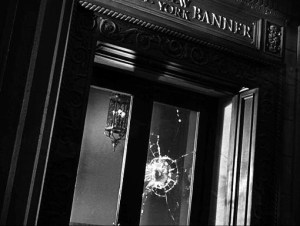
It is the element that one notices right away and which produces the first striking effects of the film. After the first scenes in which Roark successively confronts the dean of the school, Peter Keating and the old architect, scathing in their speed and the haunting verbosity of these secondary characters, we receive the first shock: the architect Henry Cameron breaks the bay window of Roark’s office with a T-square, with a totally unexpected violence, with no obvious reason—it’s a friend’s office—but as if to symbolically break up the buildings in front of him. There are thus multiple sonic assaults that punctuate the film right up to the last scene: another window broken with a stone, at the door of the hated newspaper (an effect that will be repeated in Ruby Gentry, when the whole town rises up against the heroine suspected of murder), the many sirens, that of the ambulance rushing towards the hospital, that of the boat, that of the police car at the exit of Wynand’s wedding (what is it doing there? It seems an unlikely presence to me), the model of the building that Wynand hurls down suddenly, the one knocked down with a cane by the architect who corrects the Cortlandt building, the statuette that falls to the ground, thrown from the tenth floor, the newspapers torn angrily, the boat violently splitting the waves, the work of the drilling machine in the quarry, the marble under the chimney that Dominique breaks frantically, the off-screen blast when we arrive at Dominique’s country house, announcing the final blast. There is an erotic vertigo around breakage and explosion, seemingly translating Dominique rush of desire, like an inner cry from her body. Love = Breakage = Destruction, which is reminiscent of the Eros/Thanatos of Duel in the Sun, and which clearly shows the necessity of the final explosion. Do these sounds recall the sounds of orgasm? Perhaps.

These noises sound all the more aggressive as they are unexpected. Two seconds before their appearance, we can’t imagine them entering the soundtrack. They make you feel uncomfortable. One of them—the statuette falling to the ground—is anticipated by an astonishing echo, occurring earlier, that owes to Steiner’s music.

(more…)

Next Page »