
Is it possible to say anything about this world-historical year without some amount of preliminary hand-wringing? Culture writers, film critics included, appear to feel obliged to present their bona fides, to relativize their work in view of the pandemic and to pre-empt any accusations of frivolity. We are already masters at the art; it is, after all, a profession that hits you with the question of relevance every single day. The silver lining, if one can call it that, in this catastrophe that has touched every person on the planet may be that barely any other pursuit seems any more relevant. Here’s to all those who lost their lives to the virus, to those who have been fighting to save us, and to those who haven’t lost sight of causes for justice, peace and compassion amid the global health crisis.
The enormous impact of the pandemic on film production, distribution and exhibition has been obvious. Streaming giants, namely Netflix, Amazon and Disney, who have been successful at vertical integration in the past few years (and are poised to go even further), seem to be the biggest gainers from this disruption. Whatever their claim about increase in consumer choice, it seems to me that it hasn’t really resulted in a diversity of viewing patterns. (Consider, for instance, the Sight & Sound critics’ poll: the 2019 edition had a total of 353 films chosen by 100 contributors whereas the 2020 version has 353 films from 104 contributors—hardly a sign of a paradigm shift.) Given their subscription model, these firms have every incentive to pump more and more money into marketing and hog the discourse. If this annus horribilis has proved anything, it’s that publications are more than willing to bend over and serve as unaffiliated PR organs for these companies.
While the cancelling of film festivals across the world was unfortunate, it gave publications and critics an unprecedented opportunity to bypass traditional tastemakers and widen their horizons. Considering that so many organizations, by generosity or lack of choice, presented their programs online for international viewers for the first time, it was an invaluable chance for film journalists to let their readers know that there was good, smart, moving and entertaining work—old and new—available outside of subscription walls and subcultural echo chambers they have themselves helped create. To my limited knowledge, this opportunity was squandered. Publications, predictably, saw their task as giving readers “what they want” instead of elevating them.
My own viewing this year was dominated by older films. Thanks to torrent archives and illegal websites, which are seemingly the only platforms making any effort to save and make older work accessible, I had the privilege of seeing countless great works from across decades and across the globe. Watching dozens of films by William A. Wellman, Luc Moullet and Alfred Hitchcock, most of which are available for free online, remain especially fond memories (Waltzes from Vienna (1934) and The Man Who Knew Too Much (1934) are top-drawer works!). I had great fun writing about some of them for my classical Hollywood column until it was scrapped in June.
Of the 130-odd new films I saw this year (of which three in theatres), I found no masterpieces, several accomplished works amidst a sea of middling-to-uninteresting efforts. (Shoutout to Malmkrog, Siberia and The Last City for plunging into territory conventionally considered bad taste and coming out trumps.) What I sense is that, thanks to cheap digital media, more and more independent and experimental filmmakers are simply documenting every aspect of their lives, amassing vast amounts of footage without any specific purpose in mind, and reusing them when a chance arises. With the production halt of 2020, I suspect this habit will only be more apparent in the coming months. While that is certainly a valid method of working, I can’t help but feel that so many films I saw this year came across like half-cooked soups, disparate material thrown together with the hope that it will all, somehow, result in poetry—one reason why works on this list, with their rigour, intelligence and feeling, stand out in my mind.
1. Hopper/Welles (Orson Welles, USA)
 I’ve had no greater screen delight this year than watching two white dudes chat for two hours. Orson Welles and Dennis Hopper hole up in a dark room with half a dozen technicians to talk filmmaking, politics, religion, love, magic, news, television and literature while dutiful assistants scurry about readying one refill of liquor for them after another. Welles plays the Grand Inquisitor, pressing his timid interlocutor to state his artistic and political beliefs, conjuring theories to counter him and never allowing him a resting ground. We never see him, save for rare glimpses of his bellowing pin-striped trousers moving at the edge of the frame. As Hopper’s cinematic forefather, Welles looms large, appearing to be incarnating some kind of metaphysical force, orchestrating a Kafkaesque trial for the young man. What results is a stark power imbalance between the seen and the unseen, the subject and the author, the one who is recorded and the one who wields the camera. But the primary pleasure of the film lies in seeing two artists in a terribly absorbing conversation, grappling with the cinematic-aesthetic problems of their time. Going public after fifty years, Hopper/Welles is both a standalone film and an anniversary celebration. It hasn’t dated one bit.
2. Forensickness (Chloé Galibert-Laîné, France/Germany)
 Chloé Galibert-Laîné’s funny, sharp and dizzyingly smart video work begins as a commentary on Chris Kennedy’s Watching the Detectives (2017), a desktop film about the crowd-sourced investigation on Reddit following the Boston bombing of 2013. As the director breaks down Kennedy’s film, analysing its narrative construction and its tendency for geometric abstraction, she voluntarily gets caught in an ‘analytical frenzy’, not unlike the Redditors themselves. As Galibert-Laîné seamlessly chains one stream of thought after another, her film evolves into a meta-reflection on our relation to images and our compulsion to create meaning from visual material. If Just Don’t Think I’ll Scream (2019) saw cinephilia as a self-made prison of images, Forensickness digs deeper, revealing the epistemological malaise that is the search for meaning that animates all cinephilic pursuit. Her film lays bare the adventures of the critical mind, throwing open not only its own making, but also the thoughts producing it. Forensickness may look like an object of pure play, the result of a filmmaker “seduced by her own jokes”, even a solipsistic game in the way it asserts the inescapability from these self-imposed maps of meaning, but this magnificent work is unmistakably insightful regarding the way we make sense of the world through images.
3. A Machine to Live In (Yoni Goldstein & Meredith Zielke, USA/Brazil)
 What remains of the modernist dream of reshaping human societies from the ground up based on scientific, rationalist principles? Goldstein and Zielke’s ambitious, erudite and formally complex city symphony seeks to find out. Its subject is Brasilia, the artificially created capital of Brazil that architects Oscar Niemeyer and Lúcio Costa forged out of the wilderness in the late fifties. The imposing geometric forms of the city, expressly conceived in cosmic terms and perfected like Kubrickian monoliths from outer space, appear to have all but snuffed out human presence. Machine sees this city as an otherworldly geography unfit for human life, but also allowing the possibilities of imagining utopias, catholic cultists, freemasons, biker gangs and Esperanto evangelists all finding a home within Brasilia’s orbit. Employing heterogenous narrative modes, Goldstein and Zielke develop a visually striking portrait of a city that has come to resemble a religious monument in itself, demanding awestruck worship and constant maintenance by people who can’t afford to live here. Their Brasilia is either a place that inspires dreams of reimagining life or an abyss where dreams come to die. Even as it looks back at a moment in modern intellectual history, Machine evokes questions about the future, inviting us to reflect on the eternal human desire to play demiurge.
4. The Disciple (Chaitanya Tamhane, India)
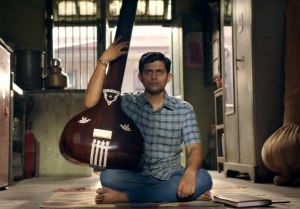 Tamhane’s superb second film feels like home territory for him. Sharad, an apprentice Hindustani music singer, is not the greatest of talents, but imagines himself as part of a tradition, one that gives a structural meaning to his life. But, the promise of omnipresence and instant gratification of the modern world beckoning him, not only does he find himself unable to live up to the lofty ideals of his tradition, he’s also is gradually disabused of these ideals themselves. In a very direct manner, The Disciple zeroes in on a fundamental, civilizational sentiment that underpins artistic succession in the subcontinent: that of filial piety, as opposed to the parricidal narrative that informs the Western conception of self-realization. Even when his faith has been questioned, Sharad continues to serve his elderly teacher, caring for him till the final days, like icon worshippers who hold on to their idols even (and especially) when the meaning behind them is lost. Tamhane builds up gradually to this assault on Sharad’s worldview, with humour, suspense and a calculated formal reserve that redoubles the impact of the emotional violence. His film invites viewers to constantly process narrative information in order to access it, providing a rich dividend for the effort.
5. Unusual Summer (Kamal Aljafari, Palestine)
 In Unusual Summer, Aljafari repurposes CCTV tapes that his father left behind after his death in 2015. The tapes are from the summer of 2006 and were used record the parking spot outside his home to see who’s been breaking the car window. Despite the dramatic promises of the CCTV aesthetic and the location of the house in the crime-ridden district of Ramla, what we get in this film are quotidian incidents, sightings of neighbours passing by, the picture of a town going about everyday business. Aljafari adds a sparse ambient soundtrack that imparts Tati-esque colour to the proceedings, with the passers-by on screen becoming veritable characters. This transformation of private surveillance footage into a session of window-watching and people-spotting produces a feeling of community and forges a relation of inheritance between the filmmaker and his father, the only two people to have seen these tapes. Supremely calming though it is, Unusual Summer is also seared by loss and mourning, the familiar faces, places, animals and trees that register like spectral presences on the lo-fi video having vanished in the intervening years following intrusions by the Israeli state. A minimalist gem that speaks to our now-amplified urge to reach out to others.
6. The Game of Shifting Mirrors (Amit Dutta, India)
 Dutta’s richly dialectical new film draws out themes from Chitrashala and Finished/Unfinished (both 2015) and puts them in a stimulating new conversation. The first section, set in the Chhatrapati Shivaji Maharaj museum in Mumbai, jumps across artefacts from several centuries while a voiceover describes an encounter with tribal artists and paintings. This contrast between the linear time and historical narrative of the British-era museum and the mythical worldview underpinning ‘indigenous’ art is given a third dimension by the film’s latter section that showcases the 8th century rock-cut temples of Masrur. Like tribal art, the temple complex has a founding myth that departs from the rigorously documented secular accounts of archaeological practice. As the industrial working hours of the first section make way for a day-night cycle, we observe the complex’s sculptural reliefs that have been partially eroded by nature. The film’s evocative organization then embodies an ambivalence towards museological conservation: while modern museums salvage art from natural degradation for the benefit of posterity, they wrench objects out of their original context, severing them from the knowledge systems and traditions that gave birth to them. In its fruitful frictions, Game suggests that perhaps all preservation necessarily entails a loss.
7. Bloody Nose, Empty Pockets (Bill Ross IV & Turner Ross, USA)
 The Ross brothers’ new docuficion follows the last day of operation of The Roaring 20s, a downscale bar fictionally set in Las Vegas, at which a bevy of social castaways gather to mourn and celebrate. While all the actors play themselves, the filmmakers loosely fictionalize the scenario, giving direction to it with certain pertinent themes. Set against the backdrop of collapsing American businesses, Bloody Nose is a hymn for failure, a note of solidarity to what the American lexicon calls “losers”. The Roaring 20s is the opposite of everything one associates with the glitz and glamour of Sin City: it’s a floundering venture that is the negative image of the American Dream. For its regulars, however, the bar is something of an institution that provides them with a public (and, at times, private) space that has become scarce elsewhere and where they can be themselves. The film’s broader view of class is compounded by a specific generational perspective that refutes the idea that the young, the ‘millennials’, can’t make it because they don’t work hard enough. A film that hits the right moods without tipping over into condescension or miserabilism, Bloody Nose deserves all the plaudits it’s been getting.
8. Corporate Accountability (Jonathan Perel, Argentina)
 Perel continues his exploration into Argentina’s military dictatorship by examining the role of large private corporations in enabling and carrying out state-sponsored pogroms against political dissidents of the junta. He photographs the company facilities as they are today while a brisk voiceover lists out how each firm helped military and security forces detain, torture and get rid of problematic workers in exchange for financial perks. The text, read out from an official 2015 report, is numbingly repetitious, and drives home the pervasiveness of these military-industrial operations. Perel’s decision to frame the sites through his car’s windshield creates a sense of illicit access, even though there is visibly little stopping him from going nearer the facilities. Some of the companies continue to operate under their own name, while some others have changed, with at least one site carrying a memorial sign for the injustice perpetrated there. Perel is, in effect, photographing the ur-filmic image of factory entrances, but all we see is a handful of vehicles leaving the gates. This eerie absence of human figures evokes the disappeared workers who, at some companies, were picked up at the entrance, a site, as Harun Farocki has demonstrated, of class dialectics. A tough nut, but wholly rewarding.
9. Film About a Father Who (Lynne Sachs, USA)
 Lynne Sachs’ frank, morally messy documentary turns around her father, Ira Sachs Sr., a ‘hippie businessman’ whose unconventional living and constant womanizing comes down heavily upon his nine children, some of whom have known the existence of the others only after decades. Sachs weaves through footage shot over half a century in half a dozen formats and layers it carefully into a simple, direct account with a voiceover addressed at the audience. She takes what could’ve been a narrow family melodrama into much stickier territory. Her film isn’t a portrait of her father, but a meditation on relationships with this man as the connecting element. Sachs goes beyond all gut responses to her father’s behaviour—disappointment, rage, disgust—towards a complex human reality that can elicit only inchoate sentiments, as suggested by the film’s incomplete title. She isn’t filming people or their stories, but the spaces between people, and how these spaces are always mediated by the actions of others. Father’s wayward life, itself rooted perhaps in a traumatic childhood, profoundly shapes the way his children look at each other. Sachs’ film is ostensibly a massive unburdening project for her; that she has been able to draw out its broader implications is a significant accomplishment.
10. Victoria (Sofie Benoot, Isabelle Tollenaere & Liesbeth De Ceulaer, Belgium/USA)
 As part of his work, Lashay T. Warren, a young family man from Los Angeles, is posted in Cal City, California, a town wrought in the fifties by a lone developer out of the Mojave Desert with the hope that it would become the next Los Angeles—a dream that didn’t come to fruition. Along with other men and women his age, Lashay is responsible for maintaining this ghost town by reclaiming its streets from nature and restoring some semblance of cartographic order. Victoria teases out various thematic layers from this singular scenario. On one level, it is an absurd tale about one of the many dead ends of capitalist enterprise, a kind of anti-Chinatown portrait of a Los Angeles that could’ve been. Lashay is like a worker repairing a remote outpost in space, marvelling at every sign of life in this almost otherworldly landscape. But he also resembles the American pioneers, whose diaries on their way to the West he emulates in the film’s voiceover. Ultimately, Victoria is a poignant, humanist document, in the vein of Killer of Sheep, about the dignity of a young Black man providing for his family, trying to graduate from high school, all the while fighting the gravity of Compton’s streets.
Special Mention: Red, White and Blue (Steve McQueen, UK)
Favourite Films of
2019 • 2015 • 2014 • 2013 • 2012 • 2011 • 2010 • 2009


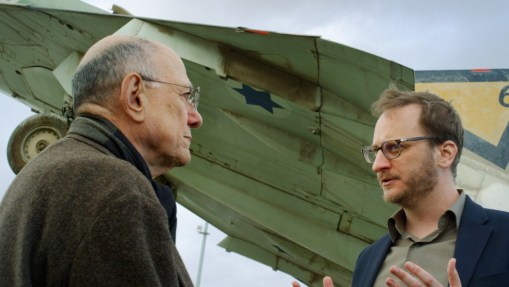


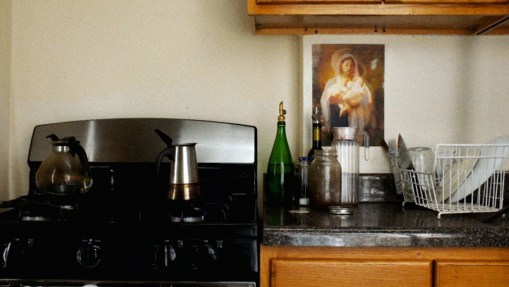



 While multiple films this year about old age have presented it as a time of reckoning, Kore-eda’s European project The Truth offers an honest, rigorous and profoundly generous picture of life’s twilight. In a career-summarizing role, Catherine Deneuve plays a creature of surfaces, a vain actress who struts in leopard skin and surrounds herself with her own posters. Her Fabienne is a pure shell without a core who can never speak in the first person. She has written an autobiography, but it’s a sanitized account, a reflection of how her life would rather have been. “Truth is boring”, she declares. Responding to her daughter Lumir’s (Juliette Binoche) complaint that she ignored her children for work, she bluntly states that she prefers to be a good actress than a good person. Behaviour precedes intent in the mise en abyme of Kore-eda’s intricate monument to aging, as performance becomes a means of expiation and a way of relating to the world. A work overflowing with sensual pleasures as well as radical propositions, The Truth rejects the dichotomy between actor and role, both in the cinematic and the existential sense. In the end, Fabienne and her close ones come together as something resembling a family. That, assures Kore-eda’s film, is good enough.
 The across-the-board success of Parasite invites two possible inferences: either that the cynical logic of capital can steer a searing critique of itself to profitable ends or that this twisted tale of upward ascension appeals to widely-held anxiety and resentment. Whatever it is, Bong Joon-ho’s extraordinary, genre-bending work weds a compelling social parable to a vital, pulsating form that doesn’t speak to current times as much as activate something primal, mythical in the viewer. With a parodic bluntness reminiscent of the best of seventies cinema, Bong pits survivalist working-class resourcefulness with self-annihilating bourgeois prejudice and gullibility, the implied sexual anarchy never exactly coming to fruition. He orchestrates the narrative with the nimbleness and legerdemain of a seasoned magician, the viewer’s sympathy for any of the characters remaining contingent and constantly forced to realign itself from scene to scene. Parasite is foremost a masterclass in describing space, in the manner in which Bong synthesizes the bunker-like shanty of the working-class family with the high-modernist household of their upper-class employers, tracing direct metaphors for the film’s themes within its topology. It’s a work that progresses with the inevitability of a boulder running down a hill. And how spectacularly it comes crashing.
 Vitalina Varela is an emblem of mourning. In recreating a harrowing moment in her life for the film, the middle-aged Vitalina, who comes to Lisbon following her husband’s death, instils her loss with a meaning. It’s a film not of political justice but individual injustice, the promise to Vitalina the that men in their resignation and madness have forgotten. It’s also a bleak, relentless work of subtractions. What is shown is arrived at by chipping away what can’t/won’t be shown, this formal denuding reflective of the increasing dispossession of the Cova da Moura shantytown we see in the film. Costa’s Matisse-like delineation of figure only suggests humans, enacting the ethical problems of representation in its plastic scheme. The film is on a 4:3 aspect ratio, but the viewer hardly perceives that, the localized light reducing the visual field to small pockets of brightness. Vitalina is a film of and about objects, whose vanishing echoes the community’s dissolution and whose presence embodies Vitalina’s assertive spirit. Her voice has its own materiality, her speech becomes her means to survival. Costa’s film is a vision of utter despair, a cold monument with an uplifting, absolutely essential final shot. A dirge, in effect.
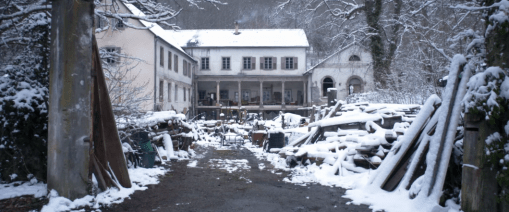
 The bird island of the title is a utopian place, a refuge for those wounded or cast aside by modernity. For sixty minutes, we are invited to look at five people working silently alongside each other in a bird shelter, tending to birds dazed by the airport next door. They don’t ask where these birds come from, nor do they expect them to leave soon. They simply treat the feathered creatures, re-habituate them into the wild and set them free. The reclusive Antonin, the new employee, is one such bird too, and his social healing at the shelter is at the heart of the film. Bird Island is full of violence, natural and man-made, all of which it treats with stoic acceptance, but it’s a work primarily about the curative power of community, the capacity for individuals to coexist in mutual recognition of each other’s frailties. In that, it’s the Catholic film par excellence, an allegory of the origin of religion. It’s also an exceptionally relaxing film to look at. Observing the participants absorbed like Carthusian monks in their individual tasks, even while working in a group, places the viewer on the same meditative state.
 Without question, Heimat is a Space in Time is the best 3½-hour film of the year. Heise’s sprawling experimental documentary uses largely personal documents—letters sent between family members, handed-down private documents—to evoke a broad history of 20th century Germany. As a narrator reads out the exchanges—Heise’s grandfather trying to reason with the Nazi state against his forced retirement, heart-rending accounts from his Jewish great grandparents describing their impending deportation, letters between his parents who were obliged to be in two different places in DDR—we see quotidian images from current day Germany and Austria, urban and rural. For Heise’s family, always made to justify their own place in the country and to never truly belong, the Germanic idea of Heimat seems positively a fantasy. While he reads out his great grandparents’ descriptions of their increasingly impossible conditions of living, Heise presents a scrolling list of Viennese deportees prepared. We try to look for the inevitable arrival of their names in the alphabetical list, our gaze forever deferred. When they do arrive, it feels arbitrary. In other words, what we hear could well be the story of any of the thousand preceding names. Perhaps all of them.
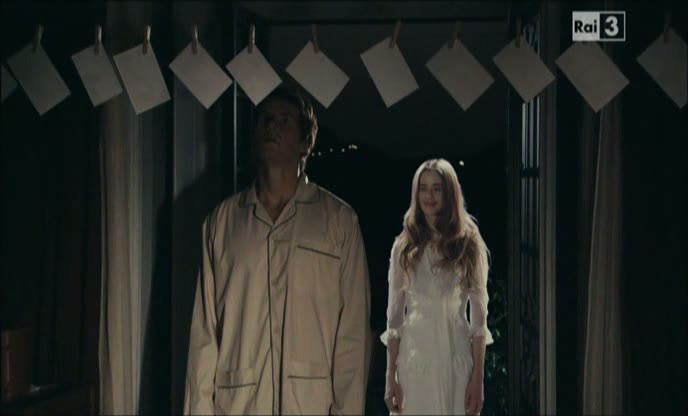
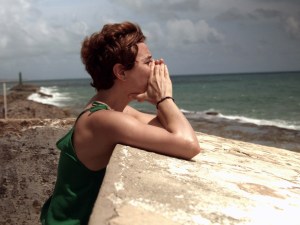 A worthy heir to Tarkovsky’s Solaris, Slits draws its inspiration from quantum physics to explore patently human concerns of loss, grief and memory. The uncertainly principle it offers is a choice between being in this world, awake to the problems of living, and finding meaning in the elsewhere. Physicist Catarina (Roberta Rangel) makes ‘sound-photos’ to study quantum the properties of light. She makes extreme zooms into a digital image to perceive the noise issuing from particular coordinates. These ‘dives’ enable her to listen to conversations from another space-time. Grieving from the loss of her child, Catarina unconsciously attempts to find closure through her research. But trying to inspect the surface of things from too close, she loses sight of her immediate reality; trying to find solace in the objectivity of science, she ends up rediscovering the great lesson of 20th century science (and cinema): that the observer influences the observation. Shot in high-definition digital video, Slits is to this new format what Blow-up was to photography. It locates in the trade-offs of the medium—between details and stability, between richness of palette and noise—visual correlatives to its key idea of quantum uncertainty. A brilliant, sophisticated work of politico-philosophical science fiction.
 Of all the recent classical Hollywood riffs in mind, none reinvigorates the B-movie tradition as intelligently or potently as Little Joe. Hausner’s modernist creature feature is a monster movie unlike any other: the dangers of the genetically-modified “happiness” plant that biologist Emily (Alice Woodard) develops is exposed early on, and there’s no triumphal reassertion of mankind to counter its menace. What we get instead is a protracted, total submission of individuality to a hegemony of happiness. Little Joe is many things at once: a multi-pronged attack on the wellness industry straight out of Lanthimosverse, the difficulty of being less than happy in an environment that demands you to be constantly upbeat, the fallout of women artists trying to expunge their maternal complexes in their work and of mothers having to lead double lives. Hausner’s camera appears to have a mind of its own, settling on the space between people, which is what the film is about: the culturally mediated relations between individuals. It’s notable that the titular plant reproduces not biologically but culturally. With its terrific score and work on colour, Hausner turns the cheesecake aesthetic of the film against itself. The result is a film of unusual intellectual density and formal frisson.
 In Status and Terrain, the German obsession with documentation and due process is called to testify to the dialectical process of historical remembrance. Adamczewski’s gently moving camera surveys the length and breath of public spaces in the Saxony region, once a Nazi stronghold, now seemingly anaesthetized under liberal democracy. Official communication, bureaucratic reports and private testimonies read on the voiceover incriminate the buildings and monuments we see on screen, revealing their role in power struggles through the ages. Just as the documents vie for a narrative on the soundtrack, ideologies once thought dead and buried surface to stake their claims on the urban landscape in the present. Adamczewski moves through 80 years of German history non-chronologically, the collage of information pointing to the living, breathing nature of political belief systems. Nazi detention of political opponents in concentration camps, Soviet retribution and blindness to victims of persecution, rise of neo-fascist groups post reunification and the historically indifferent, bulldozing force of current-day neoliberalism play out on the surface of seemingly sedate cities and towns. Status and Terrain is a sober, bracing examination of the manner in which prejudice becomes writ, which in turn becomes history, but also of the way in which this history is contested.
 The premise is a throwback to the clichés of the eighties: a group of teenagers at a suburban school prepare for their prom night. But in Taormina’s sure-handed treatment, this banal event assumes a spiritual dimension. In the film’s cubist first half, different groups of boys and girls make their way to the restaurant-turned-dance hall, where they will take part in rites of initiation into adulthood and experience something like a religious communion. And then, right after this VHS-ready high, a void descends over the film, turning its raptures into a mourning, not for those who have left this small-town existence but for those left behind: disaffected youth drift about the town or going through robotic social rituals, devoid of magic or warmth. It’s a work evidently deriving from personal experience, but one that’s refracted through a formalist lens. The strength of Ham on Rye is not the depth of its ideas, but the vigour of its prose. Taormina’s manifestly personal style emphasizes the surface of things, the idiosyncratic shot division focuses on gestures and minor physical details to construct scenes, and the eclectic sense of music imposes a global consciousness on a narrative that is otherwise extremely local.
 “Cinephiles are sick people”, said Truffaut. Frank Beauvais agrees. Following his father’s passing and a breakup, Beauvais shut himself up in his house in a trou perdu in Eastern France, and watched over 400 films in a period of seven months. Out of this glut, this sickness that Beauvais calls ‘cinéfolie’, came Just Don’t Think I’ll Scream, a film about looking, made wholly of clips from these 400 movies. Through a rapid, self-aware voiceover, the filmmaker reflects on his self-imposed isolation, his panic attacks, the poverty that prevents him from changing his lifestyle, his complicated feelings towards with political action, the conservatism of those around him and his relationship with his parents. Beauvais’s film is a record of his malady as well as its cure. In its very existence, it demonstrates what anyone sufficiently sickened by cultural gluttony must’ve felt: that the only way to give meaning to the void of indiscriminate consumption is to produce something out of it. Just Don’t Think I’ll Scream is not just a cinephile’s film, filled end to end with references, but the preeminent film about cinephilia, the solipsistic hall of mirrors that Beauvais breaks down and rebuilds inside out.



 The Seventh Art