
2022 witnessed the demise of several towering figures of cinematic modernism, none more iconic than Jean-Luc Godard. With their passing, it really feels like the end of a chapter in the story of film, one in which cinema was the privileged artform to interrogate history and the world. But their death also registers as strangely liberating in a way, like a clearing in the woods produced by fallen trees that allows us a new, privileged view. Let us hope that the work of these giants will continue to guide filmmakers and critics in their thought and practice.
In August this year, I was lucky to attend the 75th Locarno Film Festival, my first fest outside India. Basking in the gorgeous summertime scenery of Ticino and soaking up the equally sumptuous Douglas Sirk retrospective was an experience to remember, but I’m most grateful for the chance to get to know some terrific people from around the globe, among them cinephiles, curators and critics I’d known online for years but had never met. I’m truly grateful for their insight and company. Mistake: not reaching out to Luc Moullet when I was in Paris after the festival.
In a year that saw the world return to some semblance of normalcy,[citation needed] my own moviegoing habits seemed to have changed for good. The Locarno festival notwithstanding, I went to the theatres, I think, no more than four times this year (Vikram, Ponniyin Selvan: I, Kantara (all 2022) and the 50th anniversary re-release of The Godfather (1972)), which is four more than the last year. Ominous signs. That said, I was fortunate to watch three silent films on 35mm with mesmerizing live piano accompaniment at a King Vidor retrospective at the Jérôme Seydoux-Pathé Foundation in Paris in September: The Sky Pilot (1921), Wine of Youth (1924) and The Crowd (1928), the latter screening a highlight of my cinephile life.
Although I saw more films this year than any other in my memory, I didn’t watch as many new productions as I normally would, especially from India. Despite the absurd overvaluation it has been subject to in the West, I haven’t see a finer action movie in the recent past than RRR, which felt like a masterclass on how to imbue action with emotional-moral stakes, the missing soul of so many contemporary blockbusters. For all its saturated spectacle, RRR is a minimal film in the way it weaves the fewest of narrative elements in different combinations to emphatic, expressive ends. Gehraaiyaan was a compelling piece of slick, professional filmmaking, as was Jalsa. I’ve always admired the streak of self-sabotage in the career of Gautam Menon, and his superb gangster epic Vendhu Thanindhathu Kaadu harnesses that impulse productively, channelling it through screenwriter Jeyamohan’s touching, tragic vision.
A good part of my viewing this year consisted of a dive into Iranian cinema, which, I can say for certain now, is my single favourite national cinema. Among the 200-odd auteur and genre films (from native as well as expatriate Iranian directors) that I watched, there was very little that I disliked, scores of great works and at least two dozen masterpieces. I hope to publish a list soon. In the meantime, check out Another Screen‘s formidable programme dedicated to Iranian/Iranian-origin women filmmakers, which ends on the 4th of January.
Other personal discoveries this year were the films of Costa-Gavras (Picks: Family Business (1986) and Music Box (1989)), the mid-tier features of Boris Barnet (on whose Lyana (1955) I wrote a text for the amazing Outskirts magazine) and the astounding, hyper-caffeinated anime of Masaaki Yuasa (essay coming up). Without further ado, my favourite films of 2022:
1. Matter Out of Place (Nikolaus Geyrhalter, Austria)
 If researchers a few hundred years from now were to try and understand how humankind lived in the year 2022 AD, they would do well to turn to Geyrhalter’s spellbinding Matter Out of Place, an expansive survey of foreign objects littering the remotest nooks of the earth. Filmed in a dozen locations on different continents, the film traces the planetary movement of human-generated waste, the great paradoxes shaping its production and the massive efforts needed to manage its proliferation. Garbage doesn’t just cover the landscape in Geyrhalter’s film, it becomes the landscape. With cheeky visual rhymes, astute sound design, proto-Lubitschian humour and a subtly psychoanalytic approach to the physical world, Matter unearths the repressed material unconscious underlying the enticements of consumer society and international tourism. But the film offers no easy answers, presenting instead a universe whose horrors and beauties are inextricably linked, one which evokes awe and terror at humanity’s godlike capacity to create and destroy. In its firm belief that the secrets of the world reveal themselves to the questioning camera eye, Geyrhalter’s work possesses a spiritual dimension directly sdescending from the writings of André Bazin, and his new film elevates the sight of rubbish into a religious epiphany.
2. Crimes of the Future (David Cronenberg, Canada)
 Somewhere in the dematerialized wastelands of Cosmopolis (2012), overrun now by the vacuous celebrity culture of Maps to the Stars (2014), lives Saul Tenser, an “artist of the inner landscape” who grows new organs that are surgically removed by his partner Caprice during their feted public performances. Saul is a conservative in denial of the rapid transformation the human body is undergoing—a Clint Eastwood of the New Flesh—who would rather excise his new organs than embrace his true, deviant self. As governments and corporates look to quell the insurrection triggered by a cult of anti-Luddite ecoterrorists who sabotage not technology but the human body, Saul must decide whether to remain at the mercy of the algorithms or take the evolutionary leap. The most rewarding way to approach Cronenberg’s stellar, career-capping new work is to take it not as an allegory of current political debates, but literally. In Crimes of the Future, the body is indeed the final frontier, the last repository of all meaning, the sole means to spiritual edification or revolutionary change—a truism already in our Age of the Body. Filled wall-to-wall with dad jokes and dumb exposition, Cronenberg’s silly, sublime, supremely stylish treatise on corporeal capitalism is the most thought-provoking film since Pain and Gain (2013).
3. A German Party (Simon Brückner, Germany)
 Politics is dirty, and electoral politics doubly so. Few filmmakers possess the curiosity, intellectual mettle and good faith—leave alone the necessary access—to examine the unglamorous negotiations and compromises that are fundamental to the democratic process. Made over three years, Simon Brückner’s magnificent fly-on-the-wall documentary about the workings of the far-right German outfit Alternative für Deutschland (AfD) immerses us into the party’s operations, ranging from cool deliberations of executive meetings to high-temperature grassroots confrontations. The result is a markedly composite picture that offers a sense of the heterogeneity of an organization popularly considered an ideological monolith. Over six illuminating chapters, A German Party presents a political body fully caught up in the dialectical process of self-definition, an organization trying to identify itself through differentiation. The need for the AfD to go mainstream, to form alliances and influence policy runs up against the image that it has built for itself, namely that it represents a force outside the establishment. The most intriguing suggestion of Brückner’s film may be that rightward shift of the party, far from signalling the formation of a coherent ideology, may actually be the fruit of a lack of clear identity. Whether the AfD is the elephant in the room or a paper tiger, A German Party leaves it to the viewer to judge.
4. Stomp (Sajas & Shinos Rahman, India)
 The Rahman brothers’ boundary-smashing formalist work is nominally a documentary about a theatre group named the Little Earth School of Theatre. For the most part, the film showcases the troupe’s preparations for an upcoming performance at the annual function of a middle-class housing association in Kerala. We see the company’s rehearsal in considerable detail, their work on gesture, movement, voice and cadence, but the nature of their play is sketchy and elusive, like pieces of a puzzle that never fit. Rejecting literary and psychological explanations, Chavittu subverts the conventional artist profile, supplying no commentary on the meaning or significance of the rehearsal and complicating it with absurd interludes. What the filmmakers offer instead is a bracing procedural work intently focused on the physicality of its subjects, emptied of emotional life and operating together as a consummate professional unit. The sensuality that the film radiates comes not through dramatic or formal devices, but from the raw presence of young, athletic bodies populating the frame. Even when it places this performance within a satirical, self-reflexive social context, the film remains gentle, focused on the troupe’s single-minded artistry in the face of indifference and marginalization. Chavittu is all grace.
5. Nazarbazi (Maryam Tafakory, Iran-UK)
 The problem with film censorship, as Judith Williamson pointed out, isn’t that it rids movies of objectionable matter, but that it makes everything else seem dirty. Drawing images and sounds from almost a hundred Iranian films made since the 1979 revolution, overlaying them with evocative fragments of citations and original text, Maryam Tafakory’s ambitious, enrapturing video collage Nazarbazi illuminates how the Islamic regime’s censorship codes, specifically its restriction on showing men and women touching each other on screen, displaced this repressed sexuality onto other sensations, objects and aesthetic elements. An astonishing example of film criticism as an artwork in itself, Tafakory’s exhilarating, tactile montage locates the erotics of cinematic art in fluttering fabric, clinking bangles, slashed wrists, breaking glass, aromatic food, sweeping camera movements and, of course, the play of glances. Supressed desire finds a way to manifest not just in filmmakers’ cunning paraphrase of taboo actions, but simply in the ontology of the medium; sensuality in cinema is revealed not just as what artists express, but as what they can’t help but express, thanks to the inherent voluptuousness of moving bodies, caressing textures and resonating sounds. Watching Iranian films after Nazarbazi, you might find yourself asking the same question as Diane Keaton in Love and Death (1975): can we not talk about sex so much?
6. Footnote (Zhengfan Yang, USA-China)
 Terror floats in the air in Footnote, not just due to the pandemic, but also because the film’s soundtrack consists entirely of police radio communication from Chicago city. The incoming complaints are by turns petty and serious, ranging from minor disagreements with neighbours to drive-by shootings, and officers are tasked with everything from delivering a lost pet home to checking on isolated senior citizens. Seemingly gathered over a year, these excerpts reveal an extremely busy, probably understaffed police force grappling with the tensions of a diverse, multicultural city. The image, meanwhile, comprises wide-angle shots of open spaces filmed from a higher vantage point— intersections, highways, beaches, parking lots, rooftops—almost always featuring ant-like, solitary human figures animating the frame. Thanks to the thrillingly dialectical relation that Footnote sets up between sound and image, these calming panoramas become vehicles of anxiety, with human bodies turning into agents of both biological and criminal threat. Widening the chasm between the home and the world, the radio chatter colours the images with a feeling of alienation and paranoia. In the way the airwaves convert ordinary window views into something akin to CCTV footage, pregnant with dramatic incident, Footnote might be tapping into a fundamental psychological condition of life in America. Also, the finest Hitchcock remake in ages?
7. The Plains (David Easteal, Australia)
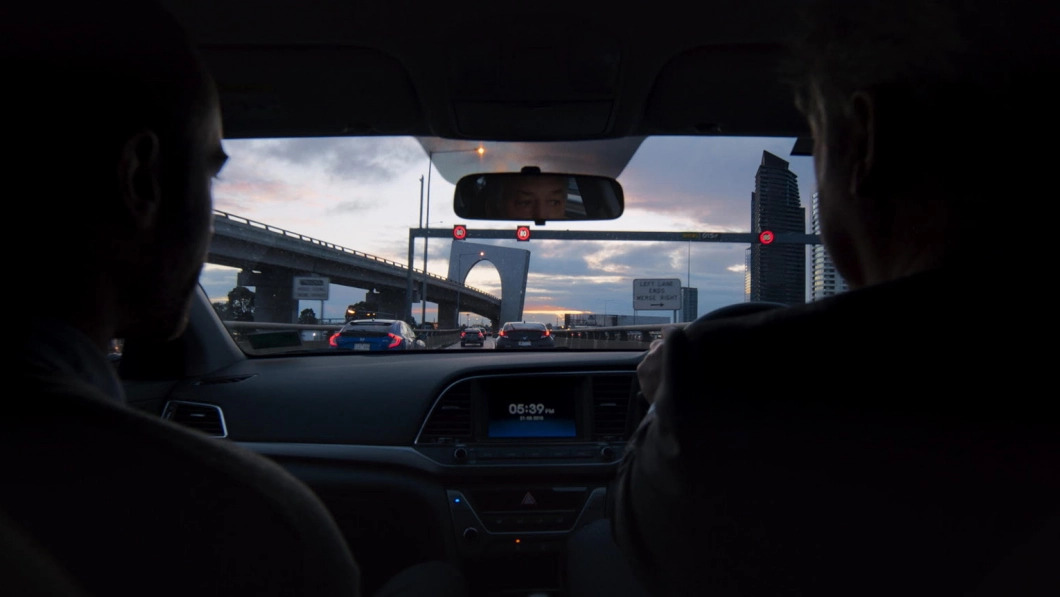 The Plains channels the spirit of Jeanne Dielman into Andrew Rakowski, a middle-aged lawyer who leaves office every evening just past 5 P.M. to drive home to suburban Melbourne. Easteal’s cyclical road movie formalizes this routine, filming Andrew’s commute over eleven different days of the year with a fixed camera from the back seat of his car. On some days, Andrew offers a lift to his colleague David (Easteal himself), probing the reticent young man on his private life while also generously talking about his own: relatives, career, romance, wealth, mental health. Literally compartmentalizing work and life, the commute creates a transitional zone where Andrew can view each as an escape from the grind of the other. It provides a moment of unwinding, freedom from roleplay that both life and work demand. Yet, for all the me-time the drive home affords, there is an eerie silence whenever Andrew isn’t chatting away or the radio isn’t on, as though this non-place, non-time were forcing him to reflect on Important Things. Despite the apparent sameness, every day brings small deviations that threaten Andrew’s reassuring routine, all accumulating into a powerful meditation on aging and the passing of time, a view of life’s parade from the wheel of his car.
8. Red Africa (Alexander Markov, Russia)
 Rivalling the best work of Sergei Loznitsa, Alexander Markov’s resplendent found-footage project samples propaganda and reportage films that the USSR made during the Cold War to strengthen its ties with newly liberated African states. In this gorgeous Sovcolor assemblage, we see Soviet Premiers and African heads of state visit each other amidst ceremony and pomp, exhibitions showcase the latest in Soviet culture and technology to the African public and students use the knowledge they have gained in Moscow for the betterment of their countries, whose exported resources return as value-added products from behind the Iron Curtain. It’s a poignant glimpse into a nascent utopia, a world that could have been, which hides as much as it reveals. With cunning visual associations, Red Africa recasts decolonisation as a formal process that concealed fundamental continuities between the departing Western powers and the Eastern hegemon. Uplifting notions of bilateral ties between Africa and the USSR are belied by the strictly unilateral flow of influence and ideology. In its attempts at creating a new world order, Markov’s sharp film demonstrates, the Soviet Union espoused anti-colonial struggles in fraught areas of the globe even as it held sway over its diverse republics—a tragic irony made apparent when the chickens came home to roost in 1991.
9. The DNA of Dignity (Jan Baumgartner, Switzerland)
 Jan Baumgartner’s moving, loosely fictionalized documentary The DNA of Dignity follows the patient, heroic work of individuals and organizations involved in identifying victims buried in mass graves during the Yugoslav wars. Along with bones, volunteers retrieve articles of clothing, toiletries and other knickknacks, all hinting at stories to be told of those they have outlived. With witnesses passing away each year and new structures waiting to be erected over these burial sites, the excavations are truly a race against time, fighting both political amnesia and nature’s complicity in the oblivion. In their quest to rescue war victims from anonymity, forensic scientists assemble excavated bones into skeletons, carry out DNA tests to ascertain identities and hand over the remains to grieving families, who haven’t had closure despite the end of the war and who confess to no longer being able to enjoy landscape without being reminded of what it hides. Baumgartner’s film obscures political and institutional details to focus on the scientific process, offering a fascinating, inspiring picture of the how the abstractions of science eventually coalesce into human stories. Its success lies in finding the right tone and distance necessary for a subject as grave and delicate.
10. Animal Eye (Maxime Martinot, France-Portugal)
 Martinot’s funny, free-spirited, quietly radical Animal Eye features a 30-year-old Breton filmmaker discussing his next project with his producer in Lisbon. He isn’t very articulate, but knows that the film will be an “autobiographic animal diary” about his dog Boy. “Films are filled with humans,” he says, “all liars.” Animals, in contrast, are not aware of the camera—or don’t care about it—and as chaotic beings of “pure present,” they evade the signifying operations of the image, emptying it of meaning and intention. As the muddled filmmaker slowly “hands over” the project to his smart, wry producer, the film’s central theme crystallizes: in neither owing anything to imagemakers nor expecting anything from them, the filmed animal offers a way out of the crippling egocentrism of artistic creation. In being just an image, the filmed animal becomes a just image. Animal Eye takes the first tentative steps towards the faint understanding that a “cinema of animals” shouldn’t consist of simply filming the world from their eyes, but filming as them, whatever that might entail. Chaining together clips of dogs from across movie history—subject to sadistic torture, sentimentalism and signification, locked out of the human realm—Martinot’s film embodies a rousing rallying cry on behalf of a “deanthropocentrized” cinema. In its own modest way, Animal Eye marks a milestone in anti-speciesist filmmaking.
Special Mention: Saturn Bowling (Patricia Mazuy, France)
Favourite Films of
2021 • 2020 • 2019 • 2015 • 2014 • 2013 • 2012 • 2011 • 2010 • 2009

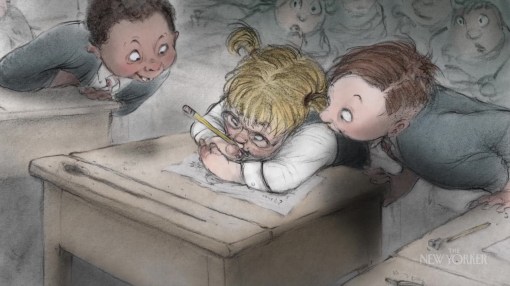


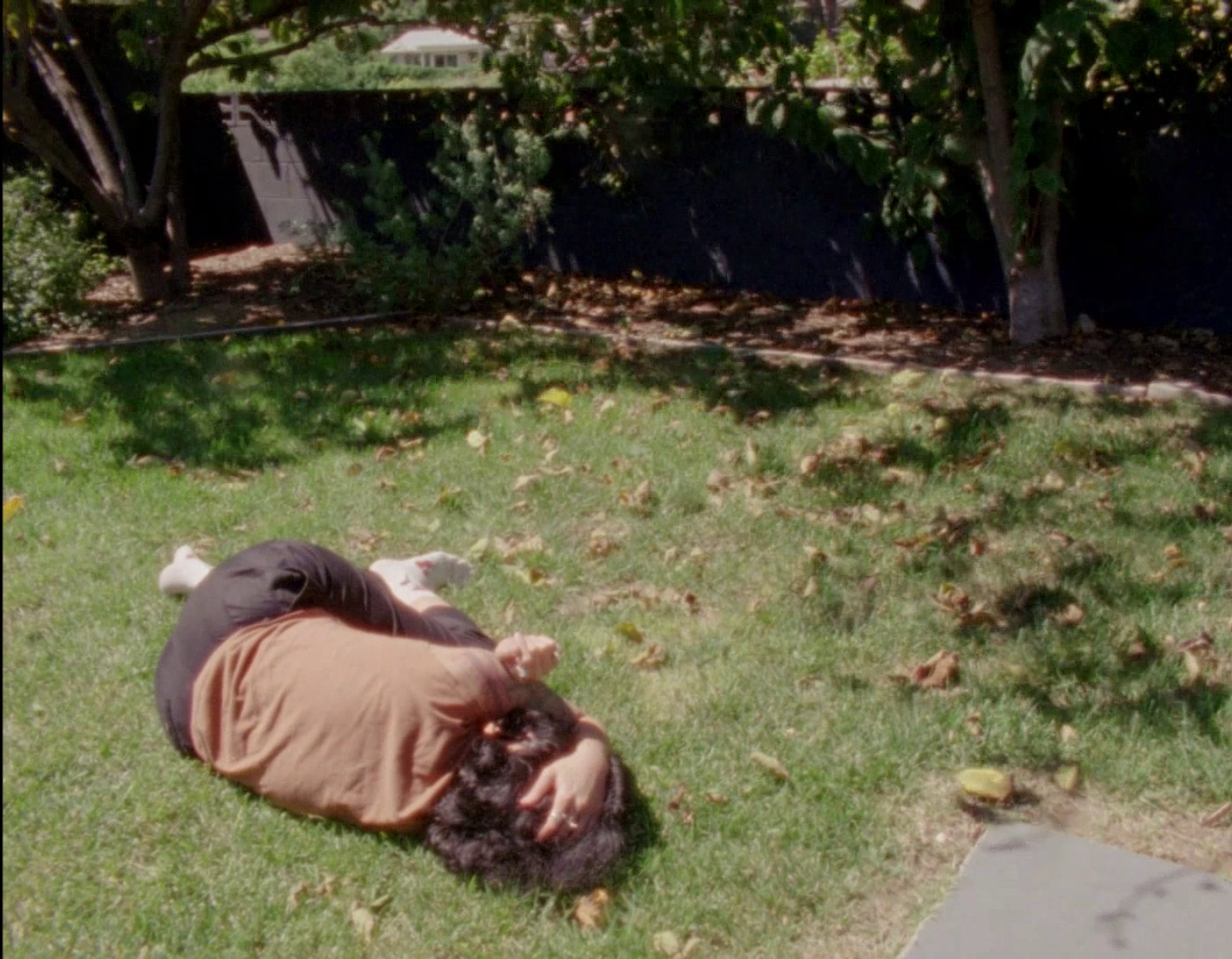







 Chan’s diaristic digital work is divided into chapters named after family members and unfurls as a process of piecing together of familial history. Through various confrontational interviews with her mother and father, the filmmaker attempts to understand their failed marriage, her strained relation with her step-father and the violence that has structured them both. Chan’s decision to put her entire life-story on film is a brave gesture, but the film closes upon itself, satisfied to be a melodrama valorizing personal experience over broader frameworks. (Consider, in contrast, the rigorous domestic formalism of Liu Jiayin or the socio-political tapestry of Jia Zhangke’s early work.) Chan misses the forest for the lone tree. Winner of the Adolfas Mekas award of the fest.
 Beep assembles anti-communist propaganda material from the 60s and the 70s commissioned by the South Korean state that was based on the mythologizing of a young boy, Lee Seung-bok, slain by North Korean soldiers. With the unseen, absent boy-hero at its focus, Kim’s film depicts the dialectical manner in which a nation defines itself in relationship to an imagined Other. Kim makes minimal aesthetic intervention into the source material – our relation to it automatically ironic by dint of our very distance from the period it was made in – restricting himself to adding periodic beep sounds to the footage, producing something like a cautionary transmission from another world.
 Black Sun opens with a composition in deep space presenting a metonym for a country in the process of development: high-rise buildings in the background as a pair of actors in period costumes rehearse a scene in the foreground. In a series of Jia Zhangke-like vignettes of Saigon set in middle-class youth hangouts scored to pop songs and television sounds, interspersed with images of a metamorphosing city, we see the distance that separates art from reality and the middle-class from the changes around it. The film culminates in a complex, home-made long take following the protagonist across her house and out into the terrace, where she dances, presumably to the eponymous song.
 The most challenging and elusive film of the competition I saw is also the most hypnotic. Cloud Shadow gives us a narrative of sorts in first person about a group of people who go into the woods and dissolve in its elements. The film is obliquely a story of the fascination with cinema, of the trans-individualist communal experience it promises, of the desire to dissolve the limits of one’s body into the images and sounds it offers. With an imagery consisting of sumptuous tints, and nuanced colour gradation and superimpositions, the film enraptures as much as it evades easy intellectual grasp. The one film of the festival that felt most like a half-remembered dream.
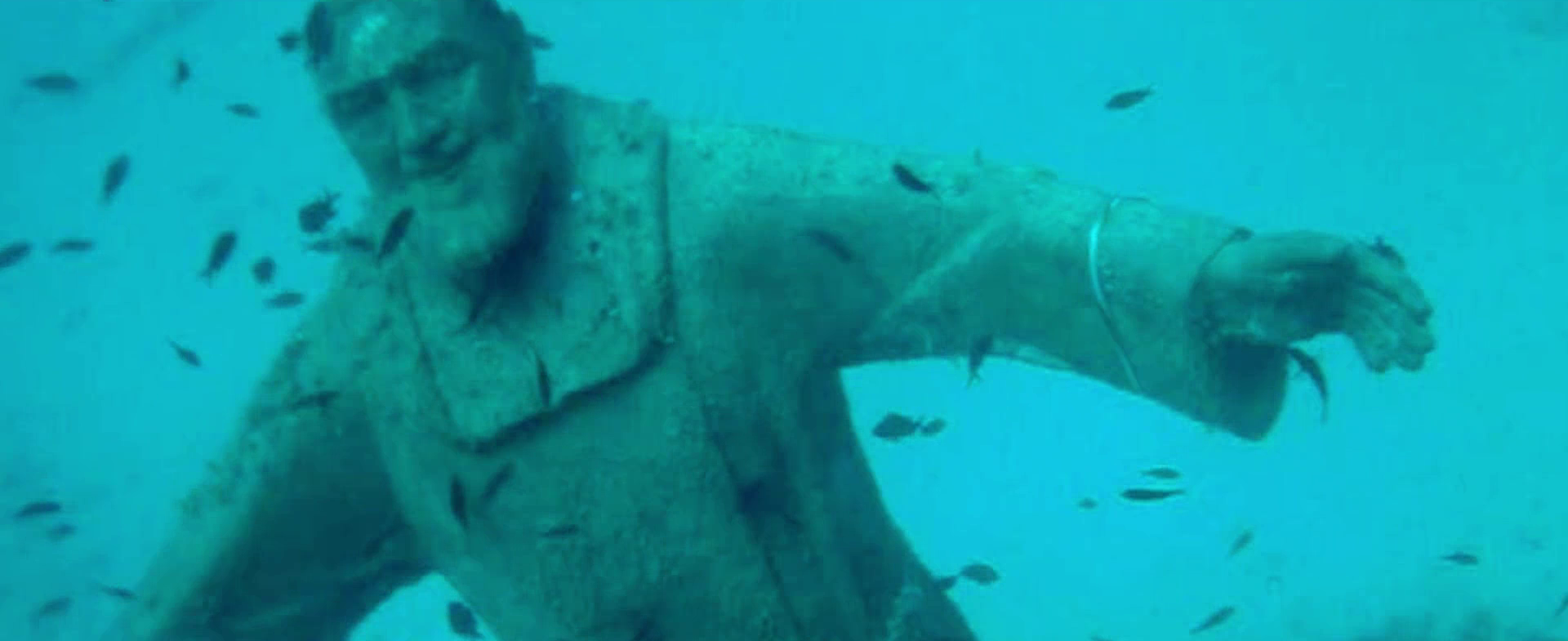
 Ferri’s teasing, playful Dog, Dear appropriates the filmed record of a Soviet zoological experiment in the 1940s in which scientists impart motor functions to different parts of a dead dog. In the incantatory soundtrack, a woman – presumably the animal’s owner – repeatedly conveys messages to it, with each of them prefaced by the titular term of endearment. Ferri’s film would serve sufficiently as a blunt political allegory about the dysfunction of communism, but I think it’s probably fashioning itself as a metaphysical question: the dog might well be kicking but is he alive? His physical resurrection will not be accompanied by a restoration of consciousness. He will not respond to his master’s voice.
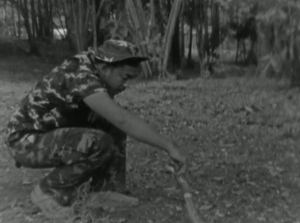 Put together from footage apparently shot over twenty years at a Thai army officer’s residence, Tesprateep’s film shows us four conscripts working in the general’s garden. We witness their camaraderie, their obvious boredom, the empty bravado in entrapping small animals and intimidating each other. The misuse of power by the officer in employing these youth to mow his lawn reflects a broader militaristic hierarchy, as is attested by the youths’ casual violence towards the animals and their brutal torturing of a prisoner. Endless, Nameless recalls Claire Denis in its emphasis on military performativity and Werner Herzog in its juxtaposition of idyllic nature and seething violence, all the while retaining an
 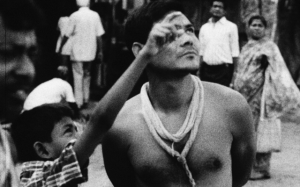 In Fictitious Force, Widmann incidentally poses himself the age-old challenge of ethnological cinema; how to film the Other without imposing your own worldview on him? The filmmaker smartly takes the Chris Marker route, avoiding explanatory voiceover for the rather physical Hindu ritual he photographs and instead holding it at a slightly mystifying – but never exoticizing – distance. Widmann’s film is about this distance, the chasm between experience and knowledge that prevents the observer from experiencing what the observed is experiencing, however understanding he might be. Fictitious Force’s considered reflexivity carefully circumvents the all-too-common trap of conflating the subjectivities of the photographer and the photographed.
 Fashioned out of footage that the artist shot during his visit to the titular natural reserve in Ontario, Fish Point comes across as an impressionist cine-sketch of the locale. The film opens with Daichi Saito-esque silhouettes of trees against harsh pulsating light – near-monochrome shots that are then superimposed over a slow, green-saturated pan shot of a section of a forest. This segment gives way to a passage with purely geometric compositions consisting of alternating browns and greens and strong horizontals and verticals. Forms change abruptly and tints become more diffuse and earthly. We are finally shown the sea and the horizon, with a rough map of the area overlaid on the imagery.
 A music video for a song that reportedly riffs on a holy chant and the traditional cry of the local ragman, Ye’s film starts out with shots of old women and men lip-syncing to the titular melody before turning increasingly darker. The rag picker of the poem progresses from accepting material refuse to buying off diseases, emotional traumas and even intolerable human characters. Ye builds the video using shots both documentary and voluntarily-performed that portray everyday life in Taiwan as being poised between tradition and modernity. The junkman of the film then becomes a witness to all that the society rejects and, hence, to all that it stands for.
 Set in a suburban Mumbai slum, Bhargava’s film takes a look into one of the reportedly many carrom clubs in the area where young boys come to play, smoke and generally indulge in displays of precocious masculinity. Where Imraan, the 11-year-old manager of the club, seems reticent before the camera, his peers and clients are much more willing to perform adulthood in front of the filming crew. While some of them are acutely aware of the intrusive presence of the camera, urging their friends not to project a bad image of the country, the film itself seems indifferent about the ethics of filming these youngsters, asking them condescending questions with a problematic, non-committal non-judgmentalism.
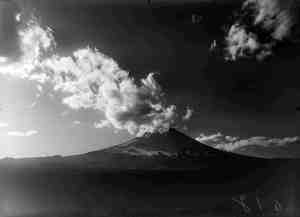 Völter’s visually pleasing and relaxing silent film is a compilation of scientific documents of cloud movement over the Mount Fuji recorded from a static observatory by Japanese physicist Masanao Abe in the 1920s and 1930s. Abe’s problem was also one of cinema’s primary challenges: to study the invisible through the visible; in this case, to examine air currents through cloud patterns. The air currents take numerous different directions and these variegated views of the mountain situate the film in the tradition of Mt. Fuji paintings. The end product is a James Benning-like juxtaposition of fugitive and stable forms, a duet between rapidly changing and unchanging natural entities.
 The most narrative film of the competition, Memorials situates itself in the tradition of 21st century Slow Cinema with its elliptical exposition, stylized longueurs, (a bit too) naturalistic sound and its overall emphasis on Bazinian realism. A young man revisits his father’s house long after his passing and starts discovering him through the objects of his everyday use, while a dead fish becomes the instrument of meditation and grieving. Though rather conventional in its workings, Memorials offers the details in its interstices fairly subtly and touches upon the usual themes of inter-generational inheritance and posthumous rapprochement, while also gesturing towards a necessary break from the past.
 Punprutsachat’s work is a straightforward document of the protracted rescue of a water buffalo from a man-made well on a sultry summer afternoon by dozens of village folk. Shot with a handheld digital camera and employing mostly on-location sound, the film presents to us the efforts of the villagers in chipping away at the edifice, restraining the animal from agitating and finally allowing it to go back to its herd. Natee Cheewit attempts to encapsulate the idea of eternal struggle between man and animal and, more broadly, between nature and civilization. The remnants of the demolished pit and the dog wandering about it are reminders of this sometimes symbiotic, sometimes destructive interaction.
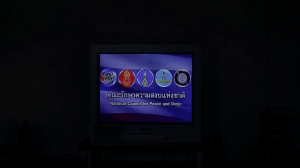 Night Watch is reportedly set in the days following the military coup in Thailand in May, 2014 – a period of state repression dissimulated by triumphalist propaganda about reigning happiness. Chulphuthiphong’s debut film showcases one quiet night during this period. Jacques Tati-esque cross-sectional shots of isolated apartments and office spaces show the citizenry complacently cloistered in their domestic and professional spaces, much like the sundry critters that crawl about in the night. Someone surfs through television channels. Most of them are censored, the rest telecast inane entertainment. Night Watch underscores the mundanity and the ordinariness of the whole situation, which is the source of the film’s horror.
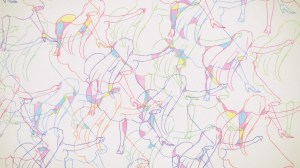 A rapid editing rhythm approximating the audiovisual assault of the information age, a visual idiom weaving together anime, pencil-drawing and Pink Film aesthetic and a soundscape consisting of reversed audio and noise of clicking mice and shattering glass defines Ouchi’s high-strung portrayal of modern adolescent anxieties. In a progressively sombre, cyclic series of events, a teenager navigates the real and virtual worlds that are haunted by sex and death around her. Ouchi’s pulsating, mutating forms and her preoccupation with the hyper-sexualization of visual culture are reminiscent of
  One of the high points of the festival, Scrapbook consists of videograms shot in 1967 in a care centre in Ohio for autistic children with commentary by one of the patients, Donna, recorded (and curiously re-performed by a voiceover artist at Donna’s request) in 2014. Donna’s words – indeed, her very use of the pronoun ‘I’ – not only attest to the vast improvement in her personal mental condition, but also throw light on the psychological mechanisms that engender a self-identity. For Donna and the other children-patients filming each other, the act of filming and watching substitutes for their thwarted mirror-stage of psychological development, helping them experience their own individuality, reclaim their bodies. Bracing stuff.
 Canadian animator Leslie Supnet’s hand-drawn animation piece is an extension of her previous work
 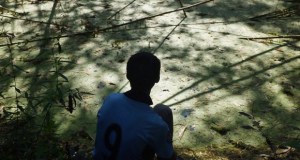 According to the program notes, the project brings together a real-life DJ who has lost her job after the coup d’etat in 2014 and an actual illegal immigrant boy from Myanmar at a secluded pond in the woods to allow them to do what they can’t in real life. We see the DJ perform for the camera, talking with imaginary strangers, giving and playing unheard songs, while the boy is content in tossing stones into the moss-covered pond. Like a structural film, The Asylum, alternates between the DJ’s ‘calls’ and the boy’s quiet alienation, taking occasional albeit unmotivated excursions into impressionist image-making, to weave a vignette about ordinary people made fugitives overnight.
 A Kiarostami-like narrative minimalism characterizes Radjamuda’s naturalistic sketch in digital monochrome of a lazy holiday afternoon. A young boy perched near the window of his house engages in a series of self-absorbed activities, while actions quotidian and dramatic, including a hinted domestic conflict, wordlessly unfold around him off-screen. A series of shallow-focus shots rally around a wide-angle master shot of the backyard to establish clear spatial relations. Literally and metaphorically set at the boundary between the inside and the outside of the house – home and the world – Radjamuda’s film is a pocket-sized paean to childhood’s privilege of insouciance and to the transformative power of imagination.
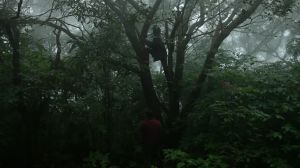 The shadow of Apichatpong Weerasethakul’s work is strongest in Kapadia’s three-part work about the cycles of life, death and reincarnation and the interaction between mankind and nature, between the real and the surreal. Set in various regions of India and in multiple languages and shot predominantly between dusk and dawn, the film has a beguiling though mannered visual quality to it, with its appeal predicated on primal, elemental evocations of the supernatural. While Kapadia’s superimposition of line drawings on shot footage to depict man’s longing for and transformation into nature demands attention, the film itself seems derivative and a bit too enamoured of its influences.
 A potential companion piece to Porumboiu’s
  At least as formally innovative as Rithy Panh’s
  Wind Castle opens with a complex composition made of an unfinished (or destroyed) building behind a burnt crater, with the moon in full bloom. We are somewhere in the Indian hinterlands, a brick manufacturing site tucked inside large swathes of commercial plantations. Basu’s camera charts the territory in precise, X-axis tracking shots that form a counterpoint to the verticality of the trees. Noise from occasional on-location radios and trucks fill the soundtrack. A surveyor studies the area and trees are marked. ‘Development’ is perhaps around the corner. But the rain gods arrive first. Basu’s quasi-rural-symphony paints an atmospheric picture of quiet lives closer to and at the mercy of nature.




 The Seventh Art