
In comparison to its documentary and animation counterparts, the slate of nominees for this year’s Academy Award for Best Live Action Short Films cuts a sorry figure. Racism, patriarchy, ableism are formidable villains embraced for their dramatic potential, turned into reliable strawmen and dutifully slain for liberal edification.
The least contentious of the nominees, Martin Strange-Hansen’s On My Mind (2021) contains no villains as such. There is certainly a greedy bar owner (Ole Gorter Boisen) who tries to palm off expensive whisky on our protagonist Henrik (Rasmus Hammerich), but even he redeems himself at the end. The bulk of the film is a single scene at the bar where Henrik tries to convince the owner and his wife (Camilla Bendix) to turn on the karaoke set so he can sing Elvis Presley’s Always on My Mind for his wife — a song that, he says, makes the soul fly. And he only has fifteen minutes to do it. The film’s strong point is this theatrical integrity of time and place, thanks to which it is able to set up fine passages of tension.
The time pressure also creates a mystery around Henrik, who is something of a poet. He is not a great singer, but the song has a great deal of meaning for him. In the film’s opening scene, he is seen breathing heavily at the window, his exhalation creating fog on the pane. He later makes a lyrical observation about it. Henrik’s existential outlook, combined with the information that he is on borrowed time, invites the supposition that he is on death row, but the mystery is resolved differently. Compared to the critical bite that the other nominees have, however, On My Mind is practically harmless.
Towering far above its competitors is Kristen Dávila’s Please Hold (2020), a Kafkaesque parable of a man arrested without charge and faced with a lifetime in prison. The tale is timeless, but the setting is an unspecified future in which automation reigns supreme. On his way to work, Mateo (Erick Lopez) is arrested by a police drone and sent to a detention facility run by a private company called Correcticorp. There are no human personnel at the complex, with everything from catering to legal services carried out through voice-commanded AI systems, all of it charged to the prisoner’s bank account.
The film may present a dystopian fantasy, but its projections are based on questions around technology and industry that are all very current: the removal of the human element from value judgment, the commercialization of personal time, the judicial fallout of machine errors, the romanticization of hand-made objects and the conception of legal process as service. These are philosophical ideas that you might find on The Guardian’s science pages, and the success of the film lies in synthesizing them into an alarming vision of the future.
Please Hold works as well as it does because it pitches this cautionary tale about technology — software, hardware, beware! — as a dark comedy rather than drama. Mateo struggles with the computer in his cell to find a lawyer to help him, but his mounting frustration cannot be taken out on the computer screen, for it is his only chance at freedom. On his prison walls, he scribbles what may be the final words of many of us when trapped in such a future: “read the fine print.”
The Long Goodbye (2020), starring Riz Ahmed, was made as an accompaniment to the actor’s album of the same name. It is understandable then that the film’s thrust is less dramaturgical than musical. Directed by Aneil Karia, it begins with scenes from a middle-class desi household in suburban Britain. An extended family prepares for a wedding: girls gossip as they put on mehndi, a couple is playing a quiz game, Riz is learning some dance moves from a nephew, blocking his father’s view of the TV. Such episodes of curated chaos, marked by accumulating friction between characters, are familiar to us from the films of Gurinder Chadha or Mira Nair.
But The Long Goodbye shifts gears when assorted armed men, clad in black, storm the house. “It’s happening,” Riz shouts, as if this invasion were long coming. It would be no spoiler to say that the family is dragged to the streets and shot as neighbours watch the horror from behind their windows. The film breaks away from its realistic description as Riz, having survived the massacre, begins a monologue in verse. His rap, a number called Where You From, speaks of his complicated identity as a brown Briton. This is slam poetry made film and the lyrics are the kind that make Twitter go into a tizz. Viewer mileage, though, would depend on their appreciation for lines like “Yeah I make my own space in this business of Britishness / Your question’s just limiting, it’s based on appearances.”
Tadeusz Łysiak’s The Dress (2020) and Maria Brendle’s Ala Kachuu – Take and Run (2020) are products of arthouse melodrama at its high academic stage. Both films offer non-normative subjects as points of identification — a working-class woman of short stature in the former, a young woman from rural Kyrgyzstan in the latter — and make us see the problems that they face because of their identity. The style is naturalistic, the filmic expression restrained and the meaning largely presented through symbolism. Cinema, in this scheme of things, becomes what the critic Roger Ebert called “empathy-generating machine.”
Even so, The Dress comes across as a rather cruel work. Protagonist Julia (Anna Dzieduszycka) is a small person who performs room service at a small-town hotel in Poland. A frustrated virgin, she makes up for her inexperience with world-weary chain-smoking. There’s another compensation at work: as someone who has lost the genetic lottery, Julia spends all her free time playing slot machines at the local bar. She faces discrimination and bigotry every day, but chooses to stay in the town and “teach people a lesson.” Her desperation results in a funny scene of flirtation where she dares an interested truck driver to take the next step.
Except for one shot of her walking with the trucker, Łysiak films Julia mostly at eye level or in isolated shots such that we don’t see how short she really is. Her periodic conversations with an older colleague (Dorota Pomykala) are a welcome relief from her disappointments. But the film keeps insisting that Julia is an incomplete woman, doomed to look yearningly at perfect feminine bodies or vent that she’d rather be a “normal woman.” It takes her through one insult after another, as though these were the only experiences available to her.
The longest of the nominees, Ala Kachuu furnishes its main character a little more manoeuvring space, but its distortions are equally telling. Sezim (Alina Turdumamatova) is an aspiring young woman from a traditional rural family. She wants to continue her studies in the city, but her parents want to marry her off. She flees the village and takes up with Aksana (Madina Talipbekova), another single young woman whose rejection of tradition has brought disrepute to her family back home. In the city, Sezim is kidnapped by a band of men and forced into marriage. Worse, her parents accept this union and abandon her to fate.
Ala Kachuu demonstrates the perils of bringing an unreflective Western perspective to bear upon non-Western phenomena that it doesn’t have the necessary intellectual wherewithal to grapple with. Picking an extreme case within the practice of bride kidnapping, the film takes the easy out way by dramatizing the struggle of an modern-thinking individual against reactionary upholders of tradition. The film may bring more attention to the bride lifting, but what it does first is to reinforce its prospective audience’s ideas of itself and the world.
[First published at News9]


 What comprises the blight of modern life? The reverse shot, answers Bruno Dumont in his scorching new dramedy about celebrity news reporter France, played by a dazzling Léa Seydoux, who cannot help but make it about herself in every story she does. Fresh off two films on
  An apartment evermore waiting to be occupied, letters responding to inquiries not heard, a voice never embodied in the image: Pereda’s five-minute short is a haunting, haunted tribute to the late Chantal Akerman that is structured around absence and substitution. We hear Pereda replying to fictitious queries by the Belgian filmmaker about renting out his sister’s apartment in Mexico City, and we see his sister readying the apartment, moving out paintings or clearing foliage from the skylight. In the film’s robust organization, Pereda, his sister and Akerman become mediums, connecting links in each other’s (after)lives: Pereda, unseen, serving as a middleman between the apartment owner and the impossible future tenant; his sister, unheard, taking the place of Akerman who will never feature in Pereda’s film; and Akerman herself, unseen and unheard, bringing the siblings together in a non-existent real estate deal. In an act of respect and love, Dear Chantal creates a physical space for Akerman to continue to exist, even if not in flesh and blood, just as
  How would Lubitsch do it? Well, if the old master were a contemporary filmmaker, ‘it’ would probably resemble Koberidze’s off-kilter, disarming romantic comedy about two lovers-to-be who work at a shop around the corner without recognizing each other all summer. What Do We See is obviously designed to please, but there is never a sense that it panders to its audience. Like the best storytellers, Koberidze knows that pleasure can be deepened by deferring gratification, and to this end, his film takes surprising excursions away from its central story, restarting at will and relegating its lead couple to the margin as though reposing faith in destiny to bring them together. This vast negative space of the narrative clarifies the larger objective of the film, which is to integrate its characters into the landscape of the ancient town of Kutuisi, whose faces and places, ebbs and flows, become the central subject. Pinning down the fable-like story on the voiceover allows the director to employ a complex, highly unusual visual syntax—that nevertheless derives from classical Hollywood cinema—without disorienting the viewer. The film involves magic, but Koberidze demonstrates that a towel flying through the frame can be as enrapturing as the most outlandish fairy tales.
 The title says it all. Loznitsa’s new documentary represents a modulation of style for the filmmaker. Where his found footage work so far dropped the viewer into specific historical events in medias res, without much preparation, Babi Yar. Context offers a broader picture. With the help of archival material, but also uncharacteristic intertitles, the film details the events leading up to, and following, the Babi Yar Massacre of September 1941, where over 33,000 Jews were killed over two days in the eponymous ravine in Kiev. We see Ukrainian citizens welcoming the occupying Nazi forces with enthusiasm and collaborating in the persecution of their Jewish compatriots. In an illustration of the failure of archival, the massacre itself isn’t represented except in photographs of its aftermath. Loznitsa’s shocking film is a rousing J’accuse! directed at his nation, at the willingness of its citizens in enabling genocide, at the amnesia that allowed for the valley to be turned into an industrial dumping ground. Loznitsa’s newfound desire to contextualize his material should be construed less as a loss of faith in images to speak ‘for themselves’ than as a critical acknowledgement of their power to deceive. After all, the Red Army is welcomed with comparable pomp after they liberate Kiev, this formal continuity with the reception of the Nazis concealing a crisis of content.
 The spectre of Harun Farocki hovers over Herdies and Götmark’s excellent documentary about war, technology and the production of images. A meditation on Western attitudes to armed conflict, Bellum unfolds as an anthology of three human interest stories: a Swedish engineer involved in designing an AI-powered military drone that will take autonomous decisions on bombing a perceived target, a war veteran in Nevada suffering from PTSD and having trouble reintegrating into civilian life, a photojournalist from the East Coast who covers the aftermath of the Afghan war. Well-meaning though these individuals might be, their lives and work are marked by a certain guilt surrounding the fact of war. This is evident in the case of the vet, but the photographer’s own activity may not be untouched by a liberal sense of culpability about her country’s interventions in Afghanistan. The engineer’s efforts to bypass the human factor of war, too, is an attempt to eradicate feelings of guilt about liquidating an enemy, which, the film’s narrator notes, is the only real restraining force in armed conflict. Bellum cogently points out the ways in which technology—of training, of intervention—increasingly eliminates human fallibility from the equation of war, for as Colonel Kurtz put it, “it’s judgment that defeats us.”
 I don’t know if Bruno Dumont and Paul Schrader saw each other’s films this year, but I’m certain they would both have much to say to one another. If
  Even if we are done with the 20th century, suggests Sīmanis’ singular, absurd period comedy, the 20th century isn’t yet done with us. When Hans, an opportunistic doorman at a Riga hotel, is falsely implicated in a bombing, he flees the Latvian capital to shuttle from one European city to another. The Europe of 1913 that Hans traverses is less a real geography than an abstract zone of competing political currents. War is around the corner, and there are several groups trying to influence the course of history. Zealous ideologues seek to entice and co-opt him, subjecting him to what Louis Althusser called “interpellation.” All through, Hans fights hard to follow his own moral compass, flee subjecthood and retain his individuality. A historical picaresque, Sīmanis’ film is interested in the singularity of this particular juncture in Western history—a point at which fin de siècle optimism about technology and human rationality came crashing against the reality of trench warfare—where countless isms sought to impose their own vision on the world. It would seem that Sīmanis views Latvia of the early 20th century as something of an ideological waystation, an unstable intellectual field where free radicals like Hans couldn’t help but be neutralized. And that vision isn’t without contemporary resonance.
 Maria Speth’s expansive documentary about a batch of preteen students, mostly of an immigrant background, in a public school in Stadtallendorf, Hessen, is a classroom film that achieves something special. Remaining with the children for almost its entire four-hour runtime allows it to individuate them, to look at them as independent beings with their own skills, desires and prejudices, just as their charismatic teacher-guide-philosopher Dieter Bachmann adopts a different approach to each of his pupils. For Bachmann, it would seem, whatever the students accomplish academically during the year is of secondary importance. He knows that he is dealing with a group with an inchoate sense of self: first as pre-adolescents, then as new immigrants. Consequently, he spends a great deal of effort in giving them a sense of community, creating a space where they can be themselves. At the same time, the classroom is a social laboratory where new ideas are introduced and the children brought to interrogate received opinion, all under Bachmann’s paternal authority. Speth insists on the particularity of these individuals and there is no sense that our star teacher is indicative of the schooling system in Germany at large. Bachmann is an exception, and in his exceptionalism lies a promise, a glimpse of how things could be.
 It’s an ingenious, wholly cinematic premise: estranged from family and friends, a sound engineer spends her nights at her film studio until she starts to experience a lag between what she sees and what she hears. Juanjo Giménez’s absorbing psychological thriller riffs on this setup, weaving its implications into a coherent character study of a young woman out of sync with her life. The result contains some very amusing set pieces constructed around the delay between sound and image, but also one of the most sublime romantic scenes of all time, one that begins with rude abandonment and ends at a silent movie show. Marta Nieto is brilliant as the unnamed protagonist who withdraws into a shell and then reconnects with herself and the world. She brings a fierce independence to the character that nuances its vulnerability. Its claustrophobic premise notwithstanding, Out of Sync feels like a very open work, integrated gracefully with the urban landscape of beautiful Barcelona. Watching the film in 2021, when so much of real-world interaction has been rendered into digital images and sounds, using Bluetooth speakers with their own latency to boot, is an uncanny experience.
 Ambitious to a fault, American artist Jordan Lord’s new work is nearly unwatchable. Yet it bends the documentary form like few films this year. Shared Resources is a home movie made over a considerable period of time, presented in scrambled chronology. We learn that Lord’s father was a debt collector fired by his bank, that his health is deteriorating due to diabetes, that the family lost most of its possessions in the Hurricane Katrina and that they had to declare bankruptcy shortly after Lord’s acceptance into Columbia University. All this material is, however, offered not directly but with a voiceover by Lord and his parents describing the footage we see, as though intended for the visually challenged, and two sets of subtitles, colour-coded for diegetic and non-diegetic speech, seemingly oriented towards the hearing disabled. In having his parents comment on images from rather difficult episodes in their lives, the filmmaker gives them a power over what is represented. Through all this, Lord initiates an exploration of debt in all its forms and shapes: paternal debt towards children, filial debt towards parents, the debt of a documentary filmmaker towards their subjects, one’s debt to their own body, the fuzzy line between love and indebtedness. This is an American film with an Asian sensibility.


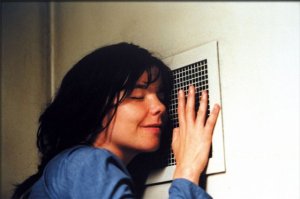 The least everyone could agree on Lars von Trier’s Dancer in the Dark (2000), without getting into a debate about its artistic merit, is that it is a work of immense range. Juxtaposing Dogme-styled kitchen sink ultra-realism with musical numbers replete with chorus dancers, it ambitiously attempts to marry genres that are positioned at the opposite ends of a spectrum. It’s a marriage that is perhaps doomed by construct, but in Trier’s film it is intended to be an unholy, internecine union. The flights of musical fantasy that Selma (Björk) launches into, like the stripped scenery of Dogville (2003), serve as Epic Theatrical devices that seek to thwart audience’s uncritical surrender to the film’s drama and continually remind them of the artificiality of the film’s construction. That even such a blatant disfiguration of the film’s tonal integrity doesn’t successfully prevent the audience from total emotional identification with Selma is less an indicator of the film’s conceptual failure than a demonstration of why a multi-generic cinema, like Bollywood, works on the same audience-character dynamic as the straightforward genre entries of the West and why a mixed-mode narrative doesn’t necessarily avoid the pitfalls of Realism. That’s because von Trier the screenwriter is an incurable melodramatist (tempered by von Trier the director), who, by heaping misery upon his protagonists, makes sure that there’s not a single dry eye in the house. (Unsurprisingly, he cites Douglas Sirk as a major inspiration here, but I’d think Sirk’s assimilation of Brecht’s method is a tad more successful). On the other hand, as a musical, von Trier’s film leaves a lot to be desired. He shoots musical numbers like action scenes (in contrast to Peckinpah, who shoots action scenes like musical numbers), forgetting that the secret to a great musical number lies in the Bazinian conquest of space and not time.
 The Seventh Art