Cinema of France


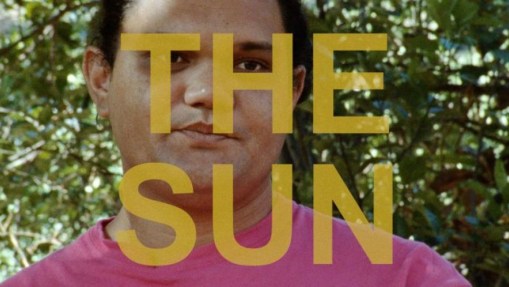
Just Don’t Think I’ll Scream (Frank Beauvais)

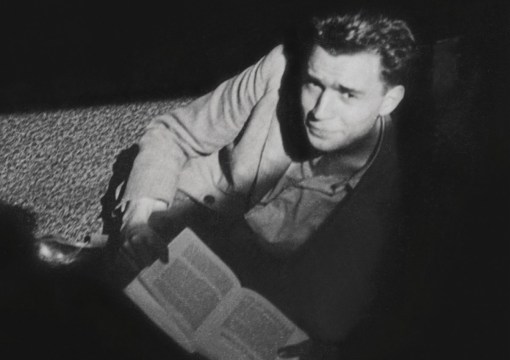
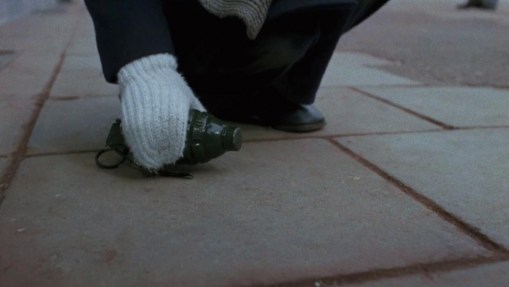
To lead a more affordable life, filmmaker Frank Beauvais moved away from Paris and settled down in a remote village in the Alsace region with his then partner. In the seven years that followed, he lost his father, who had lived with him during his final days, broke up and went into a period of intense isolation and anxiety, watching over 400 films between April and October 2016. Just Don’t Think I’ll Scream is a record of these seven months constructed solely through images from these 400 films strung together with Beauvais fast-paced voiceover. With detachment, but not without stretches of indulgent melancholia, Beauvais talks about this life of poverty, his relation to his mother living in the region, his panic attacks, his political indecisiveness caught between a feeling for revolution and a renunciation of all action. It’s an agonising life, the straightforward dramatization of which would’ve resulted in a significantly lesser film. The stasis and claustrophobia of the existence described is given a vital momentum by the lively images, rife with movement and action, and the snappy narration. The relation between word and image is literal times, and only intuitive at others. But the surfeit of images sweeps you along, not just in its volume but also in the striking detail Beauvais picks out: predominantly close up of actions, almost no faces and a generous amount of violence and decay.

In this, Just Don’t Think is the preeminent film about cinephilia, the life in films that Truffaut called a disease and which Beauvais christens “cinéfolie”. Early on, he tells us that films are not a window to the world but mirrors, that is to say a way of life that encourages self-absorption and isolation from others, which the filmmaker is happy to do, surrounded as he is by the village’s infuriating conservatism and national pride. Hearing about the attack in Nice, he unfeelingly goes back to sleep with a cynical reasoning. Like all cinephiles—in fact, like all monomanes—Beauvais absolves this unhealthy cultural consumption by turning it into a talking point, a means to a so-called higher end. He is fully aware of this self-deception and he calls out his “Machiavellian construction” to justify this “bulimia”. He muses about the vanity of a narrative in first person, the potential collapsing of a distance from the subject that the project needs. (He can’t, of course, entirely get rid of the disingenuousness of the undertaking because, for all the talk about the malaise of cinephilia, it’s clear that he’s been using it to plan this film along the way.) Despite its contradictions and predetermined construction, Just Don’t Think is an accomplishment in the way it transforms a subject of low artistic value—one man’s emergence from a rut—into a lively, fruitful meditation on a subculture.
Fourteen (Dan Sallitt)

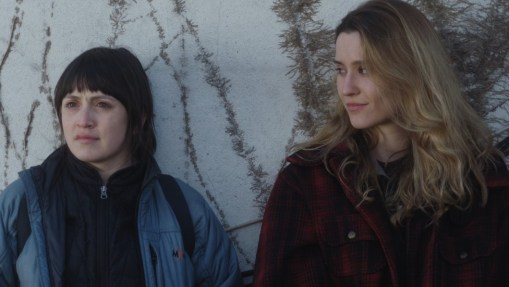
Fourteen traces the friendship between two young women, Mara and Jo, living in New York. They seem to naturally complement each other. The round-faced Mara (Tallie Medel) is petite, introspective and stands cross-legged. In a long shot midway, we see that she is among the last people exiting a train station upstate. Jo (Norma Kuhling) is lanky, slack-armed, constantly eating or smoking, and doesn’t think twice before correcting her friend on a turn of phrase. Jo calls Mara every time she’s in panic mode, Mara cancels her plans only to find Jo indifferent to her arrival. It’s clearly a parasitic relationship, but Mara feels compelled to fend for Jo for a reason that harks back to when they were fourteen. Both Mara and Jo hold temporary jobs and write on the side. Most of their interaction is about work; Mara fills application forms for the social worker Jo, while her own search for a permanent teaching position is a struggle. Fourteen contains some of the most realistic shop talk I’ve seen in films. It makes interesting what sounds unbearable in real life. The dialogue, in line with the Mumblecore tradition, seems improvised, which makes for some refreshing expressions (“stressball”, “cutting”, “eyeteeth”).

At several points, Fourteen jumps forward in time without warning and these blunt ellipses register the harsh blows of passing time even more strongly. The women change jobs, apartments and boyfriends. Mara’s fortunes improve, but Jo seems to be stagnant. Jealousy, resentment and guilt are hinted at but kept in check by the admirable performances. After a tense night of confrontation—the only tense passage in a film that’s otherwise entirely on a soft scale—the friendship gives in. Sallitt’s film is clear-eyed about the bounded nature of friendships and there’s only so much space individuals can dedicate for non-romantic relationships. It understands the way friendships wither and ossify irrevocably into a distant admiration. The understated quality of this almost Ozuvian look at non-blood ties is perhaps the reason I found the multi-tonal final sequence superfluous, ties as it does the difficult loose ends that all finished friendships invariably leave behind. Sallitt employs an unusual grammar to compose his scenes. Conversations don’t always unfold in shot-reverse shot patterns and the camera lingers long on faces, while voices emanate from off-screen. Like Bresson, Sallitt begins a shot before characters enter the field and cuts away after they’ve left. The film contains hardly any outdoor shots in its first half and opens up as it proceeds, the passage from claustrophobic NYC interiors to more open spaces paralleling the relationship between the women.
Wilcox (Denis Côté)

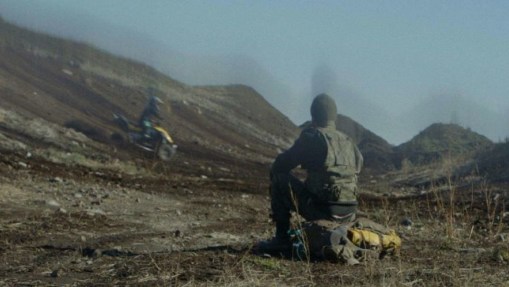
Denis Côté’s Wilcox begins and ends with a brief summary of individuals who moved away from civilization into the wilderness, sometimes undertaking odyssey-like journeys across vast and unforgiving landscapes: Everett Ruess, Carl McCunn, Dae Aabye, Christopher McCandless, Christopher Knight, Lilian Alling. Never mind that the lives of these figures only have a tenuous connection with each other, they nevertheless form a mythical backdrop to Côté’s film, which depicts the journey of Wilcox (Guillaume Tremblay) across the Canadian countryside. When we first see him, Wilcox is literally at the margins of a community paddling event. Lugging his large backpack, he wanders from one unnamed small town to another, taking shelter in deserted houses or buses, but never staying for more than one night anywhere. He meets and spends time with various old men living alone, but never forges friendships. He helps stuck dirt bikers, gives water to a dying mouse and survives on packaged supermarket food heated over a portable flame. The world seems welcoming and wholly accessible to him: he picks vegetables from fields, rides away on a borrowed bicycle and sleeps in the cellar of some unlocked house. There’s also a scene of an old man making potato wedges and tea.

Wilcox charts the same trajectory as Sean Penn’s Into the Wild, from the protagonist’s episodic encounters with people on his way out from civilization to his final spiritual revelation. But Côté abstracts out the McCandless story and empties it of its philosophical and emotional content. Most of the film has no real sound, which is replaced by a muffled, drone-heavy sound palette resembling a high-altitude ear block. We don’t know why Wilcox is on this quest, or why he attracts the hospitality and affection of the people he meets. The film assumes this is understood. Like in Ghost Town Anthology, Côté’s other film this year, there’s no sense of progress to the narrative, which could theoretically go on forever. As a result, Wilcox’s journey—distilled into a metanarrative of all those who leave society behind—becomes a means for the filmmaker to describe specific areas of Canadian landscape and culture. So we have generous views of the wooden strip houses so characteristic of Côté’s films, Wilcox pensively posing in and moving through springtime woods. Several passages are shot through a prism, making the periphery of the frame fuzzy. Equally mystifying is the choice to insert archival clips from the early part of last century—a surgeon trying prosthetic parts for WWI soldiers who have been disfigured and a series of shots of animals and birds forced together as though for a kiss—which are probably oblique references to the problems of modernity.

Monsters. (Marius Olteanu)

The most assured debut feature of the year, Romania’s Monsters is a three-part examination of a marriage in crisis. In the first section, Dana (Judith State), a thirty-something HR employee, skips her work trip and hires a taxi for the entire night. The taxi driver, whom she insistently picked, has had a terrible day, but he recognizes that the moody Dana suspects her husband of having an affair. In the second section, we see her husband Andrei (Cristian Popa) lying lonely and desolate in his swanky apartment, reaching out to Dana over phone. While Dana forges a fleeting emotional connection with the taxi driver, Andrei has a tryst ‘upwards’, unsatisfactorily hooking up with an upper-class businessman. The third part of the film presents them as a couple interacting with various members of their social circle. Monsters offers no easy answers: Andrei is gay, but is emotionally dependent on Dana, who can’t find intimacy outside their necessarily unsatisfactory marriage either. They playact happy coupledom for the world, but are also putting up a front to each other. Olteanu’s film forces us to constantly rework our perception of the characters, of them second-guessing each other and behaving the way they think the other would like them to behave, only to cause more misery.

Monsters models itself loosely after Godard’s Contempt, in its languid camera movement connecting people in different rooms, in its blue-red colour scheme, in its longueurs and in the centrality of jealousy in a relationship. At the backdrop of the marriage is a portrait of contemporary Romanian mores, its cultural conservatism, the nosiness of acquaintances, the hatred of the elites for their country, the pan-social anti-Roma prejudice, income inequality and housing problem. The success of the film is that these varied ideas only enrich the central story without ever overwhelming it. Olteanu demonstrates an ability to craft evocative atmosphere. Several passages unfold in real time and offscreen, the rhythm is consistently measured and the emotional beats genuine. The long scene of Andrei’s hook-up mixes the banal and the unusual to great effect. A large part of the film is in 1:1 ratio, which opens up to widescreen when the couple comes together in the third section, before closing in again. Despite being an unsubtle, theoretical choice, the device doesn’t come across as all that brash. The box produces exquisite closeups, helps Olteanu separate characters across shots and registers the cramped nature of the relationship. Monsters is a complex portrait of a marriage that can’t hold not just because of societal pressures, but because of the fundamental incompleteness of individuals.

Missing the Small Picture

Radio Cinéma Télévision no. 458; 20 October 1958.

Carné has often been criticized for being only a director and not an auteur of films. Doesn’t matter, Carné is taking revenge on his critics today by tackling one of the most endearing problems of our time, that of unbalanced youth. Here, it’s rich or idle Parisian students who party all day and profess a pseudo-philosophy of anarchism, which in truth is only an exact negation of bourgeois philosophy. They cheat in this: their system constrains them to reject all emotion and all sincerity. Unavowed and unavowable, a love ends in suicide.

A very interesting subject, but whose handling seems as questionable sociologically as morally. To be sure, the milieu described really exists—although it belongs to the world of five or ten years ago—but the film needs to be a lot more organized or coherent. Even though it’s about intellectuals, it can’t be said, like Carné does, that their thought precedes and justifies their action. It’s perhaps true for some, but they constitute a minority within another minority. Their presence is out of place in a movie that claims to paint of picture of modern student mores, as the diversity of typical characters proves: a bourgeois boy and a daddy’s girl, a bohemian couple, a blackmailer, a cinematheque rat, a homosexual etc. This particularization reveals an outlook quite common to middle-aged people such as Carné: the young generation is, if not lost, at least astray because it has only known a disordered world since the war of 1939. It’s not surprising that the only lucid character in the story, played by R. Lesaffre, the director’s mouthpiece in some ways, is ten years older than his sister, the heroine of the film. Tradition of pessimism so dear to Carné, where man’s happiness is at loggerheads with the laws of the milieu he lives in (see the film’s terrible, tacked-on ending), that’s refuted by reality.

Contrary to the oldest generation, which condemns the excesses of these young ones irrevocably, Carné explains and excuses them: they are victims of events; one of them was abandoned by his mother at the age of five. How convenient is the determinism to which our cinema sacrifices so much! We don’t worry about present-day action anymore, but about the past that justifies it. And the film becomes a series of filmed dialogues. Written by a Jacques Sigurd jealous of Michel Audiard’s laurels, these dialogues are rich in facile effects and prefer a vulgarity completely foreign to the story’s hero over truth.

The rather repulsively paternalistic and bourgeois tone of Young Sinners is the same one we find in reports published by mainstream dailies and magazines on the subject, piles of commonplaces of no interest. Carné resolves a problem as delicate as youth according to his gentlemanly logic. When do we see a film by Carné resolving problems of the atomic bomb or of devaluation, topics evoked here in passing? What we needed was the testimony of a young person, a specialist or a friend of youth. Rebel Without a Cause, Rendezvous in July and Astruc’s Les mauvaises rencontres—even the laconic Une vie, dealing with a more burning reality than Young Sinners—were able to bring out the positive aspects of this apparently immoral way of life. Is there really a particular problem here? Isn’t it rather an eternal question, coined here in a new way in order to pull the wool over our eyes? Sad, emotional smooth-talking is a new theme.

Honest mise en scène, but not at all commensurate with the ambitions. Effects are fortunately fewer than in Carné’s previous film. Those that remain (close-ups and dramatic crescendos, a night-time chase constructed through editing) are totally ineffective. But it’s only the best of Clouzot here. The performances are disappointing: only Pascale Petit, the only seasoned actress of the film, discovered by Astruc, comes out unscathed; Laurent Terzieff, in particular, struggles to convincingly play the impossible character of the evil genius-philosopher, a new incarnation of Fate once personified by Le Vigan, Vilar, Lesaffre.


[From Luc Moullet’s Piges choisies (2009, Capricci). See Table of Contents]

Krabi 2562 (Ben Rivers, Anocha Suwichakornpong)

Like The Sky Trembles, Ben Rivers’ collaboration with Thai filmmaker Anocha Suwichakornpong is a largely fictional, contemplative piece in 16mm and is inspired by the sights and people of the eponymous province in the south of Thailand. This work evolved out of the installation the two filmmakers developed for the Thai biennale, an event referred to in Krabi 2562. The film is a mosaic-like snapshot of the region constructed with a dozen or so characters: a mysterious tourist from another province who may be scouting locations for a film shoot, the petite guide who walks her through the history of important spots, the owner of her hotel who claims to have had supernatural encounters, the old owner of a country house she visits, the proprietor of a defunct movie theatre she finally disappears in, an ad filmmaking crew shooting on an island, and a Neanderthal couple living in the caves apparently in the same time line as the other characters. Not to mention several other outsider figures spending their summer vacation on the islands. Every one, though, seems to have some legend, story or a bit of personal history to recount.

Rivers and Suwichakornpong frame the action from a distance, with the characters of interest typically relegated to the background. Mixing interviews, vignettes of characters engaged in everyday activity or interacting with each other in refreshingly awkward dialogue and shots of the landscape, Krabi 2562 is a freewheeling work that’s always spiralling away from its ostensible plot: the disappearance of the woman. There are also a few “invented” sequences, such as a team of scientists looking for biological samples on the island. Politics is suggested through the sound of soldiers marching through the city and the film opens with an ironic-sounding scene of a school assembly where children pledge their allegiance to the religion, monarchy and the country. But these shards of information don’t necessarily fit together within a single discursive framework. What they evoke are possible histories about the region, where past and present, real and fictional, the living and the dead seem to coexist. This imaginative historiography of the film rests in an uneasy tension with its touristic aspect: though the long, meditative shots of landscapes and human activity capture the rhythm of life particular to the Krabi province, it’s not hard to see that they are also intended as promotional material for the region.

Color-blind (Ben Russell)

Shot in Brittany and French Polynesia, Ben Russell’s Color-blind opens with extreme close-ups of painted canvases that abstract figures in the painting into zones of clashing colours. Flashing on the screen are lines from a letter by Breton painter Paul Gauguin, in which the painter confesses that what appeals to him in this nude portrait of a young girl “on the verge of indecency” are the lines and forms. Speaking about his choice of colours, he adds that, in the mind of the Tahitian girl depicted, the phosphorous colours of the canvas stand for the souls of the dead. Russell’s practice has taken him to different corners of the planet and the ethical challenge in Color-blind remains the same: how does one represent the Other without exoticizing them? His response is to locate his own work critically in an uninterrogated tradition of Western representations of the Marquesas islands. But Russell’s response also involves showing the islanders as living under modern conditions and forms of knowledge. This prologue with Gauguin’s letter, setting up the theme of the outsider’s exoticization of the native, gives way to current day glimpses of the Marquesas islands: a modern music concert, commercialized dance classes, shooting of films with local men dressed in leaves, an old craftsman making a curio in his workshop. These impressions, presented without additional commentary or text, evoke an idea of preservation of tradition predicated ironically on catering to outsiders’ idea of the Polynesian culture.

Color-blind is an exploration of the history of outsider interventions in modern French Polynesian history. The legacy of French colonization is, of course, omnipresent. In a series of interviews, Russell shows a set of cards (presumably a triggering image or colour) to European and native participants, asking them to utter the first word that comes to their mind. Though the ideas are adjacent, there are important differences in nuances between the response in French compared to those in Marquesan (cf: Raúl Ruiz’s On Top of the Whale). A native tattooist talks about the outlawing of the practice by colonisers while a Frenchman expresses guilt over France’s atomic tests on the island. A German scholar discusses the work of historian Karl von den Steinen as the first written history about the Marquesas islands. A while into Color-blind, we get fades into and out of details in Gauguin’s canvases, copies of which hang in a local museum. The juxtaposition of documentary footage from the islands with representation of native bodies in these paintings throws into question Gauguin’s choices, which for all its glowing palette, seems no less colour-blind than the girl whose perception the painter presumes to be colour-naïve. It also places Russell’s own film in the outsider tradition, harking back in cinema to at least Murnau and Flaherty.

Mittelmeer (Jean-Marc Chapoulie)

French artist and filmmaker Jean-Marc Chapoulie’s Mittelmeer opens with shots of the Mediterranean Sea as filmed by closed-circuit cameras mounted on beachside hotels. The images evoke ideas of journey and mythical adventures, and the film is indeed offered as a tribute to Jean-Daniel Pollet’s Méditerranée. But these intimations of the timeless are pierced by history, the shot of a road by the Riviera calling to mind the July 2016 attack in Nice above all. Mittelmeer soon confirms the hunch as it trains its attention on the surveillance of public spaces and the public’s access to this surveillance footage. Like Patricio Guzmán’s The Pearl Button, Chapoulie’s film politicizes the stretch of geography that summer vacationers take to be a site of fun and relaxation. The Mittelmeer in Mittelmeer is a zone embodying the conflicts of our time. It is the burial ground for scores of refugees and immigrants who try to make their way into Europe and thus a border to be surveyed and protected by the state. It is also a preeminent channel of commerce, especially for large oil companies, the movement of goods across waters being more streamlined than that of people. The same containers become housing in the strictly monitored jungle of Calais.

In this regard, Peter Hutton’s At Sea and Godard’s Film Socialism are points of reference. In one passage, Chapoulie discusses the origin of piracy in the sea, relating it with the migrant inhabitants of Arcadia and noting that it was also the origin of theatre. And so he goes, constantly hopping from one set of ideas to another, from the ubiquity of CCTV cameras in public spaces, to the revolutionary theatre of protestors in the Middle East, to the relation of crude oil to history of imagemaking, to early Lumière films of people fishing and vacationing at beaches, to an American company manufacturing a device to detect shooters based on bullet sounds, to Syrian revolutionaries taking down public cameras. To be sure, these are all interrelated ideas, and stimulating ones at that, but there’s no sense that Chapoulie is synthesizing them into an essay with a central line. He constructs the film wholly from existing footage, at times colour-manipulating it, and adds an original sound mix to them, consisting of a multi-genre musical selection and amplified sounds of actions we see on screen. Also present are three human voices. Chapoulie regularly converses with his son about the images on screen, adding an element of fatherly pedagogy and virtual family vacation to the proceedings. There’s also the voice of Nathalie, a friend-collaborator, who furnishes critical commentary and personal musings. I might be underestimating Mittelmeer, but it’s a work that should’ve been better than it is.

Years of Construction (Heinz Emigholz)

Years of Construction is the first Emigholz film I’ve seen, so I don’t have a framework to access this 29th entry in the filmmaker’s Photography and Beyond series. It’s however a very strong work on its own merit. Charting the demolition and the subsequent reconstruction of the Kunsthalle in Mannheim between 2013-2018, Years presents an architecture in flux. There’s no voiceover or text, we don’t get to know anything about the institution or the building, and the film remains vehemently fixed on the material details of the transformation. Emigholz films the building from countless number of vantage points, sometimes with a Dutch angle and always from a non-intuitive point of view. These unusual compositions, nevertheless consisting of strong, expressionistic lines, serve the same purpose as many of the artworks in the museum: to slow down our eyes and force us to reflect on the architecture which is otherwise experienced simply as a negative space to the artwork. Cutting on matching movement, Emigholz accords about five seconds to each shot, no matter the amount or importance of the details it contains. This all-levelling gaze and cubist superposition asks an ontological question: can a building be completely described? But for Years of Construction, another question lies beneath: what distinguishes a building from its surroundings?

Emigholz puts in dialogue notions of indoor and outdoor all through Years. Each of the film’s six segments begins with the museum’s “exterior”—the face it offers to the surrounding city—before moving inside. He films its façade from across the park opposite, while deep-space interior shots of the museum often show the world outside. The statues in the park don’t have the aura that sculptures in the museum have, and this idea of the museum as a context-provider is at the focus of Years. Reminiscent of Berlin in Walter Ruttmann’s city symphony, Mannheim in Emigholz’s film transforms in a manner comparable to the museum: depopulated at first, it serves as a space to be filled, just like how the photograph-like shots devoid of movement in the film’s first passage give way to the busy action of dinosaur-like machines chomping on steel and concrete. Finally, Years explores the intersection between contemporary architecture and sculpture—two domains that have swapped their classical functions—as articulations of space and volume. The museum architecture, like the modernist sculptures in it, modulates visitor movement through and around it. By familiarising us with the building over 90 minutes, Emigholz obliges us to notice it in action when the museum is finally reopened for public in 2018: the sculptures now become the negative space to the architecture.

Synonyms (Nadav Lapid)

Nadav Lapid’s third film, Synonyms, like its predecessor, The Kindergarten Teacher, exhibits a special attention to words. It comes in the form of Yoav (Tom Mercier), a young Israeli ex-serviceman who leaves his home country for France. In Paris, he picks up a French dictionary and amasses synonyms to describe his hate for Israel. He refuses to speak in Hebrew, even when he works at the Israeli embassy and rubs shoulders with fundamentalist Batar volunteers. Identity being socially determined, Yoav can neither completely abandon Israel nor assimilate into the French culture that he loves unilaterally. Lapid realizes that a realist approach to this autobiographical tale would be both tedious and unoriginal, so he pegs the film on a register where psychological causality doesn’t hold. A non-professional, Mercier invests all his energy into the shots, his extreme physicality threatening to spiral out of control at all times. The film is likewise rugged, mixing nausea-inducing handheld shots with more graceful movements of the camera. The extra space available offered by the widescreen also allows for much movement and dynamism within shots.

Inspired by the location as well as his sojourn in France, Lapid draws liberally from the art film tradition. Yoav, and the bourgeois couple who shelter him after he is robbed, are variants on Bresson’s disaffected young men, and their half-naturalist, half-theatrical line delivery is similarly inflected with poetic stylization even when the content is ordinary. The constant interaction between youth, poverty and the sense of dislocation also recalls Carax, while the makeshift ménage à trois Yoav forms with his hosts could be from any post-68 French film. It’s to Lapid’s credit that he’s been able to mould these influences into a personal style. On the other hand, there’s really no framework that contains Yoav’s actions. Just when Yoav obtains French citizenship through a sham marriage, he rejects the idea owing to some undefined moral compulsion. He belts out the Marseillaise and Israeli national anthem with equal zest at the integration class, but the film also undercuts the Republican values taught at the same course. Yoav’s contradictions, as a result, feel artificial, a dramatic contrivance with very little context to back it up.

Midsommar (Ari Aster)

Having tragically lost her sister and parents, Dani (Florence Pugh) leans on her boyfriend Christian (Jack Reynor) for support. While Christian is understanding, his friends think she’s taking too much advantage of him, offering little in return. When one of Christian’s friends invites them to his village in Sweden to participate in midsummer festivities, Christian asks Dani to join them in order to not offend her rather than out of concern. When the film actually gets going, the group finds itself in an isolated commune in central Sweden. The commune, uniformly of Scandinavian extraction and sporting white costume, is welcoming of the strangers, offers them psychedelic drugs and lets them tour their facilities. But movies have prepared us to read communes as cults, and this one turns out to be no different. The summer festivities grow bizarre by the day and includes ritual suicides and sacrifices. Anthropology graduates, Christian and a friend, meanwhile, fight over the rights to write a thesis on the commune. Soon enough, the visitors make those idiotic moves characteristic of horror movies and end up disappearing, leaving Christian and Dani to fend for themselves.

If Midsommar takes its own time to move the story along, it’s because it fashions itself as an intimate film about lovers’ paranoia expressed in horror movie terms. If the film has an insight to offer, it’s that couples in isolation from each other are prone to being brainwashed into doubt, be it by well-meaning friends or by murderous cults, into believing that they deserve better than what they have. It would have served the film better then to have characters that aren’t off a stencil as they are here. Dani, especially, comes across as needier, clingier than the film supposes, and her constant anxiety about Christian ignoring her make her even less sympathetic. Nor does the film have any ambivalence towards the commune to genuinely propose it as a solution to Dani’s perennial loneliness. The tragedy of her past is inserted in flashes, claiming psychological weight in a film whose pleasures are on its surface. Midsommar succeeds primarily as an assured iteration of the last girl template and is noteworthy in how little it relies on traditional horror movie tropes: it’s shot in broad daylight of northern summer, all shocking information is signalled beforehand, and visitors to the cult meet the exact fate you imagine for them. The film has passages of alluring visual and sonic rhythm, and the long-tether narrative moves through different perspectives and spaces freely once at the camp. The camera has a life of its own, pushing and pulling, craning up and down to describe a world out of whack.

The Beach Bum (Harmony Korine)

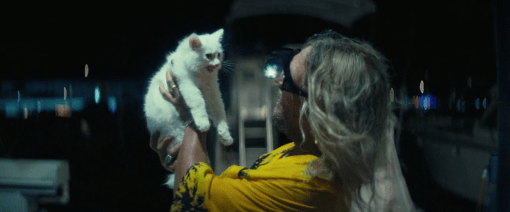
Harmony Korine’s The Beach Bum immerses the viewer into the bohemian life of Moondog (Matthew McConaughey), a seasoned hedonist spending his days on the beaches of Florida in sex, alcohol and drugs. Moondog is a poet of unusual talent, we are told, and lives off the inherited wealth of his wife Minnie-Boo (Isla Fisher), who has an open affair going on with Moondog’s friend Lingerie (Snoop Dogg). When Minnie-Boo leaves behind a will that obliges Moondog to publish his long-pending book in order to inherit her money, the decadent poet becomes a nomad, reaching out to old friends for help. With a highly expressive colour palette, Korine’s sensual direction evokes a particular, self-indulgent view of life on the beach. Cycling through sunlit exteriors, interiors of gonzo tones and moody fluorescent streetlamps, the film progresses in a mosaic-like fashion, never lingering on any event for long, just like its protagonist, even as it deals with plot mechanics. Moondog’s treads light on the ground underneath, even when he’s pushed to a corner. And the film’s breezy aesthetic beguilingly captures this sense of transience of things.

Korine punctuates Moondog’s uncommitted life with moments of pathos, culminating in a charming romantic sequence with Minnie-Boo, the nightfall, the sea breeze, the white streetlight and Peggy Lee’s If That’s All There Is brought together into a fatalistic mix overseeing the tragedy that immediately follows. The Beach Bum is evidently on the side of Moondog, whose excesses it subsumes in a Romanticist notion of the downbeat artist who flouts conventions, but sees things more clearly than those around him. Moondog is a flaneur, perennially on the road with nothing but typewriter and a sack of books, depending on the universe to see him through the day. But the film also makes it plain that Moondog’s poetry is juvenile. He plagiarises from Lawrence, Baudelaire and Whitman, but his own work reads like bathroom scribbling. The people around him indicate again and again that beneath Moondog’s shallow life lies a core of genius, that behind his ironic relation to people and things likes a being of deep sensitivity—an intimation that never comes to fruition. These assurances of greatness subsidise his vulgarity and provide a reason to consider his humanity—an instrumental morality that goes against the film’s generous-seeming outlook.

The Souvenir (Joanna Hogg)

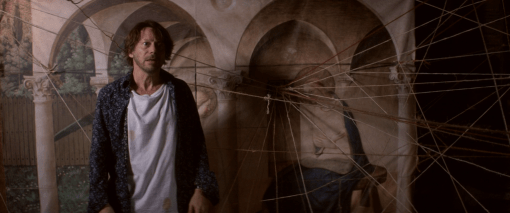
In contrast to The Beach Bum, Joanna Hogg’s Souvenir presents a modern, wholly original vision of the artist figure. Her autobiographical Julie (a heartbreakingly beautiful Honor Swinton Byrne, daughter of Tilda), a filmmaker in training, is neither a tortured genius, nor a social outcast. She is everything one doesn’t associate with artists: generous, unassuming vulnerable, passive, docile and supremely decent. She is in a romantic relationship with Anthony (Tom Burke), an opinionated, strong personality who looms large over Julie’s life. His yearning, poetic letters of love—presented as interludes read by Julie over shots of the countryside horizon—ascribe to her a power over him that (a) she doesn’t possess and (b) only serves to further disempower her. “Don’t be worthy, be arrogant”, he advises her. But Julie is incapable of feigning arrogance or authority, and that’s what gives The Souvenir its unique force. She is literally self-effacing, seen as she is at the edge of the frame for most part of the film. Julie is told to make films based on her experience, but she can’t bring herself to be arrogant enough to believe it’s worthy of being filmed. She’s always seen writing something else than her own life.

What The Souvenir gets so right is that Julie’s self-doubt as a person—in her relationship with her parents, with Anthony—feeds on and into her self-doubt as an artist. At shoots, Julie is never in control, allowing her work to be overshadowed by her collaborators. She’s mentally elsewhere, carrying the guilt of ignoring Anthony and regularly calling him back from the set. Hitchcock is invoked, and The Souvenir can be seen as a loose reworking of Suspicion, where Julie lets Anthony overpower her despite her better judgment. But unlike the swooning Joan Fontaine who is quite obviously head over heels in love with Cary Grant, Julie’s irrational attraction and jealously towards Anthony feels somewhat theoretical and laboured, added in retrospect. Shooting in 16mm in a beige-brown-white aesthetic, Hogg evokes the eighties through events entirely offscreen—money problems, Irish bombings, the flourishing of cinéma du look in France. She frames every shot with thoughtful consideration, with plenty of negative space. She often films Julie through reflective surfaces, accentuating the sense of her fragility, and cycles through familiar spaces and compositions, rendering them as intimate as the subject.

Cahiers du cinéma no. 483; September 1994

The telecast of Jean de Florette has helped draw attention to an original treatment of colour, whose seeds were already to be found in A Special Day, made in 1977 by Ettore Scola.

The novelty of this film stemmed from a colour very close to black and white, whose justification was given to us by the director’s statements. He wanted to capture the style of postcards of the era in which the story is set (the Mussolini years) and their reduced colour range propping up ultra-conformist subjects and attitudes. There was, for him, an amalgam between this antiquated two-colour palette and fascist moral rigidity. So it was fun, per Scola, to use this particular format in service of an ideology completely opposed to the one it usually emphasized and, more precisely, to tell, among other things, a short love story between a brave, prototypical Roman matron, wife of a militant fascist, and a homosexual facing deportation (a hardly credible story for Italy in the 1930s, stemming from a very anachronistic soixante-huitard liberalism, but the problem isn’t that). A little like porno on stained-glass windows or machinations of hooligans on Bach.

The hiccup is that the washing-out machine of Scola and his cameraman Santis can only work after reading these statements. Non-Italians are unaware of these old, transalpine postcards, just like Italians under forty who haven’t lived under fascism—an ignorance that will only increase in the years following the film’s release and which thus will affect a large majority of viewers. And I’m not sure if, without the help of this footnote that is the director’s interview, even older Italians can appreciate Scola’s tortured intellectualism and discover his ironic intentions. Even with the help of this key, appreciation for the film remained theoretical since it could correspond only very rarely to visual memory.

Unjustified for nearly everybody, this format contributed nonetheless to the film’s success as the reflection of a totally gratuitous fantasy, originality and mannerism. What interests a good number of cameramen is above all a chromatic and stylistic unity, a distinctive look, a personal stamp. You get the impression that, before shooting, they try to prepare their Kodak ad. I’m referring to those articles written by image masters, promoted by the monopoly in question since many years, that highlight the particularities of their art and their plastic orientation in pompous and esoteric terms.

To be sure, this very specific definition of their activity allows cameramen to recognize themselves through their work, but we are within our right to wonder if it really serves the films.

Consider Jean de Florette. The plot revolves around Jean, the poor man who will be completely ruined, and his house whose ambiance is characterized by washed-out, reduced colours, notably a rather dirty, obscure and soft yellow of the ‘dead leaves’ variety. So be it. But it’s the same for scenes set at the residence of Papet, the villain who destroys Jean, and which should be differentiated aesthetically from the house of the poor man. Perhaps this is a gesture of supreme daring: Papet is a rich Scrooge who lives in the same mediocrity as the man he ruins. Oppressors and oppressed reduced to the same condition, vanitas vanitatum… But we must disabuse ourselves: we realize that the houses in the village are also marked by an identical tone, whereas they should look wealthier and emphasize their contrast with the physical and moral poverty and isolation of the one or two principal houses.

This yellow jaundice1 has spread its wings. All villagers from the 1920s—rich, oppressed, clustered, isolated—are put in the same basket of a rather reprehensible colour. To be sure, we can appreciate the value of the yellow better when we consider that all papers from thirty or more years ago—newspapers and wall decorations—have become of this colour. What we are witnessing is an aesthetic logic based on print and thus already biased. Not everything that’s old is yellow: I’m thinking of faces, furniture, objects and stones2. And, of course, papers in 1920 or 1940 weren’t already of this colour. It’s moreover impossible today to film a real newspaper from the past, Pour vous or L’intransigeant, since we’ll immediately see from its colour that it cannot be a newspaper read by an actor in a period movie, but an antique copy that has survived generations. So you have to use expert photocopies. In a film about the past, yellowness can be justified only by an intrusion of the present, by a subjective and powerful contemporary gaze—the Carlos Saura principle—or by the sudden appearance of an abandoned house, in High Aragon for example, that has remained as it is over several decades, which is not at all the case in Claude Berri’s simplistic and unitemporal narrative.

With time, the viewer has completely assimilated this very convenient and absurd convention: when we press the yellow button, comrade Pavlov, it means we are at the beginning of the century and maybe in the countryside3. Apart from this flattening of differences, yellowness produces two other negative effects. First: the filmmaker could’ve gotten a very pretty visual effect, like the haricots of The East of Eden, or conveyed the tragedy of man without showing its face, when the little field withers due to a water shortage brought about by Papet’s Machiavellianism. But here, on the contrary, we don’t get the impression of a drought since everything was already yellow to begin with. We understand the disaster and the filmmakers’ intention through the context rather than the image. We strain to see the field as more decayed than it actually is and convince ourselves that we saw it radiant before.

Second limitation: the obscure yellow hardly allows us to see the hero’s face, which is all the more unusual since these are top-paid superstars (Depardieu, Montand). We can credit the film with this provocative, almost Godardian daring, but we clearly see that it has no place in a film of this kind based on a classical narrative and that it upsets the whole with no real benefit.

We could broadly state that the mistake lies in the sacralization of formal unity. This norm harks back to an academicism at least three centuries old. To be sure, this can be easily defended in a film with a single setting such as a prison. But unity of style doesn’t function as well when it’s not linked to a unity of place and time. It’s not just with Jean de Florette that we lament this excessive extension of a plastic universe linked to a single setting to all the settings of the film. It’s a recurrent feature today. Cameramen in comedies struggle to find their famous look since colour often comes in way of laughter. How does the grain and the sharp contrast of the remarkable Nobody Loves Me help the performance of the actors, which is the strength of the film? In Three Men and a Cradle (which I love), the central apartment is rather retro, not far from yellowness. We find it hard to see how this setting serves this comedy. Perhaps the director had an apartment like this. But we come to terms with it. What we accept less is the echo of this basic tone in most other locations of the film.

Yellowness, which we find so often today, even in Madame Butterfly, succeeds the booming fad for black in 1976-80—how far can we descend into darkness? (cf. the admirable opening sequence of Mais ou et donc Ornicar?)—and the more dubious fad for dirty, Fuji-Polar blue around 1982-85 (of the So Long, Stooge variety). In their own way, all these fashions witness a reaction against Technicolor fireworks. Aren’t they more the work of cameramen than directors? There doesn’t seem to be a real conflict in this regard. It’s hard to imagine a cameraman working against the director all through a film. But a number of filmmakers remain somewhat weak in this subject and are satisfied when a man of image proposes something. They don’t think of all the consequences of their plastic choices.

After the admirable India Song and before Jean de Florette, Nuytten was responsible for the magnificent, original photography of Zoo Zéro, which seems to come out of nothing, or from another world, and remains internally coherent contrary to Fleisher’s film, which seems to want to go somewhere but doesn’t get anywhere. Nuytten’s earnest initiatives seem to have driven him, logically enough, to become a director.


1[Translator’s note] Moullet plays on the word jaunisse (referring to jaundice but also evoking yellowness). The word has been translated either way depending on context.

2Without slipping into gaudy Technicolour or the then-recent neon lights, people nevertheless liked colours in the 1920s.

3Another related reflex has to do with the status of black and white: since the reality of the years roughly between 1914 and 1950 is known essentially through monochrome films, we tend to identify, rather excessively, this era and its neighbouring periods with black and white (often made necessary by the lack of newsreel footage in colour, especially for war movies). To make use of black and white in one of my films, I was compelled by the producer to dedicate my film to a comic filmmaker of the silent era, since silent cinema necessarily means absence of colour…  The funniest part is that colour is an absolute must for epics, films on the Renaissance or the Belle Époque. Typically, everything should be in colour before or after this gap of thirty-five or forty years.


[From Luc Moullet’s Piges choisies (2009, Capricci). See Table of Contents]


Ismael's Ghosts

“I have to reinvent myself”, says the filmmaker Ismael Vuillard (Mathieu Amalric), begging his wife Sylvia (Charlotte Gainsbourg) not to leave him. It’s hard to disagree with, considering Arnaud Desplechin’s Ismael’s Ghosts is yet another autobiographical work tossing at us the same names, themes and hang-ups that characterize his work with hardly anything to speak for it. All through cinema history, middle-aged male filmmakers, generally in their fifties, seem to have had this compulsion to fictionalize themselves on screen, warts and all, regularly mistaking self-exhibition for personal art. Their urge to either exaggerate or downplay their perceived faults more often than not comes across as self-approved absolution, non-apologies by way of apology, and barely-veiled exercises in narcissism and self-therapy. Even the classics of this “genre” (The Quiet Man, 8½, All that Jazz, Deconstructing Harry) are clouded by an over-proximity to the subject. These mid-career works are, it must be noted, different from personal projects filmmakers begin their career with: while the latter spring from a necessity to express, the films in question are invariably symptoms of a creative exhaustion if not an existential crisis. Ismael’s Ghosts provides little justification as to why the personal story of a womanizing filmmaker getting into an artistic block should interest the viewer.

The film begins as a zappy espionage thriller about a diplomat-turned-traitor Ivan Dedalus (Louis Garrel). We don’t see Ivan, but a legend is built around him by the other diplomats at Quai d’Orsay. This sequence, it turns out, is a film by Ismael—a deliberately-dumb provincial fantasy of exciting life—based on his estranged brother, now posted in Egypt (and actually based on Desplechin’s own diplomat brother Fabrice). Ismael claims to be a widower, his wife Carlotta (Marion Cotillard) having disappeared twenty-one years ago. He has a tender filial relationship with Carlotta’s filmmaker father Henri Bloom (László Szabó), also prone to nightmares and panic attacks like him. In a flashback presented through her perspective, Ismael solicits Sylvia in a sticky but authentic manner whose presumptuousness is tempered by the formal language of courtship. In a humorously creepy scene, he insists on entering Sylvia’s apartment against her objections, only to inspect its mise en scène and get out in a jiffy. For Ismael, the apartment space is an index to Sylvia’s personality, a manifestation of the id that reveals everything one needs to know about a person. He should know: his own ancestral home in Roubaix, where he hides after fleeing a shoot, is a storehouse of supressed memories and unregulated drives.

Psychoanalysis and its language are, of course, permanent fixtures in Desplechin, whose previous two features were called Psychotherapy of a Plains Indian, Three Memories of My Youth. The repressed phantom of Ismael’s Ghosts is Carlotta, who walks back into Ismael’s life as though spat back by the sea. What ensues is an unwinding of Ismael’s personal and creative life, as Sylvia leaves in heartbreak and jealousy. After sleeping with Carlotta, a hurting Ismael abandons his ongoing film to go hole up in Roubaix (Desplechin’s own hometown), where he hallucinates and goes into a downward spiral like Scottie Ferguson. When his producer comes home to take him back to Paris to finish the film, he claims he’s grieving his brother who died years ago. The producer discovers that his brother, the real Ivan, is well alive and furious at Ismael’s attempt to use his life as movie fodder. Ismael, it would seem, “kills” people off in order to both suck up the sympathy of people willing to love him and feed his own creation. When the producer confronts him again, he narrates the rest of his film: an increasingly crazy tale of international espionage that finds Ivan mistaking a Jackson Pollock scholar for a Russian spy. In this frenzy, Ismael shoots his producer in the arm. Just because.

Ismael’s Ghosts is pieced together through the perspectives of several characters. The scenes become progressively shorter as the film proceeds, sometimes reduced to a couple of shots. This perspectival dispersal isn’t dissimilar to Pollock’s “all over” paintings which, the Russian scholar claims, are actually figurative and compress Pollock’s personal relations onto the canvas. But it’s Ismael’s perspective that the film privileges. “My job (as a filmmaker) is to disappear” he claims to an actress he sleeps with (and who portrays Ivan’s girlfriend in the film within the film, perversely enough). And the action movie Ismael is making, which we see vast stretches of, is Desplechin’s way of disappearing in a film that’s otherwise too full of him. In genre terms, Ismael’s Ghosts is a schizophrenic oscillation between comedy, horror, action, melodrama (containing a couple of scenes with genuine affect) and Bergmanesque art film. It’s a highly film-aware work, employing both silent cinema tropes (irises, superpositions and back-projection) and a baroque aesthetic of accentuated colour, flamboyant camera movements, a florid string score and disjunctive edits. The actors place themselves on the neurotic scale, their caffeinated body language and expressions registering as parapraxes. There’s a lot of dressing and undressing in the film, which I suppose is also symbolic in some way. All this hyperactivity and intertextuality, however, masks a void at the heart of the film, a lack of faith in itself. Desplechin’s cinema needs a reboot.

The Double Lover

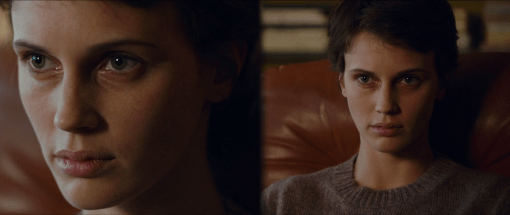
When, in The Discreet Charm of the Bourgeoisie, Buñuel and Carrière had their characters wake up from a nightmare only to find themselves in another, they were mocking the practice of bourgeois cinema to neatly pack middle-class fears into exciting but essentially harmless narrative excursions. The tendency allows the characters and the audience to get a taste of the life on the “other side” but also maintain distance by waking up/returning home when things get too hot. Freud demonstrated that dreams aren’t arbitrary images but rigorously-structured emanations of the subconscious. The Freudian invasion of cinema, however, has meant that anything put in a dreamlike narrative is expected to be meaningfully assimilated into the film’s structure. In François Ozon’s psychosexual drama The Double Lover, an apparent reworking of a Joyce Carol Oates novel, pretty much anything goes. The protagonist Chloé (Marine Vacth) may or may not be lying, may or may not be hallucinating, may or may not know the people around her. Either way, it is of little consequence. To her shrink, she says lines like “I want to remain weak” and “I exist when you see me like that”. The Double Lover would’ve functioned as a camp spoof of European art movies had it not been so serious about itself.

There is a story, though. Chloé, an ex-model, has pain in her stomach, but her doctor tells her there’s nothing physically wrong with her (first of the several false flags the film plants). She is sent to a psychiatrist, Paul (Jérémie Renier), who falls in love and moves in with her to a new apartment. Chloé discovers the existence of a lookalike of Paul called Louis, also a psychiatrist, from whom Paul is apparently estranged. Wanting to know everything about her dodgy but loving boyfriend, Chloé takes sessions with Louis, who turns out to be professionally and temperamentally the opposite of his brother. He humiliates Chloé, becomes increasingly punitive and finally rapes her, which Chloé, of course, likes—this domination cures her of her frigidity though not her pains. Paul proposes marriage, forcing Chloé to put an end to her trysts with Louis, who reveals a dark secret from the brothers’ past.

Chloé works at the Palais de Tokyo as a museum guard and the gallery’s white walls and empty exhibition spaces register as her psychological landscapes: the visceral photographs and tortured sculptures we see are, in fact, derived from images from The Double Lover. The film develops wholly from Chloé’s broken perspective, which justifies distortions of narrative information, but renders the reality of other characters irrelevant. The film, in fact, elides one crucial information in order to wrap up the plot. A creepy-seeming, horror-movie neighbour is thrown in for easy chills, and to provide a relief from the sight of the same two actors. Ozon uses a soundtrack full of false cues, always implying terror where none exists. His film recalls a host of predecessors: Hitchcock most of all, but also Cronenberg of Dead Ringers and A Dangerous Method, Polanski of Rosemary’s Baby and The Tenant, De Palma of Body Double and Passion, and even Aronofsky. In fact, The Double Lover in on such a familiar narrative and aesthetic beat that it seems machine-generated from these films: the same use of old American pop songs, the same circular-spiral camera and architectural descriptions, the same mirror motifs that are by now self-parodical arthouse shibboleths.

Ozon’s film equates psychoanalysis with fucking, both forms of the same action of penetrating a person. The idea is, of course, rather old and rests on the dual implication of the verb “to know”. The three characters take turns exercising phallic violence on each other, reflecting the changing power equation between them. Ozon’s camera constantly zooms in and out in an imitation of the sexual act. At one point, when Chloé orgasms, the camera penetrates her mouth and reaches her vocal cord. In one of the film’s first images, a shot of her vagina dissolves to a shot of her Marion Crane eye. Given it’s a film about parasitic twins, even a brash rape fantasy is furnished as character psychology. True to theme, Ozon uses several cloven compositions—split screens, but also CGI sequences of characters physically bifurcating. There’s a music-video like passage of twin boys wrestling with each other as Vacth and Renier stare directly at the camera. The glimpse of post-winter Paris and Ozon’s colour-coded mise en scène aren’t enough to relieve us from the airlessness of this by-the-numbers thriller.

CICIM Munich no. 22-23; June 1988.

Le Pont du Nord

French cinema of the last few years is based, above all, on the personality of its directors. To trace great trends in it runs the risk of giving a false impression since they are often foreign or contrary to the personality of the leading filmmakers, who run the risk of being sidestepped by our desire for generalization.

We then run the risk of forgetting unclassifiable auteurs or ones in constant evolution such as Demy, Varda, Biette, Gainsbourg, Serreau or Depardon. We run the risk of forgetting a very important stylistic principle such as Robert Bresson’s Partitivism: in his framing, the director of Lancelot du lac indeed tends to isolate one part of the body, to exclude the head, to favour an object or a series of objects, the moment the interest of the image seems hinged on this body part.

But if one had to absolutely put a label on current French cinema, I’d say that it’s a school of hazard. If the preceding decades had produced an art very much planned out in advance, one which attained its limits because of the permanent repetition of this premeditation, contemporary filmmakers, on the other hand, set out on in search of hazard, which alone seems to be capable of bringing something new. We have here Rozier, Rivette, Pialat, who, in the course of the film (Maine Océan, Le Pont du Nord, À nos amours), veer off into a fascinating, unplanned direction. Even a super-classical filmmaker like Rohmer adopted this practice in Le Rayon vert. This is also the working principle of the magnificent Petite suite vénetienne made by Pascal Kané and of Godard’s films. We even find a premeditated hazard in Bergala (Faux-Fuyants, Où que tu sois), whose scripts set off in directions which (wrongly) seem the products of chance. More simply, such hazard can be discovered by the actor’s improvisation (in Doillon, in Téchiné).

That brings us to a cinema of actors, hinged on the expression of emotions binding two or more characters together. A cinema that replaces social tapestry with bourgeois individualism so criticized by the Marxists. That’s normal for a country like France which, in the past forty years, hasn’t really know great crises: neither famine, nor revolution or dictatorship or war.  This is the cinema of Rohmer, who strikes us with his exacerbated minimalism, of Doillon, whose psychoanalytic sense is in struggle with a taste for improvisation and in whose work love comes about through the artificial creation of a conflict, a breakup, of Pialat, of Breillat (Tapage nocturne) and often of Truffaut (La Femme d’à côté).

There is also a cinema founded on the grandeur of the image which, except in Garrel, seems independent of the principle above. Contrary to what one might suppose, this essentially visual cinema, full of light and shadow effects (Garrel, Bard, Azimi, Duras) is often a broke cinema with a precarious existence. A new variant is the music-video-movie (Beineix and, on a more elaborate level, Carax): every shot wants to be a masterpiece and is built on a strong conception of lighting. But this is often at the expense of the story, if by misfortune, there is a story.

Another characteristic is the dissociation of image and sound, which we find in Hanoun, Duras, Straub, Godard, Ruiz, a new variation on counterpoint as defined by the Russians in 1930. The most famous example is the noise of seagulls over Parisian metro in Godard’s films – a way of glorifying both elements through their contrast, where an audiovisual coincidence usually tends to put the viewer to sleep.

Counterpoint doesn’t stop there in Godard. It is systematized, extended to other elements every time it can be, notably to the relation between different parts of the image. Ruiz, on the other hand, narrates a fantastic story on trivial images (Brise-glace, L’Hypothèse du tableau vole).

In France, there is a family of dark humourists (Mocky, Blier, Marboeuf, Grand-Jouan, Sentier). There is also a whole new art born of the economic necessity of shooting quickly (one to three weeks for Vecchiali, Duras, Biette). We also notice writer-filmmakers moving from one mode of expression to another with the greatest of ease. Among the golden quartet of current literature (Weyergans, Duras, Breillat, Cavanna), three of the four have made films. Rohmer alternates between theatre and cinema. Pierre Kast has been able write a novel, Le Bonheur ou le Pouvoir, the same year he made a film, Le Soleil en face, which are both of high quality. End of specialization…

We also find classical filmmakers of quality (Chabrol, Rohmer, Truffaut), who – the first two at least – are faithful to a traditional structure in the same genre. More generally in the past few years, we notice a return to narrativity, to a more classical presentation, the structuralist and poetic audacities of post-1968 tending to disappear perhaps under the influence of commercial censorship or self-censorship. It’s difficult today to imagine non-narrative films like those of Bard or Silvina Boissonas, even of Garrel. On the other hand, there is a public and critical consensus towards narrative forms like those of Chabrol and Rohmer, quite identical from one film to another, which allows for a certain perfection but also carries the risk of fossilization. French cinema, like the Italian one, tends to become a cinema of the old. At Venice in 1984, French cinema was represented – brilliantly for that matter – by the four great Rs: Rouch, Rohmer, Resnais, Rivette, with an average age of sixty-two. In contrast, the fifties generation has brought us no revelation whatsoever till date.

Experimentation seems to be reserved for certain senior filmmakers who can have their way thanks to their reputation: Resnais, whose every new film constitutes a challenge, a wager, Duras, who approaches her themes through successive recurrence of undulatory movements, Godard.

Ever since Jack Lang became the Minister of Culture (1981-1986), France is also the host country for foreigners like Hollywood once was: South-Americans (Ruiz, Jodorowsky, Santiago, Solanas), North-Americans (Kramer, Berry), Algerians (Allouache), Japanese (Oshima), Italians (Monicelli, Ferreri), Egyptians (Chahine), Polish (Zulawski, Polanski, Wajda, Borowczyk), Greek (Papatakis), Belgians (Akerman), Portuguese (Oliveira), Dutch (Ivens), which makes the notion of nationality often outdated.

Another surprising aspect is the pre-eminence of meteors, exceptional films overlooking an uneven or disappointing body of work (Blier’s Tenue de soirée, Deville’s Dossier 51) or other unique or near-unique works (Debord’s In girum imus nocte et consumimur igni, Koleva’s L’État de bonheur permenante, Dubroux’s Les Amants terribles, Breillat’s Tapage nocturne, Rouqier’s Biquefarre, Devers’ Noir et Blanc). Isolated bodies of work like those of Lampedusa, Clarin, Chamisso, Lautréamont, Lowry. This unsettles a number of people in the country where the politique des auteurs was born.

We can also list negative commonalities: predominance of crime movies, highly stylized photography working against the film, moral anachronisms (soixante-huitard behaviour in films set in the past), virtuoso verbalism of the characters for the dialogue writer to showboat with, leftist boyscoutism, where we find nothing more than in the day’s edition of Libération, overload of plot twists to avoid slow passages, lack of first-hand information about the milieux described, endless repetition of characters’ chief trait etc.


[From Luc Moullet’s Piges choisies (2009, Capricci). See Table of Contents]

Nocturama

Jean-Luc Godard’s self-styled student revolutionaries were nothing if not talkative. They crippled themselves into inaction debating over praxis and theory. For them, as for many other Godard’s radicals, the time for action was long over, it was now time for contemplation. Not yet for the youth we accompany in Bertrand Bonello’s enigmatic, double-faced Nocturama. We first see them in action, walking, boarding and getting off the subway, always moving and doing something. There’s barely a word in the first quarter hour, which proceeds by an intense accumulation of shots of characters traversing the length and breadth of Paris in great hurry. The transfers they make in the subway mirror the way the filmmaker cuts between them. This mosaic of perspectives, combined with the precise time ticker, makes a vague promise that the characters will all be eventually connected. Their surreptitious behaviour reveals that they’re involved in a conspiracy, an idea dear to Nouvelle Vague filmmakers. It wouldn’t be some time until we learn that they’re carrying out a series of assassinations and bombings in the heart of Paris, a city we see from a bird’s eye view in the first shot.

As the threads converge, we are presented with brief flashes into the characters’ past: some of them are preparing for Sciences Po and ENA, others are interviewing for dead-end jobs. They are from different racial and social backgrounds, but we’re not given any information as to how they meet each other, leave alone how they agree on a terrorist plot. This narrative gap is characteristic of Bonello’s film, which doesn’t bother spelling out the reasons for the bombings or the gang’s intentions. From the bits of information we do get, we understand that they are a faintly anarchist bunch working against what they take to be the current world order. The real France is present, muted in the background—global capital, dwindling job market, National Front, surveillance state, legalization of marijuana—but it’s only accessory to the film. What Bonello is interested in in this first part of the film is instead the mechanics of the bombing plot, the perceptual calculus involved and the sense of people invested in an abstract mission. The filmmaker dispels any echo of contemporary Islamic terrorism, and focusing on this improbable terror outfit is his way of stating his goals.

After the bombings and killings have been carried out, and as a curfew is declared in Paris, the gang takes refuge in a large, evacuated shopping mall in the middle of the city. The film makes a reverse movement from this point, tracing the dissolution of the group that was so far united on a quest. Amazingly enough, the characters believe they could get back to normal life if only they lay low in the mall for a day. They spend this time indulging themselves, wearing the mass-market clothes on display, playing with the toys, drinking up the champagne, and playing pop music on the gadgets in the electronics section. In short, they become the consumer society they despise. This portion of the film is a picture of decadence worthy of Fassbinder or Visconti, as a group once full of conviction and meaning devolves into hedonistic aestheticism. There’s even a lip-synched song one of the boys sings under a garish make up. The film turns melancholy as the inevitable end approaches, and the random violence the gang inflicts on the city finds its response in equally senseless, faceless violence of the state.

In an early flashback, one of the gang members discusses the ideal structure for a political thesis for a university examination: introduction of the problematic, dialectical presentation of arguments, a personal point of view and a conclusion—a very French, Cartesian approach to exposition that Nocturama deliberately eschews. There is no indication that the bombings were the consequence of something specific, except a global sentiment that “it had to happen”. Nor does the filmmaker take a moral stance towards their actions or their end. In fact, Bonello forestalls any sympathy for his characters through his cubist superposition of perspectives, which swaps a dramatic event with a slightly different version of the same over and over. These perspectives are not intended to be seamless, but go back and forth in time in a slightly redundant and absurd manner in a parody of closed-circuit footage omnipresent in the film.

Somewhere in Nocturama is probably a jibe at the compromised idealism of the soixante-huitards, but Bonello’s preoccupations are more philosophical than political. He’s interested in how actions are shaped by personal and symbolic meaning and how the lack of meaning can conversely produce a mechanical society. The two sections of the film converge towards different truths, one political and contingent, the other existential and eternal. After the gang has assembled in the mall, one of the boys feels estranged from the mission and slips out of the building to wander the deserted city. He’s out there to precipitate the gang’s downfall but also to make some sense of its actions. The time for action is over, the time for reflection begins.

Non-Fiction

Going by his last three features, Olivier Assayas’s films are two seemingly unrelated works welded at the hip, bound together only by an abstract idea. Clouds of Sils Maria was about the tragedy of an actor’s aging, but also about the over-visibility of star culture. Personal Shopper was at once a ghost story, a peek into the unseen side of celebrity life, and a horror tale about digital media. His new film, Non-Fiction, deals with the crisis of the publishing industry in face of the digital revolution and the ethical problems of fiction that is too personal, but it’s also a comedy about adultery among middle-aged, middle-class cultural types. These films present themselves as puzzles that promise to fit together were the viewer to supply the connecting piece.

Guillaume Canet plays Alain, the chief editor of a publishing house that’s in the process of figuring out its strategy in a fast-changing literary climate. Laure (Christa Théret), the young expert in charge of charting the firm’s digital roadmap and with whom Alain is having an affair, believes that the only way to stay relevant is to be radical, to treat tweets and texts as legitimate publishing material. Alain has just turned down the latest manuscript of Léonard’s (Vincent Macaigne), which his wife Selena (Juliette Binoche), a television actress, finds to be his best work. Léonard is in a relationship with Valérie (Nora Hamzawi), who is assistant to a rising politician of the left and who cannot humour her partner’s bouts of self-doubt and self-deluding resentment.

Like in a traditional French comedy, Assayas creates a chain of romantic affairs between the characters, but his focus is not on the entanglements they create. He treats them like hypotheses in a theory. The characters are all in the grip of professional and cultural upheavals: Alain has to react quickly and suitably to newer forms of literary consumption, Selena has to come to terms with the idea of television franchises, the monk-like Léonard must rethink the moral quandary involved in narrating the personal life of others, Valérie must understand the role perception plays in the political arena. In a way, all these issues stem from the extreme visibility, access and availability new media offers its consumers, forcing producers to constantly reinvent themselves or become obsolete. In this, Non-Fiction is of a piece with the director’s previous two films.

But what does it all have to do with adultery? I think the missing piece of this puzzle relates to the notion of double lives, which happens to be the film’s French title. Connected to their phones and tablets, the characters of the film are always elsewhere than where they are physically present. The face they present to others takes priority over their everyday relation to the people they live with, which is what adultery is at heart. Léonard insists that his novels are veiled in a smoke screen of fiction such that readers won’t suspect their autobiographical links. This self-image he creates is suppose to absolve him of the emotional violence he wreaks on the people he writes about. In positing this, Non-Fiction demonstrates a continuity between older, pre-internet forms of social behaviour and current ones, just as how Personal Shopper imagined chatting over internet as a form of spiritual séance.

Assayas’s film is also, however, a progression of tiresome, talky vignettes of people discussing the implications of internet, the devaluation of information, the narcissism involved in rejecting narcissism, the resurgence of physical books, the drawbacks of democracy and the relevance of criticism in the age of artificial intelligence. Even when actors perform them as casual dialogues over aperitif, the exchanges are overwhelming in the amount of reflection they pack. And I don’t think it’s particularly rewarding to dwell on them, function as they do as a form of smoke screen themselves to hide the film’s simple, more direct themes. Save for the final sequence filmed at a beautiful coastal location, the film is also visually exhausting with its endless supply of over-the-shoulder compositions shot in warm, indoor lighting.

Journal de la SRF no. 7; February 1982.

Sauve qui peut la vie

The best films in France today have, for the most part, what is called a “reduced” audience: between 15,000 and 1,000 viewers for Femmes femmes, J’ai voulu rire comme les autres, Passe-Montagne, Le Berceau de Cristal, Courts-circuits, Guns, Rue du Pied-de-Grue, Dora, Daguerréotypes, Vincent mit l’ane…, In girum imus nocte…,Sérail, L’Automne, Agatha, Out One, Dehors dedans, Paradiso, Le Jardinier…

The responsibility for these “failures” is often attributed to a non-conformity to the standardization imposed by the Big Villain, the three-headed oligopoly. But that’s to forget that the situation is similar, or worse, in our neighbouring countries without an oligopoly (Benelux, Switzerland) and that, in most of these cases, the Big Three have done what they could… That’s to say very little. For the problem is more serious: there is a refusal by the majority of the viewers to leave their house to go to the movies.

Hence the importance of television, our staple medium, over which our attachment to the past often prefers theatrical screenings. Let’s recall Gilson’s La Brigade: 3,000 theatrical admissions, 9 million television viewers.

It’s viewers who push the oligopoly (which sometimes prefers the nice role of the patron of the arts) towards standardization through trends, genres, and guaranteed names so that their precious time away from home and the money they spend are a sure investment while the quality of the films could only be the product of copyists.

Over eighty years, this demand for standardized products, reinforced by the capitalists of silent cinema, has continued to a point where, for a lot of viewers, the notion of quality has become one with the notion of standard. Especially in France, the cradle of an old, tired civilization, much less open to difference than the American and the African ones. For proof, you just have to look at all the customers who walked out of the aforementioned films midway.

It’s difficult to overwhelm the viewer when we, the filmmakers, ask retailers for the same cigarettes, the same aprons, beefsteaks, rump steaks, the same brand of shirts through the years.

And how could a viewer appreciate Rivette, De Gregario or Kast if he doesn’t know South-American literature (which too has a readership in France of less than 15,000), an indispensable stage in the thought process of these filmmakers? Can he appreciate Grandperret’s sense of ellipse if he has never tried his hand at editing and if he hasn’t been exasperated like us by the humdrum of the dominant narrative? If he watches ten films a year, isn’t it normal that, like the non-filmmaker creators in Cannes juries, he finds originality in the standardized product that we, after two hundred viewings a year, hate?

From Matisse to Schoenberg, from Joyce to Calder, from Beckett to Straub, contemporary art tends to be an art for the initiated. Is it possible to appreciate modern painting without having followed every step of its evolution over the last hundred years? Can we like a book without learning the language? Renoir, who passes for a popular filmmaker, said that, of the five thousand customers at Gaumont-Palace, only five really saw the film. By this measure, are the viewers of “hits” like Providence or Sauve qui peut really more in number than those of Duras or Hanoun?

That’s why the chief problem of French cinema will not be resolved by economic planning, but by the compulsory teaching of cinema at school, the analysis of films and the study of the evolution of cinema on television channels.

Teaching literature at school can be questioned. But it’s thanks to it that we don’t praise Ponson du Terrail to the detriment of Stendhal, Delly or Des Cars instead of Bernanos or Proust. On the other hand, they tell you: L’Arche perdue, les Baskets and the Disney factory over Duras, Garrel and Rivette.

The public must be changed.

Another major problem: earlier, the spectator used to make his choice based on the theatre, the genre and the star. Today, he also tends to choose according to the auteur of the film. To such a point that very few great filmmakers succeed in concealing themselves behind the genre or the actor. They are automatically assimilated into “auteur cinema”. In the olden days, before being a film by X or Y, Monsieur Lange passed for a crime movie by Jules Berry, La Petite Lise and La Vénus aveugle for serial melodramas. Les Dames du bois de Boulogne for a worldly drama by Paul Bernard. La Ronde for a bawdy film. These at least had their share of guaranteed earnings as genre films or star films – something which would be impossible today.

The tragedy is that the public which demands auteurs, unless it spends its entire life at the movies, can only “absorb” a limited number of these auteurs, those which constitute a must, in general one per country, Bergman, Saura, Wajda, Tarkovsky, S. Ray. In France, there are Truffaut and Resnais, and, in the standing room, Rohmer, Godard, and then Lelouch-Sautet-Tavernier-Blier (even if their status as auteurs is questioned). The others are in the anteroom.

Now, in France there are a hundred auteurs, another hundred pretending to be, and another thousand waiting for the chance to prove that they are auteurs. The “politique des auteurs” has thus created a gigantic garbage. Solution? Make double-billing compulsory to include an ‘arthouse’ film, encourage increase in production methods and video distribution. Create the idea of a regional auteur through a quota for regional films, eating a little into international auteurs. Promote a larger number of French auteurs at the expense of fake auteurs (Schlöndorff, Ken Russell, Scola).


[From Luc Moullet’s Piges choisies (2009, Capricci). See Table of Contents]

[I wrote this review of Textes Critiques, the complete collection of Jacques Rivette’s film criticism issued by Post-Éditions, earlier this year.]

Textes Critiques

Jean-Luc Godard quipped that his criticism represented a kind of cinematic terrorism. Serge Daney said his writing taught him not to be afraid to see. The Parisian publishing house Post-Éditions has made available a long overdue collection of his articles in French to decide for ourselves. Jacques Rivette became a filmmaker even before he became a critic. When he came to Paris from Rouen in 1950, he had already completed a short film, unlike Truffaut, Godard, Rohmer or Chabrol, his colleagues-to-be at Cahiers du cinéma and later fellow New Wave directors. By his own admission, he never wanted to be a film critic, not in the traditional sense of the term. But, considering his own dictum that “a true critique of a film can only be another film,” he never ceased to be one.

Textes Critiques as an object has the appearance of a cinephilic totem: half-a foot in size, portable, with a French flap cover in black and white featuring only an evocative photo of the author taken by Truffaut in 1950. The minimal outer design flows into the volume, a collection of Rivette’s writings devoid of photographs, film stills or images of any other kind‑an austere presentation that reflects the solemn quality of Rivette’s texts. Apart from an insightful introduction by co-editor Luc Chessel, there’s no extra fat to go with the articles: no biographical sketches, testimonies or commentaries. In other words, you don’t get any information about Rivette’s early years, his gravitation towards cinema, his activity during the months he didn’t publish reviews, the momentous “putsch” of 1963 at Cahiers or the (in)famous December ’63 special on American cinema running over 250 pages that appeared under his editorship, partly responsible for driving the magazine to the verge of bankruptcy.

Collected in the first of the five sections of the book are all of Rivette’s writing between 1950 and 1965: about 75 pieces, most of them published in Gazette du cinéma, Cahiers du cinéma and Arts. The second chapter is a re-publication of an extended discussion between Rivette, Jean Narboni, and Sylvie Pierre from 1969 on the topic of montage. The third, short section is a collection of tributes to André Bazin, Truffaut, and Henri Langlois, while the fourth brings together nine unpublished articles. Among the latter is a valuable collection of entries from a diary Rivette maintained between 1955 and 1961—a series of short, Bresson-like maxims, theoretical pilots and notes-to-self. The book ends with an insightful interview between Rivette and Hélène Frappat on the question of what makes an object of art worth critical consideration. No explanation is offered as to why the discussion on montage (published without the accompanying photograms or its original four-column format) merited selection over any of Rivette’s other roundtables at Cahiers or why the Hélène Frappat interview is more befitting a concluding chapter than any other interview with the cineaste. Ce qui est, est.

The mode of address is clearly different between the pieces from Cahiers and those from Arts. While the former’s specialized audience and acknowledged partisanship gives Rivette—and his young colleagues—license to passionate excesses, emphatic declarations and mystical aphorisms, the wide readership of Arts imparts discipline and argumentative clarity to the articles. Yet Rivette’s prose remains complex, constructed with long sentences and hefty theoretical arguments. Like the American critic Manny Farber, he feels no obligation to even summarily describe the plot, the cast or the circumstances of a film’s production. The focus is squarely on setting up the polemic or deriving general precepts about the seventh art.

In “Critic Going Everywhere,” Donald Phelps characterized Farber’s film criticism as multi-directional, gnawing away at the peripheries of what a film has to offer and “getting as far away as possible from any point, any centripetal force.” Rivette’s writing reaches outward too, frequently spiraling away from the film at hand to arrive at a provisional theory of all cinema—a theory that is always in the making, redefined and refined with every new encounter with the screen. Thus, a commentary on Chaplin’s Monsieur Verdoux (1947) serves as a launchpad for a meditation of the tension between reality and cinema. An evaluation of Alexandre Astruc’s Les mauvaises rencontres (1955) becomes a demonstration of the possible ways of talking about a debut work. A review of Otto Preminger’s Saint Joan (1957) provides an occasion for revaluating all post-war American cinema.

Yet, Rivette’s is far from an academic approach that takes films as mere evidence for substantiating a theory. These centrifugal reflections emanating from a single film are nevertheless rooted in it, enabled by it. When he concludes, in a review of Angel Face (1953), “What is cinema but the play of the actor and the actress, of the hero and the décor, of the word and the face, of the hand and the object?”, Rivette is offering as much an appreciation of the specific pleasures of Preminger’s new film as a general manner of looking at the cinema. Despite the constant evolution of Rivette’s critical position, several concerns have a permanent presence in his writing, almost all of them rooted, incredibly enough, in the sparkling, lucid first essay he published at the age of 22, “Nous ne sommes plus innocents” (1950), in the Bulletin of the Latin Quarter Cine-club run by Maurice Schérer.

REALISM

An abiding belief in realism—not the representational realism of the novel or the psychological realism of the qualité française, but the brute ontological realism of the film image—comes across as a cornerstone of Rivette’s thought as a critic and a filmmaker, a conviction that what is seen on screen derives its power from the camera’s mechanical transcription of what did take place in reality. In his first essay, he prescribes a goal for the filmmaker: “Simply inscribe on film the manifestations, the mode of life and being, the behaviour of the little individual cosmos; film coldly, in a documentary manner: the universe goes on; the camera reduced to the role of a witness, an eye.” And, in a review of Cocteau’s Orphée (1950): “The filmmaker must know to respect what he films, to submit himself to his object.” Such strong faith in the realist axiom perhaps goes some way in explaining the indifference, if not downright hostility, of the Young Turks of Cahiers to vast areas of experimental cinema engaged with more plastic-painterly qualities of the medium.

In this, and their unerring, uncritical celebration of Jean Renoir, Rivette’s earliest articles, like Godard’s, reveal a strong influence of André Bazin. Godard would work his way out of Bazin’s shadow by defending classical editing over long-shot filmmaking in pieces like “Defense et illustration du découpage classique” (1952) and “Montage, mon beau souci” (1954). Rivette, for his part, turns to technology for coming into his own. In “L’âge des metteurs en scène” (1954), an enthusiastic appraisal of the possibilities of CinemaScope, one can see him working with and against the ideas of his mentor. A characteristically Bazinian statement early in the essay—“One must be deaf not to be haunted by the clear, lively timbre of Lilian Gish’s voice.”—makes way for a grim pronouncement—“The search for depth of field is outmoded”—and a Greenbergian criterion: “Could great mise en scène, like great painting, be flat, revealing depth, not through gaps, but through notches?”

ACTOR/ACTION

One more aspect that Rivette’s written work shares with Farber’s is its eye for the human element of films. The physical presence of an actor, the concrete nature of his/her gestures and movement are, for Rivette, the primordial, structuring components of cinematic aesthetic. In his first essay, he compares the inescapably specific quality of the film image, its uniqueness of time and space, with the universal quality of literary production: “a shot always belongs to the realm of the accidental, to a unique and unrepeatable success; a sentence can be rewritten at will.” The following piece on Renoir’s The Southerner (1945) furthers the thought: “It’s once again proven that the word ‘script’ has no meaning and that there is neither now or ever a ‘script’: a film is people who walk, kiss, drink and bump their heads.”

An even more formidable but unpublished article from the same year, “The Act and the Actor,” made available in Textes Critiques, broaches the question of film actors. After some provisional but compelling reflections on the viewer’s identification with the figures on screen, Rivette goes on to anoint the actor not only as the single most important ingredient of a film, but as its very purpose to exist. “Every film is a documentary on the actor,” he remarks. “Everything must be subjugated to the actor […] Everything is but a means to reach him, from the camera movements that search him to the décor that refers to him.” He continues: “The universe has no cinematic value but in its certain relation with man who confronts and enters it […] Far from subjugating him to some or various ‘components’ of the film, everything must be ordered according to him, from him who gives everything its raison d’être.” And finally, after establishing a monistic relation between the actor and his “acts”: “Movement, gesture, act: these are then the elements the filmmaker employs; he must harness the actor as his only means of expression.”

FILM LANGUAGE

Rivette’s writing, right from “Nous ne sommes plus innocents,” militates against the pervasive idea of film as language. He traces this original sin in the universalization of D. W. Griffith’s specific idiom by later filmmakers: “The clumsy systematization of a language, of a syntax that Griffith must’ve confusedly elaborated to express himself and which was simply the superficial consequence of his particular universe put the worm into the fruit, which was to literally devitalize cinema in increasingly deaf and subtle forms.” This starkly resembles Luc Moullet’s arguments later in a lecture titled “On the Toxicity of Film Language” delivered in Pesaro in 1966: “The French who imitate American cinema are but appropriating the means conceived by Griffith and DeMille to express in the best possible way their personal universe, marked by Southern spirit and a puritanism that has nothing to do with the universe of the French directors.” While Moullet goes on to declare that “language is thus alienation,” Rivette simply characterizes cinema as a “language without law.” In other words, a means of information and expression with no inherent grammar.

PURE CINEMA

Refusing to engage in the debate concerning cinema as a pure form—which also amounts to a refusal to engage with the other hot debate of post-war French culture between “form” and “content”—Rivette’s criticism, covertly but consistently, thinks of cinema as a non-sovereign if not parasitic form. Certainly, there is mise en scène and authorship, but “nothing opposes or even separates [theatre and cinema]: both pertain to the realization of an ‘active’ universe.” This leads Rivette to some startling aphorisms: “cinema is nothing but what filmmakers do,” “mise en scène is the script,”, “[cinema] exists only its becoming, it’s what we make of it.” And from an unpublished text from 1963: “Don’t box cinema into its (so-called) classical definition. Like tonality is not the entire history of music, American cinema (of mise en scène) is only an era.” This conception of cinema as being in continuum in other art forms goes hand in hand with Rivette’s increasing interest and education in modern painting and music: his reviews of the period allude to an atonal cinema and Jean Fautrier, Jean Dubuffet, and Anton Webern are constants points of reference. It also fits together with Cahiers’ theoretical turn under Rivette’s leadership in the same year. This period saw the magazine’s first interviews with figures truly outside of the domain of cinema—Roland Barthes, Pierre Boulez and Claude-Lévi Strauss. This opening up—and perhaps the eventual subjugation—of film discourse to other sociological disciplines has, as the essays in the book show, as much to do with Rivette’s theoretical proclivities as with the magazine’s general sensitivity to the spirit of the times.

MODERN CINEMA

Throughout the book is an active if tentative search for a definition of what constitutes modernity in cinema. So, Journey to Italy (1954) makes “all films [grow] older by ten years” and Les mauvaises rencontres is “a young film, made by a youngster, for the young.” One gets a feeling that, for Rivette, modernity and youth were indissociable, just as it was for Daney who could see only a “continuation of Vichy” in the old faces still populating the post-war French screens. Elsewhere, in a review of I Confess (1953), Rivette bluntly announces that the secret of modern cinema is beyond the realm of criticism, being available only to filmmakers. But modernity is also, of course, related to conscience. A series of notes on the concept of modern cinema simply begins with the postulate, “Modern art is conscience.” The somewhat mystical passages that follow describe various forms this conscience could take: distance from the object, a rejection of classical efficiency, the preference for confession over fascination. It’s only decades later, in “The Secret and the Law,” the interview that concludes the book, that Rivette rejects the idea of innocence (in opposition to which a modern conscience could be set up) as fiction. Leaning on Kleist, he submits that the best an artist could do is “to see if there isn’t a small door at the back which would allow us to return to the original paradise.”

CHRISTIANITY

Religious parlance is most obviously present in “Lettre sur Rossellini”: “The genius of Rossellini is possible only within Christianity […] Rossellini has the eye of a modern, but also the mind of one: he is the most modern of us all; it’s always Catholicism that is the most modern.” But it also makes its appearance in diverse other forms—“Sin,” “Soul,” “God”—across the essays: “The flesh is visited by the spirit” (on Under Capricorn [1949]); “More than any other art, cinema knows to approach the mystery of incarnation.” (Tale of a True Man [1948]); “The perfect ‘neo-realist’ actor… body in search of a soul.” (Il Bidone [1955]). While it could be seen simply as florid language laden with colorful metaphors, the historical and cultural climate they were written in demands scrutiny. As Antoine de Baecque examines in La cinéphilie: L’invention d’un regard, the Young Turks at Cahiers du cinéma and Arts were consciously positioning themselves against the Old Guard of the left, hobnobbing with extreme-right figures and assuming conventional, right-wing stances. In a critical context where Truffaut could defend Nazi collaborators and Rohmer could write about cinema as the “expression of a superior race and civilization,” it’s hard to see any irony or innocence in Rivette’s lament that the contemporary public “believes neither in God nor the devil and snickers when one speaks of sin” or his proposition that cinema is at heart a Catholic form embodying the mystery of incarnation.

But the single most important object of Rivette’s critical quest is the relation between mise en scène and metaphysics—a question that features so regularly in the reviews and notes that it seems the critic was unsatisfactorily wrestling with it all through his life. A fetishization of the material aspect of cinema was always a part of post-war French cinephilia, but it was the young critics of the period writing in magazines like Cahiers who gave it intellectual and moral legitimacy by tying the purely material quality of mise en scène to metaphysics, to ethics, to specific ways of looking at the world. That is how Bazin defended the excesses of the young critics in an essay titled “How can one be Hitchcocko-Hawksian?” (1955). That is how tracking shots became a question of morality and vice versa. That is how, in “On Abjection” (1961), a single forward movement of the camera deemed a filmmaker morally contemptible.

Rivette invokes this metaphysics in many forms: as an idea of the world that comes into being just as the world is represented, a personal secret that reveals itself in its conflict with reality, a fidelity to the fundamental laws of the human body. Again and again, the filmmaking enterprise is defined as the unconscious disclosure of an invisible world, “a link between something exterior and something secret that an unexpected gesture unveils without explanation,” and the filmmaker as “the one who has the sentiment of a thing before filming it, who expresses this sentiment by varying his turn of phrase and whose sentiment is linked to a general philosophy (a metaphysics or at least a moral).” This line leads him to declare metaphysics as precisely that which escapes all human control: “Perhaps metaphysics is the arbitrary part of creation, which, surpassing the frameworks of human creation and everything capable of pinning it down, can only be the work of the hand of some god.” A filmmaker’s either got it or he hasn’t: la politique des auteurs as Jansenism.


« Previous Page — Next Page »