By the time I got to know the details, I’d already missed half of this year’s Experimenta, India’s most prominent experimental film festival founded by Shai Heredia in 2003. This year’s edition was impressive not only in its expansiveness, being categorized into competition section, country focus, artist talks, live performances and artist profiles, but also given that it was entirely crowd-funded, which surely calls for some cheers. I congratulate Experimenta and wish them bigger successes in the years to come. Here are some notes on exactly one half of this year’s fest.
INTERNATIONAL COMPETITION
(Curated by Anuja Ghosalkar)
MOUNT SONG (Shambhavi Kaul, India, 2013, Video, 9min)
 Shambhavi Kaul’s elusive, melancholy and richly atmospheric film starts with images of storm inside an artificial jungle. We don’t see the storm, just the idea of a storm, which is befitting for a film that traces the elements that constitute a sensorial experience, as when watching a film. Gliding through what looks like haunted, dilapidated sets for a Chinese martial arts movie, Kaul’s film preoccupies itself with pure form, such as the amorphous outline a wisp of synthetic smoke, visceral, staccato edits between shots and the mysterious interplay of light, dust, colour and camera movement, under the veneer of an abstract genre piece located somewhere between Masaki Kobayashi and Tsui Hark.
BURNING STAR (Joshua Gen Solondz, USA, 2012, Video, 4min)
 Modest in scope yet hypnotic in effect, Solondz’s 4-minute animation in colour is admittedly a dedication to the artist’s father who apparently wanted him to “make a more colorful work”. Colourful, it certainly is. We see a twelve-sided star, alternatively imploding and exploding in dazzling primary colours, with spiky patterns that complement its periphery moving towards and away from the star’s pulsating core, which serves both as the visual and true center of the symmetric image. The soundtrack dominated of what sounds like radio interference, reminiscent of Peter Tscherkassky’s work, attains a musical regularity that makes the film easy to groove to.
PLAY LIFE SERIES (Ella Raidel, Germany, 2012, Video, 11min)
 Raidel’s four-part study of performativity in the visual media begins with a rigged-up sword fight between two actors suspended on ropes in the woods – a scene that is soon revealed to be a part of a film shoot, prompting us to reflect not only on the artificiality of the fight, but also the film crew itself. This Brechtian gesture of exposing the inescapable element of performativity that marks all filmmaking becomes the organizing principle for the rest of the film, which emphasize the artificiality of earnest forms – melodrama, music videos and even everyday confrontations – by creating an ironical distance between them and the audience through the presence of a film crew – hardly experimental.
PARTY ISLAND (Neil Beloufa, France, 2012, Video, 9min)
 Performativity and ritualized interaction are also at the heart of Beloufa’s raunchy video work that is set in an artificial, back-projected beach, where a bunch of actors stiltedly playing vacationers go through the codified rituals of vacationing, socializing and seducing. More interesting than its ham-fisted, part-Surrealist illustration of the sexualization of images and the subliminal representation of sex through phallic imagery are its formal pleasures – its tableau-like arrangement of actors in a claustrophobic setting, the equally suffocating chopped, restrictive images, the double framing of actors through geometric shapes, the intuitive, tactile editing pattern and the intriguing interaction among multiple visual planes.
BLACK POT AND MOVEMENT (Chaoba Thiyam, India, 2013, Video, 13min)
 A simple, direct and even schematic equivalence characterizes Thiyam’s modestly but precisely named film – that between the fabrication of the eponymous black pot and the formulation of a new movement by a pair of dancers. However, like its title, Thiyam’s sepia-tinted film is entirely materialist in approaching this comparison, striking an equation between the pliant material using which the pot is made and the equally malleable bodies of the performers. The juxtaposition between the rhythm of repetitive labour and dance movements also attempts to collapse the gap between the artist and worker figures – a chasm that artists have always struggled with.
ASHURA (Köken Ergun, Turkey, 2012, Video, 22min)
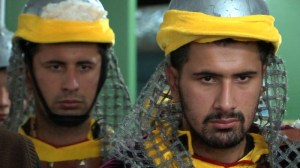 One of the more assured and less academic entries in the programme, Ergun’s compilation of vignettes from Ashura Day – the annual commemoration of the martyrdom of Hussein, the grandson of Prophet Mohammad, in the Battle of Karbala by minority Shia population in the outskirts of Istanbul – is a sketch of collective mourning, a reflection on the cultural regulation of expression of grief. Through an unforced collocation of theatrical religion and religious theater, the film demonstrates how heightened, artificial, popular forms become the most cathartic form of communal grieving and, in a general sense, how art’s purpose of embodying and representing collective apprehensions still remains central.
BLOOD EARTH (Kush Badhwar, India, 2013, Video, 40min)
 Squarely located in the now-too-recognizable genre in Indian documentary of partisan filmmaking against the repercussions of globalization, Badhwar’s film is an account of the reactions of the residents of Kucheipadar village in Odisha to the acquisition of their bauxite-rich land by mining corporates. Shinsuke Ogawa it isn’t, but Blood Earth’s documenting of the often-glossed-over fault lines in a popular movement gives it a transparency frequently absent in its contemporaries. Its best moments, however, are completely apolitical: a protracted, fixed-camera shot of a room full of noisy, convening villagers that results in strange visual patterns over time and a Daïchi Saïto-esque tracking shot of roadside plants that delightfully takes the film for two minutes into a non-representational realm. Winner of the Adolfas Mekas award of the fest.
A+ (Nobu Adilman, Canada, 2012, Video, 6min)
 Commissioned by the Liaison of Independent Filmmakers of Toronto, Adilman’s charming, humourous and even suspenseful short video, scored to a guitar solo, presents us glimpses from the meticulously maintained, hand-written film-viewing diary of super-cinephile Moen Mohammed spanning the year 2011 (inferred from an entry on Trash Humpers), consisting of movie names, year of release, director name and grades. The result is not only a straightforward documentation of the tastes of one Antonioni-loving, Godard-disliking film buff, but also an indirect snapshot of the boons of new millennial cinephilia which facilitates the viewing of such a vast, variegated repertoire of films within a short period of time.
TRAVELS ABROAD (Karl Mendonca, USA, 2013, Video, 7min)
 Mendonca’s petit film diary was shot in 8mm apparently over six years (go figure!) and charts the filmmaker’s return home from New York to India. We see the filmmaker’s ride back home through the eyes of an outsider, his (grand?) parents and his trekking into the local woods presented in a typical home video aesthetic, sometimes presented in time lapse. Marked by circular motifs, Travels Abroad is a self-proclaimed exploration of themes of migration, identity and belonging, but, in actuality, it never rises about its home movie banality and accomplishes little more than what any everyman equipped with a video camera flying back home would have shot.
PULSE (Anuradha Chandra, India, 2013, 16mm, 15min)
 A sketch of Rotterdam in 2008, Chandra’s 16mm project presents out-of-focus, low frame rate, time lapse images of the city and its environs that are abstracted till the limits of perceptibility. Owing to high exposure times, people, vehicles, seasons and the time of day are abstracted out and the residual record of static structures underscores the strongly geometrical nature of urban constructions. These images, frequently dominated by a single saturated colour, carry a tension between movement and stasis. On a level, Chandra’s film is an Impressionistic portrait of a city (with pointillist images) that explores how far a geographical entity can be visually abstracted so as to retain its identity.
DAYS OF FUTURE PAST (Joe Hambleton, Canada, 2012, Video, 8min)
 One is reminded of Chris Marker, especially the melancholy Level Five (1997), while watching Hambleton’s refreshingly widescreen structural film that employs a repeating element – the camera looking through the windshield of a car rolling on a highway before slowly zooming out and refocusing onto an object fixed to the car ceiling – while a voiceover recites what sound like diary entries of a gamer wandering internet message boards. We are in the far future, it would seem, and the current day objects – joysticks, electronic toys and other curios – in the car appear like shards from a past. The result is a meditation on memory, a reflection on how geography and everyday objects bear the trace of history.
ANOTHER COLOUR TV (The Youngrrr, Indonesia, 2013, Video, 9min)
 The Youngrrr Collective’s simple and amusing critique of the isolation of the middle class from history would perhaps have been more effective as an installation, wherein the contrast between the two sections of the screen we see – a mute assortment of various local TV telecasts serious and frivolous and the reverse-shot of a middle-class household hooked to soap operas, ‘reality’ television and religious sermons and literally imprisoned within the frame of the television – would have been even sharper when placed face-to-face. Nevertheless, by locating tawdry television productions alongside their passive consumption and internalization, the film brings to surface the artificiality of the family’s time together and the ideological-mediation of their private conversations.
NEW HARVEST (Pallavi Paul, India, 2012, Video, 11min)
 A discordant combination of talking-heads interview of a politically dissident poet, educational documentary about the desire of scientists to alter nature’s rhythm of day and night and morsels of letters real and imagined between two writers shot in digital video with harsh light sources that form deep chiaroscuros, Paul’s project revolves around things utopian – ideal yet impossible – images unmade, roads not taken. The segments or the fragments of narratives within each are linked by a dream-logic which suggest a impossibility but seem to look forward to a future where these dreams might be realized. The outcome is a set of vague stabs at anarchist political hopes.
ARS MEMORATIVA (Scott Miller Berry, Canada, 2013, Video, 20min)
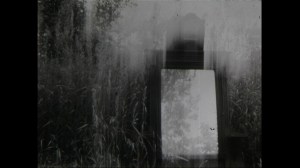 Ars Memorativa – Art of Memory – refers to the methods and techniques we use to remember things, but in Berry’s four-part examination of audiovisual media as incubators of personal memory, it also points to cinema as the preeminent art of memory, of remembrance. Amalgamating analog and digital video, celluloid and audio recordings, whose scratches, smudges and crackling noises, in their own way, act as traces from the past, the film partly ruminates on the purpose of cinema as an authentic document, as evidence of a person’s existence. Berry’s film is a modest reflection on how home movies, music records and photographs, after a person’s passing, develop the quality of preserving the history of the person’s life.
SPECIAL FOCUS: JAPAN
(Curated by Chris Gehman)
GESTALT (Takashi Ishida, Japan, 1999, 16mm, 6min)
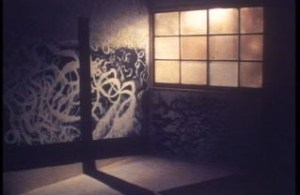 With a beguiling organ-driven soundtrack, Gestalt impresses us with the transparency its of intention, as the title makes clear, and the single-mindedness of its approach. Ishida’s delectable study in 16mm of the malleability of our perspective of space, apparently achieved by continuously repainting the walls of a room, founds itself on the interaction of various geometric and non-geometric motifs that make the space appear alternatingly two and three-dimensional. The effect is to continually keep altering our impression of the room space, and in critical theoretical terms, to undermine the artwork’s interpellation of the viewer as a subject and to destabilize the Albertian perspective on which his/her relationship with the image is based.
A FEATHER STARE AT THE DARK (Naoyuki Tsuji, Japan, 2003, 16mm, 17min)
 In the dream-like way normally unrelated objects segue into each other, Tsuji’s hand-drawn illustration of a made-up Creation myth reminds one of the Surrealist game of Exquisite Corpse, and perhaps even the works of Dali. Tsuji’s method involves drawing with charcoal on paper, photographing the result, erasing the plate and redrawing the next frame. The result is that the each frame carries a trace of the previous and, consequently, the film chronicles its own history, its own making. Tsuji’s drawings are unrealistic, disproportional, undignified and composed of fluid forms that throw his method into sharp relief. The outcome is closer to sand animation than traditional drawing
YELLOW SNAKE (Nobuhiro Aihara, Japan, 2006, Video, 10min)
 Pitched between non-representational and traditional 2D animation, Aihara’s purposefully unwieldy video work, made 5 years before his demise in 2011, consists of two distinct visual planes – a periodic flux of semi-representational figures (bottles, fingers, planets, doughnuts) progressively growing in size to give an appearance of coming out of the screen (and hence the appearance of three-dimensionality) and a realistically drawn two-dimensional yellow hand with a pointed index finger that keeps poking into this swarm of monochrome objects – laid over a discordant soundscape. Mischievous and gleefully indulgent, Yellow Snake, if not anything else, is a reflection of the artist’s own playful relationship with his drawings.
MY TOWN (Tomomichi Nakamura, Japan, 2007, Video, 17min)
 A mélange of even wider variety of animation techniques marks the quasi-Cronenbergian My Town, which draws from low-resolution photography, stop-motion animation, commercial anime drawing and video game graphics on which rudimentary pencil sketches without much foreshortening are overlaid, which, in essence, inscribes two-dimensional objects in three-dimensional space. Nakamura’s part-science-fictional part-fantastical narrative seemingly about a virus outbreak, an ensuing nuclear war and the eventual wiping out of humanity is distinguished by its soundtrack – a combination of drum beats, electronic music and low-frequency noise – and its cinematic approach to space – its simulation of film camera and its depiction of flat objects in three-dimensions.
SPACY (Takashi Ito, Japan, 1981, 16mm, 10min)
 Intermittently stitched together from hundreds of photographs taken inside a gymnasium exhibiting these very photographs, Spacy is a structural study of cinematic space that creates a mise en abyme of photographed spaces into and out of which we move until we are no longer sure of which ‘level’ we are in. Despite the rapid stream of images shot at us, our focus remains firmly fixed at the geometric center of the image around which the configuration of represented space changes continuously. This trait, along with the absence of any vertical camera movement and the many levels of space negotiated, places the film alongside contemporary First Person Shooter games like Doom.
ZONE (Takashi Ito, Japan, 1995, 16mm, 13min)
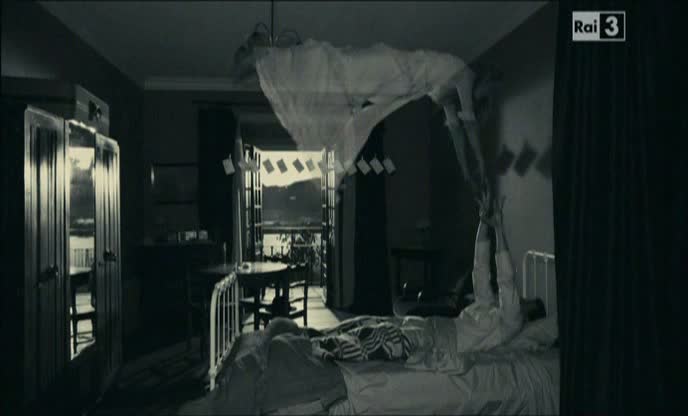
 Ito’s intense and claustrophobic piece, positioned between postmodern music videos and generic horror, shows the reanimation to life of a headless man wrapped in gauze and tied to a chair in a room populated by mirrors, a bandaged toy truck, a masked figure with light sources on him and framed photographs of eerily empty locations. Rife with movement – pleasing lateral tracking shots, time-lapse photography, reverse video and stop-motion animation – Zone plays on Kracauer’s idea of cinema as resurrection of dead objects from the ghastly stillness of photography. Ito’s psychologically motivated film is closer to classical Expressionism than his earlier structural work.
JAPANESE KITCHEN: THREE STORIES (Tabaimo, Japan, 2000, Video, 9min)
 A more traditional style, closer to commercial Japanese animation, marks the three-episode Japanese Kitchen, which presents sketches of a housewife trying to imitate recipes shown on daytime television. The manner in which the banality of the situation is superimposed over chilling body horror – beating small men and women in a mixer to produce babies, deep frying the male brain and seeds that have people crawling out when soaked in water – betrays a trace of populist horror cinema, television and literature. Tabaimo’s tongue-in-cheek triptych – commissioned for television whose audience is the very subjects of her film – proposes tantalizingly easy and morbidly humorous solutions to the demographic problems of Japan.
INCH-HIGH SAMURAI (Tanaami Keiichi and Nobuhiro Aihara, Japan, 2007, 16mm, 8min)
 One of Aihara’s last films, Inch-High Samurai is admittedly a tribute to and a re-imagination of a popular manga series the directors used to read as kids that presented the adventures of a Samurai measuring an inch in height. The difference is that this film taps directly into the libidinal foundation of the manga and crystallizes the sexual and violent forces brimming beneath. Hyper-kinetic, raunchy and decidedly over-the-top, the film opens with drawings of various body parts floating on the sea from where the little phallic Samurai begins his extremely telescoped set of frenzied adventures that is, quite literally, the stuff of wet dreams.
CHILDREN OF SHADOWS (Naoyuki Tsuji, Japan, 2006, 16mm, 18min)
 A ghastly spin on Western fairy tales, especially Hansel and Gretel, Children of Shadows is a tale of survival and growing up that is constructed with fluid, curvy and continuous forms that facilitate and highlight Tsuji’s charcoal on paper approach. The artist uses his POV like a moving camera and negotiates a three-dimensional space even when he abstains from providing a stable reference as in traditional drawings which makes it tougher to judge location or proportion. The movement of characters is slowed down, as though traversing an oneiric space, there is an affinity for closed forms and the humour is black and the drawings joyfully vulgar.
GOD BLESS AMERICA (Tadasu Takamine, Japan, 2002, Video, 12min)
 Takamine’s God Bless America gives us the artist and his female assistant sojourning inside a red-walled studio while working on a massive lump of clay present in the center of the screen and the room. We see them pass 18 days working, eating, socializing and having sex in time lapse while the clay head is moulded in such a way that it appears to sing the titular hymn in real time. If this construction of twin time frames within a single film derives from music videos, the integration of the work of art into lived-in space derives from architecture, where it becomes an object to be experienced intuitively by habitude instead of through active contemplation.
ARTIST PROFILE: JACK CHAMBERS
(Curated by Lauren Howes)
HART OF LONDON (Jack Chambers, Canada, 1970, 16mm, 79min)
 Stan Brakhage called this final film of Canadian visual artist Jack Chambers, who died of leukemia in 1977, one of the greatest films ever made. Chambers’ predominantly found-footage film exhibits touches of Brakhage’s own work, especially Dog Star Man (1961-64), in its use of roving secondary exposure, image overlaps, negatives, faster frame rates and high-velocity montage and its partly phenomenological approach to images. Opening with footage of a deer hunt – an event that would haunt the entire film – the first section of Hart of London is scored to the sporadic sound of the elements of nature and engages with visuals of architecture and everyday life in London, Ontario, superimposed with a negative that results in stereoscopic images at certain points, and, at times, abstracted away from photorealism to the point where we only observe black dabs on a white screen. Towards the midpoint, the film moves away from superimposition towards montage as the primary technique for meaning creation. It is from hereon that the film crystallizes its exploration of the cycle of life. Images from a slaughterhouse are intercut with those of a baby, dead sheep fetuses are juxtaposed with a human newborn. The architectural marvels of the first segment are responded to in the second by destruction and demolition of buildings, which become as much a spectacle as the former. On one level, the film is certainly an indictment of human egotism, which places humanity at the center of the universe and deems it as being the prime mover of all things. But it is also a meditation of humanity’s ceaseless capacity to learn, endure and survive and the film abounds with symbols of birth, rebirth and resurrection. This view of humanity from a detached, godlike-perspective takes the film closer to the oeuvre of Artavazd Peleshian, whose ultimately hopeful view of life, Hart of London echoes, however less emphatically.
ARTIST PROFILE: PANCHAL MANSARAM
(Curated by Shai Heredia)
INTERSECT (Panchal Mansaram, India, 1967, 16mm, 6min)
 Panchal Mansaram was already established as a collage artist when he came to cinema and this transition is evident in the approach to his material in Intersect, which mashes footage shot during his interactions with Satyajit Ray, Ravi Shankar and Marshall McLuhan with excerpts from TV and radio commercials. “East and West are becoming like each other” goes one stray audio bite. Evocative of the many fine experiments at Films Division – yet not as pointed or as rigorously thought out – Intersect was completed after Mansaram’s emigration to Canada and reflects the director’s own transnational status – an autobiographical element which he explored further in his mixed-media installations.
DEVI, STUFFED GOAT AND PINK CLOTH (Panchal Mansaram, Canada/India, 1967, 16mm, 16min)
An assortment of impressionistic vignettes from the city of Bombay – a place that Mansaram calls “collage in motion” – strung together by the pervading presence of the beautiful lady of the title, her stuffed goat and a piece of pink cloth, this 16mm quasi-Nouveau Realist project tries to comprehend a city partly through its extraordinary human specimen, decrepit objects and familiar images. Some passages of the film, scored to a mix of flute, trumpet and percussions, seem straight of a René Magritte tableau in the way they piece together completely dissociated commonplace objects, even though this disruption of everyday logic seems less like an ideological intervention than a gleeful vagrancy of a mischievous imagination.
REAR VIEW MIRROR (Panchal Mansaram, Canada/India, 1966-2011, 16mm, 13min)
45 years in the making, Rear View Mirror spans the entire career of Mansaram as a filmmaker and opens with the voice of the artist reciting a piece of autobiographical information. Seen through the eyes of two young tourists entering a city on a horse cart, the film unfolds as a kind of ‘re-entry’ into and ‘looking-back’ at his life in India, especially his early years in his hometown of Mount Abu in Rajasthan, suffuse with reds, yellows and browns. The images of the convivial atmosphere at the local fete is complemented by sundry images – spiritual and profane – from the city linked together by the director’s characteristic sense of humour.
ARTIST PROFILE: AKBAR PADAMSEE
(Curated by Lalitha Gopalan)
SYZYGY (Akbar Padamsee, India, 1970, Video, 6min)
 Bombay-based abstract artist Akbar Padamsee made his transition to cinema with the help of ace cinematographer K. K. Mahajan and was apparently held in high regard by Mani Kaul. A product of the short-lived Visions Exchange Workshop (VIEW) founded by Padamsee as a platform for enabling interaction between painters and filmmakers, the soundless animation Syzygy begins with basic geometric figures moving on the screen in regular patterns. With mathematical regularity, these figures morph into word grids and number lines representing distances, which in turn, gradually, give way to more complex intersection of line segments – mazes, meshes and networks. The resulting images bear similarity to the works of Mondrian and Kandinsky and serve to illuminate emotional correlatives to purely aesthetic forms such as the sense of spaciousness and liberation offered by a diagonal line slashing across a matrix of verticals and horizontals. Despite its ostensibly stream-of-consciousness approach, all the images have a regularity, harmony, and balance which throw light on Padamsee’s structured and perhaps even classicist thinking process.

 At a time when Daesh funds itself by trafficking cultural artifacts and Europe announces asylum for threatened art works, Sokurov’s marvelous, piercing film offers nothing less than a revisionist historiography of art itself. For Francofonia, History is not the content of art but its very skin. Museums flatten time, and justifiably present their contents as the highest achievements of a culture, obfuscating, in effect, their history as objects involved in power brokerage, class conflict and market manipulation. Sokurov’s film flips this perspective inside out, identifying art as being frequently the currency of diplomatic power possessing the capacity to purchase peace and as being instruments in service of totalitarian collaboration. Napoleon,
  The jeu de mots in the title says it all. Not only is this deeply death-marked, Ozuvian film an unordinary home movie, but it is also a film about not having a home. Composed of footage shot in the filmmaker’s mother’s Brussels apartment and recorded video-conference sessions between the two, No Home Movie contrasts Akerman’s professional nomadism with the perennial confinedness of her mother Natalia. Between Chantal’s constant off-screen presence and Natalia’s self-imposed captivity (within the apartment as well as the computer screen), between Here and Elsewhere, lies the film’s true space – a part-real, part-virtual space of filial anxiety and affection. Akerman’s matrilineal counterpart to Porumboiu’s
  Taxi opens with a shot of downtown Tehran photographed from the dashboard of a car. Announcing Panahi’s first cinematic outdoor excursion since his house arrest in 2011, this shot sets up the dialectics that would define the film: home/world, individual/social and freedom/captivity. Through the course of Taxi, the spied-upon filmmaker drives around the city in the guise of a cabbie, chauffeuring clients-actors from various strata of the society, and realizing a pre-scripted scenario with them whose urgent, didactic purpose can’t be more obvious. The Iranian state has forged a private prison for Panahi from the public spaces of Tehran, allowing him a mobility and false freedom that’s regulated by its watchful eyes. Panahi turns this power dynamic upside down, transforming the private space of the vehicle into a public space for debate, discussion, instruction and critique. Watching the film, I was constantly reminded of that saying beloved of Wittgenstein: “It takes all kinds to make a world”. Panahi’s very presence in the film – his image, his voice – becomes an audacious act of political defiance, a gesture of tremendous existential courage that stares at the possibility of death floating in the air. Taxi makes cinema still matter.
 A beautiful marine cousin to Guzman’s previous film, Nostalgia for the Light (2010), The Pearl Button turns its attention from the arid stretches of the Atacama to the waterfront and ice field of Southern Patagonia. Threading metaphor over metaphor, the director fashions a typically associative, richly suggestive essay film that turns the nature documentary form on its head. Guzman’s film plumbs the depths of the ocean, trying to uncover traces of suppressed, unseen history embodied by countless “missing people” – a project that derives its impetus from the filmmaker’s bittersweet childhood experience of the sea. Despite Chile’s economic indifference to its 4000-kilometer-long coastline, he notes, the sea has been indispensable those in power, serving first as the entry point of the European invaders, who wiped out the Patagonian natives, and then as the dumping ground of political prisoners during the Pinochet regime. Guzman teases out the different values that the sea holds for him, the autochthons and the Chilean state, in effect politicizing and historicizing that which conventional wisdom takes to be apolitical and ahistorical: geography and the perception of it. The result is a film of immense poetry and horror – a horror that only poetry can convey.
 The most impressive debut film of the year, Alexandra Gerbaulet’s ambitious, intoxicating Shift excavates the evolution of her hometown, Salzgitter, along with that of her family with archaeological care and scientific detachment. In Gerbaulet’s heady narration, anchored by a powerful, quasi-declamatory, rhythmic voiceover, Salzgitter’s transformation from a Nazi mining stronghold and concentration camp, through a waning industrial hub and to a nuclear waste dump parallels the gradual disintegration of the Gerbaulet family under the weight of unemployment, sickness and sexual repression. The filmmaker closely intercuts photographs and diary entries of her mother with impersonal material from popular and scientific culture, weaving in and out of both registers with ease. Gerbaulet’s film is literally an unearthing project, as the director scoops out the various historical, political and geographical layers of this war-weathered city whose tranquil current-day model housing sits atop a makeshift Jewish graveyard consisting of camp workers buried using industrial debris. “Man gets used to everything, even the scar”, declares the narrator bluntly. Shift unscrambles such a habituated view of things, observing the tragicomic tautologies in which history revisits the city. The more you dig, it would seem, the more of the same you get.
 One of my favorite films of the year is a commercial for a major power corporation made by a 106-year-old artist.
  Thomas McCarthy’s dramatization of Boston Globe’s exposé of child abuse in the Church is a robust, smart procedural that is less about picking apart the Catholic establishment than about elucidating the epistemological processes of the Information Age. Set at the transitional period between print and online news media, the film underscores the soon-to-be-outmoded physical nature of journalistic investigation. There are no antagonists of the traditional kind in Spotlight. The only obstacles to the knowledge required to carry out the exposé are the numerous procedures and institutional protocols that have for objective the protection or publication of information. It is telling that the entire film is about a pack of newswriters seeking information that’s already out in the open. What’s more, the film recognizes that the Spotlight team’s attempts to mount an institutional critique is itself inscribed within kindred ideological biases, operational strategies and structural iniquities of Boston Globe as an institution and that the metaphysical crisis that their story can potentially wreak amidst readers is but similar to the disillusionment the newsmen experience vis-à-vis their Protestant weltanschauung. With relatively uncommon formal and ethical restraint, McCarthy crafts an arresting film about how a society’s narratives are made, predicated they are as much on the dissemination of information as on their marginalization.
 ergei Loznitsa’s formidable follow-up to Maidan (2014) furthers the earlier film’s exploration of the aesthetics and mechanics of revolution, capturing a people coming together to make sense of a political limbo. Without context or a framing perspective, the film drops us straight into the streets of St. Petersburg just after the attempted reactionary coup d’état in Moscow in 1991. Confusion and mundanity – not heroics and determination – reign as we observe the formative process of a people’s movement and the imagined/imaginary social glue that causes individuals to cohere into a group. State apparatuses compete with each other for imposing a narrative onto the events, while the very toponymy of the city becomes an ideological battleground. Working off priceless archival footage, much of which is incredibly reminiscent of the filmmaker’s own cinematographic style, Loznitsa provides an invaluable glimpse into the unfurling of history, chronicling how numerous banal, unsure gestures and actions snowball into Historical Events. If Eisenstein’s better-than-the-original recreation of the October Revolution was the abstraction of materialist history into ideas, Loznitsa’s film, taking place at the same Palace Square 63 years later, rescues history from the reductions of ideology and brings it right back into the realm of the material.
 A remarkable American counterpart to J. P. Sniadecki’s The Iron Ministry (2014), In Transit unfolds predominantly as a series of interviews with a mixed bag of travellers on board The Empire Builder, a long-distance passenger train running over 3500 kilometers and spanning almost the entire width of the United States. The accounts of passengers seeking out professional and financial breakthroughs evoke the pioneer myth hinged on a “Go West” imperative while the stories of those aboard in search of their ‘calling’ demonstrate the essentially spiritual, even religious nature of their pilgrimage-like journey. The diversity and range of the interviewees and their interactions help the film depict the train as a miniature America, à la Stagecoach, and carve out a quasi-utopian space in which members across class, race and gender divides get an opportunity to converse with each other without personal baggage. Nonetheless, In Transit is less a cultural vision of a possible America than an existential meditation on what makes people embark on these journeys. One elderly war veteran remarks that he’ll never be able to see these plains again. To cite John Berger, “the desire to have seen has a deep ontological basis.”
 One of a piece with Gianvito’s Vapor Trail (Clark) (2010), Wake continues its precedent’s important investigation into the ecological consequences of the presence of America’s largest military bases in the Philippines during most of the 20th century. Like Profit Motive and the Whispering Wind (2007), Wake is guided by the spirit of Howard Zinn’s approach to history and sketches an economically-founded account of US-Philippines political and cultural relations – a history that seems to be have been lamentably wiped off from the Filipino national consciousness. Gianvito juxtaposes images from the Philippine-American war with current day images from the contaminated Subic naval base area, suggesting, in effect, the poisonous persistence of an agonizing, unacknowledged history. Wake is imperfect cinema – unwieldy and resourceful – and employs fly-on-the-wall records, talking heads, on-screen text, photographs and news clips to mount a potent critique of a historiography defined political amnesia and economic opportunism. More importantly, it is a necessary reminder that imperialism is not always about presence, action and exercise of power but sometimes also about the refusal of these very elements, that history is not only a matter of events but also processes and phenomena and that geography is always political.






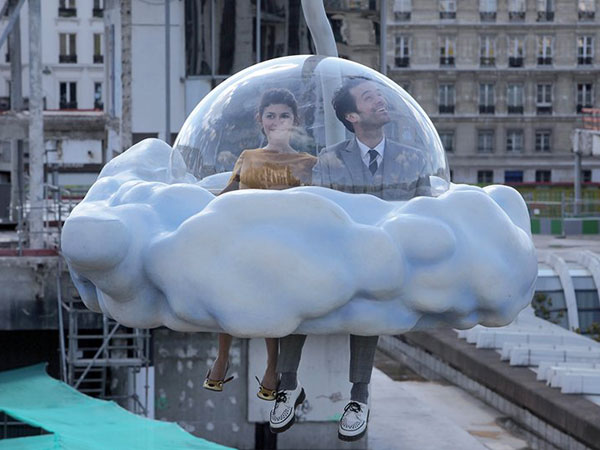





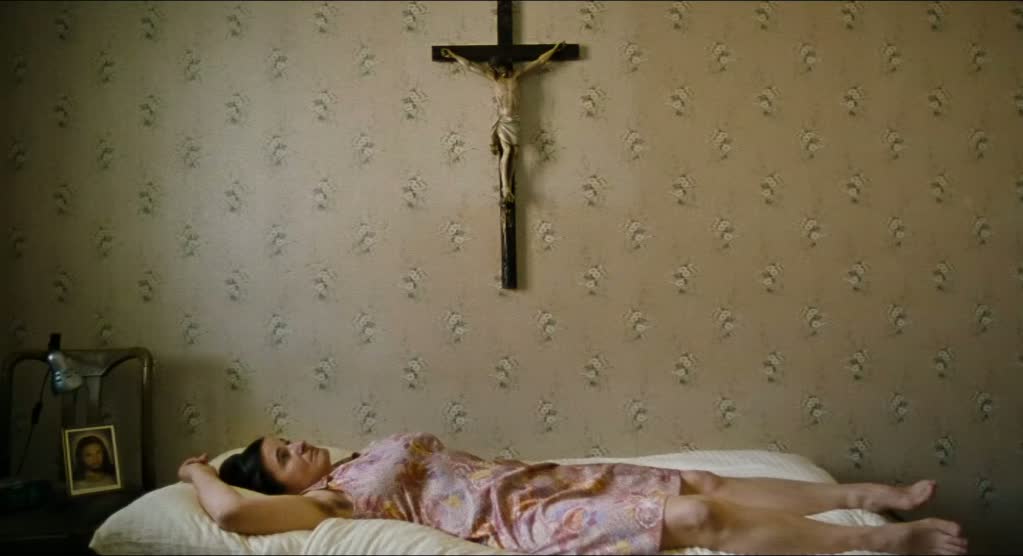
 Surely, it takes a bona fide auteur like David Cronenberg to locate his signature concerns in a text – such as Don Delillo’s – that deals with ideas hitherto unexplored by him and spin out the most exciting piece of cinema this year. Holed up in his stretch limo – an extension of his body, maneuvering through Manhattan inch by inch as though breathing – Eric Packer (Robert Pattinson) comprehends the universe outside like cinema, through a series of moving images projected onto his car windows. Why not? This world, whose master he is, is experiencing the epistemological crisis of late capitalism: the increasing abstraction of tactile reality into digital commodities. Packer, like many Cronenberg characters, is more machine than man, attempts – against the suggestions of his asymmetrical prostate and of the protagonist of Cronenberg’s previous film – to construct a super-rational predictable model of world economy – a project whose failure prompts him to embark on an masochistic odyssey to reclaim the real, to experience physicality, to be vulnerable and to ultimately die. At the end of the film, one imagines Packer shouting: “Death to Cyber-capitalism! Long live the new flesh!”
 Un chant d’amour for cinema, Leos Carax’s Holy Motors is an ambitious speculation about the total transformation of life into cinema and cinema into life – the death of the actor, audience and the camera. The European cousin to Apichatpong Weerasethakul’s Uncle Boonmee Who Can Recall His Past Lives (2010), Carax’s return-to-zero work draws inspiration from the process of film itself – death, resurrection and persistence of vision – and takes cinema to its nascence – fairground attractions, popular theatre and zoopraxography – while opening up to its future possibilities. Uncle Oscar (Denis Lavant, the raison d’etre of Holy Motors), like Cronenberg’s Packer, cruises the streets of Paris in his limo in search of purely physical experiences – a series of performance pieces carried out solely for “the beauty of the act” – only to find that the city is a gigantic simulacrum in which everyone is a performer and a spectator (and thus no one is) and where the distinction between the real and the fictional becomes immaterial. At the very least, Holy Motors is a reflection on the passing of “things”, of physicality, of the beauty of real gesture, of the grace of movement of men and machines.
 Nicolas Rey’s third feature, consisting of 9 short segments (reels, to be precise) projected in a random sequence, is a radical project that re-politicizes the cinematic image. Not only does the randomization of the order of projection of the reels circumvent the problem of the authoritarianism of a fixed narrative, it also exposes the seam between the semi-autonomous theses-like segments, thereby making the audience attentive to possible ideological aporias that are usually glossed over by the self-fashioned integrity of filmic texts. Furthermore, the existence of the film in the form separate reels is a breathing reminder of the material with which it was made: 16mm. The persistent dialectic between the visual – shots of highways, industries, farms and modernist suburban housing in the eponymous fictional city registering the sedate rhythm of everyday life – and the aural – snippets of conversations between two politicized industrial workers about the invisible tendons that enable a society to function smoothly – strongly drives home the chief, Althusserian concern of the film: the essential unity of the various, seemingly autonomous, strands of a state, contrary to claims of disjunction and autonomy.
 A film that is reminiscent of Weerasethakul’s many bipartite films, Miguel Gomes’ singular Tabu, too, works on a range of binaries – past/present, youth/old age, city/countryside, abundance/scarcity, modern/primitive, colonizer/colonized – and sets up a conversation between the carefree, profligate days of the empire full of love, laughter and danger and Eurocrisis-inflected, modern day Portugal marked by alienation and loneliness. The opening few minutes – a melancholy mini-mockumentary of sorts chronicling the adventures of a European explorer in Africa with a native entourage –announces that the film will be balancing distancing irony and classicist emotionality, donning an attitude that is in equal measure critical and sympathetic towards the past. In Gomes’ sensitive film, the heavy hand of the past weighs down on the present both on aesthetic (silent cinema stylistics, film stock, academy ratio, the excitement of classical genres) and thematic (collective colonial guilt, residual racism, punishment for forbidden love) levels and this inescapability of the past is also functions as (sometimes dangerous) nostalgia for the simplicity and innocence of a cinema lost and an entreaty for the necessity of exploring and preserving film history.
 What partially elevates the first film of Ulrich Seidl’s Paradise trilogy from its rather undistinguished concerns about emotional alienation and old age loneliness is the nexus of intriguing cultural forces that it brings into the picture by having a relatively affluent, 50-year old Austrian single-mother (Margarete Tiesel, in a no-holds-barred performance) indulge in sex tourism in Kenya along with five other women friends. The result is a rich, provocative negotiation along class, gender, race and age divides that upsets conventional, convenient oppressor-oppressed relationships. In doing so, the film wrenches love from the realm of the universal and the ahistorical and demonstrates that between two people lies the entire universe. Seidl’s heightened, bright colour palette that provides a sharp chromatic contrast to the bodies of Kenyan natives and his confrontational, static, frontal compositions (Seidl’s nudes are antitheses to those of the Renaissance), which make indoor spaces appear like human aquariums, both invite the voyeuristic audience to take a peek into this world and place it on another axis of power – of the observer and the observed.
 Sri Lankan filmmaker Prasanna Vithanage’s exquisite, exceptional adaptation of Fyodor Dostoyevsky’s The Meek One (1876) aptly locates the Russian tale of matrimonial discord between a bourgeois pawnbroker and the gentle creature he weds within the ethno-political conflict between nationalist and rebel factions of the country. Unlike humanist war dramas that, often naively, stress the underlying oneness among individuals on either side, Vithanage’s intelligent film underscores how the political haunts the personal and how the tragic weight of history impacts the compatibility between individuals here and now, while deftly retaining Dostoyevsky’s central theme of ownership of one human by another. Though liberal in narration and moderate in style compared to Mani Kaul’s and Robert Bresson’s adaptations of the short story, Vithanage, too, employs an attentive ambient soundtrack that counts down to an impending doom and numerous shots of hands to emphasize the centrality of transaction in interpersonal relationships. The metaphysical chasm between the possessor and the possessed finds seamless articulation in concrete sociopolitical relations between Sinhalese and Tamils, between the army and refugees, between the poor and the wealthy and between man and woman.
 There has always been something intensely spiritual about Tsai’s films, even when they seem to wallow in post-apocalyptic cityscapes and defunct social constructions. In Tsai’s hands, it would seem, an empty subway corridor shot in cheap digital video becomes the holiest of spaces ever filmed. Walker, a high-def video short made as a part of the Beautiful 2012 project commissioned by Hong Kong International Film Festival, crystallizes this particular tendency in the director’s work and centers on a Buddhist monk played by Lee Kang-sheng (a muse like no other in 21st century cinema). As the monk walks the hyper-commercialized streets of Hong Kong at a phenomenally slow pace for two days and two nights, his red robe becomes a visual anchor in stark contrast to the greys of the urban jungle and the blacks of people’s winter clothing and his very being, his eternal presence, becomes a spiritual grounding point amidst the impersonal hustle-bustle of this super-capitalist Mecca. Part performance art with a gently cynical punch line, part an exploration of the limits of DV, Walker is a deeply soothing and often moving work from one of Asia’s finest.
 Moving unsteadily with the help of a walking stick, the 79-year old founder of the National Film Archive of India (NFAI), P. K. Nair, despite himself, becomes a metaphor for the state of film archiving in the country. It is of considerable irony that, in a nation that prides itself for its rich cultural heritage, film archiving is considered a useless exercise. During the three decades that Nair headed the NFAI, he was instrumental in discovering the silent works and early talkies of Bombay and south Indian cinema, including those of Dadasaheb Phalke, the “father of Indian cinema”. Celluloid Man, bookended by scenes from Citizen Kane (1941), draws inspiration from Welles’ film and sketches a fascinating if reverential portrait of Nair constructed from interviews with international filmmakers, scholars, historians and programmers and curiously hinged on the fact of Nair’s “Rosebud” – ticket stubs, promotional material and assorted film-related curios that the man collected during his childhood. Shivendra Singh’s film is a irresistible romp through early Indian cinema and an endlessly absorbing tribute to a man who is fittingly dubbed the “Henri Langlois of India”. To paraphrase one of the interviewees, Phalke gave Indian cinema a past, Nair gave it a history.
 Although it might appear that it is perhaps the hollowness of Xavier Dolan’s previous feature that makes his latest, 160-minute music video look like a cinematic coup, Laurence Anyways really does succeed in accomplishing more than most of contemporary “LGBT-themed independent cinema”. While the latter – including this year’s Cahiers darling – almost invariably consists of realist, solidarity pictures that use social marginalization as shorthand for seriousness, Dolan’s emotionally charged film takes the game one step further and probes the inseparability of body and character, the effect of the physical transformation of a person on all his relationships – a transformation that is mirrored in the flamboyant, shape-shifting texture of the film – without sensationalizing the transformation itself. Rife, perhaps too much so, with unconventional aesthetic flourishes and personal scrapbook-ish inserts, the film rekindles and enriches the youthful verve of the Nouvelle Vague – a move that should only be welcome by film culture. If not anything more, Laurence Anyways establishes that critics need to stop using its author’s age as a cudgel and look at his cinema du look as something more than a compendium of adolescent affectations.
 Let me confess upfront that putting Wes Anderson’s (surprise!) whimsy, twee and self-conscious Moonrise Kingdom in my year-end list is less a full-hearted appreciation of the film than a confession that I find Anderson to be an important voice that I’m genuinely keen about, but can’t entirely celebrate. I don’t think I’ve seen any film that employs so many elements of industrial cinema yet feels meticulously artisanal, a film that, on the surface, seems to (literally) play to the gallery yet is so full of personality and one that is oddly familiar yet thoroughly refuses instant gratification. Moonrise Kingdom appears to have every ingredient of an obnoxious family comedy, but the unironic, straight-faced attitude and the single-minded conviction with which it moulds the material into an anti-realist examination of the anxieties of growing up, alone, is something not to be found either in cynical mainstream cinema or in the overwrought indie scene of America. Anderson’s neo-sincere film is, as it were, a classicist text couched within a postmodern shell, an emotional film without affect. Paper blossoms, but blossoms nonetheless.