Cinema of Germany


The recently concluded 56th edition of Visions du Réel, Nyon, Switzerland, affirms it as one of the largest documentary festivals in the world, with 154 films from 57 countries in its lineup. Numbers, though, are for accountants and PR agents. What lends Visions du Réel its strength is the continuing vitality and diversity of its programme, its mix of the popular and the experimental. Plenty of films in the selection reflect current trends in commercial documentary — and perhaps even the institutionalization of a distinct Visions du Réel style, but that is a discussion for another day. At the same time, there are also adventurous works here that buck the trend, interrogate existing conventions and expand our conceptions of documentary filmmaking.

The feature that won the top prize of the festival, Clarisa Navas’ The Prince of Nanawa, for instance, may not appear on television or in the local arthouse cinema anytime soon, at least not in its current form. Ten years in the making, Navas’ 212-minute bildungsroman chronicles the life of Angel, a chirpy young boy from Nanawa, an impoverished border town between Argentina and Paraguay. Navas met Angel accidentally in the mid-2010s at a booming black market on a bridge between the two countries. She followed him home and filmed him regularly over the next decade, forging a deep and protective relationship with him.

We witness Angel grow up — from a pre-teen to a teen father — in a disadvantaged milieu mired in drugs and violence, his sensitive, introspective side in constant tussle with his sexist and homophobic environment. Beyond the raw poetry of watching a real human being grow older on screen, what is compelling about The Prince of Nanawa is its challenging of the classic documentary principles of observation and non-intervention. We see how the very act of making a film helps the (liberal, cosmopolitan) filmmakers exert a positive influence on Angel’s life and thoughts, how his continued participation in the project helps him narrativize and assume responsibility of his own life. At one point, Angel confesses his embarrassment at trying out drugs and his fear of disappointing Navas, whose friendship serves as a kind of watchful superego throughout his formative years.

Its uplifting moments notwithstanding, The Prince of Nanawa is not a fairy tale, and it’s not always smooth sailing into adulthood for Angel, who, even at the end of the film, makes a living smuggling goods across the border and cuts his eighteenth birthday cake with an infant in hand. Nevertheless, the film builds a case for a documentary form in which the camera consciously alters the reality it films, makes active interventions into the lives of its subjects.

Like Angel, the protagonists of various other films at Visions du Réel grapple with an unstable present and an unknown future. Obscure Night – “Ain’t I a Child?”, the concluding chapter of Sylvain George’s trilogy on illegal immigration, is an extraordinary object of close, unflinching observation. I haven’t seen the first two films in the trilogy, in which George follows Tunisian teenagers trying to cross over into Europe by entering Mellila, a Spanish enclave in North Africa. In the new film, we find three of them — Malik, Mehdi and Hassan — taking temporary refuge in Paris, after having been shuttled by immigration authorities across various cities in Western Europe.

As young Maghrebi males, Malik and co. are the very posterchildren for anti-immigration sentiment. George recognizes this very well, and within the first quarter hour of his 164-minute film, he pre-empts all the usual right-wing bugbears by acknowledging them: yes, the boys steal for survival; yes, they hold regressive views about women; yes, they want to lead an easy life in Europe and profit from its social welfare policies. Malik and co. aren’t the liberal fetish objects littered across European screens.

Yet, the film deems them worthy of human and aesthetic interest. With remarkable intimacy and equanimity, George’s camera films the gang at slightly below the eye-level as they wander the roads of night-time Paris, huddle around fire, get into nasty fights with their Algerian counterparts, listen to street music or make the occasional phone call back home. An indifferent Eiffel Tower glitters perpetually in the background while the boys find themselves prisoners under an open sky, enslaved to an eternal, sordid present, with no visible way out.

Shot in stark monochrome with eye-popping passages of abstraction, George’s film lends a monumental weight to images and lives we would rather not see. The approach is comparable to Pedro Costa’s work with the residents of Lisbon’s Fontainhas. As a white artist making films on vulnerable sans papiers, George is bound to ruffle some feathers. But his film demonstrates that, sometimes, you need to strain certain ethical boundaries to arrive at newer forms of looking and understanding. Neither incriminating its subjects nor making any apology for them, Obscure Night – “Ain’t I a Child?” reveals the herculean difficulty of creating a truly humanist work.

Sergei Loznitsa’s short Paleontology Lesson takes an oblique approach to an adjacent theme. A change of direction of sorts for this singular Ukrainian filmmaker, Paleontology Lesson centres on a class of middle-schoolers on a trip to the Natural History Museum in Kiev during the Russian invasion. The kids listen to the docent speaking about millennia-old fossils and artefacts carefully preserved in the museum – the present, the past and the future of the country under a single roof, all threatened by the bombs falling outside the facility. The film ends on an eerie note, with dioramas of prehistoric humans and exhibits of their skulls. Will we end up in the Natural History Museums of the future too?

Several titles I saw at the festival featured individuals and institutions coming to grips with a brave new world. Literally so in the case of Valerio Jalongo’s Wider Than the Sky and Jeffrey Zablotny’s Messengers. Both films craft poetic renditions of research work on cutting-edge science and technology — machine consciousness in the case of the first, neutrino astronomy in the second. These are works filled with a sense of awe at human curiosity and capacity for invention, but also at its insignificance faced with the complexity of our inner life and the vastness of the cosmos.

On an earthlier note is Fabienne Steiner’s Fitting In, a fascinating fly-on-the-wall document about a new batch of students at Eendrag, a residence at the Stellenbosch University in South Africa. Once an academic stronghold of the apartheid era, the university now aims at a more ethnically diverse intake reflective of the rainbow nation. Pangs of integration abound: white and non-white students alike struggle to get used to each other’s close presence withing the residence; official communication moves from Afrikaans-only to include Xhosa and English; debates surge around the problematic names assigned to residence sections; inclusivity becomes a major talking point in student elections.

Alas, one step forward, two steps back. News about attacks on Black students echo over the radio from time to time. Edgy jokes are misunderstood, and political correctness cripples spontaneity. Fitting In presents the new Eendrag as a kind of social lab in which otherness is negotiated and understood, a miniature model of South Africa and multicultural societies across the world. There are certainly teething troubles, lingering prejudices, pressures from external culture wars. The students proceed gropingly, sometimes walking on eggshells but always with an openness characteristic of youth. The kids, the film assures, are alright.

Johannes Büttner and Julian Vogel’s Soldiers of Light, in contrast, looks at a flight away from such a new world order. The film revolves around David aka Mister Raw, an alternate healer and social-media influencer advocating raw food, veganism and natural cures. David’s quackery and suspicion of modern medicine is dangerous enough, but he is also part of the “Soldiers of Light,” an eclectic, 23000-strong network of renegades who reject the authority of the Federal Republic of Germany and proclaim to be nationals of a certain Kingdom of Deutschland. On his channel, David, who is curiously a Black man himself, amplifies the views some of these reactionaries: racialists, self-styled spiritual gurus, assorted carpetbaggers and garden-variety right-wingers.

Soldiers of Light picks on a sensational and somewhat facile subject; David and his compatriots are generous in supplying self-incriminating soundbites for the camera. But it manages to put its finger on the mechanics and fallout of conspiratorial thought. David and co. join hands not in shared belief, but in their shared rejection of what they take to be a malevolent system. In the absence of rational voices to do the necessary work of dialectical thinking, these fringe elements come together to prey on the lost and the weak (in David’s case, a schizophrenic young man named Timo) — a phenomenon on full display every day on online platforms like 4chan and Twitter (formerly X). Soldiers of Light shows that evil flourishes there where reason has no incentive to.

With only a handful of posts published, the blog pretty much went into hibernation this year. While 2024 was full of opportunities, encounters and discoveries that I am immensely grateful for, it was also, personally, a year of greater flight from the world, including the world of cinema in some ways. I cut myself off more and more from the news cycle and social media for sanity’s sake, which has meant that I’m woefully unaware of, among other things, what’s making waves in the awards circuit and what the “important” films of this year are. At a glance, I don’t recognize most of the titles featured on major year-end lists.

At the same time, I find myself more embedded than ever in the professional world of cinema, working with different film festivals in various capacities, minor or otherwise. While I haven’t been able to write and translate as much as I would love to, I’ve found myself increasingly involved in programming and selecting films. This has had, I think, considerable consequence on the way I watch and write about cinema.

Firstly, the majority of the titles I saw this year were works-in-progress (WIP): projects in post-production, without CGI, colour grading, sound-mix, and even some shots or subplots. Such a ‘pre-natal’ view of films tends to put the viewer in a state of disenchantment in which one becomes too aware of the strings being pulled: actors simulating shock, disgust or joy in front of blank screens, interacting with inexistant elements of the décor, suspended on ropes, drowned in ambient noise or struggling to convey an emotion, hoping that the music will do that rest.

Over time, watching such volumes of unfinished films could also make a year-end list like this a hassle, since it I have to constantly check whether a particular WIP that I liked last year has released this year or is still waiting for a premiere. More crucially, such lists will likely be even more aleatory and subject to the vagaries of my viewing assignments rather than, as in the past, seeking to take into consideration, even if nominally, consensus titles and popular favourites.

The bulk of my writing this year has also been of a private nature, tied to the programming work. Destined for a handful of known people within a festival, instead of a wider readership online, the texts have undergone a change in kind. If they have gained in freedom and concision, they have lost the rigour and rhetorical force that comes with public writing. I can’t yet imagine what kind of impact this might have on my instincts – and mental capacity to engage with films – in the long run.

All this preamble to say that this blog may continue to remain inactive in the coming year(s). While that is nothing new – it was already in cold storage along with my cinephilia from 2016 to 2019 – it does feel different not to be identifying primarily as a critic/translator anymore. Interesting times ahead.

Here’s wishing a happy new year.


1. The Adamant Girl (P.S. Vinothraj, India)

When Kottukkaali (The Adamant Girl) released in theatres, miraculously, in August in Tamil Nadu, it was accompanied by substantial popular backlash. Admittedly, Kottukkaali is a tough-minded work, one that is perhaps harder to instantly ‘like’ than Vinothraj’s debut Koozhangal (2021). Like the latter, it makes us intimate with the unbridled rage of its male lead, but it does so without the emotional cushion of a child’s perspective. Instead, the film performs a high-wire act, tensely balancing different, conflicting points of views towards its protagonist, Meena, a young lovelorn girl deemed possessed and taken to a local godman for exorcism by her extended family that includes Pandi, the hot-tempered cousin she is betrothed to. While the entourage constantly discusses what is to be done about the girl, Meena herself remains resolutely mute, her silence conveying both defiance and stoic resignation. Kottukkaali explores both the horrific dimensions of this pervasive practice and the subversive space of resistance it offers to the ‘possessed’, temporarily immune from secular violence. At once sophisticated and utterly simple, Kottukkaali respects its audience’s imagination and intelligence while withholding nothing from them. In its formal wit, its trenchant social portraiture and its uncompromising humanism, it represents a significant leap forward for Vinothraj. [World Premiere: Berlin International Film Festival]


2. Twilight of the Warriors – Walled In (Soi Cheang, Hong Kong)

Decades in the making, Twilight of the Warriors: Walled In, Soi Cheang’s supremely kinetic martial arts epic, forges a double legend linking the mythical past of the now-demolished Walled City and a vibrant, close-knit Hong Kong of the eighties before the island’s handover to China. In gargantuan sets of stunning detail, the film recreates the ramshackle complex, not just the densely packed mass of its buildings, but also the thriving economy and community of this dizzyingly vertical ghetto. Desperate to evade the police and gang members, scrappy refugee Lok enters the Kowloon Walled City, a seedy, crime-ridden slum complex exempt from the law and run under the benign authority of Cyclone. Lok’s diligence and fighting spirit attract the paternal Cyclone, but when the young man’s past comes to light, the very existence of the Walled City is endangered. A masterclass in modern cinematic action, the film conceives its astonishing martial-arts sequences in a close co-choreography of camera movement, continuity editing, geometric décor and athletic performers, the whole presented at human scale and close to real-time speed. With every shot having the force of an abstract painting in its dynamic sight lines, Walled In delivers a sweeping, sensational spectacle. [WP: commercial release]


3. Who Cares? (Alexe Poukine, Belgium)

Kneel down, and you will believe, said Pascal. In That Which Does Not Kill (2019), Alexe Poukine had actors re-enact another person’s reason-defying testimony of sexual assault, allowing them to find pathways to empathy through text, performance and the spoken word. Deeping this line of inquiry, Who Cares? looks at a soft-skill course in Lausanne, Switzerland, in which trainee doctors and caregivers engage in simulated conversations with actors playing patients, with the goal of being more mindful of patients’ feelings during diagnosis. At the heart of this course aimed at humanising healthcare is the belief that empathy, like other qualities, can be learnt through performance, repetition and critical feedback. Even as it brings us close to this view, Poukine’s film qualifies it, presenting us another theatre-based training session in which real medical staff grapple with their professional frustrations born of difficult working conditions, revealing how individual goodwill finds its limits in institutional realities. Like Harun Farocki’s best work, Who Cares? zeroes in on the niche rituals of a highly specialized field, only to lay bare broader civilization and historical undercurrents; in this case, the contradictions generated by the high premium placed on individual wellbeing in western societies. [WP: Cinéma du Réel]


4. The Damned (Roberto Minervini, Italy/USA)

In 1862, during the American Civil War, a troop of Union soldiers is sent to survey the uncharted territories of the West. The young men only have a vague understanding of the reasons for the war, but have their own motivations for donning the uniform. They bide their time, play cards and baseball, and engage in occasional skirmishes against a looming, largely invisible enemy. In his first fictional feature, Minervini forges a spare, brooding Western featuring the rural White southerners who populated his documentaries on backwoods America. Their dialect, diction and body language are modern, and this deliberate anachronism lends the film the texture of a filmed performance. In casting marginalized, stereotyped individuals as Union soldiers and placing them at the very origin of the creation of the United States, Minervini monumentalizes them in the vein of Straub-Huillet’s peasants-turned-gods. At the same time, the counter-casting obliges the non-actors to creatively participate in a founding myth that is very different from the “lost cause” narrative dear to the South. The result is a kind of Lehrstück for both the participants and the audience, a vital gesture of bridge-building in a house that finds itself divided once more. [WP: Cannes International Film Festival]


5. Kiss Wagon (Midhun Murali, India)

In a film culture where a project shepherded through half-a-dozen funding bodies, script labs, residencies and international co-producers is deemed ‘indie’, here is a film that obliges us to recalibrate our notions of what independent cinema could mean. The credit roll of Midhun Murali’s animated digital saga is entirely split between the filmmaker, his creative partner Greeshma Ramachandran and the voice actor Jicky Paul. Kiss Wagon charts the sprawling odyssey of Isla, a cocaine-addled courier girl, who leads a disengaged life in a police state under the sway of a powerful, puritanical cult. When she is entrusted by a mysterious client to deliver a kiss to an encrypted address, Isla finds herself on the wrong side of a massive military-theocratic conspiracy. Narrated in a mix of tongues real and invented, using a range of animation techniques classical and cutting-edge, Midhun’s film tells a mythical tale of the planetary struggle between the darkness of religious dogma and the light of cinema. A revisionist testament in four chapters, Kiss Wagon is an epic ballad of a paradise lost and regained; regained not through the force of institutionalized virtue, but through the agitations of outsiders, non-conformists, misfits and weirdos. A homemade cinematic A-bomb, delivered with a kiss. [WP: International Film Festival Rotterdam]


6. We Are Inside (Farah Kassem, Lebanon)

The family documentary may currently be the most shopworn, convention-ridden genre in non-fiction film. But Farah Kassem’s three-hour-long domestic epic We Are Inside represents a sweeping personal work that makes a strong case for its continued existence. Following the demise of her mother, thirty-something European resident Kassem returns home to Tripoli, Lebanon, after fifteen years of absence to live with her cantankerous octogenarian poet-father. She spends her time learning Arabic from him, cutting his hair, tending to his wounds, sorting his medicine, driving him around and, most entertainingly, participating in his old boys’ meetups. Poetry becomes both an heirloom the filmmaker inherits and the means through which she concretises the daughterly bond. As the world outside falls apart, with Lebanon experiencing one shock after another, the film turns into a rumination on the role of artmaking during times of political crises, the artist oscillating between the pursuit of beauty and the reflection of truth, between the personal and the political, between inside and the outside. An instructive companion piece to Abbas Fahdel’s Tales of the Purple House (2022), We Are Inside offers a rich, funny and moving work that deserves wider viewing.  [WP: Visions du Réel]


7. Wikiriders (Clara Winter, Mi(gu)el Ferràez, Megan Marsh, Mexico/Germany)

If you ever wondered where the missing Human Surge sequel was, here is a less punishing proposition. A super-chill hangout film, Wikiriders centres on a multilingual band of three friends – one speaking English, the other Spanish and the third German, interchangeably and out of lip sync – who undertake a road trip from Mexico to the USA in search of a powerful (fictional?) family that has had an outsized influence on the history of the two countries. The trio may be navigating the Mexican landscape, but they are also virtual surfers, following the rabbit hole of Wikipedia edits about/by the members of the family. Wikiriders takes the epistemological processes of the internet as inspiration for its structure, hopping from one narrative tab to another, featuring memes for characters and making maps of meaning out of digital babel, while also raising pertinent questions about the rewriting of popular history and the resistance to it through voluntary international collaboration. Imbibing the spirit of the Nouvelle Vague as well as the road movies of Monte Hellman, Ron Rice and Wim Wenders, Wikiriders embraces the fact that it’s largely discovered on the editing table. Fun, experimental and very accessible. [WP: Berlin Critics’ Week]


8. Kajolrekha (Giasuddin Selim, Bangladesh)

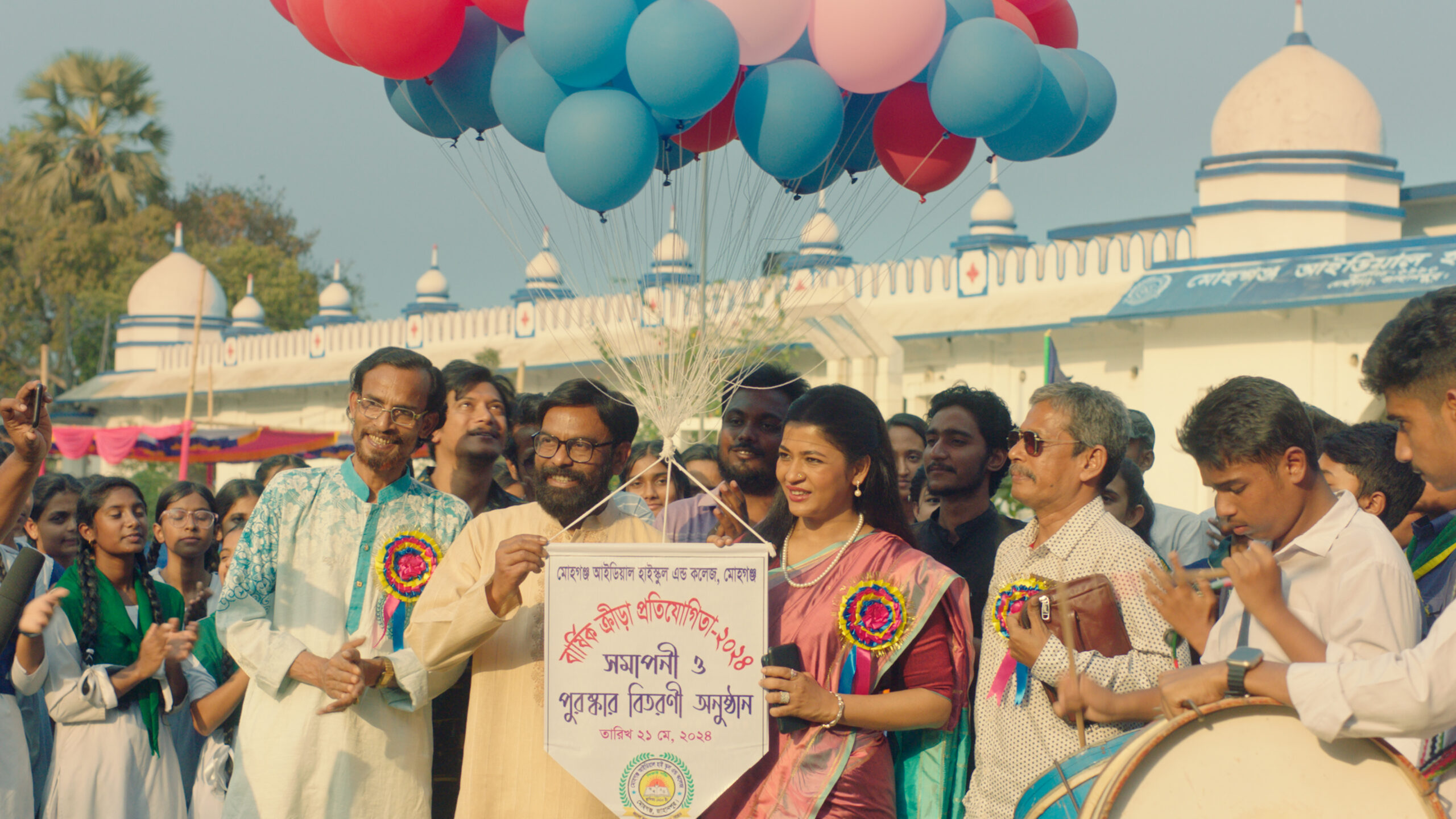
Adapted from a medieval folk ballad from the Mymensingh region of present-day Bangladesh, Giasuddin Selim’s sumptuous, widescreen musical fairytale Kajolrekha is a melodrama in the etymological sense of the word: music + drama. The film employs nearly twenty songs, sung by characters and narrators alike, to advance the plot, deepen emotions, comment on actions and, at points, critically distance the viewer from the story. Bankrupted by his gambling addiction, merchant Dhwaneshwer is given a second chance when a mysterious monk gifts him a soothsaying bird. The bird restores Dhwaneshwer’s lost glory, but also instructs him to exile his 13-year-old daughter Kajolrekha. Forced to lead a life of anonymity and hardship, Kajolrekha perseveres until the tides turn, even if it means paying a heavy price. Selim’s actors adopt a precisely stylized repertoire of theatrical gestures, postures and voice tones to express the essence of their roles, be they slaves, merchants or aristocrats. This conscious revival of a classical narrative tradition isn’t carried out ironically, but with a modernist sense of the latent possibilities of a lost artform. Moving tragically flawed characters across a perfectly orchestrated chessboard of fate and destiny, Kajolrekha reaffirms the inevitability of a just and benevolent world. [WP: commercial release]


9. Sleep #2 (Radu Jude, Romania)

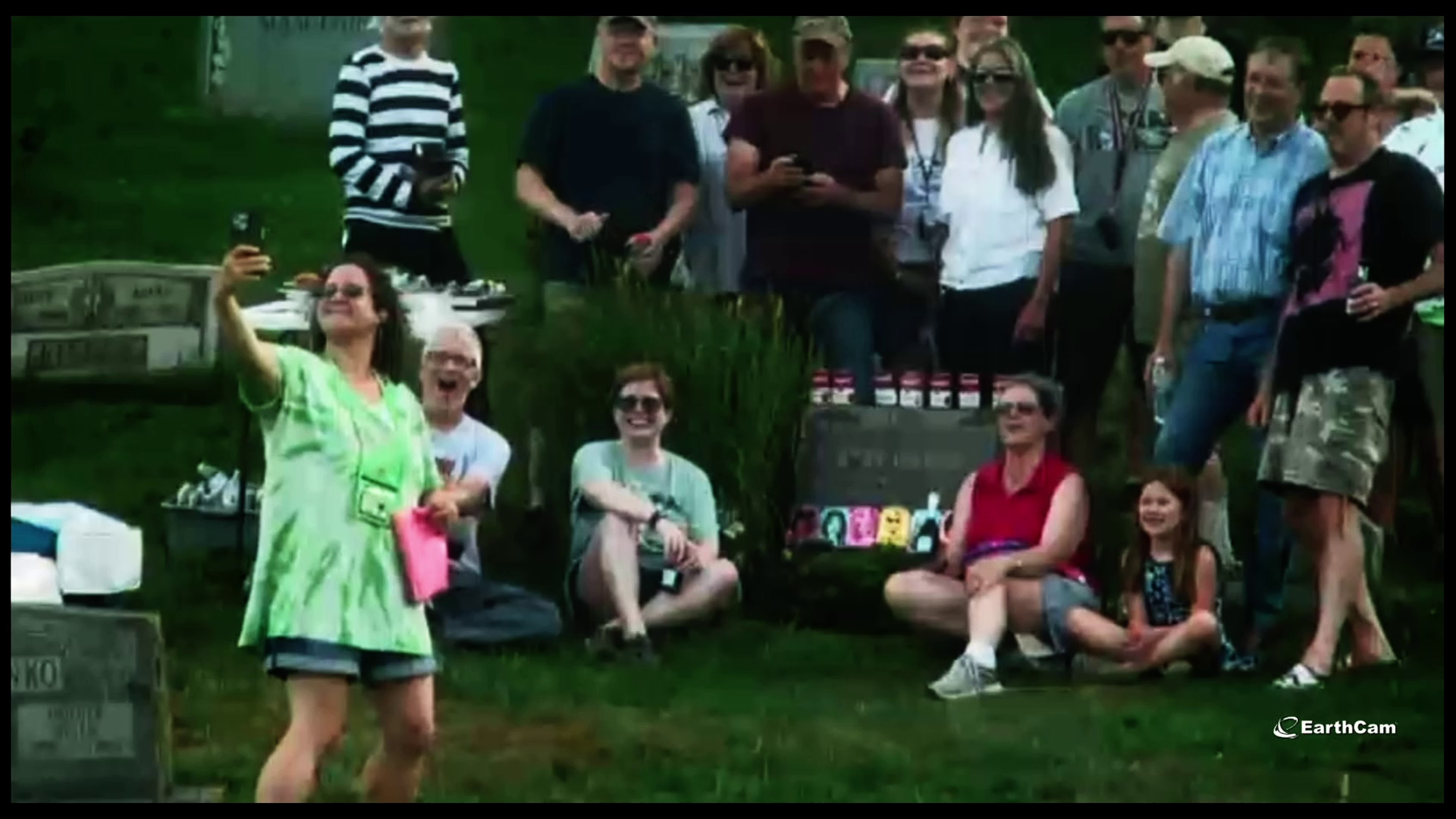
Culling from four seasons’ worth of footage from EarthCam’s live-stream of Andy Warhol’s tomb in Pennsylvania, Radu Jude fashions a spiritual sequel to Warhol’s blockbuster of boredom, Sleep (1964). Where the older film turned the dormant body of Warhol’s lover into a monument comparable to the Empire State Building, Jude’s film, almost equally unwatchable, fixates on Warhol’s own body repurposed into a public monument. As fans and curious passersby click pictures, pose flowers, decorate it with Campbell soup cans and even organize parties around it, the artist’s tomb becomes something like a collective work of art, vested with a social signification. A modern cinematic readymade, Jude’s desktop documentary crafts an unassuming essay on celebrity and fame, entirely in line with Warhol’s work. What happens when television ceases to be the arbiter of mass taste and simply becomes the condition of everyday life? Not fifteen minutes, but the possibility of eternal fame? Just as the visitors bestow the grave with meanings it doesn’t possess in itself, the act of watching the live-stream turns out to be the means by which operational images become aesthetic objects. Critically interrogating spectatorship, Jude’s fascinating film affirms the triumph of life over eternal sleep. [WP: Locarno International Film Festival]


10. Journey of the Shadows (Yves Netzhammer, Switzerland)

Once living a life of harmony in a dystopian world, two bipedal figures – humanlike but featureless, genderless – fall out under the influence of a mystical pet fish. One of them perishes, and the other embarks on an odyssey across the seas, intermittently led by a book and a candle. After countless catastrophes, this wandering being washes ashore on a pristine island, where it tries to overcome its loneliness, alas in vain. This probably isn’t what happens in Swiss multimedia artist Yves Netzhammer’s wordless, mind-bending first feature, in which identities, relations and situations are in such a flux as to resist any kind of linear synopsis. Where traditional animation advances evermore towards a utopian combination of naturalism and expressivity, Journey operates at a zero degree of digital image-making, dealing in primitive figures, bald volumes, harsh lighting, rudimentary physics, sickeningly unmodulated colours, oneiric movements, and an oppressive clarity of visual field recalling Dali or Magritte. At its best, Netzhammer’s abstract film has the subversive, Kafkaesque quality of Central European animation from the 1960s and ‘70s. Defying binaries of nature/civilization, human/technology, organic/synthetic, Journey crafts a deeply disturbing meditation on freedom, creation and self-discovery whose brutality shocks all the more in a universe so unreal.  [WP: International Film Festival Rotterdam]


Special Mention: Dahomey (Mati Diop, Senegal/Benin/France)


Favourite Films of

2023 • 2022 • 2021 • 2020 • 2019 • 2015

2014 • 2013 • 2012 • 2011 • 2010 • 2009

2022 witnessed the demise of several towering figures of cinematic modernism, none more iconic than Jean-Luc Godard. With their passing, it really feels like the end of a chapter in the story of film, one in which cinema was the privileged artform to interrogate history and the world. But their death also registers as strangely liberating in a way, like a clearing in the woods produced by fallen trees that allows us a new, privileged view. Let us hope that the work of these giants will continue to guide filmmakers and critics in their thought and practice.

In August this year, I was lucky to attend the 75th Locarno Film Festival, my first fest outside India. Basking in the gorgeous summertime scenery of Ticino and soaking up the equally sumptuous Douglas Sirk retrospective was an experience to remember, but I’m most grateful for the chance to get to know some terrific people from around the globe, among them cinephiles, curators and critics I’d known online for years but had never met. I’m truly grateful for their insight and company. Mistake: not reaching out to Luc Moullet when I was in Paris after the festival.

In a year that saw the world return to some semblance of normalcy,[citation needed] my own moviegoing habits seemed to have changed for good. The Locarno festival notwithstanding, I went to the theatres, I think, no more than four times this year (Vikram, Ponniyin Selvan: I, Kantara (all 2022) and the 50th anniversary re-release of The Godfather (1972)), which is four more than the last year. Ominous signs. That said, I was fortunate to watch three silent films on 35mm with mesmerizing live piano accompaniment at a King Vidor retrospective at the Jérôme Seydoux-Pathé Foundation in Paris in September: The Sky Pilot (1921), Wine of Youth (1924) and The Crowd (1928), the latter screening a highlight of my cinephile life.

Although I saw more films this year than any other in my memory, I didn’t watch as many new productions as I normally would, especially from India. Despite the absurd overvaluation it has been subject to in the West, I haven’t see a finer action movie in the recent past than RRR, which felt like a masterclass on how to imbue action with emotional-moral stakes, the missing soul of so many contemporary blockbusters. For all its saturated spectacle, RRR is a minimal film in the way it weaves the fewest of narrative elements in different combinations to emphatic, expressive ends. Gehraaiyaan was a compelling piece of slick, professional filmmaking, as was Jalsa. I’ve always admired the streak of self-sabotage in the career of Gautam Menon, and his superb gangster epic Vendhu Thanindhathu Kaadu harnesses that impulse productively, channelling it through screenwriter Jeyamohan’s touching, tragic vision.

A good part of my viewing this year consisted of a dive into Iranian cinema, which, I can say for certain now, is my single favourite national cinema. Among the 200-odd auteur and genre films (from native as well as expatriate Iranian directors) that I watched, there was very little that I disliked, scores of great works and at least two dozen masterpieces. I hope to publish a list soon. In the meantime, check out Another Screen‘s formidable programme dedicated to Iranian/Iranian-origin women filmmakers, which ends on the 4th of January.

Other personal discoveries this year were the films of Costa-Gavras (Picks: Family Business (1986) and Music Box (1989)), the mid-tier features of Boris Barnet (on whose Lyana (1955) I wrote a text for the amazing Outskirts magazine) and the astounding, hyper-caffeinated anime of Masaaki Yuasa (essay coming up). Without further ado, my favourite films of 2022:


1. Matter Out of Place (Nikolaus Geyrhalter, Austria)

If researchers a few hundred years from now were to try and understand how humankind lived in the year 2022 AD, they would do well to turn to Geyrhalter’s spellbinding Matter Out of Place, an expansive survey of foreign objects littering the remotest nooks of the earth. Filmed in a dozen locations on different continents, the film traces the planetary movement of human-generated waste, the great paradoxes shaping its production and the massive efforts needed to manage its proliferation. Garbage doesn’t just cover the landscape in Geyrhalter’s film, it becomes the landscape. With cheeky visual rhymes, astute sound design, proto-Lubitschian humour and a subtly psychoanalytic approach to the physical world, Matter unearths the repressed material unconscious underlying the enticements of consumer society and international tourism. But the film offers no easy answers, presenting instead a universe whose horrors and beauties are inextricably linked, one which evokes awe and terror at humanity’s godlike capacity to create and destroy. In its firm belief that the secrets of the world reveal themselves to the questioning camera eye, Geyrhalter’s work possesses a spiritual dimension directly sdescending from the writings of André Bazin, and his new film elevates the sight of rubbish into a religious epiphany.


2. Crimes of the Future (David Cronenberg, Canada)

Somewhere in the dematerialized wastelands of Cosmopolis (2012), overrun now by the vacuous celebrity culture of Maps to the Stars (2014), lives Saul Tenser, an “artist of the inner landscape” who grows new organs that are surgically removed by his partner Caprice during their feted public performances. Saul is a conservative in denial of the rapid transformation the human body is undergoing—a Clint Eastwood of the New Flesh—who would rather excise his new organs than embrace his true, deviant self. As governments and corporates look to quell the insurrection triggered by a cult of anti-Luddite ecoterrorists who sabotage not technology but the human body, Saul must decide whether to remain at the mercy of the algorithms or take the evolutionary leap. The most rewarding way to approach Cronenberg’s stellar, career-capping new work is to take it not as an allegory of current political debates, but literally. In Crimes of the Future, the body is indeed the final frontier, the last repository of all meaning, the sole means to spiritual edification or revolutionary change—a truism already in our Age of the Body. Filled wall-to-wall with dad jokes and dumb exposition, Cronenberg’s silly, sublime, supremely stylish treatise on corporeal capitalism is the most thought-provoking film since Pain and Gain (2013).


3. A German Party (Simon Brückner, Germany)

Politics is dirty, and electoral politics doubly so. Few filmmakers possess the curiosity, intellectual mettle and good faith—leave alone the necessary access—to examine the unglamorous negotiations and compromises that are fundamental to the democratic process. Made over three years, Simon Brückner’s magnificent fly-on-the-wall documentary about the workings of the far-right German outfit Alternative für Deutschland (AfD) immerses us into the party’s operations, ranging from cool deliberations of executive meetings to high-temperature grassroots confrontations. The result is a markedly composite picture that offers a sense of the heterogeneity of an organization popularly considered an ideological monolith. Over six illuminating chapters, A German Party presents a political body fully caught up in the dialectical process of self-definition, an organization trying to identify itself through differentiation. The need for the AfD to go mainstream, to form alliances and influence policy runs up against the image that it has built for itself, namely that it represents a force outside the establishment. The most intriguing suggestion of Brückner’s film may be that rightward shift of the party, far from signalling the formation of a coherent ideology, may actually be the fruit of a lack of clear identity. Whether the AfD is the elephant in the room or a paper tiger, A German Party leaves it to the viewer to judge.


4. Stomp (Sajas & Shinos Rahman, India)

The Rahman brothers’ boundary-smashing formalist work is nominally a documentary about a theatre group named the Little Earth School of Theatre. For the most part, the film showcases the troupe’s preparations for an upcoming performance at the annual function of a middle-class housing association in Kerala. We see the company’s rehearsal in considerable detail, their work on gesture, movement, voice and cadence, but the nature of their play is sketchy and elusive, like pieces of a puzzle that never fit. Rejecting literary and psychological explanations, Chavittu subverts the conventional artist profile, supplying no commentary on the meaning or significance of the rehearsal and complicating it with absurd interludes. What the filmmakers offer instead is a bracing procedural work intently focused on the physicality of its subjects, emptied of emotional life and operating together as a consummate professional unit. The sensuality that the film radiates comes not through dramatic or formal devices, but from the raw presence of young, athletic bodies populating the frame. Even when it places this performance within a satirical, self-reflexive social context, the film remains gentle, focused on the troupe’s single-minded artistry in the face of indifference and marginalization. Chavittu is all grace.


5. Nazarbazi (Maryam Tafakory, Iran-UK)

The problem with film censorship, as Judith Williamson pointed out, isn’t that it rids movies of objectionable matter, but that it makes everything else seem dirty. Drawing images and sounds from almost a hundred Iranian films made since the 1979 revolution, overlaying them with evocative fragments of citations and original text, Maryam Tafakory’s ambitious, enrapturing video collage Nazarbazi illuminates how the Islamic regime’s censorship codes, specifically its restriction on showing men and women touching each other on screen, displaced this repressed sexuality onto other sensations, objects and aesthetic elements. An astonishing example of film criticism as an artwork in itself, Tafakory’s exhilarating, tactile montage locates the erotics of cinematic art in fluttering fabric, clinking bangles, slashed wrists, breaking glass, aromatic food, sweeping camera movements and, of course, the play of glances. Supressed desire finds a way to manifest not just in filmmakers’ cunning paraphrase of taboo actions, but simply in the ontology of the medium; sensuality in cinema is revealed not just as what artists express, but as what they can’t help but express, thanks to the inherent voluptuousness of moving bodies, caressing textures and resonating sounds. Watching Iranian films after Nazarbazi, you might find yourself asking the same question as Diane Keaton in Love and Death (1975): can we not talk about sex so much?


6. Footnote (Zhengfan Yang, USA-China)

Terror floats in the air in Footnote, not just due to the pandemic, but also because the film’s soundtrack consists entirely of police radio communication from Chicago city. The incoming complaints are by turns petty and serious, ranging from minor disagreements with neighbours to drive-by shootings, and officers are tasked with everything from delivering a lost pet home to checking on isolated senior citizens. Seemingly gathered over a year, these excerpts reveal an extremely busy, probably understaffed police force grappling with the tensions of a diverse, multicultural city. The image, meanwhile, comprises wide-angle shots of open spaces filmed from a higher vantage point— intersections, highways, beaches, parking lots, rooftops—almost always featuring ant-like, solitary human figures animating the frame. Thanks to the thrillingly dialectical relation that Footnote sets up between sound and image, these calming panoramas become vehicles of anxiety, with human bodies turning into agents of both biological and criminal threat. Widening the chasm between the home and the world, the radio chatter colours the images with a feeling of alienation and paranoia. In the way the airwaves convert ordinary window views into something akin to CCTV footage, pregnant with dramatic incident, Footnote might be tapping into a fundamental psychological condition of life in America. Also, the finest Hitchcock remake in ages?


7. The Plains (David Easteal, Australia)

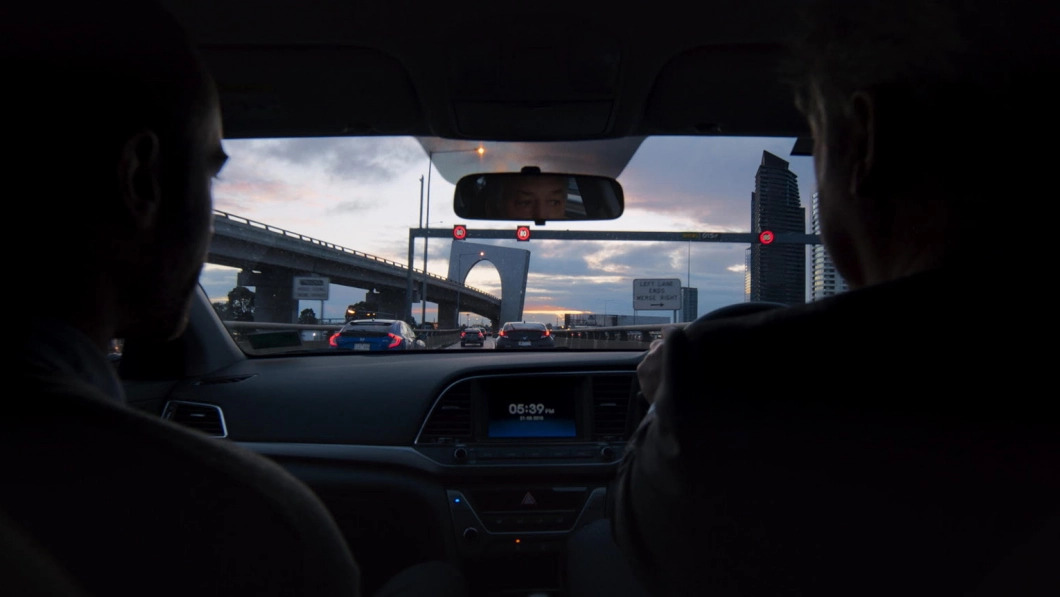
The Plains channels the spirit of Jeanne Dielman into Andrew Rakowski, a middle-aged lawyer who leaves office every evening just past 5 P.M. to drive home to suburban Melbourne. Easteal’s cyclical road movie formalizes this routine, filming Andrew’s commute over eleven different days of the year with a fixed camera from the back seat of his car. On some days, Andrew offers a lift to his colleague David (Easteal himself), probing the reticent young man on his private life while also generously talking about his own: relatives, career, romance, wealth, mental health. Literally compartmentalizing work and life, the commute creates a transitional zone where Andrew can view each as an escape from the grind of the other. It provides a moment of unwinding, freedom from roleplay that both life and work demand. Yet, for all the me-time the drive home affords, there is an eerie silence whenever Andrew isn’t chatting away or the radio isn’t on, as though this non-place, non-time were forcing him to reflect on Important Things. Despite the apparent sameness, every day brings small deviations that threaten Andrew’s reassuring routine, all accumulating into a powerful meditation on aging and the passing of time, a view of life’s parade from the wheel of his car.


8. Red Africa (Alexander Markov, Russia)

Rivalling the best work of Sergei Loznitsa, Alexander Markov’s resplendent found-footage project samples propaganda and reportage films that the USSR made during the Cold War to strengthen its ties with newly liberated African states. In this gorgeous Sovcolor assemblage, we see Soviet Premiers and African heads of state visit each other amidst ceremony and pomp, exhibitions showcase the latest in Soviet culture and technology to the African public and students use the knowledge they have gained in Moscow for the betterment of their countries, whose exported resources return as value-added products from behind the Iron Curtain. It’s a poignant glimpse into a nascent utopia, a world that could have been, which hides as much as it reveals. With cunning visual associations, Red Africa recasts decolonisation as a formal process that concealed fundamental continuities between the departing Western powers and the Eastern hegemon. Uplifting notions of bilateral ties between Africa and the USSR are belied by the strictly unilateral flow of influence and ideology. In its attempts at creating a new world order, Markov’s sharp film demonstrates, the Soviet Union espoused anti-colonial struggles in fraught areas of the globe even as it held sway over its diverse republics—a tragic irony made apparent when the chickens came home to roost in 1991.


9. The DNA of Dignity (Jan Baumgartner, Switzerland)

Jan Baumgartner’s moving, loosely fictionalized documentary The DNA of Dignity follows the patient, heroic work of individuals and organizations involved in identifying victims buried in mass graves during the Yugoslav wars. Along with bones, volunteers retrieve articles of clothing, toiletries and other knickknacks, all hinting at stories to be told of those they have outlived. With witnesses passing away each year and new structures waiting to be erected over these burial sites, the excavations are truly a race against time, fighting both political amnesia and nature’s complicity in the oblivion. In their quest to rescue war victims from anonymity, forensic scientists assemble excavated bones into skeletons, carry out DNA tests to ascertain identities and hand over the remains to grieving families, who haven’t had closure despite the end of the war and who confess to no longer being able to enjoy landscape without being reminded of what it hides. Baumgartner’s film obscures political and institutional details to focus on the scientific process, offering a fascinating, inspiring picture of the how the abstractions of science eventually coalesce into human stories. Its success lies in finding the right tone and distance necessary for a subject as grave and delicate.


10. Animal Eye (Maxime Martinot, France-Portugal)

Martinot’s funny, free-spirited, quietly radical Animal Eye features a 30-year-old Breton filmmaker discussing his next project with his producer in Lisbon. He isn’t very articulate, but knows that the film will be an “autobiographic animal diary” about his dog Boy. “Films are filled with humans,” he says, “all liars.” Animals, in contrast, are not aware of the camera—or don’t care about it—and as chaotic beings of “pure present,” they evade the signifying operations of the image, emptying it of meaning and intention. As the muddled filmmaker slowly “hands over” the project to his smart, wry producer, the film’s central theme crystallizes: in neither owing anything to imagemakers nor expecting anything from them, the filmed animal offers a way out of the crippling egocentrism of artistic creation. In being just an image, the filmed animal becomes a just image. Animal Eye takes the first tentative steps towards the faint understanding that a “cinema of animals” shouldn’t consist of simply filming the world from their eyes, but filming as them, whatever that might entail. Chaining together clips of dogs from across movie history—subject to sadistic torture, sentimentalism and signification, locked out of the human realm—Martinot’s film embodies a rousing rallying cry on behalf of a “deanthropocentrized” cinema. In its own modest way, Animal Eye marks a milestone in anti-speciesist filmmaking.


Special Mention: Saturn Bowling (Patricia Mazuy, France)


Favourite Films of

2021 • 2020 • 2019 • 2015 • 2014 • 2013 • 2012 • 2011 • 2010 • 2009

A German Party, Simon Brückner’s magnificent political documentary about the workings of the far-right outfit Alternative für Deutschland (AfD, Alternative for Germany), begins with a declaration of its own uselessness. Allaying the worry of party members that a camera in the room might make their financial discussions public, senior leader Frank-Christian Hansel informs them that the film will not release until 2022, that is after the 2021 parliamentary elections, and by then it won’t be of much value. A German Party has nothing to be embarrassed about the comment, for its goal is not to persuade voters or influence elections.

Founded in 2013, the AfD experienced a meteoric rise in its first years, winning 12.6% of the votes in the 2017 federal elections to become the first far-right party since the Second World War to enter the Bundestag. Feeding off anxieties triggered by the migrant crisis, the AfD gained as much as every third vote in certain regions of erstwhile East Germany, but has since experienced a backlash for its shift further to the right of the political spectrum. In 2020, the domestic intelligence service placed large sections of the AfD under surveillance, classifying them as a threat to the constitution.

Outside of opening and closing title cards, however, the film gives very little contextualizing information. There are few markers of time and place, no direct interviews or archival clips to aid the viewer. The film follows a handful of party members, but we learn their names only incidentally, if at all. Divided into six chapters and spanning three years, Brückner’s fly-on-the-wall documentary instead drops us into the middle of the operations, alternatingly walking us through cool deliberations of top-level meetings and high-temperature confrontations of grassroots activism. The result is a markedly composite picture that offers a sense of the heterogeneity of an organization popularly considered an ideological monolith.

The very first scene, where party workers discuss slogans coined for the upcoming campaign, lays down the orientations and beliefs of the AfD: distrust of the establishment (“Courage for Truth” goes the main catchphrase), the European Union (“More Europe, Less EU”), immigration (“Integration Needs a Dominant Culture”), eco-socialism (“Stop with the Windmills”) and a support for the army (“Modernize the Army”), heterosexuality (“Only Mom and Dad Make the Future”) and the family (“Grandkids Safeguard Grandma’s Pension”). “Screwing for pensions,” jokes one skeptical member, prompting another to point out that the slogans are there to galvanize the voter, not the partymen: the bait is for the fish, not the fisherman.

These hot-button topics recur throughout A German Party, but the film avoids sensationalism and instead emphasizes the ordinariness of the AfD’s day-to-day negotiations — a risky move that could invite charges of mainstreaming the group. The film was made with the consent and cooperation of its participants, who perhaps saw in it an opportunity to polish their public image. The individuals we see here aren’t the tattooed, tonsured skinheads of Vice documentaries, but ordinary citizens and politicians formulating responses to specific issues, solving logistical problems or involved in public outreach.

Yet, what we get is far from an attempt at white-washing, and the film sheds its mundane garb at regular intervals to reveal the pathologies of movement we are dealing with. “Those who don’t love Germany can leave,” states a speechmaker of the party’s youth faction. Another one talks about land-grabbing migrants from Africa taking up too much space in public transport. Supremacist jokes, anti-mask rhetoric, badmouthing of news media and references to Prussian valour should ring alarm bells even for the uninitiated viewer. In one sequence, party members dressed in suits drive to a refugee camp near the Bosnian border to make incendiary videos for their TikTok accounts. When they spot three figures in the far distance, they get into a mini panic and prepare to leave.

These incriminating evidences aside, the film pronounces no further judgment. It is so focused on the mechanics of party operation that every viewer is likely to walk away with their own evaluation of the AfD. There are thematic connections between the chapters, but A German Party doesn’t aim for an exhaustive portrait. Condensing five hundred hours of footage into a commercially viable two-hour runtime, the film instead positions the AfD as an elephant that can only ever be partially apprehended.

Indeed, even the members of the party perceive it in highly divergent ways. Each one has a theory of what its identity, strengths and failings are, of why the party isn’t succeeding or how it should correct course, but these assessments are riddled with contradictions. Unity is important to some, getting rid of dissidents to others. The AfD is too niche and must reach out to a wider audience, believe a few. It is already spreading itself too thin in trying to appeal to the entire right half of the political radar, think others. The fact that many of AfD’s leaders are not seasoned politicians like those in other parties is seen as both an advantage and a shortcoming.

These contradictions have to do with the evolution of the AfD itself. What is so compelling about A German Party is that it presents a political outfit fully caught up in the dialectical process of self-definition, an organization trying to identify itself through differentiation — a body at its mirror stage, as it were. The need for the party to go mainstream, to form alliances and influence policy, runs up against the image that it has built for itself, namely that it represents a force outside the establishment. The most intriguing suggestion of Brückner’s film may be that rightward shift of the party, far from signalling the formation of a coherent ideology, may actually be the fruit of a lack of clear identity; the AfD is the AfD because it is not the CDU or the NPD.

A German Party shows the degree to which AfD is caught up in an internal war between the ‘moderates’ and the ‘extremists.’ Party chief Jörg Meuthen calls the provocateurs of the party’s extreme-right factions “pubescent schoolboys,” which convinces some that Meuthen must go. (He did, in January 2022.) In convention after convention, we witness radicals elbowing out their rivals for candidacy and party positions. The fight is not just at the level of leadership; at a tiny borough meeting of three people, an elderly member bats for the deportation of Muslim families, a proposal that doesn’t go well with the meeting host.

There are other internal incompatibilities too. We see politicians promising higher financial security, better welfare, more protection from international competition to impoverished towns of the east. But a significant cross-section of the party, including its aggressive economic wing, appears to be of a libertarian tendency. The tug-of-war is most apparent on the issue of Covid-19 measures. We discover that as much as 70% of the party membership doesn’t believe that the restrictions are excessive. Yet we get the impression that the AfD condones, or has no control over, its extremist wings, Flügel and Junge Alternative, who conduct strident anti-vaccination, anti-masking rallies.

Whether this lack of consensus points to a healthy culture of debate and democracy within the party, or a kind of doublespeak that appeals to two different voter bases or simply ideological inconsistency is left to the viewer to decipher. Towards the end of the film, the residents of a flood-ravaged town refuse to take the relief money offered by the AfD, reportedly out of concern about associating with the party. Is the refusal a reflection of Germany’s robust democracy and its people’s moral courage, or is it a sign of their cowardice and self-destructive political correctness? For you to judge.


[First published in News9]

I learnt a new term on social media this year (or maybe it was last year, who knows?): the Overton Window. Wikipedia defines it as “range of policies politically acceptable to the mainstream population at a given time.” By extension, it also designates the gamut of utterances that defines the limits of a discourse at a given point in time. As we sit aghast here in India watching this window slide to the right of the political spectrum—to a point that inclusion of conservative and extreme-right figures on televised debates constitutes diversity of opinion—the pandemic appears to have redrawn the old battle lines of film discourse. Forget the fight for celluloid over digital cinematography and projection. The old fogeys of today are those that think the theatrical experience means something, while the median of the Overton Window consists in debating what makes for good OTT content.

I don’t feel particularly compelled to take sides on this debate. As it happens, 2021 was the year that I did not go to the cinemas at all, and truth be told, it wasn’t entirely due to the health crisis. A number of other projects kept me busy in these twelve months, including the release of the hardcover version of my first book, and as it is, I find it increasingly hard to get excited about this or the other production. Except for the end-year binge that made this list possible, I must say I hardly saw films in 2021 and that includes older ones. I regret not being able to watch West Side Story, which had a run of less than a week in my city and was elbowed out by another Disney tentpole released on the same day. Who would have thought that the Overton Window now ranges from Spielberg to Spiderman? Anyway, here are my favourite films from this cursed year.


1. France (Bruno Dumont, France)

What comprises the blight of modern life? The reverse shot, answers Bruno Dumont in his scorching new dramedy about celebrity news reporter France, played by a dazzling Léa Seydoux, who cannot help but make it about herself in every story she does. Fresh off two films on Joan of Arc, Dumont gets his hands dirty with the profane world of modern media. And yet, it’s a spiritual tale that he tells. The filmmaker often quotes Péguy about the need to “stand up where one is.” That is what France does after she is subject to one moral crisis after another in her professional and personal life: rattled by a minor accident that she causes, France begins to see things “as they are”, subtracting herself from the reverse shot, but this grasping at saintliness doesn’t last long. She returns to her profession, not necessarily wiser but more authentic, and in doing so, reaches a state that may be seen as one of grace. It isn’t a media satire that France is after, but something all-pervasive, the simultaneous genuineness and falsity of our emotions faced with harrowing images of the world. Dumont’s film is daring, tasteless, compelling, overblown, contradictory and superbly stylized. Familiar but uncanny, it is everything you don’t want it to be.


2. Dear Chantal (Nicolás Pereda, Mexico)

An apartment evermore waiting to be occupied, letters responding to inquiries not heard, a voice never embodied in the image: Pereda’s five-minute short is a haunting, haunted tribute to the late Chantal Akerman that is structured around absence and substitution. We hear Pereda replying to fictitious queries by the Belgian filmmaker about renting out his sister’s apartment in Mexico City, and we see his sister readying the apartment, moving out paintings or clearing foliage from the skylight. In the film’s robust organization, Pereda, his sister and Akerman become mediums, connecting links in each other’s (after)lives: Pereda, unseen, serving as a middleman between the apartment owner and the impossible future tenant; his sister, unheard, taking the place of Akerman who will never feature in Pereda’s film; and Akerman herself, unseen and unheard, bringing the siblings together in a non-existent real estate deal. In an act of respect and love, Dear Chantal creates a physical space for Akerman to continue to exist, even if not in flesh and blood, just as No Home Movie, Akerman’s final work before her suicide in 2015, grappled with the physical absence of her recently deceased mother. The film imagines an alternate reality that brings Pereda and Akerman together not in artistic collaboration, but in the banal transactions of everyday living.


3. What Do We See When We Look at the Sky? (Aleksandre Koberidze, Georgia)

How would Lubitsch do it? Well, if the old master were a contemporary filmmaker, ‘it’ would probably resemble Koberidze’s off-kilter, disarming romantic comedy about two lovers-to-be who work at a shop around the corner without recognizing each other all summer. What Do We See is obviously designed to please, but there is never a sense that it panders to its audience. Like the best storytellers, Koberidze knows that pleasure can be deepened by deferring gratification, and to this end, his film takes surprising excursions away from its central story, restarting at will and relegating its lead couple to the margin as though reposing faith in destiny to bring them together. This vast negative space of the narrative clarifies the larger objective of the film, which is to integrate its characters into the landscape of the ancient town of Kutuisi, whose faces and places, ebbs and flows, become the central subject. Pinning down the fable-like story on the voiceover allows the director to employ a complex, highly unusual visual syntax—that nevertheless derives from classical Hollywood cinema—without disorienting the viewer. The film involves magic, but Koberidze demonstrates that a towel flying through the frame can be as enrapturing as the most outlandish fairy tales.


4. Babi Yar. Context (Sergei Loznitsa, Ukraine)

The title says it all. Loznitsa’s new documentary represents a modulation of style for the filmmaker. Where his found footage work so far dropped the viewer into specific historical events in medias res, without much preparation, Babi Yar. Context offers a broader picture. With the help of archival material, but also uncharacteristic intertitles, the film details the events leading up to, and following, the Babi Yar Massacre of September 1941, where over 33,000 Jews were killed over two days in the eponymous ravine in Kiev. We see Ukrainian citizens welcoming the occupying Nazi forces with enthusiasm and collaborating in the persecution of their Jewish compatriots. In an illustration of the failure of archival, the massacre itself isn’t represented except in photographs of its aftermath. Loznitsa’s shocking film is a rousing J’accuse! directed at his nation, at the willingness of its citizens in enabling genocide, at the amnesia that allowed for the valley to be turned into an industrial dumping ground. Loznitsa’s newfound desire to contextualize his material should be construed less as a loss of faith in images to speak ‘for themselves’ than as a critical acknowledgement of their power to deceive. After all, the Red Army is welcomed with comparable pomp after they liberate Kiev, this formal continuity with the reception of the Nazis concealing a crisis of content.


5. Bellum – The Daemon of War (David Herdies, Georg Götmark, Sweden/Denmark)

The spectre of Harun Farocki hovers over Herdies and Götmark’s excellent documentary about war, technology and the production of images. A meditation on Western attitudes to armed conflict, Bellum unfolds as an anthology of three human interest stories: a Swedish engineer involved in designing an AI-powered military drone that will take autonomous decisions on bombing a perceived target, a war veteran in Nevada suffering from PTSD and having trouble reintegrating into civilian life, a photojournalist from the East Coast who covers the aftermath of the Afghan war. Well-meaning though these individuals might be, their lives and work are marked by a certain guilt surrounding the fact of war. This is evident in the case of the vet, but the photographer’s own activity may not be untouched by a liberal sense of culpability about her country’s interventions in Afghanistan. The engineer’s efforts to bypass the human factor of war, too, is an attempt to eradicate feelings of guilt about liquidating an enemy, which, the film’s narrator notes, is the only real restraining force in armed conflict. Bellum cogently points out the ways in which technology—of training, of intervention—increasingly eliminates human fallibility from the equation of war, for as Colonel Kurtz put it, “it’s judgment that defeats us.”

 

6. The Card Counter (Paul Schrader, USA)

I don’t know if Bruno Dumont and Paul Schrader saw each other’s films this year, but I’m certain they would both have much to say to one another. If First Reformed (2017) was the subtext, The Card Counter is the text, a film that is all surface. Where the earlier work stood out in the authenticity of its character and milieu, the new film aspires to an artificiality worthy of the casinos and bars it mostly unfolds in. Schrader tells the same Catholic story he has always been telling, that of God’s Lonely Man who is mired in mud but has his eyes on the skies. Oscar Isaac portrays William Tell, convict turned cardsharp who tries to save a younger man from self-destruction, but faced with divine indifference, decides to play God himself. Formally, Schrader doesn’t deviate from the Bresson-Ozu-Dreyer axis of the previous film—what Schrader rightly or otherwise called the Transcendental Style—and this reserve produces a productive friction between the film’s style and noir setting of the story. In that, The Card Counter is highly reminiscent of American Gigolo (1980), which is to say that, despite the references to Abu Ghraib, it is a work completely out of joint with the present. It is incredible this film even exists.


7. The Year Before the War (Dāvis Sīmanis, Latvia)

Even if we are done with the 20th century, suggests Sīmanis’ singular, absurd period comedy, the 20th century isn’t yet done with us. When Hans, an opportunistic doorman at a Riga hotel, is falsely implicated in a bombing, he flees the Latvian capital to shuttle from one European city to another. The Europe of 1913 that Hans traverses is less a real geography than an abstract zone of competing political currents. War is around the corner, and there are several groups trying to influence the course of history. Zealous ideologues seek to entice and co-opt him, subjecting him to what Louis Althusser called “interpellation.” All through, Hans fights hard to follow his own moral compass, flee subjecthood and retain his individuality. A historical picaresque, Sīmanis’ film is interested in the singularity of this particular juncture in Western history—a point at which fin de siècle optimism about technology and human rationality came crashing against the reality of trench warfare—where countless isms sought to impose their own vision on the world. It would seem that Sīmanis views Latvia of the early 20th century as something of an ideological waystation, an unstable intellectual field where free radicals like Hans couldn’t help but be neutralized. And that vision isn’t without contemporary resonance.


8. Mr. Bachmann and His Class (Maria Speth, Germany)

Maria Speth’s expansive documentary about a batch of preteen students, mostly of an immigrant background, in a public school in Stadtallendorf, Hessen, is a classroom film that achieves something special. Remaining with the children for almost its entire four-hour runtime allows it to individuate them, to look at them as independent beings with their own skills, desires and prejudices, just as their charismatic teacher-guide-philosopher Dieter Bachmann adopts a different approach to each of his pupils. For Bachmann, it would seem, whatever the students accomplish academically during the year is of secondary importance. He knows that he is dealing with a group with an inchoate sense of self: first as pre-adolescents, then as new immigrants. Consequently, he spends a great deal of effort in giving them a sense of community, creating a space where they can be themselves. At the same time, the classroom is a social laboratory where new ideas are introduced and the children brought to interrogate received opinion, all under Bachmann’s paternal authority. Speth insists on the particularity of these individuals and there is no sense that our star teacher is indicative of the schooling system in Germany at large. Bachmann is an exception, and in his exceptionalism lies a promise, a glimpse of how things could be.


9. Out of Sync (Juanjo Giménez, Spain)

It’s an ingenious, wholly cinematic premise: estranged from family and friends, a sound engineer spends her nights at her film studio until she starts to experience a lag between what she sees and what she hears. Juanjo Giménez’s absorbing psychological thriller riffs on this setup, weaving its implications into a coherent character study of a young woman out of sync with her life. The result contains some very amusing set pieces constructed around the delay between sound and image, but also one of the most sublime romantic scenes of all time, one that begins with rude abandonment and ends at a silent movie show. Marta Nieto is brilliant as the unnamed protagonist who withdraws into a shell and then reconnects with herself and the world. She brings a fierce independence to the character that nuances its vulnerability. Its claustrophobic premise notwithstanding, Out of Sync feels like a very open work, integrated gracefully with the urban landscape of beautiful Barcelona. Watching the film in 2021, when so much of real-world interaction has been rendered into digital images and sounds, using Bluetooth speakers with their own latency to boot, is an uncanny experience.


10. Shared Resources (Jordan Lord, USA)

Ambitious to a fault, American artist Jordan Lord’s new work is nearly unwatchable. Yet it bends the documentary form like few films this year. Shared Resources is a home movie made over a considerable period of time, presented in scrambled chronology. We learn that Lord’s father was a debt collector fired by his bank, that his health is deteriorating due to diabetes, that the family lost most of its possessions in the Hurricane Katrina and that they had to declare bankruptcy shortly after Lord’s acceptance into Columbia University. All this material is, however, offered not directly but with a voiceover by Lord and his parents describing the footage we see, as though intended for the visually challenged, and two sets of subtitles, colour-coded for diegetic and non-diegetic speech, seemingly oriented towards the hearing disabled. In having his parents comment on images from rather difficult episodes in their lives, the filmmaker gives them a power over what is represented. Through all this, Lord initiates an exploration of debt in all its forms and shapes: paternal debt towards children, filial debt towards parents, the debt of a documentary filmmaker towards their subjects, one’s debt to their own body, the fuzzy line between love and indebtedness. This is an American film with an Asian sensibility.
 

Special Mention: From Where They Stood (Christophe Cognet, France/Germany)

Favourite Films of

2020 • 2019 • 2015 • 2014 • 2013 • 2012 • 2011 • 2010 • 2009

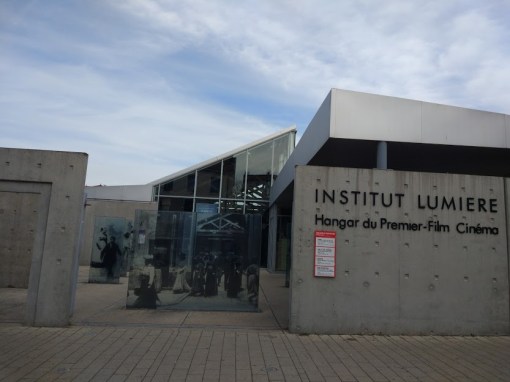
It is in leaving the Lumière factory that the workers give themselves over to cinema, that they attain the status both of actresses and of future spectators. Moving away from work, they enter the enchanted world of entertainment. For the world of work is only weakly enchanted (enchanting), and unlikely to be enchanted in return by cinema, except in the form of a nightmare…

– Jean-Louis Comolli, Images Documentaires 24

On 22 March 1895, in the Rue de Rennes in Paris, inventor and industrialist Louis Lumière presented a private demo of a motion picture system he had devised with his elder brother Auguste. The device was called Cinématographe, and the 17-metre strip of celluloid used to show its working was titled Workers Leaving the Lumière Factory in Lyon-Monplaisir. Lasting about fifty seconds when projected at a certain speed, it showed a mass of labourers, mostly women, leaving the Lumière facility at lunch hour from either side of two gateways. The audience at the demo, composed of businessman, researchers and photography enthusiasts, was very different from the people on screen, as most movie audiences would be in the coming decades. Traditionally considered the first ever motion picture, Lumière’s film bound labour and cinema together for eternity, the image of workers leaving the factory being a veritable birthmark for the medium.

What is less well-known, however, is that there were at least three versions of the film. In the first two iterations, the gates are already open, and the workers flood out from the first frame onwards. Even so, the factory is not emptied by the time the picture ends — that is, by the time the camera runs out of film. The culprit appears to be a horse buggy that takes time to come out of the facility. The third version premiered in the first commercial showing of Lumières’ films in the Grand Café on the Boulevard des Capucines in Paris on 28 December, 1895. In it, the door opens only after the film has begun, and thanks to the absence of the buggy, the workers get out in time and the door is (almost) closed. Now considered the definitive version, this “first film” in the history of cinema, was in fact a remake of a remake.

Why did Louis Lumière make several versions of the film? One theory is that, since there were no internegatives in the film development process at the time, the original negative degraded with every new print made. The picture had to be therefore reshot onto a new negative so that fresh copies could be made for various screenings across the continent. Another hypothesis is that the Lumières didn’t like the quality of the picture and judged that the factory gates should close before the camera ran out of film. After all, a door opening and closing in the manner of a theatrical curtain had a certain spectacle about it that is missing in the first two versions, which drop us in medias res, so to speak.

Whatever the reason, it is believed that, after the first version of March 1895, the brothers summoned their workers for repeated takes, sometime in early summer. The planned day of reshoot falling on the Lord’s Day, the Lumières requested their employees to come to the factory after the Sunday mass to simulate the scene of workers leaving for lunch on a workday. As a result, in the second and third versions of the film, the participants’ hats and clothes are fancier, their mood more cheerful: one female employee mischievously tugs at the skirt of another just as they take leave from each other. The actors themselves seem wiser to the presence of the camera, more professional, so to speak. In comparison to its predecessors, the third film is on the whole more harmonious, less chaotic, the flow of workers out the gates more streamlined. Except for an implacable canine and his bicycle-bound master, who appear in all three versions, the play of chance in this definitive version is minimal.

It is not known whether the participants were paid for any of the versions, if not as the first actors of cinema, at least as workers doing overtime (on a Sunday to boot — France wouldn’t become officially secular until ten years later). At the time, there was no law in effect in France limiting the working hours. Labour unions were illegal in the country until 1884 and the General Confederation of Labour (La CGT), France’s first and largest confederation of labour unions was established only in September 1896, sometime between the private and the commercial screenings of Lumières’ film. On 1 May 1891, incited by Paul Lafargue (a son-in-law of Karl Marx’s), textile workers up north organized demonstrations in favour of the eight-hour work day. In the town of Fourmies, soldiers opened fire on the demonstrators, killing nine young people.

The protests were an emanation of the ferment across the Atlantic, where there was considerable labour unrest in the preceding decade. In May 1886, workers in Chicago rallied in favour of a universal adoption of the eight-hour work day, until then applicable to only certain sections of the American workforce. The rallies turned violent, a bomb exploded and several people died. Three years later, the Second International, adopted the 1st of May as the International Workers’ Day to commemorate the events in Chicago and to continue the campaign for the eight-hour work day. The demonstration at Fourmies was part of this campaign.

Much has changed in the nature of labour, its conditions and its screen representation in the century since Lumières’ film. Workers Leaving a Factory seems to possess a historical innocence that is impossible to recapture now. The men and women leaving the Lumière factory did so in an era of industrial optimism and ground-breaking scientific progress. It wasn’t until the First World War, and its technologized warfare, that this faith in scientific rationalism was seriously questioned. With Fordism rendering skilled labour ever more marginal and the Great Depression causing unprecedented levels of unemployment, industrial work could no longer be viewed the same way. The downbeat image of hunched, robotic workers changing shifts in an underground industrial-city in Fritz Lang’s Metropolis (1927) or the cut from a herd of sheep to contemporary workers leaving the subway in Chaplin’s Modern Times (1936) altered the primal scene of Lumières’ film irrevocably.

For the centenary anniversary of Workers Leaving a Factory, German filmmaker Harun Farocki made a video work of the same name, which traces the cinematic genealogy of the “first film”. Analysing photographed images of workers at factory gates through the years, Farocki deems it “an image like an expression, which can be suited to many occasions”. His film views the area outside the factory as a dialectical space. For one, it is the place of direct confrontation between Labour and Capital: between picketers and guards, between strikers and the police. The factory gate becomes the membrane that separates work from workers, an economic system from its constituents. It is at the factory gate that Labour and Capital identify themselves by identifying the other

Farocki also regards this space as facilitating diverging definitions of the public and the private. On one hand, the factory entrance mashes private individuals into the mass being called workforce. It is for this reason that much of popular cinema centres on life outside work. In these films, narratives about individual lives begin once work is over and the impersonal, faceless workforce dissolves into separate somebodies. They replace the viewer’s leisure time with that of the characters, our problems with theirs and provide vicarious pleasures and catharses. “Whenever possible, film has moved hastily away from factories” says Farocki’s narrator, noting that in one hundred years of cinema, there have been more prisons and correctional facilities than factories and workers. It is indeed telling that mainstream cinema has shown itself better equipped to depict work when it is a form of punishment or a crime than when it is part of an everyday reality.

On the other hand, suggests Farocki’s film, the area in front of the factory gates is itself subject to competing notions of property and theft. While the territorial imperative of Capital defines this liminal space as the company’s private property, for the workers it becomes a public area of discussion, congregation and protest. “Where the first camera once first stood, there are now hundreds of thousands of surveillance cameras”, goes Farocki’s narrator, pointing out how cinema unwittingly became an instrument to safeguard Capital. The apparent innocence of Lumières’ film may, however, be fallacious too. With the camera cranked by Louis Lumière himself, and his employees dutifully hurrying out of the factory under his instructions, it could be argued that even the first film was a form of surveillance footage.

Surveying the factory gates is evidently in the interests of owners, but what happens when employees do the surveying? In the era of invisible labour — the rise of the class of knowledge workers, the erosion of the boundary between workplace and home, and the ceaseless digitization of all work in general — does it even matter if the factory gates are watched over? Some companies certainly think so. In his digital video Workers Leaving the Googleplex (2011), American artist Andrew Norman Wilson recounts the repercussions of filming and talking to workers leaving the “ScanOps” facility at Google headquarters in Mountain View, California. These temp workers, responsible for digitizing printed matter for Google Books, are comprised chiefly of people of colour and don’t have the same rights as other contract employees at the firm. Wilson, himself a contract employee with the tech giant at the time, was sacked for violating the non-disclosure agreement even though his footage barely shows any worker leaving the building. If Lumières’ film has any lasting politico-cinematic lesson, it’s that bosses will always want to be the ones holding the camera.

[Originally published at Firstpost]

Is it possible to say anything about this world-historical year without some amount of preliminary hand-wringing? Culture writers, film critics included, appear to feel obliged to present their bona fides, to relativize their work in view of the pandemic and to pre-empt any accusations of frivolity. We are already masters at the art; it is, after all, a profession that hits you with the question of relevance every single day. The silver lining, if one can call it that, in this catastrophe that has touched every person on the planet may be that barely any other pursuit seems any more relevant. Here’s to all those who lost their lives to the virus, to those who have been fighting to save us, and to those who haven’t lost sight of causes for justice, peace and compassion amid the global health crisis.

The enormous impact of the pandemic on film production, distribution and exhibition has been obvious. Streaming giants, namely Netflix, Amazon and Disney, who have been successful at vertical integration in the past few years (and are poised to go even further), seem to be the biggest gainers from this disruption. Whatever their claim about increase in consumer choice, it seems to me that it hasn’t really resulted in a diversity of viewing patterns. (Consider, for instance, the Sight & Sound critics’ poll: the 2019 edition had a total of 353 films chosen by 100 contributors whereas the 2020 version has 353 films from 104 contributors—hardly a sign of a paradigm shift.) Given their subscription model, these firms have every incentive to pump more and more money into marketing and hog the discourse. If this annus horribilis has proved anything, it’s that publications are more than willing to bend over and serve as unaffiliated PR organs for these companies.

While the cancelling of film festivals across the world was unfortunate, it gave publications and critics an unprecedented opportunity to bypass traditional tastemakers and widen their horizons. Considering that so many organizations, by generosity or lack of choice, presented their programs online for international viewers for the first time, it was an invaluable chance for film journalists to let their readers know that there was good, smart, moving and entertaining work—old and new—available outside of subscription walls and subcultural echo chambers they have themselves helped create. To my limited knowledge, this opportunity was squandered. Publications, predictably, saw their task as giving readers “what they want” instead of elevating them.

My own viewing this year was dominated by older films. Thanks to torrent archives and illegal websites, which are seemingly the only platforms making any effort to save and make older work accessible, I had the privilege of seeing countless great works from across decades and across the globe. Watching dozens of films by William A. Wellman, Luc Moullet and Alfred Hitchcock, most of which are available for free online, remain especially fond memories (Waltzes from Vienna (1934) and The Man Who Knew Too Much (1934) are top-drawer works!). I had great fun writing about some of them for my classical Hollywood column until it was scrapped in June.

Of the 130-odd new films I saw this year (of which three in theatres), I found no masterpieces, several accomplished works amidst a sea of middling-to-uninteresting efforts. (Shoutout to Malmkrog, Siberia and The Last City for plunging into territory conventionally considered bad taste and coming out trumps.) What I sense is that, thanks to cheap digital media, more and more independent and experimental filmmakers are simply documenting every aspect of their lives, amassing vast amounts of footage without any specific purpose in mind, and reusing them when a chance arises. With the production halt of 2020, I suspect this habit will only be more apparent in the coming months. While that is certainly a valid method of working, I can’t help but feel that so many films I saw this year came across like half-cooked soups, disparate material thrown together with the hope that it will all, somehow, result in poetry—one reason why works on this list, with their rigour, intelligence and feeling, stand out in my mind.


1. Hopper/Welles (Orson Welles, USA)

I’ve had no greater screen delight this year than watching two white dudes chat for two hours. Orson Welles and Dennis Hopper hole up in a dark room with half a dozen technicians to talk filmmaking, politics, religion, love, magic, news, television and literature while dutiful assistants scurry about readying one refill of liquor for them after another. Welles plays the Grand Inquisitor, pressing his timid interlocutor to state his artistic and political beliefs, conjuring theories to counter him and never allowing him a resting ground. We never see him, save for rare glimpses of his bellowing pin-striped trousers moving at the edge of the frame. As Hopper’s cinematic forefather, Welles looms large, appearing to be incarnating some kind of metaphysical force, orchestrating a Kafkaesque trial for the young man. What results is a stark power imbalance between the seen and the unseen, the subject and the author, the one who is recorded and the one who wields the camera. But the primary pleasure of the film lies in seeing two artists in a terribly absorbing conversation, grappling with the cinematic-aesthetic problems of their time. Going public after fifty years, Hopper/Welles is both a standalone film and an anniversary celebration. It hasn’t dated one bit.


2. Forensickness (Chloé Galibert-Laîné, France/Germany)

Chloé Galibert-Laîné’s funny, sharp and dizzyingly smart video work begins as a commentary on Chris Kennedy’s Watching the Detectives (2017), a desktop film about the crowd-sourced investigation on Reddit following the Boston bombing of 2013. As the director breaks down Kennedy’s film, analysing its narrative construction and its tendency for geometric abstraction, she voluntarily gets caught in an ‘analytical frenzy’, not unlike the Redditors themselves. As Galibert-Laîné seamlessly chains one stream of thought after another, her film evolves into a meta-reflection on our relation to images and our compulsion to create meaning from visual material. If Just Don’t Think I’ll Scream (2019) saw cinephilia as a self-made prison of images, Forensickness digs deeper, revealing the epistemological malaise that is the search for meaning that animates all cinephilic pursuit. Her film lays bare the adventures of the critical mind, throwing open not only its own making, but also the thoughts producing it. Forensickness may look like an object of pure play, the result of a filmmaker “seduced by her own jokes”, even a solipsistic game in the way it asserts the inescapability from these self-imposed maps of meaning, but this magnificent work is unmistakably insightful regarding the way we make sense of the world through images.


3. A Machine to Live In (Yoni Goldstein & Meredith Zielke, USA/Brazil)

What remains of the modernist dream of reshaping human societies from the ground up based on scientific, rationalist principles? Goldstein and Zielke’s ambitious, erudite and formally complex city symphony seeks to find out. Its subject is Brasilia, the artificially created capital of Brazil that architects Oscar Niemeyer and Lúcio Costa forged out of the wilderness in the late fifties. The imposing geometric forms of the city, expressly conceived in cosmic terms and perfected like Kubrickian monoliths from outer space, appear to have all but snuffed out human presence. Machine sees this city as an otherworldly geography unfit for human life, but also allowing the possibilities of imagining utopias, catholic cultists, freemasons, biker gangs and Esperanto evangelists all finding a home within Brasilia’s orbit. Employing heterogenous narrative modes, Goldstein and Zielke develop a visually striking portrait of a city that has come to resemble a religious monument in itself, demanding awestruck worship and constant maintenance by people who can’t afford to live here. Their Brasilia is either a place that inspires dreams of reimagining life or an abyss where dreams come to die. Even as it looks back at a moment in modern intellectual history, Machine evokes questions about the future, inviting us to reflect on the eternal human desire to play demiurge.
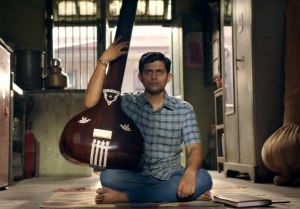
 

4. The Disciple (Chaitanya Tamhane, India)

Tamhane’s superb second film feels like home territory for him. Sharad, an apprentice Hindustani music singer, is not the greatest of talents, but imagines himself as part of a tradition, one that gives a structural meaning to his life. But, the promise of omnipresence and instant gratification of the modern world beckoning him, not only does he find himself unable to live up to the lofty ideals of his tradition, he’s also is gradually disabused of these ideals themselves. In a very direct manner, The Disciple zeroes in on a fundamental, civilizational sentiment that underpins artistic succession in the subcontinent: that of filial piety, as opposed to the parricidal narrative that informs the Western conception of self-realization. Even when his faith has been questioned, Sharad continues to serve his elderly teacher, caring for him till the final days, like icon worshippers who hold on to their idols even (and especially) when the meaning behind them is lost. Tamhane builds up gradually to this assault on Sharad’s worldview, with humour, suspense and a calculated formal reserve that redoubles the impact of the emotional violence. His film invites viewers to constantly process narrative information in order to access it, providing a rich dividend for the effort.

 

5. Unusual Summer (Kamal Aljafari, Palestine)

In Unusual Summer, Aljafari repurposes CCTV tapes that his father left behind after his death in 2015. The tapes are from the summer of 2006 and were used record the parking spot outside his home to see who’s been breaking the car window. Despite the dramatic promises of the CCTV aesthetic and the location of the house in the crime-ridden district of Ramla, what we get in this film are quotidian incidents, sightings of neighbours passing by, the picture of a town going about everyday business. Aljafari adds a sparse ambient soundtrack that imparts Tati-esque colour to the proceedings, with the passers-by on screen becoming veritable characters. This transformation of private surveillance footage into a session of window-watching and people-spotting produces a feeling of community and forges a relation of inheritance between the filmmaker and his father, the only two people to have seen these tapes. Supremely calming though it is, Unusual Summer is also seared by loss and mourning, the familiar faces, places, animals and trees that register like spectral presences on the lo-fi video having vanished in the intervening years following intrusions by the Israeli state. A minimalist gem that speaks to our now-amplified urge to reach out to others.


6. The Game of Shifting Mirrors (Amit Dutta, India)

Dutta’s richly dialectical new film draws out themes from Chitrashala and Finished/Unfinished (both 2015) and puts them in a stimulating new conversation. The first section, set in the Chhatrapati Shivaji Maharaj museum in Mumbai, jumps across artefacts from several centuries while a voiceover describes an encounter with tribal artists and paintings. This contrast between the linear time and historical narrative of the British-era museum and the mythical worldview underpinning ‘indigenous’ art is given a third dimension by the film’s latter section that showcases the 8th century rock-cut temples of Masrur. Like tribal art, the temple complex has a founding myth that departs from the rigorously documented secular accounts of archaeological practice. As the industrial working hours of the first section make way for a day-night cycle, we observe the complex’s sculptural reliefs that have been partially eroded by nature. The film’s evocative organization then embodies an ambivalence towards museological conservation: while modern museums salvage art from natural degradation for the benefit of posterity, they wrench objects out of their original context, severing them from the knowledge systems and traditions that gave birth to them. In its fruitful frictions, Game suggests that perhaps all preservation necessarily entails a loss.


7. Bloody Nose, Empty Pockets (Bill Ross IV & Turner Ross, USA)

The Ross brothers’ new docuficion follows the last day of operation of The Roaring 20s, a downscale bar fictionally set in Las Vegas, at which a bevy of social castaways gather to mourn and celebrate. While all the actors play themselves, the filmmakers loosely fictionalize the scenario, giving direction to it with certain pertinent themes. Set against the backdrop of collapsing American businesses, Bloody Nose is a hymn for failure, a note of solidarity to what the American lexicon calls “losers”. The Roaring 20s is the opposite of everything one associates with the glitz and glamour of Sin City: it’s a floundering venture that is the negative image of the American Dream. For its regulars, however, the bar is something of an institution that provides them with a public (and, at times, private) space that has become scarce elsewhere and where they can be themselves. The film’s broader view of class is compounded by a specific generational perspective that refutes the idea that the young, the ‘millennials’, can’t make it because they don’t work hard enough. A film that hits the right moods without tipping over into condescension or miserabilism, Bloody Nose deserves all the plaudits it’s been getting.


8. Corporate Accountability (Jonathan Perel, Argentina)

Perel continues his exploration into Argentina’s military dictatorship by examining the role of large private corporations in enabling and carrying out state-sponsored pogroms against political dissidents of the junta. He photographs the company facilities as they are today while a brisk voiceover lists out how each firm helped military and security forces detain, torture and get rid of problematic workers in exchange for financial perks. The text, read out from an official 2015 report, is numbingly repetitious, and drives home the pervasiveness of these military-industrial operations. Perel’s decision to frame the sites through his car’s windshield creates a sense of illicit access, even though there is visibly little stopping him from going nearer the facilities. Some of the companies continue to operate under their own name, while some others have changed, with at least one site carrying a memorial sign for the injustice perpetrated there. Perel is, in effect, photographing the ur-filmic image of factory entrances, but all we see is a handful of vehicles leaving the gates. This eerie absence of human figures evokes the disappeared workers who, at some companies, were picked up at the entrance, a site, as Harun Farocki has demonstrated, of class dialectics. A tough nut, but wholly rewarding.


9. Film About a Father Who (Lynne Sachs, USA)

Lynne Sachs’ frank, morally messy documentary turns around her father, Ira Sachs Sr., a ‘hippie businessman’ whose unconventional living and constant womanizing comes down heavily upon his nine children, some of whom have known the existence of the others only after decades. Sachs weaves through footage shot over half a century in half a dozen formats and layers it carefully into a simple, direct account with a voiceover addressed at the audience. She takes what could’ve been a narrow family melodrama into much stickier territory. Her film isn’t a portrait of her father, but a meditation on relationships with this man as the connecting element. Sachs goes beyond all gut responses to her father’s behaviour—disappointment, rage, disgust—towards a complex human reality that can elicit only inchoate sentiments, as suggested by the film’s incomplete title. She isn’t filming people or their stories, but the spaces between people, and how these spaces are always mediated by the actions of others. Father’s wayward life, itself rooted perhaps in a traumatic childhood, profoundly shapes the way his children look at each other. Sachs’ film is ostensibly a massive unburdening project for her; that she has been able to draw out its broader implications is a significant accomplishment.


10. Victoria (Sofie Benoot, Isabelle Tollenaere & Liesbeth De Ceulaer, Belgium/USA)

As part of his work, Lashay T. Warren, a young family man from Los Angeles, is posted in Cal City, California, a town wrought in the fifties by a lone developer out of the Mojave Desert with the hope that it would become the next Los Angeles—a dream that didn’t come to fruition. Along with other men and women his age, Lashay is responsible for maintaining this ghost town by reclaiming its streets from nature and restoring some semblance of cartographic order. Victoria teases out various thematic layers from this singular scenario. On one level, it is an absurd tale about one of the many dead ends of capitalist enterprise, a kind of anti-Chinatown portrait of a Los Angeles that could’ve been. Lashay is like a worker repairing a remote outpost in space, marvelling at every sign of life in this almost otherworldly landscape. But he also resembles the American pioneers, whose diaries on their way to the West he emulates in the film’s voiceover. Ultimately, Victoria is a poignant, humanist document, in the vein of Killer of Sheep, about the dignity of a young Black man providing for his family, trying to graduate from high school, all the while fighting the gravity of Compton’s streets.


Special Mention: Red, White and Blue (Steve McQueen, UK)


Favourite Films of

20192015201420132012201120102009

[From Luc Moullet’s Fritz Lang (1963/70, Seghers). See Table of Contents]

III. CONCLUSION


Lang and Our Times


Lang’s body of work is among the most important in Germanic cinema. It’s generally placed before those of Lubitsch and Pabst, but immediately after that of Murnau. From an international perspective, Lang is always cited among the greatest, but never among the highest echelons, often because of a respect for tradition rather than a knowledge of his work. He tends to be considered a filmmaker of the past, an academic director. Rare are those who love his entire body of work, from 1919 to 1960: older critics see him disappear from cinema in 1926, reappear furtively in 1931 (M), or even in 1936 (You Only Live Once). The youngest don’t like his first expressionist films, and locate his real beginnings towards 1924, or 1928, or 1936, or even near 1946. Leftist critics consider only the films between 1928 and 1938 as valuable. There’s a fierce and vain battle between the supporters of German Lang and those of American Lang, which hasn’t facilitated the understanding of his work.

As a matter of fact, Lang’s body of work is one and indivisible. That’s what makes for its power and its weakness. Its power, because this unity is evidently made of equal (or almost equal) films, or at least ones worthy of interest, except Guerrillas. It can’t then be said that Lang, who has more than thirty successes to his credit, has made bad films. It’s a performance that was equalled, by Hawks, by Hitchcock most notably, but never surpassed. None of these films is really independent of the others. The body of work is to be explained, in its totality, by the course of its evolution. And it’s nothing less than the moving course of a human life that we have the pleasure of following, a pleasure superior to the one felt before any one of these films taken alone, which is only one moment in the evolution, and thus incomplete.

The period of search, of artistic youth, is logically completed by the period of maturity, which marks an end point. The contrary is equally true, for this second period lacks the power, the ardour of youth. Hence the difficulty in selecting films that are representative of Lang in the public’s eyes, films that stand apart from others and allow us to describe his art to the layman who has neither the time nor the possibility to see his forty-three films, of a total length of sixty-seven hours. Der müde Tod, Siegfried, Metropolis, M, say the old. M, You Only Live Once, say the more moderate ones. M, Fury, Hangmen Also Die, affirms Lang. Human Desire, Moonfleet, While the City Sleeps, according to the young. Finally, the two Hindu films for the extreme-right among our critics. The game is rather vain, and I don’t think it’s any useful to play it. But it shows clearly that there aren’t any perfect masterpieces, superior to the rest of the films, like it is the case with Buñuel, Capra, Dreyer, Dovzhenko, Eisenstein, Gance, Mizoguchi, Murnau, Stroheim, Sternberg, Vidor, Vigo, Welles, who are “auteurs of films”. Along with Godard, Griffith, Hawks, Hitchcock, Renoir, Rossellini, Lang belongs to the class of “auteurs of bodies of work”.

(more…)

A Fish Swimming Upside Down (Eliza Petkova)

Philipp, an affluent, middle-aged widower (Henning Kober), marries young Andrea (Nina Schwabe) and installs her at his swanky house. Also living in the house is his son Martin (Theo Trebs), a young man who holds onto his mother’s photos and resents his father bringing home a new wife. Philipp is constantly away on business, and with little to do outside of her work with developmentally challenged children, Andrea languishes in the spacious house. It’s peak summer, and with the beautiful Andrea lounging around the swimming pool, you can be sure Martin isn’t going to end up calling her ‘mommy’. Petkova’s second feature is reminiscent of early works from the so-called Berlin School: stories about rich, white people suffering existential ennui presented in a clinical steel-and-glass style made of static shots or discreet camera movements and no music. This is a resolutely low-key work that limits itself to the love triangle at the centre. Like the outsider in Pasolini’s Teorema (1968), Andrea is a mysterious figure with no past whose love is boundless; everyone comes under her aura. But this inclusivity doesn’t sit well with Martin, who becomes blind with jealousy. The film moves along this unveiled Oedipal rage that takes many victims and eventually implodes. Petkova populates the film with several children’s games, presumably with a view to impact some psychological nuance to the relationships. She finely evokes the languid mood of summer afternoons, and is able to introduce a vital element of sensuality into the Berlin School style. But the rewards are minor: the film is so enamoured with its provocation that, minus the underlying myth, its characters become shadow beings outside of society and history.

The Metamorphosis of Birds (Catarina Vasconcelos)

Catarina Vasconcelos’ debut feature is a very easy film to like. There is, firstly, its spellbinding plastic beauty. Shot in 16mm, the film lovingly combines soft diffused lighting, oil-painting colour, richly detailed period objects into striking tableaux, often seeking to emulate Renaissance still life. Then there is its evocative voiceover, in which Vasconcelos details the life of her grandparents through poetically reimagined letters. Grandfather Henrique is at sea touring Portugal’s colonies while Grandmother Beatriz raises her many children alone. The exchange between them revolves firstly around, of course, the distance between them, and then the children, who haven’t seen their father for years. In Vasconcelos’ rarefied, romanticized re-conception, they become quasi-mythical figures—the absent Father, the suffering Mother—who come alive through the objects associated with them. The items chart the passing of the years, reflecting political changes: the fall of the empire, counterculture stirrings and the end of the Salazar regime. Jacinto, the filmmaker’s father, comes of age, discovering love and death. When Grandmother dies, and as the film’s focus shifts to Jacinto and the loss of his wife, the tone changes from yearning to mourning, and the narrative devolves into pure metaphor around a Tarkovskian desire to become one with nature, reprising symbols established earlier. On its face, Metamorphosis is a tribute to Vasconcelos’ father, one that preserves the memory of his parents and narrativizes his life for him, sharing the burden of bereavement in the process. The film recalls the work of Victor Erice and Sergei Paradjanov to some degree, especially in its capacity to create ravishing images out of personal history. It is evident that the film seeks to be a work of aching beauty, but there’s the lingering feeling that it does the aching for us.

Garage People (Natalija Yefimkina)

Natalija Yefimkina’s creative documentary centres on a small-town subculture in the far reaches of Russia. In a chain of garages located at a remove from their low-income homes, mostly middle-aged men spend their free time working on their passions. They have converted these tin-shed structures into a veritable ‘man cave’ serving various functions: carving workshop, metal foundry, scrap recycling yard, quail breeding facility, music room, even a WW2 cosplay warehouse. For these men on the fringes of Putin’s Russia, such privately-owned garages are a ‘third place’ away from their soul-crushing mining work and the strictures of domesticity, a space that helps create meaning to their lives. Like a primitive artist par excellence, Viktor has built four floors underneath his garage by digging with a shovel for over fifty years. He doesn’t know its purpose yet, but the digging has provided him with a purpose—a purpose that he inexplicably loses all of a sudden shortly before his demise. The whole town seems stuck in time, isolated from the rest of the world, save for a train that passes now and them. The younger folk hope to escape to greener pastures, while the older ones have found some sort of meaning between individual pursuit and communal life. Whether they are belting out a heavy metal number or getting into drunken brawls, director Yefimkina observes the garagists from a distance, synthesizing these vignettes along different thematic lines such as work, family, romance and community. Garage culture isn’t exactly news, but Yefimkina succeeds in infusing the film with a melancholy mood that is usually the reserve of fictional works. By imaginatively rearranging her material and slightly fictionalizing it, she has been able to convert it into an empathetic portrait of dead-end lives comparable to wistful snapshots of small-town America such as The Last Picture Show (1971) and Ham on Rye (2019).

Camagroga (Alfonso Amador)

Alfonso Amador’s absorbing documentary about the Horta of Valencia, said to be one of the most fertile corners of Europe, pivots around the Ramón family: farmer Antonio, his daughter Inma and her son Marc. Over one year, they grow, harvest, sort and ship tiger nuts to milk extraction facilities. There are highways and railway lines running adjacent to their land, which is under the threat of being invaded by commercial establishments and public infrastructure projects. Camagroga shuttles between two types of documentaries, at times uneasily: one that follows the lifecycle of a food commodity from production to consumption and one that observes life in a rural region under the throes of ‘globalization’. It complicates the former narrative further by intercutting it with shots of other crops being grown and processed, such that it’s not always clear at what stage of the cycle we are in. But what is most striking about the film is its rhythm. Director Amador cuts close. When there isn’t much movement within a shot, he lets it linger for no more than 3-5 seconds. This almost metronymic, Emigholz-like editing imparts a slightly frenetic pace to the film. As a result, we don’t get a sense of the rhythm of life in the region, in a way that we do from Shinsuke Ogawa’s A Japanese Village (1982), an important precursor to Camagroga. What is gained, however, is the knowledge of how labour intense the process is, involving manual intervention at all stages of production, with the only ‘dead times’ being Antonio and co. breaking for a sandwich or a cigarette while talking to the camera. It’s notable in this regard that Amador only shoots in daytime, that is to say work hours, keeping out all private aspects of his subjects’ lives. A tribute, then, to the labour of these folks whose faces seem as worked over by time as their land.

Forensickness (Chloé Galibert-Laîné)

Chloé Galibert-Laîné’s funny, sharp and dizzyingly smart video work is an antidote to the overdose of audiovisual soup that passes for essay film these days. Forensickness begins as a commentary on Chris Kennedy’s Watching the Detectives (2017), a desktop film about the crowd-sourced investigation on Reddit following the Boston bombing of 2013. As the director breaks down Kennedy’s film, analysing its narrative construction and its tendency for geometric abstraction, she voluntarily gets caught in an ‘analytical frenzy’, not unlike the Redditors who ascribed meaning to every detail that caught their eye in photographs from the bombing site. As Galibert-Laîné seamlessly chains one stream of thought after another, her film evolves into a meta-reflection on our relation to images and our compulsion to create meaning from visual material. Even as she exposes how we live in an era of debunking that firmly believes that images conceal messages, she can’t help but point at similar motivations driving her interrogation. Every proposition, every experience of hers on the desktop is turned on itself and subject to interrogation. And it works perfectly because Forensickness is precisely about the need to meaningful synthesis of divergent experiences. If Frank Beauvais, in Just Don’t Think I’ll Scream (2019), saw cinephilia as a self-made prison of images, Galibert-Laîné digs deeper, revealing the epistemological malaise that is the search for meaning that animates all cinephilic pursuit. Her film lays bare the adventures of the critical mind, throwing open not only its own making, but also the thoughts producing it. The film may look like an object of pure play, the result of a filmmaker “seduced by her own jokes”, even a solipsistic game in the way it asserts the inescapability from these self-imposed maps of meaning. But even as a snake eating its own tail, Forensickness is unmistakably insightful regarding the way we experience the world through images. If it isn’t the desktop film to end all desktop films, it’s hard to imagine what lies ahead for this form.

The American Sector (Pacho Velez, Courtney Stephens)

The American Sector takes up a subject matter that ships with a bundle of contained themes: scores of Berlin Wall fragments scattered across the United States. Anyone (like me) who has hunted for fragments of the Wall or even looked at the Wikipedia page of the location of the fragments must’ve had at least a faint thought about the implications of decontextualizing a historical object. Velez and Stephens’ film latches onto these incongruities, giving us a tour of Wall fragments installed in various public and private spaces including five-star hotels, movie studios, army bases, corporate retreats, hobbyist clubs, universities, museums and even the CIA HQ in Langley, Virginia. Shots of the fragments quietly towering over surroundings alien to it are sometimes mixed with soundbites by citizens and public officials about the provenance and the meaning of these monoliths. The filmmakers probe interviewees for what the Wall means to them, and we get fairly interesting and varied answers: a symbol for the abstract notion of freedom, a sign of hope for immigrants hoping for a better life, a reassurance for Black families that they are historically not alone, a token of cordial US-German political relations, a remembrance of a simpler time when the enemy was clear, even a container of religious truth serving as the backdrop for Christian passion plays. The overarching irony—the appropriation of foreign history to reinforce American exceptionalism—is echoed by two students at the University of Virginia, who see the amplified presence of the fragments in the campus, which has little relation to the Wall’s history in the first place, as an affront to the local history of slave labour that built the university. Thanks to its fertile subject, the film doesn’t have to sweat to bring these frictions to the surface. The American Sector accomplishes what it sets out to do, but it may have had been more rewarding had it been willing to stick its neck out and embrace a larger debate, especially at a moment where our discourse on monuments and their context is more fraught than ever.

[From Luc Moullet’s Fritz Lang (1963/70, Seghers). See Table of Contents]

Contemplation (1954-60)


The last phase of Lang’s work embodies, not the view of a man who asks himself painful questions about life, its meaning and the moral value of men of his time, but a superior view, that of God, which observes the indifference of the external world to the individual, the difficulty of communication between individuals caught up in the Social Order. Lang responds to it with an equal indifference that establishes his superiority. That was already the attitude of his positive heroes, stingy when it came to gestures and movements.

Critique now gives way to contemplation. Films like Ministry of Fear, The Woman in the Window, Rancho Notorious, and The Big Heat at times demonstrate this contemplative style inherited largely from a tradition of objectivity in classical American cinema and from the commercial necessity for double games. But now contemplation attains an excessive degree, moving far away from classicism.

Truth be told, there was a film foreshadowing this tendency even in the German period. Twenty-six years before Human Desire, Frau im Mond (Woman in the Moon, 1928) reconciled its sets and its style: it’s indeed a lunar film. The plot, centred on the conquest of the moon and on the conflicts between scientists and profiteers in search of precious metals, conflicts aggravated by the presence of Gerda Maurus, is simply a pretext to showcase the sets and to place characters within these sets. There’s no human emotion. Everything here is a decomposition of the emotional and physical movements of characters who are analysed with a meticulousness, a mania that makes Frau im Mond the longest (two-and-a-half hours), the most boring and the most painful film by Lang for those who aren’t interested in following the work of the creator through the plot. There’s here the same abstract scheme as in Kriemhilds Rache, a scheme based on the repetition of identical movements, on the rotation of similar acts that end up bestowing even such excess with the outline of a vertiginous, wholly intellectual fascination, producing a new form of poetry.

Five films fall in this line, two American works, one of them rather Germanic in its style, and three other German ones. All five reprise earlier attempts made from a very different point of view, one which isn’t that of contemplative maturity: Human Desire (1954) is an improved version of Clash by Night (1951), in the similarity of its atmosphere and themes, and The Big Heat (1953), whose actors reappear here, but not in their critical virulence. Beyond a Reasonable Doubt (1956) takes While the City Sleeps (1955) further, minus the critique once more. Der Tiger von Eschnapur and Das indische Grabmal (1958), Die 1000 Augen des Dr. Mabuse (1960) rework Lang’s earlier films (1922, 1932) and scripts (1919).

(more…)

Next Page »