
With only a handful of posts published, the blog pretty much went into hibernation this year. While 2024 was full of opportunities, encounters and discoveries that I am immensely grateful for, it was also, personally, a year of greater flight from the world, including the world of cinema in some ways. I cut myself off more and more from the news cycle and social media for sanity’s sake, which has meant that I’m woefully unaware of, among other things, what’s making waves in the awards circuit and what the “important” films of this year are. At a glance, I don’t recognize most of the titles featured on major year-end lists.
At the same time, I find myself more embedded than ever in the professional world of cinema, working with different film festivals in various capacities, minor or otherwise. While I haven’t been able to write and translate as much as I would love to, I’ve found myself increasingly involved in programming and selecting films. This has had, I think, considerable consequence on the way I watch and write about cinema.
Firstly, the majority of the titles I saw this year were works-in-progress (WIP): projects in post-production, without CGI, colour grading, sound-mix, and even some shots or subplots. Such a ‘pre-natal’ view of films tends to put the viewer in a state of disenchantment in which one becomes too aware of the strings being pulled: actors simulating shock, disgust or joy in front of blank screens, interacting with inexistant elements of the décor, suspended on ropes, drowned in ambient noise or struggling to convey an emotion, hoping that the music will do that rest.
Over time, watching such volumes of unfinished films could also make a year-end list like this a hassle, since it I have to constantly check whether a particular WIP that I liked last year has released this year or is still waiting for a premiere. More crucially, such lists will likely be even more aleatory and subject to the vagaries of my viewing assignments rather than, as in the past, seeking to take into consideration, even if nominally, consensus titles and popular favourites.
The bulk of my writing this year has also been of a private nature, tied to the programming work. Destined for a handful of known people within a festival, instead of a wider readership online, the texts have undergone a change in kind. If they have gained in freedom and concision, they have lost the rigour and rhetorical force that comes with public writing. I can’t yet imagine what kind of impact this might have on my instincts – and mental capacity to engage with films – in the long run.
All this preamble to say that this blog may continue to remain inactive in the coming year(s). While that is nothing new – it was already in cold storage along with my cinephilia from 2016 to 2019 – it does feel different not to be identifying primarily as a critic/translator anymore. Interesting times ahead.
Here’s wishing a happy new year.
1. The Adamant Girl (P.S. Vinothraj, India)
 When Kottukkaali (The Adamant Girl) released in theatres, miraculously, in August in Tamil Nadu, it was accompanied by substantial popular backlash. Admittedly, Kottukkaali is a tough-minded work, one that is perhaps harder to instantly ‘like’ than Vinothraj’s debut Koozhangal (2021). Like the latter, it makes us intimate with the unbridled rage of its male lead, but it does so without the emotional cushion of a child’s perspective. Instead, the film performs a high-wire act, tensely balancing different, conflicting points of views towards its protagonist, Meena, a young lovelorn girl deemed possessed and taken to a local godman for exorcism by her extended family that includes Pandi, the hot-tempered cousin she is betrothed to. While the entourage constantly discusses what is to be done about the girl, Meena herself remains resolutely mute, her silence conveying both defiance and stoic resignation. Kottukkaali explores both the horrific dimensions of this pervasive practice and the subversive space of resistance it offers to the ‘possessed’, temporarily immune from secular violence. At once sophisticated and utterly simple, Kottukkaali respects its audience’s imagination and intelligence while withholding nothing from them. In its formal wit, its trenchant social portraiture and its uncompromising humanism, it represents a significant leap forward for Vinothraj. [World Premiere: Berlin International Film Festival]
2. Twilight of the Warriors – Walled In (Soi Cheang, Hong Kong)
 Decades in the making, Twilight of the Warriors: Walled In, Soi Cheang’s supremely kinetic martial arts epic, forges a double legend linking the mythical past of the now-demolished Walled City and a vibrant, close-knit Hong Kong of the eighties before the island’s handover to China. In gargantuan sets of stunning detail, the film recreates the ramshackle complex, not just the densely packed mass of its buildings, but also the thriving economy and community of this dizzyingly vertical ghetto. Desperate to evade the police and gang members, scrappy refugee Lok enters the Kowloon Walled City, a seedy, crime-ridden slum complex exempt from the law and run under the benign authority of Cyclone. Lok’s diligence and fighting spirit attract the paternal Cyclone, but when the young man’s past comes to light, the very existence of the Walled City is endangered. A masterclass in modern cinematic action, the film conceives its astonishing martial-arts sequences in a close co-choreography of camera movement, continuity editing, geometric décor and athletic performers, the whole presented at human scale and close to real-time speed. With every shot having the force of an abstract painting in its dynamic sight lines, Walled In delivers a sweeping, sensational spectacle. [WP: commercial release]
3. Who Cares? (Alexe Poukine, Belgium)
 Kneel down, and you will believe, said Pascal. In That Which Does Not Kill (2019), Alexe Poukine had actors re-enact another person’s reason-defying testimony of sexual assault, allowing them to find pathways to empathy through text, performance and the spoken word. Deeping this line of inquiry, Who Cares? looks at a soft-skill course in Lausanne, Switzerland, in which trainee doctors and caregivers engage in simulated conversations with actors playing patients, with the goal of being more mindful of patients’ feelings during diagnosis. At the heart of this course aimed at humanising healthcare is the belief that empathy, like other qualities, can be learnt through performance, repetition and critical feedback. Even as it brings us close to this view, Poukine’s film qualifies it, presenting us another theatre-based training session in which real medical staff grapple with their professional frustrations born of difficult working conditions, revealing how individual goodwill finds its limits in institutional realities. Like Harun Farocki’s best work, Who Cares? zeroes in on the niche rituals of a highly specialized field, only to lay bare broader civilization and historical undercurrents; in this case, the contradictions generated by the high premium placed on individual wellbeing in western societies. [WP: Cinéma du Réel]
4. The Damned (Roberto Minervini, Italy/USA)
 In 1862, during the American Civil War, a troop of Union soldiers is sent to survey the uncharted territories of the West. The young men only have a vague understanding of the reasons for the war, but have their own motivations for donning the uniform. They bide their time, play cards and baseball, and engage in occasional skirmishes against a looming, largely invisible enemy. In his first fictional feature, Minervini forges a spare, brooding Western featuring the rural White southerners who populated his documentaries on backwoods America. Their dialect, diction and body language are modern, and this deliberate anachronism lends the film the texture of a filmed performance. In casting marginalized, stereotyped individuals as Union soldiers and placing them at the very origin of the creation of the United States, Minervini monumentalizes them in the vein of Straub-Huillet’s peasants-turned-gods. At the same time, the counter-casting obliges the non-actors to creatively participate in a founding myth that is very different from the “lost cause” narrative dear to the South. The result is a kind of Lehrstück for both the participants and the audience, a vital gesture of bridge-building in a house that finds itself divided once more. [WP: Cannes International Film Festival]
5. Kiss Wagon (Midhun Murali, India)
 In a film culture where a project shepherded through half-a-dozen funding bodies, script labs, residencies and international co-producers is deemed ‘indie’, here is a film that obliges us to recalibrate our notions of what independent cinema could mean. The credit roll of Midhun Murali’s animated digital saga is entirely split between the filmmaker, his creative partner Greeshma Ramachandran and the voice actor Jicky Paul. Kiss Wagon charts the sprawling odyssey of Isla, a cocaine-addled courier girl, who leads a disengaged life in a police state under the sway of a powerful, puritanical cult. When she is entrusted by a mysterious client to deliver a kiss to an encrypted address, Isla finds herself on the wrong side of a massive military-theocratic conspiracy. Narrated in a mix of tongues real and invented, using a range of animation techniques classical and cutting-edge, Midhun’s film tells a mythical tale of the planetary struggle between the darkness of religious dogma and the light of cinema. A revisionist testament in four chapters, Kiss Wagon is an epic ballad of a paradise lost and regained; regained not through the force of institutionalized virtue, but through the agitations of outsiders, non-conformists, misfits and weirdos. A homemade cinematic A-bomb, delivered with a kiss. [WP: International Film Festival Rotterdam]
6. We Are Inside (Farah Kassem, Lebanon)
 The family documentary may currently be the most shopworn, convention-ridden genre in non-fiction film. But Farah Kassem’s three-hour-long domestic epic We Are Inside represents a sweeping personal work that makes a strong case for its continued existence. Following the demise of her mother, thirty-something European resident Kassem returns home to Tripoli, Lebanon, after fifteen years of absence to live with her cantankerous octogenarian poet-father. She spends her time learning Arabic from him, cutting his hair, tending to his wounds, sorting his medicine, driving him around and, most entertainingly, participating in his old boys’ meetups. Poetry becomes both an heirloom the filmmaker inherits and the means through which she concretises the daughterly bond. As the world outside falls apart, with Lebanon experiencing one shock after another, the film turns into a rumination on the role of artmaking during times of political crises, the artist oscillating between the pursuit of beauty and the reflection of truth, between the personal and the political, between inside and the outside. An instructive companion piece to Abbas Fahdel’s Tales of the Purple House (2022), We Are Inside offers a rich, funny and moving work that deserves wider viewing. [WP: Visions du Réel]
7. Wikiriders (Clara Winter, Mi(gu)el Ferràez, Megan Marsh, Mexico/Germany)
 If you ever wondered where the missing Human Surge sequel was, here is a less punishing proposition. A super-chill hangout film, Wikiriders centres on a multilingual band of three friends – one speaking English, the other Spanish and the third German, interchangeably and out of lip sync – who undertake a road trip from Mexico to the USA in search of a powerful (fictional?) family that has had an outsized influence on the history of the two countries. The trio may be navigating the Mexican landscape, but they are also virtual surfers, following the rabbit hole of Wikipedia edits about/by the members of the family. Wikiriders takes the epistemological processes of the internet as inspiration for its structure, hopping from one narrative tab to another, featuring memes for characters and making maps of meaning out of digital babel, while also raising pertinent questions about the rewriting of popular history and the resistance to it through voluntary international collaboration. Imbibing the spirit of the Nouvelle Vague as well as the road movies of Monte Hellman, Ron Rice and Wim Wenders, Wikiriders embraces the fact that it’s largely discovered on the editing table. Fun, experimental and very accessible. [WP: Berlin Critics’ Week]
8. Kajolrekha (Giasuddin Selim, Bangladesh)
 Adapted from a medieval folk ballad from the Mymensingh region of present-day Bangladesh, Giasuddin Selim’s sumptuous, widescreen musical fairytale Kajolrekha is a melodrama in the etymological sense of the word: music + drama. The film employs nearly twenty songs, sung by characters and narrators alike, to advance the plot, deepen emotions, comment on actions and, at points, critically distance the viewer from the story. Bankrupted by his gambling addiction, merchant Dhwaneshwer is given a second chance when a mysterious monk gifts him a soothsaying bird. The bird restores Dhwaneshwer’s lost glory, but also instructs him to exile his 13-year-old daughter Kajolrekha. Forced to lead a life of anonymity and hardship, Kajolrekha perseveres until the tides turn, even if it means paying a heavy price. Selim’s actors adopt a precisely stylized repertoire of theatrical gestures, postures and voice tones to express the essence of their roles, be they slaves, merchants or aristocrats. This conscious revival of a classical narrative tradition isn’t carried out ironically, but with a modernist sense of the latent possibilities of a lost artform. Moving tragically flawed characters across a perfectly orchestrated chessboard of fate and destiny, Kajolrekha reaffirms the inevitability of a just and benevolent world. [WP: commercial release]
9. Sleep #2 (Radu Jude, Romania)
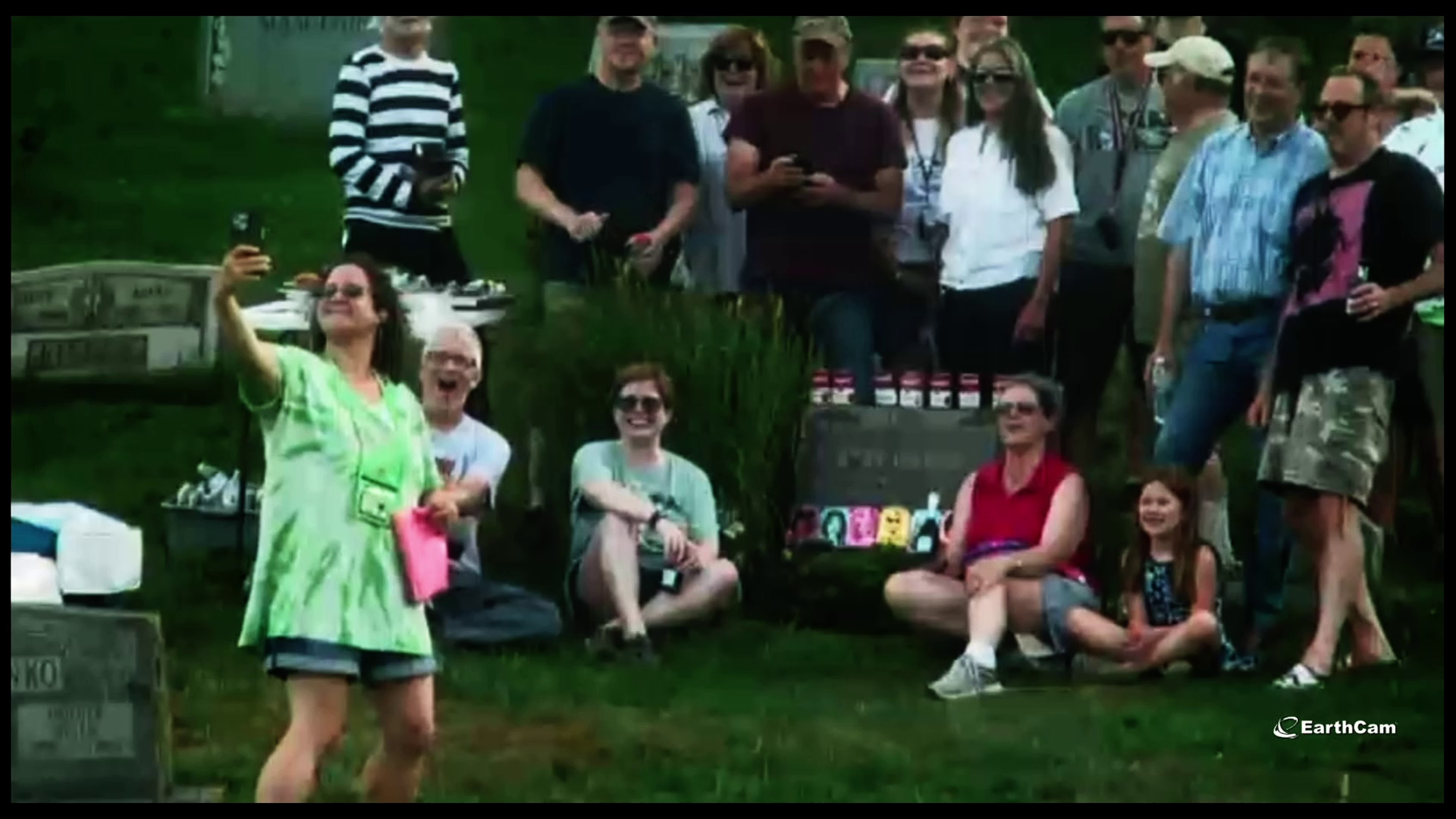 Culling from four seasons’ worth of footage from EarthCam’s live-stream of Andy Warhol’s tomb in Pennsylvania, Radu Jude fashions a spiritual sequel to Warhol’s blockbuster of boredom, Sleep (1964). Where the older film turned the dormant body of Warhol’s lover into a monument comparable to the Empire State Building, Jude’s film, almost equally unwatchable, fixates on Warhol’s own body repurposed into a public monument. As fans and curious passersby click pictures, pose flowers, decorate it with Campbell soup cans and even organize parties around it, the artist’s tomb becomes something like a collective work of art, vested with a social signification. A modern cinematic readymade, Jude’s desktop documentary crafts an unassuming essay on celebrity and fame, entirely in line with Warhol’s work. What happens when television ceases to be the arbiter of mass taste and simply becomes the condition of everyday life? Not fifteen minutes, but the possibility of eternal fame? Just as the visitors bestow the grave with meanings it doesn’t possess in itself, the act of watching the live-stream turns out to be the means by which operational images become aesthetic objects. Critically interrogating spectatorship, Jude’s fascinating film affirms the triumph of life over eternal sleep. [WP: Locarno International Film Festival]
10. Journey of the Shadows (Yves Netzhammer, Switzerland)
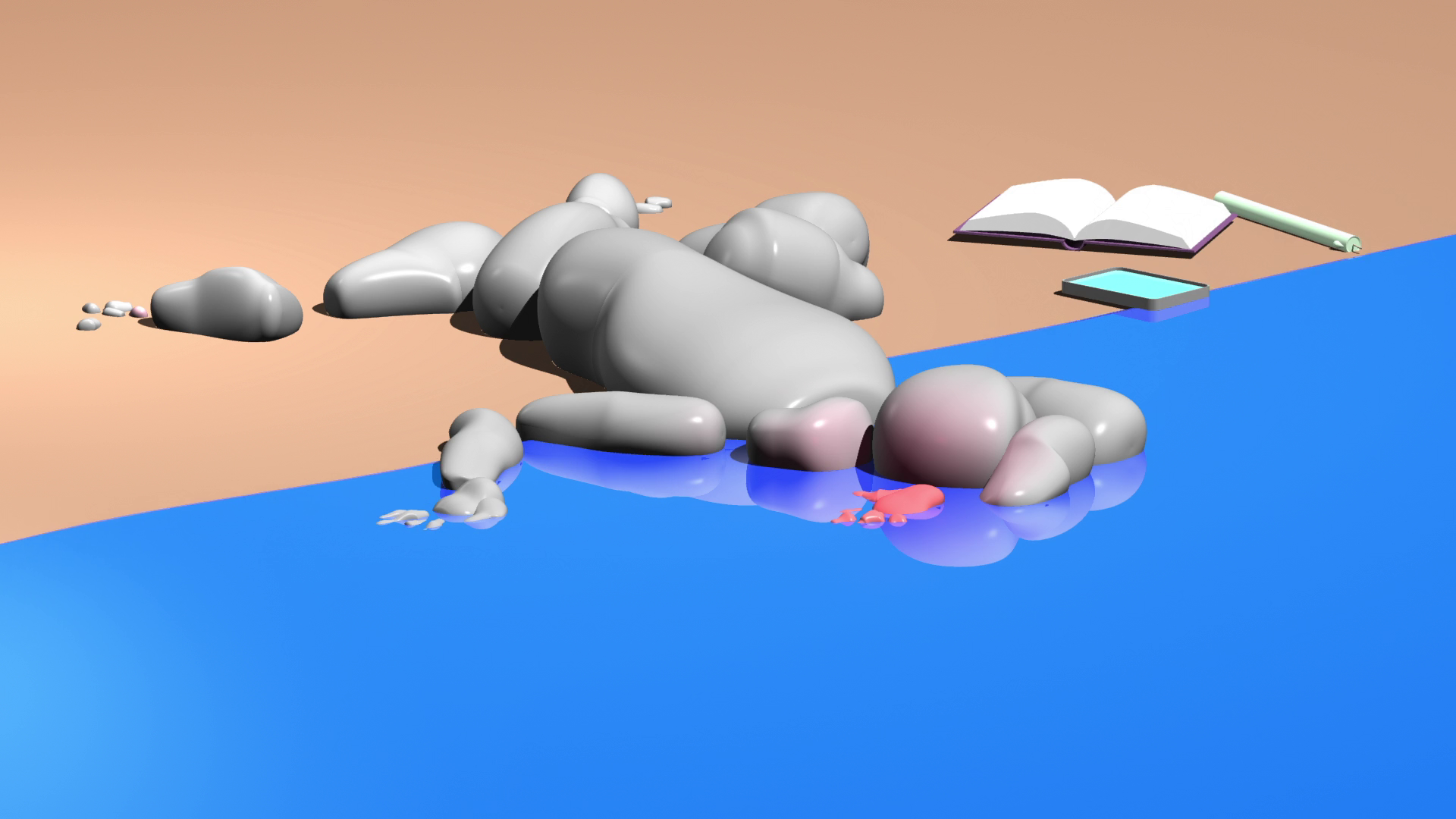 Once living a life of harmony in a dystopian world, two bipedal figures – humanlike but featureless, genderless – fall out under the influence of a mystical pet fish. One of them perishes, and the other embarks on an odyssey across the seas, intermittently led by a book and a candle. After countless catastrophes, this wandering being washes ashore on a pristine island, where it tries to overcome its loneliness, alas in vain. This probably isn’t what happens in Swiss multimedia artist Yves Netzhammer’s wordless, mind-bending first feature, in which identities, relations and situations are in such a flux as to resist any kind of linear synopsis. Where traditional animation advances evermore towards a utopian combination of naturalism and expressivity, Journey operates at a zero degree of digital image-making, dealing in primitive figures, bald volumes, harsh lighting, rudimentary physics, sickeningly unmodulated colours, oneiric movements, and an oppressive clarity of visual field recalling Dali or Magritte. At its best, Netzhammer’s abstract film has the subversive, Kafkaesque quality of Central European animation from the 1960s and ‘70s. Defying binaries of nature/civilization, human/technology, organic/synthetic, Journey crafts a deeply disturbing meditation on freedom, creation and self-discovery whose brutality shocks all the more in a universe so unreal. [WP: International Film Festival Rotterdam]
Special Mention: Dahomey (Mati Diop, Senegal/Benin/France)
Favourite Films of
2023 • 2022 • 2021 • 2020 • 2019 • 2015
2014 • 2013 • 2012 • 2011 • 2010 • 2009
 Surely, it takes a bona fide auteur like David Cronenberg to locate his signature concerns in a text – such as Don Delillo’s – that deals with ideas hitherto unexplored by him and spin out the most exciting piece of cinema this year. Holed up in his stretch limo – an extension of his body, maneuvering through Manhattan inch by inch as though breathing – Eric Packer (Robert Pattinson) comprehends the universe outside like cinema, through a series of moving images projected onto his car windows. Why not? This world, whose master he is, is experiencing the epistemological crisis of late capitalism: the increasing abstraction of tactile reality into digital commodities. Packer, like many Cronenberg characters, is more machine than man, attempts – against the suggestions of his asymmetrical prostate and of the protagonist of Cronenberg’s previous film – to construct a super-rational predictable model of world economy – a project whose failure prompts him to embark on an masochistic odyssey to reclaim the real, to experience physicality, to be vulnerable and to ultimately die. At the end of the film, one imagines Packer shouting: “Death to Cyber-capitalism! Long live the new flesh!”
 Un chant d’amour for cinema, Leos Carax’s Holy Motors is an ambitious speculation about the total transformation of life into cinema and cinema into life – the death of the actor, audience and the camera. The European cousin to Apichatpong Weerasethakul’s Uncle Boonmee Who Can Recall His Past Lives (2010), Carax’s return-to-zero work draws inspiration from the process of film itself – death, resurrection and persistence of vision – and takes cinema to its nascence – fairground attractions, popular theatre and zoopraxography – while opening up to its future possibilities. Uncle Oscar (Denis Lavant, the raison d’etre of Holy Motors), like Cronenberg’s Packer, cruises the streets of Paris in his limo in search of purely physical experiences – a series of performance pieces carried out solely for “the beauty of the act” – only to find that the city is a gigantic simulacrum in which everyone is a performer and a spectator (and thus no one is) and where the distinction between the real and the fictional becomes immaterial. At the very least, Holy Motors is a reflection on the passing of “things”, of physicality, of the beauty of real gesture, of the grace of movement of men and machines.
 Nicolas Rey’s third feature, consisting of 9 short segments (reels, to be precise) projected in a random sequence, is a radical project that re-politicizes the cinematic image. Not only does the randomization of the order of projection of the reels circumvent the problem of the authoritarianism of a fixed narrative, it also exposes the seam between the semi-autonomous theses-like segments, thereby making the audience attentive to possible ideological aporias that are usually glossed over by the self-fashioned integrity of filmic texts. Furthermore, the existence of the film in the form separate reels is a breathing reminder of the material with which it was made: 16mm. The persistent dialectic between the visual – shots of highways, industries, farms and modernist suburban housing in the eponymous fictional city registering the sedate rhythm of everyday life – and the aural – snippets of conversations between two politicized industrial workers about the invisible tendons that enable a society to function smoothly – strongly drives home the chief, Althusserian concern of the film: the essential unity of the various, seemingly autonomous, strands of a state, contrary to claims of disjunction and autonomy.
 A film that is reminiscent of Weerasethakul’s many bipartite films, Miguel Gomes’ singular Tabu, too, works on a range of binaries – past/present, youth/old age, city/countryside, abundance/scarcity, modern/primitive, colonizer/colonized – and sets up a conversation between the carefree, profligate days of the empire full of love, laughter and danger and Eurocrisis-inflected, modern day Portugal marked by alienation and loneliness. The opening few minutes – a melancholy mini-mockumentary of sorts chronicling the adventures of a European explorer in Africa with a native entourage –announces that the film will be balancing distancing irony and classicist emotionality, donning an attitude that is in equal measure critical and sympathetic towards the past. In Gomes’ sensitive film, the heavy hand of the past weighs down on the present both on aesthetic (silent cinema stylistics, film stock, academy ratio, the excitement of classical genres) and thematic (collective colonial guilt, residual racism, punishment for forbidden love) levels and this inescapability of the past is also functions as (sometimes dangerous) nostalgia for the simplicity and innocence of a cinema lost and an entreaty for the necessity of exploring and preserving film history.
 What partially elevates the first film of Ulrich Seidl’s Paradise trilogy from its rather undistinguished concerns about emotional alienation and old age loneliness is the nexus of intriguing cultural forces that it brings into the picture by having a relatively affluent, 50-year old Austrian single-mother (Margarete Tiesel, in a no-holds-barred performance) indulge in sex tourism in Kenya along with five other women friends. The result is a rich, provocative negotiation along class, gender, race and age divides that upsets conventional, convenient oppressor-oppressed relationships. In doing so, the film wrenches love from the realm of the universal and the ahistorical and demonstrates that between two people lies the entire universe. Seidl’s heightened, bright colour palette that provides a sharp chromatic contrast to the bodies of Kenyan natives and his confrontational, static, frontal compositions (Seidl’s nudes are antitheses to those of the Renaissance), which make indoor spaces appear like human aquariums, both invite the voyeuristic audience to take a peek into this world and place it on another axis of power – of the observer and the observed.
 Sri Lankan filmmaker Prasanna Vithanage’s exquisite, exceptional adaptation of Fyodor Dostoyevsky’s The Meek One (1876) aptly locates the Russian tale of matrimonial discord between a bourgeois pawnbroker and the gentle creature he weds within the ethno-political conflict between nationalist and rebel factions of the country. Unlike humanist war dramas that, often naively, stress the underlying oneness among individuals on either side, Vithanage’s intelligent film underscores how the political haunts the personal and how the tragic weight of history impacts the compatibility between individuals here and now, while deftly retaining Dostoyevsky’s central theme of ownership of one human by another. Though liberal in narration and moderate in style compared to Mani Kaul’s and Robert Bresson’s adaptations of the short story, Vithanage, too, employs an attentive ambient soundtrack that counts down to an impending doom and numerous shots of hands to emphasize the centrality of transaction in interpersonal relationships. The metaphysical chasm between the possessor and the possessed finds seamless articulation in concrete sociopolitical relations between Sinhalese and Tamils, between the army and refugees, between the poor and the wealthy and between man and woman.
 There has always been something intensely spiritual about Tsai’s films, even when they seem to wallow in post-apocalyptic cityscapes and defunct social constructions. In Tsai’s hands, it would seem, an empty subway corridor shot in cheap digital video becomes the holiest of spaces ever filmed. Walker, a high-def video short made as a part of the Beautiful 2012 project commissioned by Hong Kong International Film Festival, crystallizes this particular tendency in the director’s work and centers on a Buddhist monk played by Lee Kang-sheng (a muse like no other in 21st century cinema). As the monk walks the hyper-commercialized streets of Hong Kong at a phenomenally slow pace for two days and two nights, his red robe becomes a visual anchor in stark contrast to the greys of the urban jungle and the blacks of people’s winter clothing and his very being, his eternal presence, becomes a spiritual grounding point amidst the impersonal hustle-bustle of this super-capitalist Mecca. Part performance art with a gently cynical punch line, part an exploration of the limits of DV, Walker is a deeply soothing and often moving work from one of Asia’s finest.
 Moving unsteadily with the help of a walking stick, the 79-year old founder of the National Film Archive of India (NFAI), P. K. Nair, despite himself, becomes a metaphor for the state of film archiving in the country. It is of considerable irony that, in a nation that prides itself for its rich cultural heritage, film archiving is considered a useless exercise. During the three decades that Nair headed the NFAI, he was instrumental in discovering the silent works and early talkies of Bombay and south Indian cinema, including those of Dadasaheb Phalke, the “father of Indian cinema”. Celluloid Man, bookended by scenes from Citizen Kane (1941), draws inspiration from Welles’ film and sketches a fascinating if reverential portrait of Nair constructed from interviews with international filmmakers, scholars, historians and programmers and curiously hinged on the fact of Nair’s “Rosebud” – ticket stubs, promotional material and assorted film-related curios that the man collected during his childhood. Shivendra Singh’s film is a irresistible romp through early Indian cinema and an endlessly absorbing tribute to a man who is fittingly dubbed the “Henri Langlois of India”. To paraphrase one of the interviewees, Phalke gave Indian cinema a past, Nair gave it a history.
 Although it might appear that it is perhaps the hollowness of Xavier Dolan’s previous feature that makes his latest, 160-minute music video look like a cinematic coup, Laurence Anyways really does succeed in accomplishing more than most of contemporary “LGBT-themed independent cinema”. While the latter – including this year’s Cahiers darling – almost invariably consists of realist, solidarity pictures that use social marginalization as shorthand for seriousness, Dolan’s emotionally charged film takes the game one step further and probes the inseparability of body and character, the effect of the physical transformation of a person on all his relationships – a transformation that is mirrored in the flamboyant, shape-shifting texture of the film – without sensationalizing the transformation itself. Rife, perhaps too much so, with unconventional aesthetic flourishes and personal scrapbook-ish inserts, the film rekindles and enriches the youthful verve of the Nouvelle Vague – a move that should only be welcome by film culture. If not anything more, Laurence Anyways establishes that critics need to stop using its author’s age as a cudgel and look at his cinema du look as something more than a compendium of adolescent affectations.
 Let me confess upfront that putting Wes Anderson’s (surprise!) whimsy, twee and self-conscious Moonrise Kingdom in my year-end list is less a full-hearted appreciation of the film than a confession that I find Anderson to be an important voice that I’m genuinely keen about, but can’t entirely celebrate. I don’t think I’ve seen any film that employs so many elements of industrial cinema yet feels meticulously artisanal, a film that, on the surface, seems to (literally) play to the gallery yet is so full of personality and one that is oddly familiar yet thoroughly refuses instant gratification. Moonrise Kingdom appears to have every ingredient of an obnoxious family comedy, but the unironic, straight-faced attitude and the single-minded conviction with which it moulds the material into an anti-realist examination of the anxieties of growing up, alone, is something not to be found either in cynical mainstream cinema or in the overwrought indie scene of America. Anderson’s neo-sincere film is, as it were, a classicist text couched within a postmodern shell, an emotional film without affect. Paper blossoms, but blossoms nonetheless.
 The Seventh Art