Cinema of India


[The following interview was conducted for the Forum section of the Berlinale, where the filmmaker’s second feature Kottukkaali had its world premiere in February 2024.]

Berlinale Forum: As far as I know, the starting point for your film was an incident in your own family. Could you speak a bit about how you developed this into a script and a film?

PS Vinothraj: Yes, such occurrences were very common in my childhood, and I just internalized them growing up: “that’s how things are.” But once I became a filmmaker, there was another event in our extended family. That’s when I started exploring this idea, of how these foolish beliefs are fed into people when growing up. Doing so, I realized that it’s not an isolated incident in one village in the south of India. Rather, it happens all across the country. And women are usually the centre of such rituals and practices. This is when I felt it deserved to be made into a film.

Even as we speak, people are either making plans to visit seers for this ritual of exorcism, or they’re on their way back. It’s happening every minute.

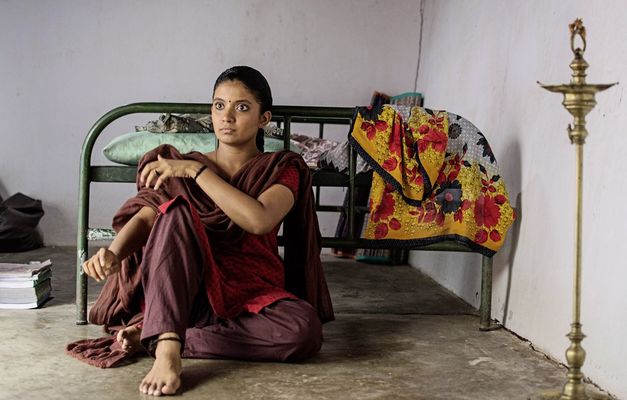
The protagonist Meena is silent for most of the film. How did that develop?

In situations such as these in real life, the girl is usually silent and hardly allowed to express herself. It’s everyone around the girl who constantly speaks about her. And this is one of the reasons why I tried to portray Meena as a silent character. But I also think silence can convey adamance, more than overt arguments or fights. Meena has made up her mind, and no matter what the people around her do or say, she is steadfast in her thoughts and desires. I wanted to visually convey her grit and resolve, and that’s why I wrote her that way. Her silence is a defiant, adamant kind of silence.

We were wondering if the English title The Adamant Girl is the literal translation of Kottukkaali, or there’s some other meaning to the word.

In Southern Tamil Nadu, the word ‘kottukkaali’ is a dismissive term used to describe women, young and old, who do or say what they want. It’s very much related to the sense of an adamant girl.

Speaking about the form of the film, our selection committee liked that it is a road movie, and that you don’t exploit the more melodramatic aspects of it. How did you make this decision?

The intention was to closely follow people who have a certain belief system. And the goal was not to demonize or falsify them. The violence that they cause is an unwitting, innocent kind of violence. And the idea was to follow the characters in their world and observe their behaviour and beliefs, before finally arriving at a statement. That’s what led to the form of the film, which basically follows the characters in their everyday behaviour, speech and rituals.


[Read the full interview here]

[Part of Curator’s Corner, a section dedicated to showcasing work of emerging and marginal filmmakers.]

When I remarked earlier this year that South Asia is currently a hotbed of exciting cinematic work, one of the filmmakers I had in mind was 24-year-old Abdul Aziz, an alumnus of Whistling Woods International, Mumbai, who has already three feature films to his credit. A digital native, Aziz’s foray into filmmaking was in the form of short VFX exercises, tongue-in-cheek takes on popular cinema with homemade CGI. Following his graduation in 2019, he set out to make a two-part fictional film exploring romantic relationships across age groups, but as the project took shape, the Chennai-born filmmaker came to the conclusion that it may be better served if each part were a feature in its own right, to which was added a third film. The result was a trilogy of riveting and wholly refreshing works: the Tamil-language Window Flowers (Jannal Pookkal), the Telugu-language Monsoon Breeze (Ruthupavanalu) and the Hindi-language Petals in the Wind (Pankhudiyaan).

Watching the films together, several commonalities surface. All three stories take place over an emotionally eventful evening and culminate at the crack of dawn. They begin indoors, take long detours outdoors and feature extremely low-light sequences illuminated by computer screens or electronic trinkets. Shot quickly over a few days, the films contain no more than two or three characters and typically pivot around a single dramatic revelation, flanked by other events of quotidian drama involving objects such as a plastic bag, a wallet or rose petals. There is a great deal of food banter — preparing meals, discussing menus, talking recipes — but hardly any sight of food. Other subtler crosscurrents unite the trilogy, but Aziz is conscious not to overwhelm individual films with an overarching conceptual design.

Window Flowers (2023, world premiere at International Film Festival Pame, Nepal) begins with a young man (Ajay Serma) knocking at the door of someone who wouldn’t open. After kicking about for a while, he rides back home on his motorcycle to his Mumbai apartment, which he shares with two other men, to spend an evening of disappointment and low-grade heartbreak. Until the funny and spectacular final shot of the film — running for over half an hour — we don’t know what’s eating the young man, but the film works up an inchoate atmosphere of bachelor pad melancholia that is raw and unrelenting. With a bold mid-film excursion into loosely related archival footage, Window Flowers reveals a curious filmmaker working out the poetics of smartphone cinematography — low-light, auto-focus, optical image stabilization, vertical format, long durational — which find fuller expression, formal unity and technical control in Monsoon Breeze.

The second, and in my view the strongest, film in the trilogy, Monsoon Breeze (awaiting world premiere) hits the ground running in setting up scenario of high domestic drama. Deepu (Deepshika Dinapatti) has moved with her mother to Mumbai for her master’s studies. Just when the two prepare to spend an evening shopping, Deepu learns that her estranged father (T.B Naidu) has come home to visit them after nearly a year, right on her parents 25th wedding anniversary. In the cut of the film I saw, this confrontation is staged in a single shot of over an hour, in which we share the father’s barely veiled discomfort in visiting his family, his pretence of normalcy, his forced sense of paternalism, but also his streaks of grace and genuine affection. But the film is centred on the mother, played superbly by Latha Naidu with a reserve, wile and toughness no doubt intimate to Indian viewers but seldom seen on screen.

The strength of Monsoon Breeze lies in the way it plays off an experimental form against a classical dramaturgical outline. The constant threat of the film’s fiction rupturing at any moment, by a stray incident or a technical botch up, is attenuated by the conscious fiction of happy homecoming that the father enacts on his arrival. Among other things, Monsoon Breeze puts a finger on what familial estrangement in an Indian context looks like, every strained moment between father and daughter filled not with uncomfortable silence, but crushingly banal small talk. And when the talk stops, it all comes down like a ton of bricks.

The tension is less familial than sexual in the third film, Petals in the Wind (in post-production), set this time in a tourist-filled Goa. A young couple (Jyotsana Rajpurohit and Dhruv Solanki), dressed like figures in a studio photograph from the 1980s, checks into a secluded guesthouse just after their wedding. They change and go to the beach on a bike, click pictures, take a ride on the giant wheel and return home late without having had anything to eat all afternoon. As they order food online and begin to make love, minor inconveniences snowball into major conflict. Shot (by Devankur Sinha with a digital camera) largely on crowded locations around the beach, the film offers a stark change in scenery from its Mumbai-set predecessors. Crafting a work about the collapse of a honeymoon fantasy, Petals in the Wind offers a perfect midpoint between the romantic frustrations of Window Flowers and the marital disillusionment of Monsoon Breeze.

Window Flowers

Window Flowers

Monsoon Breeze

Monsoon Breeze

Petals in the Wind

Petals in the Wind

Window Flowers and Monsoon Breeze were shot on a smartphone by Aziz himself in real locations and lighting conditions, with live sound and non-professional actors. Although professionally trained, Aziz is inspired by the specific emotional qualities of phone videos. “I would say my usage of the phone camera is more ‘phone’ than ‘camera’,” he remarks, adding that he finds “the emotions evoked by these new-age ‘home videos’ in our phone galleries to be quite a powerful cinematic experience.” The filmmaker had a revelation in college when he revisited a video shot at a party. “I knew everything about the people in it, their relationships and the drama in their lives” he says. Watching the video, he recalls feeling that “there is no film that has ever conveyed more emotional truth than what I’m seeing now.” As a filmmaker, he thought, “you just need to bring your audience to a point where they think I know these people and what’s going on with them.”

There is a pointedly embodied quality to Aziz’s films, both in their hypermobile, handheld cinematography and in the way the films allow viewers to project themselves into their material worlds in an unbroken, video-game like manner. Stylistically speaking, Aziz’s films seem to inhabit an underexplored area of contemporary cinema located between the kind of muscular neo-realism that has become de rigueur in international filmmaking and contemplative slow cinema, dominated by static framing and long shots. Aziz’s work broadly shares with the former a belief in the revelatory aspect of the camera and a tendency to immerse the viewer in a plausible, coherent world resembling ours. At the same time, like slow cinema works, Aziz’s films pay obsessive attention to the minutiae of everyday living, its precise rhythms and its inexhaustibly rich textures.

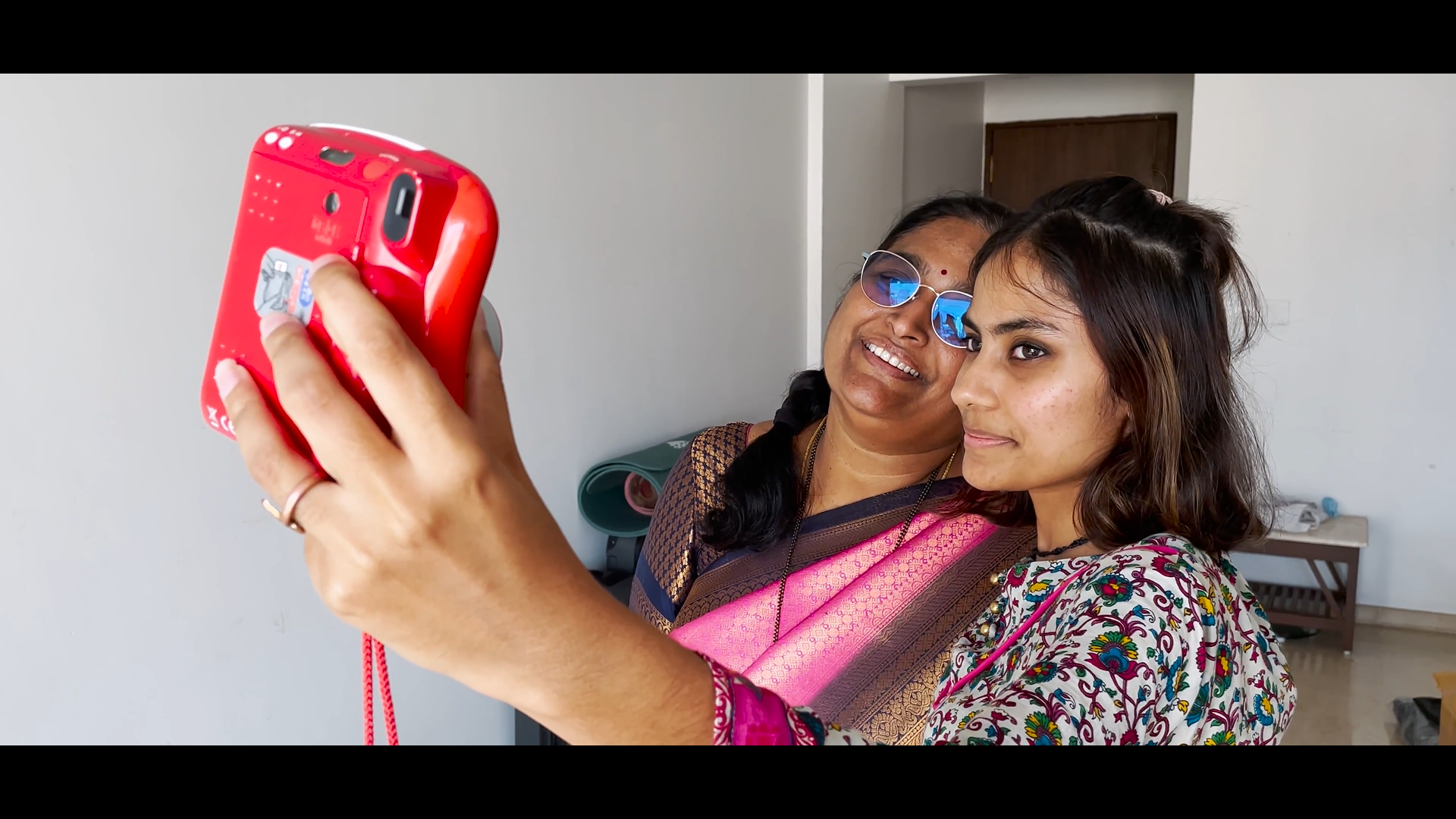
A lot of this attention develops through exceptionally long shots, often of a labyrinthine choreography, lasting dozens of minutes, that follow the actors from up so close that their features are unflatteringly warped. It isn’t just a question of chaining together stunning long takes — although some of the shots, spanning different apartment complexes and times of the day, are indeed stunning. What gives Aziz’s films their power, I think, is the way they assert the intransigent reality of things taking their own time. These things may be material, like polaroids developing or idlis being prepared over the course of a single shot, or more abstract ones, like the time it takes for the father’s ego to subside in Monsoon Breeze or for the bride to prepare herself mentally for the wedding bed in Petals in the Wind. This insistence on real-time development produces remarkable passages of on-screen poetry, like breaths of a loved one preserved in a balloon.

Then there is the matter of the writing. Aziz’s films are scripted to the last detail, but looking at them, it is hard to believe that they weren’t entirely improvised. What stand out are the filmmaker’s ear for the essential bizarreness of quotidian chatter, his attention to moments that seem so random that they could only have come from real life and the employment of props that are remarkably uncinematic. The persistent mundanity of the dialogue, always compelling but divested of the need to reveal character or impress the audience, isn’t the kind of slick, anti-climactic patter you find, say, in Tarantino’s films. It rather elevates the ordinariness of everyday speech, rendering it interesting in a manner that traditional movie scripts refuse to.

All this turns Aziz’s films into a kind of vernacular urban ethnography that documents the behaviour, body language and mores of a specific social stratum with a precision and candour that is bracing. There is nothing crowd-pleasing about these films, little concession to character types and a whole lot of faith in the audience. In their internal variations, Aziz’s three films become testimonies to the filmmaker’s evolving ideas about screen realism, its limits and its relationship to higher truths. Embracing mistakes and refusing surface polish, they constitute an imperfect, rough-edged cinema that broaches the formal taboos of industrial and academic filmmaking. I can’t wait for the world to discover these films, vivid and throbbing with life.

If you are a critic or a programmer wishing to see these films, please reach out to Aziz at the address below.


Bio

Abdul Aziz is a 24-year-old filmmaker from Chennai, Tamil Nadu, based in Mumbai. He passed out of Whistling Woods International (specialized in film direction) in 2019. He was awarded at the 52nd International Film Festival of India (IFFI) in the first edition of their Creative Mind of Tomorrow program for his diploma film Tulips. He has written and directed three independent feature films Window Flowers, Monsoon Breeze and Petals in the Wind. He has also co-written a commercial black comedy starring Swastika Mukherji titled Dead Dead Full Dead and an indie road movie titled Blah Blah Blah.

Contact

abuthoaziz@gmail.com | Instagram | Twitter

Filmography

  • Tulips, 2019, 18 min., digital
  • Trees and Their Loved Ones, 2022, 30 min., digital
  • Jannal Pookal (Window Flowers), 2023, 105 min., digital
  • Ruthupavanalu (Monsoon Breeze), 2024, 120 min., digital
  • Pankhudiyaan (Petals in the Wind), 2024, 103 min., digital
  • Writer, Dead Dead Full Dead (dir. Pratul Gaikwad), 2024
  • Writer, Blah Blah Blah (dir. Dhruv Solanki), 2024

Showcase

Trailer for Window Flowers (2023), password: WF


Trailer for Monsoon Breeze (2024), password: MB


[Part of Curator’s Corner, a section dedicated to showcasing work of emerging and marginal filmmakers. See here for details.]

Class, cuisine, Catholicism and climate change intersect in compelling ways in Rishi Chandna’s absorbing new work Virundhu (The Feast), set for its world premiere at the Clermont-Ferrand International Short Film Festival in February 2024. Produced in collaboration with the Krea university, Andhra Pradesh, The Feast is the first of a trilogy of films around the broad theme of water, with a focus on the sociological aspects of the relationship between humans and water systems.

A self-taught filmmaker with a professional background in advertising, Chandna honed his craft making candid, feature-length wedding documentaries for his friends. After a few years of making commercials, he chanced upon the subject of his first documentary, the widely circulated Tungrus (2017). This short, endearing portrait presents an eccentric glimpse into the foibles of human-animal co-existence. Featuring a middle-class family in Mumbai that has a rowdy rooster for a pet, the film draws its energies from the surreal sight of this rustic bird lording over the urbane surfaces of a high-rise apartment until it’s shown who’s the boss.

If Tungrus limits itself to the private realm of a cramped apartment, Party Poster (2022), in my opinion Chandna’s best work yet, is explicitly a work about public spaces. Made during the pandemic, Party Poster trains its lens on the phenomenon of civilian, group-commissioned posters erected during Mumbai’s Ganesh Chaturthi celebrations. Both an aesthetic object subject to meticulous design and densely symbolic field of signs, the poster offers Chandna a chance to examine the city’s fraught class dynamics as well as the contradictions of urban living in general. I’ve written about the film in more detail here.

The observational humour inherent in both these documentaries (which you can watch below) feeds into The Feast, Chandna’s first foray into full-fledged fiction. Set in an impoverished fishing village in the wetland region of Ennore-Pulicat in northern Tamil Nadu, the 25-minute film has two narrative strands. In the first, we follow the efforts of Mary, a woman of about forty, as she sources ingredients for a traditional fiesta she plans to throw: prawns, milkfish, mullets, mud crabs. With the area’s industrial pollution turning the waters increasingly hostile to life, and to fishing as a profession, this is no mean task. Enterprising and resourceful, Mary is obliged to search far and wide to secure her raw material.

The primary (and it turns out, the only) recipient of the feast is Thomas, an affluent politician of some power who was once a boy in the same fishing community. We understand from their interaction that Thomas and Mary were childhood friends who still maintain a cordial if somewhat formal relationship. Christmas is around the corner, and Thomas is dillydallying on an approval he is expected to give for the establishment of a cement factory in the village.

And so, the day of the feast arrives, and the local chapel – which seems both long abandoned and haunted by spectral presence – is spruced up. This place of worship soon turns into a theatrical stage as Mary orchestrates an unforgettable evening for Thomas. The Proustian repast shows him glimpses of a long-lost heaven, while the prayer that precedes it puts the fear of hell in him. The solemnity of the setting, as well as the stateliness of the compositions, are balanced by the wit and the humour of the scene.

The film calls to mind Babette’s Feast (1987), in which a lavish meal thaws the frozen spirits of an orthodox Protestant community in rural Denmark. In The Feast too, food is a repository of shared memories and values, capable of effecting profound spiritual transformation. But the emphasis of Chandna’s film is less theological than political. Mary is a curator figure, and the sumptuous variety of her menu, which has her negotiating with many villagers to get the right kind of fish, speaks of a personal touch. At the same time, it reflects an ecological crisis where the diversity of marine life is endangered by human activity. The film thus zeroes in on the precarity of an extended ecosystem: marine biodiversity, but also the ways of life around it such as food and religious traditions.

The Feast features noteworthy performances by professional actors, primarily Antony Janagi (who is a theatre practitioner) and George Vijay Nelson (who transitioned from television into cinema). But the film’s acute sense of place is entirely a product of the filmmaker’s documentary eye, which makes The Feast a very interesting alchemy of diverse approaches. An alumnus of the 2021 Sundance Screenwriters Lab and the NFDC Film Bazaar’s Co-Production Project, Chandna is currently working on his first feature, Ghol, about a penniless fisherman whose fortunes change when he makes a prize haul of a rare fish.


Bio

Rishi’s debut short documentary, Tungrus (2018), was shown at Hot Docs, Visions du Réel, BFI London Film Festival, IDFA and became an Oscar-qualifying short documentary after winning at the Slamdance Film Festival. His second short, Party Poster (2022), showed at Palm Springs International Film Festival, Krakow Film Festival, DocAviv, Glasgow Short Film Festival and others. Both films released online on New York Times’ Op-Docs. Rishi’s feature film in development was selected at the Sundance Screenwriters Lab, Cannes Film Market and Hong Kong Asia Film Financing Forum where it won the top HAF Fiction Award for a non-Hong Kong project.

Contact

rishichandna2020@gmail.com | Website

Filmography

  • Tungrus (2018), 13 min., digital
  • Party Poster (2022), 20 min., digital
  • Virundhu (The Feast) (2024), 25 min., digital
  • Ghol (The Catch) (work-in-progress)

Showcase

Tungrus (2018)

Party Poster (2022)

Each passing year seems objectively, measurably worse than the one before, at least on a world-historical level, unveiling new lows for evil, stupidity, hypocrisy and tyranny across the globe. I’ve done nothing to change any of it, but I’m glad that, unlike me, there are people who aren’t desensitized, wilfully blind or paralyzed by analysis fighting the good fight. More power to them.

The blog hasn’t been terribly active this year. In February, I started a curatorial section on the site to showcase work from up-and-coming filmmakers, but I haven’t been able to keep it up at a rate I would like. I hope I can resume the section in 2024, even if at irregular intervals.

The primary reason for the inactivity is that I made my first foray into festival programming this year. I was on the South Asia selection committee for the Jio MAMI Mumbai Film Festival (October-November 2023) as well as the upcoming Berlin Critics Week (February 2024). Both assignments meant six months of intense, non-stop film viewing. A revelation from my time on the MAMI committee is that South Asian cinema is absolutely exploding, with crazy, ambitious works emanating from unlikely corners of the subcontinent, made by passionate individuals with little institutional or industry connections, with private resources unrelated to traditional channels of funding. It was truly an eye-opening discovery. Exciting times ahead for South Asian cinema.

For the first few months, however, I had a voluntary, almost systematic immersion into the history of avant-garde film, especially works from North America. I watched over 700 titles, long and short, canonical and lesser-known. I complemented this with reading books on the subject: Sheldon Renan, Amos Vogel, P. Adams Sitney, A.L. Rees, Stephen Dwoskin, William C. Wees, Jonathan Rosenbaum. But the single most instructive source was Scott MacDonald’s A Critical Cinema (1988-2005), five volumes of magnificently detailed interviews with avant-garde filmmakers from across generations and geographies. These exhilarating, demanding months of watching and reading truly felt like a substantial phase of my cinephile education.

It was also the year I published by second book, Moving Images, Still Lives, a lavishly illustrated monograph on Amit Dutta’s film Nainsukh (2010), published by Artibus Asiae of the Museum Rietberg Zurich. (Readers in India may consider buying a copy off Amazon, where a very, very limited number is on sale.) This book was an opportunity for me to undertake a different kind of writing — less spontaneous but more scholarly, with arguments propelled more by citations than passion. Also, until now, my references in visual arts were almost entirely European and American. Writing on Nainsukh meant researching into Pahari miniature painting and the world it issues from — an exposure I’m really grateful to have gotten.

I had no greater experience this year than watching Lijo Jose Pellissery’s Nanpakal Nerathu Mayakkam (2022), a work I would without hesitation count among the ten or so finest films ever made in India. Heck, had I seen it a few months earlier, it would’ve made it to my ballot for Sight & Sound’s all-time poll. With age, I encounter fewer and fewer films capable of shaking me up the way Pellissery’s masterpiece has. It is one of the great spiritual works of the cinema.

I didn’t see as many commercial releases as I would’ve liked, and the ones I did weren’t too inspiring. I’ve consistently had problems with Martin Scorsese’s films set in cultures foreign to him, and despite the thrilling opening hour, Killers of the Flower Moon felt crippled by the same respectful distance that hamper Kundun (1997) and Silence (2016). I found Oppenheimer and Barbie equally tedious, both movies arriving with their own halo. Among Indian releases, I found things to like in several works, such as Thankam, Maaveeran, Kaadhal: The Core, Chithha, Jigarthanda DoubleX, Animal, Viduthalai Part 1 and Haddi, but few were convincing in their entirety. So the list below is entirely composed of titles I saw at festivals or as part of my programming work. They all had their world premieres in 2023 at the festivals mentioned. Needless to say, this is a somewhat arbitrary list, and I can count about seventy other films that could be here instead. But I’ll spare you the hand-wringing. Happy new year.


1. Kayo Kayo Colour? (Shahrukhkhan Chavada, India)

Rare are Indian films centred on marked Muslim characters, and rarer are those that don’t employ these characters primarily as objects of violence and social injustice. In Shahrukhkhan Chavada’s tender, trailblazing Kayo Kayo Colour?, Muslim bodies exist in an existential autonomy, untouched by dramatic aggression and capable of accessing a whole range of human experience. Chavada’s film depicts the everyday life of an extended working-class family in a Muslim quarter in the outskirts of Ahmedabad on a historic day. We see a woman waking up early to do household chores, her husband trying to procure funds to buy an autorickshaw, their children playing gender-segregated games. Public spaces come alive with shrieking middle-schoolers, a mother folds clothes with a daughter who has made it out of the ghetto, a girl sleeps over at her grandparents’ place—routines that become electrifying expressions of communal life. With striking passages of dead time and non-narrative digressions, the film creates space for its characters to breathe freely, to simply be. This is a work that opens up a new way of looking at life in India. In its wonderous gaze at the world, in its incredible generosity, in its profound humanity, there’s little I’ve seen of late that comes close. [World Premiere: International Film Festival Rotterdam]


2. Mr. Junjun (Niu Niu, China)

In a masterpiece the world is sleeping on, Niu Niu forges a simmering, Dardennes-style character study of a middle-aged taxi driver on the brink of explosion. A fifty-year-old single man responsible for a recalcitrant, semi-paralyzed father, Mr. Junjun must recover his debts to get out of a deep financial hole, but every effort he makes in this direction pushes him further towards the point of no return. The cruel pleasure the film offers is in prolonging Junjun’s moment of rupture through a series of secondary errands that he must run order just to stay afloat: the picture of life passing by even before you can get a hold on it. And yet, this is no mean neorealist melodrama. We have very little access to the inner universe of the bespectacled Junjun, who is a pure man of action, filmed from behind, moving purposefully through the world if only in order to stay where he is. You sense that this man will break down any minute, yet there is tremendous tenderness and grace in him — and in the film, for him. Prepare to be knocked down by the most sublime ending of the year. [WP: Pingyao International Film Festival]


3. Slow Shift (Shambhavi Kaul, India-USA)

The work of Shambhavi Kaul, which has a knack for transforming real landscapes into otherworldly vistas, finds its perfect subject in the medieval city of Hampi in Southern India. The seat of the Vijayanagara Empire in the fourteenth century, Hampi is today a World Heritage Site attracting tourists from across the globe. In Slow Shift, Kaul crafts a spectral, non-narrative travelogue of the site that unearths its historical, mythical, geological, ecological and cultural layers. Weaving together images of stately rock-cut monuments, precariously posed stone clusters and an army of langurs taking over the depopulated site, the film forges a post-human space eerily resonant with the barren cityscapes that became common during the pandemic years. In a manner reminiscent of Richard Serra’s monumental steel sculptures, Slow Shift strikes a precarious balance between majestic stasis and imminent collapse. By combining moments of instantaneous change in the landscape with more long-term transformations as evidenced by Hampi’s weatherworn structures, the film evokes the different time scales simultaneously at work in nature, reminding us that even the mightiest empire will turn to rubble one day. It’s truly a planet of the apes, and we’re only squatters. [WP: Toronto International Film Festival]


4. Fauna (Pau Faus, Spain)

Aging shepherd Valeriano lives with his herd on the outskirts of Barcelona. With his children away and with a debilitating orthopaedic problem that requires him to hang his boots, he struggles to keep his profession alive. He supplies sheep to a high-tech laboratory next door, which runs tests on them as part of its research to develop a vaccine for the Covid19 virus. Except for animals brought in through carefully controlled doorways, the lab is hermetically sealed from all biological intrusions, while Valeriano makes periodic visits to the city hospital for his therapy. From this incredibly rich scenario, Pau Faus’ Fauna weaves an extraordinary, complex examination of the ways in which science, ecology and tradition prove inextricably linked in contemporary life. “I believe that truth has only one face: that of a violent contradiction,” these words from Georges Bataille form the epigraph to Faus’ deeply moving, frequently heartrending observational documentary. With equanimity and wit, the film shines a light on humankind’s curious tendency to accelerate change while also fighting it, to master nature and technology while also being overwhelmed by them. Fauna creates ample space for reflection and critique, but supplies no easy answers. [WP: Visions du Réel, Nyon]


5. The Film You Are About to See (Maxime Martinot, France)

Maxime Martinot’s short essay is a brilliant investigation into the ways in which cinema exhibition and spectatorship are mediated by paratexts within and outside the films. Repurposing a range of verbal material intended to set context for viewing — disclaimers, introductory warnings, fourth-wall breaking intertitles, notices from theatre management — the film examines the fraught, slippery nature of the relationship between text and image in cinema. Systematically interspersed with these title cards are excerpts from across the history of moving images, arranged more or less in chronology. The Film You Are About to See cogently demonstrates the extent to which such title cards serve to fix the meaning and affect of images, and to counter, as Roland Barthes put it, “the terror of uncertain signs.” The disclaimers we see in the film have a striking resemblance to modern-day trigger warnings that seek to shield viewers from presumed psychic assaults. However, in its savvy assembly of ambiguous movie clips, Martinot’s film suggests that this is an ultimately futile enterprise, for images will always find a way to escape domestication and remain polysemous in the face of texts that seek to pin them down. [WP: Cinéma du Réel, Paris]


6. Valli (Manoj Shinde, India)

Valli is a man forced to be a Jogta, a living deity with a female form, believed to be capable of blessing those who worship and honour her. When he isn’t in his Jogta form, though, Valli is bullied by the village men for his feminine ways. The premise prepares you for an overwrought, sentimentalist work, yet Valli is anything but. Manoj Shinde’s stellar film is less about an individual trapped in a body than about a body trapped in a role, deified and debased, outcast and central to the social fabric at once. Valli takes an ultra-melodramatic subject and drains it off all excess, at times with the grace and wisdom of Hou-hsiao Hsien. The lead character is subjected to abuse and insult, but what we see as his reaction is defiance, contempt, indifference, anger, humour — everything that assures us that his dignity and integrity can’t be taken away. Vast passages of non-dramatic action allow the individual to just be. Delivering what is for me the screen performance of the year, Deva Gadekar is phenomenal as Valli, infusing every frame he is in with astounding bits of non-narrative magic, his androgynous body and its gratuitous gestures becoming transfixing without being fetishized. [WP: Singapore International Film Festival]


7. Camping du Lac (Éléonore Saintagnan, Belgium-France)

“I’d like to tell you an odd thing that happened.” So begins Éléonore Saintagnan’s gentle shape-shifting epic that metamorphoses from an understated fable to an absorbing myth to an startlingly immediate ecological parable. There will be no shortage of odd things in this one-of-a-kind film that revels in the power of invention and storytelling. Éléonore, played by the director herself, is stranded in Brittany, France, after her car breaks down on the way to the ocean. With little choice, she decides to lodge at a camping site by the Lake Guerlédan while her car is repaired. As she observes a host of characters at the camp, the film itself embarks on strange and beautiful narrative excursions. Together, these quaint detours, whose significance remains tantalizingly elusive, impart a starkly spiritual dimension to Saintagnan’s film, a sense of wonder at the various realities around us, visible and invisible. A gorgeously shot exploration of isolation and community, Camping du Lac may ultimately be about the ways we are (or fail to be) in communion with the mysteries of the world, and in that regard, this is a work wholly in tune with our times. [WP: Locarno International Film Festival]


8. Mithya (Sumanth Bhat, India)

After the sudden death of their parents, eleven-year-old Mithya and his young sister are taken by their aunt and uncle to their home in Udupi, much to the exasperation of the boy’s paternal relatives back in Mumbai. While the two clans fight for custody, Mithya struggles to find his moorings in a new environment, his growing sense of security undermined by a creeping feeling of re-living his original tragedy. Engineer-turned-filmmaker Sumanth Bhat’s supremely assured first feature makes us intimate with the experience of its young protagonist while also keeping us at a critical remove from his thoughts. A work that trusts the audience’s capacity for imagination and empathy, Mithya equally respects the complexity of a bereaved child’s inner world, never giving into facile poetry or genre convention. The adults, too, are invested with great dignity even when they are flawed individuals; Mithya’s uncle gets possibly the most piercing line of dialogue I heard this year, one that reveals an entire childhood. With its magnificent child performances in long shots, bold sense of ellipsis, delicately sketched character motivations and unnerving editing associations, Mithya is a virtuoso work end-to-end, an exemplar of honest, personal filmmaking. [WP: MAMI Mumbai Film Festival]


9. Dreams About Putin (Nastia Korkia & Vlad Fishez, Russia)

Following the Russian invasion of Ukraine, the widely reported phenomenon of people dreaming about Vladmir Putin found a new life, with Russian citizens turning to social media to describe their nocturnal encounters with their dear leader. In Dreams About Putin, Nastia Korkia and Vlad Fishez put together a hypnotic anthology of such dreams, recounted by interviewees to the camera and subsequently rendered as oneiric mindscapes in a 3D video-game engine. Periodically woven between these animated passages are archival clips of the real Putin delivering a Christmas address, atop a glider or going on a hike. Are the interviewees dreaming, or are they being dreamt? A work perfectly reflective of a world of tinpot dictators, lopsided wars and generative AI, Dreams About Putin presents a stunning look into the deliriums of those in power and the powerlessness of those who can only be witnesses to it. Korkia and Fishez concoct a bleak vision of a Russia trapped in a megalomaniac’s nightmare in which even live-action footage of Putin’s macho outings acquires a thoroughly surreal quality. Simple, funny, entrancing, with an end sequence that is the most glorious dream of all. [WP: International Documentary Film Festival Amsterdam]


10. Berlin (Atul Sabharwal, India)

Few Indian filmmakers have a firmer command over vernacular genre filmmaking than Atul Sabharwal, who is at the top of his game in Berlin, a scintillating spy thriller revolving around sign language (!) in which we become, as one character puts it, outsiders who feel like insiders. 1993, New Delhi. The Indian Intelligence Bureau has arrested a deaf-mute man suspected of plotting the assassination of Russian president Boris Yeltsin, who is in the country to renew diplomatic ties after the fall of the Soviet Union. They recruit Pushkin, a sign-language instructor, to help them with their interrogation, but the translator is soon nudged out of his neutrality by a rival governmental organization. Berlin, named after a café that was a safe trading post for spies of all stripes, finds Pushkin, as well as India, at a moment of swaying allegiances. A masterclass in staging what is essentially an extended, talky interrogation, Sabharwal’s super-smart, giddily plotted film sweeps us into a treacherous terrain of self-preserving intelligence agencies competing for legitimacy in a new world order. Come for the spectacle of Rahul Bose chewing scenery, stay for an exquisite treatise on the slow demise of the Non-Alignment Movement. [WP: Indian Film Festival of Los Angeles]


Special Mention: The Other Profile (Armel Hostiou, France-DRC)


Favourite Films of

2022 • 2021 • 2020 • 2019 • 2015 • 2014 • 2013 • 2012 • 2011 • 2010 • 2009

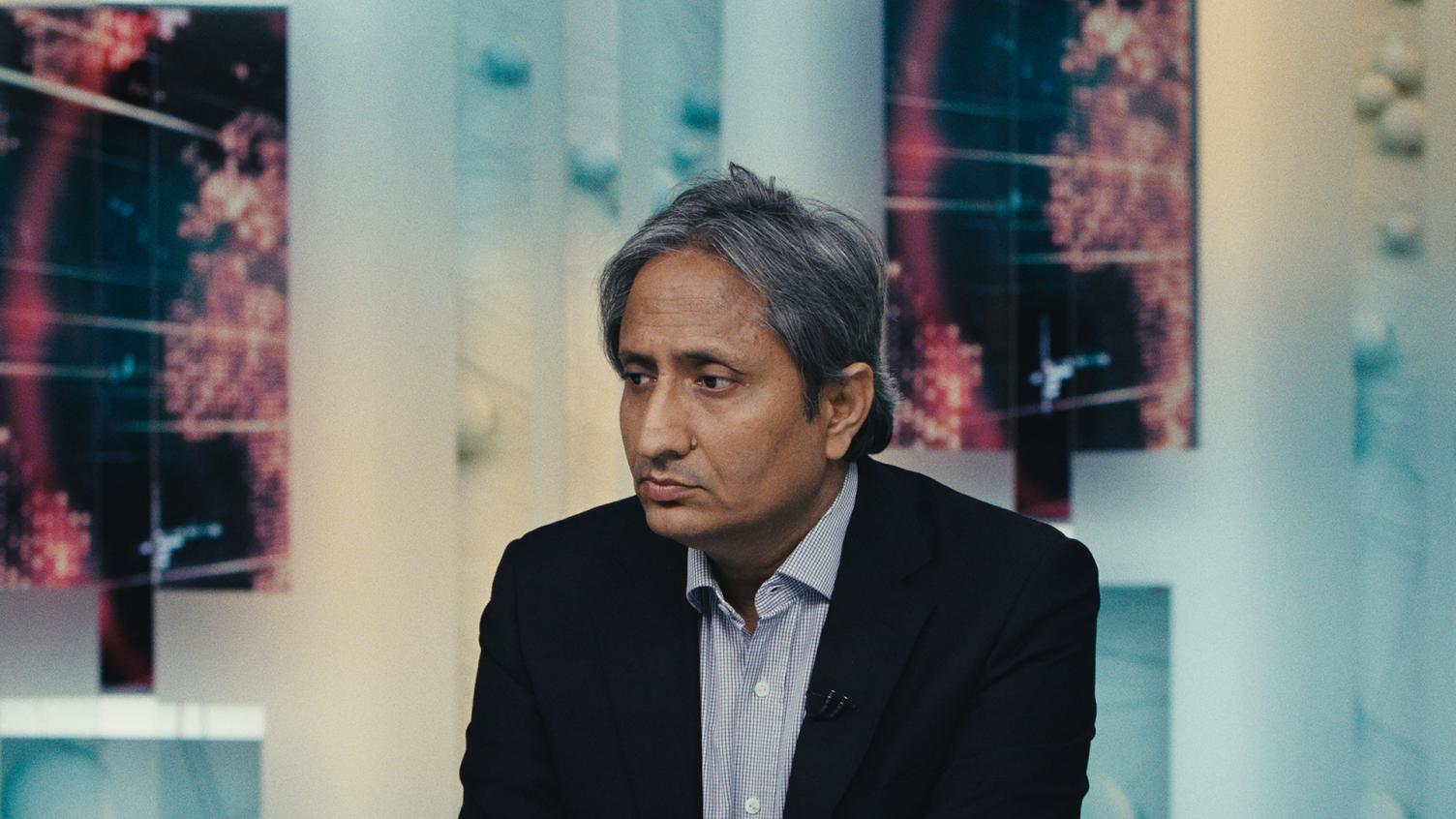
Early in While We Watched, Vinay Shukla’s intimate documentary on the life and work of the acclaimed Indian journalist Ravish Kumar, we see the newsman receiving compliments from a fan at a petrol station. As Ravish takes leave of his discontent admirer, a faint smile crosses his face, only to dissolve into his trademark frown when his car leaves the station. The smiles will be fleeting all through Shukla’s film, much like the short-lived victories and brief moments of joy that the journalist experiences at home and his newsroom. For the most part, we witness Ravish drained, slouched in a chair, his hair dishevelled, his face buried in his palms or the crook of his elbow.

Long affiliated with the New Delhi Television (NDTV) before its hostile takeover by billionaire Gautam Adani in December 2022, Ravish Kumar came to be perceived as one of the last bastions of independent journalism in a media climate increasingly in thrall to the Narendra Modi-led Indian government. Structured around half-a-dozen key events from 2018-19 — including the attempted murder of student activist Umar Khalid, the attack on security personnel in Pulwama, Kashmir, and the General Election 2019 — While We Watched weaves a robust cause-and-effect narrative that offers a study in contrasts: we witness how Ravish’s sardonic, reasoned language in discussing these hot-button issues stands out against the strident demagoguery of his counterparts on other TV channels.

It isn’t a battle of equals by any means. Stacked against Ravish are not just vicious troll armies and powerful media houses attacking him covertly or otherwise, but also a malevolent state that grinds down dissident organizations by means of defamation lawsuits and income-tax raids. At one point in the film, a major scoop about an instance of cow vigilantism is thwarted by selective disruptions of the broadcast. Ravish’s phone buzzes with calls from bullies with the choicest invective and his physical safety is threatened, resulting in a police officer being assigned to escort him.

Ravish responds to such orchestrated harassment with a resigned smile, and notwithstanding his ordeal, he remains very much accessible to those reaching out to him. While We Watched is certainly a tribute to the journalist’s conviction and persistence, but Shukla isn’t interested in telling a triumphalist tale. The film is shot through with a melancholy reflective of Ravish himself, who registers less as an unflappable crusader demolishing ill-informed opponents (though he does get a moment or two of that) than a solitary romantic whose heart beats for a lost cause.

While We Watched places significant emphasis on Ravish’s perennial loneliness. The hawk-nosed journalist is largely seen in profile in tight closeups, severed, as it were, from the world around him. He is withdrawn into himself, even when he is at gatherings and parties, his face and body never ceasing to relay his disappointment and world-weariness. As other television channels grow in popularity and revenue, resignations and farewell parties multiply at Ravish’s office, his trusted colleagues moving on to greener pastures.

This solitude is redoubled by the format of Ravish’s prime-time show on NDTV which, as the fan at the petrol station points out, relies on the star-anchor’s persuasive monologues rather than the sensational panel discussions seen on other news channels. Is Ravish simply jaded and too much in love with his own voice to have invitees on his show? Or is it that he resists the faux-neutrality of such pseudo-debates that turn every story into an occasion for communal polarization? The film doesn’t tell us. But what is sure is that Ravish finds himself increasingly isolated from his peer group, with sporadic gestures of solidarity coming from fledgling journalists and college students. At regular intervals, we see him read his own words off a teleprompter, as though he is walled in by them, with no other voice coming in support.

In its unwavering focus on Ravish to the exclusion of other anchors working alongside him, While We Watched risks overstating his predicament and minimizing the role of NDTV as an institution with its own policies and imperatives. Even so, the film succeeds in giving a sense of what it takes to be a national journalist in India today, of the price to be paid in remaining upright in a world all too willing to bend down. Watching Ravish soldier on despite workplace attrition and dwindling spectatorship, continuing to gather information from conscientious reporters and disgruntled youth, we come to recognize the value of speaking truth as a worthy goal in itself, beyond its mediatic reach and capacity for influence. As Ravish put it in his now-famous speech at the Magsaysay award ceremony that bookends the film: “Not all battles are fought for victory. Some are fought simply to tell the world that someone was there on the battlefield.”


[First published in Sight and Sound]

[Part of Curator’s Corner, a section dedicated to showcasing work of emerging and marginal filmmakers.]

Delhi-based Supriya Suri has made four films, short and long, that could hardly be more unlike each other: an experimental profile of a celebrated filmmaker, a fictional character study of small-time urban criminals, an expositional documentary about a film personality and a diaristic feature about a family pilgrimage. Taken together, they attest to a constantly self-reinventing creativity trying out various subject matters, styles and modes of expression. Professionally trained in film direction, Supriya segued early into film criticism and curation before making works of her own. “I never saw filmmaking as a journey,” she says. “Making one film was the ultimate goal, and I put a lot of pressure on myself to get it right. For the longest time, I didn’t get into direction.”

Supriya’s two documentary featurettes comprise a study in contrasts. Commissioned by the now-defunct Films Division, her debut Maestro, a Portrait (2013) is an oblique, non-biographical profile of Bengali filmmaker Buddhadeb Dasgupta that synthesizes vastly disparate material—poetry, paintings, classical music, film excerpts and archival footage—in its attempt to arrive at deeper insights into its subject. Eschewing exposition or direct interviews, the film presents a silent Dasgupta striking solemn poses in different environments while a cluster of voices reads out heterogenous texts in English, Bengali and even Portuguese.

In a more radical departure, Maestro refuses to demarcate Dasgupta’s words and images from those by others that are cited; for instance, excerpts from the films of Dadasaheb Phalke, Luis Buñuel and Satyajit Ray are seamlessly woven with ones from the Bengali auteur’s works. What we get in effect is a mosaic of cinematic and literary references in dialogue with Dasgupta’s cinema, arranged into themes of memory, dream and myth—a stream of images and texts that flow into and out of Dasgupta’s films. In its rejection of authorities and hierarchies of information, Maestro registers as an unusual, ambitious study that assumes some degree of familiarity with the subject.

Aruna Vasudev – Mother of Asian Cinema (2021), on the other hand, crafts a relatively more conventional portrait of the eponymous film critic and programmer. Through talking-head interviews, archival material and voiceover, we come to learn about an enterprising individual who significantly contributed to giving Asian cinema an identity as Asian cinema. Quickly covering Vasudev’s years as a student and an apprentice filmmaker abroad, the film devotes more attention to the magazine Cinemaya, the organization NETPAC and the film festival Cinefan, all of which she co-founded with a view to foster and promote Asian cinema.

“I was making a short film in which she played herself,” Supriya recalls. “But I realized that she was old and had started forgetting things.” Supriya, thus, abandoned the short film for the documentary with a view to preserve Vasudev’s stories and experiences. The testimonies in Mother of Asian Cinema capture a sense of Vasudev’s outgoing, friendly personality as well as her astounding capacity to forge lasting links across the globe. At the end, we see Supriya herself in front of the camera, recounting Vasudev’s influence on her own journey and, in some respect, tracing her professional lineage—a theme that finds echo in Supriya’s most recent work, the mid-length feature We Shall Meet Yet Again (2022).

At the centre of the short film Boys from Hinterland (2019) are two men on a bike; poker-faced, clad in black leather and almost comically representative of a strain of brash Haryanvi masculinity. They mug pedestrians and other commuters in a series of orchestrated robberies, only to blow their loot on booze. In lateral tracking shots, we see them cruise the vast, desolate highways around the national capital, high-rise buildings in the background furnishing silent commentary. Yet it is neither sociological portraiture nor genre thrill that Supriya is after. Ostensibly inspired by Robert Bresson, Boys from Hinterland strives to capture the feeling of drifting under the open skies, finding existential freedom if only in criminal behaviour.

Produced by Supriya herself, We Shall Meet Yet Again documents her journey with her mother and grandmother to pilgrimage sites in Northern India. For the most part, the film unfurls like generational road movie around their trip to Haridwar, Hrishikesh and Kashi. The three women revisit the places where they once lived and meet local priests to help them trace their lineage using bahis, pilgrim registers maintained through the centuries and updated whenever a birth or a death occurred in the pilgrim’s family. Between these visits, we witness the women in conversation in guest houses and in trains, speaking reverently of the river Ganga or philosophizing about the ephemerality of life. “I would tell them the beginning, middle and end of a given scene, and they would fill up the rest,” explains the filmmaker. “It was a very improvised process of shooting.”

If We Shall Meet Yet Again presents three generations of women, it doesn’t, however, place emphasis on their differences. There are certainly superficial distinctions: the filmmaker converses in Hindi with her mother, who uses Punjabi with her mother. Serial shots underscore the hair, attire and footwear of the three women. But absent is the kind of friction and clash of worldviews typical of intergenerational narratives. The reticent Supriya hardly speaks in the film, and mother doesn’t seem to have much to disagree with grandmother either. If anything, commonalities—such as a shared interest in spiritual literature and ancestry information—bring out continuities between the three women.

The apparent unity is compounded by the fact that the film offers us no privileged perspective; no voiceovers, texts or instructive moments that tell us how we should interpret the events we see. Even the film’s autobiographical dimension is obscured to the viewer who is unaware that it features the filmmaker and her real family. This absence of a discursive framework keeps us at a distance from the women’s words and experiences, but it also empties the film of an egocentrism that lends it an unassuming, self-effacing quality.

Even so, the film takes matrilineage as its central theme, if only to examine its otherness within Hindu social and religious contexts. Firstly, the notion of women undertaking a pilgrimage by train, all by themselves, runs counter to both road movie conventions and the reality of Indian public transport. But the fact that the ladies successfully trace their lineage or conduct shradh rituals, traditionally male prerogatives, on the ghats of the Ganga attests to changing times and mores.

Times are indeed changing; grandmother’s son (the filmmaker’s uncle), we learn, is planning to emigrate, leaving her alone in the house and under the sole care of her daughter, who lives separately in the same city. Supriya’s film eventually becomes a record of this delicate bond between mother and daughter, who are filmed in two shots side-by-side on the train, often re-enacting fictionalized exchanges. What emerges from this portrait of maternal inheritance isn’t nostalgia or family pride, but a muted sense of patriarchy’s failings. “I’ve always regretted not knowing my paternal grandparents well enough,” Supriya recalls. “So the film was also an excuse to spend more time with my naani.

We Shall Meet Yet Again is currently looking for a distributor.


Bio

Supriya studied film direction with Egide Scholarship at Conservatoire Libre du Cinéma Français in Paris, France. She started her career as the founding member of Cinedarbaar in India in 2009. With her organisation, she has been involved in curatorial practices, film criticism and educational programmes, and has organised several film festivals across India. She co-founded and wrote for a film magazine Indian Auteur and ran a cinema gallery 13BCD in New Delhi. As a film curator, she was nominated by the U.S government for the IVLP to talk about Indian films in the USA. She also runs her production company Maison Su that focuses on international co-production projects. She was a jury member for Cineaste International Film Festival, India, in 2021. She was recently invited by META Cinema Forum, 2022 in Dubai as a speaker on Asian Cinema. She was also on the jury of 28th Kolkata International Film Festival, 2022, for Asian Select category awards.

Contact

info@maisonsuentertainment.com

Filmography

  • Maestro, a Portrait — A Film on Buddhadeb Dasgupta, 2013, 52 min., digital
  • Boys From Hinterland, 2019, 14 min., digital
  • Aruna Vasudev — Mother of Asian Cinema, 2021, 65 min., digital
  • Main Tenu Phir Milangi (We Shall Meet Yet Again), 2022, 65 min., digital

Showcase

Maestro, a Portrait (2013)

https://www.youtube.com/watch?v=SIsDqlTP95k&ab_channel=FilmsDivision

Boys From Hinterland (2019), password: hinterland@watchnow

https://vimeo.com/703848579

Aruna Vasudev — Mother of Asian Cinema (2021), password: vasudev@2021

[Part of Curator’s Corner, a section dedicated to showcasing work of emerging and marginal filmmakers. See here for details.]

Shishir Jha is a filmmaker from Darbhanga, Bihar, who lives and works in Mumbai. An alumnus of the National Institute of Design, Shishir began making short films to teach himself particular aspects of moviemaking while also holding a job in the advertising industry. He has recently made his debut feature Dharti Latar Re Horo (Tortoise Under the Earth, 2022), a meditative docu-fiction set in an adivasi region of Central India plagued by the ecological repercussions of unchecked mining. While Tortoise Under the Earth is still seeking distribution, viewers can get a good sense of Shishir’s work from two of his short films, The East Wind (2016) and Te Amo (2016), both presented below along with a classroom project, Goodbye and Other Stories (2018).

A monodrama set in a mountainous stretch of Maharashtra, The East Wind centres on an unnamed middle-aged man seemingly mourning the disappearance of his wife. The film, however, only hints at this premise, refusing to spell it out except as visual clues: photographs of the man and his now-absent family, a dream-like tracking shot suggesting a journey away from the protagonist, who gazes yearningly at the photos or off-screen. Images of the man cooking his sorry meal or fetching water from across the valley, and of clothes left unattended to, signal a breach in the routine without putting too strong an emphasis on it. The wind blows, ushering in the first rains. Life goes on.

Ostensibly influenced by Béla Tarr, The East Wind demonstrates Shishir’s taste for elliptical, contemplative storytelling that privileges mood, atmosphere and landscape over character development or narrative detailing. The film doesn’t narrate a story as much as dwell on a state of mind — a kind of static portraiture that characterizes the filmmaker’s other work as well. Even so, it helps that he has a professional actor in Robin Das, whose weather-beaten face and downcast body become the primary expressive vehicle of the film. Shishir has subsequently worked predominantly with non-professionals, which certainly stretches their capabilities even as the films gain in documentary authenticity.

In 2016, Shishir participated in a workshop by Abbas Kiarostami at the EICTV film school in Cuba. Scouting neighbouring villages with an interpreter for possible subjects for a short film, he found an elderly couple living on the ground floor of a housing complex in Pueblo Textil, Bauta. On Kiarostami’s advice, he spent time getting to know them, observing their environment and shooting them in their routine while proposing to them small situations to improvise on. “I don’t speak Spanish, and I developed something intuitively based on my impression of their interactions,” says Shishir.

The result was the film Te Amo, a charming picture of old-age togetherness, routine pleasures and the banality of a contended life, unfolding on a lazy summer afternoon. Arcadio and Nelsa, the couple, have obvious charisma and their endearing chattiness and enthusiastic participation draw Te Amo far away from the laconism of The East Wind. “I discovered the power of language to express emotions for the first time,” says the filmmaker. “I realized that this was magic.” The film was well-received at the workshop and garnered Kiarostami’s appreciation. “The experience gave me confidence that I can make a film anywhere,” adds the filmmaker.

Speaking of his first feature film, Shishir notes that Tortoise Under the Earth was an extension of Te Amo: “With the same approach, I wanted to tell a longer story.” At the time, he was reading Paul Olaf Bodding’s work on Santhali folklore and Hansda Sowvendra Shekhar’s short story collection The Adivasi Will Not Dance (2015). Inspired equally by the play of myth and nature in the films of Apichatpong Weerasethakul, Shishir set out to the district of East Singhbhum in Jharkhand, exploring the area with the help of the activist Jeetrai Hansda. “I realised that Bodding’s Santhal is far away from today’s Santhals,” he says in an interview, ”there are new problems, new possibilities and new issues.” Instead of forcing his experience into a pre-determined narrative framework, Shishir spent his months simply gathering images and sounds from the region.

It wasn’t until he came across Jagarnath and Mugli Baskey that he found his human-interest story. A middle-aged couple who have lost their daughter to unstated causes, Jagarnath and Mugli live by themselves in a spacious house in the village. Like in Te Amo, Shishir recreated their everyday interactions as fiction, partly conceived by the protagonists themselves, giving us a picture of a loving couple living in harmony with the nature around them. Mugli speaks to flowers and sings songs of lament; Jagarnath talks to a bird and buys bangles for his wife. Woven through these domestic scenes are images from an annual festival in which Jagarnath plays percussions and a village fair where the couple have themselves photographed at a makeshift studio.

This soft, rarefied drama of rural idyll is, however, interrupted by environmental threat. We learn that the region has been poisoned by rapacious Uranium mining, the footprint of which hasn’t ceased to expand. True to the understated nature of Tortoise, this invasion first appears as noise — a distant thud of the machines — before we see its material consequences in the form of water poisoning and forced eviction. Jagarnath tries to sensitize the youth of the area, who seem playful and somewhat indifferent to their collective plight, showing little desire for action. Jagarnath is, on the other hand, determined that he will not leave his home. In a beautiful night-time sequence, he stares straight at the headlights of an ominous off-screen vehicle — heels dug into the ground, fists clenched — offering an uplifting note of defiance.

Tortoise Under the Earth is above all a humanist portrait of Jagarnath and Mugli. Shishir does not regard his film as a work of activism. The politics of Uranium mining, says the filmmaker, is not something that he was expressly seeking to address. But having spent time with the couple as their guest, it was something he couldn’t avoid, so much was it a part of their identity and existence. In that respect, Tortoise serves to register that, for people like Jagarnath and Mugli, the business of living is inextricable from their struggles against erasure.


Bio

Shishir Jha is a Mumbai-based filmmaker born in Bihar, India in 1988. He graduated from the National Institute of Design (NID), Ahmedabad, with a bachelor’s degree in Film & Video Communication Design. He received a Diploma in Filmmaking at the workshop of the late Abbas Kiarostami at EICTV (Escuela Internacional de Cine y TV) in Cuba in 2016. He has made several short films, and Tortoise Under the Earth is his first feature film.

Contact

rumrainroad[at]gmail[dot]com | Instagram | Twitter

Filmography

  • Meghna, 2009, 2 min., digital
  • Guddi, 2011, 5 min., digital
  • The East Wind, 2015, 15 min., digital
  • Segment in Shuruaat Ka Interval, 2014, 5 min., digital
  • Te amo, 2016, 18 min., digital
  • Goodbye & Other Stories, 2018, 18 min., digital
  • Dharti Latar Re Horo (Tortoise Under the Earth), 2022, 97 min., digital

Showcase

The East Wind (2015)

Te amo (2016)

Goodbye & Other Stories (2018), password: humara123


I’m very pleased to announce that my second book, Nainsukh, the Film, has been published by the Museum Rietberg Zürich, under its Artibus Asiae imprint, marking its first ever film-related publication. The book is a monographic exploration of Nainsukh (2010), a semi-biographical film on the eponymous eighteenth-century miniature painter, produced by Eberhard Fischer and directed by Amit Dutta.

Partly an art-historical survey of the development of Pahari painting in Northern India and partly a stylistic, thematic and film-historical investigation into Nainsukh, this compact volume is exquisitely designed and illustrated with hundreds of gorgeous paintings, film stills and photographs from the production. It is a companion piece of sorts to my first book, Modernism by Other Means: The Films of Amit Dutta (2021, Lightcube). Why don’t you pick up both?!


Description

Nainsukh of Guler was an eighteenth-century miniature painter from the hills of Northern India. With his patron, the prince Balwant Singh of Jasrota, this master artist created some of the most refined, delicate works of Indian painting, which seem to have been, in the words of art historian B.N. Goswamy, not painted as much as breathed upon paper.

In 2010, Swiss art historian Eberhard Fischer produced a film titled Nainsukh, an experimental biopic based on Goswamy’s writings on the Guler master. Directed by Amit Dutta, this art-historically rigorous, formally playful screen biography brought the painter’s works to life, offering vivid reimaginations of the circumstances of their making.

Nainsukh, the Film: Still Lives, Moving Images delves into this enchanting, singular work located at the confluence of art and film history. With detailed contextual information, the book accompanies the reader through the world of Nainsukh, illuminating the themes, style and genealogy of one of the most sublime cinematic creations of the twenty-first century.


Links

Museum Rietberg Shop (international shipping)

Amazon India (India only)

[Part of Curator’s Corner, a section dedicated to showcasing work of emerging and marginal filmmakers. See here for details.]

Formally trained in cinematography, 28-year-old Agrima (aka Ajrul) is an independent filmmaker from Karnal, Haryana, in Northern India. Besides smaller exercise films, Agrima has made two shorts so far — 2019’s Jee Ka Janjaal: The Prominence of the Unseen and 2021’s Cocrunda 0.5mg (TV iv OTT) — both of which seem to me to be concentrated explorations of feelings of disgust and repulsion; the bibhatsa rasa as Indian aesthetic theory has it. They are both highly subjective works reflecting psychological states dominated by these sentiments. Disorder, decrepit rooms, dead and decaying animals, leftover food, bodily emanations, diseases, caustic colours, high-strung sound effects are some of the prominent elements of the films.

Agrima recalls having watched Emir Kusturica’s Underground (1995) and Black Cat, White Cat (1998) as a child. “I remember I was really fascinated by how deeply chaotic it was,” she adds. Viewing theatrical and film adaptations of Ghashiram Kotwal and Oedipus Rex one after the other while a student of English literature in New Delhi initiated her into a more formal understanding of the two mediums. Further influences came in the form of John Carpenter’s They Live (1988), Harmony Korine’s Gummo (1997), Pankaj Advani’s Urf Professor (2001) and, most importantly, Sion Sono’s Love Exposure (2008).

The seven-minute Jee Ka Janjaal was a direction assignment at film school. “I was still inexperienced to instruct a crew,” says Agrima. “So I ended up doing almost everything myself.” The film begins like a parody of true-crime TV shows, with the camera hovering over a disorderly, nearly unlivable hostel room – a veritable compendium of aforesaid elements. The protagonist (Snigdha) is seated deflated on the floor, surrounded by lizards, a lit cigarette dangling from her mouth. She is sweaty, her breath short and rapid, like that of a reptile. Shortly after, a mute “lizard man” (Varshney) creeps over her on a couch, running his hands under her clothes, causing her to throw up. Unable to confront him, she watches the man defile a doll and suddenly finds herself afflicted with mysterious skin lesions. Her trip to the hospital, however, proves even more traumatic.

Jee Ka Janjaal is ostensibly a personal work born of a sense of vulnerability. “At film school, I was for the longest time feeling isolated,” notes Agrima. “I also had some strife with how things were going on at the school. So I isolated myself. After living alone for a long time with just lizards in my room, I somehow came up with this afternoon reverie of a girl who was thinking of disgust in terms of body fluids, men, sexual activity and all of those things.” A sense of loathing pervades Jee Ka Janjaal, but it is primarily located in male bodies—the lizard man, the doctor’s bobbing Adam’s apple, the compounder’s unusual features—which gives a pointedly sexual dimension to the protagonist’s revulsion.

Cocrunda, in that regard, exercises greater control over its material, sublimating the feeling of repulsion in bodily humour. The threat of contamination is generalized, scattered across characters in this film, which features two oddball schoolteachers and their preteen vlogger daughter named Ozu (G. Maa Hei). In fact, this home-movie turned psychedelic-comedy opens with an exogenous menace. After Romanchitt (V. Armaan), the dubious newspaper guy, gives brash, unsolicited feedback on Ozu’s recent video, we see him lick the day’s edition and toss it into Ozu’s home. This original, biological and psychological invasion of the household gives rise to a series of others: a cockroach that slithers up the kitchen table, the pills that Mother keeps swallowing, the marundas, or sweet rice balls, that Father chomps down despite his diabetes and finally the TV news that suffuses the air with manufactured emergencies.

As her parents go through their routine in a drug-fuelled haze, Ozu films them with her phone camera, turning her life into the film we are watching. Ozu herself is on medication for her mood swings, which may partly explain the distorted nature of the events we see in the film, shot from up close in a warped perspective. A standoff eventually ensues between the three family members, each blackmailing the other with withdrawal of their preferred poison. “Everybody in the film is my family, except for the little girl,” says Agrima. “This is the second time I’ve shot this film. I shot the first version with a niece of mine. She abandoned the film after three days because of the cockroaches. So I had to audition for the role of the girl.”

Queasy-making and possibly anxiety-inducing, Cocrunda obliquely taps into the amorphous dread of life under lockdown in its evocation of different kinds of contamination: viral infection, food poisoning, drug overdose, invasive surgery, media manipulation and the danger of a young girl ‘exposing’ herself to the world through her videos. Instead of locating this dread in particular objects and people, Cocrunda displaces it from one tactile image to the next, thanks to an unnerving chain of subconscious associations: a dead rat, Romanchitt licking the newspaper, Father turning the pages of the said newspaper by licking his fingers; Mother using a pest repellent to protect Ozu, who crushes her tablets to make them look like the pest repellent, which in turn comes to look like cocaine; Father eating marundas, an organ extraction that resembles pest control, Father eating parathas and so on. Given that several of these images involve oral ingestion of some kind, Cocrunda has the power to induce a visceral response in the viewer. Judge for yourself!


Bio

Agrima, 28, is an independent short film director, a trained cinematographer and a mixed-media visual artist from Karnal, Haryana. She has done her Masters of English Literature course from Miranda House, Delhi University, and a Post-Graduate Diploma in Film and Digital Cinematography from Satyajit Ray Film and Television Institute, Kolkata. Having fashioned her sensibilities through a diverse range of media, her approach to filmmaking is utterly interdisciplinary. Her formal preoccupations with language, literature and cinema, her spiritual connections to what is considered ‘trash’ for most archives and her phenomeno-political understanding of the world are important to her filmmaking.

Contact

agrima1445[at]gmail[dot]com | Instagram

Filmography

  • (it)Selfie, 2018, 4 min., digital
  • Tumi Keno Chole Gele Debanjan, 2018, 2 min., digital
  • Jee ka Janjaal: The Prominence of the Unseen, 2019, 7 min., digital
  • Cocrunda 0.5mg (TV iv OTT), 2021, 10 min., digital
  • Chronicles of Kanchan and Yunga, 2022, 2:06 min., film

Showcase

Cocrunda 0.5mg (TV iv OTT) (2021)

Jee ka Janjaal: The Prominence of the Unseen (2019)

“Don’t use your powers to feed your perversions,” police officer Suresh Menon (Gautam V. Menon) tells off his subordinate Raghavendar (Chetan), who has stripped his detainees in an effort to extract vital information. It’s probably too telling a comment, for Viduthalai Part 1 (“Freedom”) offers director Vetrimaaran one more occasion to anthologize his fantasies of sadistic, retributive and occasionally poetic violence. Set in the 1980s, the film follows the efforts of the police in eradicating armed rebellion in a mineral-rich corner of rural Tamil Nadu in order to make way for mining corporations to set up shop. Newly appointed as a driver to a unit working deep in the forest, constable Kumaresan (Soori) runs up against his superior Raghavendar after he develops affection for the local population, who support the rebellion and distrust the law enforcers.

Manifesting variously in allegorical (2011’s Aadukalam), legal (2016’s Visaranai) and historical (2018’s Vada Chennai and 2019’s Asuran) forms, violence has been the idee fixe, the central subject of Vetrimaaran’s body of work. Yet, barring perhaps Visaranai, his films have proven themselves increasingly unwilling to transform it artistically, to relate the viewer to on-screen violence in any other terms than voyeuristic.

The problem is that Vetrimaaran is so committed to a form of seamy, immersive realism that the only way he can depict violence is in terms of its real-world plausibility; the primary effect he aims at is moral outrage. The problem is also that Vetrimaaran has now been overtaken by hacks who have perfected his original method and rendered it highly conventional. You can’t help but laugh or wince when the police in Viduthalai wrest away adults from a hut to leave behind a crying infant. Or when Raghavendar, having stripped a group of women, asks his deputy for chilli powder, kindling the sordid parts of our imagination. With Viduthalai, Vetrimaaran may have voluntarily turned himself into a meme.

Like Asuran, Viduthalai applies a jittery editing to the most basic of conversation scenes, never lingering on the actors for more than a couple of seconds. When, for instance, protagonist Kumaresan and his sweetheart Tamizharasi (Bhavani Sre) are talking at a shrine in the woods, the camera keeps switching perspectives, suggesting inexistent threats. This CCTV-adjacent aesthetic is generalized in Viduthalai, which, while nominally told in Kumaresan’s epistolary voiceover, keeps shifting perspectives for the sake of furnishing additional narrative information. The film treats its actors like non-professionals, rarely providing them close-ups or extended shots outside of kitschy montage songs, because Vetrimaaran seeks to neutralize their performance with heavy dubbing — the same kind of asynchronous mush that made Asuran so jarring — which undermines his otherwise realist approach.

The longer shots in the film, on the other hand, are devoted to passages of extreme physicality. We see Soori running in from deep inside the frame, out of breath, or doing squat walks as part of punishment in unbroken shots. It is plain by now that Vetrimaaran is excited at the prospect of choreographing such convincing scenes of exertion and torture, compared to the simple, mundane presence of bodies talking to one another. It’s as though Vetrimaaran the filmmaker is bored to death by Vetrimaaran the screenwriter, who can’t help but insert political lectures into the mouths of characters or flatter us with snappy, jargon-laden insider talk among top-level police officers.

A number of things nonetheless ensure Viduthalai is never less than absorbing. The inspired casting, for one; to see a tragic hero in the perennial comic Soori not only imparts a dialectical streak to the protagonist, it also affords Vetrimaaran to work out a nurturing, vastly different kind of masculinity than the avenging, star-driven model of Asuran. Flabbier than usual, the middle-aged Soori can hardly pass for a rookie cop, but his naivete and professional disenchantment are never in question. It’s touching to see his unprepared body slip on rocks, jump across rooftops or trudge through a difficult, rocky terrain — a terrain that is transformed into a garden through the power of his love. Despite his omnipresence in Tamil cinema these days, Gautam Menon is excellent as a ruthless officer who is persuaded that winning hearts and minds is the first step to defeating terror (although his character undergoes an inexplicable corruption that gives mixed signals which are never resolved).

Among the most articulate, committed filmmakers of his generation, Vetrimaaran takes obvious pleasure in elucidating ideological processes shaping his narrative. To this end, we have the superintendent of police, played by cinematographer Rajeev Menon (the third director in the cast after Gautam Menon and Tamizh, who plays another policeman), expounding on political strategies such as party-led protests that act as democratic safety valves against armed insurgency, poster campaigns to instil hope in doubtful investors or having decoy militants surrender in a ploy for the police to take moral high ground. If these details don’t make you laugh, they are bound to leave you impressed — just like the flashy, one-shot train wreck that opens the film.

The most compelling aspect of Viduthalai is, however, its final (and only) set-piece which intercuts between the aforesaid scene of Raghavendar humiliating the women and an ununiformed, unarmed Kumaresan running through a maze-like town chasing the rebel leader Perumal (Vijay Sethupathi, who appears after an hour into the film). The sequence intriguingly casts Kumaresan’s courage as a product of desperation, an act of “fleeing forward.” The scene is also rather surprising in the manner in which it pits Kumaresan’s romance not against his allegiance to the police force, as we are led to expect, but against his newfound sympathy for Perumal. In doing so, it approximates the paradox of identification that Visaranai posed insofar as we are caught between a desire to see the cops succeed in capturing Perumal and a profound hatred for them for what they are doing to the captive women.

Viduthalai is, to be sure, an improvement over the slapdash production that was Asuran. It certainly isn’t made with an eye on the box-office, and if it does bomb, which is a likely development, Vetrimaaran would still go to bed a happy man. But the film doesn’t seem to me like an inflection point in his career, for it doesn’t evolve Vetrimaaran’s style as much as harden it, set it in stone. And that’s too unfortunate for a filmmaker who has just begun.

« Previous PageNext Page »