Blowup (1966) (aka Blow-up)
English
Michelangelo Antonioni
“I wish I had tons of money… Then I’d be free.”
 Michaelangelo Antonioni‘s films have always tried to establish the growing distance between humans and the alienation of self in the modern society. Though L’Avventura (1960) is his most intense meditation of that concept, it is measured in its pace and may not entice viewers of the newer generation. Ironically, his Blowup (1966) has more lovers now than it had during its time! Unlike its contemporaries which age with time, Blowup‘s appeal seems to grow with the years.
Thomas is a young and famous photographer who has models running after him for an appointment. He is indifferent towards them and even treats them as mere objects to the extent of being misogynistic. He spends his time doing ritualistic things such as collecting scrap objects and antiques. One day he finds a couple talking in a park and photographs them. The female in the couple finds this and asks him to return the film. On refusal, she tracks him to his studio and gives a futile attempt at recovering it. Getting suspicious, Thomas examines the photographs by blowing them up to the point where he sees a man holding a pistol among the bushes. He goes to the park to check and finds a corpse near the bushes. Shocked, he tries to call his friends who are too busy living in their own fantasy. Next morning, he revisits the park and is befuddled to find the corpse missing. He is not able to gather what is happening. In what I consider as one of the best endings in cinema history, a group of mime artists recreate a tennis match as Thomas watches on. Suddenly they act as if the ball has gone out of court. They ask Thomas to throw the ball in. Trying not to look different, he “throws the ball” to them. As the “match” progresses, Thomas is able to hear the hitherto silent rally of the ball. Thomas stands alone on the vast empty field as the screen fades to black.
Thomas is dissatisfied with a simple photograph of the park and digs deep into the picture using blow-ups. Thomas tries to find something extraordinary out of the ordinary picture similar to his real life where he is trying to find some meaning out of nothingness. He pursues false and assumed passions, engages in activities that only seem to bring happiness and tries to find an interpretation to everything and eventually fails. After the final encounter with the mime artists, he learns that the ball itself is a figment of his imagination. Thomas has realized his alienation and spoiled quest for meaning. Winner of Palm D’Or at the Cannes Film Festival in 1967.
 Seldom do films come that are so simple in their presentation yet possess such strength in their characters. These are the films that sweep you off the ground with their sheer brilliance. Federico Fellini’s La Strada (1954) is a benchmark for industries such as Bollywood which flourish on fantasy for film making. La Strada marks Fellini’s transition from neo-realism (His previous film being the brilliant I Vitelloni (1953)) to fantasy. And what a transition it is!
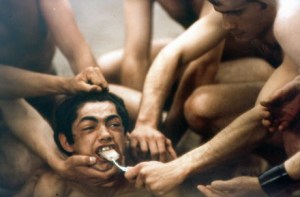 Once in a while, there comes a movie that shatters the beliefs of people on cinema and redraws the lines between right and wrongs of the medium. These are the films that redefine the boundaries of film making thus providing new standards and freedom for films to come. At a time when swearing on screen was a taboo, came the classic Gone With The Wind (1939) with the legendary “Frankly my dear, I don’t give a damn.” quote. A Clockwork Orange (1971) that questioned induced goodness and evil in a very strong way, Straw Dogs (1971), famous for its graphic rape scene, Un Chien Andalou (1929) that introduced surrealism in cinema, the semi-snuff Cannibal Holocaust (1980) and its brutality – all these movies may have been snubbed by audience and critics at the time of their release, but no one can question their impact on the future generation of directors.
 The Seventh Art