Le Salaire De La Peur (1953) (aka The Wages Of Fear)
Henri-Georges Clouzot
French
“When someone else is driving, I’m scared.“

After his back to back successes with Le Salaire de la Peur (1953) and Les Diaboliques (1955), Henri-Georges Clouzot was considered a leading contender for the throne of “The Master of Suspense” and a force Hitchcock had to reckon with. Incidentally, Hitchcock himself was hot under the collar for having lost the filming rights of the above two films to Clouzot who had delivered them big time. Though not as prolific or consistent as Hitch, Clouzot is nevertheless placed in the same league as the former. His famous pair of films has spawned tens of remakes, both faithful and revamped. The Wages of Fear may arguably be the more potent of the two by a miniscule margin.
(Spoiler Alert)
Mario, Jo, Bimba and Luigi are the temporary residents of Las Piedras, a small town in South American. Each of them has a need to earn a tidy sum of money in a very short amount of time. Just then, they find out that one of the oil fields of Southern Oil Company (SOC), the drilling giant which owns a number of fields in the country, is on fire and two truckloads of nitroglycerine are required to put them out. However, a tiny jerk to these trucks could blow them to nonexistence. These four people volunteer to drive the truck to the oil field for a decent sum of money. The rest of the film follows their nasty ride to hell and beyond, literally.
No other film ending has been as much debated upon as the ending of The Wages of Fear. Clouzot, clearly making a statement against the Hollywood endings, did the unthinkable and totally shattered the perception about films of the audience then. Additionally, the ending sequence also raises questions about death, fate and their inevitability, that reach out to everyone irrespective of their age, situation or morality. Till date, the ending elicits mixed reactions, ranging from brilliant to silly.
In Richard Schickel’s documentary The Men Who Made the Movies: Alfred Hitchcock (1973), Hitchcock puts forth his idea of suspense as thus: “If two people are talking across a table and a bomb suddenly explodes from under it, the audience is excited for about 10 seconds. But if in the same situation, if you tell the audience that there is a bomb that will go in exactly 5 minutes, viewers are pushed the edge of their seats for the whole 5 minutes and will be praying for the men to get out of that place. You can’t make the bomb explode after that, for it will disrupt the comfort level of the audience”.
This is exactly the style used in The Wages of Fear too. Only that Clouzot does not care about the last clause. The best part about this theory regarding on-screen suspense is that it can never become obsolete. A bomb threat is as gripping now as 50 years earlier. This, perhaps, is the major reason for the slew of similar films from across the world. The audience knows what is going to happen in the next few minutes, but still finds the happenings irresistible. Don’t forget to check out Andrei Tarkovsky’s student film There Will Be No Leave Today (1959) for a different take on the same structure.
Clearly, the most prominent theme in the film is the capitalist exploitation and misuse of power over the developing and third world countries. The Southern Oil Company (SOC, obviously, representing the US oil giant) in the film is portrayed as a materialistic and ruthless firm that pays for the fear and lives of the men in terms of money. This provided the west yet another reason to boo down the film. However, the film had already been recognized as a classic and Clouzot became yet another French director to look out for.
 Michaelangelo Antonioni‘s films have always tried to establish the growing distance between humans and the alienation of self in the modern society. Though L’Avventura (1960) is his most intense meditation of that concept, it is measured in its pace and may not entice viewers of the newer generation. Ironically, his Blowup (1966) has more lovers now than it had during its time! Unlike its contemporaries which age with time, Blowup‘s appeal seems to grow with the years.
 Seldom do films come that are so simple in their presentation yet possess such strength in their characters. These are the films that sweep you off the ground with their sheer brilliance. Federico Fellini’s La Strada (1954) is a benchmark for industries such as Bollywood which flourish on fantasy for film making. La Strada marks Fellini’s transition from neo-realism (His previous film being the brilliant I Vitelloni (1953)) to fantasy. And what a transition it is!
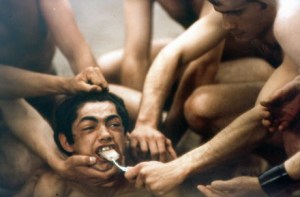 Once in a while, there comes a movie that shatters the beliefs of people on cinema and redraws the lines between right and wrongs of the medium. These are the films that redefine the boundaries of film making thus providing new standards and freedom for films to come. At a time when swearing on screen was a taboo, came the classic Gone With The Wind (1939) with the legendary “Frankly my dear, I don’t give a damn.” quote. A Clockwork Orange (1971) that questioned induced goodness and evil in a very strong way, Straw Dogs (1971), famous for its graphic rape scene, Un Chien Andalou (1929) that introduced surrealism in cinema, the semi-snuff Cannibal Holocaust (1980) and its brutality – all these movies may have been snubbed by audience and critics at the time of their release, but no one can question their impact on the future generation of directors.
