Ellipsis


Indigène d’Eurasie (2010) (Eastern Drift)
Sharunas Bartas
French/Lithuanian/Russian
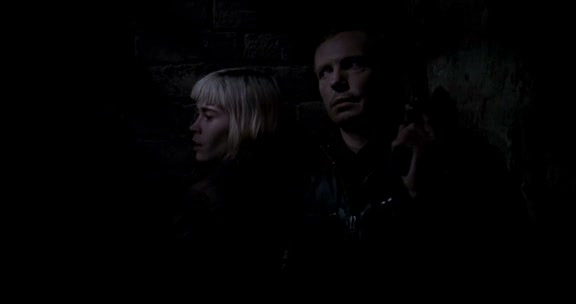
 

Eastern DriftThe trajectory of Lithuanian helmer Sharunas Bartas’ filmography, in a sense, runs anti-parallel to that of Béla Tarr, with whom the former shares a number of artistic, political and philosophical inclinations, and has moved from extreme stylization to rough-hewn naturalism, from near-total narrative abstraction to flirtation with generic structures, from semi-autobiographical meditations set against the backdrop of Soviet collapse to highly materialist tales of marginal lives in the Eurozone. (In fact, one could say that the exact tipping point occurs at Freedom (2000).) Eastern Drift finds the filmmaker moving one step closer to conventional aesthetic as well as dramatic construction and follows Gena (Bartas himself), who is on the run after he knocks off his Russian boss after an altercation over a hefty sum of money. Even though the film has the appearance of a Euro-thriller, with the protagonist hopping from one major city of the continent to another, each of which regularly gets its token establishment shot (and all of which look very similar for the untrained eye), it actually moves against the grain of the sub-genre. Unlike the traditional European action picture, in Eastern Drift movement – the prime action over which the narrative is founded – itself is problematized. A large part of the proceedings is made up of Gena trying to sneak in and out of buildings as well as countries and finding himself thwarted at almost every move. An antithesis to the utopianism of Eurozone and its myth of intra-continental mobility, Eastern Drift crystallizes and futhers Bartas’ preoccupation with suffocating national borders, although the scenario over which he builds his argument remains moot.


[Capsule added to The Films of Sharunas Bartas]
Project Nim (2011)
James Marsh
English

 
Project Nim

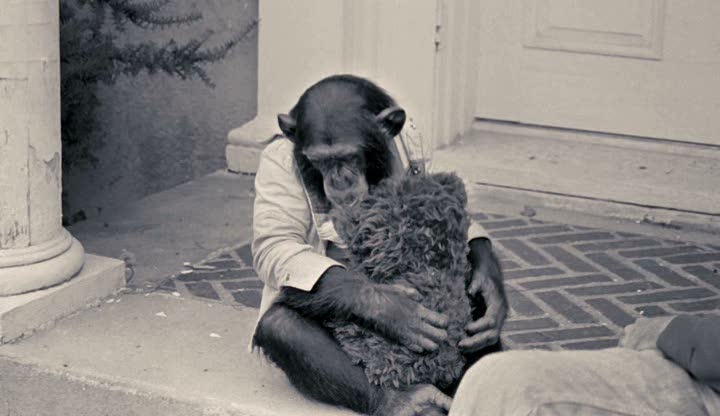
Project Nim (2011), directed by James Marsh of Man on Wire (2008) fame, gives to us the life of Nim Chimpsky, the chimpanzee at Columbia University that was being trained to communicate in sign language, as narrated by Dr. Herbert Terrace (the head of the project) and his team of trainers. We see the animal being taken away from his mother by force, brought up along with human children at one of Terrace’s friends’ home, transferred back to the university, sold to a drug-testing facility and, finally, to a private ranch. We witness the devastating tragedy of Nim’s life, as he is deracinated, trained for years to become human-like only to be expected, subsequently, to behave like chimpanzee. Throughout, there is an ambivalence based on the nature versus nurture question that we experience: Is Nim’s rapid learning curve an indication of the dominance of social relations in shaping communication or is his random acts of violence a clinching proof for the presence of an innate animal essence? The interviewees describe their relationship to Nim in very human terms and one wonders if some of it is not the projection of their own anthropomorphic understanding of the animal’s behaviour. Consequently, Nim becomes something of a MacGuffin that everybody is talking about, but no one knows what it exactly is. The film’s sympathies clearly lie with the animal, to such an extent that it refuses to see the complexity of the situation. Abstracting scientific research as animal cruelty, the film fails to take into account the more pressing issues that are being addressed by such projects. To add to this gross simplification, Marsh’s questionable fictional restaging of facts and regular use of unrelated footage in order to prevent the film from becoming a talking-heads documentary betrays a lack of faith on the material and an unwarranted fear that a straightforward presentation would be ‘uncinematic’.

Jiabiangou (2010) (The Ditch)
Wang Bing
Mandarin


The DitchWang Bing’s The Ditch (2010), the filmmaker’s first full-length fictional feature, is a recreation of Jiabiangou Labour Camp located in the Gobi desert, where prisoners accused of belonging to the Right were sent in order to be “re-educated” through hard labour. We see prisoners being brutalized, living continuously in starvation and in pathetic trenches. We see them surviving on small critters, regurgitated food particles and even buried corpses. There are two kinds of landscapes that they inhabit – the seemingly-infinite plains of the desert where they toil during the day time and the cramped and under-lit trenches that they take refuge during the night – both of which Wang shoots characteristically in digital video on Steadicam and in long shots. The result has the hangover of Wang’s documentary features and each scene comes across less like illusionary fiction and more like the recording of a performance. The acting, likewise, is perched between the emotive and the expressionless. Consequently, Wang’s foray into the grammar of conventional fictional cinema – the occasional shot-reverse shot and close-ups – sticks out as high relief. No doubt, like Brutality Factory (2007), his first stab at fiction, he’s dealing with thin material here that concerns itself more with the need to remember than with the necessity of analytically dealing with history. This approach – the raison d’être of his best non-fiction works – reveals itself as a substitute for straightforward documentation and intentionally swaps prison dynamics for a survival sketch. However, there is one ironic detail that Wang seems to be arriving at here: that Mao’s re-education program at the camp for purported Rightist subversives only teaches them one thing: Every man for himself.

Vénus Noire (2010) (Black Venus)
Abdellatif Kechiche
French/Afrikaans/English


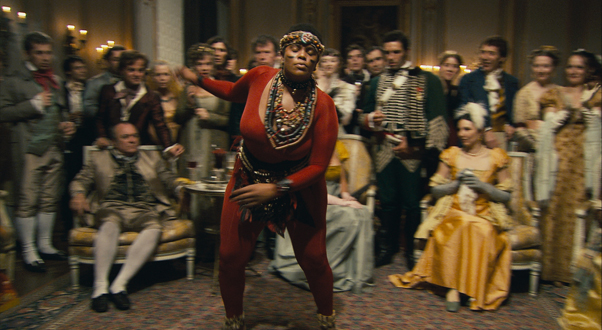
Black VenusAbdellatif Kechiche’s Black Venus (2010) opens with a scene set in the Royal Academy of Medicine, Paris during the year 1815, in which we see a group of biologists studying the preserved cadaver of an African woman. We learn that she was Saartjes Baartman (Yahima Torres, in a no-holds-barred, one-of-a-kind performance), a South Arican native who migrated to London (and, later, Paris) and allowed herself to be displayed by her employer as a savage in front of curious, paying customers. We see the ruthless physical and racial harassment – not entirely without her consent – that she undergoes. We also see that her status as an ethnic outsider cuts across class (the rich libertines of Paris as well as the proles of London throng to see her) and gender (there are, in fact, more women than men during these shows) divides. Structured as a series of exhibitions – classroom lectures, freak shows, courtroom hearings, party entertainment – Black Venus chiefly concerns itself with the process of comprehending, through the acts of seeing, hearing and touching. Saartjes becomes something of a litmus test for each set of audience, which affirms its own identity and view of the world though her radical ‘otherness’. (That these events take place just after the French Revolution produces interesting implications). During the five years she spends in Europe, Saartjes finds herself increasingly objectified (from a savage, to an exotic body, to an amalgam of unusual body parts) and mystified (that is, she becomes a sum of perceptions). Although overlong and overdetermined, Black Venus weaves a bracing film out of a devastating life story, a testament of whose power is the epilogue of the film, where we see Saartjes’ remains being returned by the French government to South Africa for her final rites.


(Image Courtesy: Slant Magazine)

Life In A Day (2011)
Various
Various


Life in a DayRidley and Tony Scott’s production house Scott Free, in association with LG and YouTube, invited users from around the world to submit footage of their lives shot on July 24, 2010 as a part of a socio-cinematic experiment. Out of the 4800 hours of video gathered, chief director Kevin Macdonald and co. wove this exhilarating 90-minute ride, Life in a Day, which, on its surface takes us through one day in the life of people from around the world. If Dziga Vertov attempted to sketch a portrait of a pulsating city as seen through the Kino-Eye over a day and Medvedkin had Soviet peasants shoot their own lives, edited the obtained footage in his Cine-Train and played it back to them, Life in a Day combines both these ideas and realizes them in a post-globalized cultural-economic climate – a time where the omnipresence of branded consumer products is matched by the ubiquity of low-cost image-making instruments. An endless play of presence and absence, lack and excess, similarity and difference, the homogenous and the un-normalizable and the empowered and the marginalized, Macdonald’s virtually inexhaustible film is a snapshot of planet earth in all its glory, stupidity and complexity. So much film theory has sprung up since Vertov et al made their films and what is of interest is not only the relationship between individual shots, but also the dense cultural content within each one of them that enriches our response manifold. Sporadically erratic and miscalculated, Life in a Day nevertheless achieves the remarkable feat of synthesizing a coherent, mesmerizing and, indeed, philosophically ambitious film from the very elements that have become the antithesis of these traits. What appears as a paean to narcissism to some commentators seems to me as a heightened awareness of one’s own existence. The act of photographing oneself – on a particular day and for a particular purpose – prompts one to be continuously conscious of the passing of time and the finitude of experience. One frustrated lady sums it up in the film’s final line: “Today, even though nothing great happened, tonight, I feel as if something great happened.

Batang West Side (2001) (West Side Avenue)
Lav Diaz
Tagalog/English


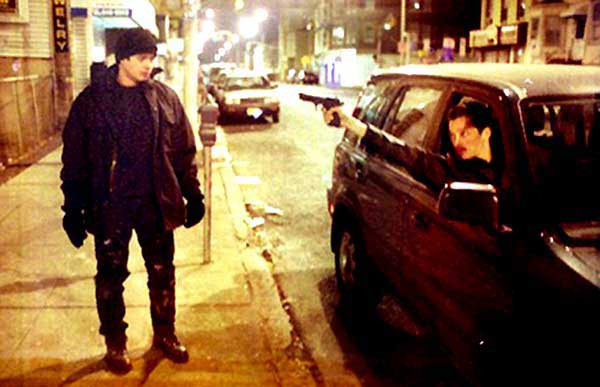
West Side AvenueThanks to West Side Avenue (2001), clearly Lav Diaz’s first major work, we now know what will happen if the Filipino filmmaker takes to genre filmmaking. Diaz takes the standard policier, blows it to a size beyond what the text can handle and, in essence, brings to surface the mechanics of the genre. Constructed as a (seemingly endless) series of interrogations and recollections, a la Citizen Kane (1941), the film presents itself like a sphere without a centre. (Like Charles Kane, the relationship of all the characters to the dead boy at the centre of Diaz’s film – which is developed strikingly with a plethora of parallels – becomes the guiding device.) The procedure becomes so routine and schematic, aided to a large degree by the repetition of spaces and compositions, that the lead detective (Joel Torre) becomes something of a Melvillian zombie trudging through generic structures. But then, talking about Diaz’s film in terms of the genre is not half as justified as reading it from a national and auteurist perspective. Firmly planted in historical and geographical particulars – Filipino youth living in and around Jersey City during the turn of the century – the film takes up the issue of disappearing Filipinos – a sensitive idea that would be pursued further in other forms the later films – and examines the historical deracination and alienation that marks these young men and women. The relationship between the various characters with the killed teenager reflects their own conflicted relationship with their homeland. The film, itself, is somewhat (and slightly problematically) neo-nationalistic in flavour, gently appealing for cultural consciousness, integration and a “return to one’s roots”. The narrative mostly involves the investigation of the murder of one Manila teenager, If one moves beyond its precise sociological ambitions, one also discovers the flourishing of to-be-familiar stylistic (and narrative) devices: Scenes in master shots, montage of long takes, monochrome passages in. video and use of total amateurs. (Oddly enough, my favorite scene in the film is among the most uncharacteristic of Diaz’s cinema: a breakfast scene cut with verve comparable to Classical Hollywood). However, the most unmistakable authorial trademark of West Side Avenue is also the feature that attracts me most to Diaz’s work: the candidness and enthusiasm about his politics and political engagement, in general, as well as that rare faith in and love for cinema. That is why, towards the end of the film’s five hours, when the detective and the filmmaker – two professions seeking to discover truth – catch up with each other and restore the hitherto-absent heart of the film, you don’t if Diaz identifies with the detective or the filmmaker. He’s both.


[Capsule added to The Films of Lav Diaz]

Pina (2011)
Wim Wenders
German/French/English/Spanish/Croatian/Italian/Portuguese/Russian/Korean


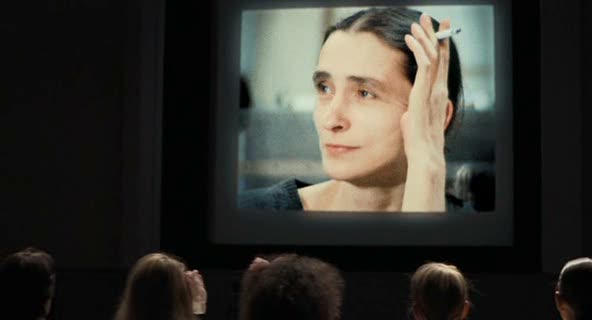
Maya Deren, committed perhaps more than anyone else to marrying choreography with film, once wrote: “There is a potential filmic dance form, in which the choreography and movement would be designed, precisely, for the mobility and other attributes of the camera, but this, too, requires an independence from theatrical dance conceptions.” This could well have been a mission statement for Wim Wenders’ Pina (2011), which attempts to re-imagine Bausch’s most famous works for a cinema audience and, specifically, for 3D technology. Consisting of an assortment of performances of Bausch’s famous pieces – performed on stage as well as outdoors in the choreographer’s home town – and interviews with her protégés, the film locates itself on this side of her passing and plays itself openly as a tribute rather than a cine-profile. Although it appears that art forms are being nested one inside another – Wenders’ film records Bausch’s choreography, which, in turn, is viewed as painting-on-stage – Pina comes across as collaboration between two art forms, as it is between two of its eminent practitioners – one feeding into another. Dance and cinema are presented as two universal forms bypassing verbal language, as is made explicit in the frequently interrupting (and consistently impoverishing) interviews in which we see Pina’s dancers – of different ethnicities, cultures and languages – sitting idly before the camera while their testimonies play as voiceovers, as though reducing both forms to their very basics – image and gesture. As for the dances themselves, we respond to the sheer physicality of them, more than their meaning, which is enhanced by Wenders’ restive, ever-tracking and craning camera that provides us the best of vantage points and brings us close to actually taking part in the performances.

One Way Street: Fragments For Walter Benjamin (1992)
John Hughes
English/German/Russian


One Way Street: Fragments for Walter Benjamin(The other) John Hughes’ One Way Street: Fragments for Walter Benjamin (1992) seeks to present vignettes from the German philosopher’s life as well as his writing, predictably, in a form that reflects Benjamin’s own working method. As a result, fragmentation – pictorial and structural – becomes the (dis)organizing principle of the film. Multiple sub-frames (recalling Nick Ray’s cherished avant-garde film), graphic overlaps and abrupt colour shifts on the visual front are complemented by a thoroughly variegated set of exposition devices: hammy enactment of biographical minutiae, talking heads of authors who have written on Benjamin and other intellectuals of Weimar Germany, fictional interviews and an onslaught of quotes by Benjamin – onscreen as well as vocalized, reminiscent of Alexander Kluge’s attempts at adaptation of Marx, This ‘unclassifiability’ of the film finds an echo in the seeming malleability of Benjamin’s body of work – appropriated by a variety of disciplines and practitioners – which becomes one of its areas of investigation. Never dwelling on a particular strain in Benjamin’s thought (nor enriching our understanding of these dimensions), the film emphasizes the non-teleological nature of his work which resists ideological or philosophical reduction. At times, trying to emulate his subject, Hughes also takes to chains of free associations – toys/soldiers/toy soldiers etc. – that don’t necessarily take us deeper than the surface pleasures they offer. However, probably the most wanting quality of the film is that, situated on this side of the collapse of Berlin wall, the film doesn’t seem to want to open up Benjamin to the present, content in presenting a portrait of the writer locked in a time capsule – exactly the attitude towards past that Benjamin was operating against.


Gandhi To Hitler (2011)
Rakesh Kumar Ranjan
Hindi

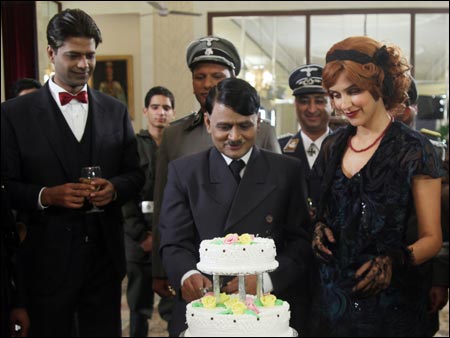
Gandhi to HitlerThere are three sets of letters written in Gandhi to Hitler (2011) – from Gandhi to Hitler just after the Blitzkrieg, from Hitler to his people just before his death and between a jingoist Indian army officer (Aman Verma) wandering war-torn European countryside and his Gandhian wife back home – none of which are ever read. This is only one of the hundred methods by which the film engages in there-are-no-winners-in-war philosophizing and attempts to establish a ‘universality’ of grief and suffering. The picture is an amalgam of wish fulfillments: a chance for the writer-director to remake both Saving Private Ryan (1998) and Downfall (2004), for the home audience to see their own WW2 movie and for Raghuvir Yadav (Adolf Hitler) to be paired with Neha Dhupia (Eva Braun). Only Mohandas Gandhi gets a raw deal, existing solely as a mirror image of the German chancellor. (This vehement contrast informs the organization and style of the first section of the movie: Hitler snaking through in his bunker cut to Gandhi walking through the corridors of his Ashram, the Führer belittling the officers around him with Gandhi preaching to his followers, the gradual disintegration of the Reich with the fortification of Gandhian movement). This split is also established within the third narrative track centering on the officer (and his Gandhian wife) leading group of Indian soldiers (under S. C. Bose, who sided with the German army), consisting of men of various religious persuasions. Not just the structure, but every shot in Gandhi to Hitler exists to present an idea, to illustrate a convenient thesis, while the direction, acting, editing and photography go into auto-pilot. But the film’s boldest move – which, I’m sure, reviewers would relish picking on – is to have an all-Indian cast, speaking Hindi throughout: a virtue born out of necessity that’s also a rebuttal of conventional wisdom about realistic storytelling, which is fixated on appearance, plausibility and imitation.

(Image Courtesy: GlamSham)

We Can’t Go Home Again (1976)
Nicholas Ray
English


We Can't Go Home AgainNicholas Ray’s We Can’t Go Home Again, ostensibly the director’s most personal and complex film, was made by the director and his students during his stint as a film professor at State University of New York, Binghamton, under abysmal financial conditions (which is also what the film is about). Ray kept editing the film for almost a decade and the final version never saw the light of the day. The second cut, which dates to 1976, is as far from the studio pictures made by the filmmaker as it can be. We are far from the eye-popping days of ultra-widescreen, for one, with its 4:3 ratio. Instead of the frame becoming an infinite canvas in front of us, it keeps diminishing, sharing screen space with a bunch of similar frames. (The film was shot on a number of formats, projected on a single screen, which was then recorded on 35mm). This splintering of the visual field, the generally pathetic sound and the entire filming method highly befits both the ideological fragmentation of Ray’s radicalized students and the progressive mental and physical breakdown of Ray himself (who appears to play a slightly fictionalized version of himself). This sharing of screen space by multiple smaller frames, like a cubist painting, seems to suggest the amorphous worldview of the misguided youngsters – types from an era – who see the equally vacillating Ray as some sort of secondary father figure, one away from home. The one-eyed Ray, as if throwing light on the politics of his films, seemingly advises them, without condescension, that no ideological position must blind them of the human elements that make up the system, that an eye for an eye makes the whole world blind.

« Previous PageNext Page »