Hollywood


The Curious Case of Crazy Cartoons

RoadrunnerCartoons are the closest approximation to Tarantino’s movies. They start out as a simple ideas inspired by real-life objects/characters/situations and go on to evolve into completely new universes with their own sets of mythologies and histories. Although controlled to the last pixel by their creators, these cartoon characters take up a life of their own and, in the process, have the creators conform to their characteristics. A sub-art form by itself, the cartoon provides so much scope for exploration of both the animation medium and of cinema itself (by exclusion of reality). When Émile Cohl created Fantasmagorie (1908), now accepted as the first ever animation movie, he had given a mile of head start for the genre with the film’s no-holds-barred repudiation of real space and time. Since then, sadly, animation seems to have been moving in the opposite direction, trying to imitate “normal” cinema with its gargantuan technological expertise,  in the same way the latter tries to imitate life. These CG devils do not seem to understand that animation is both an adversary and a complement to photographic cinema – an extreme form of wish fulfillment that wears its manipulation on its sleeve – rather than a clone. Like all genres, the clichés have remained, the spirit and meaning buried. Premiering almost six decades ago, the Wile E. Coyote vs. The Roadrunner cartoon series is one that takes these clichés to the most extreme and, by doing so, digs into the most basic and pertinent of all questions about the medium – What does it mean to be a cartoon?

Honey, I Dehumanized the Kids

The Roadrunner series was conceived by Chuck Jones and Michael Maltese.  And Chuck Jones is as true an auteur that one can find in cartoon filmmaking. One can almost immediately tell a Jones cartoon from the others. His toons are characterized by hard edged drawings with jittery motion that lacks real continuity. His characters are true caricatures, deliberately far from reality, with justifiably no depth at all. These characters somehow appear to know that they are in a cartoon. Consider his stint as the director of the famed Tom and Jerry show. Till then, Hanna and Barbera had been presenting us cutesy, smooth lined and lovable characters (This still remains my favorite era in the Tom and Jerry series) who call out for empathy. With the arrival of Jones, however, things take a dark turn as we see a frenzied Tom chasing a Jerry who seems to be perennially on crack. Jones removes any trace of cuteness from these characters, providing features like vicious teeth and pointed whiskers, and disallows any sympathy for them from us, at least by the virtue of their appearances. It is as if Jones believes that we should know that these are just cartoons and their lives are not going to be altered by our sympathy. That does not mean that he doesn’t give us emotional anchors to hold on to in his cartoons, but just that he consistently avoids the threat of realism – of appearance and of emotions – that plagues the cartoon world so often.

Although it never really upped the ante for the Tom and Jerry series, his style sure does work wonders here. In the Roadrunner series, too, there are no attempts at unwarranted emotional bonding even though one does end up rooting for Wile E. within minutes into each episode. For a comparison, these cartoons of Jones are like the early short films of Chaplin that relied purely on slapstick, without ever concentrating on the Tramp’s relationship to us like the later Chaplin films do. Jones relies on Woody Allen kind of humour – throw them all and see what sticks – with his relentless series of gags. His humour does not depend on what happens (which, by the very virtue of the Roadrunner series, is known to every one), but how does it happen and how long does it take to happen. Part of the fun in watching the Roadrunner cartoons arises from this surprise element of time that comes into picture in these skirmishes. Consider this random episode called Hip Hip-Hurry! (1958) that Jones directed. The episode consists of 8 gags of lengths 58, 30, 26, 8, 28, 35, 25 and 106 seconds respectively. The numbers are enough of a witness that Jones revels in writing both gotcha gags and wait-wait-almost-there-boom set pieces (which were a characteristic of his Tom and Jerry cartoons too) equally. And that is the only kind of unpredictability that he allows in the world of Roadrunner.

[Hip Hip-Hurry! (1958)]

Once More Upon a Time in the West

The idea of the Roadrunner show resembles a western (The fact that the coyote is a symbol of the Native American makes this notion all the more interesting!). Like the western genre, it originates as a piece of history – a shred of fact that a coyote is trying to get his hands on a roadrunner – and then develops itself as a myth that is derived from that piece of history (that the coyote always goes after the bird). Two primary characters facing each other off in a vast, cruel and blazing environment is one of the biggest stereotypes of the now-extinct genre. In Roadrunner, too, the geography is sparse, torrid and lifeless and painted with mostly brown and deep yellow colours. Furthermore, the western has always been a playground for writers to tease our moral standings and to tantalize us with notions we try to take for granted. Usually, the “morally good” according to law and social institutions for justice, in the form of police and the sheriff, is pitted against the morally good according to personal conscience and intuition, in the form of the noble outlaw and the lone ranger. Scenarios are written in such a way that our empathy goes against the justice system, which seems to be blinded by its own rules, and the audience is made to unconciously question the way laws are made. In the case of Roadrunner, this sense of balance between “good” according to public opinion and right-wing morality and “good” according to personal experience and emotional connection is maintained in the form of the roadrunner and Wile E. respectively. The cerebral part of us tells us that the roadrunner is never the instigator of trouble and it is plainly wrong to try to kill the harmless being. On the other hand, by virtue of the script, we end up supporting the coyote’s efforts and even want him to get the bird for once. The result is the deletion of human morality – the notion of heroes and villains and good and bad – from the Roadrunner universe.

No Man’s Land

One observation that one immediately makes when watching the Roadrunner cartoons is the strange absence of humans in the toons. There are no human “characters” in the series as such, even though they make their presence in the world felt indirectly now and then. Even when they do, in the form of the regular afternoon trains that run over Wile E., the random trucks that get him at the tunnels and the friendly neighbourhood highway chases, they merely act as deus ex machinas that make sure that Wile E. does not catch roadrunner and that he always chases him.  Same is the case with the ACME Corporation, from where Wile E. obtains all his bizarre gadgets. He always gets what he wants from them although one is not sure how the economy allows for this. ACME is not very unlike our capitalistic companies that benefit from people’s internecine quest for climbing the social ladder as fast as possible and which try to rake money even at the  cost of deterioration of people‘s ways of life (and history has made sure that this policy of ACME holds good for Certain Intelligence Agencies too!). Both humans and institutions perpetuate the myth of the roadrunner and Wile E by their non-intrusion and occasional intrusion. Furthermore, there are no laws in the Roadrunner world.  Unlike in movies like Toy Story (1995), where the toys had to obey the rules of the human world and come into true existence only when they are far removed from observation, Wile E. need not be ever conscious of his actions. He knows that he is being observed by the humans and he would always be made to chase the roadrunner. Even science, with its selective application of its laws, seems to want to keep the myth alive.  All Wile E. can do is to conform to this “fascist conspiracy” of the external world.

The Cartoon with(out) a Difference

In the case of The Roadrunner series, one is safe in saying that if you’ve seen one, you’ve seen them all. Far from being wrong, it is the very truth of the world of Roadrunner. The stories of all the episodes of the series are so identical to one another, that it would only be a miracle if one can identify individual episodes. You have this lanky, brown coyote – about 45 years of age, one would say, if Jim Carrey were to play him – who tries, in every which way possible, to get his hands on this clever, thin roadrunner bird. Predictably (I mean predictably), he fails, only to get up again and repeat the process. Each of these vignettes starts out and ends in the same way – with Wile E. concocting some new plan to get hold of the Roadrunner and with him getting caught in his own trap respectively. The only difference between each of these encounters lies in the way Wile E. fails in his mission. In fact, the whole universe of Roadrunner relies on repetition – repetition of situations (what would Roadrunner be without the top view of Wile E. falling into the cliff?), repetition of geography (more than in any other cartoon, the scenery in these cartoons repeats very often, especially noticeable in the background during the chases) and repetition of structure (to the point that the relative ordering of the vignettes and the episodes is ultimately immaterial). Heck, even the single piece of speech in the series comes in the form of a repetition – “Beep Beep”.

But then, there are traits that are also shared by every other cartoon (Garfield often speaks to us out of context of the cartoon about these clichés) and also perhaps the easiest ones to devise. But, the real success of the Roadrunner series lies not in using these clichés, but retaining them forever, even at the cost of being unfunny and redundant. Jones takes the practice to the breaking point (and beyond) by bombarding us with the same elements over and over. And, through this monotony, he achieves something much more than instant chuckles. Harold Ramis’ brilliant Groundhog Day (1993) examines, albeit in photographic reality, what it takes to live in a completely predictable world – a world that is mathematically derivable, geographically utopian and emotionally unresponsive. Its protagonist, Phil Connors (who is worthy of Bill Murray), after some days of rejoicing over the unlimited power that he has been given, finds himself completely alienated from his people and then, gradually, comes to accept his situation. Beyond that point, he stops attempting to break the loop of time and decides to enrich his own life and that of the others. Now that it is neither possible for him to pursue any goal in life that he may have had nor take his own life, he realizes that the only difference that he can make in this world is to make the people around him happy, even if it is just for a couple of hours. Phil Connors isn’t very unlike our hero Wile E.

Deconstructing Wile E.
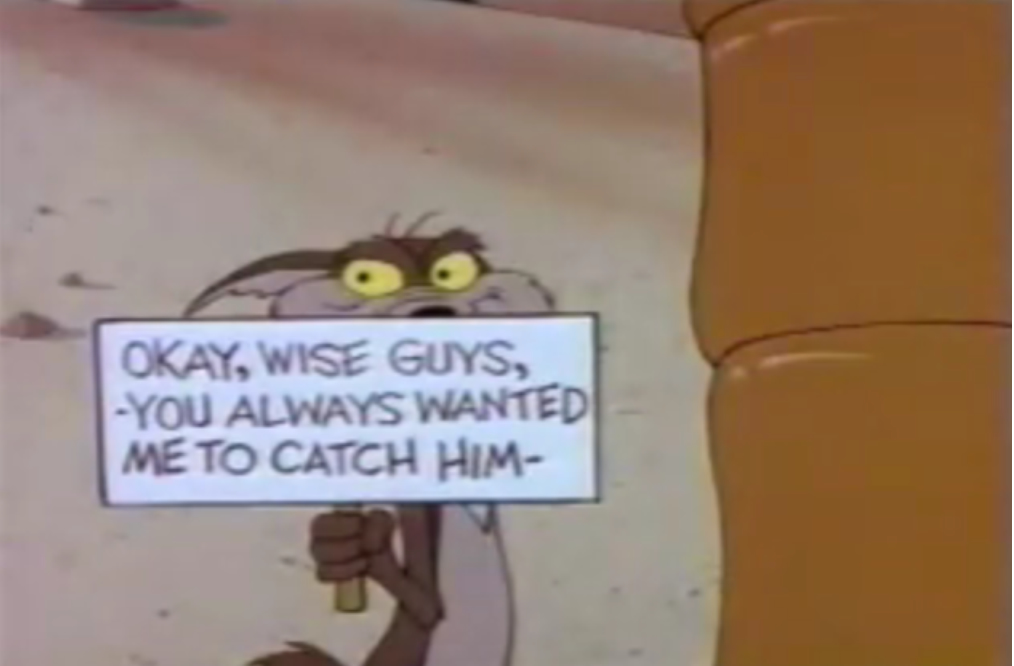
RoadrunnerThe world of Roadrunner is the perfect cartoon world. It is a world devoid of the notions of hunger, injury and death. Even though Wile E. believes that he chases the bird in order to eat it, that can never be his actual motive. The very fact that he keeps chasing the bird for years in vain suggests that food is never a point of concern for him. His role in life is to chase the roadrunner and nothing else at all. In this regard, he shares a very ironical relationship with the bird. For one, he cannot and will not catch roadrunner ever because, if he did, he would not have anything else to do in his life. In that case, he would lose his identity and turn from being a cartoon ‘character’ with unique characteristics to being a mere ink stain on a sheet of coloured paper. He would then be wandering the wilderness for eternity. Nor can he renounce the chase altogether for that would tantamount to him catching the bird and subsequently losing his identity. On the other hand, the roadrunner’s role is to be chased. Since Wile E. knows that his only option is to chase the bird, roadrunner needn’t ever instigate him. But if ever, Wile E. digresses from his job, it would be the roadrunner’s duty to pull him back into the loop since he has his identity to retain. The whole of fabric of Roadrunner is based on this paradoxical relationship that the two characters share.

Now, this is not the foundation that shows like Tom and Jerry are raised on, although they, too, are reduced to no more than a bunch of futile chases. The kinship between Tom and Jerry is built around the human world, unlike in Roadrunner, like a refrigerator loaded with food, a stray canary or a runaway bear. At any point, Tom and Jerry could make a pact and go on with their lives independently – which means that Tom can laze around forever and Jerry can pinch cheese whenever he wants. But, in the case of Wile E., there are no such easy alternatives. His world is defined solely by his chases and contains no other dimension. Tom or Jerry need not be in every scene in an episode, but Wile E. has to be present in every setup of every vignette and, if needed, in every frame. Like Barry Lyndon, the coyote’s life is sealed in the two dimensions he lives in (The ideal sequel, if you can call that, to the Roadrunner show will not be in 3-D, but rather in 1-D, with the two characters represented as two dots that never meet). Even though the initial motive for Wile E. is to catch roadrunner and that for the roadrunner is to evade the claws of Wile E., in the long run, they would inevitably reverse their roles. That is, the coyote. will, eventually, make sure that he doesn’t catch the bird and the roadrunner will make sure that he is chased. This is almost exactly the kind of relationship that Batman and the Joker share in The Dark Knight (2008).

One is tempted to compare the fate of Wile E. to that of Sisyphus, the Greek king who is made to roll a mammoth boulder over a steep hill slope forever, only to find it roll back down (Is it just a coincidence that Wile E. is seen shoving huge rocks time and again?). The coyote’s life, too, goes around in such pointless loops with no end in sight. In fact, Wile E. is the quintessential Absurd Hero, like Sisyphus, who realizes the pointlessness of his life and nevertheless continues. I’m a philosopher only as much as Barack Obama is a ballet dancer, but from what little I have heard about Camus, he draws three possible responses to this realization of the absurdity of the world – Faith, Suicide and Existence. He seems to reject the first two ideas, denouncing them as tricks to repudiate the truth about the meaninglessness of life. In the third option he proposes that life be lived for-the-moment and enjoyed to the fullest, without any hope or ambition and with the constant knowledge of the absurdity of it all, and thus have complete freedom over our actions. This way, the refusal of suicide becomes the very token of acceptance of absurdity and the freedom of choice that it provides. Now, this is where Roadrunner really takes its medium seriously. Unlike Sisyphus, Wile E. (and Phil Connors) does not even have the choice of suicide, so that he can refuse it. His world knows no death. Nor can he make a leap of faith, for he has nothing to hope for, except maintaining status quo. Thus, Wile E. can only take up the third option of living life for what it is. Wile E., like most Chuck Jones characters, knows that he is in a cartoon, that he has to carry on his chase act for ever and that there is no meaning to his life. So all he can do is keep chasing roadrunner – keep pushing the rock – in an attempt to keep both of them happy. Camus sums up the Sisyphus situation fittingly: “The struggle itself towards the heights is enough to fill a man’s heart. One must imagine Sisyphus happy.”. The same should be said about Wile E.

(pic courtesy: The Yerton Dreamhouse)
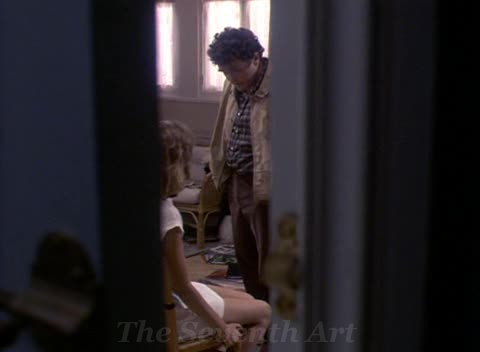
Repulsion (1965)

Repulsion (1965)

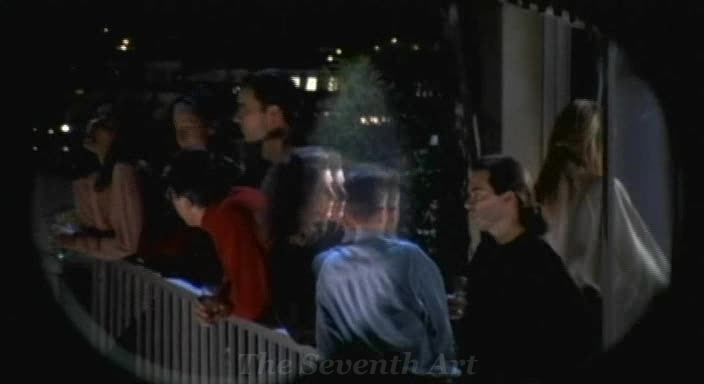
Cul-de-sac (1966)

Cul-de-sac (1966)

The Fearless Vampire Killers (1967)

The Fearless Vampire Killers (1967)

Rosemary's Baby (1968)

Rosemary's Baby (1968)

The Tragedy of Macbeth (1971)

The Tragedy of Macbeth (1971)

Chinatown (1974)

Chinatown (1974)

The Tenant (1976)

The Tenant (1976)

Tess (1979)

Tess (1979)

Pirates (1986)

Pirates (1986)

Frantic (1988)

Frantic (1988)

Bitter Moon (1992)

Bitter Moon (1992)

Death and the Maiden (1994)

Death and the Maiden (1994)

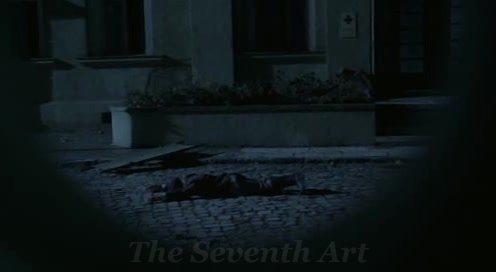
The Pianist (2002)

The Pianist (2002)

After watching Inglourious Basterds last week, I skimmed through a few films I was referring to in my review and felt that Tarantino’s movie, its last chapter in particular, refers to them in a manner slightly deeper than mentioned. What I present here may be plainly speculative, but the very fact that Tarantino’s film retains enough ambiguity to generate such arguments makes the film one to be celebrated. Inglourious Basterds, more than any other movie, seems to be closest to Jean Luc Godard’s History of Cinema (1988-98). If one considers Godard’s film as a classroom lesson in cinema (Why not? The movie even resembles an office presentation!), then Tarantino’s movie is a student project (that would easily get an A+) based on that lesson. It seems that everything that the French discusses in his video anthology is absorbed and blended cleverly into a mainstream flick by Tarantino. For the sake of simplicity, I lift and reproduce the same lines from my post on Godard’s film to compare it with Inglourious Basterds.

“If we had to single out Godard’s most favorite quote it has to be the misattributed Bazin one: “The cinema, substitutes for our gaze a world that corresponds to our desires”. And this is where the series kicks off. Cinema as a substitute for our dreams – the dream factory. Godard explores the meaning of “dream” as interpreted by the two functioning extremes of cinema then. He presents the occident interpretation as one that had converted cinema into a portal offering an alternate reality, a second life, to the audience whose “dreams” were the fodder for the larger-than-life images that the films projected -one that continues till date.”

Tarantino’s film, on a basic level, as the director himself confesses, is a form of wish fulfillment. As with his other films, Inglourious Basterds unfolds as a revenge saga. But by situating his plot amidst real life events, unlike its predecessors, Tarantino is able to involve his audience more and provide better justification to the characters’ actions, rather than dealing with simple morality.

“[Godard] argues that cinema could have prevented unfortunate tragedies and averted genocides rather than merely crying over damages dealt and observing helplessly the misery of its subjects.”

Here, Tarantino seems to deviate. He seems to be of the opinion that cinema, perhaps all art, can’t ever change the world (unless, of course, you consider the way he uses it in the movie!). Proof? Take a look around. What it can do is to change the image of the world when it is passed onto a new generation.

“And in resonance with this ideology, instead of bemoaning what is lost and what could have been, Godard anticipates the death of cinema (He apparently asked Henri Langlois to burn the archives). Death, so that it can rise again from the ashes. “Art is like fire. Born from what it burns.” says Godard and that is precisely what he desires – Cinema to go down with all its exploitations and restrictions and rise in its purest form. Back to infancy, so that it can learn everything out of free will, without rules and without vanity.”

This is exactly what Marcel does when he burns the films – destroying those exploitative propagandist films of the Nazis and perhaps also those WW2 films that insist upon being loyal to reality and hence impotent. With the fire at the cinema hall that flips conventional reality, Tarantino places us at the beginning of a new history – of cinema (courtesy Tarantino) and of the world (courtesy Marcel).

“Godard attempts to reconstruct history as seen in retrospect. He utilizes existing film fragments to fabricate various histories of film – the one that was and the ones that weren’t but could have been. He examines how cinema could have been made independent of historical accounts and even made to influence them.”

This theory seems to form the core of Inglourious Basterds. Why should art ever trail history? As Bazin would say, Realism in cinema should just be the means, not the end itself. Tarantino, like Godard, sure can’t change history, but, at least, he can examine the history – again, of cinema and of the world – that could have been.

“Godard elucidates this servile relation that cinema bears to history using images of dictators and authoritarians. He highlights how the visual medium itself is being manipulated by a few people in power and how in turn, modern cinema manipulates the audience. Godard reproaches this moral policing and expresses his disapproval of the hypnosis that the TV-driven audience is subjected to. He appeals for a cinema that provokes but doesn’t direct, a cinema that gives you options but doesn’t select one, a cinema that makes you think and doesn’t think for you and a cinema that is only complete with its audience. As he quotes in one of the segments, “Cinema does not cry. Cinema does not comfort us. It is with us. It is us”.”

Tarantino, also, fills the film with fascists who seem to be exploiting the medium for questionable purposes. Goebbels’ film, like many a mainstream film that are made by another kind of fascists, has manipulated reality and wants its audience to buy that as truth. And Shoshanna’s film (like Tarantino’s) is what Godard seems to be wanting in place of Goebbels’.

“There is an intriguing recurrence of the image of human hands in the film. Godard urges artists to think with their hands – their real tools that have the potency to both create and destroy, to beautify and to horrify, to document and to change. He argues that these are the instruments capable of changing and redefining history and it is the weakness of the mind that hinders the possibility.”

Marcel, who had ‘created’ the small film with Shoshanna, is the one who would be setting fire to the pile of nitrate films. Tarantino, too, highlights his hand as he flicks the cigarette on to the heap – the hand that went from mere documentation of reality to direction of reality.

Brandon Colvin is of the opinion that Inglourious Basterds is primarily a comedy. I’m going to take a diametrically opposite path and say that this movie, when reduced to its human elements, stripped of all its film references and modernist facets, is a tragedy with a martyr called Shoshanna at its heart. The word ‘tragedy’ is often used loosely and seems to denote every tale that has a pathetic, miserable and depressing outcome. But, surely, Tragedy does not base itself upon emotions. In fact, it is quite the opposite. A tale is said to be tragic when two morally unquestionable and righteous forces are made to clash and a situation evolves when one of them has to let go of its stance, despite all convictions and emotions for the greater good. Tragedy is always the result of a choice that calls for a great sacrifice to go with it. As they say, it is our choices that define us. And a tragic choice defines us for life – either as a hero or as a coward (“merely human” would be the euphemism). Sansho the Bailiff (1954), even with its heavy pathos, is a melodrama whereas The Dark Knight (2008), despite its uplifting upshot, remains a tragedy. Shoshanna could well have married Zoller and led a very content life. Instead, she repudiates that path and takes up the task of liberating the Jews at the cost of her own life. Tarantino, apart from using Ennio Morricone’s moving piece Un Amico, employs mythological and historical iconographies to underline the magnitude of this tragedy.

The final chapter of Inglourious Basterds has got to be the densest that Tarantino has ever filmed. The chapter is ambiguously titled “Revenge of the Giant Face” as if recalling some B-movie from the 50s. But more than that, it seems to me now, it tries to allude to two of the most iconic “giant faces” of women that we know. The first would be that of Maria Falconetti in Carl Dreyer’s The Passion of Joan of Arc (1928) – a film that is constructed out of hundreds of such giant faces. The tale of Joan of Arc by itself is a tragedy in which Joan sacrifices a normal life for the good of her people, much like Shoshanna, who, too, goes down in flames at the end of her journey. Only that Shoshanna doesn’t just suffer and prefers to take all of them down along with her. And then there is the most dreaded giant head in Greek mythology – that of Medusa the Gorgon – a mere gaze into whose eyes is supposed to petrify you. Daniel Ogden (source: Wikipedia) describes this stare of Medusa’s as “seemingly looking out from its own iconographical context and directly challenging the viewer”. Now, the Nazi officers in the final chapter are watching a fictional film, seated safely away from real life action, without any apparent threat from the images on the screen. When Shoshanna slips in her own film, with her gaze directed towards the Nazis, she essentially “looks out of context of the movie”, challenging, literally, the viewers, in a manner in which the modernist director used their actors, and petrifying them by dragging them out of their passive state.

The Passion of Joan of Arc - Dreyer

Medusa - Franz von Stuck

Inglourious Basterds - Tarantino

But then, our ideas about these two iconic characters are derived only through images and shadows – through paintings, through Dreyer’s film and through textual accounts. As George Steiner put it, “It is not the literal past that rules us. It is images of the past.” With the passage of time, history and mythology mingle to such an extent that it becomes virtually impossible to separate them. In Chris Marker’s magnum opus The Owl’s Legacy (1989), Jean-Pierre Vernant illustrates the mythos behind this practice of image (which is a word that referred to doubles, miniatures, copies and ghosts in general in Ancient Greece, the land of tragedies) creation. He tells us that images, for Ancient Greeks, were a means of facing man’s worst fears by reducing them down to caricatures. In Medusa’s case, this meant that they could see her directly in the eyes (a la Perseus who used a mirror – an image creating device – to slay her) and subsequently use these images to intimidate enemies. In Vernant’s own words: “So there is a way, though images and through stories of disarming the horror of death that the monstrous face expresses and which the image carries out so that what can’t be seen can be depicted in many ways” (recalling Godard’s quote about movies in History of Cinema: “How marvelous to be able to look at what we cannot see.”)

In the final chapter of Inglourious Basterds, Tarantino absorbs these images of dead characters from tragedies in mythology and history, blends it with the “image” of the tragic Shoshanna, who too is now dead, and, in essence, creates a mythology (Shoshanna the martyr) and history (Shoshanna the WW2 hero) of his own. Now, this is not far from what he does with his other characters in his movies, wherein he imbibes mythos and facts from within cinematic history to create new ones for his own characters. Only that, in Inglourious Basterds, his canvas seems to have expanded, with his universe transgressing boundaries defined by the history of cinema.  Furthermore, Tarantino uses the images of the movie – his Medusa mask – to “look at what he cannot see” in reality. Throughout the movie, he keeps attacking Hitler’s “image”. He depicts Hitler as a weak and paranoid individual with vermin like attributes. When he kills him in the final shootout, it is the “image” of Hitler that he wants to kill (much like the mentality behind voodoo and effigy-burning practices), for he can’t kill him in reality – exactly the same thing that Florya (Aleksei Kravchenko) does in Come and See (1985) when he fires at a photograph of Hitler in an attempt to undo the images of history, if not history itself.

In The Conformist (1970), Bertolucci equates the fascists with Plato’s prisoners of the cave, suggesting that they are blinded by fake ideologies fuelled by personal insecurities. In The Owl’s Legacy, Marker equates the audience in the cinema hall (citing Simone Weil) to those prisoners, proposing that they are blinded by images they see on screen and take them for reality. In Inglourious Basterds, Tarantino combines both these notions and presents us Nazis watching movies in a cinema hall. These “blind” Nazis enjoy the massacre that Zoller is doing on the screen, assuming that this is how it was. Zoller, on the other hand, is the only person there who knows it wasn’t so and leaves the cinema hall, breaking free from one of the captive caves he is occupying. Additionally, Tarantino does not forget to free his audience from the chains of their cave. Like it was done in Bertolucci’s film, he keeps reminding us that we are watching a movie and whatever we are seeing is a mere paining on a plastic canvas (contrary to what other films on historical subjects want us to believe). In chapter two, Raine, seated at the centre of an arrangement that resembles a Greek theater, tells the captured Nazi officer that “watching Danny beat the Nazis to death is the closest we ever get to going to the movies”. Raine seems to know that he is just the shadow of a man placed on a simple image. And because he regularly attempts to remind us of the fakery of it all, Tarantino’s violence also helps to serve the same purpose – to try to disengage us from whatever is depicted on cinema screen even when it is unmitigated and concrete. As the movie’s title confesses, its all a fraud and a very beautiful one at that.

[The Conformist (1970)]

[The Owl’s Legacy (1989)]

(Images Courtesy: Imaginary Year, Hellenica)

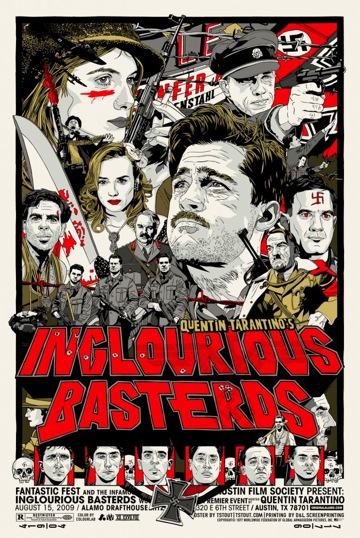
Never mind the Schindlers, here come the Inglourious Basterds

Never mind the Schindlers, here come the Inglourious Basterds
(Image Courtesy: Scanners)

If there is any filmmaker whose single film could evoke comparisons ranging from Happy Gilmore (1996) to La Dolce Vita (1960), it would have to be Quentin Tarantino. But why not? Here is a director who has made a name with his unique style that more or less marries the crassest and the classiest of film elements. It almost seems like no matter what film you name, you can always find a connection to Tarantino’s. Here he is, with his ultra-violent WW2 epic Inglourious Basterds, releasing in India on the birthday of a person who has become an icon of non-violence. An unimaginably large number of essays, analyses, critiques, blog posts and reviews have cropped up within weeks of its release, with opinions running the gamut, and that just goes to show how provocative this one is. It has even raised questions about creative licenses and the unlimited freedom it has given artists through the years. With Inglourious Basterds, Tarantino strays out of what many people would have till now called his comfort zone and has proven once and for all his status as an pop auteur. Inglourious Basterds may not be the film of the year, it may not even be the director’s best film, but it sure is the most important film of the decade.

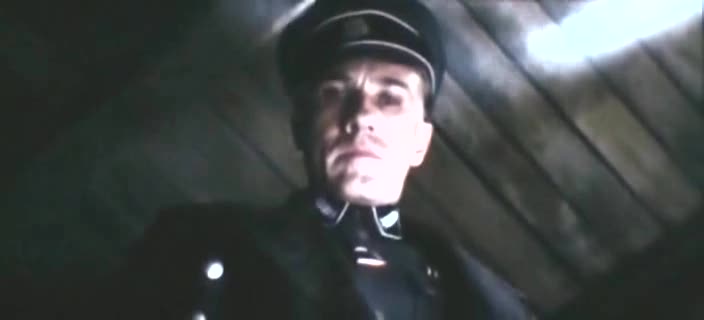
For the uninitiated, here is the central premise of the film. Nazi propaganda minister Joseph Goebbels (Sylvester Groth) has just produced a film titled Nation’s Pride involving the real-life exploits of a Nazi Private Frederick Zoller (Daniel Brühl), who plays himself in the movie and which is going to be screened a cozy little theatre in Paris owned by a Jewish woman Emmanuelle aka Shoshanna (Mélanie Laurent). A group of American Jewish soldiers now called The Basterds, led by Lieutenant Aldo “The Apache” Raine (Brad Pitt), along with inputs from the allied forces plans to blow up the theatre in order to get the leading Nazi men including Hitler (Martin Wuttke). However, to complete their mission they have to get through the cunning and powerful Colonel Hans Landa (Christopher Waltz) who is in charge of the security at the grand event and who never leaves any stones unturned to trace out the Jews that the Nazis are in search of. Meanwhile, Shoshanna, whose family was murdered four years ago by Landa plans for her own revenge by blowing up the cinema hall using inflammable nitrate films that she has stocked through the years. Of course, as always with Tarantino, this summary is completely unimportant in comparison to what he achieves in the film.

With Inglourious Basterds, gone are the romantic days of Renoir when a couple of gentlemanly officers could end the war over a cup of tea. Now, deals are meant to be broken, enemies are meant to be stabbed from behind their backs and friends are supposed to be ratted on. Enemy corpses aren’t supposed to be given a proper burial, but should have their scalps removed. Instead of receiving a gentle kiss on their hands, ladies have their necks wrung. “I respectfully disagree” makes way for a “*bleep* you”. “Nat-zi ain’t got no humanity” replaces universal brotherhood. And scheduled duels are substituted by under-the-table gunfights. Everything in Inglourious Basterds is guerilla-esque, everyone in the film remains true to the title of the movie.  Nothing is sacrosanct, everything is to be questioned. Tarantino’s army is one that lives and moves in the shadows. What you see most definitely isn’t what it is. Like the film hints in the card game that the officers play in the tavern in the fourth chapter, the inhabitants of Tarantino’s new universe wear so many masks one over the other that it almost reduces to a Scooby Doo adventure. One isn’t supposed to believe what one sees, even if it’s all written out there.

The idea is simple. Inglourious Basterds is a 5-set tennis match. The Jews win it 3-2. For every Nazi set, there is a Jew set that follows. Throughout the film we see characters trying to get the upper hand and stay on top in whatever way possible. Even within individual chapters small scale power games are at work and one isn’t always sure how it is all going to turn out. The final images of these chapters alternate between images of the Nazis and those of the Jewish characters – Landa kissing Shoshanna goodbye, Raine carving out a swastika on a Nazi soldier, Shoshanna planning the film, Landa digging out Hammersmark’s shoe and Raine, again, with his masterpiece – much like a close tennis match. Each sequence, each shot and each dialog seems and feels like a tennis rally. The director regularly places his actors on either side of the widescreen and the audience’s eyeballs are made to go left and right throughout each conversation. Tarantino’s editing pattern could well apply to a Wimbledon telecast, for it mixes over-the-shoulder shots and two shots effectively as if providing both the audience’s and the camera’s viewpoints of the “match”. And of course, Tarantino’s writing ensures that we get the reward for the tense stretch of time he puts us through during each conversation.

The mere skeleton of the plot would reveal that Tarantino is reversing conventions here. For once, he is allowing the Jews to kill Hitler. But Tarantino keeps underlining, hinting, presaging and highlighting this reversal of roles between the Jews and the Nazis throughout the film. There is some sort of reversal going on within each structure and substructure of the film. Take the magnificent first chapter of the film wherein Tarantino throws at us everything that the film will offer us in the rest of the chapters. As Landa sits at the table, surrounded by the farmer’s family, it looks as if it is Landa who is being questioned. We are soon proven wrong and Tarantino’s majestic train of role-reversals kicks off once Landa starts digging. In a Bertoluccian touch, Tarantino keeps breaking the 180 rule without any hesitation, allowing his camera (helmed by ace cinematographer Robert Richardson) to wander into both sides of the two-shot setup to suggest the inversion of the hunter-prey relationship that adorns the whole conversation. Even his dialogues are decorated with such rhetorical clauses like “If I were in your position…” and “If you were in my shoes…”. Or consider the way he writes the first and final chapters such that they mirror each other entirely. If the Nazis kill a few Jews hiding below them during the first chapter, the Basterds will similarly gun down hundred times that number of Nazis in the last one. If Landa lights up his pipe to create a small smoke cloud in the farm house, a whole cinema hall will be burnt by the Jews. If LaPadite (Denis Menochet) is the betrayer of Jews in the opening chapter, Landa will become the traitor among the Nazis in the final chapter. Both Tarantino’s camera angles and his actor placements locate and relocate the relative positions of the Jews and Nazis throughout the film in a manner that recalls the way young Bertolucci handled his mise en scène in The Conformist (1970), which too revolved around faked identities and interchangeable personas and which Tarantino seems to be alluding to in the final few minutes of the movie.

Inglourious Basterds - Landa

Inglourious Basterds - Raine

Tarantino really puts his audience in a dicey situation here. Inglourious Basterds has been called a revenge fantasy. But never does a character in the film mention that it is a mission of revenge. The Holocaust hasn’t yet happened in the movie time and there are only hints of the Nazi’s plans for the Jews. It is only in hindsight, with the knowledge of what happened in reality, that we are able to call the film a revenge saga. If there is someone in the audience who is oblivious to Holocaust, the film might just appear otherwise. Tarantino teases us with the notion that revenge is the same kind of crime as the one that instigates it, but aided and justified by the passage of time – an idea that was ineffectively explored in Gaspar Noé’s positively disturbing Irreversible (2002). Tarantino lets the two worlds – the “real” reality and the film’s reality – collide and one’s response just depends on how much of a balance one wants to maintain between “what happened” and “what happens”. We can choose to either draw the line between “what-might-have-happened” fiction and “what-couldn’t-have-happened” fiction early on in the film or wait till Tarantino draws it for us in the last chapter.

Some commentators have suggested that Inglourious Basterds tries to humanize the Nazis and gain sympathy for them. But, surely, it isn’t the fault of the movie that we pity the SS officer when the Bear Jew prepares for the homerun or when the Nazis turn to ashes in the theatre. It is simply the ways movies work. Given a pattern of narrative, we seem to generally tend to support the weak, the suffering and the oppressed, thanks to our morality. Be it aliens of sci-fi flicks, tribes of exotic countries or mute animals of the jungles, we tend to patronize them, putting them on our moral scales. When, in A Clockwork Orange (1971), Alex de Large (Malcom McDowell) is trained to respond in a predictable fashion to certain impulses at the reformatory, Kubrick, in some ways, is speaking in a self-reflexive fashion. Alex is pure evil and there can be no other justification for his acts other than the fact that he is an evil-doer. Even so, Kubrick makes us accomplices to his acts and eventually makes us root for him. It is Kubrick who is manipulating his audience as a cosmic joke. And it has taken around four decades for some filmmaker to stimulate us in such equally provocative fashion and, in the process, make us evaluate our own moral standing and the way we tend to judge characters – on and off-screen. Speaking of A Clockwork Orange, Hans Landa drinking his glass of milk is reminiscent of and as chilling as Alex holding it in Korova Milkbar

Tarantino adorns the movie with a slew of sight gags, much like the ones we see in the Bugs Bunny cartoons, almost none of which actually fails. During Landa’s interrogation of LaPadite, at one point, he unveils his gigantic, almost unreal, smoking pipe dwarfing that of LaPadite. In the fourth chapter, when the Gestapo officer comes from within the tavern to question the officers about their accent, we see a huge whisky glass in front of him that’s unlike anything we’ve seen in the scene. Even in the last scene, when Landa hands over his knife to Raine, we are shown that Raine’s knife is the bigger one!  Furthermore, during the second chapter, as we are introduced to Hitler, he is posing for a gigantic portrait, indicating that his image is much more formidable than the man himself, whom Tarantino is happy to caricature. In fact, all these in-jokes would have fell flat if Inglourious Basterds had indeed played out as a straightforward drama. Thankfully, Tarantino’s characters are themselves cartoon-ish in nature, hence justifying whatever deformation Tarantino does to them and his attempts to reduce intense and delicate power games to petty mine-is-bigger arguments.

Tarantino doesn’t just bend and blend genres here, he takes them along the movie. His characters don’t simply absorb from genres, they are the genres. Inglourious Basterds is the kind of movie that will happen if a filmmaker casts non-actor cinephiles to act in a WW2 movie. Tarantino’s history is not a history given to him by text books (which by itself is a corrupt version), but one given to him by cinema. His characters aren’t those defined by the WW2 setting of the film, but ones from our age that have strayed into a WW2 movie. These aren’t characters have evolved from the film, but ones that have been pushed into it. What Tarantino does here is that he picks stereotypes from every genre of popular cinema and cooks them up in his WW2 broth.  In Godard’s Pierrot Le Fou (1965), the titular character tries to chew more than he can bite by jumping from one genre of cinema to another and trying to pirate the film away from the director to places only he wants to be (Early in the film, director Samuel Fuller tells us that movies are all about emotions). Continuing the tradition of Godard’s influence on Tarantino, Inglourious Basterds too absorbs quite a bit from the French, especially Pierrot. In Tarantino’s film, too, each character tries to hijack the movie from the genre it is supposed to be, as if protesting the director’s decision of forcefully situating them out of place.

[Inglourious Basterds Trailer]

Almost every character in the film tries to own a sub-genre. With his ultra neat conversational ethics and table manners, not to mention the tinge of narcissism, Landa is the quintessential smooth-talking secret agent (Landa himself insists that he is a detective later on). Aldo Raine is the leader of the men who are on a mission type, with his I-don’t-give-a-damn attitude. Shoshanna thinks she is the next Beatrix Kiddo, with her all-red femme fatale act. Poor little Zoller tries to be the romantic hero despite his designation in the film. Bridget von Hammersmark (Diane Kruger), already an actress, wants to be the deadly female spy (someone mentions Mata Hari as she talks during the tavern scene). Lt. Hicox (Michael Fassbender) is altogether from a different country’s cinema, with all his ethnic and lingual idiosyncrasies intact (“Well, if this is it, old boy, I hope you don’t mind I go out speaking the king’s?” ha!).  Even Herr Goebbels seems to think that he is in a B-grade sci-fi flick (“I have created a monster” he says). Much has been said about the corny celebratory ritual that Donny Donowicz (Eli Roth) performs at the end of his “innings”, but that only conforms to the genre that he is – the B-Comedy subgenre (Apparently, Adam Sandler was to play this part – who else?). You’ll either love his lines (and his bizarre nasal accent) or hate them, depending on how much you appreciate such type of comedy.

Apart from playing out their genres in the movie, the characters in Inglourious Basterds keep assuming different nationalities and ethnicities. Faking accents, speaking multiple languages, feigning papers and changing appearances seems to be order of the day. Characters are recognized using ethic slurs and covers are blown with the minutest of faux pas (which sort of brings back the scintillating experience of watching last year’s treasure In Bruges, which got everything right when it tried to marry the most serious of genre elements with the most absurd of situations). “I am a slave to appearances” confesses Aldo Raine as he handcuffs Landa in the final scene. Everyone in the film is. The multilingual Landa wants the Italian names to have a ring to them. The “little man” is unhappy about the unfair nickname that the Germans have given him. Hitler is convinced that the Bear Jew is a golem. Shoshanna goes to the extent of performing a full fledged ritual for this purpose. Right from the misspelt title you are told that what it looks or sounds like isn’t what it is. Tarantino pulls our legs as he switches the subtitles on and off throughout the movie, giving us only the most basic of information and leaving the rest to our ‘expertise’.

Tarantino’s complete disregard for the content of his film and his prankster attitude towards it are characteristic of Jean-Luc Godard too. But even with all the influence Tarantino has managed to kill his “father” with a distinct style that borrows from Godard’s yet deviates starkly. The greatest asset that Tarantino seems to possess is the ability to maintain a consistent tone in the movie. Even when he marries genres as wide and fatal as melodrama and thriller, he maintains a certain kind of detachment from it that lends these sequences a tongue-in-cheek flavour which unites them under a single stylistic umbrella despite their vast disparity. One deadly flaw that Vishal Bhardwaj’s Kaminey (2009) had was that, in an attempt to marry genres, he ended up marrying styles too, which made the film be nothing more than a surface imitation. On the other hand, even when he cuts to cheesy in-movie documentaries (narrated by Samuel L. Jackson), again reminding us of Godard’s My Life To Live (1962) where the director seamlessly includes a mini documentary that lists down statistics and factoids about prostitution in Paris, Tarantino maintains a strong grip on the filmmaker’s gaze towards his subject, never allowing us to mistake him for inconsistency of style.

Tarantino’s idea of filmmaking is akin to blowing a balloon. He blows and blows, till the onlookers cringe and then he allows it to pop. The mantra, for him, seems to be not “if it bends its funny, if it breaks it’s not funny”, but “if it bends its funny, if it breaks it’s funnier”. This way, I guess one could call him anti-Hitchcockian. Hitchcock’s sums up his legendary theory of suspense thus:

There is a distinct difference between ‘suspense’ and ‘surprise’, and yet many pictures continually confuse the two. I’ll explain what I mean.

We are now having a very innocent little chat. Let us suppose that there is a bomb underneath this table between us. Nothing happens, and then all of a sudden, ‘Boom!’ There is an explosion. The public is surprised, but prior to this surprise, it has seen an absolutely ordinary scene, of no special consequence. Now, let us take a suspense situation. The bomb is underneath the table, and the public knows it, probably because they have seen the anarchist place it there. The public is aware that the bomb is going to explode at one o’clock and there is a clock in the décor. The public can see that it is a quarter to one. In these conditions this same innocuous conversation becomes fascinating because the public is participating in the scene.

The audience is longing to warn the characters on the screen: ‘You shouldn’t be talking about such trivial matters. There’s a bomb underneath you and it’s about to explode!’

In the first case we have given the public fifteen seconds of surprise at the moment of the explosion. In the second case we have provided them with fifteen minutes of suspense. The conclusion is that whenever possible the public must be informed. Except when the surprise is a twist, that is, when the unexpected ending is, in itself, the highlight of the story.

Take the case of Tarantino. The audience always knows the outcome of his set pieces – that the balloon is going to pop one way or the other. Additionally, he doesn’t inform his audience of the popping time. Instead of making us ask questions like what will happen, he makes us ask when will it happen (and here, Tarantino likes to stretch the audience’s patience). Furthermore, Hitchcock preferred not to make that bomb of suspense explode, for he believed that it will make the audience uncomfortable, whereas one can bet that Tarantino will relish in showing what you expect (Not only will the Hitchcockian bomb explode, but limbs will fly, heads will roll and blood will flow). In fact, in Inglourious Basterds, not only do the Basterds’ bombs explode, but the theatre burns as per Shoshanna’s plans, Landa’s “private” bomb goes off and Donowitz and Ulmer (Omar Doom) manage to machine gun down the Nazis. Talk about beating a dead horse. But, on the other hand, Tarantino also uses a lot of the master’s techniques in Inglourious Basterds as he builds the film with the aid of a series of Red Herrings and Macguffins (One could have sworn that Landa had Shoshanna when he orders the milk). I am, however, undecided about the violence that the director depicts since it doesn’t work just on a purely cartoon level as in the Kill Bill movies. Here, the violence is closer to reality and one only wonders if Tarantino would have lost anything at all if he had cut away before the moment of gore.

But Tarantino’s film, like all his other works, is at heart about cinema. His streak of film references and tributes continue as he recalls a number of films from the past that he has grown up with. He pays homage to German cinema throughout Inglourious Basterds with a large number of Dutch angles that never once feel forced or out of context. In the final chapter, which begins with images recalling Fassbinder’s The Marriage of Maria Braun (1979, complete with the 360 degree Ballhaus shot), Tarantino takes this fetish to a whole new level. The film within the film, Nation’s Pride (actually directed by the Bear Jew), presents to us a German propaganda movie made in the style of a Soviet propaganda movie, Battleship Potemkin (1925) in particular, forming an unusual alliance between two countries that could have only been possible in cinema. This whole set-piece works on multiple levels of realities. If Goebbels is making a fiction within the fiction based on a distorted form of reality within the fiction, Tarantino too is making a fantastical fiction that relies on betraying reality. Only that Tarantino’s ethics are far from Goebbels’ (which is actually the way Hollywood tells it). It’s certainly less exploitative to heavily exaggerate a reality that never was than to mildly dress up a reality that was.

Early this year, Tarantino called Woody Allen’s widely and undeservedly trashed Anything Else (2003) one of the 20 best films made after he entered the industry. And not surprisingly, much is common between these two films despite their stylistic differences. In Anything Else, David Dobel (Woody Allen) tries to break out of the schlemiel image that the director had created for himself through the 70s and the 80s. “The issue is always fascism” he says in the film and he smashes the car windows of two thugs who bully him out of a parking space. What Woody was trying here is to undo history – both personal and collective – as he guides his younger self, Jerry Falk (Jason Biggs), who prefers “writing a biting satire in the quiet and safety of some delicatessen”, away from what he has become. Tarantino realizes that the only way to undo history, if not in reality, is through art and that art, in many ways, does not owe anything to political and historical “reality”. When Shoshanna switches from one projector to another during the screening, she is actually shifting the movie from one reality onto another – from a history we all know to a history that could have been.

[Tarantino interview]

Tarantino’s mission of trying to carve out a fantastical alternate reality isn’t really a unique one. In Godard’s magnum opus History of Cinema (1988-98), he keeps talking about two kinds of histories – the history that was and history that could have been – of cinema and that of the world. He argues that cinema could have indeed prevented large scale mishaps and put an end to Nazism once and for all. Tarantino realizes that this is nothing more than an elegiac fantasy and makes a joke out of it all telling us that the only way cinema could have brought about a political change was physically – by blowing itself up. And that the only way it could have ended Nazism was by putting them all into a large room and burning it down. In a scene that echoes the final few minutes of The Cameraman’s Revenge (1912), which was a film that reflected our tendency to believe that if it is cinema it must be true, Marcel (Jacky Ido) burns the pile of nitrate films to blow up the theatre as a huge heap of bullets piles up on the screen resembling it. With that, Tarantino is happy to plainly flesh out his idea of history that could (should) have been.

His attempt, like Allen’s in Anything Else, is to shatter the image that, especially popular cinema, has bestowed upon minorities of America through its incessant ethnic stereotyping – the suffering Jew, the benign black and the noble Native American. Let’s face it; it would only be a miracle if we ever see a black/Native villain in a summer blockbuster. So in a way, the revenge, led by Aldo-Shoshanna-Marcel, isn’t merely a fantastical Jewish revenge for the Holocaust, but a revenge for all the minorities and nonconformists of a cinema (industry) whose fascist producers insist upon maintaining status quo and sticking to a “final solution” (No wonder Marcel burns the movie reels). For Tarantino, who has been a popular nonconformist throughout his career in Hollywood, this is surely the sweetest revenge fantasy possible. It is his fairy tale and he is telling it the way he wants it to be. When Landa finds a single shoe in the tavern following the shoot out he must have realized he is in someone’s Cinderella story. The truth is that it’s Tarantino’s.


Verdict:

P.S: Christopher Landa delivers the performance of the year. His scene with Hammersmark is one to worship.


Essential Reading:

Jim Emerson’s series of articles on the movie at Scanners

David Bordwell’s take on the film at Observations on film art and Film Art

The Auteur’s Round-up of articles in their Notebook

Mark Baker, Adrian Martin, Jan Epstein and Nathan Wolski discuss the film’s wider aspects at The Monthly

Ed Howard and Jason Bellamy in conversation at The House Next Door

Sounds From A Town I Love (2001)
Woody Allen
USA
3 Min.


Long before young directors started professing their love for their hometowns through segment films, we have had directors whose relationship with their city has been more than a mere proposal. I mean, what would Fellini be without Rome, Scorsese without New York or Truffaut without Paris? And how can one ever forget to add the love affair between Manhattan and Woody Allen to that list? Sounds From A Town I Love (2001) was made as a part of the New York Concert that was held following the 9/11 attacks and presents us snippets from phone conversations of random individuals walking on the streets of the city. When the Academy decides to hand the life time achievement to Allen, they might very well go with this clip for the introduction because Sounds, in a way, helps to sum up the whole career of Woody Allen and, in particular, his style of script writing. The throw-them-all-you’ve-got attitude that is so consistently manifest across his filmography and also within each film is very evident in this short too. Most of the one liners work, big time, and some don’t. The camera tracks, in a way that seals the authorship of the film, along with the actors who deliver these lines the same way that Woody the actor himself would have done. Extremely neurotic and utterly funny at once, these characters are all blasts from the past for anyone who has relished the director’s films. The neighbourhood, which is the raison d’etre of this short, is quite familiar to all of us now and only adds to the nostalgic trip. And that introduction message by the director, where he promises his fans that he would make up for it if they felt that this short film was bad, just goes to show how his relationship with his audience has changed post-Deconstructing Harry (1997)

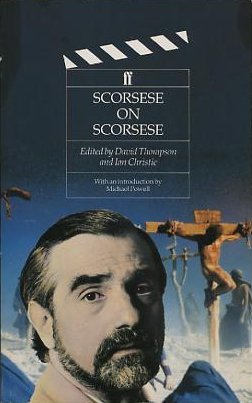
Scorsese On Scorsese
Martin Scorsese (Edited by: David Thompson and Ian Christie)
Faber and Faber, 1979
 

“But prayer is really dealing with what you have in the home, dealing with the family, how you raise your children, how you relate to your wife. May be that’s what prayer really is in the modern world”


–    Martin Scorsese (Scorsese on Scorsese, 1979)


Scorsese on ScorseseAmazingly, last night I had the most memorable dream of my life and the best part is that I remember all of it in detail. I was at Scorsese’s house and talking to the man himself about the cinema in India and the deteriorating state of old regional films. How about that?! Dr. Freud would immediately remind me that I had finished reading Scorsese on Scorsese just the day before. Whatever the case is, reading Scorsese on Scorsese is best approximated as an extended conversation with the director. In fact, editors David Thompson and Ian Christie have done a splendid job by keeping factual autobiographical details to the minimum, presenting them as small italicized snippets between Scorsese’s talks, hence removing any hindrance for us to speak with Scorsese the man and Scorsese the director. Though compiled from a set of lectures and interviews the director had given around the world, Scorsese on Scorsese never gives you the feel of an authoritative person directing you towards what you have to know. Instead, Scorsese recollects events, almost from the top of his mind, lets us interpret and thus get to know the man and his films more.

Divided into six chapters, the first of which details his childhood and teenage memories and the rest taking us virtually through the making of each one of his movies, Scorsese on Scorsese is a joy ride for any film buff. There is much humour throughout the book and at times you almost hear Scorsese break out with his characteristic and infectious laughter. Many would agree if I say that Scorsese is one of the biggest film buffs of the world and this opinion is established as a fact in these texts. There is almost no line in the book where you don’t hear the man come up with a movie comparison or a simile that is related to the movies. Even in the most commonplace of statements, like feeling sick on the sets (“…I was coughing on the floor and sounding like a character from The Magic Mountain”), recalling parking problems (“…but destroying things as in a Godzilla movie”) or describing the streets of New York during summer nights (…reminds me of the scene in The Ten Commandments, portraying the killing of the first born, where a cloud of green smoke seeps along the palace floor…), Scorsese’s never flagging enthusiasm for the cinema surfaces.

Scorsese on Scorsese is a must-read for anyone who doubts Scorsese’s status as a genuine auteur. As one moves along in the book, one sees that all of Scorsese’s characters have a bit of Scorsese in them and could be seen as extensions of his personality in a fictional world (Be the screenplay officially by Schrader, Price or Minion, Scorsese invariably seems to have had a hand in their final versions). Although the book covers the directors career only till New York Stories (1989), one can see the same phenomenon carry on in his later films too. As Scorsese goes on explaining how each movie, each scene and each set piece came about one can actually see the deep influence that his childhood and teenage has had on his thought process and his vision of the world. He elaborates on what made him take to priesthood and then the transition to cinema (He says: “In my neighbourhood, the people in power were the tough guys on the street, and the Church. The organized crime figures would tip their hats to a priest and watch their language, an they would have their cars and pets blessed”).

This book was compiled just after The Last Temptation of Christ (1988) hit the screens and it is evident that the whole book centers itself on this event. Right from the unusual introduction chapter, which recounts the events that preceded the release of the controversial movie, one can see that the authors intend to take a look back at the director’s career standing at this historical point. The concept of religion is also manifest in Scorsese’s talks throughout the book as he subtly reveals how his experience during the days as a young priest, away from the meanness of the streets, shows itself in almost all his early films. Be it overt as in Mean Streets (1973) or underneath as in Taxi Driver (1976), the idea of God and religion, Catholicism in specific, seems to be always present, mostly in the form of a hope for redemption, in his movies. In hindsight, The Last Temptation of Christ almost looks like a confrontation of sorts with his own inability to reconcile between what he learnt in the Church and what he saw in the streets.

Another interesting thing is that even though he has had to put up with a lot, Scorsese never dwells on the difficulties much. Yes, he does talk about them in detail, but he makes all his travails sound like simple trivia and things of distant past. It is remarkable how he has earned the title of a major Hollywood director (in spite of his legendary association with New York), especially after his near ostracism by the studios after The King of Comedy (1982). He makes the trouble he had shooting After Hours (1985) and The Color of Money (1983) sound so amusing that one tends to overlook how appallingly tough it must have all been. The book complements these accounts with loads of rare, behind-the-scenes photographs from his movies, the complete story board of the final scene in Taxi Driver drawn by the director himself and other stills from famous movies, including the ones he cites as inspirations, placed side by side as if the director himself is showing us what went through his mind when he made those compositions. There is even a still of Michael Jackson and Martin Scorsese in discussion during the shoot of Bad (1986)!

During the course of all this recollection, Scorsese talks about some abandoned scripts and some ideas for future that now seem so fascinating. He talks about a script called “Gangs of New York” that couldn’t be realized (and which eventually got made in 2002 perhaps with much change), he mentions that he doesn’t really want to do remakes (he made Cape Fear (1991) almost immediately!) and that he was immensely influenced by the music in the Moroccan film Transes (1981) (which has now got restored by the World Cinema Foundation headed by him and shown online for free!). Those who still think that Scorsese has sold his soul to Hollywood of late, I think, would see that The Aviator (2004) is as personal a movie as Taxi Driver or Raging Bull (1980) once they read this book, or rather this memorable evening of reminiscing with Scorsese. At the end of it all, it feels like if Scorsese had indeed taken up priesthood as a profession, which seems to have seemed very likely, the world would have got one good priest more but one great director less. Now, what kind of an unfair exchange is that!


Verdict:

P.S: Scorsese on Scorsese contains one of the greatest forewords that I have read. I type it down for you here:

What’s Hecuba to Him?

The first Martin Scorsese film that I saw – or that saw me – was Alice Doesn’t Live Here Anymore. The actors were directed with assurance. There was not a frame wasted. I said to myself: Michael Powell, you’re going to have a good time – this man knows where he’s going and you’re going with him. On the screen we were entering a fast food emporium, with two splendid actresses volleying words and phrases at one another. It was like watching a singles match on centre court at Wimbledon, between two champions. I hadn’t seen match play like this since I saw Pat and Mike.

We screened Taxi Driver. ‘Stop! Stop!’ I said. ‘Who’s that devilish actor who plays the Devil in the scene with Robert De Niro?’
‘That’s Scorsese.’ Said my friend, who had arranged the screening.
‘What! Can he act too?!’
He smiled, ‘want more?’
‘Is there more?’
He nodded vigorously. ‘Much, much more.’

He arranged a screening of Mean Streets. It was in a little projection theatre off Wardour Street, London WI. There were four of us and the projectionist. When the screening ended, we looked at each other, stunned. The five of us crossed a narrow street and went into a pub that was just on the verge of closing. Nobody else was there. Still we said nothing. There was nothing to say.

All art is one, and every artist owes a duty to his art. We can’t all be masters, but we can know a master when we see him, because he has something to say to us, and sooner or later imparts it. The difference between these films of Martin Scorsese’s is that with Alice and Taxi Driver he handles the materials like a master; with Mean Streets he is in direct contact with the audience, from the beginning to the end. This is the rarest gift given to a movie director. Most directors, however wise, however experienced, however resourceful, however bold, don’t have it and never will have it. Marty always had it.

He has this great, generous gift of creating a situation for an audience, and sharing it with them. He is the ventriloquist and his doll, the singer and the song. In his latest film, Life Lessons, Marty performs the same miracle, he is the painter and his palette, he is the pupil and the master, he is the cunning of the fox and the innocence of the child, he is the voice of the tape deck screaming ‘A Whiter Shade of Pale’.

When Hamlet sees the tears in the Player’s eyes, and asks Horatio:

What’s Hecuba to him or he to Hecuba
That he should weep for her?

he is asking the same question that we ask of ourselves when Scorsese, in The Last Temptation of Christ, gives us our first glimpse of that hill called Golgotha. For, as the tears spring to our eyes, we know that we shall see that hill again, and then it will be our last sight on earth – and his.


Michael Powell
March 1989

Transformers: Revenge of the Fallen
 

Verdict:

Stanley Kubrick Directs:  Expanded Edition
Alexander Walker
Harcourt Brace Jovanovich (HBJ), 1972
 

A brief internet research about the best books written about the life and works of Stanley Kubrick gave me quite a few results with Alexander Walker’s Stanley Kubrick Directs (Expanded Edition) topping the list. Since there wasn’t any book called Kubrick on Kubrick, I had to go for this one! Stanley Kubrick Directs is literally a page-turner, for it contains more images than text. The book is divided into six sections – The Man and Outlook, Style and Content and four chapters dedicated to four of Kubrick’s most famous films.

stanley_kubrick_directsA friend once remarked that there was spirituality in the way Max Ophüls’ camera moved. I was reminded instantly of Kubrick then. But surely, not for the same reason. Kubrick’s tracking shots are anything but spiritual. I should label them “satanic”. These bewitchingly ominous shots, in my opinion, are the essential sequences from each of the films – be it in the French war trenches, in Korova Milkbar or aboard the Discovery space shuttle. And reading that Kubrick was impressed by Ophüls’ films forced a smile on my face. This is not the only reason that I find the opening section of the book – Stanley Kubrick: The Man and Outlook – fascinating. Walker presents us all of Kubrick’s preoccupations as a child and as a teenager and later establishes how the reverberations of these influences find their way to most of Kubrick’s films. As a film buff, it is rewarding to dig deeper into Kubrick’s films after reading these facts.

But Walker follows it up with the most disappointing of all sections in the book. In this section, titled Kubrick: Style and Content, Walker aims to present us the working methods of Kubrick. Unfortunately, this part turns out to be nothing more than a briefing of Kubrick’s early films, till Lolita (1961), interspersed with elaborations of some obvious facets of Kubrick’s films. Walker’s digresses without hesitation and adulterates the section with facets not in line with the chapter’s objective and analyses that at times seem downright speculative.  As a result, this section seems like a poor excuse for a ramp up to Kubrick’s masterpieces that were to follow.

The book then presents us illustrated analysis of Kubrick’s Big 4 that followed – Paths of Glory (1957), Dr. Strangelove (1964), 2001: A Space Odyssey (1968) and A Clockwork Orange (1971). The first two films here take up two thirds of the analysis section and ironically are the least satisfying. Both the analyses of Paths of Glory and Dr. Strangelove are fraught with screenshots (by Halcyon) that are subsequently verbalized. Having presented the early influences of Kubrick, Walker should have let the audience connect the dots and interpret the film their own way. But he starts deconstructing Kubrick’s mise-en-scene frame by frame and strips us completely of the joy of discovering a film. No, I’m not cribbing, but it is a bit discomforting to see such great films presented cut and dried, preventing further exploration the reader may otherwise be tempted to perform. I know this is an analysis, but why at such grassroots level?

Surprisingly, Kubrick’s most profound film is given the least space. A big positive for this section is that it does not go over the top like many an analysis written on the film. Walker sticks generally to the technical and narrative aspects of 2001: A Space Odyssey and discusses “2001 that could have been” citing various choices made by Kubrick with respect to the script. However, it is dissatisfying to see the film grossly ignored in comparison to the earlier two films and sidelined to a smaller status. The film by itself warrants elaborate literature and any analysis should most definitely include the higher aspects it tries to encompass. Walker just grazes through those notions and it never looks like it is for the good of the audience.

But, comes the essay on A Clockwork Orange to salvage the book’s pride. This is the best of the four analyses and serves as a grand climax to an otherwise dissatisfactory book. This is one section that respects the complexity of the film but never once shirks discussion. Walker makes a great move by not just diluting the mise-en-scene by deconstructing it to particulars. He seamlessly integrates multiple ideas the film presents and provides us a solid critical analysis that clearly shines in comparison with the previous three. And it is this section that provides a sense of comfort when one closes the pretty ordinary book.

This book is widely considered the best book on Kubrick till date and that worries me. Kubrick’s canvas is visibly vast and if this is the best of literature available on him, there is a long way to go. Stanley Kubrick Directs does present considerable detail for people who are confused why he is the most critical Hollywood director on a technical level, but the treatment of the content of his film leaves a lot to be desired. May be I expected a bit too much.

 
Verdict:
 

Note: This is a section where I will be blogging on books on films and filmmakers. The entries will be far and few, but this will at least provide me an opportunity to read text – a thing that I used to hate till now.

The 81st Annual Academy Awards

The 81st Annual Academy Awards

It’s that time of the year again! Yet another year where the whole world is ridiculing the Academy Awards aka The Oscars, yet looking forward to it (to ridicule it of course!). With each film site/blog on earth trying to crack the ever controversial results, I too decided to give it a shot. Originally, I just wanted to cast my vote among the nominees. But hey, a prediction is a win-win situation. If you get them right, a pat for yourself and if not, you get to curse the Academy! Of course, the nominee list itself is ultra-absurd and carefully leaves out the really good films. Here it goes anyway.


Best Motion Picture of the Year

The Curious Case of Benjamin Button (2008): Ceán Chaffin, Kathleen Kennedy, Frank Marshall

Frost/Nixon (2008): Brian Grazer, Ron Howard, Eric Fellner

Milk (2008): Bruce Cohen, Dan Jinks

The Reader (2008): Anthony Minghella, Sydney Pollack, Donna Gigliotti, Redmond Morris

Slumdog Millionaire (2008): Christian Colson


Academy’s Vote: Slumdog Millionaire (2008): Christian Colson

Emotions are soaring high for this harmless and lightweight contender among the residents. And the path to the Oscar doesn’t disagree. This one has got odds of 99 to 1. That 1 is for The Curious Case of Benjamin Button that may just be the darkest horse ever.

My Vote: The Reader (2008): Anthony Minghella, Sydney Pollack, Donna Gigliotti, Redmond Morris

This is an easy choice for me. Not just that the other nominees don’t hold a candle to this one, but The Reader is made in the tradition of finest contemporary films from Europe and its value is going to just escalate with the years. A film that grows on you in the truest sense of the word.


Best Performance by an Actor in a Leading Role

Richard Jenkins for The Visitor (2007/I)

Frank Langella for Frost/Nixon (2008)

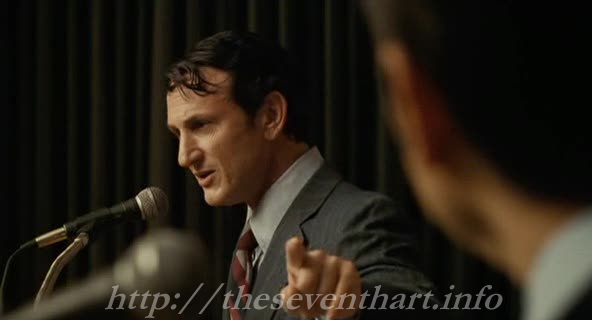
Sean Penn for Milk (2008)

Brad Pitt for The Curious Case of Benjamin Button (2008)

Mickey Rourke for The Wrestler (2008)


Academy’s Vote: Mickey Rourke for The Wrestler (2008)

Oh, it looks like this is a three way race between our horses Rourke, Penn and Jenkins. Oh no, our first horse has fallen. It is Jenkins and it looks like it is going to be a photo finish…. No, no wait. Look at Rourke The Ram Robinson go… Blazing away as if on steroids. He’s taken it and how!

Penn has got the award in 2003 and the Academy will not hesitate from giving it whole heartedly to Rourke.

My Vote: Mickey Rourke for The Wrestler (2008)

Sean Penn may be Frank Capra of the actors, but what Rourke‘s got here is a Citizen Kane. There wasn’t and will never be any performance like this from him. The Wrestler is a great example of what Method Acting could do to a film and there isn’t anyone else who could be cast so effectively. Go Randy Go!


Best Performance by an Actress in a Leading Role

Anne Hathaway for Rachel Getting Married (2008)

Angelina Jolie for Changeling (2008)

Melissa Leo for Frozen River (2008)

Meryl Streep for Doubt (2008/I)

Kate Winslet for The Reader (2008)


Academy’s Vote: Melissa Leo for Frozen River (2008)

This category mirrors the previous one closely with the last three actresses coming in big time (and the Brangelina pair being the filler noms). Kate Winslet seems to be the absolute favorite everywhere. And Meryl Streep would be here even if she had played the lead in Rambo 5. But I have a gut feeling that the Academy will snub the last two again to make up for their mistake that they did with Gena Rowlands

My Vote: Melissa Leo for Frozen River (2008)

Both Streep’s and Winslet’s acting enhance the written characters, but Leo’s performance defines it. Like Rourke, Ms. Leo has pulled off something very unique and probably once is a life time. I would have given an arm for Meryl Streep’s win until I saw Frozen River.


Best Performance by an Actor in a Supporting Role

Josh Brolin for Milk (2008)

Robert Downey Jr. for Tropic Thunder (2008)

Philip Seymour Hoffman for Doubt (2008/I)

Heath Ledger for The Dark Knight (2008)

Michael Shannon for Revolutionary Road (2008)


Academy’s Vote: Heath Ledger for The Dark Knight (2008)

Right from the day Ledger passed away, there has been an onus placed on the Academy. But luckily for them, Ledger comes up with this. Strange that the Academy took it for granted that in a Batman film the villains are always supporting actors. Why do they notice only the unstoppable force and not the immovable object?!

My Vote: Heath Ledger for The Dark Knight (2008)

It would be a crime or a plea for insanity if I vote otherwise. All the other actors in this category, who had done great work actually, had it coming. Downey Jr. plays a very tough character that works on multiple levels of self-consciousness, but The Joker is untamed savagery.


Best Performance by an Actress in a Supporting Role

Amy Adams for Doubt (2008/I)

Penélope Cruz for Vicky Cristina Barcelona (2008)

Viola Davis for Doubt (2008/I)

Taraji P. Henson for The Curious Case of Benjamin Button (2008)

Marisa Tomei for The Wrestler (2008)


Academy’s Vote: Viola Davis for Doubt (2008/I)

No, no. She’s not the token black person. Her performance comes as a surprise, both on and off the screen. Her role could have been called badly cast for she was pitted against three established actors. But she shows otherwise.

My Vote: Viola Davis for Doubt (2008/I)

For me, this boiled down to Ms. Davis and Ms. Cruz. I would have blindly given it to the latter if not for the feeling that she has done this kind of charming act somewhere before, many times.


Best Achievement in Directing

Danny Boyle for Slumdog Millionaire (2008)

Stephen Daldry for The Reader (2008)

David Fincher for The Curious Case of Benjamin Button (2008)

Ron Howard for Frost/Nixon (2008)

Gus Van Sant for Milk (2008)


Academy’s Vote: Danny Boyle for Slumdog Millionaire (2008)

Danny Boyle has reinvented something as far as the West is concerned. They never could come to terms with Bollywood until Slumdog Millionaire showed up to appease them. Mr. Fincher could have posed some threat, but he fails himself. And so does Van Sant.

My Vote: Stephen Daldry for The Reader (2008)

Another sitter of a choice. Stephen Daldry’s direction is uncompromising and his mise-en-scene, meticulously controlled. His immense confidence on his actors and script are one for the arthouses. Take a bow Mr. Daldry. You have to be satisfied with my vote alone though.


Best Writing, Screenplay Written Directly for the Screen

Frozen River (2008): Courtney Hunt

Happy-Go-Lucky (2008): Mike Leigh

In Bruges (2008): Martin McDonagh

Milk (2008): Dustin Lance Black

WALL•E (2008): Andrew Stanton, Pete Docter, Jim Reardon


Academy’s Vote: In Bruges (2008): Martin McDonagh

I may have just gone against my better side of the brain. Though WALL•E is the kind of material that Academy considers its 2001, the film turns spoof-like and a tad restless. Not that the committee considers all that, but WALL•E already has a lock and would have to let go of this one.

My Vote: In Bruges (2008): Martin McDonagh

In Bruges is my favorite fiction of the year and its script would show why. Awe-striking use of the material at hand, McDonagh should have been nominated for the director category too. Genre-bending and genre-blending isn’t restricted to French films and Tarantino alone, says McDonagh


Best Writing, Screenplay Based on Material Previously Produced or Published

The Curious Case of Benjamin Button (2008): Eric Roth, Robin Swicord

Doubt (2008/I): John Patrick Shanley

Frost/Nixon (2008): Peter Morgan

The Reader (2008): David Hare

Slumdog Millionaire (2008): Simon Beaufoy


Academy’s Vote: Slumdog Millionaire (2008): Simon Beaufoy

Academy: “The Curious Case of Benjamin Button is too long, Doubt is too stagey, Frost/Nixon is real, The Reader is too Cannes. Slumdog Millionaire is just about perfect”

Beaufoy packs all that is wanted in this kind of a film with all the vignettes from the country of the snake charmers that is just too good to resist.

My Vote: Doubt (2008/I): John Patrick Shanley

Sober, neat and beautifully rendered script stands out among the five and is going to become one of the most respected films of the decade. Characters are written without prejudices, interaction between the film and the audience remains pristine, never once incriminating or loving its central characters. Top Notch.


Best Achievement in Cinematography

Changeling (2008): Tom Stern

The Curious Case of Benjamin Button (2008): Claudio Miranda

The Dark Knight (2008): Wally Pfister

The Reader (2008): Roger Deakins, Chris Menges

Slumdog Millionaire (2008): Anthony Dod Mantle


Academy’s Vote: Slumdog Millionaire (2008): Anthony Dod Mantle

There is no stopping Slumdog Millionaire. Mantle’s camera is “energetic” and seems to intensify the visuals of the film, though it never determines it. This would seem like a easy choice for the committee.

My Vote: The Dark Knight (2008): Wally Pfister

I would have loved to see Kaminski for Indiana Jones 4 here in the list. Watching The Dark Knight is an experience and Wally Pfister is a prime reason. The tag of an action film will hurt him in the awards ceremony, but the truth is that he has pulled off something humongous and something sweeping that can’t just be covered up.


Best Achievement in Editing

The Curious Case of Benjamin Button (2008): Angus Wall, Kirk Baxter

The Dark Knight (2008): Lee Smith

Frost/Nixon (2008): Daniel P. Hanley, Mike Hill

Milk (2008): Elliot Graham

Slumdog Millionaire (2008): Chris Dickens


Academy’s Vote: The Dark Knight (2008): Lee Smith

This is a close call between Slumdog Millionaire and The Dark Knight, but the Oscar committee would not want to increase the ire of the Batman franchise fans and would give this category to it.

My Vote: The Dark Knight (2008): Lee Smith

Slumdog Millionaire does well, but The Dark Knight’s editing literally zips the film from a 4 hour drag to what it is. Making the audience restless in every sense of the word, The Dark Knight’s Editing hits the nail on the forehead.


Best Achievement in Art Direction

Changeling (2008): James J. Murakami, Gary Fettis

The Curious Case of Benjamin Button (2008): Donald Graham Burt, Victor J. Zolfo

The Dark Knight (2008): Nathan Crowley, Peter Lando

The Duchess (2008): Michael Carlin, Rebecca Alleway

Revolutionary Road (2008): Kristi Zea, Debra Schutt


Academy’s Vote: The Curious Case of Benjamin Button (2008): Donald Graham Burt, Victor J. Zolfo

This one is essentially a competition between the first three nominees. Changeling has been done before numerous times. The Dark Knight doesn’t show out its fantastic art work. And The Curious Case of Benjamin Button visibly makes emphatic statements as far as its production design is concerned. Sweeney Todd (2007), had a similar footing and it went all the way.

My Vote: The Curious Case of Benjamin Button (2008): Donald Graham Burt, Victor J. Zolfo

The Dark Knight’s vision of a nihilistic world is extremely well designed. Gotham City is crafted to perfection, but the film otherwise takes place indoors or in utter blackness. The Curious Case of Benjamin Button wins by a micro margin here with its mystical brown and progressively empty spaces in the film.


Best Achievement in Costume Design

Australia (2008): Catherine Martin

The Curious Case of Benjamin Button (2008): Jacqueline West

The Duchess (2008): Michael O’Connor

Milk (2008): Danny Glicker

Revolutionary Road (2008): Albert Wolsky


Academy’s Vote: The Duchess (2008): Michael O’Connor

Hold on. I have not seen the film per se, but heck, here is a costume drama arriving after a long time and the Academy will not forget to pounce on it. It looks like this one has a lock and I go with the mass opinion.

My Vote: Milk (2008): Danny Glicker

This may be a case of Emperor and his New Clothes (no, pun unintentional) like Van Sant’s films themselves, but Milk’s costume is deliberately sober and simple like the film. There are no special costumes designed to highlight Harvey but makes him one of the very many people of the world. For once, a costume design that conforms to the film’s theme.


Best Achievement in Makeup

The Curious Case of Benjamin Button (2008): Greg Cannom

The Dark Knight (2008): John Caglione Jr., Conor O’Sullivan

Hellboy II: The Golden Army (2008): Mike Elizalde, Thomas Floutz


Academy’s Vote: Hellboy II: The Golden Army (2008): Mike Elizalde, Thomas Floutz

The Academy has two choices – to award either the Rick Baker kind of extravagance or to surprise all with the low-key but formidable make up used in the first nominee. The fact that they did not nominate the first installment in the Hellboy series makes me suspicious.

My Vote: Hellboy II: The Golden Army (2008): Mike Elizalde, Thomas Floutz

I may have voted for The Curious Case of Benjamin Button if not for the intervention of CG that prevents clear classification. Hellboy II: The Golden Army takes extreme pains to present us a world full of unimaginable creatures that should not go unnoticed.


Best Achievement in Music Written for Motion Pictures, Original Score

The Curious Case of Benjamin Button (2008): Alexandre Desplat

Defiance (2008): James Newton Howard

Milk (2008): Danny Elfman

Slumdog Millionaire (2008): A.R. Rahman

WALL•E (2008): Thomas Newman


Academy’s Vote: Slumdog Millionaire (2008): A.R. Rahman

Slumdog Millionaire isn’t like anything Hollywood has ever heard before. Luhrmann teased them with it, but Boyle floods them. If they loved Slumdog Millionaire to death, it is largely due to the emphatic soundtrack that stands tall among mellower tunes.

My Vote: Take a guess!


Best Achievement in Music Written for Motion Pictures, Original Song

Slumdog Millionaire (2008): A.R. Rahman, Gulzar(”Jai Ho”)

Slumdog Millionaire (2008): A.R. Rahman, Maya Arulpragasam(”O Saya”)

WALL•E (2008): Peter Gabriel, Thomas Newman(”Down to Earth”)


Academy’s Vote: A.R. Rahman, Gulzar(”Jai Ho”)

Finally a Masala song to which the westerners have shamelessly let their legs loose. If one loved the film, one would doubly love the fascinatingly-ludicrous end credits pepped up by the fizzy voice of Sukhwinder Singh.

My Vote: A.R. Rahman, Maya Arulpragasam(”O Saya”)

This is essentially choosing one out of two songs for me and O Saya is magical on screen. I would have loved to see The Wrestler and Gran Torino over here, but the votes wouldn’t have changed.


Best Achievement in Sound

The Curious Case of Benjamin Button (2008): David Parker, Michael Semanick, Ren Klyce, Mark Weingarten

The Dark Knight (2008): Ed Novick, Lora Hirschberg, Gary Rizzo

Slumdog Millionaire (2008): Ian Tapp, Richard Pryke, Resul Pookutty

WALL•E (2008): Tom Myers, Michael Semanick, Ben Burtt

Wanted (2008): Chris Jenkins, Frank A. Montaño, Petr Forejt


Academy’s Vote: WALL•E (2008): Tom Myers, Michael Semanick, Ben Burtt

Another close call between WALL•E and Slumdog Millionaire as both of them rely heavily on the environment in the film. WALL•E wins by a margin because the whole of its first half is communicated almost only by sounds and the Oscar people would not hesitate to convert their “aaws” and “oohs” into an award.

My Vote: WALL•E (2008): Tom Myers, Michael Semanick, Ben Burtt

It’s a real joy watching a film that builds its atmosphere on silence, grunts and only a couple of syllables – “Eeeevaaaaa”. The first half of the film is up there with the greatest of silent films and its sound design is extends the possibilities.


Best Achievement in Sound Editing

The Dark Knight (2008): Richard King

Iron Man (2008): Frank E. Eulner, Christopher Boyes

Slumdog Millionaire (2008): Tom Sayers

WALL•E (2008): Ben Burtt, Matthew Wood

Wanted (2008): Wylie Stateman


Academy’s Vote: Slumdog Millionaire (2008): Tom Sayers

Slumdog Millionaire may lose out to The Dark Knight in the Editing category, but this one would be a revenge of sorts. This is one dark horse of a category where it seems like anyone could win without a surprise.

My Vote: Slumdog Millionaire (2008): Tom Sayers

The sounds in the film zip back and forth in time and space like the movie itself and Sayers uses clever sound bridges to extract jolts and jumps from the audience to the maximum. This would be one award that the movie really deserves.


Best Achievement in Visual Effects

The Curious Case of Benjamin Button (2008): Eric Barba, Steve Preeg, Burt Dalton, Craig Barron

The Dark Knight (2008): Nick Davis, Chris Corbould, Timothy Webber, Paul J. Franklin

Iron Man (2008): John Nelson, Ben Snow, Daniel Sudick, Shane Mahan


Academy’s Vote: The Curious Case of Benjamin Button (2008): Eric Barba, Steve Preeg, Burt Dalton, Craig Barron

This is the pacifier for what is going to be one of the biggest snubs of recent years. The CG team here blurs the line between, acting, make-up and animation seamlessly and the others have to nod.

My Vote: The Curious Case of Benjamin Button (2008): Eric Barba, Steve Preeg, Burt Dalton, Craig Barron

This is serious LOL stuff. In a year with a dozen superhero films, only 3 nominees? And what ever happened to Speed Racer? The Curious Case of Benjamin Button has to satisfy itself with one of the minor awards, for which it has done darn well.


Best Animated Feature Film of the Year

Bolt (2008): Chris Williams, Byron Howard

Kung Fu Panda (2008): John Stevenson, Mark Osborne

WALL•E (2008): Andrew Stanton


Academy’s Vote: WALL•E (2008): Andrew Stanton

Is there even a question? The Academy invented this category for Pixar. And Pixar follows the decision up with such gems.

My Vote: WALL•E (2008): Andrew Stanton

I feel bad for Kung Fu Panda. It had wanted so much and did it with all sincerity. But Pixar make it seem like they are in a different genre altogether.


Best Foreign Language Film of the Year

Der Baader Meinhof Komplex (2008)(Germany)

Entre les murs (2008)(France)

Revanche (2008)(Austria)

Okuribito (2008)(Japan)

Vals Im Bashir (2008)(Israel)


Academy’s Vote: Vals Im Bashir (2008)(Israel)

Aah, The Middle East, the oil nations, war, anti-war, politics, wrath of Persepolis. All the Oscar ingredients. Only The Class might stop this one.

My Vote: Revanche (2008)(Austria)

Only seen two films here. I liked Vals Im Bashir very much. But Revanche – what a sleeper of a film! Never thought this one would make it here and turn out so good. A film that I would like to compare with The Reader. This one stays with you long after the end credits roll. That is if you are game for it.


Best Documentary, Features

The Betrayal – Nerakhoon (2008): Ellen Kuras, Thavisouk Phrasavath

Encounters at the End of the World (2007): Werner Herzog, Henry Kaiser

The Garden (2008/I): Scott Hamilton Kennedy

Man On Wire (2008): James Marsh, Simon Chinn

Trouble the Water (2008): Tia Lessin, Carl Deal


Academy’s Vote: Encounters at the End of the World (2007): Werner Herzog, Henry Kaiser

It would seem like the Academy would not award another eco-friendly documentary and give it to the unstoppable Man On Wire. But going by the reputation and long overdue recognition of Herzog (who was promoting the film at the Oscar meet), the Oscar may just go to Encounters at the End of the World.

My Vote: Encounters at the End of the World (2007): Werner Herzog, Henry Kaiser

I’ve seen only a couple of films here too. But an easy choice nevertheless. Encounters at the End of the World is my favorite film (along with In Bruges) of all those in the list and perhaps of the year too. There is no way I can stop myself from voting for and recommending this film. It’s a relentless and shattering exploration of human instincts that just wouldn’t leave you alone.


Predictions Tally: It looks like it is Slumdog Millionaire all the way. The Curious Case of Benjamin Button ate up worthier nominees and in turn is going to be eaten up by the minnows. What a waste!

Slumdog Millionaire (7), WALL•E (2), The Dark Knight (2), The Curious Case of Benjamin Button (2), The Wrestler (1), Frozen River (1), Doubt (1) In Bruges (1), The Duchess (1), Hellboy II: The Golden Army (1), Encounters at the End of the World (1), Vals Im Bashir (1)


Watch this space for the results and comments on those! By the way, there is another set of awards being given away a day before The Oscars – The Independent Spirit Award. If you are a person who takes awards as recommendations, watch out for that one.

That’s it from the Road to the Oscars (RTTO) series from me. Hope we have a great year for cinema ahead.

Good Bye and Good Luck!


[Edit] The Results:

Best Picture: Slumdog Millionaire (2008): Christian Colson

Best Actor: Sean Penn for Milk (2008)

Best Actress: Kate Winslet for The Reader (2008)

Best Supporting Actor: Heath Ledger for The Dark Knight (2008)

Best Supporting Actress: Penélope Cruz for Vicky Cristina Barcelona (2008)

Best Original Screenplay: Milk (2008): Dustin Lance Black

Best Adapted Screenplay: Slumdog Millionaire (2008): Simon Beaufoy

Best Director: Danny Boyle for Slumdog Millionaire (2008)

Best Cinematography: Slumdog Millionaire (2008): Anthony Dod Mantle

Best Editing: Slumdog Millionaire (2008): Chris Dickens

Best Art Direction: The Curious Case of Benjamin Button (2008): Donald Graham Burt, Victor J. Zolfo

Best Costume Design: The Duchess (2008): Michael O’Connor

Best Makeup: The Curious Case of Benjamin Button (2008): Greg Cannom

Best Original Score: Slumdog Millionaire (2008): A.R. Rahman

Best Sound Mixing: Slumdog Millionaire (2008): Ian Tapp, Richard Pryke, Resul Pookutty

Best Sound Editing: The Dark Knight (2008): Richard King

Best Original Song: Slumdog Millionaire (2008): A.R. Rahman, Gulzar(”Jai Ho”)

Best Visual Effects: The Curious Case of Benjamin Button (2008): Eric Barba, Steve Preeg, Burt Dalton, Craig Barron

Best Foreign Language Film: Okuribito (2008)(Japan)

Best Animated Feature: WALL•E (2008): Andrew Stanton

Best Documentary feature: Man On Wire (2008): James Marsh, Simon Chinn

Best Documentary Short: Smile Pinki (2008) – Megan Mylan

Best Animated Short: Maison en petits cubes, La (2008) – Kunio Katô

Best Live Action Short: Spielzeugland (2007) – Jochen Alexander Freydank


Endnote: The Academy has been pretty safe afterall! Except for the odd snubs like Waltz with Bashir and Martin McDonagh, it has played considerably safe and comforming to the previous award ceremonies. Strange to see Asians all over the Kodak theater – more than the amount they were seen in the films of 2007. Whatever. Let’s hope there are some really good and worthy films next year.

Director: Gus Van Sant

Cast: Sean Penn, Josh Brolin, James Franco, Emile Hirsch

The Buzz: Nominated in Best Picture, Best Director, Best Actor, Best Supporting Actor, Best Original Screenplay, Best Editing, Best Costume Design and Best Original Score categories

The Run: Won SAG Award for Best Actor

Milk

A Bit Cheesy

Sean Penn is one of the best actors around. No other actor, save DDL, has been so prolific and so perfect. Every gesture, move and expression that he presents is an indication that the academy has to more than make it up for their gross overlooking of his directorial film Into The Wild (2007). And Sean Penn is the only thing in Milk that actually lives up to all that hype.

Milk depicts the last eight years of Harvey Milk, America’s first “openly gay” statesman. This is a clever decision by Van Sant to spare us of the emotional torture and discrimination that Harvey might have faced in his teens and twenties. He makes the film event driven instead of character driven (which the subject matter might have readily prompted to). He starts off well utilizing newsreels to depict the political drama (without further unnecessary dramatization like Oliver Stone or now, Ron Howard) and shooting only the process of revolution using the most trivial of conversations taking place inside petty buildings. He never highlights Penn’s character and treats him as any other friendly neighbourhood hero. But all is consistent only till the half way. Van Sant is tempted to stage the political rising and breaks out into the open (may be that is the bloody point, but I don’t buy it). Newsreels take a back seat and Van Sant goes Hollywood. The underdog victory, the gruesome and sympathetic murder, the cut to the past, the consequence – we’ve all seen that before. All that one takes back is Penn’s wonderful portrayal of Harvey Milk – a person much more inspiring than the film.

Gus Van Sant has always been an enigma to me. I do not know what people saw in his earlier Palm D’Or winner Elephant (2003) and I do not understand what the hype around Milk is all about. Sean Penn’s masterful performance coupled with Obama’s dream run was perhaps the catalyst required to make emotions soar for the American audience. For me, it remains one of the most disappointing films of the year.

« Previous PageNext Page »