Hollywood


Thunderball (1965)
Terence Young
Bond, James Bond: Sean Connery
Arch Rival: Emilio Largo (Adolfo Celi)
Bond Girl: Domino Derval (Claudine Auger)

Thunderball (1965)

Thunderball (1965)

The fourth offering in the so far successful Bond series, Thunderball,  takes the English agent into the island country of Nassau. The film starts with Angelo, a double who replaces the murdered French pilot Derval, and takes the responsibility of transporting nuclear bombs during a training session . He  tranquilizes the unsuspecting flight crew and crashes the plane into the ocean. Emilio Largo, or Number 2 in the infamous SPECTRE organisation, kills Angelo for protesting and takes away the bombs. Bond, meanwhile, meets Domino in Nassau, who happens to be the Largo’s mistress and tells her the truth about her brother Derval. She helps Bond in going into largo’s lair undercover which reveals Largo’s plans of blowing up Miami. With the help of long tiem CIA friend Felix Leiter, Bond manages to put down largo’s underwater minions and disarm most of the bombs. But Largo’s not down yet…

Undoubtedly the weakest link in the early Bond films, Thunderball is too long, too indulgent and tries too much. The only highlight of the film remains the fantastic underwater sequences that are shot masterfully. Perhaps, the makers got too carried away by the triple success and wanted to take it to a whole new level. Surprisingly remade as an unofficial Bond movie Never Say Never Again (1983) with Connery reprising his role for one last time.

Goldfinger (1964)
Guy Hamilton
Bond, James Bond: Sean Connery
Arch Rival: Auric Goldfinger (Gert Fröbe)
Bond Girl: Pussy Galore (Honor Blackman)

Goldfinger (1964)

Goldfinger (1964)

What followed next would be my favorite Bond film of all time – Goldfinger (1964). In this installment of the series Bond follows Auric Goldfinger, a wealthy gold trafficker whose sole intention remains to control the flow of gold all over the world. He is assisted by his deadpan soldier Oddjob whose throw of his hat can spice a man into two and veteran pilot Pussy Galore and her team of trained fliers. As Goldfinger is concocting a plan called Operation Grand Slam with the Chinese agents Bond overhears and promptly gets captured. Goldfinger later rejoices telling his plan to the seemingly helpless bond. According to it, Pussy Galore’s team of pilots would spread a certain type of nerve gas in the area around Fort Knox and paralyzing everyone around. Goldfinger would meanwhile take a weapon-laden truck into Fort Knox, blow it out and hence destroy the total gold supply of the country. Then the whole world would have to beg him for gold. Mwhahahahaha….

Quintessential Bond film entertains audience with the same charm today as it might have at the time of its release. Intentionally over the top, Goldfinger has become the template of all megalomaniacs that would follow, even the most comic ones. The film’s got everything in boosted proportions – an immensely evil plan, Bond in severe trouble, fantastic action and entertainment. A hat trick film for the young Bond series. You haven’t watched Bond if you haven’t watched Goldfinger.

When Information Technology is lethal

When Information Technology is lethal

Body of Lies is being promoted with the tagline “From the director of Black Hawk Down and American Gangster”.  It is a bit surprising that a director, who has given better films such as Alien (1979) and Blade Runner (1982), has selected two of his lesser films for promotion. But Ridley Scott has the special Knack of jumping from one genre to another genre but still making the film as entertaining as the others. He could well have promoted Kingdom of Heaven (2005) as “From the director of Gladiator and 1492: Conquest of Paradise” or boosted the ratings of the drama A Good Year (2006) as “From the creator of Thelma & Louise and Matchstick Men”.  This time he sticks to the action genre following the moderate success of American Gangster (2007).

Body of Lies follows the Middle Eastern operations of C.I.A as seen by Roger Ferris (Leonardo DiCaprio), an agent who is sent to Amman, Jordan to find clues to the location of Al Saleem (Alon Abutbul), the leader of one of the biggest terrorist organizations around. He is instructed by the higher official in US, Ed Hoffman (Russell Crowe). The whereabouts of Saleem is totally unknown, for the gang neither uses the wired medium nor the wireless one for communication. Ferris decides to take the help of Hani (Mark Strong), the head of the local intelligence who means business and believes that torture and punishment are different. But Hoffman seems to have higher plans, totally oblivious to Ferris, taking its own course based on the whims of the people in power. Trusts are breached, deception becomes the prime weapon and lying becomes the order of the day

In this age of advanced communication and enhanced methods of surveillance, it sounds too easy to detect or monitor a geographical area or even one single person. But Body of Lies reveals otherwise. It tells us that it is not about “In spite of” but about “because of”. Sometimes, it is the concealment of information that helps one gain upper hand and it is the very availability of information that makes one group vulnerable. Hani mentions in the film that America cannot keep a secret because it is democratic. Indeed, it is the ones with the most primitive methods of communication who maintain anonymity and ones like Sadiki fall prey to higher power in the domain.

Russell Crowe time and again comes out with these wonderful supporting roles that one wonders why he doesn’t act more often and in bigger films. His wry wit and over the phone elegance may just earn him a nomination this time too. But the pick, and naturally, is Leo DiCaprio. After his peak of performance in The Aviator (2004), one expects him to cruise through this one and he does. Although not a groundbreaking or fresh role for him, the energy and intensity he infuses into the Ferris character leaves one trembling at the end of the film.

A film that involves communication and, more than that, struggle for it naturally involves various media of conversation and correspondence and the sound department makes crystal clear distinction between, phone lines, walkie-talkies, rendezvous, TV telecasts and footage tapes with élan. And the rhythmic sound editing aids it big time. It is such a good experience watching it in the big screen with a good sound system. The score of the film also needs a special mention and though conventional, Marc Streitenfeld tries different sounds and tempos that separate it from other war scenes and chase sequences.

With a runtime of around two hours and a half, the film is a bit excruciating to watch especially with its incessant thriving on torture scenes, which in other ways do aid the film’s feel. But let’s face it, Ridley Scott’s biggest advantage is the script he churns out with his writers and that is a job half done. William Monahan (The Departed (2006) fame) adapts David Ignatius’ book well and maintains the pace of the film and does not corrupt it with unwanted twists and turns. Even some important plot details are suitably kept off-screen.

A break from the overdose of superheroes this year, it is good to see the normal ones struggling to live for a day. Body of Lies may not be the starting point of the sober films that usually hit the screens in the late part of the year, but definitely serves as the gateway to better films that are going to reap the awards.

Verdict:

From Russia With Love (1963)
Terence Young
Bond, James Bond: Sean Connery
Arch Rival: Red Grant (Robert Shaw)
Bond Girl: Tatiana Romanova (Daniela Bianchi)

From Russia With Love (1963)

From Russia With Love (1963)

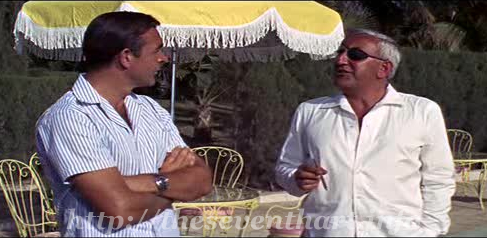
The second in the series of Bond films, From Russia With Love, takes Bond to newer places and heights. In this version, Bond has to capture a decoding machine built by the Russians called Lektor. For this he has to go to Istanbul, Turkey and evade the attempts of SPECTRE to kill him and get their hands on the machine. SPECTRE, the secret organization introduced to us in the previous film, is lead by the unknown Number 1 who will only be revealed in You Only Live Twice (1967). SPECTRE has assigned a female commander, Rosa Klebb, to terminate Bond and avenge the death of Dr. No. Bond is to meet up with Tatiana Romanova, the Embassy official and get the machine from the consulate. They manage to board the Orient Express with the machine. Just as they think they have done their work, they come to know that Klebb is not through yet.

Famous for the absence of the “Bond, James Bond” quote, From Russia With Love lives up to the prequel with more action, more technology and more style. The title sequences, the grand photography and thematic music add up the charm. Many call it the best in the series and the film does live up to all that hype. The film’s premise is so befitting to the cold war era it was made in and no wonder JFK loved this film! A very memorable film as a whole.

Dr. No (1962)
Terence Young
Bond, James Bond: Sean Connery
Arch Rival: Dr. No (Joseph Wiseman)
Bond Girl: Honey Ryder (Ursula Andress)

Dr. No (1962)

The film that started it all – Dr. No. Set in the West Indian country of Jamaica, the film follows a British secret agent Bond who is on the mission of solving the mysterious killing of another fellow British man John Strangways. He eventually arrives to know that a certain island called Crab Key, an arcane place of mysterious happenings, possesses deposits of radioactive rocks and tat Strangways was after the same thing. He also meets Honey Ryder, a shell collecting damsel and as Bond makes way into the island with Honey, he finds out that a huge organization has its base there and is led by Dr. No. After Bond and Honey are captured by the men there, he gets a rendezvous with Dr. No that reveals the organization as SPECTRE. Can bond escape the clutches of Dr. No and save the American rockets from being destroyed by him?

Apart from becoming a historical piece, Dr. No is a damn interesting film with great scenes and a superb score. My favorite Bond title track “Three Blind Mice” is in this film. Sean Connery is the embodiment of style and had already set a very high standard for all the Bond heroes to follow. Although more mellow and deliberate than the subsequent Bond films that had action taking the driver’s seat, Dr. No still remains a must watch for all action fans for the intensity of lead and for the significance of introducing us to quirky yet suave world of Bond, James Bond.

He's back!

With exactly 21 days to go for the next Bond film, I intend to present a series of brief pieces about the 21 official Bond films so far. – One a day – and possibly culminating with the full review of Quantum of Solace. And if you want to gear up for the big event in style, be sure the catch the previous films, preferably, in order. And great news for Indian fans is that they will be getting to watch the film almost on the day of its international release itself.

This series will not provide comprehensive reviews, but will just give an outline of the films, for it is the action and not the words that drive Bond films. Less talk and more watching is the key to Bond films. So sit back and watch the man in action, perhaps with a round of Martini – Shaken, not Stirred!

"How long are we gonna do the same thing?"

"How long are we gonna do the same thing?"

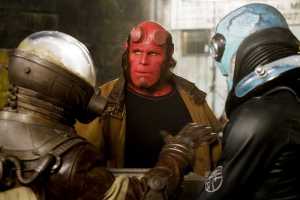
Cigar. Cuban. Now you pissed me off!” says the protagonist of Guillermo Del Toro’s latest venture Hellboy II: The Golden Army as the baddie’s sidekick Wink, yields a blow to his face, making his favorite tool fall into water. With a face that looks like a cross of a samurai and X-Men mutant beast, Hellboy (Codename Hellboy) is a character right out of the pulp magazines.  And with a name like that and a storyline that aids the use of eye-candy incredibly, the producers would always rest assured. Plus one to the count of superhero films in 2008.

So we have here this bunch of four central ultra-cool mutants – The cigar chewing, beer boozing, borderline-colonel Hellboy (Ron Perlman), the earth element, The timid and brainy Abe (Doug Jones), the  water ingredient, the intensely anxious Liz (Selma Blair), the fire girl and Johann Krauss (James Dodd) the German intellectual forming the wind element of the group bound by (the absence of) the fifth element. All hell breaks loose when the exiled Prince Nuada (Luke Goss) of the mythical world decides to call it quits with the truce with the humans that called for peace and aided the banishment of their indestructible “Golden Army”. The film’s best moment, perhaps, comes around this point where we see the mythical prince practicing his sword in a fairly mythical milieu and just as he finishes, a high speed train whizzes past behind him! One feels that he is in for a great time. NO.

But for this, the prince has to unite the three pieces of the all-powerful golden crown that controls the army and hence break his bonds with his family that preserves two of the pieces. Meanwhile, Hellboy and Liz are trying to reconcile with the discerning eyes of the human world and form a happy little familial world for themselves. And when their paths cross, it’s the same thing all over again. Villain hurts hero, hero gets back big time. All this happens on a high-speed, immensely attractive vehicle called Computer Graphics that seems to never tire the audience. Year after year, be what the form, this boon (?) given by science has been regularly and faithfully exploited.

It is clear that Del Toro has the uncanny ability to blend elements of the ever enchanting world beyond the natural – the mythical – with the harsh realities of the existential one. But where Pan’s Labyrinth (2006) scored was in its treatment of the two worlds. Those worlds never saw each other, those worlds were never affected the clockwork of each other, those worlds were bliss. Here, Del Toro has let one world loose into another, arguably corrupting not only the integrity of the worlds but also of the plot itself. The Golden Army hence becomes no better than a CG-driven superhero flick that succumbs to market demand.

Of course, the film has its own charming moments where you tend to forget all the stereotype moments so far. Consider the scene where Hellboy and Abe retire in the library after a hard day’s work. They listen to “Popular Love Songs”, sipping loads and loads of beer, singing along unabashedly and cruising into a hilariously contemplative mood. One does forget that these guys aren’t humans and smiles all the way. Additionally, Hellboy is amusing with all his one liners and his thinking-with-his-knuckles attitude. But that’s just about everything that you take back from the two hours of runtime. Like Iron Man (2008), The Golden Army also seems to rely too much on these things.

Clichés galore, The Golden Army seems like an exercise in typical Hollywood film craft. The cool and funny gang of superheroes, check. The megalomaniac baddie who turns out to be the boss, check. A thin thread of romance between the good side and the bad one, check. Sacrifice of a lesser but lovable character for the greater good, check. CG flood, manipulative score, tilted camera angles, check, check and check. Once can go on and on, but somebody’s got to do the job. Every year, there seem to come a few films that offer what the audience wants but are so easy to be smashed. But if not for them, we would not be appreciating better ones, would we?

Verdict:

12 Angry Men (1957)
Sidney Lumet
English

“I’m just saying it’s possible”


12 Angry MenIf I was to choose one debut movie from Hollywood that I would have loved to make, it would not be Citizen Kane (1941), it would not be Duel (1971) but it would be Sidney Lumet’s 12 Angry Men (1957). Perhaps the word “Powerhouse” was coined keeping 12 Angry Men in mind. The film still has the raw power to shake, thrill and move audience of any generation. The granddaddy of all courtroom dramas.

12 Angry men follows the decision making process of the 12 titular men, coming from carious strata of the society, on a teenage murder convict inside a single room as all of them but one ritualistically try to wrap up things with the seemingly solid evidence provided to them. Juror #8 (Henry Fonda) is disgusted at disposing off a life so simply and tries to make the rest of them deliberate over their decision. What begins as a single dissident voice turns out into a fierce tug of war that gradually descends into a no competition. All of them slowly realize that what they have at hand is supposed to be a qualitative process and not quantitative and that there is more than a vote at stake.

12 Angry men remains one of the best character studies made on film till date. The protagonists enter the room with wide range of mentalities ranging from boredom and arrogance to curiosity and apathy. As the day progresses, each person’s mentality catalyses the others’ and the chemistry within the members changes in order to suit each other’s ideologies. At the end of it all, not only is the prejudice of the characters shattered but so is the audience’s preconceived notion about the power of cinema. The viewer will walk out of the movie with open minds as the characters walk out of the dreaded room.

The most stunning aspect about the film is that nobody knows the truth at the end of the ordeal – Neither the characters nor the audience. One is reminded slightly of Kurosawa‘s minimalist masterpiece Rashomon (1950), for both deal with subjective accounts of crimes and yearning for absolute truth. Kurosawa’s film leaves the audience helpless and craving for objectivity with the woodcutter’s benign act being the only comforting element, whereas 12 Angry Men makes them gradually reconcile with the fact that there is much more to “truth” than meets the eye. The film’s greatest success lies not in changing the decision of the characters, but in making them and the audience acknowledge the fact that there are possibilities outside their frame of minds.

Minimalism in film is ironically a very tough job and not many have achieved it with success. As they say, it is difficult to be simple. Pulling off a film inside a single room and with a dozen characters is definitely not an easy task and Lumet has done it with more than perfection. What could have easily rolled off to a claustrophobic garrulous mess is instead fabricated into a gripping study of human characters and group dynamics. The performances are all top rate and one wonders if these characters were written with the corresponding actors in mind. Lee. J. Cobb‘s loud arrogance is as moving as Martin Balsam‘s quiet leadership. Such great casting never comes often.

Needless to say, 12 Angry Men forms the cream of greatest American films ever made and is in the same league as Kubrick’s and Ford’s masterpieces, if not better. Be whatever your mood while you watch the film, you will end up awe-struck at the flawless execution and at the realization that only “Seeing is Believing“.

The Killing (1956)
Stanley Kubrick
English

“It isn’t fair. I never had anybody but you. Not a real husband. Not even a man. Just a bad joke without a punch line…”


The KillingWhenever Kubrick’s canon of films is discussed, this quiet little early gem is invariably lost out amidst the mammoths like 2001: A Space Odyssey (1968), and A Clockwork Orange (1971). But very much in the same way the latter films defined cinema of their decades, The Killing (1956) forms a vital film of the 50’s Hollywood.

The Killing follows a group of men who plan to carry out a robbery in a race course booking center. The group includes a cop in financial distress, an ex-convict who dreams of getting away to a remote place with his all-trusting girlfriend, the bumbling cashier at the booking counter, an employee at the course and a couple of other contract hires. They carry out the plan as per the text book alright, but the real trouble begins later, as usual. Things deviate from the schedule and needless to say, go awry. Thus follows a Tarantino-esque proceeding towards an immortal climactic scene.

When viewed today, it is inevitable that one is reminded of films like Reservoir Dogs (1992) and similar movies of the Tarantino age. The ultra-solemn genre of heist films is considered to be resurrected by the wry humour of Reservoir Dogs. But Kubrick had done the same even during the inception of the genre. Consider the scene where Sherry (Marie Windsor) is shot by her husband George (Elisha Cook). She goes down saying “It isn’t fair. I never had anybody but you. Not a real husband. Not even a man. Just a bad joke without a punch line.”. Now which director (but Kubrick) in his right senses would have made such a move in the age of Rififi (1954) and Asphalt Jungle (1950)?

The Killing is perhaps the oldest film with non-linear narration that I have seen. Multiple points of view give rise to different visual segments that overlap temporally and evoke a sense of thrill that is so uncharacteristic of the 50’s. I don’t know how the audience would have reacted then, but when viewed today, the film seems to have grown with time and its potency to enthrall audience has visibly become enhanced, considering the slew of films based on similar structures that flooded the 90’s. The film provides ample scope for a remake, for it seems tailor made for the new audience.

Black comedy, that would go on to become a strong point in many Kubrick films, clearly shows its roots in The Killing. The movie’s intense plot never becomes heavy handed, thanks to the presence of a comic thread throughout, be it in the strained relationship between the Peatty couple or be it in the intriguing arrogance of Nikki Arcane. Though the explicit oral narration becomes irritating at places, the film’s dynamics have enough to overcome that. At a time when film-noir had become a genre and heist films had become a sub-genre, The Killing sought to break away from rigid rules and provide fluidity and hence novelty to the genre.

It is fascinating to see what Kubrick has churned out without the use of even one A-list actor. The Killing was enough to launch Kubrick big time and tell the industry that he had arrived. There was no stopping the master now.

Apocalypse Now (1979)
Francis Ford Coppola
English

“The Horror, The Horror.”


Apocalypse Now

The name Francis Ford Coppola has become synonymous with The Godfather (1972). The Coppola-Puzo-Brando-Rota quartet had indeed pulled off what many could not even have dreamt of. But a film released a few years after the lionization of Don Vito Corleone, Apocalypse Now (1979), may arguably be Coppola’s real masterpiece. Fraught with stars such as Marlon Brando, Martin Sheen, Harrison Ford, Robert Duvall, Laurence Fishburne and Dennis Hopper, Apocalypse Now has the raw power to top the list of best (anti-)war movies.

Captain Willard (Sheen) lies on his bed in the interiors of Vietnam. He is fed up by the war yet is unable to detach himself from it. He tries to vent out his frustration physically. Note that many things here were completely improvised including the mirror shattering. He is called for action by his superiors and learns that he has to go in search of a man called Colonel Kurtz (Brando), who has deserted the army and had taken a course of action on his own somewhere in the neighbouring country. Willard is asked to “exterminate him with extreme prejudice”. Here begins Willard’s journey of discovering Kurtz and hence himself.

Coppola’s masterful use of imagery is at its peak in Apocalypse Now. The film starts with bright light and sparse locales. As the film progresses and as Willard ventures into his own dark psyche, the lights dim and the surroundings descend into thick impenetrable jungles and raging streams. By the end of the film, nothing but silhouettes is visible and Willard has discovered that he and Kurtz are one and the same by now. Though visibly inspired by Werner Herzog‘s astounding Aguirre: The Wrath of God (1972) in the use of landscapes, Coppola’s work has enough horsepower to be considered a standalone classic. Herzog’s film had a very fantastic setting and contemporary themes whereas Coppola’s is a more Americanized and hostile version rooted in reality.

The film’s relationship with Aguirre does not stop there. Very much like the trouble between the lead and the director in Aguirre (Herzog had made Kinski act at gunpoint!), Apocalypse Now, too, marked the souring of relationship between Brando and Coppola. First off, Brando refused to read Joseph Conrad‘s book as was needed by Coppola. Furthermore, Brando had accumulated lots of flak from the industry for supporting the cause of the natives and hence the Oscar refusal. He had become apathetic towards Hollywood and had become quite irritable by now. The epic documentary Brando (2007) provides some nice insights to the making of the film. Interestingly, Brando refused to share the screen space with Hopper stating that the latter hadn’t had a bath for days.

Primarily, Apocalypse Now depicts the variegated impact of war and violence on the minds of men and how a small perturbation can increase alarmingly into madness. Kurtz went awry, the photographer succumbed to it and Willard breaks away. If it was the mellifluous and grand waltz of Nino Rota, it is the aggressive and unmitigated freedom of The Doors. Right from the first minute with “This is the end”, their soundtrack embodies what could be called the zeitgeist of the 70’s. Master DOP Vittorio Storaro captures the escalating fright and savagery of the protagonist and the environment with equal vigour and provides an unparalleled showdown for this unparalleled war movie.

« Previous PageNext Page »