Marathon


Diamonds Are Forever (1971)
Guy Hamilton
Bond, James Bond: Sean Connery
Arch Rival: Ernst Blofeld (Charles Gray)
Bond Girl: Tiffany Case (Jill St. John)

Diamonds Are Forever (1971)

Diamonds Are Forever (1971)

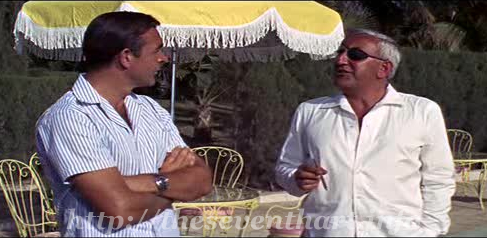
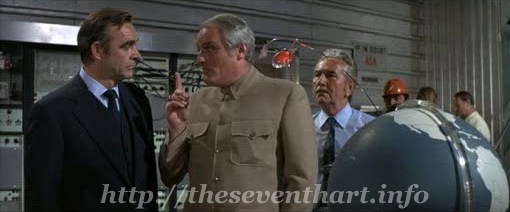
This issue takes Bond in search of revenge for the murder of Teresa in the previous film, On Her Majesty’s Secret Service (1969). Incidentally, he must also bust a diamond smuggling case that seems to take the world towards a diamond crisis. For this, Bond heads towards Amsterdam, disguises as Peter Franks, a notorious smuggler and allies with another one, Tiffany Case . Meanwhile, two thugs, Mr. Wint and Mr. Kidd, presumably Blofeld’s assistants, carryout a series of murders of smugglers across the world. As Bond “mines” into the case with the help of Case, he comes to know of Blofeld’s comeback and his persisting plans to take over the world. Bond sets out to destroy Blofeld’s diamond-based laser satellite that he intends to use to burn out world nations. But there is a catch, Blofeld has created multiple copies of himself… and his cat’s.

Sean Connery reprises the role of James Bond after a single film break and for the last time. This would also be the end of Ernst Blofeld – Bond’s longest surviving nemesis, played by as many as three different actors. More humourous than the preceding Connery films, Diamonds are forever presents almost all the characteristics of a typical Bond film – over the top car chases, over-the-edge spying, femme fatales and of course, the only-possible-in-a-Bond-film plans to rule the world.

On Her Majesty’s Secret Service (1969)
Peter R. Hunt
Bond, James Bond: George Lazenby
Arch Rival: Ernst Blofeld (Telly Savalas)
Bond Girl: Tracy di Vicenzo (Diana Rigg)

On Her Majesty's Secret Service (1969)

On Her Majesty's Secret Service (1969)

It is time for a change in Bond as Connery steps down from the prestigious pedestal to make way for George Lazenby. As Bond is enjoying his stay in Portugal he is kidnapped by Draco’s men. Marc-Ange Draco, is the chief of European organization Unione Corse and has a daughter Tracy Teresa, with whom Bond is already acquainted with. Draco asks Bond to marry his daughter in exchange for valuable information about the whereabouts of Ernst Blofeld. Bond agrees and subsequently travels to Bern with Teresa where He learns that Blofeld has set up a research laboratory on the hills of the Alps. He also comes to know that Blofeld is holding about a dozen women and brainwashing them into spreading his bio-chemical weapons all over the world.  Bond disguises as a professor and enters the institute and tires to bust Blofeld’s plans. He succeeds in destroying the lab and marrying Teresa, but Blofeld’s still alive.

Most atypical Bond so far, On Her Majesty’s Secret Service is chattier and mellower than all the other films in the series. Though his only film as Bond, George Lazenby does well to be remembered by fans. Bond manages to even get involved in a conjugal relationship taking the “unBondness” of the film to the maximum. Sandwiched between two typically Bond Connery films, Lazenby’s quiet venture is a much needed hiatus from the monotony and also a refreshing point for the films to follow.

You Only Live Twice (1967)
Lewis Gilbert
Bond, James Bond: Sean Connery
Arch Rival: Ernst Blofeld (Donald Pleasence)
Bond Girl: Kissy Suzuki (Mie Hama)

You Only Live Twice (1967)

You Only Live Twice (1967)

The next installment in the series would be You Only Love Twice, the first Bond film shot in Asia. The film kicks off with strange events in space as a mysterious contraption seems to be swallowing both the American and the Soviet spaceships. Before both the countries pin the blame on each other and jump into another world war, British government asks Bond carry out his investigations in Japan, where they suspect is the hideout of the spacecraft. Bond arrives in the oriental country where he is aided by the local force lead by Tiger Tanaka. He finds out that a local chemical company is shipping rocket chemicals surreptitiously into an unknown area. For this, Bond disguises himself as a Japanese even rigging up a fake marriage with Tanaka’s protégé Kissy Suzuki. Bond sets out on his gyrocopter to find the place, in vain. Finally, with the help of Kissy, Bond finds the secret lair where the craft is and successfully infiltrates it. He meets the Number one of SPECTRE aka Ernst Stavro Blofeld!

If Thunderball was deep inside the water, You Only Live Twice goes aerial. The plot is kept simple and would form the basis of another Bond film Tomorrow Never Dies (1997). You Only Live Twice, to an extent, makes up for the heavy blow dealt to the series by its predecessor Thunderball (1965). Blofeld (more famous as Dr. Evil in Austin Powers series!) makes his first appearance after indirectly threatening in previous three films.

Thunderball (1965)
Terence Young
Bond, James Bond: Sean Connery
Arch Rival: Emilio Largo (Adolfo Celi)
Bond Girl: Domino Derval (Claudine Auger)

Thunderball (1965)

Thunderball (1965)

The fourth offering in the so far successful Bond series, Thunderball,  takes the English agent into the island country of Nassau. The film starts with Angelo, a double who replaces the murdered French pilot Derval, and takes the responsibility of transporting nuclear bombs during a training session . He  tranquilizes the unsuspecting flight crew and crashes the plane into the ocean. Emilio Largo, or Number 2 in the infamous SPECTRE organisation, kills Angelo for protesting and takes away the bombs. Bond, meanwhile, meets Domino in Nassau, who happens to be the Largo’s mistress and tells her the truth about her brother Derval. She helps Bond in going into largo’s lair undercover which reveals Largo’s plans of blowing up Miami. With the help of long tiem CIA friend Felix Leiter, Bond manages to put down largo’s underwater minions and disarm most of the bombs. But Largo’s not down yet…

Undoubtedly the weakest link in the early Bond films, Thunderball is too long, too indulgent and tries too much. The only highlight of the film remains the fantastic underwater sequences that are shot masterfully. Perhaps, the makers got too carried away by the triple success and wanted to take it to a whole new level. Surprisingly remade as an unofficial Bond movie Never Say Never Again (1983) with Connery reprising his role for one last time.

Goldfinger (1964)
Guy Hamilton
Bond, James Bond: Sean Connery
Arch Rival: Auric Goldfinger (Gert Fröbe)
Bond Girl: Pussy Galore (Honor Blackman)

Goldfinger (1964)

Goldfinger (1964)

What followed next would be my favorite Bond film of all time – Goldfinger (1964). In this installment of the series Bond follows Auric Goldfinger, a wealthy gold trafficker whose sole intention remains to control the flow of gold all over the world. He is assisted by his deadpan soldier Oddjob whose throw of his hat can spice a man into two and veteran pilot Pussy Galore and her team of trained fliers. As Goldfinger is concocting a plan called Operation Grand Slam with the Chinese agents Bond overhears and promptly gets captured. Goldfinger later rejoices telling his plan to the seemingly helpless bond. According to it, Pussy Galore’s team of pilots would spread a certain type of nerve gas in the area around Fort Knox and paralyzing everyone around. Goldfinger would meanwhile take a weapon-laden truck into Fort Knox, blow it out and hence destroy the total gold supply of the country. Then the whole world would have to beg him for gold. Mwhahahahaha….

Quintessential Bond film entertains audience with the same charm today as it might have at the time of its release. Intentionally over the top, Goldfinger has become the template of all megalomaniacs that would follow, even the most comic ones. The film’s got everything in boosted proportions – an immensely evil plan, Bond in severe trouble, fantastic action and entertainment. A hat trick film for the young Bond series. You haven’t watched Bond if you haven’t watched Goldfinger.

From Russia With Love (1963)
Terence Young
Bond, James Bond: Sean Connery
Arch Rival: Red Grant (Robert Shaw)
Bond Girl: Tatiana Romanova (Daniela Bianchi)

From Russia With Love (1963)

From Russia With Love (1963)

The second in the series of Bond films, From Russia With Love, takes Bond to newer places and heights. In this version, Bond has to capture a decoding machine built by the Russians called Lektor. For this he has to go to Istanbul, Turkey and evade the attempts of SPECTRE to kill him and get their hands on the machine. SPECTRE, the secret organization introduced to us in the previous film, is lead by the unknown Number 1 who will only be revealed in You Only Live Twice (1967). SPECTRE has assigned a female commander, Rosa Klebb, to terminate Bond and avenge the death of Dr. No. Bond is to meet up with Tatiana Romanova, the Embassy official and get the machine from the consulate. They manage to board the Orient Express with the machine. Just as they think they have done their work, they come to know that Klebb is not through yet.

Famous for the absence of the “Bond, James Bond” quote, From Russia With Love lives up to the prequel with more action, more technology and more style. The title sequences, the grand photography and thematic music add up the charm. Many call it the best in the series and the film does live up to all that hype. The film’s premise is so befitting to the cold war era it was made in and no wonder JFK loved this film! A very memorable film as a whole.

Dr. No (1962)
Terence Young
Bond, James Bond: Sean Connery
Arch Rival: Dr. No (Joseph Wiseman)
Bond Girl: Honey Ryder (Ursula Andress)

Dr. No (1962)

The film that started it all – Dr. No. Set in the West Indian country of Jamaica, the film follows a British secret agent Bond who is on the mission of solving the mysterious killing of another fellow British man John Strangways. He eventually arrives to know that a certain island called Crab Key, an arcane place of mysterious happenings, possesses deposits of radioactive rocks and tat Strangways was after the same thing. He also meets Honey Ryder, a shell collecting damsel and as Bond makes way into the island with Honey, he finds out that a huge organization has its base there and is led by Dr. No. After Bond and Honey are captured by the men there, he gets a rendezvous with Dr. No that reveals the organization as SPECTRE. Can bond escape the clutches of Dr. No and save the American rockets from being destroyed by him?

Apart from becoming a historical piece, Dr. No is a damn interesting film with great scenes and a superb score. My favorite Bond title track “Three Blind Mice” is in this film. Sean Connery is the embodiment of style and had already set a very high standard for all the Bond heroes to follow. Although more mellow and deliberate than the subsequent Bond films that had action taking the driver’s seat, Dr. No still remains a must watch for all action fans for the intensity of lead and for the significance of introducing us to quirky yet suave world of Bond, James Bond.

He's back!

With exactly 21 days to go for the next Bond film, I intend to present a series of brief pieces about the 21 official Bond films so far. – One a day – and possibly culminating with the full review of Quantum of Solace. And if you want to gear up for the big event in style, be sure the catch the previous films, preferably, in order. And great news for Indian fans is that they will be getting to watch the film almost on the day of its international release itself.

This series will not provide comprehensive reviews, but will just give an outline of the films, for it is the action and not the words that drive Bond films. Less talk and more watching is the key to Bond films. So sit back and watch the man in action, perhaps with a round of Martini – Shaken, not Stirred!

CHAPTER 20: EPILOGUE

Not a single scene, line or character is wasted in the film. In fact each character is used to the maximum by employing the fitting metaphors and allegories. Each line carries so much weight that the film packs more than thrice the film’s length in it.  The screen time is so judiciously used that one can feel how serious the film is both for its makers and viewers. It is one rare Indian film that invites the viewer to take part in the film and not just sit back and wait for things to happen. A truly multi-layered film that delivers different amounts of entertainment, thought and excitement depending on the viewer’s perception and perceptibility.

The quality of the techniques employed in the film has “class” written all over. The music in the film never becomes emotionally manipulative as less confident directors would have opted to use. Kamal uses the right amount of amplitude and tempo for the music that Ilayaraja has given which ranges from classical Carnatic, Hindustani and Lavni to western classical and choir music. The compositions were done using the Budapest orchestra and symphony group in Hungary. Alternatively, silence is also used effectively in many places. Being a period film, Art direction becomes vital for description of the story. Sabu Cyril has taken care of that big time. Right from the old Pears calendar in Birla House to the British cement advertisement in Calcutta, from the Tanjore paintings in Srirangam to  the vehicles and instruments in the cities, not one object or concept is anachronistic or out of place.

Costume designer Sarika Haasan cruises through the project, probably her biggest yet. The costumes range from traditional Iyengar, Bengali and Marathi to conventional British and Gandhian. Her work perfectly provides the soul for Kamal Haasan’s narration. Thiru’s camera work comfortably underlines the emotions that the director wants to convey. Employing high and low angle shots to respectively contrast the saviour and the saved, the majority and minority and the violent and non-violent, the cinematography is effective in capturing the romantic and physical closeness of humans and also the emotional alienation and friction between individuals.

It is just a cliché to talk about the greatness of Kamal Haasan’s performance. I will just skip that and assure you that Hey Ram will easily count in his top five performances ever. With an army of India’s finest grade-A actors that includes Nasseeruddin Shah, Om Puri, Girish Karnad, Hema Malini, Shah Rukh Khan, Rani Mukherjee and Atul Kulkarni, one cannot complain about the performances. All the actors have dubbed for themselves, though making it difficult to follow at times, adding to the depth of the characters.

Perhaps the biggest asset to the film is its refusal to employ black and white characterization. Right from Gandhi to Govardhan, no body is projected as an all good person and everybody has their own selfish reasons in their life. As these flawed yet lovable characters lead their routine lives, Saket, another deeply flawed character, completes his pitch perfect character arc. A rare thing to see in Indian films is this transparent treatment of their characters.

They say a picture is worth a 1000 words. And a film is worth a 1000 pictures. I say a movie like Hey Ram is worth a 1000 films. With the help of his top grade technicians, his most personal and riveting script, fabulous performances and brilliant direction, Kamal Haasan has woven a film that is truly anti-violent and makes a heart felt appeal to stop the atrocities carried out in the name of God.

“Hey Ram” is not only the call of the victims towards God for help, it is also one man’s cry to himself, to find the reason for his spiritual disappearance and the quest to restore humanity and peace within him and outside him. The film, way ahead of its times, was a box office failure but will be hailed as a classic decades after its release. It will be recognized as the turning point of Indian filmdom and these two words will resonate as the Vande Mataram of Indian cinema: Hey Ram!

Go To Chapter

1 2 3 4 5 6 7 8 9 10

11 12 13 14 15 16 17 18 19 20

You can find the pdf version of the same analysis here
CHAPTER 19: INTO THE FUTURE

Hey RamCut to the present. The video becomes full fledged colour, suggesting that all that has been hidden is now revealed. The walls are decorated with the photographs that were taken during the entire journey of Saket’s madness. Saket Ram describes the photographs to Tushar. Tushar then asks if he could take back his great grandfather’s sandals and spectacles back. Saket says that it indeed belongs to him and returns it. What Saket Ram Sr. took from Gandhi Sr., Saket Ram Jr. returns to Gandhi Jr. As he returns the grasses, Saket Ram tries to look through it, as if trying to look at the world through the eyes of Gandhi. Tushar follows suit and tries to look through the glasses too.

The song that is being played in the back ground is “Ram Ram, Hey Ram” – A very vibrant and majestic tune that talks about non-violence, cultural tolerance, the future and need for resurrecting humanity. Ironically, without playing a somber tune on the death of Gandhi and Saket, a more motivating tune is being played hinting that past is past. We have to learn from it and move forward carefully. It is up to the new Gandhi and the new Saket, the youth of India, to lead the nation on a non-violent path. As the end credits roll on, Saket and Tushar open up the windowed wall that has a huge sketch of Gandhi, allowing sunlight to pierce the room for the first time metaphorically opening up Gandhiji’s mind to the world and appealing to the nation’s youth to expose themselves to the history of the nation and also gain an insight of Gandhiji. The song attains its crescendo at this point. The screen fades to black, the song continuing, as the future of India stand near the open door discussing the nations past, present and future.

Go To Chapter

1 2 3 4 5 6 7 8 9 10

11 12 13 14 15 16 17 18 19 20

« Previous PageNext Page »