Review


[An edited version of the following text was originally published in Pardo, the Locarno Film Festival’s official daily magazine.]

Glancing back at life during the Covid-19 outbreak, the atmosphere of dread that reigned – the pervasive fear of infection, suspicion of the other, the heightened awareness of the fragility of civilization – feels a little quaint and remote. The swift response of modern medicine in curbing the pandemic has made a cataclysmic past seem somewhat abstract, even if the ravages of the virus were anything but.

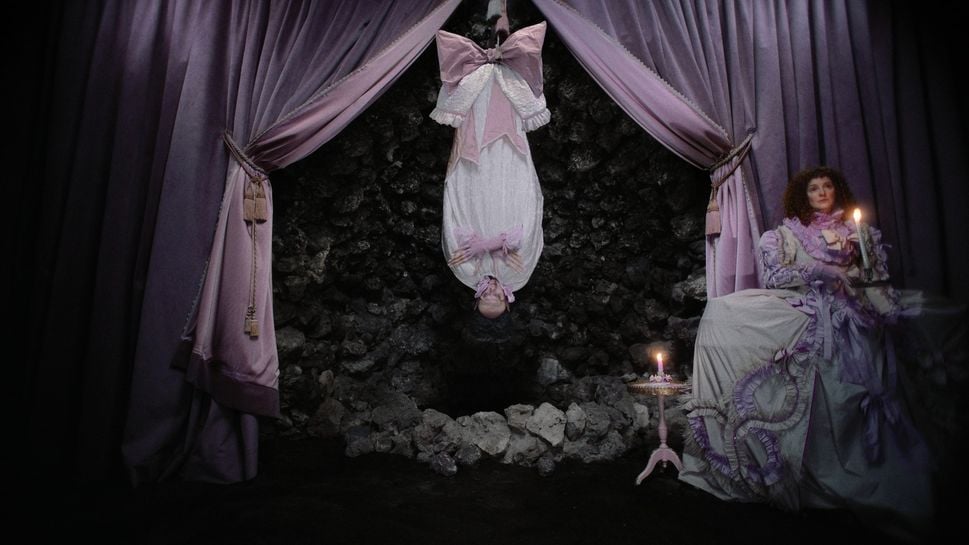
Spanning three eras, writer-director Eduardo Casanova’s sprightly tragicomedy Silence contemplates not one but two epidemics from the vantage point of the present. The first act, set in a gothic mansion in the 14th century, centres on a family of vampires grappling with an existential threat: with the bubonic plague raging, there are fewer healthy people left to feed on. Worse, one of them, Veronica (Ana Polvorosa), has fallen in love with a human, to the great dismay of her orthodox sisters. Seeking to save him from her siblings’ wrath, Veronica reveals the truth about herself to her lover, only for her trust to be betrayed.

Cut to the 20th century. It’s the late 1980s, and the plague has given way to the AIDS epidemic. Broke, bedridden and as conservative as her sisters once were, Veronica is under the care of her daughter Malva (Lucía Díez), a bleeding heart who prefers synthetic blood to the real thing. Malva is in love with a human too, a drug addict to whom she isn’t confident enough to disclose her identity. But when the contagion outside comes home knocking, she is forced to set things straight.

Full of comic situations and lines, dramatic compositions, rapid-fire editing, and baroque musical passages, Silence is a buoyant, quick-footed work. It bends vampire lore to humorous ends, using it, for instance, to satirize generational differences and political correctness. Yet an unmistakeable tragic undercurrent courses through the film. In the figure of the vampire, Casanova locates both the shame of having to lead a double life and the anguish of having to outlive your loved ones.

More importantly, Silence processes the trauma that the queer community had to suffer during the AIDS epidemic, or what was dubbed the “gay plague” in an act of political weaponization. The prohibitions on love, the stigma of contamination and the self-imposed invisibility that Veronica and Malva endure mirror the experience of the protestors outside their apartment. “Silence = Death,” goes their slogan, questioning the omerta that reigns around the subject of HIV.

Looking back from a more humane world in 2030, the closing stretches of the film evoke at once a sorrow for those who succumbed to AIDS and a relief at the normalization of the disease, which has ceased to be the death warrant that it once was. As Malva and her lover exchange bodily fluids in passionate embrace, Silence becomes as much a celebration of this freedom from mortal fear as the inescapable sensuality of cinema itself.

[An edited version of the following text was originally published in Pardo, the Locarno Film Festival’s official daily magazine.]

Strolling home through the countryside, insouciant teenager Eva plays mock bride, gathering white flowers to adorn her billowing hair. Her aunt warns her about the danger that lies buried in these parts. “Keep playing in those bushes, and you’ll say bye to those legs,” she cautions. In a few moments, Eva’s life will indeed turn upside down, but these landmines, remnants of the recent civil war in Rwanda, won’t have been the cause.

After her aunt walks ahead, Eva’s dreamy idyll is interrupted by a group of young men who whisk her away. Eva, now a kidnapped bride, finds herself in a suburban house, married to a functionary named Silas. If the casualness with which Eva loses her freedom is shocking, it pales in comparison to what follows. Deferring to tradition, Eva’s relatives advise her to accept her fate, which entails not just a psychological adjustment to her new situation, but also painful acts of forced sexual maturity.

Eva spends her days in silent protest, yielding to Silas physically but without an iota of emotional involvement. However, she finds solace in the company of Silas’s female cousin, residing in the same house, who informs Eva of the unfathomable trauma their family had to endure during the Civil War.

Bonding over a shared history of deprivation, the two women forge an empowering dynamic that oscillates between the maternal and the sisterly. As Silas’ cousin, Aline Amike cuts a wise, world-weary figure who navigates this male-centric world with a mix of resignation and caution. Sandra Umulisa’s Eva is the image of innocence defiled, her residual girlishness exorcised in agonising routines of precocious conjugality. Together, the women engage in nourishing conversations and rituals of mutual care, carving out a space of healing from the violent strictures of family life.

The premise of The Bride is the stuff of high melodrama, but in her assured debut feature, director Myriam U. Birara adopts a measured, pared back approach that keeps the temperature of the material in check. There is no musical score here to amplify the emotions, only occasional acapella vocals of a haunting quality. The austerity of the sound design makes Eva’s helpless cries all the more harrowing.

To the same end, Birara develops her scenes entirely in static shots whose simplicity belie their exquisite colour and compositional balance. Shot by Bora Shingiro in soft natural light and an earthy palette of browns and whites, the film keeps us at a critical distance from Eva even as it makes us intimately familiar with her predicament.

[An edited version of the following text was originally published in Pardo, the Locarno Film Festival’s official daily magazine.]

What are conscientious artists to do, especially those dependent on state support for their work, when their country is waging a lopsided, genocidal war? Challenging the state, if it is possible at all, could invite reprisals. Dramatizing one’s personal anxieties risks producing narcissistic exercises in self-flagellation. Trying to find nuance might amount to little more than well-intentioned handwringing, while dodging the political altogether would smack of cynicism.

In Some Notes on the Current Situation, Israeli filmmaker Eran Kolirin gestures at one possible way out of this impasse, crafting a work where politics exists as a substructure, as a kind of collective unconscious that rises to the surface in all its nastiness every now and then. Bearing the subtitle “a film set before World War 3”, Kolirin’s 79-minute feature is divided into half-a-dozen loosely connected chapters, several of them set in nondescript countryside, devoid of all signs of the ongoing war. In fact, if not for its title, one could hardly say that the film deals with “the current situation” at all.

Kolirin, though, is no stranger to tackling politics head-on. His last feature, Let It Be Morning (2021), was an Arabic-language adaptation of Palestinian author Sayed Kashua’s Hebrew-language novel of the same name. It featured an all-Palestinian cast that boycotted, with Kolirin’s approval, the Cannes premiere of the film in protest against what they perceived as the Israeli state’s appropriation of their work. Like Morning, Notes is backed by the Israel Film Fund, but it’s a much smaller project with a cast of Jewish actors donning multiple roles.

Each chapter of Notes is something of an absurdist sketch, centring on rituals or interactions that defy rational explanation. In the film’s overture, for instance, a woman pushes against a concrete building with all her might, in the zealous belief that it is collapsing. She demands a passerby to lend her a hand. The man is confused, but obliges nonetheless. With the help of two others, they manage to prevent the impending catastrophe and, in the process, restore colour to their monochrome world. What begins as an individual delusion snowballs into a collective psychosis.

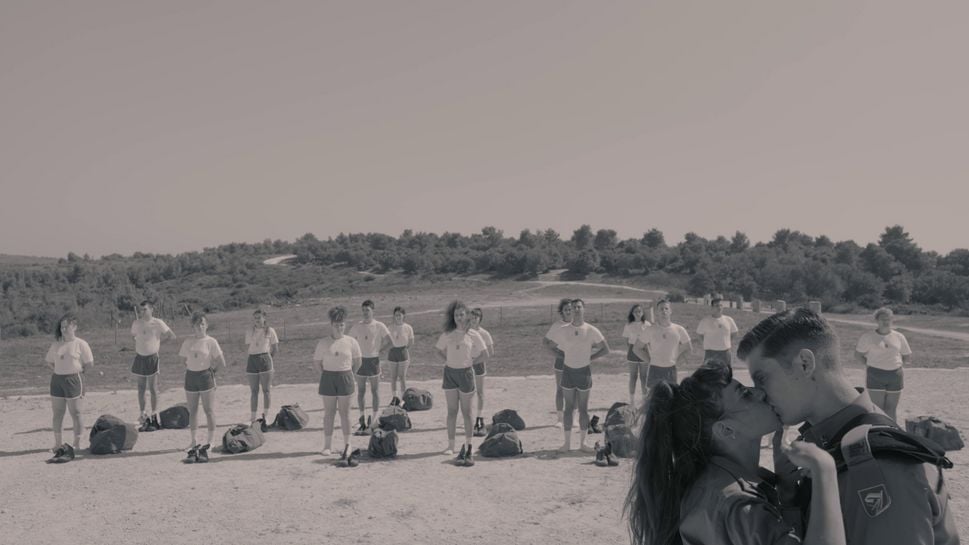
In another segment, a couple drives endlessly around the desert, their delivery truck loaded with snow, looking for the set of Theo Angelopoulos’ new movie. It turns out that the pair are time travellers from the past who have teleported themselves to a country they don’t recognize anymore. Elsewhere in the film, a sadistic military drill becomes the occasion for a return of the repressed.

This mosaic of humorously bizarre vignettes, a little reminiscent of the work of Roy Andersson, doesn’t yield easily to interpretation. The pleasure, on the contrary, is in their thought-provoking elusiveness. In the film’s Coen brothers-like coda, an elderly rabbi encounters a wayward husband and tells him the tale of a young Jewish scholar who meets his Inuit fiancée’s family. Suffice to say, the story ends with broken teeth and a tear-filled feast.

What moral lesson the husband, or we, are to draw from this outlandish parable is not immediately clear. But the inchoate, oppressive feeling of meaninglessness that it leaves behind is undeniable. Faced with film’s many Kafkaesque situations, we find ourselves in a state of fugue, just like the characters. Coursing through Notes is a strong sense of confusion and dislocation, the sentiment of finding oneself profoundly out of step with the logic of the world. In that, the film is perhaps entirely emblematic of “the current situation”.

[An edited version of the following text was originally published in Pardo, the Locarno Film Festival’s official daily magazine.]


In December 1978, the Entermedia Theatre in East Village, Manhattan, was host to a three-day celebration of writer William S. Burroughs and his vision of the space age. Titled Nova Convention, the event brought together a range of avant-garde artists and thinkers who responded to Burroughs’ work through readings, conversations and performances. The then-64-year-old writer was a central presence himself, dressed in grey suit and a green fedora hat, reciting various unpublished pieces with his distinctive nasal twang.

A student at the New York University, Howard Brookner filmed the convention as part of his ongoing documentation of Burroughs’ life. Much of this material remained unseen until 2012, when Brookner’s archive was rediscovered in Europe and the USA, and subsequently restored through the efforts of his nephew, the filmmaker Aaron Brookner. In Nova ’78, the younger Brookner and co-director Rodrigo Areias offer a kaleidoscopic reconstruction of the event, liberally mixing on-stage performances with intimate behind-the-scenes footage, interviews with friends and other everyday vignettes.

Each number is emblematic of the freewheeling nature of the convention: Philip Glass producing hypnotic loops on a synthesizer, Merce Cunningham dancing to a baritone vocal piece by John Cage, Patti Smith offering to reimburse disappointed viewers before shredding her guitar, Frank Zappa reading the ‘talking asshole’’ bit from Naked Lunch (1959), or Laurie Anderson performing her song “From the Air”, assisted by Bobby Bielecki’s electronic effects.

Armed with a zoom lens, Brookner’s nimble camera floats around the artists and the audience, now capturing Burroughs lost in thought, now filming street scenes around the theatre. Inspired by the writer’s style, Nova ’78 juxtaposes starkly disparate material, such that actual poetry often rubs shoulders with poetry of a more mundane kind, one that grasps life in motion. Emerging from the film is an image of Burroughs as a fiercely independent, politically committed figure, opposed to every stripe of fundamentalism and authoritarian control.

Above all, Nova ’78 provides a precious glimpse into a creative community untouched by the logic of technocracy and corporatization. The convention isn’t any ‘gig’, and the artists and thinkers gathered here register as real individuals with eccentricities, not self-styled brands in thrall to showbiz mandates. The ease and spontaneity with which they participate in the event, and the unaffected warmth and respect with which they speak of Burroughs, attest to a high degree of personal integrity as well as a sense of genuine camaraderie. In that, Nova ’78 truly feels like a time machine.

[An edited version of the following text was originally published in Pardo, the Locarno Film Festival’s official daily magazine.]

Time seems to stand still in the village of Ribeira Funda, tucked between the boundless ocean and the majestic mountains on the island of São Nicolau in Cape Verde. The moss-laden rocks, dilapidated stone houses, jagged pathways that comprise its expressionistic scenery appear to have existed since time immemorial.

Haunting this eternal landscape is old man Quirino, at once a king and a castaway, who leads a self-sufficient life in one of these houses, with a rooster for company. Signs of history soon surface — a radio bringing news from elsewhere, batteries, razor blades, cigarettes — cutting down this mythical figure to human scale. On the voiceover, Quirino recounts his memory of Ribeira Funda, once a thriving agricultural land, now drought-stricken and deserted.

The old man, we learn, has continued to live in this ghost village decades after its original inhabitants abandoned it for greener pastures. But now his faculties are failing him, and he must prepare for the great voyage beyond.

In his second feature The New Man, Carlos Yuri Ceuninck adeptly blends historical fact, lived experience and personal memory, crafting an ambitious, contemplative work that ventures beyond simple documentary portraiture. Part a sociological sketch, part a philosophical parable, Ceuninck’s film interweaves intimate observational vignettes, breathtaking landscape photography and a polyphonic voiceover in a way that both explains its subject and endows him with an irreducible mystery.

The New Man stands in interesting conversation with Wang Bing’s Man with No Name (2010), another absorbing record of a recluse at the edge of civilization. But where Wang remains a strict chronicler of the present, Ceuninck introduces what seem like visions from the past and the hereafter. Unfolding on a metaphysical stage lit by the celestial bodies and the scored to the churning seas, The New Man seamlessly melds myth, dreams and reality, illustrating that even a single, unremarkable life embodies the drama of the cosmos.

Ceuninck keeps pace with Querino’s quotidian rhythms, developing his film in long shots with little dramatic action, relieved regularly by glimpses of young boys playing, dancing or working the fields. Are these images from Querino’s own youth? Or are they part of the many legends that surround the village?

Querino’s sense of self is evidently bound to his memories of growing up in Ribeira Funda, but we also perceive that the land has an identity only insofar as its inhabitants bestow it with meaning. “There were many storytellers here,” Querino laments, “but death came, and it spared nothing and no one.” The New Man thus registers as an elegy, not for the man or his land, but for the intangible ties that bind them together. Death is on Querino’s mind as he too prepares to leave the village, but something far more significant will have died before his mortal end.

[An edited version of the following text was originally published in Pardo, the Locarno Film Festival’s official daily magazine.]

“My whole trouble was that at no point was I able to lose my administrative and critical faculties,” remarks Judas in Paul Claudel’s short story The Death of Judas (1933). Claudel’s bracingly revisionist account makes a case for the twelfth apostle, recasting him as a sardonic, inquiring man who saw through the intellectual obfuscations of the miracles and the cowardice of his fellow disciples. This Judas celebrates his philosophical freedom even in death, suspended from a tree, unbound by the constraints of the cross that consumed his master.

Taking over the baton from Claudel, writer-director Giulio Base gives the devil its due in Judas’ Gospel, fully humanizing the treacherous figure and dramatizing his tussle with reason and faith. In Base’s retelling, born under a cursed star, Judas endures a harrowing childhood in a brothel. Wielding a bloody dagger, he rises to power and fortune, only to give it all away when Jesus (Vincenzo Galluzzo) summons him. Wise in the ways of the world, Judas is moved not so much by the Prophet’s supposed miracles, but by His simplicity and capacity for grace.

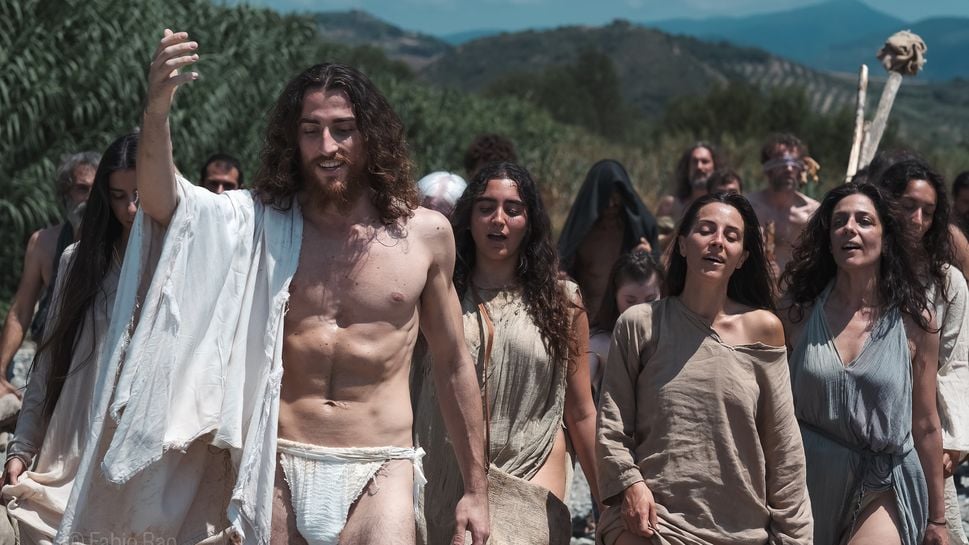
Base presents Jesus as a radical egalitarian, a proto-hippie whose following comprises men and women alike, without authority or hierarchy. With a forgiving smile, He condones the libertine goings-on in the group, which He leads from place to place over three years. In a subversion of the injunction against idolatry, Jesus is visible, front and centre, throughout the film, anchoring the image with His radiant presence. Even so, we don’t hear His voice except at choice moments, as when He beckons Judas or eulogizes Joseph at his funeral.

Judas, on the other hand, is simply a cloaked figure whose face never once shown to us. Yet it is his lucid, layered monologue that propels the narrative. Drawing us into an entirely subjective space, this voiceover (delivered by the gravel baritone of Giancarlo Giannini) accompanies us through the maze of Judas’ mind, his confusions about Jesus’ plans for him, his sense of superiority over his unlettered peers, and his messiah complex undone by his human failings.

As one’s image complements the other’s voice, Jesus and Judas become inextricable entities bound by prophesy. “Everything in the world exists thanks to its opposite,” Judas notes, implying that his treachery and Jesus’ ascension are mandates of the same divine will. Judas’ labyrinthine reasoning brings him to the conclusion that he was the only apostle faithful enough to carry out the betrayal, yet he succumbs to human logic at the moment of Crucifixion. Thematically and formally thought-provoking, Base’s film unveils Judas in all his fascinating contradictions. Ecce homo.

[An edited version of the following text was originally published in Pardo, the Locarno Film Festival’s official daily magazine.]

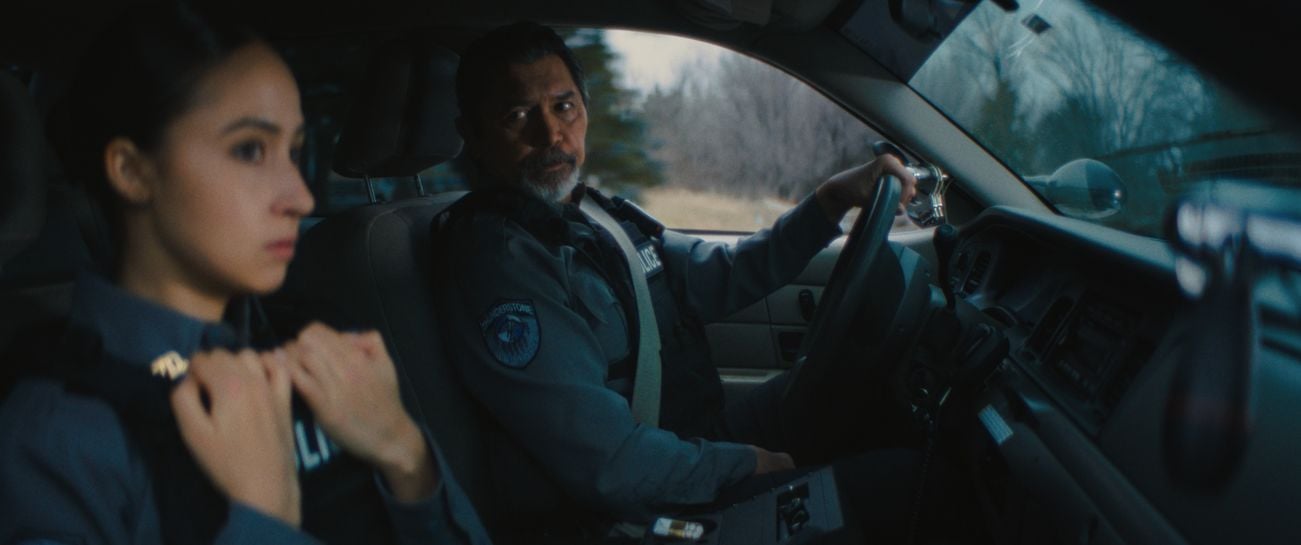
“We are all squatters here, Toto”, quips officer Teddy Sharpe (Lou Diamond Phillips) to his rookie beat partner Sandra Scala (Dana Namerode). A half-Filipino working for the tribal police in Thunderstone indigenous reservation, Teddy is an ethnic outsider. But as someone who has grown up among the Native Indian community, he is intimately familiar with the ways of the reservation, now under the sway of drug cartels and warring gangs. “We have our laws and punishment, the streets have theirs”, goes another of Teddy’s nuggets to Sandra.

In Keep Quiet, Vincent Grashaw (Bang Bang, Locarno Film Festival 2024) offers a gritty, longfused crime drama that puts the conventions of the genre at the service of a complex sociological reality. The reservation, in Zach Montague’s close-grained screenplay, is host to competing moral codes and regimes of authority: indigenous gangs who fashion themselves as a brotherhood above American law, the district police who only view them as anti-social elements to be clamped down, and the tribal police who perform an interstitial peacekeeping role.

At the centre of this vortex is Teddy, who uses his official power to curb delinquency in the reservation, but who is also mindful of the larger needs of the community. Having possibly wronged the community in the past, he is desperate to keep children away from both the streets and the law. But when Richie (Elisha Pratt), a reckless ex-convict, returns to the reservation with vengeful motivations, Teddy’s hopes of stemming the cycle of crime and violence are severely tested.

Shot by Brandon Waddell with an acute feeling for shadows, Keep Quiet offers a shining example of lean, no-frills genre filmmaking: invisible craft deployed to draw us into a believable, realistic world. Despite the richly detailed backstories to the characters, Grashaw succeeds in imparting immediacy and momentum to the narrative, never allowing the film to wallow in psychology. In that, he is aided by convincing performers such as Namerode and Pratt, who bring to life, with admirable economy, individuals fighting their own demons.

But the beating heart of the film is Phillips, who distils classical Hollywood models of middle-aged masculinity into Teddy: wise, sardonic, measured in action and word, with occasional touches of irascibility that only reveals an impatience with empty niceties. His moral sense is derived from a spontaneous, practical intelligence rather than theory or self-analysis. Yet he can be lucid when necessary, evoking a knotty, painful past with razor-sharp clarity and concision. Phillip’s Teddy is John Wayne and James Stewart rolled into one.

[An edited version of the following text was originally published in Pardo, the Locarno Film Festival’s official daily magazine.]

It only takes a few seconds into Ancestral Visions of the Future to perceive that it is a markedly different work from Lemohang Mosese’s two breakout features from 2019: the epistolary essay Mother, I Am Suffocating. This Is My Last Film About You. and the community portrait This Is Not a Burial, It’s a Resurrection. To be sure, there is a remarkable continuity of thematic concerns across the three films by this Lesotho-born, Berlin-based artist, chiefly the fraught political and religious history of his home country, its spiritual amnesia and its desolate present mired in crime and violence.

But while Mosese’s earlier outings were framed through designated points of view — an unnamed letter writer in Mother and a diegetic storyteller in Resurrection — the new work is direct in its address and features a first-person voiceover by the filmmaker himself. Dense and florid, this voiceover lends the film the texture of a highly stylised poetic memoir. We learn, for instance, that Mosese’s mother always fought for a better life, dreaming of a comfortable home for her children and “stubbornly refusing to greet the hand of permanence”.

Yet Visions ventures beyond the confessional mode, unfurling alternatingly as a personal essay about the filmmaker’s native country and as a fragmentary fiction involving symbolic characters. Prominent among these is Sobo (Sobo Bernard), a healer-puppeteer who preserves the nation’s pre-colonial consciousness, and Manthabiseng (Siphiwe Nzima), a wandering woman who stands up to the ominous gangland cars that zip through the streets and leave bloodshed in their wake. Through these characters, Mosese constructs a layered assessment of his homeland, marked both by an appreciation for its bygone splendours and a profound disillusionment with its current-day perversions.

This ambivalence is echoed by Mosese’s own feelings as an artist in exile, someone whose work revolves around questions of memory and identity, yet whose own identity remains in flux. Steering clear of nostalgia, Visions refuses to separate fond recollections of the past from their material reality. At one point, for example, Mosese speaks of falling in love as a child with cinema in a hall that also reeked of human waste.

Evocative of the words in the voiceover, but never merely illustrative, the imagery of Visions weaves together impressionistic documentary footage with surreal, Sergei Parajanov-like tableaux. The film’s slightly oblique visual organisation expands the oral descriptions while also opening up secondary associations between sound and image. The resulting work hovers entrancingly between the familiar and the strange, reality and myth, fact and metaphor.

Forty years after its original premiere, the Odia film Maya Miriga (1984), a touchstone of the Parallel Cinema movement, will be presented in a restored version at the Cinema Ritrovato Festival in Bolonga, Italy, in June. Directed by Nirad Mohapatra (1947–2015), Maya Miriga was part of the Critics Week at the Cannes Festival in 1984, alongside such titles as Billy Woodberry’s Bless Their Little Hearts and Leos Carax’s Boy Meets Girl. The film has been restored by the Film Heritage Foundation (FHF) at the L’Immagine Ritrovata laboratory in Bologna, in association with Digital Film Restore and Prasad Corporation in Chennai.

A graduate of the 1971 batch of the Film and Television Institute of India, Mohapatra made numerous documentaries, television series, industrial and educational films across his three-decade career, but Maya Miriga remained his sole fictional feature. “I had conceived the idea [for the film] in one of my intense moments of loneliness and deep depression and it had undergone several changes in various phases.”, notes the filmmaker. Shot by Rajgopal Mishra in a warm, sober colour palette, the film demonstrates a great feeling for the interplay of harsh natural light and deep shadows — a sensuous quality that can be appreciated fully in the pristine new version.

Set in the town of Puri, Maya Miriga is the saga of a joint family driven to disintegration by ambition, opportunity, festering resentment and, simply, changing times. A stern but honest headmaster on the brink of retirement, Raj Kishore Babu (Bansidhar Satpathy) lives in a fairly capacious house with his elderly mother, wife and five children: the dull and reliable college lecturer Tuku, the IAS hopeful Tutu, the self-doubting MA graduate Bulu, the rebellious and cricket-obsessed Tulu and the only daughter Tikina. While the men pore over files or hang out on the terrace, Prabha, Tuku’s wife, bears the burden of the upkeep of the house. The apparent stability of the home comes undone when Tutu cracks the civil service examination.

The narrative spans many months and proceeds by substantial leaps in time. We witness Tutu becoming a bigshot who marries into money, Prabha suffocating under the patriarchal order of the house, Tulu trying to break out on his own, Bulu imploding when surrounded by high achievers and Raj Babu grappling with post-career emptiness.

Through gradual buildup of dramatic detail, the film shapes into a poignant tragedy of a middle-class family torn apart by its own cherished values. The father’s insistence on academic excellence, the pressure on the sons to find respectable jobs, the irreconcilable expectations of wealth and traditionalism from the daughters-in-law — all turn out to be ticking time bombs for the household.

We also learn that the family has property back in their ancestral village that no one takes care of, suggesting that Raj Babu is himself a migrant who left his landlord father for greener pastures in Puri. Mohapatra’s film thus captures a crucial moment in Indian social history between two generations of labour migration, one giving rise to joint families inhabiting independent houses in towns and the other producing nuclear families looking towards metropolises.

Maya Miriga is a veritable compendium of middle-class mores and codes of behaviour: how do individuals get their decision ratified by other members of the family, what are one’s duties when returning home after a stroke of success, how should guests comport themselves when visiting? With finesse and grace, Mohapatra’s film illuminates the gendered division of labour, the intergenerational etiquette and the power hierarchy that holds sway in an undivided family.

An abandoned site spruced up for the film, the house itself plays a central role, exercising a gravitational pull that the characters struggle to escape. Actors move in and out of its dark recesses, as though consumed and spat out by the structure. Its imposing pillars, its bright courtyard and its open terrace all seem extensions of the power relations binding its inhabitants.

Maya Miriga is certainly a melodrama, but on a subtler register than seen on most Indian screens. The influence of Satyajit Ray, especially of a work like Mahanagar (1963), is discernible here, but Mohapatra’s film also shares lineage with the innumerable family dramas of contemporary theatre and popular cinema across the country. “The balance that I ultimately wanted to achieve”, the director remarks, “was between realism and simplicity on the one hand and my preoccupation with a certain cinematic form on the other.”

An admirer of Japanese filmmaker Yasujiro Ozu, Mohapatra strips away his material of all dramatic fireworks. The non-professional actors are all filmed in mid-shots, and never in close-ups, in a way that integrates them with their surroundings. Their emotions are muted; the dialogue, music and reactions whittled down to a minimum. A sense of serenity reigns over the film, which progresses with relative equanimity through both joys and sorrows.

The question, to my mind is an ethical one – to excite the senses to the point of disturbing their rational thinking is a certain sign of disrespect to the audience.”, writes Mohapatra, proposing that filmmakers must leave the viewers “a margin to move closer to the work and have a more active participation, a greater sense of involvement in the process.” “I believe, freedom is alienated in the state of passion.”, he adds, “One should not therefore seek to overwhelm the audience.

Maya Miriga represents the FHF’s second restoration project this year after Shyam Benegal’s Manthan (1976), which had its premiere in the Classics section of the Cannes Film Festival in May. Carried out in association with Sandeep Mohapatra, the filmmaker’s son, the restoration process was long and arduous. The original 16mm camera negatives, found abandoned in a warehouse in Chennai, were severely compromised and had to be manually repaired over several months before it could be scanned in Bologna. The results were complemented with material from a 35mm print of the film from the National Film Archive in Pune, which also served as the source for the soundtrack. With the revival of this seminal film, Odia cinema promises to draw much needed attention from the rest of the country as well as the world.


[First published in Mint Lounge]
Whether one admires it or not, it is hard to deny that Dibakar Banerjee’s Love Sex Aur Dhokha 2 is unlike anything being made in Mumbai right now. The array of trailers that preceded my screening of the film offers a good sample of where Bollywood is otherwise right now: Bhaiyya Ji (a Southern-inspired actioner), Srikanth (an underdog biopic) and The Sabarmati Report (a rabblerousing right-wing political drama), the latter produced by Balaji Motion Pictures, the same company that has issued Banerjee’s film. Like its 2010 predecessor, LSD 2 positions itself consciously at the margin of the industry, drawing its energies from both new media environments and independent filmmaking while at the same time profiting from the mechanisms of professional production and distribution.

The original LSD was a three-part morality play that probed the unsavoury intersection of salacious sex, burgeoning media and cheap digital image-making. The new film retains the structure and the stridency of the original, but goes further by removing the last remaining guardrails that assured us that there may be a way to steer clear of this impending dystopia. Expanding the earlier film’s scope to newer forms of mediation, LSD 2 informs us that we are now fully living in a technocratic nightmare and the only way out is further inside; that delulu is the only solulu.

The opening part of LSD 2 is set entirely inside a Big-Brother-like online reality TV show titled Truth Ya Naach (Truth or Dance), where viewers with smartphones can tune into the camera of any of the participants as well as bet on them in each episode. Participants, in turn, can choose to turn off their cameras at the risk of audience disengagement. At the end of each episode, one participant is eliminated by the panel of judges, played by Anu Malik, Sophie Choudry and Tusshar Kapoor. Banerjee amplifies the self-cannibalizing nature of this ecosystem by mixing show footage with viewer reactions to each episode in the form of vlogs, podcasts and memes.

The nominal protagonist of the section is Noor (Paritosh Tiwari), a transwoman participant whose ratings skyrocket once her estranged mother (Swaroopa Ghosh) is invited on to the show. However, a change in sponsors of Truth Ya Naach has meant that the show has to pivot to family friendly audiences, forcing the showrunners to evict Noor within the logic of the show. The show’s progressive veneer of inclusion makes way for mother sentiment, both thrown out once they are milked to their limits. Within this totalizing simulacrum, the mother’s sceptical outsider perspective is first presented as a point of identification for us, the viewers of the film who are invited to look at everything on display with contempt, but it is jettisoned when mother herself internalizes the rules of the game.

This kind of narrative rug pulling continues in the second (and possibly the weakest) segment of the film, albeit on a less ironic and more realistic register. Kullu (Bonita Rajpurohit), a transgirl working as a janitor at the metro station, is assaulted in a park. Kullu’s boss Lovina (Swastika Mukherjee) helps her file a case, but when compromising details emerge from the police investigation, she finds a PR disaster on her hands. No more a perfect victim, Kullu is a timebomb for the company whether she withdraws the case or pursues it, and Lovina, like the showrunners of Truth Ya Naach, is forced to orchestrate Kullu’s exit by other means. Unfolding through video calls and Zoom conferences, this segment immerses us into the disintegrating mind of Lovina, a single mother whose motives are obscured by her constant frustrations. Things are further complicated with the introduction of other plot elements, such as a housing crisis and an extra-marital affair.

But the film really piles it on in the third segment. An influencer named Game Paapi (Abhinav Singh) is on the verge of internet legend when doctored sex pictures of him are leaked during a live stream by a bad actor. As a reputation management firm tries to put a positive spin on this, Game Paapi himself takes flight in shame and denial, rejecting the iniquities of the real world to establish a cult in the metaverse. Or something. A ChatGPT-level rehash of half-informed boomer techno-prophesies, this section throws in everything you’ve heard about the dangers of artificial intelligence and cyberbullying and then some. Things veer further into incomprehensibility thanks to some aggressive mumbling by the actors, esoteric internet speak and a good dose of enthusiastic censorship.

Each segment of the film is inspired by a specific video medium — live television, video conference and webcasting respectively — and the colours, editing, camera movement, the choice of lenses and the production design are all determined in accordance with these devices. Banerjee’s impressive attention to the specific visual texture and syntax of each medium is superseded only by his incredible ear for language and speech patterns. The third section performs an accelerationist sensory assault, employing a bone-rattling synthesis of webcam footage, recreated memes, AI-generated poop, cable news blight and some queasy-making animation. The film’s sound, on the other hand, is uniformly dull, dousing all the amateur visual spice in a professionally mixed sonic soup.

Throughout, Banerjee takes pains to remind us that everything we are seeing is mediated by a camera with a vested interest. To this end, he even uses points-of-view shots in sequences where a diegetic camera is absent — a blunt tactic normalized half way into the film. LSD 2 foregrounds the inescapability of these media environments, moving from traditional television’s self-rejuvenating search for total reality to Web 3.0’s rejection of reality in favour of an alternate, synthetic universe. This absolute, conspiratorial conception is offset by characteristically dry humour, such as the sight of Game Paapi’s mother bringing lunch to the desk of her YouTuber son, or Noor’s mother on Truth Ya Naach belting out a number titled “Gandi Taal” (Dirty Beat) with the decorum of a ghazal singer.

One of the most striking things about LSD 2 is how unprovocative it is despite handling sensational material and hot-button issues. (As an aside, this film is a good example of how to cinematically engage with bigotry and discrimination without recreating it in the name of realism.) Banerjee is not a provocateur, but a moralist at heart, and for all its bleak cynicism and psychological murkiness, the film is remarkably single-minded in its critique. LSD 2 puts its finger on a historical moment when public-facing corporate capitalism, social movements around marginalized sexual identities and a rapidly changing media landscape run up against two-faced middle-class values. Each of these forces is now an ally, now an enemy to the other, each one interacting with the other with a view to self-perpetuate. It is pertinent that the film ends with an interview between a traditional television anchor and a multiverse personality, both connected to pliant viewers on one end and corporate sponsors on the other. In LSD 2, you can check out of late capitalism any time you like, but you can never leave.

Next Page »