Review


The Fribourg International Film Festival, which completed its 36th edition in March, has made a part of its program available online to watch for free until April 18. Two short films in competition, one from India and one from Pakistan, make intriguing forays into social portraiture through very different formats.

Rishi Chandna’s excellent short documentary Party Poster offers a glimpse into Mumbai’s visual culture around the Ganesh Chaturthi festival. Every year, residents of Bandra’s laundrymen association commission a banner to accompany the festivities in the dhobi colony. These posters follow a convention: horizontal layout, bright background, an image of Lord Ganesh on top, lines of text inviting onlookers to the pandal, a graphic representing the legacy of the colony and, most crucially, an array of mugshots of the men (and only men) organizing the event at the bottom of the image. The latter respects a hierarchy, with the faces of the most influential individuals dominating those of junior members of the committee.

Distinguishable from movie posters that feature in countless montages about Mumbai, the festival poster is something of a self-referential object, an icon attracting worship. While its nominal function is to invite passers-by to the festival, it really seeks to draw attention to its own grandeur and to valorise those who have put it up. One interviewee in the film describes these banners as a gateway to popularity, even asserting that without them, one doesn’t even exist. After the festival, they sometimes get recycled, serving as thatching material against rain water or, tellingly, as the makeshift wall of a local shrine.

Party Poster is set in 2020, and the pandemic has had financial repercussions on the washermen community: the contributions for the festival have dropped and poster printing has become more expensive. The Ganesh idol too seems to have shrunk in response. Rajesh, Munna and Prem, the three figures that the film follows, feel strangely obliged to include Covid-awareness messages on the banner, exacerbating the fight for poster real estate: faces become more crowded, shoulders are cut off, the Ganesh image is cut down in size.

What’s worse, these awareness messages seem to be at odds with the purpose of the poster. Rajesh & co. want to lead by example by appearing with masks on the banner, but no one would be able to identify them anymore. They recognize the contradiction inherent in asking the public to stay home while inviting them to the festival. Reflected in their ambivalence is a tug-of-war between the eternal desire for community and the urgent need for social distancing. Chandna includes a very funny shot of an organizer who instructs caterers not to serve those without a mask and then, realizing the presence of the camera, quickly pulls up his own mask.

Party Poster zeroes in several such tensions that the poster culture embodies. Imitating the prime minister, Rajesh wraps a scarf over his mouth in place of a mask. He lives in a shantytown, but still believes he can work his way up the party ladder. To this end, he asks the poster designer to make the tilak on his head more prominent. The poster provides him a relief from the anonymity of the city, whose contempt for people like him is barely concealed: outside the colony stands a hoarding for a high-rise apartment complex that promises its customers “mask-free living”; that is, away from the crowd that Rajesh and his friends represent.

In Arun Karthick’s Nasir (2020), Ganesh Chaturthi was an occasion for Hindu assertion, pandals and processions staking a claim on the secular landscape of Coimbatore, Tamil Nadu. In Party Poster, the festival procures a semblance of enfranchisement to otherwise marginalized individuals. It does this not only by offering them a chance to momentarily assimilate into dominant identities, but also by allowing them to participate and bond together in the open ritual of putting up banners without governmental or corporate retaliation.

The film, however, takes pains to point out that this poster culture is nonpartisan and that individuals and organizations of all stripes partake in it: political parties, professional fraternities, cultural associations. In opening the phenomenon up, Party Poster poses the question of who owns a city. The hoardings all carve out private shrines out of public spaces — an encroachment that the authorities appear to tolerate seasonally. Rajesh and his friends perch their banner on a tree by the main road. With no additional support, the installation looks fickle and Chandna amplifies the sense of fickleness by filming it from a distance at late night.

The fragility is but more than just physical. Like the festival, the empowerment that Rajesh & co. experience in putting up their banner comes with an expiry date as well. When the season comes to a close, the men carefully dismount their poster and take it back into the colony, ruling out any more outsider attention. As the credits roll, we see municipal authorities bringing down banners in a different part of the town. Public space is reclaimed and re-secularized, but in doing so, it is also reintroduced into the market for corporate bidding.

In Seemab Gul’s short drama Sandstorm, on the other hand, it is a question of private images and private spaces. Zara (Parizae Fatima) is a high-schooler from an upper middle-class home in Karachi. She has befriended a young man from another city (Hamza Mushtaq) with whom she chats every day in the privacy of her room. On his request, she sends him a video in which, sporting a sleeveless kurta, she performs a dance with her dupatta. The man saves the clip that was supposed to vanish and tries to take advantage of Zara with it.

The threat, and the boyfriend’s comment that her dance looked a little chhichhori (subtitled as “slutty”), cuts Zara’s world down and makes her realize how limited it is. She is truly free only in her room and has to lie to her father about her secret conversations. A neighbour appears to stare at her as she is removing her lingerie from the clothesline. At her all-girls school, she is taught that women’s virtue is the foundation of a civilization.

Sandstorm is indeed about gendered social norms and the double standard that men have. But the film focuses on Zara’s response to it more than anything else. Gul shoots Zara from up close, at her eye level and largely from over her shoulder, resulting in a surfeit of left and right profiles. This abstracts the world around the girl and invites the viewer into her inner life. We dwell on Zara’s long hesitation before she sends the clip, we observe her anxiety over the video leak in her interaction with others, and we see something that we seldom see on screen: the first pangs of sexual shame.

Caught between propulsive desire and restraining guilt, Zara’s reactions to the blackmail are soaked in an ambiguity that sustains the tension. Some of this ambiguity passes through the dupatta she wears, which registers first as a sensual dance prop, then as a sexual accessory and finally as a boa constrictor that wraps around Zara’s neck. On the day that she is supposed to meet him, Zara turns the dupatta into a headscarf at the request of her boyfriend, putting on and then rubbing off her lipstick. The scarf eventually helps her gain anonymity and evade the scrutiny of the man’s eyes, threatening to turn the film’s feminism — despite its obvious sympathy for Zara — into a cautionary defence of tradition: “see what happens when you don’t cover up.”


[First published in News9]
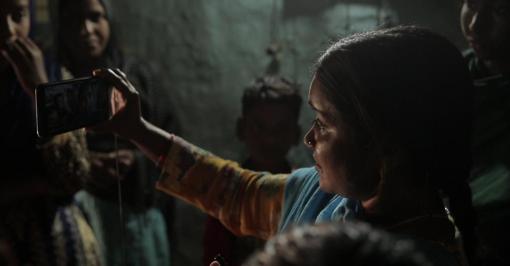
Writing with Fire, directed by Rintu Thomas and Sushmit Ghosh, is a documentary about Khabar Lahariya, an all-woman media company based in the Bundelkhand region of Uttar Pradesh. But in the run-up to the Oscars, where it has been selected for the Best Documentary Feature award, the film has become the story. On 21st March 2022, the editors of Khabar Lahariya put out a statement distancing themselves from Writing with Fire, which they believe “eclipses the kind of work and the kind of local journalism we have done for twenty years.”

This soft disavowal has come as a surprise to the filmmakers, who had so far enjoyed the support of the newspaper and its journalists. Whether the volte face stems from a puritan recoil from international recognition for a grassroots organization, or a resistance to being co-opted by partisans, or simply post-election damage control, we won’t perhaps know. But the affair goes to show that, even in a closed system like filmmaking, the best intentions may not always lead to favourable outcomes.

And the best intentions, Writing with Fire abounds with. In fact, it casts Khabar Lahariya as nothing less than David taking on Goliath; the opening title cards tell us that when Lahariya was set up in 2002, it was “expected to fail,” but that it went on to “stir a revolution.” With wide-eyed admiration, the film profiles the reporters of the newspaper who brave societal discrimination, sceptical family members, unsupportive husbands, malevolent governments, corrupt police force and internet trolls to give voice to the voiceless and speak truth to power.

We don’t get to know about the history of the newspaper, its charter, its funding mechanisms or its machinery as such. The film instead looks at its everyday operations by following three of its reporters. Meera, who is currently the Bureau Chief of the outlet, was married at the age of fourteen, had children in high school, completed her masters and became something of a mentor in Lahariya’s ranks. The younger Suneeta is articulate, plucky, unmarried and a resident of a mining town devastated by illegal extraction. Shyamkali would seem to be the oldest of the three and is still a learner. Writing with Fire films them on buses, trains, autos and on foot, as they travel to towns and tiny hamlets in search of stories. The women cover a host of topics including elections, sexual assault, sanitation, illegal mining and religious radicalisation.

The film captures Lahariya at a moment of transition: after fifteen years of newspaper publishing, the company is launching its YouTube channel, which means that its employees will now have to produce video content too. Meera trains junior reporters on the use of smartphones, but there is still apprehension about the new medium. The upskilling is however successful, and over the course of the four years over which Writing with Fire was shot, Lahariya accumulated over 500,000 subscribers. Over time, the reporters themselves become savvier, more well-versed with the aesthetics and rhetoric of video reportage. The film fashions Lahariya’s growth as a value-neutral media success story, periodically showing us its increasing viewership and reach.

To see marginalized young rural women actualize themselves through education, employment and technology is thoroughly uplifting, and for them to do this through conscientious journalism is stirring. But Khabar Lahariya’s recent statements evidence a disconnect between how the organization regards its own work and the film’s response to it. There is a process of contextualization at work all through Writing with Fire that views the newspaper’s day-to-day efforts through the prism of national political discourse. This reframing obscures as much as it clarifies.

On one hand, the film’s national consciousness performs the important task of analysing Lahariya’s larger role within the political climate of the country. To this end, it stands to reason that the murder of Bangalore-based journalist Gauri Lankesh is one of the stories that Writing with Fire includes: in the film’s view, the reporters of Lahariya face adversity as reporters, in addition to their other identity-based disadvantages. The narrative firmly establishes that theirs is a risky, even life-threatening occupation that is not welcome in these quarters. In that regard, their participation in Writing with Fire may have come with the promise of some degree of immunity, in addition to publicity.

At the same time, the film’s approach reveals a tendency to simplify, to recast something new and specific in terms of the familiar. Writing with Fire explicitly pits the newly minted BJP government of Uttar Pradesh with the operations of the Lahariya, in effect bringing them on the same playing field. But what for the film amounts to a direct defiance of an extremist leader may perhaps only be the negotiation of everyday reality for Lahariya’s field workers — we don’t get to know how they perceive this exactly. Sword-wielding, effigy-burning Hindu Yuva Vahini youths make sensational fodder for the national media, but it is hard to believe that such a low-hanging fruit would provoke similar reactions among the reporters.

Moreover, in its effort to editorialize the Lahariya story, Writing with Fire risks making the mistake of sorting complex issues into distinct progressive and reactionary camps: patriarchy, intolerance, casteism and avarice are the sole dominion of the latter, while Lahariya embodies the ideals of liberal democracy. There is undeniably some truth to the classification, but any reasonable person living in the country would know that reality is more intransigent than what such mental models would allow for.

This rhetorical manoeuvre becomes something of a handicap in the film’s depiction of Lahariya as an institution. To its credit, Writing with Fire dedicates passages showing the functioning of the outlet: how raw footage by reporters is edited and transmitted on the internet by a group of younger, savvier newswomen. In the monthly meetings or yearly outing, Lahariya comes across as a fairly democratic outfit where every voice is heard. But the film doesn’t get into the disagreements and ideological differences within the organization. This homogeneity is discordant, especially as we can perceive class differences between the reporters and the newspaper’s top brass — it is probably in response to this impression that Lahariya’s statement emphasizes the heterogeneity of their newsroom.

But the accusation that the film passes off some of its own footage as Lahariya’s is more serious since it suggests a formal obfuscation rather than mere ideological simplification. Writing with Fire presents the reporters’ work through video clips that simulate the YouTube browsing experience, complete with upload titles, subscriber count and user comments. A cursory search on the site doesn’t bring up these videos for verification, but given that an original shot of Yuva Vahini members taking a selfie is cut to the same image embedded in Lahariya’s report on the topic, the charge has substance.

In the same vein, the presence of the film crew alongside the reporters called for a little more reflexivity. Meera’s inquiry at a police station is shot with two cameras and edited into a shot-reverse shot sequence. Another interview appears to be photographed with two lenses. Point of comparison: the documentary A Rifle and a Bag (2020), in which an Adivasi woman’s interactions with the state are shot with a single camera setup from the behind the functionaries. Writing with Fire raises questions that plague other works of its kind: did the presence of the film camera facilitate or complicate Lahariya’s access to people in power? What was the film’s process of collaboration with Meera and co.? How did the subjects of Lahariya’s stories perceive the film crew?

To be fair, these formal issues are challenging to address without making the work cripplingly inward looking, and the film’s introduction of extraneous footage into Lahariya’s reports may finally be excused as a lapse of judgment. Above all, Writing with Fire has a communicative purpose that it achieves with considerable success: to present and celebrate a form of journalistic endeavour that instils hope in those who find it increasingly hard to come by. By linking Lahariya’s reporting to remedial actions by the state, the film assures us, willingly or not, that that the powers that be can still be held accountable. In that, Writing with Fire is possibly more optimistic than a lot of its viewers.


[First published in News9]

In the biopic The Eyes of Tammy Faye (2021), nominated for the Academy Award for Best Actress, Jessica Chastain plays the titular evangelist who, along with her husband Jim Bakker, preached the gospel to millions of households via satellite television, before fading away in financial fraud. The female preacher is an unusual but striking figure in cinema, embodying Hollywood’s attitudes towards both organized religion and working women.

In The Miracle Woman (1931), Florence Fallon (Barbara Stanwyck) takes to evangelism as a means of avenging her father, who dies of heartbreak after the church board replaces him with a younger pastor. In the film’s opening scene, she rages at the complicity of the congregation and drives them out of the church: “You’re thieves, killers, adulterers, blasphemers and liars six days a week, and on the seventh day you’re hypocrites!”

Director Frank Capra is often associated with sentimentalism, but there is a strong cynical streak that courses through his work. Florence’s business of saving souls is portrayed like a circus, complete with designated freaks and a pack of lions. The employees of the ‘company’ are party animals, and her manager doesn’t mind snuffing out a dissident or forcing himself on Florence.

The Miracle Woman was made at a time when the talkies were increasingly populated by wisecracking city girls. Stanwyck herself represents the quintessential screen cynic, wise in the warped ways of the world, hardened to its injustices. Her Florence is an A-rate con woman, but she is shown as someone with an uncorrupted core. Having abandoned her father’s ideals, she feels guilty and wants to come clean. She redeems herself in a climactic sequence — an inversion of the opening — where she pleads with a gathering of churchgoers to keep faith and not to abandon a burning tabernacle.

The ending of Capra’s film comes from Sinclair Lewis’ novel Elmer Gantry (1927), which was adapted by Hollywood’s in-house liberal Richard Brooks into a 1960 movie of the same name. The protagonist of the film is Elmer Gantry (Burt Lancaster), a smooth-talking city slicker who starts as a petty salesman and goes on to become a zealous crusader for God. But in some ways, Elmer Gantry is the story of Sharon Falconer (Jean Simmons), a small-town revivalist preacher who dreams of founding her own church one day.

When we first see Sister Sharon, she is dressed like a milkmaid — one among the commoners — and distances herself from the “stodgy old ministers discussing hell and damnation.” Her spiel is successful, but Gantry, who wiggles her way into her good books, has bigger plans for her. Eventually they form a tandem: he puts the fear of Hell into people while she promises them Heaven. Gantry’s increasing influence and hypnotic power is reflected in Sharon’s bewitched, frightened eyes. Caught between the old school revivalists, who still want to it to be a rural movement, and the entrepreneurial churches of the city, Sharon’s dilemma is the dramatic focus of the film.

Elmer Gantry is a caustic work typical of post-studio era Hollywood. It is hard to read Lancaster’s Gantry, who can talk eloquently about the healing power of faith, but also quote from the scriptures themselves to repudiate religion as childish. Lefferts, a skeptical journalist (Arthur Kennedy), stands in for the audience, but the film spares Sharon its cold treatment. While she too is touched by Gantry’s ambitions, her faith remains untainted, so much so that it turns out to be an expression of naivety by the film’s end. She is the New Testament to Gantry’s Old Testament, preaching love and persuading even the hardboiled Lefferts to take a knee for Jesus.

Like Sharon’s, Tammy Faye’s vision of God isn’t retributive. As a child, she grows up in a fundamentalist household where makeup is sin and mortification the only path to grace. In reaction to this punishing puritanism, Tammy projects a positive piety predicated on love for all of God’s creatures. This is what connects her to her husband-to-be, Jim Bakker (Andrew Garfield), who advocates enjoying earthly pleasures at a trial sermon in their seminary.

Tammy’s unconditional love also means that she is blind to social codes and taboos that prescribe behaviour. In the film’s view, if Tammy’s actions seem to us to be models of liberal acceptance — disregarding gender segregation at parties, plugging penile pumps or inviting HIV patients on her show — it is only the by-product of her undifferentiated view of human life. “I do my best to maintain a blameless conscience before God and before men,” she tells her professor. Love of God and love of men are for her not just inextricable, but the same. That is why the medium of television exerts such a primal attraction: if TV broadcast offers millions of attentive eyes for Jim, it translates to millions of receptive ears for Tammy to spread the Good Word.

Jessica Chastain’s portrayal is challenging to pull off as well as to evaluate since it is a performance of a performance. Tammy is a superficial woman in the etymological sense of the word. All her emotions show instantly on her face and body. She nods in fervent agreement to Jim’s declarations at his trial sermon. Her professor disapproves of her makeup and compares her to a harlot, and Tammy scowls so bluntly in response that it comes across like sarcasm. “I have no secrets,” she tells Jim, “What you see is all there is of me, I don’t pretend to be something I’m not.”

This transparency and guilelessness are suspect at first: it is hard to imagine that she isn’t hiding something beneath this unambiguous exterior. But Tammy’s surface emotionality only serves to conceal a void. Chastain’s performance turns around the idea that the real Tammy Faye was a creature of the media and a purely external being. The film ascribes this hollowing-out of Tammy’s inner world to parental neglect in her childhood. When young Tammy sulks at the dinner table for not being allowed inside the church, her mother asks her to “stop performing.” To compensate for this maternal indifference, the girl creates an imaginary friend that would later become one of the puppets used on her TV show.

Cinema being an art of surfaces, it is impossible without context to tell performance from mental illness. Or from miracles for that matter. When little Tammy enters the church against her mother’s wishes, she is gripped by religious rapture and falls to the ground spouting arcane exhortations. We can’t quite say if it is really spiritual transport that we are witnessing or a devious act by the girl to get back at her mother.

If the film pathologizes her spirituality, it doesn’t question Tammy’s faith. Like Benedetta (2021), which premiered a few months earlier, The Eyes of Tammy Faye entertains the possibility that its protagonist completely believes in what she claims, even though there is the constant doubt that she may be a charlatan. Practically everything Tammy says is prefaced by a “God tells me to,” but viewers need not believe her proclamations; they only need to believe that she believes in them. By the end, despite Tammy’s dyed hair, tattooed lips and flamboyant eyelashes, despite Chastain’s deforming prosthetics and flashy tics, Tammy registers as an authentic character. This is perhaps the film’s success.


[First published in News9]

Slavoj Žižek once argued to the effect that capitalism can only truly be actualized in a communist state like China. In Ascension (2020), nominated for the Best Documentary Feature Oscar, American filmmaker Jessica Kingdon travels to the country that she has roots in to test this hypothesis, as it were. Amassing footage from factories, markets, corporate offices, training seminars, recycling plants, business conferences and theme parks, Kingdon builds an experimental documentary that seeks to illustrate the march of the free market, Chinese style.

The film opens in a literal labour market where head-hunters from various companies recruit blue collar workers like hawkers selling wares. They announce the nature of the job (standing/sitting), wages offered, allowances and other curious requirements: no tattoos, no prison record, perfect vision, no metal implants in the body and maximum allowed height. Once the quorum is achieved, company buses ferry the new recruits to their respective dormitories and workplaces.

Shortly after this, we see vignettes of Taylorized labour from the food, textile and packaging industries: workers sort roasted ducks, jeans pants, plastic bottles or syringes, while elsewhere, they segregate incoming trash for recycling. The job is repetitive, but the procession of commodities on conveyor belts makes for alluring patterns. Soundbites present employees’ complaints with their bosses and their pay.

This section also contains the most extraordinary find of the film: a nearly all-woman shop floor that manufactures life-size sex dolls. The women are absorbed in work, either designing the dolls or instructing trainees on finer details. Their precision and skill make them look like gynaecologists or coroners; they measure the size of nipples, craft private parts, glaze the skin and fill cavities. They handle chemicals and high-temperature tools without gloves, and this scene of women exposing their real bodies to hazard in order to produce fantasy bodies makes for some uncanny images.

Half-an-hour into the film, the attention turns to the service industry, where neophytes in different domains are put through arduous, even inhuman training regimes. This is evident in the episode set in a company that supplies security personnel. Indistinguishable from an army boot camp, the firm’s induction programme humiliates recruits for their mistakes, makes them slap each other until they are sore and has them perform dangerous car stunts. But equally rigorous are the preparatory classes in the field of hospitality, where candidates are instructed on how many teeth to show when smiling or how high to raise the arms when going for a hug.

How is capitalism à la chinoise different from capitalism elsewhere? For one, it is complicated by forces external to the market, but not inimical to it. Ascension traces how the Chinese state’s emphasis on civic virtues combines with free market values to inculcate an economic morale in the citizens. Trainees pledge their “loyalty” to the company: “I will behave myself!  I will follow orders!” they declare marching. The Chinese dream — hard work guarantees success — is only the American dream in garb, but when laced with a dose of wounded nationalism, it can become a moral imperative.

Ascension, however, has greater ambitions and makes forays into the informal economy of freelancers and influencers — the subject of Shengze Zhu’s fine documentary Present.Perfect (2019). Streaming their lessons or everyday life simultaneously on different online portals using multiple smartphones, these young entrepreneurs use the same predatory language of their corporate counterparts: “knowledge that is monetized is useless” avows one personal branding guru; “influence or be influenced,” states another.

The film trains its guns finally on the consumers themselves: hordes of young college goers enjoying theme park rides, kiddies on a day out at the water world, gamers sealed to their seats playing Dota in internet cafes. We accompany an affluent family that at an upscale restaurant, served by the waiters we have just seen in training. They discuss European table manners, cutlery design, ski resorts and the trade war with US. It would seem that the elites are in some kind of self-training too, modifying their manners to imitate old world bourgeoisie.

Ascension contains some on-screen text and snatches of conversations between factory workers. But there are no voiceovers or talking head interviews with authorities to guide us through its narrative. It is indeed admirable that the film expects the audience to do the intellectual labour of accessing its meaning. But this comes at the cost of rigour.

Ascension is characterized by the bloat that often accompanies an overabundance of research material. Like American documentarian Lauren Greenfield, Kingdon has enviable access to scores of factory floors, corporate training programs and consumer forums — access whose details she does not care to reveal. Her film seems gripped by the anxiety of leaving anything out from the wealth of footage that must have come from this outing.

The result is a highly unwieldy film that goes everywhere and nowhere in particular. It isn’t that Ascension has no discursive framework, but that its material is so wide-ranging and scattershot that the film’s argument is generalized and its focus spread thin. Kingdon jumps not just across industries, factories, work sites and job descriptions, but also across economic activities and modes of being. The film’s vignettes are all connected by the single fact that the participants in them are embedded in the capitalist machinery. But then, who isn’t? Filmmakers perhaps. That Ascension is produced by MTV, a network known for shaping late-capitalist visual culture, is an irony that the film lets pass by.

It is to Kingdon’s credit that the film does not devolve into a freak show like Greenfield’s Generation Wealth (2018) or Sascha Schoeberl’s Mirror, Mirror on the Wall (2020), although the shot here of an automatic piano playing the Addams Family theme doesn’t exactly feel out of place. The filmmaker is also able to capture workers during their “down time”, breaking for lunch, taking a nap or watching videos at work.

These embellishments aside, the dominant note of Ascension, amplified by a nervous-making score, will only serve to reinforce the viewer’s prejudices: factories are dehumanizing places, the rich are fake and shallow, the service industry is a put-on, and the planet is drowning in our greed and glut. The film’s formal gambit, which has precedents in non-narrative works such as Godfrey Reggio Koyaanisqatsi (1982) and Ron Fricke’s Baraka (1992), means that we barely get to know the opinions of the participants themselves on work, money and good living.

The concern that Ascension exhibits about the malaise of our times is obviously justified. But its diagnosis lacks the discipline and precision needed to advance the debate. There is a shot of a caged ostrich late in the film, sandwiched between sequences about video gamers and theme park visitors. Its purpose or emotional logic is unclear, and like much else in the film, it is washed away in the excess on display. Kingdon’s film needed just what its subjects do: a little bit of minimalism and abstinence.


[First published at News9]

In Thomas Balmès’ docu-fiction hybrid Sing Me a Song (2019), a young Buddhist monk-in-training in rural Bhutan is obsessed with his smartphone and decides to travel to Thimphu to meet a singer that he has discovered on WeChat. At the centre of Lunana: A Yak in the Classroom (2019), the first Bhutanese film to be nominated for the Oscar award for Best International Feature Film, there is a young man obsessed with gadgets too, but he is forced to make the reverse journey.

Ugyen (Sherab Dorji) is an orphaned middle-class public-school teacher in Thimphu who dislikes his job. He wants to emigrate to Australia and become a singer, a fact that upsets his grandmother (Tsheri Zom) and surprises his friends. At the office of the education secretary, he gets a scolding for his lack of motivation and receives a punishment posting to the mountainous village of Lunana, which shelters “the remotest school in the world.” (That the ministry posts their worst teacher to their neediest school is more telling.) “I can’t do this, I have an altitude problem,” he demurs. “You don’t have an altitude problem, you have an attitude problem,” the secretary hits back.

With his Australian visa still under process and his contract with the ministry still active, Ugyen is compelled to leave for Lunana, a location five kilometres above sea level and only accessible after eight days of arduous trekking. Over the course of the trip, on-screen texts alert us to the increasing altitude and decreasing population. Ugyen begins in denial, disregarding the villagers who have come to receive him, burying his head instead in his smartphone and iPod. He shuts himself off from the captivating sights and sounds of the landscape, its beliefs and mores, until the batteries run out, forcing him to engage with his surroundings. He comes to notice the harshness of life in the highlands, its grinding poverty and its changing climate.

Way before he reaches his destination, Ugyen is welcomed by the entire population of Lunana. The head of the village Asha Jinpa (Kunzang Wangdi), who becomes something of a father figure to Ugyen, accompanies him to his residence. There is no electricity, the toilet is a hole in the floor, and the windows are covered with paper. The school, too, is poorly equipped. There is no blackboard, paper is scarce as money, the desks covered in dust; it’s that the school shuts down in winter, when the designated teacher has to leave Lunana before the village is snowed in. Ugyen is understandably vexed and tells Asha that he wants to leave at the earliest opportunity.

Right off the bat then, we know the familiar direction that the film will take. A city brat, Ugyen will be disabused of his prejudices and will learn to appreciate life in the highlands, thanks to noble villagers. Sure enough, as he begins to reluctantly teach the children of Lunana and those of the neighbouring villages, Ugyen comes to perceive the value that his teaching holds for them. His iPod is relegated to a corner of the house and his beloved Australia brochure turns into a scribble pad for song lyrics.

The narrative simplicity and emotional clarity of Lunana should not, however, occlude its subtler qualities. There is very little musical score in the film, with most of the songs that we hear sung by the characters themselves. This spareness, like the acapella songs of the herders, serves to deepen the viewing experience rather than supplant it. The yak that the singing herdswoman Saldon (Keldon Lhamo Gurung) ties in Ugyen’s classroom has a symbolic function, but it isn’t rubbed in our faces.

Likewise, the actors, a mix of professionals and villagers alike, don’t go beyond a given range. Their reactions are not amped up for effect. Sherab Dorji’s Ugyen is introduced as a self-absorbed, indolent fellow, but the performance and the writing don’t allow this to devolve into petulance. Nor do they distort the character to effect a transformation in him. There is certainly an evolution to Ugyen, but it isn’t a Damascene conversion that he is put through.

Indeed, the staying power of Lunana (and the gut punch it delivers at the end) might have to do with the fact that it doesn’t resolve the tensions it sets up. There are no miracles in the film. Ugyen decides to stay back in the village not because he changes, but because he is contractually obliged. We don’t know what happens to his girlfriend in Thimphu, and his attraction to Saldon isn’t brought to a completion either. A dissolve late in the film from the mountains of Lunana to the Bondi beach in Sydney is quite unsettling in this respect.

The importance that Bhutan accords to its citizens’ happiness is rightly renowned — Ugyen sports a T-shirt that promotes Bhutan’s Gross National Happiness index — but the film raises the question of what that happiness consists of. Ugyen’s aspirations would have him move to Australia to pursue a career in singing, but his work as a teacher effects a positive change in many more lives. In that sense, his move from Thimphu to Lunana foreshadows his planned move to Australia, with the difference that it is his personal wishes that are snuffed out here rather than those of the people around him. It is the classic conflict of modernity, one between the desire of an individual and the needs of his community. Flee gives it a specific form by refracting it through Bhutan’s education policy.

Curiously, the anxiety that Ugyen’s impending emigration produces is framed firstly as a matter of abandoning national responsibility rather than as an error in his judgment of his inner needs. Ugyen’s grandmother, who vanishes from the film early, is worried less about his posting to Lunana than about his decision to resign from a government job. In the village, wide-eyed children speak of their ambition to serve the king. They sing the national anthem every day, even if they don’t know of a world beyond the mountains. The faith that the villagers in the film repose on the power of education is thoroughly moving.

Lunana’s journey to Oscar nomination is a story of its own: made in 2019, it was disqualified from submission because Bhutan did not have an Oscar committee to send films through. When it was resubmitted through a newly formed committee the following year, the Academy had to add Bhutan to the list of countries in their submission portal. Over the past two years, the film has won numerous awards at festivals and found distribution in several countries.

More than its commercial power or aesthetic merit, however, Lunana must first be seen as a gift. To bring back images, to tell stories of people from a place without electricity, with very little access, is a logistical marvel, but a film from underrepresented cultures also opens us up to lives and landscapes that we might not have otherwise known. Without Lunana, we may not have known of Pem Zam, the heart-breaking school captain who plays herself in the film, and that would have been a loss.


[First published at News9]

Animation films can conjure worlds that don’t exist, furnish a picture of how things could be. But they can also make interventions into our world, make visible all that is unseen in it, all that refuses to be seen. It is perhaps for its expressive qualities that some of the better animated films of recent years have put it at the service of real biographies. Persepolis (2007) described a young Iranian girl’s search for identity in Europe. In Ari Folman’s Waltz with Bashir (2008), an army veteran struggles with the memories of the 1982 Lebanon War. In Danish filmmaker Jonas Poher Rasmussen’s new work Flee (2021), a refugee gathers courage to recount his painful journey from Afghanistan. The film has been nominated for the Academy Award for Best International Feature Film, Best Documentary Feature and Best Animated Feature — an unprecedented combination.

The refugee in question is Amin (a fictional name), a man of about forty who fled the Taliban with his family as a young boy. Amin, his mother and his three siblings took shelter in post-Soviet Moscow and waited for his elder brother in Sweden to help them into Europe. In Moscow, the family was harassed by the police for overstaying their visa and were threatened with repatriation. With the help of small sums of money, Amin’s sisters were smuggled into Sweden in subhuman conditions. Amin’s fate was determined by his trafficker, who dispatched him to Denmark, away from his siblings, with the instruction that he should never talk about his family. After decades of silence, Amin finally opened up to filmmaker Rasmussen, his long-time friend, resulting in the film.

Rasmussen has a background in radio and he says he initially approached Flee like a radio documentary. Over four years, he interviewed Amin at his own convenience and pace — a process that is illustrated in the film — and amassed over fifteen hours of testimony. At some point, he expanded the project into a documentary film. Amin was concerned that this might expose his identity and bring him unwanted attention. When Rasmussen got a chance to participate in an animation workshop a while later, he found a solution to the dilemma: the project would now be an animated docudrama.

Rasmussen condensed the material he had gathered down to around two hours, which then served as the base for an animation team led by Kenneth Ladekjær. Sifting through many visual styles, Rasmussen and Ladekjær decided on a kind of hand-drawn, 2-D animation that, while vivid in its anime-like discontinuities and its lack of photographic smoothness, does not diminish the gravity of Amin’s experience.

This process meant that the narrative was strictly guided by Amin’s words. Even details that aren’t accompanied by his description have the texture of recollected memory: a young Amin brushing his sister’s hair as she trades Bollywood cards with a friend, posters of Bloodsport or Mardon Wali Baat in his bedroom, point-of-view shots of treetops or street lights as Amin is being trafficked through forests and cities.

The choice to animate the film helps conceal Amin’s identity, but it also serves to solve an ethical problem. Flee contains several harrowing passages of human suffering that would have been questionable were they dramatized using actors: Amin’s sisters being transported in cargo containers, his family traveling in the deck of a trafficking boat or Amin fleeing the mujahideen. During these episodes, the film’s animation segues into black-and-white abstraction such that we only see the barest details of what follows. The result retains the horror of the events while affording us a necessary distance from them.

It isn’t that Rasmussen doesn’t want to show violence and hardship on screen. Woven throughout Flee are archival newsreels and TV clips, presented in a boxed-in frame, of the unrest in Afghanistan following the communist overthrow of the monarchy, the civil war after the withdrawal of Soviet troops, a sordid refugee camp in Estonia and other scenes of human trafficking. Some of these are disturbing, bloody scenes. It is rather that, in animating the personal experience of refugees like Amin, the film offers private images where public archives fail. In the process, the film is able to develop a more rounded portrait of displaced persons than what the media presents.

In framing Amin’s past through his interactions with the filmmaker, Flee foregrounds testimony over truth. After all, Rasmussen has no other material to corroborate his subject’s account. But this reflexivity isn’t used to cast doubt over his friend’s past. Late in the film, Amin recalls being unable to control his tears while recounting his story to the Danish authorities as a teenager, even though this story was made up by the traffickers who brought him into the country. The film’s focus is not the accuracy of Amin’s recollection of his past, rather the weight that this past has on his present.

To this end, Rasmussen intersperses Amin’s biography with tensions from his present life. Amin’s boyfriend Kasper is looking for a new house in the Danish countryside for them to settle in, but Amin has plans to move to the US to pursue his post-doctorate — a fact that he reveals to Rasmussen first. One prospective house reminds Amin of his time at an asylum, and he is worried about slipping into depression at this new place. On the other hand, Amin’s constant peregrination rests heavily on him and he expresses a wish to settle down. But this desire for home is strained by Amin’s quest for academic excellence, which he feels he owes his family, who sacrificed everything for his survival.

Flee illustrates with remarkable economy how Amin’s traumatic past has a strong bearing on the image he has of himself and others. He feels responsibility for his elder brother not being able to start a family because the latter had to spend all his money trying to rescue his siblings. The freedom and sense of self that Amin gains as a gay man in the West comes at the cost of a sense of community that he had back home in Afghanistan, where his queerness would have brought his family into disrepute. Amin’s progressive acceptance of his homosexuality is thus accompanied by a progressive dissolution of his family. In that respect, until the confession that is Flee, he has always had to lead a double life where a part of his identity had to be kept under wraps.

Rasmussen knows Amin since high school, but it reportedly took Amin twenty-five years to be finally able to tell anyone his story. Amin explains this reticence in terms of the fear of being repatriated by the authorities — a fear that became a real threat when he confided once to an ex-boyfriend. “When you flee as a child, it takes time to learn to trust people. You’re constantly on your guard, even when you’re in a safe place,” notes Amin as he lands back in Copenhagen after his post-doctorate. At the airport, he stares at Kasper from a distance for a long while before approaching him. It isn’t just that Kasper represents a “safe place,” but also that he represents home — an idea that is inextricable from anxiety for Amin, who has always had to flee it despite himself.


[First published at News9]

Lips don’t touch when you say Gehraiyaan (“Depths”), the title of Shakun Batra’s third film. But they are always sealed in this story of cheating, subterfuge and long-kept secrets. Deepika Padukone plays Alisha, a yoga instructor living with adman-turned-aspiring-writer Karan (Dhairya Karwa). She is estranged from her father (Naseeruddin Shah), whom she holds responsible for her mother’s suicide. She meets her affluent cousin Tia (Ananya Pandey), who is in town to meet her social climbing fiancé Zain (Siddhant Chaturvedi), a property developer beholden to her money. The four set sail on a yacht to Tia’s swanky beach house outside the city. Tia and Karan are long-time friends, and in their shared feeling of being outsiders, Zain and Alisha fall for each other and begin an affair. Matters are complicated as Karan proposes marriage to Alisha and as Zain gets into financial issues, finding himself increasingly dependent on Tia’s wealth. The narrative proceeds like milk on a low flame.

Besides its plot-level similarities to Match Point (2005) or even Cassandra’s Dream (2007), there is possibly another reason why the film recalls Woody Allen. Gehraiyaan is written like a Greek tragedy in the way it moves ahead with a sense of inevitability. I can think of no event in the film that could been removed without bringing the whole edifice down. Like Oedipus, Alisha thinks she is breaking out of her preordained fate by making choices, but all of it only seems to lead her to the ultimate punishment of forbidden knowledge. (She believes she is unlucky in life, but it is precisely a stroke of luck that saves her from death.) It is, however, not a divine law that she transgresses by her actions. If Woody Allen’s universe is a morally neutral place where goodness is a pose, justice a matter of chance, the world of Gehraiyaan is ruled by a moral law governing the family, which revisits the characters in tautological forms and holds terrible sway over their lives. In the most touching moment of the film, Alisha’s father looks at a pair of bloody scissors that Alisha, her world shattered, has used to try and cut herself with. He grits his teeth and quietly withdraws into his room. It’s that he has seen this before.

Gehraiyaan is about the inheritance of malady, and its tight writing sets up a domino chain of personal choices that wreck other people’s lives: Alisha’s mother’s mistake estranges her husband, whose aloofness upsets Alisha, who, not wanting to end up like her mother, forces the issue with her fiancé. Differently put: Tia’s father’s mistake estranges his wife, whose inability to trust carries over to Tia, who, not wanting to end up like her mother, forces the issue with her fiancé. It is uncanny how Alisha’s self-image, her idea of where she is in life, is poised on her perception of her parents’ relationship — a self-image that could have been completely different had she read the relationship differently. In spite of the social bubble that they live in, the characters of Gehraiyaan are anchored, imprisoned in their personal past. Because of the film’s artful dodging, I was first led to believe that the writers are giving Alisha the same raw deal that they gave Ratna Pathak Shah’s character in Batra’s earlier work Kapoor & Sons (2016), a sense that she is ascribing her misery to her partner’s lack of material progress. Thankfully, this turns out to be not (entirely) true.

Gehraiyaan attests to a marked leap in Shakun Batra’s directorial capabilities, and I get the feeling that he aspires to an invisible style that can adapt itself to different kinds of material. The director’s hand that was a little too palpable in Kapoor & Sons retreats into the background in the new film. There is, to be sure, the Woody Allen-like treatment to bickering characters, with the Steadicam trailing behind actors walking in and out of room. But for the most part, the film displays the anonymous slickness that characterizes the work of several Hollywood auteurs. On the other hand, it is also clear now what kind of situations that get Batra’s juices flowing: sequences turning around withheld information set in partitioned spaces, of which there are multiple in Gehraiyaan. The night-time set-piece on the yacht with Alisha and Zain is superbly directed; despite the literal quality of its lyrics, the score is genuinely ambiguous and Padukone perfectly conveys the drowsy sickliness that hits the stomach following a revelation like that. This scene alone is a calling card to Hollywood.

Another unusual aspect of Gehraiyaan is how much of its story is actually conveyed by actors talking to each other. Where a more traditional filmmaker might have staged the episodes from the characters’ past as flashbacks, Batra has them delivered to us largely in words. So we have Tia telling Zain about Alisha’s father, Alisha telling Zain about Tia’s relation to Karan, Zain telling Alisha of his abusive father, and so on. This disregard for the golden principle of “show, don’t tell” has two effects. It brings the characters closer to one another, and not just the ones talking. But more importantly, it allows the film to remain with just these handful of characters for almost its full runtime. What struck me about Gehraiyaan is how little excursion it makes away from its central figures. We don’t see Tia’s father, her mother only appears in video calls, Alisha’s mother is unseen except in Lynne Ramsay-like flash inserts and Karan’s parents barely register. Scenes are centred, instead, on interactions between any two of the four protagonists (the film is a repository of two-shots). The result of this economy is that the world is whittled down to these figures, the movie turning into a kind of chamber drama scattered across the city.

Which city, though? Gehraiyaan is nominally set in Mumbai, but it is starkly different from the Mumbai we usually see on screen. This was already the case with the de-Coonoored Coonoor of Kapoor & Sons, but it appears that Batra doesn’t even want to use the city for local colour here. The bulk of his new film takes place in private (or privatized) spaces: apartments, holiday homes, upscale restaurants, hotel rooms, yachts, corporate offices. Except for a carefully curated section of the Marine Drive, there are no crowded public spaces, and public transport is limited to taxis at best: no teeming locals, no quaint BEST rides as you’d see in a Mani Ratnam movie. The sight of unwashed masses is kept out of the frame just like intense tints are kept out of the sober, matte colours of the visual palette. The most jarring shot in the film is perhaps the one where we see Zain stop at a corner store carrying a flashy hoarding. Even the Indian tricolour on top of Zain’s yacht seems out of place.

So would an American flag for that matter, for these people don’t seem to belong to any particular place. Gehraiyaan produces the impression that it could have taken place anywhere in the world (and I don’t mean this as a put-down). It seems like a deliberate decision on Batra’s part to de-familiarize the city, to renew its iconography. His solution is to turn it into a kind of Los Angeles outside of Los Angeles. Its title notwithstanding, Gehraiyaan is a film of surfaces, its imagery of Mumbai closer to David Hockney’s LA than anything closer home: pools and skylines, glass and reflection. It is a work that would be at home in Thom Andersen’s Los Angeles Plays Itself (2003).

Despite the cloistered quality of its narrative, despite the characters’ writerly laments that they feel stuck, the feeling I got from Gehraiyaan is a sense of openness. A large part of it has to do with the film’s extremely wide aspect ratio (2.39:1), which is able to fit not only Zain’s rented yacht, but also Padukone’s long legs, which determine the composition in many shots. The skyline, the sea, the beach, the yacht all establish Gehraiyaan as a strongly horizontal film and redouble the sense that it is an LA movie superimposed on Mumbai, like Tia’s accent which, to my ears, straddles Valleyspeak and South Bombay talk.

Given Zain is a property developer, it is understandable that the film has an interest in horizontality. Gehraiyaan may be a middling movie about relationships, but it is a very good movie about real estate. Even within the privileged cocoon of the story, there are finer class stratifications: Tia the rich, Zain the arriviste, middle class Alisha and the bohemian Karan. But more crucially, their relationships are all mediated by private property. “I need some fucking space,” Karan cries out, but it is more than just mental space. He and Alisha live in a tastefully decorated (and tastefully dishevelled) 2-BHK (or 3?), but they are trying to move to a new apartment — a fact that Alisha sheepishly tells Tia when the latter comes slumming. To write his novel, Karan moves into Tia’s beach house in Alibaug, which Tia lets Zain mortgage following business trouble. Zain sets up a studio for Alisha, using it as address for a shell company. Relationships in this film sour because real estate deals sour. No money, no honey. There you have it: Gehraiyaan, Marxist movie.

Director Karthik Subbaraj is movie crazy. Like many Tamil filmmakers, he is drawn to intertextuality, but has a temperament that doesn’t allow it to get out of hand in the way it might in a Venkat Prabhu film. It shouldn’t be surprising then that he has cast actor Vikram and his son Dhruv as father and son going at each other in his new work titled Mahaan. It’s an enticing setup: a sparkling Vikram creates a suitable springboard for Dhruv, whose first two ill-fated films came from the cottage industry of Arjun Reddy remakes; performing bits from his father’s classic films, Dhruv reminds us, even if negatively, that talent isn’t inherited.

Vikram plays Gandhi, a middle-aged professor suffocated by his name and the high-minded ideals of his freedom-fighter father. Following the advice of a Randian mendicant (Ramachandran Durairaj), he decides to live out his desires in the company of bar owner Satya (Bobby Simha) and seedy politician Gnanam (Vettai Muthukumar). This betrayal of Gandhian values outrages his wife Nachi (Simran, in a poorly written role), who walks off from his life with their son Dada (Akshath Das). Nursing resentment at this alcohol-driven dissolution of his family, an older Dada (Dhruv) becomes a teetotalling cop to wipe out his wasteful father’s liquor empire.

Like a number of other screenwriters, Karthik Subbaraj is attracted to character pairs, symmetry, mirroring, reversals of roles. This was already obvious in Jigarthanda (2014), whose clever underlying concept had a filmmaker and a gangster trade places. Mahaan abounds with these structural games, which is indeed what sustain the film. The screenplay is divided into clear halves, with Dhruv Vikram making an appearance at the midpoint — a smart ploy that allows his father to shield him for over an hour and lends the film a new lease of energy.

The first half unfolds like a game of rummy; that is to say, through a series of coincidences and lucky accidents. Having cut loose from his regimented life, Gandhi meets business partners Satya and Gnanam (there is some play around their names which respectively mean “truth” and “knowledge”), who, it turns out, are childhood acquaintances. It is hard to buy that this 40-year-old repressed man can so easily ease into one vice after another, but like a round of cards, that is exactly the hand we are dealt. Vikram is fantastic as Gandhi, and despite such radical distortions his character is subjected to, he gives a sense of a coherent person buried beneath all the gaudy shirts and ridiculous coiffure.

As Gandhi keeps leveling up (down) like a debauched game character, Satya has a religious epiphany that makes him gradually distance himself from Gandhi’s dreams of an empire (ba-dum-tsh). This double transition is conveyed through a montage in which images of Satya becoming a born-again Christian are intercut with Gandhi multiplying his murders: a reversal of the Godfather principle. By the end of the film, the two swap places, with Satya reaping the bitter rewards of Gandhi’s bad company.

The second half, in contrast, is a game of chess, where Gandhi’s perfect hand comes undone by his son’s meticulous scheming. If Gandhi’s journey was that of the id unleashed, Dada’s is the return of the superego. A mirror image of his idealistic grandfather, Dada watches over his father even as a child, ferreting out his petty secrets and telling on him. Gandhi and Dada take turns playing father and son, looking out for each other despite their best judgment. They are both introduced (and later developed) through sequences of stylized violence, Dada’s legal killings somewhat amped up to make us wince. Confusing determination with rigidity, though, Dhruv is less than fantastic; it is hard to make out if he is taking a phone call or getting ready to do crunches.

More pairings and reversals: there are two heroes, two friends, two sons, two wives, two weddings, two separations, two telescoped flashbacks to childhood, two scenes of violence in picturesque landscapes. We are in tic territory when even secondary characters seem to have secondary romances going on. Gandhi loses a son figure in the second half, recalling the way he saved one in the first. With age, he grows his hair long as his wife shortens hers. Dada’s revenge on his father is elaborated like a bloody closure to the traumatic scene of his childhood.

These patterns are alluring, and they give solid form to the film’s argument that people who kill for ideology are as vicious, if not more, as people who kill for money, limited as the latter are by their appetite or conscience. But Karthik Subbaraj contrives his screenplay further for these elements to fall in place. A major set-piece in the second half, set in a police bunker designed like an avant-garde theatre set, finds Gandhi and Dada pointing a gun at each other, a cunning image that the whole sequence (and film) seems to be imagined around. But everything in the set-piece before and after this shot shares none of its zing: Dada is elaborately re-established as a sociopath while Gandhi swings from self-effacing helplessness to super-heroic surety and back.

Mahaan is powered by its transitional bits rather than its big scenes, which invariably fall flat. There are three sequences featuring Gandhi and Satya at various stages of their friendship and life. The second of these is poignant, although perhaps redundant, but the other two are quite trying, especially the final one that is set up to resolve another symmetric dilemma: Dada lives if Satya dies and vice versa. An inexplicable scene between Gandhi and his wife Nachi is shoehorned late into the film in order to satisfy the logic of what is to follow.

On the other hand, Mahaan’s tedious passages are also frequently intertwined with its finer qualities. Gandhi’s first fight scene — and I suspect this is where many viewers will take leave of the film — is set in a scenic location surrounded by mountains. As a heavy tries to kill his son with a hammer, Satya cries out in prayer at a crucifix in the distance. Gandhi stops the hammer just as it is about to go down. It’s a rank Tamil movie cliché, but the way it is shot, with Gandhi’s arm jutting out of the sky as if it were the hand of God, shifts the scene’s focus to Satya’s revelation. Unbelievable though the ensuing fight is, there is something in the combination of the locale, Gandhi’s flashy clothes and the pseudo-single shot filmmaking that holds it all together.

As a director, Karthik Subbaraj can often be weird; not weird enough to be creative like Shankar, just weird enough to stick out. He loves his intercutting: the early scene of escalating hysteria where Nachi walks off on Gandhi is finely separated across two groups of actors. The gratuitous quarter hour at the end is split between three spaces and two timelines — a demanding device for the viewer to process. Another effect of modern Tamil films trying to pack 200-minutes worth of narrative into 150: action and dialogue overlapping; we would see items being exchanged across shots while or before we hear about them, as when Gandhi wears his new glasses before we learn that they’re a birthday gift.

Karthik Subbaraj can ask us to make impossible leaps of faith in following Gandhi’s descent into the dumps, but he can also be overly logical in covering his trail, with countless inserts and exchanges whose sole purpose is to cement story gaps. There are fetish images here, like Gandhi with a Tommy gun, but also purely odd ones like Gandhi discarding a movie ticket in the shower drain or a politician literally jumping in joy after having his visitors thrown out. Now that Jai Bhim (2021) has shown us that décor details could be adjusted weeks after a film’s release, Karthik Subbaraj may even consider adding a few more Gandhi photos or crosses in the background.

The first few minutes of Gurvinder Singh’s Adh Chanani Raat (“Crescent Moon”), which premiered at the Harbour section of IFFR, are of such economy and precision that they set up the lead character with great clarity: arriving at a small-town railway station in Punjab, Modan (Jatinder Mauhar) tells a rickshaw puller that he has always paid only 10 rupees — and not 150 as the man demands — for the ride to his village. Deciding to walk instead, he finds himself giving directions to a passing SUV: he delivers it fumblingly, albeit with a feigned authority that makes it evident that we have here a man who thinks he belongs in these parts, but has been long evicted from them by time.

There is a reason why time feels out of joint for him: he is returning after fifteen years of prison time for murder. When Modan arrives home to his aged mother (Dharminder Kaur), the prodigal son takes some time to absorb the situation, to come to terms with the fact that things aren’t the same anymore. The landlords who killed his father have taken over the village, pushing his family to the outskirts. Worse, his own brothers are working with the landlords now and have built a mansion from the new money. Simmering with rage at this double betrayal, Modal wanders the village at night, ending at the local watering hole where, by way of gossip, drunk old men bring us up to speed on the family rivalry.

When good sense returns, Modan decides to build life anew: he breaks with his brothers to reconnect with an old friend Ruldu (Samuel John), a man without an ounce of ill will towards him. Modan begins to work on Ruldu’s sugarcane fields and, with the help of his friend, restores the ancestral the property from which his family was evicted. He reinstates his mother in this house that she had been made to leave six years ago. Soon after, wishing to start a family, Modan marries Sukhi (Mauli Singh), a young widow with a child.

A home, however, can’t be collected and this dream assemblage of Modan’s strains at its seams: uprooted from her other sons, mother feels somewhat restless at this new-old place; she doesn’t exactly get along well with Sukhi and wanders away from home. Sukhi has her own personal baggage that she is not ready to share with new husband. Waking up next to a toddler doesn’t, moreover, seem to be the image of domestic bliss that Modan had imagined for himself. Ruldu’s aggressive neighbours encroach his land, provoking the two friends to fight back. Modan’s younger brother, too, has run-ins with the landlords and comes over to his elder sibling’s side. All through, there is a constant threat that Modan might regress into the past.

Inspired by from Gurdial Singh’s novel of the same name (1996), Adh Chanani Raat is resolutely fixed on Modan, his figure, his world, his violence. Except for an unexpected flashback where we see Modan killing a man in revenge, the landlords he seethes against are barely seen, so much so that they could represent a metaphysical threat; indeed, when Modan creates a ruckus around the landlords’ bungalow towards the film’s end, he looks up at the sky as though he were challenging gods rather than men. But the entities that are on the margins of Modan’s universe offer a more telling commentary, an alternative to its model of retributive masculinity: Ruldu’s reticent young son, the beseeching voice of the landlords’ mother that echoes Modan’s mother, Sukhi’s child who may yet be saved from this cycle of revenge.

Yet this privileging of Modan’s perspective also disadvantages the film in some ways. One the one hand, the narrative intends us to view him as a victim of the landlords’ chicanery and his belligerence as noble resistance to them. But because the antagonists have no presence in the film, this implied injustice doesn’t register as well as it should. I think the script forces the matter further by having Modan spontaneously instigate a violent confrontation whose bloody outcome comes across less like tragic fall than mere machismo that was asking for it: play stupid games, win stupid prizes.

Jatinder Mauhar, six feet tall, plays Modan as a hulking creature ready to combust at any moment. There is little history in his performance, little sense that this man has spent 15 years in a cell, and I think this is what the script expects of him: a character so consumed by revenge that even time hasn’t muffled the indignation. Gurvinder devotes long shots of him just walking, which gives us an inkling of his blind determination, but it is a shot of him uncharacteristically coming home with a bag of groceries that expresses his essential unpreparedness for what he desires.

Like Gurvinder’s previous films, Adh Chanani Raat continues to present a Punjab that the rest of us rarely get to see: people as they are, proud, kind, arrogant, dignified. Shots of Modan sneaking out from his brother’s oversized mansion on a used motorbike, with prayers blaring out from a gurdwara nearby, or the long sequence of him rediscovering his childhood home — made of a slowly panning camera reminiscent of Mani Kaul — give a hint of the work’s lived-in texture.

On the contrary, the film doesn’t clearly establish the geography of its story; the relation between the brother’s mansion (supposedly on the “outskirts”), the ancestral home (in the village? town?), the landlord’s bungalow and Ruldu’s cane fields is never evident, which means Modan’s constant peregrinations between these locations are even more disorienting; this, despite the fact that Ruldu offers Modan a charming tour of the transformations in the village, its growing inequality, its realigned power relations and its material problems.

Lastly, I had the impression that Gurvinder would rather have made Adh Chanani Raat on celluloid, where the camera movements could have been put to better effect. As it is, the film has the look of a ‘90s telefilm shot on analog video, especially the night scenes that appear somewhat diffuse or bleached out. It also takes some shine off the actors’ performances.

The star-crossed lovers of Indian cinema may declare that their romance is divine, but it isn’t every day that they actually become the playthings of gods. Seeing the world through each other’s eyes, whispering tender secrets in each other’s ears, retaining one another’s memory, expressing emotion in lofty proclamations — Rahat Mahajan’s debut feature Meghdoot (“The Cloud Messenger”), in competition at the recently concluded IFFR, takes these ideals of Hindi movie love at face value and gives them a weight by encoding them in Indian mythology.

The year is 1995 and the setting is a mixed-gender boarding school nestled in the mountains of Himachal Pradesh. Quiet yet mischievous, Jaivardhan (Ritvik Tyagi) is instantly smitten by new student Tarini (Ahalya Shetty), victim of visions. This adolescent romance is, however, framed by a faux-Orphean legend where yaksha lovers Jaivardhana and Tarini are separated by the jealous, ten-headed king Dashanana — this story told intermittently in a mixed style that draws elements from traditional dance forms of Kerala. As the film progresses, the two strands cross paths, interpenetrate each other to a point that it is not possible to tell the text from subtext anymore.

Life at the convent is presented mostly through caricatured professors seemingly out of Another Brick in the Wall, but these jarring bits soon recede into the background, for Mahajan’s film isn’t all that interested in the banalities of campus life. It is a work at once rooted in a specific milieu and slightly unmoored from it. If it uses the rectilinearity of the school’s colonial architecture to stately effect, its tracking shots and shallow-focus cinematography detach the protagonists from these environs, which become increasingly alien to them.

Meghdoot is not Rockford. While it is patently a coming-of-age tale, the film doesn’t refract this experience through the prism of male sexuality or view it with nostalgic indulgence. None of Jaivardhan or Tarika’s peers are individualized, which means that we are spared a lot of colourful frat talk. The film’s strength instead lies in identifying completely with its young leads, who experience their union literally as a matter of life and death.

The mythical narrative, for its part, is impressively produced, with the performers arranged in precise tableaux vivants in a muralled palace and the story recounted by a Kudiyattam narrator in magnificent Carnatic vocals. However, I found the whole idea chafing in the way it uses Kudiyattam/Theyyam primarily for its spectacular potential rather than for what it is as a form. Now, I know next to nothing about Kudiyattam/Theyyam and I am not a purist; an artist has all the right to pick and choose elements from one form to adapt it to another. But in their use of sound elements external to these forms — hums, dramatic strings — and their repetitive if immersive forward tracking shots, these passages register too much as a forceful upsell of Indian mythology, closer to the assured commodification of music videos than the tentative heterogeneity of artistic experiments. (Mahajan reportedly has a background in visual marketing of Bollywood productions.)

But my bigger reservation was with the film’s construction. Evidently, Meghdoot seeks to provide thematic heft to its central love story by framing it through legend. But the parallels are so closely established, all the symbols so clearly mapped out, that the narrative becomes overdetermined by the myth. Watching the film, I was reminded of Christian Petzold’s Undine (2020), another water-obsessed work that employs an enveloping fable to impart mystery to the clinical relations of a present-day love story.

Mystery, though, is regrettably absent in Meghdoot, where everything is rationalized to a point that the viewer is left with a gradually self-solving puzzle. Instead of the myth infusing everyday life with a sense of the eternal and the inexplicable, the uncanny is made familiar by the literal-minded intercutting. Late into the film, Jaivardhan stares at a photograph made by Tarini. The film ensures that it cuts to the reverse angle and shows what exactly is present in the photo. This kind of instant gratification, I’m afraid, permeates the film, where the viewer is rewarded for practically no work.

It is undeniable that the multi-hyphenate Mahajan thinks cinematically. The assured repetition of compositions and sounds—canteen, dorm, bathroom, stairs, swimming pool, trumpet calls, electrical arcs—the division of dialogue across spaces with actors striking poses as they declaim impossible lines of dialogue, the leisurely pace despite the brisk editing pattern, the composition of points-of-view shots and the sporadic attention to telling documentary detail all point to a filmmaker with a native literacy in the medium.

Meghdoot also reveals an excellent direction of inexperienced actors in demanding roles. Ritvik Tyagi hurtles through the frame in a very physical performance, his rookie earnestness completely convincing. In contrast to her mythical counterpart, Ahalya Shetty’s droopy-eyed Tarini is taller than her partner, a piquant difference that is emphasized in the many mid-shots they stand together in. Her stature and broad shoulders also make it easier to spot her in a group shot, of which there are numerous in the film. The only misstep may be the role of Mr. Sapru (Raj Zutshi), a visiting photography teacher, whose serious tone and deliberate, self-important diction are exacerbated by a slew of didactic, overexplanatory lines.

But these fine qualities make me wish that the film didn’t have to play as safe as it does, to be so ready to please. For a story about the hereafter and the beyond, Meghdoot is unfortunately too much of this world.

[Edit: I learn now that the traditional dance form is in fact Kudiyattam (and not Theyyam, as previously mentioned in the review), with the film borrowing elements of Theyyam for some of the figures. I’ve corrected this in the text.]

« Previous PageNext Page »