Review


Apples

A burly guitarist stands at the corner of a street trying to master the notes of “Twinkle, Twinkle Little Star”. A man passing by listens to him intently and drops a coin in appreciation of the effort. The passer-by knows a thing or two about starting from scratch, for he is one of the thousands in the city to be diagnosed with amnesia, an epidemic that seems to have neither cause nor cure. A lucky few have family members who come to pick them up from the hospital, countless others are simply labelled “unidentified”: individuals with no identity or social network to speak of.

The passer-by is the unnamed protagonist of Apples, Greek filmmaker Christos Nikou’s compelling if somewhat mannered directorial debut, currently screening in the Viewing Room of the Dharamshala Film Festival. One of the “unidentified”, he is convinced by the doctors at a neurological hospital to sign up for their “New Identity” programme, which aims to help these blank slates start life anew. Installed in a sparsely furnished apartment, the man receives regular “tasks” from the chief doctor via audio cassettes that he must complete and furnish proof of with photos. The tasks are increasingly convoluted and psychotic, instructing the protagonist to crash a car, jump from heights and worm his way into the household of a recently deceased.

The element that fuels the narrative of Apples, and sustains our curiosity, is the mystery around the man’s relationship to his past and the uncertainly about the direction of his future. The character wanders across playgrounds, theatres, discotheques, strip clubs, pubs and parking lots, completing eccentric assignments that take him vaguely through the signposts of childhood, adolescence and adulthood. There is a sense that he is undertaking these tasks with the sole purpose of converting them into polaroid souvenirs. A pointedly millennial condition, this obligation to create a new album of life events, to prove that he has lived these moments, supplants the experience of these events itself.

The pathos of the lead character’s attempts to narrativize his life is undercut by hints that he may not entirely be the tabula rasa that we take him to be. From early on into the film, we are made privy to incidents that reveal that the man might be consciously running away from a past and is, in fact, not amnesiac. His resistance to being identified at the hospital, his “stealing” of symptoms from other patients and the rare instants where he lets his guard down suggest that what the man may be suffering from is not forgetfulness but memory.

Part of what is admirable about Apples is that, far from intending to cheat the audience as to the truth about the protagonist’s condition, it proposes the character’s dual being as authentic in itself. Nikou’s film is about grief and its repression, and it submits that the desire for a spotless mind is as inextricable a part of human existence as the will to forge a personal history. To this end, the director refuses to let us into the protagonist’s mind and plays instead on his inscrutability. The character, who understandably dresses up as an astronomer at a costume party, is never quite anywhere.

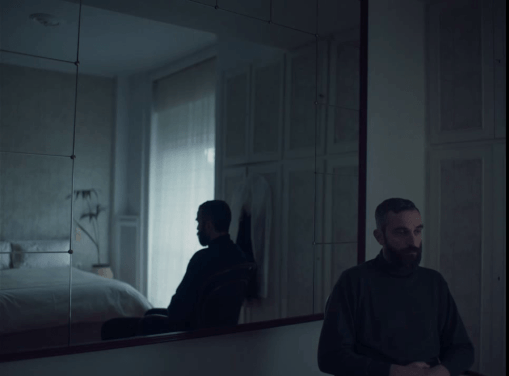
Played by a bearded Aris Servetalis, who cuts the figure of a stoic philosopher parachuted into modern Athens, the protagonist says very little, expresses even lesser. Even when he sings or dances, he looks like he’s executing an idea of song and dance. Nikou, who dedicates the film to the memory of his father, instead fixates on shots of the actor eating, sitting or staring into the distance. Looking at him biting into one apple after another, we wonder if anything at all lies behind his cryptic, silent stare.

Apples is thin on narrative incident or exposition, and fashions itself above all as the study of a cipher. As is de rigueur in cinema of this kind, Nikou shoots in shallow-focus, pivoting his compositions on Servetalis’s sculptural face and upper body. The actor is consistently decentred in the frame, reflecting the character’s loss of centre and the feeling of being never blending into the landscape. Outside of another “unidentified” woman (Sofia Georgovassili), whom the protagonist meets during one of his tasks, there are few full-fledged characters, which encourages Nikou to stay away from shot-reverse shot patterns.

Contemporary Greek filmmakers operating in this narrative mode can barely escape comparisons to Yorgos Lanthimos, with whose idiosyncratic, high-concept works Apples has considerably in common. Besides borrowing his lead actor from Alps (2011), Nikou channels his compatriot in his taste for absurd plot developments, unorthodox shot composition, clinical indoor settings and handling of secondary characters, who are suitably caricatured in voice and gesture to the benefit of the protagonist.

Nikou, though, pitches his film at a level above realism—the viewer is simply expected go along with the premise, which may not stand logical scrutiny—but several notches below Lanthimos-like parable. He accentuates the incongruence by a calculated anachronism: his film looks by turns contemporary and futuristic, but is strewn with props that are forty years old. While such preconceived quirks as the film’s 4:3 aspect ratio have by now become veritably academic, Apples keeps it light and avoids being overwhelmed by its film-awareness.
 

[Originally published at Firstpost]

Dāvis Sīmanis’ The Year Before the War, which premiered in the Big Screen Competition section of the International Film Festival Rotterdam (IFFR) in February, has all the potential to be one of the great festival hits of the year. It’s certainly among the most polished, good-looking films at the IFFR. Presented in a striking monochrome palette, it’s a period picture unfolding over several European locations and in multiple languages. As such, it has the finish of a high-end arthouse production that is bound to appeal to a larger audience. Most importantly, it has got, yes, a vision.

Set in 1913, Sīmanis’ film centres on Hans (Petr Buchta), a doorman at a hotel for international visitors in Riga, Latvia. When we first see him, he obsequiously bows to a German tourist who injures and racially abuses a black porter trying to pick up his luggage. He is told off by a colleague for this abhorrent behaviour – a minor reprimand that triggers a major change of attitude in Hans, who starts by tossing a coin from his ill-begotten Trinkgeld to the porter on the ground.

In the following weeks, Hans begins to stand up against quotidian acts of injustice, without actually adhering to a cause like his colleague had advised. When he is falsely implicated in a bombing carried out by anarchists at his hotel, he flees Riga to shuttle from one European capital to another for the rest of this momentous year.

The Europe that Hans traverses is less a real geography than an abstract zone of competing political currents. War is around the corner, and there are several groups trying to influence the course of history. Over the course of his cross-continental flight, Hans encounters figures like Lenin, Freud, Mata Hari, Hitler and Stalin. Everyone recognizes him instantly, identifying him as a certain Peter (in reference to the mysterious Latvian-born London anarchist Peter the Painter).

Like in a wrong man thriller by Hitchcock, Hans disowns the name at first, but eventually slips into the role, getting admitted to a mental asylum, serving as a shill at Lenin’s demonstration, and even carrying out acts of violence in Peter’s stead. Over the course of these events, zealous ideologues seek to entice and co-opt him, subjecting him to what Louis Althusser called “interpellation”: the recruitment of the individual as a subject of a Grand Narrative.

All through, Peter fights hard to follow his own moral compass, to flee subjecthood, and to retain his individuality. As the Great War ends, however, he finds himself a hero and in the upper echelons of the Soviet state, dispatching dissidents to gulags with a wave of the hand. So, in line with his friend’s counsel, Hans does indeed become the flag-bearer for a cause, ‘turning into’ Peter wholeheartedly, but he is not necessarily any better than the man who bowed down to a bigot at the entrance of a hotel. In the scheme of The Year Before the War, it’s those who believe in an ideal that are capable of much greater violence than apolitical opportunists.

Sīmanis’ film is essentially a historical picaresque. But where the protagonist of a picaresque is a fully-formed subject, Hans is a cipher in the process of becoming one, rendering The Year Before the War something of a commentary on the genre. Simaris is interested in the singularity of this particular juncture in Western history – a point at which fin de siècle optimism about technology and human rationality came crashing against the reality of trench warfare, all the paths of glory leading to the grave – where countless isms sought to impose their own vision on the world.

The Year Before the War translates the torrid atmosphere of this period into a frenzied mise en scène that is as effective as it is film-aware, Simaris’s style here echoing the ironic textures of Lindsay Anderson and Guy Maddin. Hans’ increasing confusion and loss of a sense of self is conveyed through expressionistic devices that also pay homage to post-war silent cinema. The performances of the actors are similarly stylized, poised above naturalism and steadily developing towards a fever pitch; the political personalities, especially Lauris Dzelzitis’s glass-eyed Lenin, are virtually high-strung puppets.

In Escaping Riga (2014), Sīmanis zeroed in on two 20th-century figures born in the Latvian capital – the filmmaker Sergei Eisenstein and the philosopher Isaiah Berlin – who were swept along by intellectual waves of the time and ended up on the opposite sides of the Iron Curtain. There’s something of them in Hans, a small man caught up in big events, who might have been a doorman all his life in any other era. It would seem that Sīmanis views Latvia of the early 20th century as something of an ideological waystation, an unstable intellectual field where free radicals like Hans can’t help but be neutralized. And that vision isn’t without contemporary resonance.


(First published at Ultra Dogme)

Like several events over the past year, the 50th edition of the International Film Festival Rotterdam (IFFR) was reconceived in light of pandemic-imposed restrictions. In addition to a significant part of the proceedings taking place online, the festival is also split across February and June, with a host of repository screenings (online and off) and a special exhibition at the Eye Filmmuseum in Amsterdam offered for audiences in the interceding time.

It was also the year that the festival found a new director in Vanja Kaludjercic, who, in an interview with Screendaily, evoked her work as a programmer with festivals specializing in a diverse range of cinemas. The programming at IFFR this year, too, was nothing if not eclectic. The films on showcase spanned a range of styles, genres, budgets and themes, suggesting a festival beginning to open up to newer horizons while remaining focused on its mission of promoting up-and-coming talent around the world. The June leg of the IFFR promises to throw more light on the overall character and orientation of the festival under the new direction.

Two films set in Japan, featured in the Big Screen Competition section of the festival, provide complementary perspectives into the intersection of class and gender in Japanese society. At first glance, the films couldn’t be any more different: one is a classically-styled fiction, while the other is a sport documentary. Yet, the two films succeed, in their own ways, in drawing out what they see as certain fundamental features of the national temperament.

Adapted from Mariko Yamauchi’s serialized novel Ano Ko wa Kizoku (2015-16), Aristocrats presents two narrative arcs each centred on one young woman. Hanako (played by Mugi Kadowaki) is the last child of an upper-class household in a posh ghetto of Tokyo. The opening scene, a New Year dinner in an upscale restaurant, establishes the family dynamic: just jilted by her fiancé, Hanako sits humiliated in silence as everyone from grandma to her sisters offers tone-deaf advice on how she should find a new partner soon.

And so, Hanako is sucked into the rigmarole of arranged marriage, meeting one unsuitable boy after another in locations across Tokyo. Where another film might have dispatched these unfortunate encounters in a quick, comic montage, director Yukiko Sode chooses to flesh out each meeting, dwelling on Hanako’s discomfort in not just interacting with these basket cases, but in negotiating these alien spaces of the city.

The problem with Hanako, however, is less romantic than existential. She is a cipher with no identity of her own. Brought up in the cocoon of ultra-privilege, she never comes into her own, moving straight from the role of a father’s daughter to that of an aristocrat’s trophy wife to that of a mother to a political heir. In the duty-bound upper echelons of Japanese society, Hanako must fulfil the social function ordained for her, whether she wills it or not.

Miki (Kiko Mizuhara), on the other hand, has always had to fend for herself. Born in a modest household in the provinces, Miki is nearly forced to drop out of her college by her ne’er-do-well father and takes up a job as a hostess to be able to continue her studies. Not all spaces of Tokyo are open to her, but as a working-class girl, she enjoys freedoms that Hanako in her regimented social station cannot. She lives alone in a studio in the city, drives around on a bicycle and forges friendships in a way her social better can’t imagine. Even formally, her story moves freely between the past and the present, in contrast to the strict linearity of Hanako’s narrative.

The first time the two women meet, it’s in order for Hanako to confront Miki about her relationship with her aristocrat husband, whom the latter had met in college and had an affair with ever since. What one expects from the scene is an expression of jealousy and anger from the women; what we get, instead, is mutual curiosity and respect. The affair itself comes to an end in a dignified, bittersweet fashion.

The two meet one more time in the film. Hanako, resigned to her gilded cage, spots Miki on the road. Miki takes her to her tiny studio, which Hanako peruses with a fascination recalling Greta Garbo’s ‘memorization’ of the bedroom in Queen Christina (1933). It’s a busy loft, filled with souvenirs and photographs, attesting to a life of individual enterprise and genuine camaraderie – concrete signs of a personality that prompts Hanako to take control of her own life.

Issues of class and gender identity are present in a more subdued manner in Witches of the Orient, French filmmaker Julien Faraut’s documentary about Japan’s legendary national women’s volleyball team that won the gold medal at the 1964 Olympic Games in Tokyo. Given the epithet of the film’s title by the Soviet press for their athletic wizardry, the team went undefeated for 258 games in the early sixties – a still unbroken record – and were eventually assimilated into Japan’s broader pop culture.

The film opens with a lunch meeting between some of the players as they are today. Faraut takes us through their daily sport routine, while their voices on the soundtrack furnish recollections of their glory days. Some of the teammates are no more, some infirm, but most still very fit, and at least one still coaching younger volleyball teams. The film doesn’t get too much into the details of their private lives, allowing their public role to take centre stage.

The team originally belonged to a textile factory in the Osaka prefecture, where the women worked at daytime. After their shift, they would train for the rest of the day, sometimes until dawn. Faraut, who is in charge of the audiovisual repository at the French national sports institute, INSEP, unearths archival clips that show the rigours of the women’s training: a barrage of balls directed at individual players, who keep throwing themselves at the ground with the last ounce of energy in order to gain the points that will allow them to wrap up the session.

Faraut charts the team’s dream run by intercutting footage from the games with clips from an animated television series that was later made based on the team’s sporting exploits. Set to pulsating electronic music, these dynamic sequences neatly illustrate the way the rugged working-class bodies of the players were idealized and exaggerated into elegant, expressive anime forms that became part of Japan’s popular lore.

Towards the end of the film is a sequence presenting Japan’s astounding rise from a country left in ruins by the war to being a global industrial giant in less than two decades. In a bit of cultural essentialism, Faraut equates this economic miracle with the volleyball team’s ascent to world domination, the common thread being the indomitable determination of the Japanese in beating almost impossible odds. It is pertinent that the team’s brutally exigent coach, Hirobumi Daimatsu, was a commander in the Imperial Army who survived starvation with his platoon in the Burmese jungle.

Despite the heterogeneity of their source material, both Aristocrats and Witches of the Orient adopt a relatively simple style that can at times even feel rather flat and disinterested. But through accumulation of detail upon detail, both films manage to achieve a certain critical weight and emotional resonance. They are likely to travel far.


(Originally written for Firstpost)

The Last Farmer, multi-hyphenate Manikandan’s fourth directorial venture, is nothing if not timely. To be sure, in a country where agrarian suicides are permanent fixtures in the annual news cycle, any work about farmers is timely. But the premiere of Manikandan’s film also coincides with the nationwide protests underway against newly enacted agricultural reforms. As a story about the only remaining farmer of a village, it is, at the very least, bound to benefit from and contribute to the discourse.

Any film by Manikandan is a closely-plotted affair, and The Last Farmer juggles no fewer than four narrative arcs. It is, firstly, the picture of a village that overcomes its internal divisions when faced with adversity. Old customs, beliefs and ways of life are revived as the crisis galvanizes the villagers around an expiatory feast. Thwarting its progression, a second storyline finds the titular last farmer, Mayandi (Nallandi), being harassed and ground down by the legal establishment for having buried dead peacocks found on his land.

Woven through this mesh are vignettes that dramatize items from the headlines: the persistence of drought, the introduction of GM crops, the financialization of agriculture and the corporate takeover of farm lands. There is even an extended star cameo by Vijay Sethupathi as a wandering holy fool who moves in and out of village life. The result of this narrative density and shifting focus is that the film is made less of fleshed-out scenes than of short, melodramatic incidents that move the plot forward.

The farmer is arguably the single most sacred figure in modern Tamil cinema, rivalled perhaps only by the Sri Lankan Tamil. And Manikandan’s film has no intention of impinging on this saintly aura. Its protagonist is the last fount of agricultural knowledge within a largely oral tradition. He leaves everyone who comes into his orbit in thrall, and the filmmaker treats him with comparable awe and piety, even at the risk of idealizing the character. This renders The Last Farmer a film primarily addressing an urban Tamil audience, one which longs for a lost unity back home.

With Lenin Bharathi’s Merku Thodarchi Malai and Mari Selvaraj’s Pariyerum Perumal (both 2018), it seemed as though the ideological and aesthetic stakes of village-based Tamil cinema could never be the same again. While it wishes away the deep, irreconcilable caste divides unveiled by the latter film, The Last Farmer owes a debt to the Vijay Sethupathi-produced Merku Thodarchi Malai, not just in its use of crane shots to chart mountainous landscape, but also in the way it adapts some part of its comprehensive political-critical outlook.

But Manikandan is no ideologue. His film is less the product of cohesive theoretical reflection than a personal tribute to his ancestors. (In the film’s opening credits, he mentions his lineage up to three generations—a first in cinema?) It is made with the filmmaker’s characteristic humour and attention to detail, nowhere more evident than in the authentic courtroom scenes, which were already a standout in his previous work, Aandavan Kattalai (2016). He depicts the village with a cinematographer’s eye, integrating its geography, people and nature into a whole ecosystem, which is one of the film’s main themes. The Last Farmer registers as a work Manikandan had to get out of his system, but the feeling remains that his sentimental attachment to a subject close to his heart may have come a little undone by his distance from it as an essentially urban filmmaker.


[Originally written for the International Film Festival Rotterdam]

pebbles

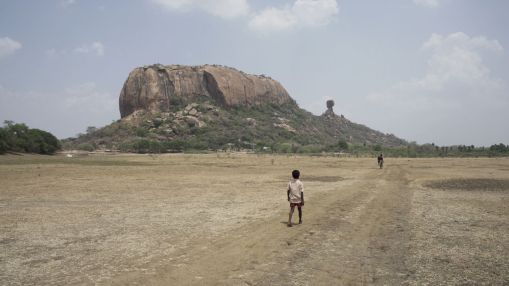
There is a scene early on in P.S. Vinothraj’s first feature Pebbles that takes place in a town bus. Diverging from the story at hand, the director fixates on a series of objects that accompany the passengers: a marapachi doll, a yellow cloth bag, a new set of brass lamps, a CRT television, plastic water carriers. It’s the sort of sentimental detail, each item conveying a world of stories, that gives the film its lived-in quality. As the bus plods along the narrow road, someone smokes one beedi too much. A scuffle ensues, waking up a sleeping baby at the back and bringing the shuttle to a halt.

If these sensations of small-town transit are ostensibly wrought from experience, Pebbles supplements them with material ripped from the headlines. The film unfolds in parched stretches in the outskirts of Madurai in Tamil Nadu. Once there were rivers in in these lands, but all that remain today are signs: empty water canals, drought-resistant vegetation, dying springs. And pebbles. The possibility of agriculture having collapsed, some families have resorted to hunting and consuming rats.

Amid this bleak picture is the story of a father and a son. The man, an alcoholic, seethes with uncontrollable rage at his wife who has left him. The internal movement of the film is closely coupled with the rhythms of this man’s quivering body. Despite the bottle, he walks briskly, his chest heaving, as his child follows him far behind in a mix of fear and concern. For the most part, Pebbles is a horizontal film made of characters traversing the frame from left to right. As the man heads towards his in-laws’ place to find his wife, we also get a tapestry of scenes from the village in the background.

The child, in contrast, is a mute receptacle to his old man’s violence whose muteness is also a force tempering this violence. He wants his family to stay together. When his father sets out to board a bus back to his village to take it out on his wife, he tears up the wad of cash entrusted to him, forcing both of them to walk back home. As a collector of pebbles, the boy knows that this unforgiving landscape has a way of smoothening rough things. Sure enough, the long pedestrian voyage under the scorching summer sun does things to the man’s head, even if it doesn’t entirely cool it down. By the time he reaches home to down some water and food, the film too has settled into a sedate rhythm. Pebbles, then, isn’t as much a story of the terrain as a story by the terrain.

Even when it goes through familiar emotional beats, Pebbles manages to remain fresh, an important quality for a debut work. Vinothraj executes bravura sequences with serpentine camera movements, but he is also concerned with capturing a child’s confusion within a conflict situation. His film is about survival, about life in its barest details, but it doesn’t rule out the capacity for aesthetic experience: waving a balloon out the bus window, transforming dry leaves into a simulated rain shower, collecting feathers and pieces of a broken mirror. And pebbles.


[Originally written for the International Film Festival Rotterdam]

City Hall, or 272 minutes of “the future that liberals want”. I don’t know if Frederick Wiseman intended his film to coincide with the run-up to the American elections. But what is certain is that this wide-ranging documentary on the day-to-day operation of the Boston municipal government presents the city as a kind of laboratory offering a glimpse into one possible future for the nation. Mayor Marty Walsh, who is a something of a protagonist in the film, says so in no uncertain terms: he hopes Boston will be a model for other cities to follow. If Boston is a laboratory, what are the experiments? More equitable contracting opportunities, better rehabilitation facilities, reinforcements for food banks, construction of homeless shelters, more funding for eviction prevention, pushback against discriminatory renting practices, certification for same-sex marriages, authorization of marijuana retailing, increase of inner-city school capacities, and so on. True to his style, Wiseman films all these processes non-intrusively, in which the subjects don’t interact with the filmmaker or even look at the camera. Most of the film’s scenes are either speeches to an audience or a group discussion, both of which allow the filmmaker to compose them with countless portraits of attentive faces.

While what we see is practically the ‘Democratic agenda’ made real, Wiseman remains focused on a central theme. Boston, we are told, is 55% non-white, a fact that the city hall hopes to reflect in its policies. Wiseman, likewise, picks out diverse faces in the audience speaking or listening closely, as though to mirror Boston’s demographic distribution. In a way, City Hall is a picture of how a multicultural city comes to terms with its ethnic reality, how identity groups gain in power and how values enshrined by institutions are challenged and modified, all through democratic, constitutional means. However, given Wiseman’s non-interventional style, we aren’t told what to make of these observations. Wiseman doesn’t provide any reaction to the municipality’s policies from people and institutions outside it. In this absence, the audience’s own opinion about the proceedings comes into play in a significant way. In other words, viewers from the extreme-right could find as much material to justify their beliefs as liberals might.

On the other hand, the fact that there is hardly any friction within the operations of the city hall itself tilts the film’s balance. For a film about democracy in action, we barely see any dissent within the meetings themselves. We get new angles into specific issues, sure, but nothing that resists the fundamental thrust of the institutional charter. Only a faintly humorous, somewhat superfluous sequence late in the film, in which businessmen seeking to commercialize marijuana in an impoverished district face the cross-examination of the district residents, comes anywhere close to capturing the fault-lines of the democratic process. Moreover, Mayor Walsh unequivocally comes across as a political hero dedicated to the cause of his people. The mayor is everywhere, now supporting a gathering of nurses on strike, now thanking a group of war veterans, now extending support to Latina hopefuls, now organizing an NAACP rally. The only opposition he faces in his work is Trump’s federal policies, which register as an abstract external threat that the paternalist mayor will help his people overcome. In this respect, the film veers uncomfortably close to propaganda.

So it’s ambiguous whether City Hall is really ambiguous. The film adds to the impression of objectivity by expanding sideways. Almost obsessively, Wiseman documents operations at every organ of the city hall, located all across the city: from traffic control to pest control, from animal shelters to archaeological repositories, from cross-cultural cooking sessions to construction sites. This breadth is aimed at exhaustiveness, to show that the municipality’s operations touch every aspect of the city’s life. To this end, Wiseman glues together his sequences with shots from the city streets showcasing residential and official architecture, commercial establishments and the sea port. This offers a dialectic in which the city hall’s work becomes the invisible labour sustaining the order and beauty of Boston’s visible surface. Conversely, these digressions also risk scattering the focus of the film, all the more so because they are presented in bits and pieces, almost half-heartedly. City Hall is at its strongest when it depicts Boston as a seismograph of the larger changes afoot in America. At the same time, when it remains on its focal point, it starts losing its nuances. More than Boston, it’s Wiseman’s film that is a real litmus test for its viewers.

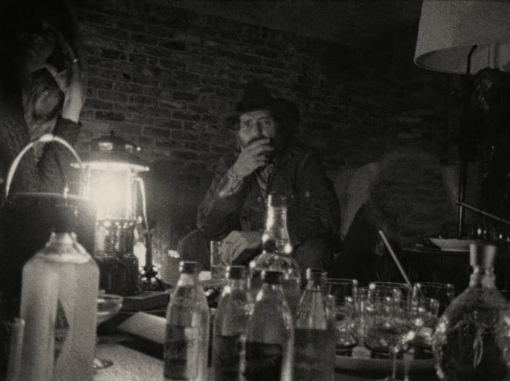
Orson Welles has been quite productive of late, considering he’s been dead for 35 years. Produced by the same team as The Other Side of the Wind (2018), Hopper/Welles is a documentary born of the director’s filmed discussions with Dennis Hopper in 1970, prior to the making of Wind. Coming out of their graves to give us company in our collective confinement, Welles and Hopper hole up in a dark room with half a dozen technicians to talk filmmaking, politics, religion, love, magic, news, television and literature while dutiful assistants scurry about readying one refill of liquor for them after another. Talk is perhaps not the right word here, for what Welles to Hopper does may better be described as an interrogation, a grilling. He plays the Grand Inquisitor, pressing his timid interlocutor to state his artistic and political beliefs, pulling theories out of nowhere to counter him and never allowing him a respite or a resting ground. While part of it is low-key ragging, Welles’ insistence clearly comes from a place of goodwill and seeks to draw out the young man’s best. Hopper, in his early thirties, is rather unsure and self-contradicting before Welles’ towering figure. Sporting a hat, he constantly caresses his beard, qualifying all his tentative, half-joking answers with a nervous, self-protective giggle. What Hopper lacks in persuasiveness he makes up for with his keen attention and youthful vigour; his eyes are full of life. “You’re a hard man to talk to”, he tells his questioner.

At the beginning of the film, a short text let us know that both Welles and Hopper changed the face of movies with their respective debuts. In doing so, it places both filmmakers at par with each other. That doesn’t quite reveal the entire picture. Now, in 1970, Welles is a greatly respected, almost legendary figure, but whose glory days are behind him, something of a ‘has-been’ if he ever ‘was’ for Hollywood. Hopper, on the other hand, is a star hot off an era-defining blockbuster in Easy Rider (1968). Yet, in their conversation, they are able to find a common ground, namely the question of authenticity in filmmaking. We never see Welles, save for rare glimpses of his bellowing pin-striped trousers moving at the edge of the frame. Hopper’s eyes, wide in evident admiration, follow him everywhere he moves in the off-screen space. At several points, the Caravaggesque Hopper literally looks up at Welles, who appears to be playing some kind of metaphysical force, re-orchestrating a Kafkaesque trial for Hopper. What results is a stark power imbalance between the seen and the unseen, between the subject and the author, between the one who is recorded and the one who wields the camera. Hopper’s cinematic forefather looms large over him even as he speaks about the need to one-up his old man.

I can’t imagine what form the film would’ve taken had Welles edited and completed it himself, but as it exists, it looks nothing like what he has done until this point. Shot with multiple handheld cameras and a single lantern next to Hopper, the film never ‘settles down’. The operators constantly move around the room, seemingly for no reason, relocating the camera, changing focus, zooming in and out in a way that may be disorienting for those interested solely in the dialogue. The camera’s magazines run out and the clapboard cracks indifferently in front of Hopper’s face even when he is in the middle of an important point. Whether on Welles’ instructions or on editor Bob Murawski’s, the view keeps switching from one camera to another at a frenetic rhythm, with inexplicable black leaders inserted in between shots. The overall impression is that Welles is making something like a Cassavetes picture, improvising the whole film with his actor by placing him in a dramatic situation and teasing out his responses by way of direct questioning. Welles, we are told, is also in character, as the filmmaker from Wind, and Hopper calls him Jake (Hannaford) as well. So the film may be said to operate in some undefined region between documentary and fiction, a precursor to F for Fake (1973); as much a story about a director shaping and rehearsing with his actors as a record of a man eating, drinking and getting drunk over two hours.

But the primary pleasures of Hopper/Welles are rather straightforward: two maverick filmmakers in a terribly fascinating conversation. The movie-related anecdotes that emerge are very interesting, for instance Hopper’s relationship with the Fondas, or his work on Crush Proof (1972), a self-financed experimental film by architect François De Menil (scion of the Schlumberger family and a cousin to Sylvina Boissonnas, producer of avant-garde French films including the early work of Philippe Garrel), as are the political talking points, such as Welles’ support for Francisco Franco, his prediction about a black US president and Hopper’s observation about the rift between the counterculture and deep America as he saw it in the varied response to Easy Rider. Most of all, it is compelling to see two artists grapple with the cinematic-aesthetic problems of the time. As the discussion turns around the films of De Sica and Antonioni, Hopper and Welles reflect on the challenges in dealing with boredom and lack of drama on screen, a few years before Jeanne Dielman (1975), among other narrative films, would do away with drama altogether. Going public after 50 years, Hopper/Welles is both a standalone film and an anniversary celebration. It hasn’t dated one bit.

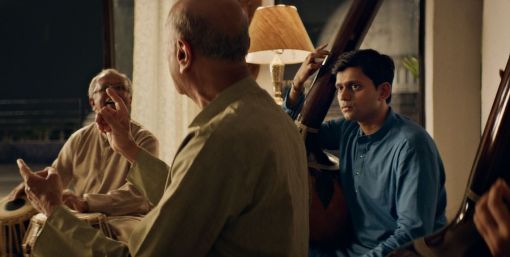
Chaitanya Tamhane’s splendid follow-up to Court (2014) deepens, inverts one of the primary themes of his debut feature. If the defence lawyer of the earlier film (Vivek Gomber, the producer of both projects) was an idealist groping his way through an indifferent system, Sharad, an apprentice Hindustani music singer not only finds himself unable to live up to the lofty ideals of his tradition, but is gradually disabused of these ideals themselves. Sharad (Aditya Modak, a Hindustani singer himself) is a conservative in the literal sense of the word. His occupation is to conserve: he works at a small music publishing house that transfers old cassettes and LPs into CDs. On a regular basis, we seem him physically caring for his aging, ailing Guruji (Pandit Arun Dravid), applying ointments, helping with his toilet, preparing food for him and accompanying him to concerts as well as clinics. Sharad is not the greatest of talents, he’s not even his Guruji’s best disciple, but imagines himself as part of a tradition, a tradition that gives a structural meaning to his life, but one that dissolves into legend the further one follows it into its past.

Sharad witnesses this tradition getting progressively ‘diluted’ under the pressures of modernity and technological advancement. He possesses rare recordings of lectures by his Guruji’s teacher, a fabled figure named Maai (‘mother’), none of whose music exists in any recorded form. Maai’s lectures call for an ascetic, spiritually rarefied, extremely demanding way of life on the part of the Hindustani musician (the words ‘disciple’ and ‘discipline’ sharing etymological roots). His own Guruji, on the other hand, concedes to a few intimate concerts to make ends meet. Sharad is scolded by Guruji for wanting to start performing concerts at the age of 24. He, in turn, finds it in order to set up a personal website and to teach music at a school, but chastises one of his teenage students who wants to join a ‘fusion’ band. On television, he watches kids without any musical lineage finding wide recognition, just as he notices on the internet that his peers have had larger worldly success without having to go through the rigours he has had to. The promise of omnipresence and instant gratifications of the modern world beckon him, but—spirit willing, flesh weak—Sharad soldiers on, hanging on to Maai’s words like St. Bruno to the crucifix: “While the world changes, the cross stands firm.”

On one level, the film is dramatizing artistic doubt, the musician’s feeling that he simply isn’t good enough. But, as a Hindustani vocalist, the stakes are higher for Sharad. His own failure to live up to certain ideals is one thing. But it’s when he learns from a music historian—or rather, realizes himself—that the tradition he enshrines is itself a bundle of legends that his life’s foundations are assailed. It isn’t, then, a dilution of tradition that modernity ushers in as much as a disillusioning, a reinterrogation. Maai and Guruji, it turns out, aren’t the exemplars Sharad had taken them to be. To be sure, he had this doubt all along, for he knows that his own father, despite his passion for and knowledge about the music of his tradition was a mediocre musician himself; for, at some point, Maai’s discourse becomes one with his own inner voice. The fountain is corrupt, innocence is lost.

Tamhane builds up gradually to this assault on Sharad’s worldview. But he isn’t particularly interested in showing how Sharad reacts to this epistemological violence. In fact, he takes particular relish in not giving us an idea of how he reacts. Throughout the film, he cuts from a popular talent hunt on television to Sharad watching it with a poker face; that is, Tamhane doesn’t tell us how to react to the TV show. That’s because it doesn’t matter whether Sharad regards the show with the condescension and contempt of a superior musician or whether he is jealous and resentful about its enticements. What matters is that he is exposed to socio-artistic structures outside his own.

In a very direct manner, The Disciple zeroes in on a fundamental, civilizational sentiment that underpins artistic succession in the subcontinent: that of filial piety, as opposed to the parricidal narrative that informs the Western conception of self-realization. Even when his faith has been questioned, Sharad continues his service to Guruji, caring for him till the final days, like icon worshippers who hold on to their idols even (and especially) when the meaning behind them are lost. Physically as much as psychically and artistically, he labours under the weight of Guruji, just as the rebelliousness of the lawyer of Court simmers under a begrudging respect (and dependence on) his father. In both films, this Oedipal repression is set against the pragmatism of the mother, who, in The Disciple, is more worldly, not possessing the redoubtably attractive idealism of the father. In the film, Sharad is estranged from his mother following his father’s death, and connects with her only after the idealist parental figures—Guruji and Maai—pass away in his mind. I must add that this bit of psychoanalysis isn’t at all gratuitous; it seems plain that the film is dealing in these simple, bold relations in a very frontal way.

Bold is not the adjective one may think of when speaking of the baby-faced Tamhane, who comes across as a well-behaved, dutiful child himself in his interviews, or of his two films, which seem rather averse to emphasis or overstatement. But some of the bluntness of The Disciple could hardly be described otherwise. One of Tamhane’s ostensible strengths is his belief in the importance of humour to his work. While comedy remained a sporadic visitor to the Court, here it is systematized, generalized in the way the filmmaker links two sequences. Some of it is pretty on-the-face: shot of Sharad sitting stunned in disbelief at losing at a competition cut to him meditating at a yoga class to let off the steam, moaning sounds from a pornographic clip spliced with Sharad’s belaboured aalap. If this is easy laughs, it also attests to a filmmaker’s increasing confidence about his material: the humour doesn’t undermine the characters’ values or the gravity of their situation.

Tamhane also has the very valuable knack of picking up interesting faces. His lead actors, many of them musicians themselves, are all very good; Modak undergoes an incredible physical transformation midway in the film, gaining a telling paunch that reinforces his kinship to the lawyer of Court. But I refer to the faces in the crowd, each of which seems individualized, with its own story. Tamhane’s sedate, wide-angle style was served well by the subject matter of Court, where almost every scene has a crowd. The Disciple, however, except in its fascinating shots of concert audiences, limits the filmmakers to a few characters, resulting in several conversations filmed tastefully as a two- or three-shot over a table, with the camera slightly arcing towards Sharad.

Equally of note is Tamhane’s decision to vary his compositions throughout the film. Firstly, we hardly see Sharad in the same place more than once. It takes a while for us to inventory all the spaces Sharad haunts: Guruji’s spare loft in a chawl, the independent house where he lives with his poor aunt, its terrace where he practices, the recording studio where he works, the yoga class, the various concert halls and patrons’ houses. Even when Sharad is in the same space, the composition is so starkly different that we don’t perceive right away that it’s the same location. The effect of this variation is that it doesn’t let Sharad settle into a routine, and he is constantly caught in a spatial flux. The only strong, anchoring image of the film finds Sharad on his bike, cruising on Mumbai’s deserted late-night roads, listening to Maai’s lectures—his sole guidepost in a changing universe. The Disciple is also a period movie that unfolds over several decades—and a meticulous one at that, picking out era-specific electronic gadgets, currency notes and porn clips—and ends in our time of the thumping return of conservatism (to be liberal about it), which imparts an ironic colour to Sharad’s disillusionment. Maybe it’s appropriate that, in our era of hollow idols, the film closes with Sharad stepping into his father’s shoes, giving up performing to run a music label, even though the hallowed values of his father have been rendered void.

[From my column on studio-era Hollywood films for Firstpost]

Boxing films are always something more than about boxing. The violent quality of the sport, the limited space of the ring and the unique social profile of its participants render it conducive to productive artistic interventions. Adapted from Joseph Moncure March’s prose poem of the same name from 1928, The Set-Up (1949) centres on Stoker (Robert Ryan, in a characteristically tough, anti-heroic turn), a 35-year-old boxer riding on a string of failures, getting ready for what may be his last shot at success. Unaware that his managers have made a $50 deal with the opposing team to ensure he loses the match, Stoker prepares for the fight against the wishes of his girlfriend (Audrey Totter), who wants him to give up fighting and settle down.

It isn’t usual for Hollywood films to be adapted from poetry. But March’s composition, which one commentator described as “a noir poem”, with its vernacular language and short, punchy verse lends itself easily to cinematic transcription. March himself was a film enthusiast who admired the economy of movie storytelling (“I learn something of value every time I see a picture, even if it’s rotten—and when it’s a really good one, my eyes pop out and I feel like taking up embroidery as a life work.”) His poem’s protagonist is a black man described thus: “Pansy had the stuff, but his skin was brown / And he never got a chance at the middleweight crown”. In the screen adaptation, this character is changed to a white man, Stoker, who identifies with the one black boxer in the changing room.

This whitewashing of the protagonist has two effects. One, it shifts the story’s social focus from race to class. Hollywood before the Civil Rights Movement was still tongue-tied on the question of race, but it was always more responsive to the plight of the poor white. With the war over and veterans returning to civil life, the triumphalist tone of war-time movies made way for a more sombre atmosphere in films dealing with urban realities. RKO studio head Dore Schary, director Robert Wise and writer Art Cohn were well-known liberals with interest in social themes. In The Set-Up, they use the situation of a washed-out pugilist to emphasize the impossibility of the American dream and the persistence of violence in public consciousness.

The first time we see Stoker, he falls face down on the ring following a knock-out. This downbeat image gives way to a shot of a street with neon lights sardonically reading “Paradise City” and “Dreamland”. Stoker, like his peers, clings to the dream against incredible odds, always believing in the illusion that he is “one punch away” from success. The Set-Up is certainly an underdog story, but one which recognizes that the underdog loses the war even if he wins a few battles, especially when the system is betting on his failure. Stoker does come out on top against his rival in the ring, but soon as he leaves the arena, he is thrashed by a group of men who break his right hand for good. Casinos, those embodiments of the American dream, have taught us the lesson: you don’t get to win against million-to-one odds and walk away scot free.

Making Stoker a white character also imparts a markedly existentialist thrust to the narrative. This is because stories amenable to existentialist reading, or written in existentialist terms, were often structured around a white, male subjectivity. Stoker’s predicament is explicitly formulated as that of a man trying to find meaning in an absurd universe. He is an aging boxer struggling to prove his worth in a world where the new is constantly replacing the old. In the changing room, he experiences vicarious pleasure and fear watching young, idealist debutants getting ready for their first match or expressing their hope for a chance at the title. This boxer of twenty years, whose sole supporter is another aging newspaper boy, sees the doors of his life shutting one by one. The spaces he inhabits in the film—his apartment, the changing room, and the arena—seem like claustrophobic, enclosed spaces with no exit.

More than the boxing ring, it’s the changing room around which the film is structured. This constricted room of male bonding, whose busy activities are filmed in deep-space compositions, is a zone where men can express their vulnerabilities without self-consciousness, a privilege unavailable in the ring or elsewhere. All the emotions Stoker experiences before his final shot at success — fear, ambition, disgust, temptation and domestic anxiety — are externalized through other characters in the room, who serve as a kind of Greek chorus. The changing room is a purgatory of comings and goings, a limbo between dream and reality. It is also a transitional space located literally between home and the ring; Stoker keeps peeking out to see if Julie has left their apartment, his anxiety relieved when he notices that she might be on her way to the match.

Julie, though, refuses to enter the arena. She spends her evening wandering the city streets, gripped by the dread of imagining Stoker hurt beyond repair. A moment of respite finds her observing young boys and girls indulging in pranks and games of chance at a penny arcade—a dream-like space as artificial as the ring. The film gives the appearance of unfolding in 72 minutes of real time. But it nests two experiences of time within its narrative. Julie’s 72 minutes agonizing over her boyfriend’s fate feels much longer than Stoker’s waiting for his match, which marches on like the clocks we see throughout the film, implacably, indifferently. It’s this binocular perspective of time, accelerating or slowing down depending on whose point of view it’s sharing, that lends the film a meditative, philosophical quality.

Julie’s refusal to enter the arena is also a refusal to partake in its violence. Throughout The Set-Up, and during Stoker’s fight in particular, Robert Wise intercuts the boxing with reactions of people in the arena. As men and women whoop and holler, changing their allegiance to whoever is landing the harsher blows, we witness a primal taste for animalistic violence sublimated in sports. Images of bellowing spectators make us aware of ourselves as movie viewers, revealing the sadistic gaze underpinning all violent spectacle, a gaze that has the power to kill. To this end, Wise photographs the match from outside the ring, so that the ropes are visible at all times during the fight. This decision conflates the film viewer with the spectator in the arena. It also creates a sense of entrapment around the fighters, who come across as captives made to kill each other for mass entertainment.

But that doesn’t prevent The Set-Up from being a spectacle in itself. Wise, who edited Orson Welles’ Citizen Kane (1941), exhibits a dynamic style comprising of elaborate camera choreography, wide-angle, high-contrast cinematography that makes use of all image planes, and a great sensitivity to the movement of boxers in the ring. The film barely has any musical score, and its soundtrack is made almost wholly of dialogue and environmental sounds. Even so, we don’t feel distanced from the action for a moment. In presenting the fight in all its vigour and energy, but breaking it regularly with somewhat repulsive shots of gesticulating spectators, the film has its cake and eats it too. Like many of the wonderful films discussed in this column, The Set-Up is a thing and its opposite, suffused with those perplexing, contradictory impulses that make the best of classical Hollywood cinema so rich and alive.


[Originally published at Firstpost]

[From my column on studio-era Hollywood films for Firstpost]

With the American economy recovering under the New Deal and workers getting back to the factories, it would seem that a more fundamental anxiety about the industrial age resurfaced in Hollywood cinema. Fordist production of the previous decades had vitiated the skilled workforce, reducing the factory employee to a tiny cog in the production machinery—an awareness that was heightened by the brief favour socialism enjoyed in the country in the late 1930s. Chaplin’s Modern Times (1936) responded most famously to this alienation of the worker by satirizing the principles of industrial management. The Paramount production Reaching for the Sun (1941) takes a less jovial route, exploring the theme within the framework of romantic comedy and marital drama.

Adapted from Wessel Smitter’s novel F.O.B. Detroit (1938), Reaching for the Sun follows Russ (Joel McCrea), a backwoods clam-digger who moves to Detroit to work in a car factory so he can afford an outboard motor for his boat. He plans to get back to the countryside as soon as he purchases the motor, but just as his roommate and colleague Bennie (Eddie Bracken) warns, he falls in love, marries and has a child in the city before he knows it. Obliged to toil at the factory to support his family, but also facing the opposition of his wife Rita (Ellen Drew) who wants to continue living in the city, Russ finds his dream of moving back to the woods slipping away from him.

Russ is first presented an innocent idealist living in harmony with nature, untouched by the harsh realities of industrial life. He lives for his clams, whistles at birds and deer. There’s not a resentful bone in his body: when he sees another clam-digger making a bigger haul with his motor boat, he simply tilts his head, as though to say “lucky man!”. McCrea’s towering stature bestows a rich dialectical quality to the character. Despite his lumberjack-like build, Russ is a gentle giant who gets knocked down repeatedly by Herman (Albert Dekker), his romantic rival at the factory. He keeps his hands close to his body even when he’s agitated. When he punches through a door in a rare fit of rage, it’s an evidently clumsy blow, made against his natural instinct.

Rita, in total contrast, is a world-wise city girl, a waitress and a taxi dancer who ribs Russ’ Southern-boy courteousness (“What will you have, or is that too personal?”). She has no abiding relation to nature: she doesn’t want to move to the countryside and falls into a brook the only time Russ takes her there. When they relocate to a new house, Rita points to a sorry excuse for a tree, telling Russ she picked this spot because she knows how much he loves nature: “The man said in the spring it has leaves and everything.” Just beyond this tree is a construction crane moving about its limb ominously.

The central theme of Smitter’s book, reprised as a secondary motif in the film, is modern man’s enslavement by his own inventions. “A machine geared to a man is one thing. A man geared to a machine is something else.”, writes the author. When we first see Russ in the film, he wedges out a truck stuck in the mud using a pair of logs. But the initial temptation of an outboard motor gradually brings him in contact with bigger and bigger machines. His first fight with Herman is with bare fists, the second with crowbars and pliers, and his final battle takes place through gigantic machines the two men operate. In the latter skirmish, Russ and Herman are barely visible, having become ghosts in the machines.

The film’s primary focus, however, is the machine that modern life as a whole is. Director William Wellman and scriptwriter Leslie River displace the immediate socio-industrial thrust of Smitter’s story on to an existential plane. Their Russ is a Thoreau-like figure wanting to live away from community in self-sufficiency, but who is caught in the rigmarole of social life, his personality gradually hollowed out by everyday grind. When Rita blasts him for obsessing over his outboard motor, he pensively tells Bennie that, without it, “I’ll be like everyone else”.

The machine thus comes to represent the life Russ dreams of, the identity he tries to hold on to. But, like the car in Ritwik Ghatak’s Ajantrik (1958), it is also a physical entity that supplants Russ’ human relations. Just after he purchases the motor, Russ carries it gently like a baby wrapped in rags. He addresses it with a “she” and nurtures dreams for it. In a humorous scene, he and Bennie try to get the motor started in their boarding house, just as two bumbling men would handle an abandoned baby. The machine competes with both Rita and Russ’ real baby for his attention and resources; at one point, it lies next to him on his marital bed, after Rita and her baby have left the house.

A contemporary New York Times review regretted such a comic treatment of the subject, criticizing the way the film strips away the socio-political import of the book. While this may be a fair objection, it should also be noted that the light touch of the film does not imply frivolity of intention. Producer and director Wellman, who retired early from filmmaking to spend more time with his family, often made pictures about characters who had to make hard choices between professional and personal lives. He recognizes the modern apprehension at the heart of the story. His success lies in finding a form that registers this hefty idea without letting it overwhelm the narrative.

A number of scenes in his film function on a register that is neither wholly comic or dramatic, an ambivalence that works in its favour. In a reconciliatory exchange, Rita inquires how important she is for Russ. Russ tells what she wants to hear, but when she asks “more than the outboard motor?”, he goes silent in a manner that’s both poignant and funny. In another sequence, Russ and Bennie attend a class for to-be-fathers where they are to learn how to handle newborns. It’s a broadly comic scene about changing gender roles, but Russ’ reaction to the idea of washing a baby’s bottom, a mixture of fear and worry, is the opposite of what such a comic scene demands. Towards the end, just after Rita has left with the baby, Russ receives a laudatory certificate from the class for being the best father—an ironic moment that’s tragic even if Rita and the baby were with him.

This heartfelt angst about the costs of domestic life is complex and unresolvable, all the more why the film’s ending seems so ridiculously contrived. Where Smitter’s novel leaves Russ hopelessly crippled after an industrial accident, he not only gets artificial legs in the film, but is able to move to the countryside with Rita and the baby. While there’s little reason to suspect that Wellman, known for his obstinacy and independent spirit, had to compromise, the postcard picturesqueness with which this tacked-on happy ending is filmed — Rita tossing a steak and singing a folk tune in the country house—can’t possibly be taken at face value. Considering that Wellman shows a large banner at the car factory reading “Quality First” (and not “Safety First”) just after Russ’ accident, we may suppose self-parody at work. It may be that a country on the brink of a great war simply needed to believe in such happy endings.


[Originally published at Firstpost]

[Disclaimer: I know the filmmaker Arun Karthick on Facebook. In principle, I don’t write about films by people I’m acquainted with. But since Nasir had a worldwide screening on YouTube as part of the We Are One festival, I thought it okay to write about it. Take it with a pinch of salt all the same.]

Arun Karthick’s Nasir is built on a series of refusals. As a non-Muslim filmmaker telling the story of a poor Muslim man, Arun seems to have felt that the only way he can negotiate this dilemma is by refusing to give in to objectifying characterizations of Muslims typical of a whole lot of non-Muslim cinema. So very little about Nasir (Koumarane Valavane) marks him as a Muslim in the viewer’s eyes. He doesn’t wear a kurta, doesn’t have a skullcap and doesn’t shave his moustache. We never see him eat meat or biryani. He doesn’t live in a Muslim ghetto, his impoverished neighbourhood accommodating poor of all stripes. His speech is plain, largely untouched either by Dakhni Urdu or the prevalent Kongu accent of Tamil. His household isn’t teeming with children; in fact, Nasir doesn’t have a child of his own, and he takes care of an orphaned, developmentally challenged teenager at home. This considered refusal of artificiality must not be confused with authenticity.

This extends to the dramatic construction as well. Right at the outset, we learn that poor Nasir needs money: he has an ailing mother and a memorial ceremony is around the corner. It’s the most melodramatic of all premises. But the film refuses to take Nasir through a parade of frustrations, disappointments and humiliations. The drama is constantly deferred, relegated to the margins, until late into the film. The filmmaker is mostly content in observing Nasir’s workaday over 24 hours, starting from his morning routine until his walk back home from work late in the evening. Nasir works at a clothing outlet, and the film captures his interaction with colleagues, customers, his boss and his family at length, interspersing it with pensive moments of Nasir smoking beedi.

Nasir is a relic from another time, something of a poet adrift in a commercial world. He listens to music on a tape recorder, writes loving letters to his wife who’s away from home for just three days. Like his poetry, his understated but distinctly innocent romanticism are at odds with a universe of short-term relationships and teenage affairs. His long letter to his wife—doubling as an elaborate expository device read out as voiceover—is interrupted thrice by instances of violence. But Nasir is out of pace with the world in other ways as well. As an unmarked Muslim unbound by his community and uninvolved in debates surrounding Islam, he mentally lives in a time and place in which he could survive behind the general anonymity of the city and the marketplace.

Echoing this isolation, the film hems close to Nasir’s perspective of things. The viewer experiences only what the protagonist experiences. Nasir is the centre of the cosmos on whose margins tumultuous things unfold, things that he keeps at bay unwittingly or not: signs of anti-Muslim sentiment and political mobilization in the city. A shorter sequence at his shop transposes Nasir’s condition temporarily onto a female co-worker. As the men at the outlet discuss porn, sex and adultery, the camera leaves Nasir to follow the young woman around the store as she tries unsuccessfully to ignore this ostensibly uncomfortable discussion.

Nasir’s observational approach isn’t new, and it plants itself firmly in the Hubert Bals-sponsored tradition of meditative fiction filmmaking. The film starts out with extreme close-ups of scenes from Nasir’s household, partially blocked or obscured images offered through layers of fabric or grills so that the viewer squints to perceive what’s happening. This formal scheme loosens up as Nasir sets out for the day, the scenes at the clothing shop serving both as visual and comic relief. The filmmaker often fixates on minute details of décor, setting or actors’ bodies, with one afternoon sequence around Nasir’s nap turning into an abstract vision of a state between dream and waking life. While this fetishization of the ordinary remains eccentric and tasteful for most part, it sometimes tips over into the exotic, such as when we see Nasir’s prayer at the mosque—a rare sign of his Islamic affiliation—at great, almost voyeuristic detail that goes against the general principle of the film.

On the other hand, the film’s treatment of the city of Coimbatore in Tamil Nadu, where the story is set, is quite refreshing. My recent memory of the city on screen is in the noxious Suttu Pidikka Utharavu (2018), where it’s a contested town filled with treacherous North Indian immigrants and Muslims to be strictly policed and surveyed from apartment rooftops. In Nasir, in contrast, we witness the city almost exclusively from the eye level on the street.

To be sure, the film does not purport to offer an objective, value-neutral glimpse of the city. For instance, we hardly see any political or film posters on its walls, or hear Dravidian political rhetoric—sights and sounds that are integral to public experience in Tamil Nadu. And the same could be said of the deep-seated caste and ethnic fault lines of the city. In Nasir, it would seem that these details have been supplanted by a pan-national communal discourse: Jamaats and Mahasabhas announce themselves on the walls as Nasir walks from his neighbourhood to the larger city—sequences whose lengths seem determined by the soundbites from mosques or BJP speeches we hear on the soundtrack. And a vaguely suspicious North Indian presence is still felt on the narrative periphery, most notably in the ubiquity of Ganesha idols during the Ganesha festival, which here becomes an occasion for Hindu assertion and mob violence.

Even so, Nasir does a good job of capturing the unique visual culture of the state, the sensory overload it imposes on the public, vying for its attention akin to the shop worker who calls out to potential customers: flashy private vehicles at a mofussil bus depot, serpentine chains of stores selling the same wares, coloured decorations cutting across roads like wires, etc. More importantly, it touches on the fragile cosmopolitanism of the city, easily upset by politically-motivated communal polarization.

Critics have hailed Nasir for its reserve, its abstinence from grandstanding, its relegation of the political to its margins and its refusal to give a message. While some of it is true, I think this profoundly mischaracterizes the film. For one, the rejection of messaging is new only as far as one compares it to mainstream Indian cinema, a comparison with little possible ground. Nasir is as far from mainstream Indian cinema as it is from Hollywood; its lineage is different and specific. Considered in light of other Rotterdam-funded films of the past two decades, its minimization of the political and its refusal to preach is wholly in line with that tradition.

Moreover, it isn’t to the film credit to say that it focuses on some fuzzy humanism, keeping the political and the communal out of its scope. Nasir’s indifference is a virtue only as far as there’s the threat of political and religious violence about him. The marginalization of the political is part of the film’s emotive substructure and not some independent artistic choice outside of its desire to follow Nasir’s life. One collapses without the other. Finally, it seems plain as day to me that Nasir has a message and one it wishes to convey ardently. It isn’t an ambiguous film by any measure, and there are no dozen ways of reading it. It isn’t any less message-oriented than many liberal-minded mainstream pictures, and to acknowledge that doesn’t take anything away from the film’s accomplishment.

[Spoiler alert]

Which brings me to the film’s ending. As Nasir walks home at night, reciting the letter to his wife on the voiceover, a Hindu mob confronts and kills him. Where arthouse filmmaking would typically omit this graphic event, presenting vignettes of its aftermath alone, Arun chooses to depict the violence. The camera unhinges from the tripod, frenetically following the men pouncing on Nasir. The shaky camera abstracts the lynching such that that the mass of men is reduced to an indistinct blob of low-def colours, with a face or a snatch of dialogue emerging from time to time to pin down the meaning of the event.

It is a bold choice that finds a novel (and morally defensible) midpoint between the iniquity of representing such violence and potential perversion (not to mention the aesthetic staleness) involved in artfully eliding the event. But I do wonder whether it isn’t a superfluous ending that could’ve been done away with altogether. I understand that it’s intended to inscribe homicidal violence within the everyday experience of the poor Indian Muslim. But I also think that it topples the affair by suggesting that the travails of Indian Muslims could only make sense within the optic of murderous communal violence. In other words, the low-key struggles born of structural problems—lack of state support, the dearth of economic opportunities, the obligation to ply one’s trade under neutral names, the pressure to move to the Gulf, the intersectional violence on women and the disabled—that are the focus of the most part of the film risk being relativized by what is evidently a coup de théâtre. It reduces the admirable qualities of the film to the setup for a dramatic punchline.

« Previous PageNext Page »