Translations


[The following is a translation of Luc Moullet’s Fritz Lang (1963/70, Seghers). The book consists of two parts: Moullet’s monograph and a collection of writings by and on Lang. I have chosen not to translate the second part because (a) Lang’s articles and interviews were originally published in English and are thus available in English elsewhere, (b) many of the texts on Lang (by Bazin, Godard, Rivette etc.) are already translated in their entirety into English, and (c) I think the second part, with its patchwork of excerpts, registers more as filler material that adds little value to Moullet’s monograph.]

I. Search (1916-1949)

II. Maturity (1951-1960)

III. Conclusion

[The following is a translation of a set of letters between Raymond Bellour and Marie Redonnet on Satyajit Ray’s Days and Nights in the Forest (1970), originally written in 1993 and published in Bellour’s Pensées du cinéma (2016, P.O.L.)]
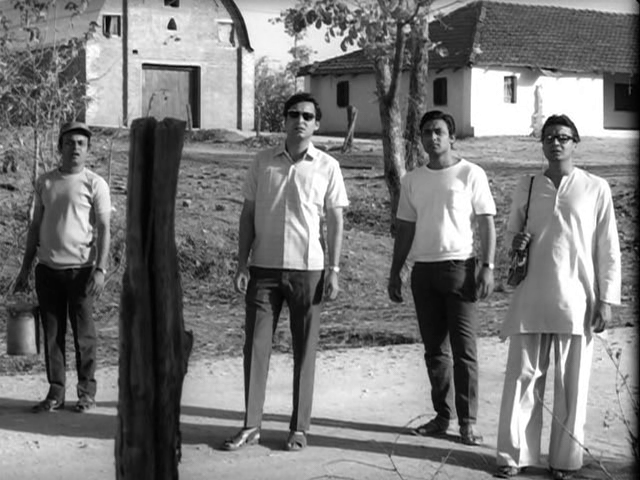
Days and Nights in the Forest

It’s always strange to walk out of a film with another person when we don’t know them well enough to be sure (a dangerous certainty) that they are thinking what you’re thinking. Especially when the film surprised you, took unexpected turns that you felt you followed well, and you don’t know if the other person, who might not have the same relation to cinema, reacted to the film in a similar way, or will at least use similar words to describe it.

Here, on the other hand, was a certainty, still a silent one: we liked the film. Terribly so: it left us speechless for a while, but we knew we’d have time to discuss it in the evening (a civilized ritual around the 8PM screening: have the dinner after the film in order to work on it slowly, privately, like an event that you don’t want to overload with other things, or digest at the wrong time).

Like all memories, of course, it later becomes something of a dream (I have always admired, with perhaps an excessive mistrust, those who are able to recount old conversations as if they had recorded them: are they so different from me, or do they implicitly embrace a mixture of truth and fiction? Or maybe they take notes immediately. But in that case, etc. etc.) I remember latching on to some references to articulate my surprise, to rationalize my amazement: this Satyajit Ray, who couldn’t apparently be more different, made me think, at least in his setup, of Rohmer (this was suggested to me by a friend of mine who loved the film and urged me to go see it right away), of early Fellini (I Vitelloni, for example), or even of Hawks (the fate of groups, the games of men and women, the transition from light to serious, the logic of plot reversals: the miraculous balance of “classical” cinema, modern though it is). In short, it’s still about the Rules of the Game between ethics and aesthetics (now that I’m writing (to you), I recall that Ray had assisted Renoir on The River).

I perhaps told you this, we thought it was really extraordinary that we could prepare for this transformation, that we could retain all the trivial elements of this story, as though suspended in a fishing net, in order to fully make use of them, in the form of a viewer memory, when the story veers, first slowly and then suddenly (that’s where the dexterity, the miracle lies), into the tragic, assuming a sweeping density by endowing its four merry men with a touch of fate.

We didn’t need to recount the film to each other at that point because we had just walked out of it, but we have to play that (minimal) game here. It’s not wholly true though: we did recount it in way, in order to pinpoint the moments in the film that had struck us and to arrive, unwittingly, at what had transfixed us.

So I’ll recall the crux here: four friends leave Calcutta to spend some time in the countryside. Two of them, familiar actors in Ray’s films, look like respectable executives; the third is a famous sportsman (he’s the only one with a backstory, presented through a really unexpected flashback that occurs during their journey, in the middle of their banter, signalling the future course of the film: his girlfriend has left him brutally following a mediocre, incriminating letter from him.); the fourth is the joker of the gang. They move into a forest guest house after bribing its watchman. There’s another house nearby, and the men get to know the family living there: father, daughter, daughter-in-law and her young boy. There are also women of the village, Duli being one of them. The film tells the story of these four bachelors who are out seeking adventure, going around these women towards whom their desire remains vague, only to turn concrete before their imminent departure: Sekhar, the jester, doesn’t get anyone; the sportsman Hari is committed to Duli; Asim to the daughter, Aparna; and Sanjoy to Jaya, the daughter-in-law (I checked these names in Charles Tesson’s book on Ray).

We were hardly interested in Hari, I think, except in order to notice what was extreme about the beautiful native (Duli) who sells herself, who is of a sensuality at once raw and perverse, mastered and uncontrolled, but very autonomous in any case, during the love scene in the forest, the only scene of lovemaking, of which the hero ends up being the victim (after the young woman leaves, he is assaulted by a villager whom he had unjustly accused of theft: the villager had observed the scene, which thus becomes more intense)

But the impression left by the scene fed into what we were constantly thinking about: that here was an extraordinary film on men and women, extraordinary because of the stance taken by a man to show the superiority of women when it comes to intelligence and behaviour in romantic relations.

We soon arrived at the great scene between Asim and Aparna, which could appear to be the most beautiful moment in the film. The groundwork for it is laid by two previous scenes thanks to which the film takes a turn and speeds ahead: a memory game in the forest in which Aparna crushes everyone, Asim in particular, the only one who puts up a fight; and a visit to the local fair, during which the group splits into three couples, with the sensual counterpoint of traditional dances to go with it—it’s audacious of Ray to film these female bodies so modestly and so sensually, to show them in harmony with the couples trying to find their feet.

We were amazed by how Aparna’s character, quite enigmatic so far, somewhat charming but sarcastic and rather removed, bursts out with a contained violence towards a half-flirtatious, half-romantic and mostly childish man, to whom she nevertheless imparts a consistency because she confides to him: her ability to memorize everything since early childhood, her brother who killed himself three years ago seemingly without reason, her mother who set herself on fire when Aparna was twelve. All this to explain her distance, her inability to enter the game of explicit seduction and her marked singularity (I thought so later, I think so now: is this Ray’s romanticism, an idealism that bestows the woman with an extra bit of aura and depth? Or as we originally thought: the naivete and vulgarity of men with their simplistic, dull desire—or, at least, the image they give of that—which rejects not only what is singular in a woman’s desire, but also the identity proper to a mutual desire, its only chance of being shared.)

But we hadn’t yet come to the scene that became, for us, the scene—that’s why we wanted to see the film together the next day, to freely write a few pages each to prolong the memory of what we discussed that evening, before, during and after the sad result of the elections (I’m looking at this obscene image on channel 2 again, enough to singlehandedly condemn television, which can never be cinema: between Madelin and Longuet, presentable forty and fifty somethings passably done up, stands a pulpy student of twenty-three years, fleshy lips and long hair, supposedly representing French youth and especially showing the desire they may have for her).

I think it was I who stopped suddenly at the scene that was hiding beneath what we had discussed before, like how one stops before an evidence: I told you that we’d just witnessed one of the most violent scenes of desire that cinema has ever offered. Until this scene, Jaya seemed, in contrast to her sister-in-law, a rather simple character: a sociable, cheerful woman (we have just learnt of the suicide of her husband from Aparna, but our attention doesn’t shift to her). Jaya returns home with Sanjoy from the fair to which he had accompanied her; she offers him coffee; they are alone in the house, where Ray has set up a muted but very charged lighting scheme that tightens the space. Jaya goes into her bedroom for a moment (there’s a fluctuation of memory here stemming from one of those loose ends characteristic of great mises en scène) and comes out of it transformed, covered with jewellery bought with Sanjoy at the fair. She offers herself with an absolute immodesty that reinforces what she recounts: the death of her husband, widowhood, the wife’s desire expected to vanish with her husband’s death. Sanjoy listens to her in silence, terrified. He is unable to take a single step towards her or make even one of the gestures he evidently imagined and looked forward to; he can only clam up. The more Jaya’s desire saturates the space the more thoroughly Ray’s sequencing withdraws into itself, so as to suddenly limit the whole world to what is happening—or rather, what is not happening—between this man and this woman.

That is where we began to feel differently. I was with Sanjoy, lost, understanding of his terror, projecting something of myself onto the character without knowing where each of us was, caught in a vague no man’s land. I told you how, when confronted with certain bodies, bodies that are too strange but whose strangeness is fascinating, a kind of imaginary madness opens up; I guess everyone has his own, which he recognizes the day it happens (this is amplified for me here by the evident otherness of the Indian woman that Jaya embodies so strongly: heavy, somewhat fleshy body of a glowing sensuality that doesn’t coincide really with the material body and induces a disorder, a dissociation between seeing and touching, or even between two modes of seeing, two modes of touching, which we’d prefer keeping apart). You seemed surprised by this male thing; and you spoke to me about the woman. You told me (I couldn’t think of it that way): a woman can offer herself like that only in order to want to not be taken. She remains in her mourning, which she bears tragically, which she exhibits, to the point of obscenity. This excess she indulges in is what protects her; this excess in which the other is nothing, can’t project himself into, for she desires him in a dead man’s place, as though to prove to him that he has no place there. Writing to you, I wonder if it’s this very intuition that Sanjoy has, considering that his terror mounts to such a degree: the fear of being denied, like the fear among women, as they say, when they can’t tolerate a pure, immediate physical desire. The harrowing magic of the scene, which we must see again to know more about, at least on the means of producing such a shock, could be in not letting either the man or the woman, who are trying to talk to about it like us, decide whether there’s a shade of comprehension or an opacity in what surfaces and dramatically stops between a man and a woman, whether either of them is aware of the horror they provoke in the other or whether these two horrors simply coexist in a space that has become, either way, unbearable.

R.B.

(more…)
[The following is a translation of an article by critic and filmmaker Pascale Bodet published in Trafic 95 (September 2015). I’m immensely grateful to Mr. Samuel Bréan for finding me a copy of the article and to Ms. Bodet for her permission and generous support.]

The Golden Bird

Let’s begin with two dreamlike, unsettling fictional films made by Amit Dutta at the Film and Television Institute of India at Pune, the film school he was trained at: Kramasha (To Be Continued, 2007, 22’) and Aadmi Ki Aurat Aur Anya Kahaniyan (The Man’s Woman and Other Stories, 2009, 78’)[1].

Here’s one of the three stories in Aadmi Ki Aurat Aur Anya Kahaniyan. Married man Jainath is obsessed with the tattoo of his wife Krishna Bai, who has her own name tattooed on the hand. Jainath wants to cut his wife’s hand off. He wanders around with his friend who jokes (“Till the wrist, or till the shoulder?”), then incites Jainath to scrape the tattoo with a blade, then to attack it with sulphuric acid. In this tale, there are no good spirits to suggest tattooing both names—Krishna Bai’s and Jainath’s—on the same hand. The friend makes increasingly evil suggestions until the moment where Krishna Bai’s name appears, not just on her hand, but on the marital pillow. Noticing this new inscription, we understand that Jainath has let go of his evil spirit (who withdraws out of bitterness) to become his own good spirit. Jainath has another obsession now: he loves his wife; he forces her into embroidery. Independently of its sonic and visual (35mm) beauty, of the charm of its sound effects and of the tropical, diurnal, nocturnal dampness, I remember that the character of the friend/evil spirit renders this tale at once more prosaic (two friends wander about, talk, meet again and separate) and more fantastic (the friend is the evil double of an already malevolent hero).

Now, can we review the viability of cinema as an instrument for the search of truth? Money and human relationships always intervene in filmmaking but technology minimizes their necessity, giving more space and time to the inner journey. Filmmaking becomes more personal, almost intimate. It happens outside the purview of an audience, at least a real audience. No money to be earned, nor much fame. Then what is the reward left to the filmmaker? The answer for me could be: ‘the process’*. The possibility now to live one’s film more profoundly and intimately than ever. The kind of subject one chooses, the reading, learning and thoughts one lives through the making of a film become the most important reason for making it. Cinema becomes a way of searching and learning through culture, history, music, beauty, and eventually truth (?).

*In Kashmir Saivism, some scriptures have the concept of prakriya denoting a prescribed practice (of ritual or meditation), which is the same as the highest knowledge; the path therein is one with the destination. [2]

(more…)

[The following is a translation of an ‘ad review’ by Serge Daney published in Libération on 13 May 1982 and reprinted in Daney’s Ciné Journal Vol. 1 (1998, Cahiers du cinéma)]

May 1982. There’s always the temptation to put advertisements under the scanner of film criticism.

The scene takes place in a shop. There’s the saleswoman and there’s a client. What’s being sold? Rolls of fabric arranged in base cabinets or wrapped over an asexual mannequin placed on an old-fashioned sales counter? It’s not very clear. Everything melts into a fuzzy, pastel-coloured set: mauve, pink, green. The two women are in sober clothing. The saleswoman is modern, glowing, with sparkling eyes: she could feature on a leftist political poster. The client is a posh, snooty, idle bourgeois woman: she’s the kind that starts dancing abruptly in American musicals. At least twenty years separate the women. The shop window overlooks an abstract, scarcely-populated street. A pensive, bearded man passes by. The action begins.

  • Could I help you? (a revolving tracking shot, straight out of Universal-period Sirk, accompanies the client towards the counter).
  • I’d like to see that one… show me everything actually (the client is very mobile; she begins a kind of seduction dance in front of the saleswoman, who never leaves the counter).
  • Each one has its own scent… The pink one: rose; the mauve one (close-up of the saleswoman): lavender; the green one: vetiver, I’d say (adds the client dreamily) … Let me see the mauve one under the light (she goes off screen from right).
  • 2-ply, ma’am! (the saleswoman raises her voice from afar)
  • And what sizes do they come in? (Wide shot of the shop showing the saleswoman behind the counter, over the shoulder of the client, who is mincing in the foreground)[1].
  • Just one! (close-up once again). That should easily be enough. (Embarrassed).
  • Hmm! (pauses). Oh! I really don’t know which one to pick. Couldn’t you give me a sample from each? (The acting here is very good: a sudden cutaway shows the slouched body of the client from a three-quarter back profile, as if this body were saying, “I can’t take it anymore, I give up, I leave it to you” and falling apart dangerously only to pull itself together during the movement that brings the client back, beaming and childlike, towards the counter).
  • Certainly, with pleasure. (Close-up of the saleswoman who trots out these words with gleaming eyes, stressing on the word “pleasure”).

All this lasts thirty seconds and thirteen shots. The reader must’ve understood what I’m talking about. It’s about a commercial and it’s about pleasure. The object being sold isn’t silk or batik, but elegant rolls of Trèfle brand toilet paper. A final shot, the fourteenth, shows the multicoloured rolls as a voiceover coos: “Trèfle in four scents: a very fine collection”. There are so many reasons to love and analyse this anal, and hardly banal, commercial that I won’t resist the pleasure of listing two or three of them for cine-telephiles.

Selling toilet paper as though it were a collection of rare and priceless fabric is one idea. Imagining a shop that sells just that is a second (rather dreamlike) idea. To have two women play the scene is a third one. “Normal” sanitary ads generally begin with a dreadful observation about filth in order to construct the ideal of a miraculous cleanliness (one recalls the terrible Mr. Clean). It’s the opposite here. It’s because the whole scene is drenched in the cleanliness of a pastel-coloured dream that the evocation of filth assumes its entire weight. And that it’s a confrontation between two women introduces an undeniably perverse dimension.

This small masterpiece of classical shot sequencing could help introduce our film school students to things as serious as the shot and the countershot, the cutaway and the depth of field. It’s the entire tradition of American comedy that comes alive before our eyes, by way of the obvious reference to Jacques Demy. From McCarey to Cukor. The impossibility of showing certain (lowly) things compelled the American filmmakers to invent a very cunning mise en scène. The dirtier the idea, the cleaner their shot sequencing. It’s the same case here.

For this little film on the pleasure of wiping yourself clearly deals with the unspeakable. The RFP (Régie française de publicité [French advertising board]) wasn’t mistaken either. From what I’ve heard, they may have censored the film. A flushing sound was supposed to accompany the shot where the unrolled roll becomes a kind of umbilical cord between the two women. The RFP didn’t want this noise. Nor this desire.

And yet, the voiceover of the fourteenth shot tries pointlessly to make us memorize the expression “Trèfle in four scents”. But the damage has already been done: it’s the penultimate shot, the thirteenth, with the mysterious “Certainly, with pleasure” that remains in memory. At this precise moment, the saleswoman conveys another message, a message that no product can make us forget, something along these lines: I can satisfy your choice, whatever it may be. Your demands will always fall short of what I can offer you. And that is the real message of the commercial, of all commercials.


Footnote:

[1] Translator’s Note: A couple of details in the article are incorrect. Here, for instance, Daney describes the reverse view of what is actually seen in the ad. Two lines later, he ascribes the client’s movements to the saleswoman. I have corrected the text accordingly.

[The following is a translation of Serge Daney’s interview with Satyajit Ray published in Libération on 9 February 1982 and reprinted in Daney’s Ciné Journal Vol. 1 (1998, Cahiers du cinéma). With kind help from Laurent Kretzschmar of the indispensable Serge Daney in English blog.]

Satyajit Ray by Nemai Ghosh

February 1982, Calcutta

In which we go meet Satyajit Ray at his home in the city that he never stopped loving.

At any rate, he’s stands tall. Heads and shoulders above the rest. He just celebrated sixty years of life and twenty years of cinema. To the rest of the world, he is “Satyajit Ray”, the symbol of Indian cinema. But in his country, where films are made on an assembly line (743 films in 14 languages in 1981) and dreams are ruthlessly manufactured, he’s the first one to have left the factory. It happened between 1952 and 1956, here in Calcutta, and the film was called Pather Panchali. Since then, with his baritone voice and his impeccable English, Ray has never yielded on the most important thing: to shoot at home in his language (Bengali). A little less than thirty films in twenty-five years. But Indian cinema, the “all India film”, hasn’t yielded to him either. The struggle has been long. When you leave Bengal and ask the man in the street, no one knows Ray anymore. When you remain in Bengal and talk to any kid coming your way: he knows the names of stars, of cricket players and of Ray.

He’s at home in Calcutta. This inconceivable city, where it seems so easy to live and so easy to die, oozes with culture. Ray writes, produces drawings, composes music, and one day, in 1947, the year of independence, he starts the first film club in Calcutta. Ever since, this old capital of colonial India (from 1773 to 1912), this “premature metropolis” that has become a giant village, remains the conscience of Indian cinema. The film festival (called “filmotsav” here) is a genuinely popular event. The theatres—New Empire, Metro, Jamuna, Society, Jyoti, Paradise, Elite and Glove—are full. A ticket is a precious commodity. Tickets for second-class seats are sold on the black market.

Reaching Satyajit Ray’s house isn’t hard. Bishop Lefroy Road isn’t far from Chowringhee, the aberrant centre of this decentred city. Overcrowded arcades face an empty stretch of land where, amusingly, the Russians and Hungarians have been pretending for years to construct a metro that, all of Calcutta likes to think, will collapse with the first train (they still have ten years to go, says Ray who finds the idea funny). The filmmaker’s house is located in a central district of Calcutta, in a rather calm and posh neighbourhood. The houses, their windows and balconies have been fittingly corroded by humidity. Their ochre is turning into black. Ray lives on the top floor of a mansion barely older than him. I notice the spacious office where he receives me. I make out the rest: slow domestic helps, plants, film reels piled up, a diorama of greeting cards on a small table (it’s January, and the winter weather is wonderful), books of course, an old radio, two windows overlooking two streets, folded newspapers and, in an armchair, Satyajit Ray, very relaxed and even cheerful. Ray expects admiration from a visiting Westerner. He knows he deserves it. This respect pleases him but doesn’t surprise him anymore.

That’s for the image. As for the sound, the pitch is set by crows that caw with as much repressed hate as on the soundtrack of India Song. Traffic jams, human cries, honking automobiles, street vendors and assorted birds make for the rest. It’s simple: the city enters by the window.

(more…)

[From Luc Moullet’s Politique des acteurs (1993, Cahiers du cinéma). See Table of Contents]

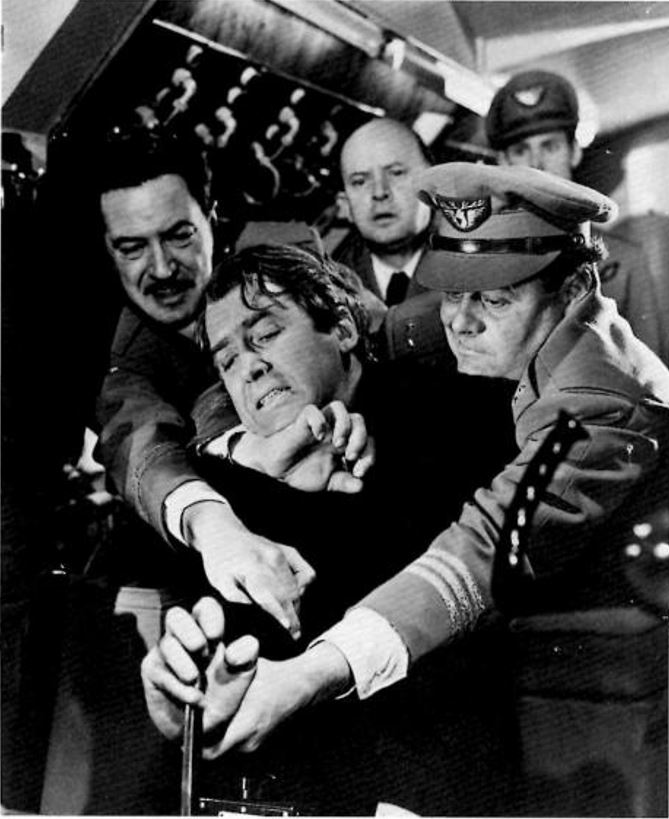
Four hands: another contagion effect (No Highway in the Sky, 1950)

James Stewart appeared on the firmament of the film world in 1938 with Capra’s You Can’t Take It with You, which won the Oscar for Best Picture. This celebrity comes about awkwardly: first of all, Stewart has only the fourth role in the film, after Lionel Barrymore, Edward Arnold and Jean Arthur. More importantly, even though he is the prototype of the indolent dreamer, his character belongs to the world of the rich, while his fiancée lives in a family of outcasts, among whom he feels totally at ease. The interest is thus centred on the conflict between the heads of the two families, Stewart putting them in contact with each other. His role could’ve been stronger had his character reproduced the mentality of the rich, whereas it’s the opposite here.

This shakiness is aggravated by the fact that Stewart hasn’t yet found his line as an actor. With his co-star Jean Arthur, he copies Cary Grant (and she, Katharine Hepburn) as he moves across the restaurant, stuck behind her to hide the ridiculous inscription she has on her back, some months after the similar—and more successful—scene from Bringing Up Baby. The second film he makes with Capra, Mr. Smith Goes to Washington, contains some shots—notably during the turbulent meeting with the press after the publication of an article ridiculing him—that relate him to his great friend Henry Fonda: his hair falls over his forehead and comes close to his cheeks, making his face look very thin. We perceive in him the hunted, rebellious man of You Only Live Once. At one point in You Can’t Take It with You, he has, on one part of the forehead, the famous little lock of hair of Gary Cooper, the protagonist of the first Shopworn Angel that Stewart just remade. Moreover, Mr. Smith, with Capra’s help, is a close cousin to Mr. Deeds.

This proximity can be linked to the fact that Cooper, Fonda and Stewart are all Tauruses. I had the greatest contempt for astrology until the day I realized that most great actors (Fonda, Welles, Gabin, Fernandel, James Mason) were born under this sign. It’s too good to be a coincidence, especially considering that Capra was born on the 19th of May, a day before Stewart, and that Borzage (who gave JS the leading role in Mortal Storm) belonged to the same vintage: it’s really a great family…

From You Can’t Take onwards, Stewart’s individuality starts to manifest itself: his novel play of hands often has a precise signification. So the dance of his fingers on the table constitutes a direct allusion to the guests who are enjoying themselves at the house of his future father-in-law. The work on repurposed gestures is very successful: he raises his hand toward the boy employed by his father, as though to slap him. He abandons his primitive impulse, and regains his gesture in a way, so as to not look like an idiot: in the continuity of the movement, he goes on… to brush his jacket.

This work on hands is quite good in one scene of a film made slightly later, Made for Each Other (1939): he informs his mother that he is married to the girl next to him by pointing his thumb alternatively towards the girl and himself. In the same film, we find an identical principle, but with the head this time: he lets the viewer know that he has understood his wife’s allusive speech suggesting that she is pregnant, simply by lowering his head four times in a twitchy manner. Before this, we weren’t sure of the real meaning of this speech. This sharp movement, mixed with emotion, helps us understand everything. Great art consists of doing away with speech, of saying everything through gesture, especially when it involves important events: a marriage, a birth.

In You Can’t Take, his stubborn way of keeping his mouth open without speaking is particularly audacious. This trait allows us to better place the character: it’s the Capraesque Naïf, dazed and out of sync with reality. This perfectly suits Stewart, who displays the temperament of a dreamer in real life and whose physique, with his wide cheeks somewhat depressed towards a visible chin, midway between Jerry Lewis and Eddy Merckx, and his lanky figure, give the impression of ingenuousness.

(more…)

[From Luc Moullet’s Politique des acteurs (1993, Cahiers du cinéma). See Table of Contents]

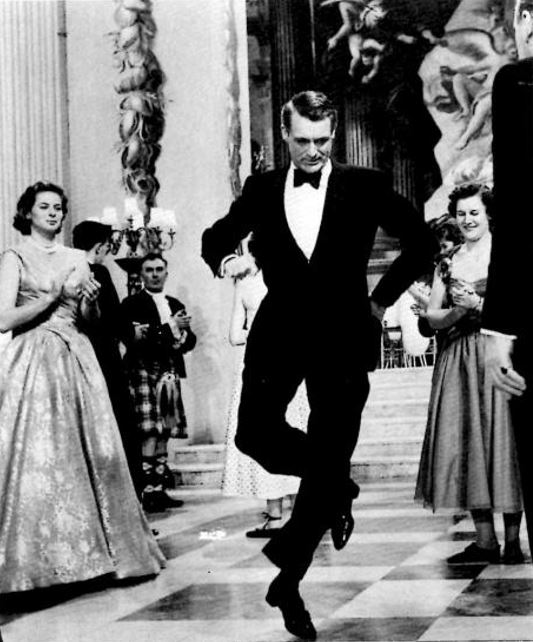
Each of the four limbs follows one or two different directions (Indiscreet, 1958)

Cary Grant is in the same boat as Cooper or Wayne: his first films, made for the same company—Paramount, as it happens—during the thirties, offer us a rather aseptic, standardized actor. We have the slightly caricatured proof of that in his role in Blonde Venus (Sternberg, 1932), where he plays opposite Marlene Dietrich as her wealthy seducer and impresario. Despite his brief scenes, we get to see him in the attire of a horseman, a yachtsman, and in several other expensive costumes. The husband, Herbert Marshall, and, especially, Marlene Dietrich get numerous medium shots. Not Grant, who is more of an image, a silhouette. Sternberg’s contribution to the film somewhat surpasses Paramount’s standards. With Cary Grant, Sternberg seems to have wanted to replicate the Gary Cooper of Morocco: the same short sentences, the same emphasis on the nose. Choosing Cary as a first name in 1932 was perhaps not an innocent choice. Grant appears much older than his age of twenty-eight. It’s perhaps the only time in his career that he has a massive appearance. With his large, immobile face, he resembles Sternberg’s future actors like Mature or Mitchum rather than Cooper. He moves very little. He delivers a blow to an adversary the first time we see him. He is entirely a Sternbergian man, having little to do with Grant’s personality of the years to follow.

Sylvia Scarlett (1935), his second excursion from Paramount, gifts us a real actor. The film revolves around a young woman (Katharine Hepburn) who is obliged to dress up as a man in order to help her fugitive father. Grant plays a curious character, an Englishman like himself (while he would be an American in the great majority of his films) of an indefinite status: a conman, he begins by shamefully exploiting the father and the “daughter” before helping and protecting them. He generally plays leading men in other films, but here, he vanishes towards the end, letting Katharine Hepburn marry Brian Aherne. But this isn’t exactly a disappearance, since Hepburn wears Grant’s black jacket and closely imitates his behaviour in the train, seen in the film’s very first scene.

There is a key to better understand, to differently understand Sylvia Scarlett and Grant’s entire body of work. At the beginning of this book, I intended to abstain from talking about the private life of the artists. I hope the reader will forgive me if I contradict this principle. I promise not do so again. But this infraction of critical ethics appears indispensable to me. Grant was married five times, for quite short periods of time. This added to his legend as a handsome seducer. But the recent biography by Charles Higham and Roy Moseley [1] indicates that Grant was bisexual, and that his heterosexual relations were generally, let’s say, less happy than the others. Since the book was not mired in any controversy, we could trust its authors. This explains the brevity of his marriages, and perhaps even Grant’s delayed paternity (at sixty-two years). The many marriages served, if not as a cover, at least as tryouts with varying degrees of success. These particularities were hushed up by gossip columnists. For if it was known that the greatest seducer of women was closeted, the whole Hollywood scaffolding could likely collapse, and the squealers with it.

I probably don’t even have to apologize for this reference to private life. For it fortunately makes up for another, more or less unconscious reference to a fake private life: if we were blind to Cary Grant’s ambiguity, it was because his image as an eternal skirt-chaser distracted us from the reality on screen, and prohibited us from thinking even for a moment of this ambiguity.

(more…)

[The following is a translation of a chapter from Serge Toubiana’s memoirs Les fantômes du souvenir (“The Ghosts of Memory”, 2016, Grasset)]

Anxious to know if Maurice was suffering, Sylvie Pialat called the doctor. The prognosis was that he’d possibly not last the weekend. We three had a meeting of sorts to decide whether or not to increase the morphine dosage. That very evening, just before midnight, Maurice Pialat died in his bed. He was in the sky-blue shirt that Emmanuèle and I had gifted him on 25 December 2002 during the Christmas meal we were invited to. Sky-blue suited him well, Maurice seemed at peace after a long illness.

Shortly before Maurice’s death, Sylvie did the right thing by inviting all those who mattered in his personal and professional life one after the other. She wanted everyone to have a memory of Maurice, without the regret of not having seen him one last time. But he wasn’t capable anymore of recognizing the person sitting next to his bed. The only one whose voice and presence he recognized by instinct was Gérard Depardieu. Whenever he entered the bedroom, the actor had the gift and energy to banter and make himself heard. Maurice’s face would then light up with a faint smile. The two men loved each other deeply, there was an obvious and natural complicity between them that Maurice had with no one else, except of course Sylvie.

An intense atmosphere reigned all through the night of 10-11 January, suffused with remembrance and shared affection. Death brought together those who were present physically. At one point, I had to take little Antoine in my arms and grip him tightly because his body trembled as he cried. I was able to calm him after several long minutes. He slowly pulled himself together and received his friends from the neighbourhood. The children soon started playing and running around, but ensured they went to see Maurice on his deathbed from time to time.

Around 1 AM, Sylvie asked me to take care of the funeral services. I’d never done that. On the telephone, a man asked me pointed questions that I was unable to answer. Something like: “How many people should the vault accommodate? Two or three? Should the service be religious or not?” “Hmm… a little religious but not too much!”, I mumbled. Behind me, Sylvie, Daniel Toscan du Plantier and Isabelle Huppert burst out laughing. Daniel Toscan du Plantier came up with the right answer quickly: “Antoine is too young; I think a vault for two will do!”

(more…)

[From Luc Moullet’s Politique des acteurs (1993, Cahiers du cinéma). See Table of Contents]

The first real appearance (Stagecoach, 1938)

Stagecoach (1938) is distinct in its sobriety and simplicity. There are effects but they aren’t visible. They are perfectly integrated into the continuity of editing. It’s the ideal stylistic exercise for film schools to take note of.

Even so, John Ford went for a flashy effect—just one—which is completely incongruent with the rest of film. It occurs in the first shot John Wayne appears in. Here is the film that will rescue him from oblivion and make him world famous. And how is he introduced? Firstly, notice that we see him eighteen minutes after the film has begun. A delayed entrance that is quite useful and well-planned: we have already heard much about Ringo Kid in the preceding conversation. This delay could seem normal: after all, Wayne’s is only the second name in the credits behind Claire Trevor, and as we have seen, it’s a good strategy to delay the entrance of the second protagonist.

But what an entrance! Everything has been smooth so far. Suddenly, without any narrative reason, there is a tight shot of the unknown Wayne all by himself, with the tracking camera culminating in a closeup, and the Monument Valley in the background, overlaid on a thunderous score. All this for a gentleman who stops the stagecoach with a hand signal, not for a holdup but simply to use the public service: to alert the driver…

We can’t think of a better beginning for a mythification. What’s curious is that it’s for a square almost unknown to the big studios, a handsome, scrappy giant, a sharpshooter trapped in Z movies of Republic Pictures where he had made forty mid-length features in six years. Ford seems to have wanted to create a star, his star, since they were to make fifteen films together in twenty-five years. The most faithful duo in the history of cinema. Amazing intuition, when none of the earlier films helped foresee Wayne’s abilities.

Ford places Wayne in the shadows—mythicizing darkness—as much as possible, while his partner Claire Trevor is frequently in full light in the preceding shot. One wonders if this doesn’t reflect a certain lack of confidence of Ford in the dramatic capabilities of his new protégé. Testimonies confirm this: Ford had asked Wayne to emote as little as possible, to stay impassive. Whatever the case, even if it was necessitated by fortuitous reasons, the mythification is no less present, and will continue to shape Wayne’s future work in a very perverse way.

At the end of the film, Wayne kills two villains within a few seconds. We don’t have time to see anything. As Wayne joins Claire Trevor, he is seen from behind. It’s only when he is very far in the background that he turns and lets us see his face.

(more…)

[From Luc Moullet’s Politique des acteurs (1993, Cahiers du cinéma). See Table of Contents]

The saga of the left profile: Cooper has to always have the most marked face possible… (Sergeant York, 1941)

Gary Cooper became famous, most of all, in uniform: thirty of his eighty-two films present him in attire, starting from Opus 5, Wings (1927), till the penultimate one, The Wreck of the Mary Deare (1959), and we must perhaps also include For Whom the Bell Tolls, where he is in plainclothes but at war. He stands, then, for the conventional, official Right, somewhat perverted towards the end of his career since, in the comedy You’re in the Navy Now (1951), he plays an officer holding a post that has nothing to do with his capabilities, since The Court Martial of Billy Mitchell (1955) shows him as an outcast general criticizing the decisions of the army. And the captain of the Mary Deare, the only man on board the ghost ship that traffics arms, would also go on trial, just like Billy Mitchell.

But more than a moral value, the uniform represents a visual asset: it throws Cooper’s great height into relief. His lean build makes him look almost like a model. All outfits go on him: army, navy, air force, ancient (in Westerns) or exotic (attire of the French legionnaires) uniforms, or both at once (The Lives of Bengal Lancer).

Morocco (1930) is not the first film where he is a legionnaire (there was Beau Sabreur already in 1928), but it’s the one that imposed this brand image. Undoubtedly, the success of Morocco incited lazy producers to cast him as an army man in five consecutive films from 1931 to 1933.

Watching Sternberg’s Morocco, we could say that Cooper is more of a silhouette, a statue, an image, a model, a prop, an element in the general aesthetic of the film. He belongs to the class of Sternbergian strongmen, the giant variety (like John Wayne later) that alternates with the stout variety (Bancroft, Jannings, McLaglen, Beery, Mature), the Mitchum of Macao being both — a predilection that might explain the failure of Crime and Punishment, Raskolnikov-Peter Lorre being evidently the antithesis of the Sternbergian man.

This mythical aspect goes hand in hand with the spirit of the film. You get the feeling that Sternberg—in this film as in his other works of the period—accepted and even sought out all the already-mythologized elements of convention—a handsome army man, a femme fatale, an impossible love, a rich and wily old French seducer, and the charms and the dangers of mysterious Africa. This strategy allowed him to come out of all charges unscathed: if the film failed, wise guy Sternberg could always claim that it was impossible to make anything from such a ridiculous plot. If the film succeeded, he could boast of having overcome all these superhuman obstacles.

(more…)

« Previous PageNext Page »