Director Karthik Subbaraj is movie crazy. Like many Tamil filmmakers, he is drawn to intertextuality, but has a temperament that doesn’t allow it to get out of hand in the way it might in a Venkat Prabhu film. It shouldn’t be surprising then that he has cast actor Vikram and his son Dhruv as father and son going at each other in his new work titled Mahaan. It’s an enticing setup: a sparkling Vikram creates a suitable springboard for Dhruv, whose first two ill-fated films came from the cottage industry of Arjun Reddy remakes; performing bits from his father’s classic films, Dhruv reminds us, even if negatively, that talent isn’t inherited.
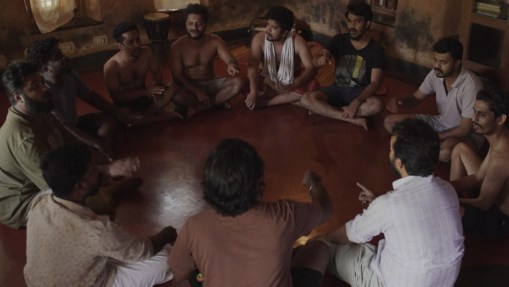
Vikram plays Gandhi, a middle-aged professor suffocated by his name and the high-minded ideals of his freedom-fighter father. Following the advice of a Randian mendicant (Ramachandran Durairaj), he decides to live out his desires in the company of bar owner Satya (Bobby Simha) and seedy politician Gnanam (Vettai Muthukumar). This betrayal of Gandhian values outrages his wife Nachi (Simran, in a poorly written role), who walks off from his life with their son Dada (Akshath Das). Nursing resentment at this alcohol-driven dissolution of his family, an older Dada (Dhruv) becomes a teetotalling cop to wipe out his wasteful father’s liquor empire.
Like a number of other screenwriters, Karthik Subbaraj is attracted to character pairs, symmetry, mirroring, reversals of roles. This was already obvious in Jigarthanda (2014), whose clever underlying concept had a filmmaker and a gangster trade places. Mahaan abounds with these structural games, which is indeed what sustain the film. The screenplay is divided into clear halves, with Dhruv Vikram making an appearance at the midpoint — a smart ploy that allows his father to shield him for over an hour and lends the film a new lease of energy.
The first half unfolds like a game of rummy; that is to say, through a series of coincidences and lucky accidents. Having cut loose from his regimented life, Gandhi meets business partners Satya and Gnanam (there is some play around their names which respectively mean “truth” and “knowledge”), who, it turns out, are childhood acquaintances. It is hard to buy that this 40-year-old repressed man can so easily ease into one vice after another, but like a round of cards, that is exactly the hand we are dealt. Vikram is fantastic as Gandhi, and despite such radical distortions his character is subjected to, he gives a sense of a coherent person buried beneath all the gaudy shirts and ridiculous coiffure.
As Gandhi keeps leveling up (down) like a debauched game character, Satya has a religious epiphany that makes him gradually distance himself from Gandhi’s dreams of an empire (ba-dum-tsh). This double transition is conveyed through a montage in which images of Satya becoming a born-again Christian are intercut with Gandhi multiplying his murders: a reversal of the Godfather principle. By the end of the film, the two swap places, with Satya reaping the bitter rewards of Gandhi’s bad company.
The second half, in contrast, is a game of chess, where Gandhi’s perfect hand comes undone by his son’s meticulous scheming. If Gandhi’s journey was that of the id unleashed, Dada’s is the return of the superego. A mirror image of his idealistic grandfather, Dada watches over his father even as a child, ferreting out his petty secrets and telling on him. Gandhi and Dada take turns playing father and son, looking out for each other despite their best judgment. They are both introduced (and later developed) through sequences of stylized violence, Dada’s legal killings somewhat amped up to make us wince. Confusing determination with rigidity, though, Dhruv is less than fantastic; it is hard to make out if he is taking a phone call or getting ready to do crunches.
More pairings and reversals: there are two heroes, two friends, two sons, two wives, two weddings, two separations, two telescoped flashbacks to childhood, two scenes of violence in picturesque landscapes. We are in tic territory when even secondary characters seem to have secondary romances going on. Gandhi loses a son figure in the second half, recalling the way he saved one in the first. With age, he grows his hair long as his wife shortens hers. Dada’s revenge on his father is elaborated like a bloody closure to the traumatic scene of his childhood.
These patterns are alluring, and they give solid form to the film’s argument that people who kill for ideology are as vicious, if not more, as people who kill for money, limited as the latter are by their appetite or conscience. But Karthik Subbaraj contrives his screenplay further for these elements to fall in place. A major set-piece in the second half, set in a police bunker designed like an avant-garde theatre set, finds Gandhi and Dada pointing a gun at each other, a cunning image that the whole sequence (and film) seems to be imagined around. But everything in the set-piece before and after this shot shares none of its zing: Dada is elaborately re-established as a sociopath while Gandhi swings from self-effacing helplessness to super-heroic surety and back.
Mahaan is powered by its transitional bits rather than its big scenes, which invariably fall flat. There are three sequences featuring Gandhi and Satya at various stages of their friendship and life. The second of these is poignant, although perhaps redundant, but the other two are quite trying, especially the final one that is set up to resolve another symmetric dilemma: Dada lives if Satya dies and vice versa. An inexplicable scene between Gandhi and his wife Nachi is shoehorned late into the film in order to satisfy the logic of what is to follow.
On the other hand, Mahaan’s tedious passages are also frequently intertwined with its finer qualities. Gandhi’s first fight scene — and I suspect this is where many viewers will take leave of the film — is set in a scenic location surrounded by mountains. As a heavy tries to kill his son with a hammer, Satya cries out in prayer at a crucifix in the distance. Gandhi stops the hammer just as it is about to go down. It’s a rank Tamil movie cliché, but the way it is shot, with Gandhi’s arm jutting out of the sky as if it were the hand of God, shifts the scene’s focus to Satya’s revelation. Unbelievable though the ensuing fight is, there is something in the combination of the locale, Gandhi’s flashy clothes and the pseudo-single shot filmmaking that holds it all together.
As a director, Karthik Subbaraj can often be weird; not weird enough to be creative like Shankar, just weird enough to stick out. He loves his intercutting: the early scene of escalating hysteria where Nachi walks off on Gandhi is finely separated across two groups of actors. The gratuitous quarter hour at the end is split between three spaces and two timelines — a demanding device for the viewer to process. Another effect of modern Tamil films trying to pack 200-minutes worth of narrative into 150: action and dialogue overlapping; we would see items being exchanged across shots while or before we hear about them, as when Gandhi wears his new glasses before we learn that they’re a birthday gift.
Karthik Subbaraj can ask us to make impossible leaps of faith in following Gandhi’s descent into the dumps, but he can also be overly logical in covering his trail, with countless inserts and exchanges whose sole purpose is to cement story gaps. There are fetish images here, like Gandhi with a Tommy gun, but also purely odd ones like Gandhi discarding a movie ticket in the shower drain or a politician literally jumping in joy after having his visitors thrown out. Now that Jai Bhim (2021) has shown us that décor details could be adjusted weeks after a film’s release, Karthik Subbaraj may even consider adding a few more Gandhi photos or crosses in the background.


What comprises the blight of modern life? The reverse shot, answers Bruno Dumont in his scorching new dramedy about celebrity news reporter France, played by a dazzling Léa Seydoux, who cannot help but make it about herself in every story she does. Fresh off two films on
An apartment evermore waiting to be occupied, letters responding to inquiries not heard, a voice never embodied in the image: Pereda’s five-minute short is a haunting, haunted tribute to the late Chantal Akerman that is structured around absence and substitution. We hear Pereda replying to fictitious queries by the Belgian filmmaker about renting out his sister’s apartment in Mexico City, and we see his sister readying the apartment, moving out paintings or clearing foliage from the skylight. In the film’s robust organization, Pereda, his sister and Akerman become mediums, connecting links in each other’s (after)lives: Pereda, unseen, serving as a middleman between the apartment owner and the impossible future tenant; his sister, unheard, taking the place of Akerman who will never feature in Pereda’s film; and Akerman herself, unseen and unheard, bringing the siblings together in a non-existent real estate deal. In an act of respect and love, Dear Chantal creates a physical space for Akerman to continue to exist, even if not in flesh and blood, just as
How would Lubitsch do it? Well, if the old master were a contemporary filmmaker, ‘it’ would probably resemble Koberidze’s off-kilter, disarming romantic comedy about two lovers-to-be who work at a shop around the corner without recognizing each other all summer. What Do We See is obviously designed to please, but there is never a sense that it panders to its audience. Like the best storytellers, Koberidze knows that pleasure can be deepened by deferring gratification, and to this end, his film takes surprising excursions away from its central story, restarting at will and relegating its lead couple to the margin as though reposing faith in destiny to bring them together. This vast negative space of the narrative clarifies the larger objective of the film, which is to integrate its characters into the landscape of the ancient town of Kutuisi, whose faces and places, ebbs and flows, become the central subject. Pinning down the fable-like story on the voiceover allows the director to employ a complex, highly unusual visual syntax—that nevertheless derives from classical Hollywood cinema—without disorienting the viewer. The film involves magic, but Koberidze demonstrates that a towel flying through the frame can be as enrapturing as the most outlandish fairy tales.
The title says it all. Loznitsa’s new documentary represents a modulation of style for the filmmaker. Where his found footage work so far dropped the viewer into specific historical events in medias res, without much preparation, Babi Yar. Context offers a broader picture. With the help of archival material, but also uncharacteristic intertitles, the film details the events leading up to, and following, the Babi Yar Massacre of September 1941, where over 33,000 Jews were killed over two days in the eponymous ravine in Kiev. We see Ukrainian citizens welcoming the occupying Nazi forces with enthusiasm and collaborating in the persecution of their Jewish compatriots. In an illustration of the failure of archival, the massacre itself isn’t represented except in photographs of its aftermath. Loznitsa’s shocking film is a rousing J’accuse! directed at his nation, at the willingness of its citizens in enabling genocide, at the amnesia that allowed for the valley to be turned into an industrial dumping ground. Loznitsa’s newfound desire to contextualize his material should be construed less as a loss of faith in images to speak ‘for themselves’ than as a critical acknowledgement of their power to deceive. After all, the Red Army is welcomed with comparable pomp after they liberate Kiev, this formal continuity with the reception of the Nazis concealing a crisis of content.
The spectre of Harun Farocki hovers over Herdies and Götmark’s excellent documentary about war, technology and the production of images. A meditation on Western attitudes to armed conflict, Bellum unfolds as an anthology of three human interest stories: a Swedish engineer involved in designing an AI-powered military drone that will take autonomous decisions on bombing a perceived target, a war veteran in Nevada suffering from PTSD and having trouble reintegrating into civilian life, a photojournalist from the East Coast who covers the aftermath of the Afghan war. Well-meaning though these individuals might be, their lives and work are marked by a certain guilt surrounding the fact of war. This is evident in the case of the vet, but the photographer’s own activity may not be untouched by a liberal sense of culpability about her country’s interventions in Afghanistan. The engineer’s efforts to bypass the human factor of war, too, is an attempt to eradicate feelings of guilt about liquidating an enemy, which, the film’s narrator notes, is the only real restraining force in armed conflict. Bellum cogently points out the ways in which technology—of training, of intervention—increasingly eliminates human fallibility from the equation of war, for as Colonel Kurtz put it, “it’s judgment that defeats us.”
I don’t know if Bruno Dumont and Paul Schrader saw each other’s films this year, but I’m certain they would both have much to say to one another. If
Even if we are done with the 20th century, suggests Sīmanis’ singular, absurd period comedy, the 20th century isn’t yet done with us. When Hans, an opportunistic doorman at a Riga hotel, is falsely implicated in a bombing, he flees the Latvian capital to shuttle from one European city to another. The Europe of 1913 that Hans traverses is less a real geography than an abstract zone of competing political currents. War is around the corner, and there are several groups trying to influence the course of history. Zealous ideologues seek to entice and co-opt him, subjecting him to what Louis Althusser called “interpellation.” All through, Hans fights hard to follow his own moral compass, flee subjecthood and retain his individuality. A historical picaresque, Sīmanis’ film is interested in the singularity of this particular juncture in Western history—a point at which fin de siècle optimism about technology and human rationality came crashing against the reality of trench warfare—where countless isms sought to impose their own vision on the world. It would seem that Sīmanis views Latvia of the early 20th century as something of an ideological waystation, an unstable intellectual field where free radicals like Hans couldn’t help but be neutralized. And that vision isn’t without contemporary resonance.
Maria Speth’s expansive documentary about a batch of preteen students, mostly of an immigrant background, in a public school in Stadtallendorf, Hessen, is a classroom film that achieves something special. Remaining with the children for almost its entire four-hour runtime allows it to individuate them, to look at them as independent beings with their own skills, desires and prejudices, just as their charismatic teacher-guide-philosopher Dieter Bachmann adopts a different approach to each of his pupils. For Bachmann, it would seem, whatever the students accomplish academically during the year is of secondary importance. He knows that he is dealing with a group with an inchoate sense of self: first as pre-adolescents, then as new immigrants. Consequently, he spends a great deal of effort in giving them a sense of community, creating a space where they can be themselves. At the same time, the classroom is a social laboratory where new ideas are introduced and the children brought to interrogate received opinion, all under Bachmann’s paternal authority. Speth insists on the particularity of these individuals and there is no sense that our star teacher is indicative of the schooling system in Germany at large. Bachmann is an exception, and in his exceptionalism lies a promise, a glimpse of how things could be.
It’s an ingenious, wholly cinematic premise: estranged from family and friends, a sound engineer spends her nights at her film studio until she starts to experience a lag between what she sees and what she hears. Juanjo Giménez’s absorbing psychological thriller riffs on this setup, weaving its implications into a coherent character study of a young woman out of sync with her life. The result contains some very amusing set pieces constructed around the delay between sound and image, but also one of the most sublime romantic scenes of all time, one that begins with rude abandonment and ends at a silent movie show. Marta Nieto is brilliant as the unnamed protagonist who withdraws into a shell and then reconnects with herself and the world. She brings a fierce independence to the character that nuances its vulnerability. Its claustrophobic premise notwithstanding, Out of Sync feels like a very open work, integrated gracefully with the urban landscape of beautiful Barcelona. Watching the film in 2021, when so much of real-world interaction has been rendered into digital images and sounds, using Bluetooth speakers with their own latency to boot, is an uncanny experience.
Ambitious to a fault, American artist Jordan Lord’s new work is nearly unwatchable. Yet it bends the documentary form like few films this year. Shared Resources is a home movie made over a considerable period of time, presented in scrambled chronology. We learn that Lord’s father was a debt collector fired by his bank, that his health is deteriorating due to diabetes, that the family lost most of its possessions in the Hurricane Katrina and that they had to declare bankruptcy shortly after Lord’s acceptance into Columbia University. All this material is, however, offered not directly but with a voiceover by Lord and his parents describing the footage we see, as though intended for the visually challenged, and two sets of subtitles, colour-coded for diegetic and non-diegetic speech, seemingly oriented towards the hearing disabled. In having his parents comment on images from rather difficult episodes in their lives, the filmmaker gives them a power over what is represented. Through all this, Lord initiates an exploration of debt in all its forms and shapes: paternal debt towards children, filial debt towards parents, the debt of a documentary filmmaker towards their subjects, one’s debt to their own body, the fuzzy line between love and indebtedness. This is an American film with an Asian sensibility.