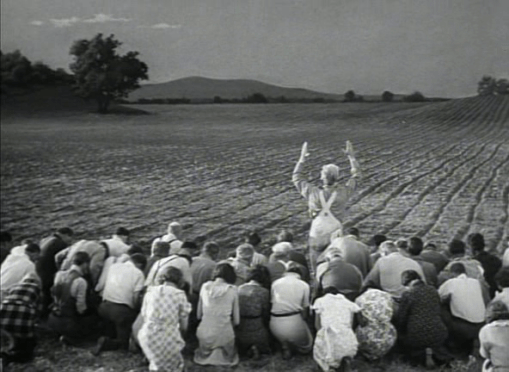
The Slide of the Admiral

Cahiers du cinéma John Ford special; 1990

7 Women

My article championing The Rising of the Moon was rejected in 1957 by Cahiers, who asked me for an article on Ford in 1990…

The first impression upon contact with the John Ford phenomenon is that of immensity: hundred and twelve feature films and about twenty short films. No other great filmmaker has been able to compete with such abundance. No one ever can. Indeed, Ford’s extreme productivity is related to, among other things, his activity in the silent era. Talkies demand more time.

While it doesn’t rule out familiarity, this high productivity seems to refuse the possibility of a synthesis. It takes four months for a necessarily incomplete retrospective since about thirty movies from the 1920s were never found. By the time the last work is screened, the memories of the first ones have already dimmed. Forty years have passed between my first contact—The Informer—and North of Hudson Bay, which I could see a few days ago. Forty years, almost as long as Ford’s working life. The abundance becomes a handicap here: you don’t dare to write on something that overwhelms you, you don’t dare to speak about it. From there to oblivion…

It’s true that this concern for thorough knowledge is a relatively recent demand. Should we go back to the principles of old criticism which based itself only on the most noteworthy works? The first John Ford fanboy, Jean Mitry, used to say that it’s stupid to want to watch all the films of a director. All the more so for Ford… Should we dream, like we do for writers, of a “portable Ford”? The hiccup is that no one agrees on the choices. It’s possible to imagine two books on Ford having no common title in their table of contents. In fact, the books by Jean Roy and Lindsay Anderson aren’t far from this this extreme hypothesis.

High productivity is an important part of the body of work that we can’t ignore or hide.

Even though, at certain times, Steamboat Round the Bend or Tobacco Road get preference in my estimation, I think that my favourite Ford is Seven Women, the last of the hundred and twelve films. Not only do I prefer Seven Women but I what I like the most in the film is its last minute, the triumphant suicide, Ford’s coda leading up to an aggressive, brutal laconism unheard of in his body of work and open to multiple meanings.

I fell in love when I saw Seven Women during its release, when I didn’t know it would be his last film. And I also think Ford (who had other projects at the time and wasn’t the kind that thought of retirement) didn’t conceive it as a testamentary film. It’s thus at once a natural expression—for Ford—and a natural emotion—for me—entirely related to the film and unrelated to the context.

But that it’s the last hour of the longest filmography in the entire history of cinema past and future, the very last minute of some ten thousand minutes of film (work of an old gentleman of flagging health) that moves me the most is something altogether stunning.

I wonder if I could ever, in life like in art, find an occurrence that propels me more towards optimism, a pure optimism free of dross since it’s produced by one of the most tragic scenes.

You’ll tell me it’s a choice peculiar to me. But it’s close to the current critical norm: the referendum organized by the Brussels Cinematheque in 1977 revealed the pre-eminence of The Searchers, the 108th Ford picture, over all others. It established the clear lead of The Man Who Shot Liberty Valance, number 109, over The Informer, once a central pillar, now dispensable.

There is also a very surprising trend in Hollywood cinema, where the late career of “greats” is always a little disappointing or withdrawn (Hawks, Hitchcock, Vidor, Griffith, Borzage, Capra, Chaplin, Mann, Preminger, DeMille etc.) I can think of only Mankiewicz who overcame this challenge, thanks to a somewhat anticipated retirement.


Though it would be adventurous to define the silent period about which we know little, it’s permissible to think of it as the break-in period, with some titles more notable than others (Hell Bent), and to say that Ford’s body of work really begins towards his fiftieth film, somewhere near Three Bad Men or Four Sons or Arrowsmith.

It’s the opposite of modern European careers, where the first feature is generally among the best, if not the best, and where one barely reaches twenty or thirty films at the end of the career.

This abundance has produced an experience, an incomparable self-assurance. In his early talkies, Ford seems to be a master of all situations when he takes on the most ambitious projects. It’s hard to imagine him anxious on the eve of a shoot, or during takes, or during the release date. Shooting becomes an everyday reality and loses its importance. Ford makes films like a baker makes bread. The notion of a body of work doesn’t make a whole lot of sense for him. He never lingers on the editing table. He never wastes time at the launch of a film. The pleasure of getting back with his shooting crew can become the primary motivation.

One could evoke Walsh in this regard. But he pushes this laidback quality too far: he doesn’t always come to the shoot. Reading his memoirs, it seems that screwing an actress or fighting with a rival was more important for him that the final product. There isn’t a thematic unity in his work.

Only Mizoguchi—a little less productive—can be compared to Ford. Moreover, it would be very instructive to see Oyuki the Virgin (1935) and Stagecoach (1938), its remake of sorts, one after the other since both films take off from Boule de Suif. Sansho the Bailiff shares the perspective of The Grapes of Wrath. The difference between the two men lies in the great care Mizoguchi demonstrated towards his scripts. On the other hand, Ford sometimes took them as they came, days before the shoot for which he was assigned at the last moment. I think he made no fundamental distinction between his films and those by others for which he shot some difficult shots.

Other differences relate to the pre-eminence of the individual—and women—in the Japanese filmmaker and the small group—and men—in the American. And then Ford was more a raconteur and Mizoguchi a storyteller.


Ford’s laid-back nature, which can account for his power, also makes for his weakness. The politique des auteurs found it rather hard to assimilate him since it postulates that great filmmakers manage to ennoble everything they touch. Now if, after the early years, we find practically no false notes in Hawks and Hitchcock, it must be admitted that Ford is something of a concern. He is successful with one in every two films. At sixty, he still finds a way to churn out three insipid works one after the other: Mogambo, The Long Gray Line, and Mister Roberts. Not to mention duds like The Black Watch, Wee Willie Winkie or Gideon’s Day: films that had no chance of success owing to the mediocrity of their raw material, made for money, the desire to travel and work as a team, the presence of a mascot or a pet cause.

We often speak about Ford’s eclecticism on account of the variety of genres he handled. But this eclecticism turns out to be illusory: no musical, no horror film. There is no crime movie except the mediocre Gideon’s Day. Clearly, Ford doesn’t like the detective genre. On two other occasions (Up the River, The Whole Town’s Talking), he dissolves into comedy. Admiral Ford is fascinated only by the navy. If he encounters the army (What Price Glory) or the air force (Air Mail), he diverts everything into comedy.

To distinguish the Westerns from the Irish films is vain: Indians and Irishmen are similar minorities, just like Mormons (Wagon Master) or Jews (Little Miss Smiles), and he sometimes pits Irishmen or Mexicans against Indians.

In fact, the eclectic quality of the scripts is almost always nullified by the polarization along some well-known principles: small groups, mothers, families, comical sidekicks, the ball scene, twilight figures from the last decade. Always the great outdoors, or the small town. New York almost never appears. With a little exaggeration, I could say that Ford has only ever made one film. We are far from the bulimia of a Duvivier or a Tavernier.


If one likes Ford, one could be shocked that the filmmaker had no political leaning except those of his clients, or whatever was fashionable. One would’ve loved to find something constantly, deeply moral, to trace anti-racist seeds much before Sergeant Rutledge or Cheyenne Autumn, in the first Westerns or in Stagecoach, to uncover a common thread between the generosity of The Grapes of Wrath or the sectarianism of This is Korea! or Seven Women. Notwithstanding some brilliant theses on this topic—Ford’s bonhomie softening the harshest features of almost all his characters—opportunism appears to be the sole truth. But is it really opportunism? Isn’t it rather a somewhat systematic acceptance, with no ulterior motive, of whatever the era has to offer? A concurrence with the silent majority, which sometimes he precedes by a little (Fort Apache)? Ford, like many first- and second-generation immigrants, has a principled respect for his country of adoption and its beliefs. The very fact of having taken the surname of one of capitalism’s greatest henchmen as his alias is revealing.


Ford’s power resides firstly in a dialectic between the presentation of mythologies and familiarity, the absolute and the relative, the thought-over and the lived, the moral and the picturesque, heavy clouds of Fate and hands on the ass. It’s the vigour and spontaneity of McLaglen, Fitzgerald or Ward Bond that help the spectral compositions of August or Toland push through. Not always: monotony looms large, and so does vulgarity.

The picturesque aspect has to do with the abundance of living beings (hence the small group), the multiplicity of their actions in the shot or in the sequence. Ford is perhaps the American filmmaker who has worked the most on the difference in dialects and accents (Doctor Bull).

The expression of mythologies is carried out either through the meaning of actions or through the photography: shadows, back lights, immense settings that diminish man. Mythologies in Ford become extremely dangerous when they are limited to themselves (cf. the clear failures of The Fugitive and The Informer). Photographic overload and second-hand expressionism make the films go around in circles, while most often, the image skilfully serves as the lyrical amplification of realistic everyday details.

We could, however, invert the proposition and assert that the picturesque leads nowhere without the help of mythologies. We have for proof the success of Tobacco Road. But that was an exception. Dialectic nevertheless makes for the greatest part of Ford’s body of work. Its two components can be found in the same instant or be linked by a pan shot or a cut. What counts is the variety of links Ford finds between them.

There are other related forms of contradictory balance within a film, or across films. It could be said that Ford takes wicked pleasure in doing the opposite of what he has just done. His greatest quality is concision, but in The Searchers, he does his best to make us feel the long passage of time involved in a hunt spanning many years, rendering the ideas of revenge and racism ridiculous. In The Rising of the Moon, from one sketch to another, he alternates the impression of rapidity and slowness for both characters and viewers. This probably explains his political fickleness better. Ford, the champion of the macho movie, the maker of two films without women—Men without Women and The Lost Patrol—that were perhaps the first of their kind, also made hymns to mothers and ended his career on a film almost entirely without men (Seven Women), the two male characters being a weakling and a monster.


We could define Ford’s art as an art of “sliding between notes”. Hence, the importance of dissolves and other transitions (The World Moves On, The Grapes of Wrath). The viewer shouldn’t realize he’s watching a movie and that the movie has already started. Often, moreover, nothing of importance really happens (Judge Priest, Doctor Bull, Tobacco Road, The Long Gray Line etc.). We wonder what we can say about the films, which sometimes leads to a negative judgment. All very classical values. After all, isn’t Ford the only classicist in the history of cinema worthy of interest? And our critical armada isn’t up to the task to deal with this exceptional case.

One problem remains: this precious sense of “sliding” seems to be the same in both the masterpieces and the failures of Ford. We nevertheless sense a huge difference in quality between them. We could point out the customary concision of a scene in Gideon’s Day or The Long Gray Line, but we could also wonder whether it wouldn’t have been better had he dropped the entire scene, or had he not made the film at all.

Ford’s art seems elusive, impossible to pin down. It’s in the method, but it surfaces only when the material is rich. It takes us back to a very old rule of thumb: to make a good film, you need a good script and then good direction. Isn’t it symptomatic that three of his best films (The Grapes of Wrath, Tobacco Road and, more obliquely, Stagecoach) were adapted from high-profile literary works? Isn’t The Grapes of Wrath better than How Green Was My Valley simply because Steinbeck is a better writer than Llewellyn? Ford is the opposite of Hitchcock, who often needed a terrible, totally unbelievable script (Psycho, North by Northwest) to be able to rise above its faults and outdo himself.


Why is it that the film version of The Grapes of Wrath has survived in people’s minds more than the book, while there’s no big difference between the two? Is cinema so weak an art that a solid adaptation of a good book can pass for a masterpiece? In contrast, there’s much higher competition in literature. Even so, there are more concessions in Ford’s film, such as the inversion that pushes the most optimistic episode at the government camp to the end of the film; and this immaculate, smooth-talking Fonda (Fonda is outstanding, but that is not the problem) who is clearly a reflection of the Hollywood hero, absent in the original.

The difference is that agricultural migration was dealt with more often in writing and almost never on film. But isn’t all this to the credit of the very idea of filmmaking?

The difference is that Steinbeck rubs it in, harnesses all the possibilities of every scene, while the film skims over the facts, taking their essence and moving quickly to the next scene. It has become the first road movie, a succession of signposts producing an unquestionable, objective curtness that limits pathos. But weren’t these omissions made in order to cut the film down to two hours from six? And isn’t it the scriptwriter Nunnally Johnson who’s primarily responsible for that?

Ford succeeds when he appears to efface himself behind others, behind the material of his films. Might his role simply be that of a supervisor, a mediator? And might not our concern for analysing Ford’s specificity go against the grain of his body of work?


[From Luc Moullet’s Piges choisies (2009, Capricci). See Table of Contents]

Asuran

After two modest, moderately successful projects in Polladhavan and Aadukalam, it seemed to me that Vetrimaran truly hit his stride with his third feature, Visaranai (“Interrogation”), an unflinching look at police brutality whose intelligent structure stoked and then implicated the viewer’s apathy towards the issue. But delusion of precocious grandeur caught up with the filmmaker sooner than I expected, his next film, Vada Chennai (“North Chennai”), a hollow, self-styled epic mistaking scale for vision, straining for import at every turn. Vetrimaran’s new film Asuran (“Demon”) assures us that Vada Chennai wasn’t a stray blip, but a sign of things to come. A mediocre work in terms of not just artistic merit, but even basic technical competence, it continues the rapid plunge of a director who was briefly the white hope of Tamil cinema.

Vetrimaran’s second literary adaptation after Visaranai, Asuran begins in medias res, with Sivasami (Dhanush, in his fourth collaboration with the filmmaker) and his son Chidambaram (Ken) making their way through a water body. They have murdered a VIP from the village and are being pursued by the dead man’s family. As they pause at a hilltop, a narrator (the director himself) takes us into the reasons for their flight. Sivasami’s three acres were being eyed by the upper-caste family owning most of the land in the area, and this led to a series of confrontations between Sivasami’s hot-blooded son Murugan (Teejay) and the landed family, resulting the murder that triggered Sivasami’s flight. A large part of the “present” traces Sivasami and his son walking day and night, traversing the lawless terrain of the countryside in the hope of getting to the nearest city, where they have a hope of surrendering themselves to the law.

Like Vada Chennai, the nested structure of Asuran seeks to dig beneath present-day conflicts to reveal the deep-rooted nature of oppression. In another flashback on their flight, Sivasami details his tragic past: his job as a toddy-maker with an upper-caste baron in another village, his romance with his sister’s daughter, the organized struggle of his brother towards getting back lands their community lost to the baron, Sivasami’s own political awakening following his boss’s betrayal, the escalation of violence succeeding a volley of public humiliations, ending in a bloodbath modelled on the Keezhvenmani massacre. In the present, Dhanush plays a character well above his age: a timid middle-aged drunk with a curved spine, a ridiculous patch of white hair, a loose shirt, a soiled veshti hovering above the ankle and a Palakkad towel on his shoulder. It’s a character that’s emasculated to prepare us for the Sivasami’s heroics in the past: the sight of Dhanush’s young, thin frame taking down scores of thugs, always punching above its weight.

These passages of poetic justice are also what vitiate the film. Every time the narrative pries open the question of structural violence, Vetrimaran sublimates it in the macho spectacle of Sivasami dishing it to his oppressors. In a film full of institutions failed and functional, it’s only the agency of brute person-on-person violence that’s given any real weight. And how? Vetrimaran depicts all acts of lynching, humiliation and aggression in full detail, allowing the audience to partake in it, while at the same time using these scenes to drum up sentiments in favour of Sivasami’s retribution. For a filmmaker who was so clear-eyed about audience participation in Visaranai, he treats the viewer like a Pavlovian dog, introducing an exhausting trumpet theme to whip up emotion every time Sivasami moves in shallow-focus, slow motion to take down a gang in a bloody skirmish.

The first part of the film (the “present”) contrasts Sivasami’s non-violence with his son Murugan’s machismo, a trait that the younger Chidambaram inherits a while later. Chidambaram (and his mother played by Manju Warrier) belittle Sivasami’s submissive impotence, permitting film to restore his masculinity through a triumphalist assertion of Sivasami’s bravery through his violence. This presentation of Sivasami as a supremely macho, courageous man also allows the film to seal his lineage, Murugan’s and Chidambaram’s sense of honour being only a bequest of the respectable patriarch. Following the bloodshed of Sivasami’s youth, the narrator notes in all sincerity that Chidambaram understands now that his father isn’t useless. This demagogical bent of the film isn’t part of some legend-building exercise, for Sivasami’s political consciousness vanishes as quickly as it came. At one point, the wise, old Sivasami tells his son that acting on impulse is what led to his family—a patently untrue claim that falsifies the bigger battle his brother was fighting. At the end, he gives a hollow-sounding sermon about education (!) as the sustainable solution to their oppression.

But Vetrimaran’s focus, justifiably, is not on the politics but the spectacle. The entire thrust of the story is not on whether Sivasami will get justice, but on whether he and his son will get caught in their flight. And the director uses several devices at his disposal to bludgeon us into revulsion: a lynching that’s staged the same way a boar hunt earlier was, a public humiliation around a pair of slippers (a symbol of self-respect of the oppressed akin to the towel around Sivasami’s forehead) photographed and edited sensationally, the extended, CGI-enabled sight of a rotting, decapitated corpse. The tactic was the same in Visaranai, but the sadism there was integral to what the film sought to do. Moreover, the dubbed sound of Asuran is significantly out of sync with the image, which lets us suppose that that major rewrites were involved post-shoot or that last-minute self-censorship was called for. In any case, it suggests that Vetrimaran’s daring stems wholly from the script and, when that’s compromised, the filmmaking is too.

Of course, Vetrimaran is not a hack, and there are aspects that come through. He composes almost the entire film in wide shots, sometimes extremely long shots à la Mysskin that turns characters into mice in a maze. His eye for landscape is still intact: Sivasami and Chidambaram sneaking through marshes, shrublands, rocky fields and plantations like in a studio Western gives an existential counterpoint to the father-son relationship, which is one of the film’s focal points. He also emphasizes the difference between the well-lit, geometric streets of the upper-caste main village and the irregular, moonlit pathways of the theru, the kutcha settlement of Sivasami’s community. And it’s commendable that he resists the temptation to DI-enhance the dull colours of the landscape, which here simply exists.

On the other hand, there’s a markedly rushed quality to the shot and sequence composition bordering on embarrassing (at least two shots with the .ari file name on them visible!). The edits are constantly confusing and one particularly egregious scene of a Panchayat meeting cycles through scores of shots of random perspectives just in order to dramatize the proceedings. Sivasami’s past proceeds at a breakneck speed to show betrayal and revenge even before the initial dynamics are settled—clearly an afterthought to reduce runtime. Vetrimaran arm-twists Sivasami’s relationship with his elder son into a sympathetic register through a set of rather outmoded choices. The distance offered by his wide-angle, long-shot composition—with actors moving about the space like on stage—collapses when he is dealing with scenes of violence, which simply advances on auto-pilot. The sound-mix, likewise, is overly detailed with redundant information even when the shots allow the actors to breathe. A dire undertaking that continuously short-changes both its viewers and subject matter.

Joker

(Possible spoilers ahead)

You were never really here is what the Joker thinks the world is telling him. It is also the title of the film I was most reminded of watching Joker, nevertheless reminiscent of several other works whose influence it carries lightly. In Lynne Ramsay’s 2017 thriller, Joaquin Phoenix played Joe, a traumatized war vet living in a New York apartment with his eccentric mother. In trying to clean up the rotten system ruling the city, Joe also struggled against an inheritance of malady, a violent disposition that might already be running through his veins. Explicitly channelling Taxi Driver, Ramsay’s film was a meditation on violence and masculinity that offered a critical distance to events Scorsese’s film denied. Both Joaquin Phoenix and Robert De Niro feature in Todd Philips’ new film, but masculinity is hardly the pressing question here, for Joker is the story of a subjectivity reduced to dust.

When we first see Arthur Fleck alias Happy alias Joker, he’s in front of a mirror putting on clown makeup. He’ll be in front of mirrors two more times in the film, but he’ll look at his own image on the newspaper and television all through. There’s a split between Arthur’s external and internal selves that Philips and Phoenix emphasize through a range of formal choices. Arthur is a social outcast, and in the opening passages of Joker, he alternatingly comes across as a threat and a victim. The melodramatic scenes depict him being ridiculed and bullied, while his interactions with decent people forebode an outward aggression. Moreover, Arthur has a medical condition—he laughs uncontrollably in stressful situations—which makes those around him suspect he’s being funny, even though he’s feeling the opposite in reality. Arthur’s behaviour belies the conventional equation of laughter with comfort and control. And Phoenix does a phenomenal job of embodying this duality.

This split perspective of Arthur as a comic and a tragic figure suspends the viewer in an uneasy relation with the character. Scenes of Arthur’s debasement prompt us to sympathize with him and expect retribution, but it’s far from liberating when he does get back at his tormentors. Part of the reason for this is that Philips and co-writer Scott Silver remove the character from the mythos of the comic world and plant him within a realistic discourse around mental health. Arthur is admittedly deranged and acts of vengeance aren’t gratifying or cool; for the most part, they are untimely and disproportionate. Philips, in fact, distances his revenge from any sense of poetic justice. The first time Arthur hits back is in a subway where three Wall Street types are beating him wild. Arthur kills them with the gun he’s carrying, but Philips composes the sequence as though it were an accidental happening. The first bullet goes off during a scuffle under flickering light and Phoenix plays the scene like a survival attempt.

Arthur tries uneasily to comply to social codes, but he’s always laughing at the wrong lines. His internal life, on the other hand, is tenuously held together by a handful of relations: his self-deluding mother living in the past, the man she says is his father, the woman next door he grows close to and De Niro’s comic talk show host Murray Franklin whom he takes to be a father figure. When these relations are proven to be lies one by one, Arthur’s inner life collapses and he becomes a purely external being, a public image without connotation. Joker traces in these disappearing connections to the reality the seeds of the character’s nihilism. With all narratives about himself falsified, Arthur becomes a being without history or future, and the universe emptied of import. The money-burning, neutral chaos that the Joker stands for corresponds to a loss of internal signification. The anarchy he witnesses at the end of the film, consequently, is a pure spectacle without meaning.

When asked about his motivations, the Joker maintains that he’s apolitical and that he has nothing to do with the anti-rich movement his subway murders have initiated all over Gotham city. It’s the world around him that ascribes a political meaning to his actions. To be sure, the Gotham city of Joker is not a morally neutral space. The garbage flooding the town is as much moral as physical—a detail that is established in the first scene in which a teenage gang harasses and beats up a hapless Arthur. The head of the Wayne corporation, Thomas Wayne (Bruce’s father) is a neoliberal figure running for mayor’s office who thinks that the city needs to be cleaned of its super rats and that vigilantes like the Joker are losers hiding behind a mask. Funding for social welfare and healthcare is being cut down—Arthur’s medical visits are forced to end—and resentment about inequality is in the air.

Arthur too shares the sense of disenfranchisement the Blacks around him experience. But the Joker is no Bane. For him, the sight of protesters donning clown masks and taking to the streets has no political weight; it’s a show to be enjoyed. Even though the protesters appear to take him as a figurehead, he doesn’t represent any community and religion is wholly absent in this world. There’s no feeling of injustice (to him or to his mother) fuelling Arthur’s actions, which are merely reactions to an environment trying to erase his existence. Of course, there’s no such thing as a truly nihilistic act. That’s why the film’s climactic passage doesn’t wholly cohere: when Arthur (now self-christened Joker) is invited to Murray’s show to be humiliated, he launches into a screed about how the world is indecent and malevolent—hardly the words of a person who sees no meaning to things. What the harangue does is to provide a cri de coeur for someone who has been proven to be hollow.

This last scene also underscores the film’s starkly non-mythical bent. Though the Joker might be nihilist, the film is anything but. In trying to understand the origins of Joker’s anarchism, the film exhibits the sort of empathy and insight-creation that’s usually the reserve of realist cinema. Given the industrial context of superhero franchises and cinematic universes, which depend on fan loyalty and familiarity for their signification, I think it’s also commendable that Joker offers a self-contained work that uses the Batman mythos only as a remote backdrop, like the way, say, Ben Hur uses the Bible. Compare the film’s sustained engagement with Arthur’s experience to the third-act shift in The Dark Knight Rises, which few viewers outside of fans could find interesting. The result comes close to the semi-independent cinema of the seventies. Philips and cinematographer Lawrence Sher balance warm and cool colours in almost every shot—reflecting Arthur’s split image—to produce textures that, to my eyes at least, resemble 16mm. Their 1.85:1 ratio Gotham city seems painstakingly reconstructed from archival documents of Manhattan. Phoenix, in an evidently virtuoso performance, walks its sordid streets, going up and down staircases, looking up and down television images, contorting his emaciated body in a combination of ballet and tai chi. Thankfully, the film does justice to him.

On Inspiration and Neorealism

Radio Cinéma Télévision no. 483; 19 April 1959.

Wind Across the Everglades

It’s not because—in accordance with his sacrosanct habit of quitting a film on the eve of the last day of shooting when it’s not commensurate with his genius—Nicholas Ray abandoned the “set” of Wind Across the Everglades that it must be considered a lesser work. It’s not a masterpiece and it will figure perhaps at the eight position among the seventeen films of its auteur; but it’s nevertheless above the mean.

Unfortunately, it’s one of those ambitious films intended for an adventure movie market and, in this market, way too far from the norm. If he likes big subjects, Nicholas Ray nonetheless doesn’t consider the adventure movie a minor genre. For him, action, the behaviour of man in the natural world, teaches us everything about the individual and the universe. That was what was novel in Bigger than Life, where each psychological feature was expressed by the most violent of physical gestures.

Contrary to what we might think before seeing it, Wind Across the Everglades isn’t any Hollywood film. It’s an independent production put together by Budd Schulberg, writer of socially-oriented films like On the Waterfront and A Face in the Crowd, who hates nothing more than Hollywood. But the story of this film demonstrates that he hasn’t understood what Ray sought beneath the neorealist principle of the film. For Ray, neorealism is a passkey to profundity while, for Schulberg, it’s neorealism for the sake of neorealism. Since Italians make good films in the street, it’s enough to copy them and sit with your arms folded.

Made on a small budget in the vicinity of a small village in the marshes of Everglades (Florida)—a wild, tropical Bresne—in entirely natural settings, with unknown, indigenous and amateur technicians and actors—it’s a jockey playing the ex-jockey, a boxer playing the ex-boxer, a famous writer playing the man of law—Wind Across the Everglades is first of all a documentary. Ray isn’t satisfied reusing footage from Warner Bros’ documentary stock. He films himself the shots of birds and reptiles which are among the most beautiful that cinema has given us. Beautiful in their violence, in their striking framing, in the poetic movement (which we find again in the scenes played by actors) by which the camera moves towards the animal, in the very manner that Ray directs these animals by making them overcome various obstacles. A Walt Disney crew already went to the region, but couldn’t give us as lively a document.

The subject? Like in all Nicholas Ray films, it’s violence. At the turn of last century, a young professor of natural science, now a guard at the Everglades natural reserve, seeks to stop the massacre of millions of birds that Cottonmouth, surrounded by outcasts, lunatics and convicts, hunts for pleasure in the depths of the marshes. The most surprising aspect is this portrait of beings on the margins of the society that interests Ray, who spent a part of his youth rummaging in the least civilized regions of the USA (even The Lusty Men and Hot Blood focus on bohemian lives and gypsies). But the portrait here is very cruel (cf. the jockey character). The struggle of the young man against violence is only of secondary interest. Ray has already dealt with that subject a number of times, and today he has dedicated himself to seeking the poetry of reality.

And so, the guard takes great pleasure in the lives of his worst enemies. Like in Bitter Victory, whose most subtle scene—the snake and the gunshot—we find reversed here, which also recalls the ending of Run for Cover, Wind Across the Everglades shows us the fever of men and the uniqueness of things. A very 1900s bath in the sea, a baroque pleasure house, an insane feast and a dying Burl Ives calling out to the crows: “Come and get me! Swamp-born, swamp-fattened!” The actors—Christopher Plummer, Chana Eden, Sammy Renick—are excellent since Nick Ray knows how to make them accomplish very natural gestures, which he accompanies with very short camera movements that give the impression of improvisation. In such a feverish life, the hero is always dishevelled, just like the film. The colour is average; the script, editing and music, very mediocre.

Will a more homogenous, more complete work, where the subject is just a pretext, emerge from this return to nature, whose beauties Nick Ray has naively sought to capture with the same love for life as a Griffith (Schulberg, though, hardly likes it)? That’s what happened with Renoir and Rossellini. Unfortunately, Ray is unemployed since a year thanks to a lack of clients.


[From Luc Moullet’s Piges choisies (2009, Capricci). See Table of Contents]

[From my column on studio-era Hollywood films for Firstpost]

Sergeant York

Howard Hawks’ Sergeant York (1941), starring Gary Cooper as First World War hero Alvin C. York, was the biggest box-office draw of the year and was nominated for eleven Academy Awards. Even so, it isn’t cherished the same way the classics of the period are. The film doesn’t feature in critics’ polls nor do cinephiles count it among director Hawks’ finest. There are reasons for this. Produced by the Warner Brothers, Sergeant York is ostensibly a prestige picture, very different in tone from the studio’s lean, mean films about the “little guy”. Intended to celebrate Alvin York’s personality and exploits, it’s too reverential of its subject, taking artistic omission or modification as sacrilege—understandable given that the studio had a tough time convincing York to let them make a film of his life. Moreover, it’s not as muscular and economical as the regular Hawks picture, with its pious solemnity and overlong acts and coda. Yet, Sergeant York is full of those fruitful tensions and contradictions typical of Golden Era Hollywood, that glorious period of film production between the 1910s and the 1950s.

The film opens with a church service by Pastor Pile (Walter Brennan) in a village tucked away in the mountains of Tennessee. As the pastor talks about God’s stray sheep, he’s interrupted by the sound of gunshots. It’s York and his pals, drunk and raising hell on a Sunday morning. Disappointed, York’s hardy, suffering mother (Margaret Wycherly) requests the pastor to pump some sense into her wayward son. The pastor tells York that a “fella’s gotta have roots in something outside his own self”. The sermon doesn’t move York, but he does change. The first half of the film unfolds like a religious parable, tracing a boorish, vengeful drunk’s transformation into a forgiving Christian. The first turning point comes in the form of Gracie (Joan Leslie), the girl York intends to marry. To that end, he works day and night to buy some “bottom land”, a piece of field in the valley more fertile than his barren ranch on the hills. When cheated out of the deal by the landowner, he sets out to kill him, only to be struck by lighting on his way. Saved by what appears to be a miracle, York trudges into the church, having found the light.

This Damascus conversion is only the first of York’s two major transformations. After York, the champion of turkey hunting, turns non-violent, America decides to enter the Great War. The year is 1917 and, after an unsuccessful attempt at abstaining from drafting, York enlists as a conscientious objector. His sharp-shooting skills at the training grounds gain him a promotion, but he refuses it. His superiors have a long conversation with him, handing him a book of American history, and emphasizing the price one must pay for freedom and Christian living. Still unable to reconcile the commandment against killing and his duty to protect life, York retreats to the countryside, where another supernatural intervention turns his attention to Matthew 22:21 in the Bible. This military reasoning—now a foundational belief of American foreign policy—relieves York of his dilemma and he submits to earthly authority with gusto: not only does he kill German soldiers, but he almost single-handedly captures 132 more in a bloody operation.

The film follows York’s outward spiral, from his self-centred individualism to his coupledom, to his community membership, and finally his American citizenship. This corresponds with an opening up of the film’s consciousness as it moves from the secluded life in the hills, to the national melting pot that is the army, and to the veritable international forum that is the war trenches. Hawks is in his elements when dealing with the egalitarian camaraderie of the recruits at the army camp, and the idea of inverting the village topography in the war field is interesting. But for most part he’s clamped down by the material’s reverence. Hawks and his cinematographer Sol Polito shoot a good part of the film in Warners’ house style full of lights and shadows, but York’s transformation scenes are conceived with a preciousness and sentimentalism closer to Frank Capra territory. His second conversion is a baroque sequence filmed on the edge of a rock, with the silhouette of York and his dog set against the sunset, as the conflicting demands of the pastor and the captain on the soundtrack. Once York’s moral quandary is resolved, the film goes down the hagiographic slope.

In his Oscar-winning role here, Gary Cooper refines the naïf character he developed in Capra’s Mr. Deeds Goes to Town (1936) and Meet John Doe (1941). Forty years of age, Cooper interprets the character with a boyishness endearing in its absurdity. He grooms himself awkwardly in front of a mirror as “ma” fixes his pants and makes his meals. His characterization as a great shooter who eschews violence gives him a power that pays off at the end. That he could finally kill the German soldiers the same way he shot turkeys back home bestows on him an aura of innocence beyond corruption. Cooper conveys his entire character with a play of his fingers, especially his thumb: he adjusts his suspenders, dabbles with “bottom land” soil on a plate, turns the page with a lick of his thumb, hesitates with his left hand and, more remarkably, wets the aim of his rifle with saliva before shooting—a single gesture that seals his status as a son of the soil untainted by war, business and the big city life.

Sergeant York isn’t significant, however, for Cooper’s performance as much as for its crucial historical situation. It was made at a time when America had not yet entered the Second World War. The political discourse was divided between isolationists, such as Charles Lindbergh, who didn’t want America to get involved in Europe and those, like the Communist Party of America, who wanted to intervene on humanitarian grounds. These tensions are palpable in Sergeant York, made by Warner Brothers, the first studio to pull its films out of Nazi Germany. Both producers, Jesse Lasky and Hal Wallis were Jewish, as were two of the film’s four writers. One of the co-writers is filmmaker John Huston, a well-known anti-Nazi. Their film clearly calls for an American intervention. The facts from World War I are superimposed current events. The Germans officers in the film are cunning and back-stabbing, far cry from Jean Renoir’s uprooted gentlemen, while Britishers and Frenchmen are good blokes.

One the other hand, the film is directed by someone known to be casually anti-Semitic and fronted by the symbol of corn-fed Americana, Cooper, who testified against suspected communists in Hollywood after the war. The film’s duality is apparent in its ambivalence towards the York’s village. With their blissful ignorance of the war and geographical isolation, the villagers are depicted as being in the wrong by the script, but Hawks treats them with an affection and respect that files their rough edges. The discrepancy was, of course, resolved by the Japanese attack on Pearl Harbor months after the film’s release. Now, to be in the war and to be an American and a conscientious Christian were not a contradiction in terms. The film’s success is testified by the soldiers it encouraged to enlist in the army and by the fact that Sergeant York was presented as an evidence of communist influence in Hollywood during Senate hearings in September 1941. By December that year, though, all this was a footnote.


[Originally published at Firstpost]

Better than the Bridge on the River Kwai

Radio Cinéma Télévision no. 474; 15 February 1959.

The Naked and the Dead

South Pacific, 1943. Three protagonists. A sadistic general who professes the greatest contempt for his soldiers and who enjoys throwing his cigarette butt on ground to humiliate his camp officer by asking him to pick it up. He’ll present him lame excuses in the end, lose face before the entire army and resign. A brutal, fascist lieutenant who crushes small birds with his fist, spits his beer on women’s faces, pulls out gold teeth from the Japanese he kills for fun and for reselling the teeth in question. His need for violence will drive him to his death. An idealist and human officer who leads a difficult mission across an island infested with enemies. Injured, he will be saved thanks to the friendship of his men.

Adapted from Norman Mailer’s great war novel that appeared about a decade ago and which has become a classic since, the script of this film recalls another famous film, adapted from another well-known war novel: The Bridge on the River Kwai. The same old song about the ideal of man and the absurdity of war.

But Raoul Walsh’s film trumps that of Sam Spiegel and David Lean solely through the strength of its mise en scène, a constant throughout the film’s 130-minute runtime.

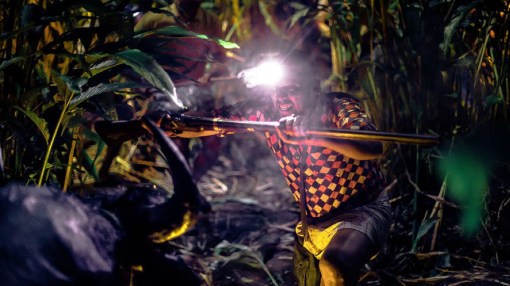
The death of a soldier bitten by a strangely beautiful snake is depicted with a striking violence and realism. All resources of landscape—jungle, tall grass, the rocky peak that the small troupe scales at the end—are harnessed with virtuosity and variety. For once, we are in a real jungle, and the camera weaves in and out of it with as much difficulty as the hero.

In non-combat scenes, it’s the good mood that sustains interest. The relationship between solders is described with a charming bonhomie. The interludes of familial life, full of freshness, grace and poetry, contain some of the best shots ever filmed by Raoul Walsh, whose career nevertheless features more than a hundred films, of which seventy-five are worthy of interest. One must see Barbara Nichols and Aldo Ray play Bulls and Cows, trying to out-moo each other, and especially the extraordinary tracking shot that closes Cliff Robertson’s dream. One must also point out James Best’s excellent performance and remarkable composure. In short, a beautiful film, a super-production that’s also a work of quality and which completely deserves the success the public has given it.


[From Luc Moullet’s Piges choisies (2009, Capricci). See Table of Contents]
The Treasure

The Treasure, the fiction film Corneliu Porumboiu made between two splendid documentaries, The Second Game and Infinite Football, begins with an image of paternal anxiety that would be at home in either of the latter films. Seated at the back of a car, Alin (Nicodim Toma) is upset that his father Costi (Toma Cuzin), offscreen, was late to pick him up from school. Costi replies that he wasn’t late, merely hiding, and that Robin Hood is never late. Alin doesn’t buy it, and tells Costi he isn’t Robin Hood. This offhand exchange, which has little to do with the plot of the film, functions as a kind of primal wound in the father-son relationship that Costi will attempt to mend. A little further, when he learns that Alin is being bullied by a classmate at school, Costi kneels down to teach his son how to handle it. In a tender bit of education, he instructs Alin to push the bully away and scream, but not to hit him. Later in the film, Costi chides his wife for letting Alin know he’s out looking for a treasure because it will set him up for disappointment. Among the numerous pleasures The Treasure offers is an endearing but unsentimental image of a father who judges himself through the eyes of his son.

Like all Porumboiu protagonists, Costi is a functionary. He is responsible for resolving land disputes, for authorizing private property. Costi is a straight shooter, he cannot lie. When his unemployed neighbour, Adrian (Adrian Purcarescu), shows up at night asking for a large sum of money, Costi turns him down, giving a clear account of his situation. Unwilling to let go of Costi, Adrian tells him that his great grandfather had buried a treasure in their ancestral house before the communists took over, and that if Costi helped him hire a metal detector to fish it out, he’d share half of whatever they find. Skipping his bill payments, Costi arranges for the sum of money. The two set out on a Saturday to Adrian’s country home, where they’re joined by Cornel (Corneliu Cozmei), the metal detector guy. Working with two devices whose operation they can’t entirely trust, the trio scans the length of the garden and zeroes in on a spot. After a protracted quarrel with the impatient Adrian, Cornel drives away, leaving the neighbours to dig alone.

With its simple premise and single line of thought, The Treasure resembles a short story. Like Police, Adjective, the film is a procedural that emphasizes the duller, everyday facets of the treasure hunting process. Costi slips away from the office in the afternoon to go look for metal detectors. He discusses pricing and timing with a small agency, but finds Cornel at the exit willing to do it at a cheaper rate. Back at office, his boss confronts him about his afternoon absence, and Costi tells him the truth. Incredulous, the boss is convinced Costi’s having an affair. A considerable part of The Treasure finds the three men walking like zen monks in the garden, hoping that the detector reveals something. There’s a significant presence of technology in the film in the form of various electronic devices but also as numbers and charts. The men’s faith that these figures will announce good news resembles something like a superstition.

The Treasure is set against the backdrop of contemporary Bucharest—its problems of unemployment, mortgage pressures and wealth inequality—but is essentially a fairy tale. It is a fairy tale because it’s set against these harsh realities. Rendering Costi as a sympathetic man in financial distress, Porumbiou pegs the film as a rags-to-riches narrative of individual success, prompting the viewer to cheer for the man in his treasure hunt. Costi, for his part, does everything he can to spoil this: he tells pretty much everyone around him what he’s up to, the villagers around the country house turn nosy, and even the police get a whiff of it. But none of it hinders their project; true to template, they discover a treasure. Porumbiou, however, concocts an ending that pulls the rug from underneath us, turning the fairy tale’s ideology inside out. More precisely, the ending displaces the film from one fairy tale to another. We realize then that the film’s focal point was somewhere else, that the listener the story is being recited for isn’t us but Alin.

The Treasure explains this shift in historical terms. The three men are looking for a treasure buried in a land that may have been under dispute during the 1848 revolution in which, we are told, sons of landlords redistributed their elders’ property. Adrian believes the treasure itself was buried in the 20th century, before the communists’ time. It turns out it wasn’t; it was buried during the communist regime. The ancestral home was a school under the communists, became a bar after the 1989 revolution and came back to Adrian in 1998. As the men dig, they find evidence of the site being used as a brick-producing site and later a steel mill. Like Alex Gerbaulet’s Shift, The Treasure reframes the story of the present through several levels of history buried underneath. As the men excavate the history of Romania layer by layer, they discover constantly changing definitions of wealth and crime: from private property being theft to its infringement defining theft. In doing so, The Treasure imagines fairy tales as negations of the social conditions producing them. Robin Hood can flourish only in a greatly inequal society. What did communist kids dream about? Stock markets, probably.

Graduation

Dreams of escape is what Cristian Mungiu’s Graduation begins with too. Romeo (Adrian Titieni), a surgeon, imagines a better life in the West for his daughter, Eliza (Maria Drăguș), who needs to perform well in her high-school examinations if she is to get a scholarship to Cambridge. A day before the exams, she is assaulted on way to school apparently by a convict on the lam. Eliza is understandably traumatized and doesn’t perform as well as she should’ve in the first exam. Fearing this might ruin his plans for her, Romeo arranges for her next evaluation to be rigged against the wishes of his bedridden wife, Magda (Lia Bugnar). In this, he is aided by a chief inspector, a deputy mayor and an educational officer, all four trading favours with each other.

Graduation opens with a shot of someone digging outside Romeo’s apartment complex in broad daylight. It’s an image that’ll appear one more time, but one that won’t be explained. Similarly, we aren’t told who is it that’s throwing stones at Romeo’s windows. Romeo simply accepts these events and is convinced of the deep rot afflicting the world around him. A potentially damning bit of information about Eliza’s boyfriend at the scene of the assault is also left hanging, even by Eliza whom it concerns the most. Romeo is having an affair with an administrator at Eliza’s school, a fact that the long-suffering Magda knows about, but doesn’t bring up. Everybody in Graduation is ethically compromised—there’s no moral centre to the film—because that is the only way to cope with things around here.

When Magda doesn’t agree with Romeo rigging the exam results, he reminds her of their own broken aspirations. They had decided to return to Romania after the revolution, but things haven’t changed as they wished. He tells Magda that Eliza, having had a cocooned upbringing, won’t be able to handle with the sordid realities of the country and must do what they couldn’t. Romeo repeatedly asserts, spelling out the film’s anti-moral, that sometimes the results are more important that the means. In exchange for favourable exam results, Romeo prioritizes the deputy mayor, who put Romeo in touch with the education officer, for a liver transplant. It doesn’t seem like anyone is losing out by Romeo’s bypassing of the transplant waiting list, just as it seems no one is really affected if Eliza’s score is fudged. But, of course, someone is.

What Graduation continuously points out is Romeo’s willing blindness to things. He believes that Eliza wouldn’t have been assaulted had the police done their job properly, but who’s to say that the convict’s escape wasn’t one of these ‘harmless’ arrangements? He complains about corruption and stagnation, but dodges draft and thrives as a surgeon thanks to these very elements. The institutions the film revolves around—police, hospital, school, town hall—aren’t pictured as Kafkaesque labyrinths but intimate spaces made or broken by individuals in it—something like a family, which is here a tainted institution too. Romeo exploits and benefits from due process not being followed in these institutions. His downfall comes when people, for once, start doing the right things: the investigation bureau decides to examine the deputy-mayor’s dealings, the police sniffs out Romeo’s arrangement, Eliza refuses to follow his instructions and loses faith in him.

Like in an art film of the seventies, Mungiu takes considerable pleasure in charting the downfall of respectable middle-class Romania. Romeo’s sealed-off existence is hinted at from the very first scene, where it’s pierced by a stone hurled at his window. The doctor spends rest of the film trying to fix this hole, literally and symbolically. Mungiu composes several indoor shots with windows visible in the background, the opening scene having prepared us to expect them to shatter any moment. This sense of fragility and pervasive dread—peaking in a late scene in which Romeo wanders a shady neighbourhood pursuing Eliza’s assaulter, only to struggle to get away from the location—is counterbalanced by the rather affectionate portrayal of the father-daughter relationship. I was reminded of Ozu throughout Graduation, with its long shots of Romeo peeling fruits, changing shirts or just sitting in wait of his daughter’s imminent departure. The pain of generational shift is brought into focus through the figure of Romeo’s ailing mother, who doesn’t want Eliza to leave Romania. That Eliza is the one who saves her grandmother in one scene, when Romeo is at his lover’s place, reinforces the film’s implicit theme of the necessity to own up to the past.

Metaphysics of the Arabesque

Radio Cinéma Télévision no. 444; 20 July 1958.

The Quiet American

When it appeared in 1955, the Englishman Graham Greene’s novel The Quiet American was a big succès de scandale. With the recent guerrilla wars in Indochina as the backdrop, it tells us the story of a typical British journalist, Fowler, who colludes with the communists to plot the death of his rival in politics and love, his friend Pyle, the typical American. Pyle believes that neither the communists nor the French can find a solution to the Indochina problem. He supplies ammunitions to an army of dissidents that represents, for him, a life-sustaining “third force”. This fascist third force increases its horrible attacks, like the one where explosives are hidden in bicycle pumps. It’s because the lives of thousands of innocents are threatened, because Pyle, an always self-assured Bostonian confident of his ideals and convinced of the moral value of his acts, remains unconscious of his actions that Fowler agrees to his murder. The Americans made a hue and cry about this book, which violently expressed the eternal aversion the British have for them. Not without reason: Greene’s partiality crudely pitted the calm, sceptical and praiseworthy objectivity of the Englishman against the ridiculous, criminal and naïve self-assurance of the American. A puerile simplification that’s far from the truth: the particular stands for the general. And it’s obvious that all Americans aren’t like Pyle, nor all Englishmen like Fowler, that each civilization contains good and bad values in equal parts. Moreover, the style left a lot to be desired, with its false journalistic objectivity awkwardly inspired by the first Malraux.

Total change of tone in Mankiewicz’s film. The eighth quarter-hour makes us suppose that Pyle was a brave fellow and that Fowler, the intelligent and lucid Englishman, was taken for a ride by the communists, whose skilful manoeuvres had forced him to judge Pyle guilty. He was only too happy to condemn him: Pyle’s disappearance will allow him to win back the favours of his eternal mistress, whose hand Pyle had just asked. That’s the explanation of the third man, Vigot, the cunning French inspector. The most surprising part is that this interpretation corrects multiple plot holes and improbabilities of Green’s novel. And we’ll still never know the exact truth… Like for The Barefoot Contessa, we can quote Pirandello without being way off.

This dramatic turn of events, this unpredictable reversal is presented with a diabolical intelligence. No dramatic insistence whatsoever: a turn of dialogue just when our attention goes lax reveals the trick; the word “plastic”, based on whether it’s said with an s or without, whether it’s French or English, changes the face of the world. It’s appropriate here to insist particularly on the value of this reversal: some “modern” films and novels—it’s enough to name Orson Welles—go against the idea of the “message”, so dear to ambitious artists, and locate their meaning, just like the exceptional range of their aesthetic, on the destruction of a carefully elaborated message; truth lies way beyond moral stances. Critical towards Pyle and generous towards Fowler, the film finally inverts these values. Pyle’s self-assurance lay on a solid and honourable base. Fowler was just a coward, a victim led astray by the gullible idiocy of tortured, hung-up English intellectuals: the last shots make him a pitiable, ridiculous quiet Englishman. The film is the sum of these two points of view.

This explains the film’s surprising critical and commercial failure: Mankiewicz cheats his viewer, who thinks he’s watching a traditional display of anti-Americanism and gets a confirmation of his prejudices for two-thirds of the film, only to be taken for a ride at the end, just like Fowler. Mankiewicz has perhaps ended his career for having caught false intelligence, which seeks not the truth but to distance itself from tradition at all costs, and the famous fear of being fooled in their own trap. Some claim that the end was more or less imposed by the distributors; in truth, though, we have here one of the most independent films that America has ever sent us since it was even produced by our auteur-director and his company, whose name pays tribute to Beaumarchais.

Moreover, the aesthetic confirms the meaning of the work: it’s in the line of Giraudoux. Arabesques, an affectation and a literary style are its major features. The mise en scène takes pains to reproduce reality in all its forms for us: lightness and “fluidity” make way for dramatic composition and psychological study. The impression is that of liberty: things and beings seem to present themselves to us as though the auteur had nothing to do with them.

The film is more satisfying when objects occupy more space than characters. This can be explained by the literary, and not cinematic, character of the great Mankiewicz, who is only a good metteur en scène. This perfectly neutral Saigon as it presented itself during location shoot, with its suburban look cluttered with scrapyards and wastelands—while our detractors asked for local colour—is very curious. The festival scenes which open and close the film are among the most beautiful moments of contemporary cinema. This ballet with masques, confetti, garlands, monster heads and heroes scattered by the crowd represents in a typical fashion an 18th century universe, which is Mankiewicz’s own. It recalls The Rules of the Game and The Golden Coach without paling in comparison.

Over two hours, our protagonists talk in a room. Mankiewicz was thus hard put to find a novel way of directing actors. We have here a great progress over The Barefoot Contessa: to be sure, Audie Murphy, Michel Redgrave and Claude Dauphin seem to be acting in the same fashion, with their banal looks, creased foreheads and worried faces. But such performance corresponds more with the film’s subject than with the excellent and inventive direction of actors that we usually find in Mankiewicz’s work. In a ballet, individuality is subsumed in the whole.

Finally, one must point out the richness of the dialogue and their constant creativity. Mankiewicz is always on the lookout for the odd and the fantastic. He often plays on language conflicts and ambivalence of words. With him, cinema gives us not a filmmaker, but a genius litterateur. We are perhaps losing out on something there. But what are we complaining about? Even if the opposite is impossible, cinema can always contain within itself both cinema and literature. Even if the latter dominates, we don’t have the right become vociferous defenders of a cinematic specificity which, over the years, has proven to be highly fallacious.


[From Luc Moullet’s Piges choisies (2009, Capricci). See Table of Contents]

Austerlitz

Ukrainian filmmaker Sergei Loznitsa’s Austerlitz is a typically rich and rewarding examination of the present’s relationship with the past and the commodification of history. Shot in the Sachsenhausen concentration camp near Berlin seemingly over one summer day, the film centres on tourists who visit the camp either on their own or as part of a guided tour. We don’t follow particular individuals or groups, but the general progression of the film follows the guided tour from the entry to the exit. We observe them through the architectural elements of the buildings on the camp, the double framing producing a necessary distance. The sound mix is dense and complex and picks up various different voices on the site. Guide commentary and tourist chitchat, mostly in Spanish and English, overlap to produce a disorienting palette reflective of modern confusions regarding historical interpretation: a speech about the isolation chambers at the site is overlaid with a tourist speaking about his South African trip, the camp tour perceived as being in a continuum with other vacation activities.

Loznitsa shoots with long lens, which allows him to remain at a distance from the tourists, who hardly notice or pay attention the camera; it’s to the credit of camera placement that he’s still able to get such long, uninterrupted shots, which always begin after the camera has been on for some time. It is also noteworthy that he doesn’t provide us any sights the tourists themselves might be seeing, remains as he does mostly outside the buildings. Austerlitz, like Shirin, is not about the observed but the observer, not about history but the consumption of history. In fact, we are never told which concentration camp we are in; I had to look it up. As is characteristic of the filmmaker, Loznitsa’s meditative and observational film offers no informational text or voiceover, leave alone indications as to what we are to make of these vignettes. A thoroughly non-polemical work, Austerlitz trusts the audience to not only supply the required historical context to understand the images, but also exhibit the moral sensitivity needed to garner insight from them.

The tourists behave as any group behaves in a culturally-significant space. They amble around the site in grudging respect; their blasé body language makes it seem like they are in a forced school trip or a not so amusing theme park. Naturally, they are in casual summer clothes, which includes dozens of message T-shirts. (One guy wearing a Jurassic Park tee is particularly helpful to the film’s cause.) Their mass-market clothing, advertised to them as embodiments of their individuality, turns them—like all of us—into walking banners for corporate branding, and this tension between mass consumption and individual inclination is also present in the way they consume the sights of the camp. Except for a few fleeting moments of solitary contemplation, they are pulled into the rhythm of the guided tour, with its regular snack and toilet breaks. They pose at torture poles and the ovens as they would at an amusement park. Austerlitz, however, does not incriminate them or deem them shallow. It is what it is, and the viewer is free to make his own judgments about their comportment. Loznitsa’s choice to shoot in black and white, in fact, refuses the potentially jarring presence of colours at the site.

There’s clearly a sense that something is missing from the images and sounds of Austerlitz. That something, the negative space of the film, is history itself. The past in Loznitsa’s film exists in an inverted relation to the present, for what we see in the film completely belies our knowledge of the concentration camps. The somewhat frivolous behaviour of the tourists, who dawdle as though they were in a shopping mall, is a negation of the sombreness of camp life. The crowd of tourists is unregulated, moving in all directions. They enter and exit the different facilities of the camp at will. They have food and drink at hand at all times. Most significantly, they possess an abundance of recording equipment that photograph every inch of the site. In contrast, hardly any images exist of the Holocaust, this “black hole of history” in Georges Didi-Huberman’s terms, one of whose defining features is the suppression of any documentation about it. Photography is also an existential act. Photographing a monument is a testament to the photographer being present at that place and partaking in the longevity of the monument, which will no doubt outlive the photographer. In that sense, Austerlitz is a snapshot of our life today, with all its fears and anxieties seen reflected in the Holocaust.

Loznitsa’s work has consistently engaged with the way history is recorded and given shape to. It has brought to surface the intimate relation between history and theatre, between the meaning of events and their appearance. In Maidan, the theatre of revolution is indissoluble from the revolution itself. It is in the form of the protests—the choruses, the banners, the slogans—that people recognize themselves as actors of history. In The Event, the conflict between the revolutionaries’ unsure understanding of what’s happening and the narrative imposed by state apparatus crystallizes into a synthetic vision of history. Both these films centred on a collective recognizing itself through a shared revolutionary identity. In Austerlitz, the tragedy of history resurfaces as commercial theatre. The mass is no more the subjects of history but its consumers. If the Nazis benefited from production at the camps, private and public operators now profit from the mass tourism industry. It is significant that Loznitsa’s film ends with a reference to the Lumières, with the visitors leaving the camp, now a veritable tourist factory. Unlike Lumières’ workers, though, they are in no hurry to get back home. They linger and take selfies at the gate. They are, after all, on vacation. Arbeit macht frei, indeed.

Donbass

Donbass opens in what it calls “Occupied Territory in Eastern Ukraine”. Calling the region that—and not Novorossiya or Donetsk People’s Republic or Luhansk People’s Republic—makes it clear that Loznitsa’s latest fictional film is partisan. The scene is a make-up room and the actress in frame complains about the pay. A woman in military outfit barges in and evacuates the dozen or so people inside. They actors aren’t surprised and rush out as per instruction. The handheld camera follows them in long shots to a location where they wait for further indications. Following the sound of an explosion, the crew is led to the site of a bus bombing, where they enact a TV reportage. The actress pretends to be a shopkeeper who rushed to the location after the blast. Loznitsa has perhaps never been more direct. This revelation of the mise en scène of false flag terrorism and manufactured news in Russia-backed secessionist Ukraine, which boomerangs back on its participants later, spells out both the filmmaker’s sentiments and the film’s modus operandi.

Donbass is divided between “Ukraine” and “Occupied Territory in Eastern Ukraine”, but spends most of its time describing life in the occupied region. Like Loznitsa’s first feature My Joy, the film is a series of aborted vignettes, stubs that vanish after they’ve served their purpose. This employment of interruption as a stylistic element helps the film paint a mosaic-like picture of the region and liberates it from the need to give a narrative envelope to such disparate threads. After the opening bombing, we move to a maternity hospital in which the new official-in-charge denounces his predecessor’s crimes while being in cahoots with him, a drama during a Ukrainian political meet where one libelled lady pours a bucket of goo on a political leader, a reportage of people living in bunkers in the occupied territory, an anticlimactic meeting between a Christian pacifist and a newly-minted official, an ingenious description of corruption where the new army hijacks cars of businessmen and extorts money from them, a confrontation of the insurgent soldiers with a visiting German journalist whom they denounce as fascist, the punishment of an erring soldier by the rest of his regiment, assorted scenes at various checkpoints, exchanges among common people in the bus reminiscing about their losses in the war, and several other scenes and stray incidents. Loznitsa trains his attention on the power trips common people willingly embark on given the chance.

But Donbass is not some falsely-neutral study of the human condition; it clearly takes sides without reducing the complexity of the matter at hand. It is Loznitsa’s documentary eye that nuances proceedings. In the film’s most remarkable detour, we attend a partly-grotesque, partly-endearing wedding in a registrar office in the occupied region—the first wedding in the self-proclaimed Novorossiyan union. Two “revolutionaries” are getting married and their uniformed, gun-toting comrades are here to wish them. The incredible energy of the scene apart, what registers is the attempt of a fledgling nation trying to define itself through rituals and symbols: the Novorossiyan marriage certificate, the national flag, the national anthem and the patriotic hails. Similarly, in another scene, a captured Ukrainian soldier is displayed at a bus stop, where the public humiliates and assaults him. There’s a hint of sadism in Loznitsa presenting the discomfiting affair in its entirety, but the stories of the people accusing the captive of rigging mines that killed their near and dear are equally distressing. In this sequence, setting image against sound doesn’t cancel them out; it enhances their truth value. In both scenes, it isn’t clear whether Loznitsa is critical of the participants in the ceremony. His success lies in making us look for values beyond that question.

Like Austerlitz, Donbass is full of shots making and unmaking themselves: we see elements constantly filling and emptying the frame. This alternation of density and rarefaction gives the film a rhythm akin to breathing, as does its combination of highly nervous action and anodyne conversations. Despite its scattershot narrative, we are always sure of where we are and what the dynamics between characters are. This is partly because the filmmaker guides our attention by placing the Ukrainian and Novorossiyan flags in nearly every shot. Loznitsa is a filmmaker with a remarkable eye for large groups of people, and Donbass contains several shots of individuals vanishing into the crowd or coming out of it. In one scene, we see people having set up camp outside a police station, dinner table and all. It’s a succinct image of the transitional period of revolution, right in line with the film’s thematic interests. The regiment without a chief, the maternity hospital with conflicting leaderships, the army unit without official funding, all point to a nation in the process of defining itself. A country in its mirror stage of development, it could be said, if only Loznitsa weren’t such a materialist.

Austerity of Style

Radio Cinéma Télévision no. 408; 10 November 1957.

A King in New York

In this quixotic narrative, whose only point of reference is the central character, various themes intertwine as they do in music. This style goes hand in hand with the expression of a complex reality that words can hardly express: everything can be both irritating and pleasant. “Life would be dull without all these worries”, affirms King Shahdov. Hiding behind the hysteria of rock’n’roll is the beauty and sensitivity of a night club singer. Polemist, Chaplin still is, but having become wiser and more lucid with old age, he towers over events and ideologies.

His style? He presents facts without technical affectation and in a very concise manner (see the revolution scene), but lingers over that which seems secondary to us. Every other scene is a discussion in a hotel room, an interlude but also a reflection of reality: modern life alternates action with the rhythm of a telephone. The triteness with which the scenes are presented without relief only increases the force of the smallest original notation, be it dramatic – the young hero’s tears – or comic – Dawn Addams’ play with legs in the shower – or the king’s abrupt emotional attack.

Like all creators, Chaplin forces himself into extreme austerity. Dramatic surprise is avoided, the gags pitilessly dissected and the end effect predictable from a long way away (see the fire hose). Product of subtractions more than additions, the result is better, bringing to cream pies their intellectual coefficient.


[From Luc Moullet’s Piges choisies (2009, Capricci). See Table of Contents]