Chuck Workman’s Precious Images (1989), commissioned by the Director’s Guild of America at the unofficial centenary of cinema, is made of hundreds of shot fragments collected from numerous Hollywood titles – mostly highly popular – each of which, generally, lasts for not more than half of a second. If one can get past obvious objections about a centenary film which is made of films from just one film industry and which includes works that had vehemently announced their breakup from it, Precious Images comes across as an effective if not exactly exhilarating tribute to classic Hollywood cinema. Workman assembles his material more on intuition than theory and the film moves from one genre to another, less through their external generic classification and more through the emotional impression the selected shots create. As a result, films from genres such as thriller and horror reside with each other while romance and comedy go hand in hand. Furthermore, Workman cuts his films like the finest of Hollywood films do: manipulative enough to guide our attention from one shot to another and tasteful enough to restrain from overkill. Also typically Hollywood is the way the film employs music and sound bites, mostly culled from iconic film scores, to pull together the disintegrated structure of the film. Putting aside the lingering feeling that this is Hollywood patting its own back for everything that it’s done, Precious Images makes for a great spot-the-movie game.
By a bizarre coincidence, I came across this movie the same day I saw Joel Bocko’s uber-geeky montage that spans 60 years of world cinema. Joel’s vastly superior film plays out like the output of a malfunctioning super-projector in its final minute of operation. Essential viewing, below.
Ridley and Tony Scott’s production house Scott Free, in association with LG and YouTube, invited users from around the world to submit footage of their lives shot on July 24, 2010 as a part of a socio-cinematic experiment. Out of the 4800 hours of video gathered, chief director Kevin Macdonald and co. wove this exhilarating 90-minute ride, Life in a Day, which, on its surface takes us through one day in the life of people from around the world. If Dziga Vertov attempted to sketch a portrait of a pulsating city as seen through the Kino-Eye over a day and Medvedkin had Soviet peasants shoot their own lives, edited the obtained footage in his Cine-Train and played it back to them, Life in a Day combines both these ideas and realizes them in a post-globalized cultural-economic climate – a time where the omnipresence of branded consumer products is matched by the ubiquity of low-cost image-making instruments. An endless play of presence and absence, lack and excess, similarity and difference, the homogenous and the un-normalizable and the empowered and the marginalized, Macdonald’s virtually inexhaustible film is a snapshot of planet earth in all its glory, stupidity and complexity. So much film theory has sprung up since Vertov et al made their films and what is of interest is not only the relationship between individual shots, but also the dense cultural content within each one of them that enriches our response manifold. Sporadically erratic and miscalculated, Life in a Day nevertheless achieves the remarkable feat of synthesizing a coherent, mesmerizing and, indeed, philosophically ambitious film from the very elements that have become the antithesis of these traits. What appears as a paean to narcissism to some commentators seems to me as a heightened awareness of one’s own existence. The act of photographing oneself – on a particular day and for a particular purpose – prompts one to be continuously conscious of the passing of time and the finitude of experience. One frustrated lady sums it up in the film’s final line: “Today, even though nothing great happened, tonight, I feel as if something great happened.”
The Turin Horse (Image Courtesy: MottoMagazinBlog)
There are 30 shots in all in Hungarian couple Béla Tarr’s and Ágnes Hranitzky’s The Turin Horse (2011), 29 of which involve a moving camera and most of which are elaborately choreographed amalgam of camera movements. The first and possibly the most exhilarating shot of the film is a compounded crane and tracking shot in which we are presented with a horse cart and its driver. The dolly tracks at the pace of the cart and its craning arm films the cart primarily from two directions perpendicular to each other: a view lateral to the line of action and a view of the horse head-on and up close. (This combination of lateral and head-on angles of the camera will form a major visual motif in the film.) We see the horse pushing hard against the gale, with its mane fluttering backward. We see the man, equally haggard, with his hair swept back by the wind like the mane. We also note that, by himself, the man is static while the horse is the one moving forward and taking him along – a minor detail but also an illustration of the film’s chief theme. The equivalence between the horse and its driver becomes even more pointed as the film cuts to the second shot, where we see the man – now on foot – pulling the horse into the stable (also reiterated in shot no.22 where the man’s daughter does the pulling). After the second shot, the film shifts indoors, where the major part of the film unfolds.
Inside, we follow the man, Ohlsdorfer (Janos Derzsi), and his daughter (Erika Bok, who plays a counterpoint of sorts to the character she played 17 years ago in Satantango (1994)) as they go about doing their daily work for 6 consecutive days: she gets up first, wears the countless number of clothes hanging on the wall, adds firewood to the hearth, fetches water from the well, dresses up the man, who has a paralyzed right hand, and boils the potatoes so that they can have lunch. Much of the action involves, as does the latest Dardennes feature, closing and opening of doors, necessitated by the beastly windstorm that plagues the outdoors. Their house is sparse and functionally furnished. Not only are the walls entirely unadorned, but the coating is coming off. The man seems to be a cobbler and he, possibly, sells the belts he makes in the town. The family does not seem to particularly religious. It does not have appear to any neighbours or visitors, save for the man (Mihály Kormos) who comes to their house to get his keg of country liquor filled, and the band of gypsies which arrives at their well for water, only to be shooed off by the old man.
The day-to-day events repeat over and over, of course, but Tarr (Please rest assured that I’m not forgetting the contribution of Hranitzky here and elsewhere) and regular DoP Fred Keleman photograph them from different setups each day, trying out various possible configurations and presentations and as if illustrating the Nietzsche’s concept of Eternal Recurrence that informs the structuring of the film. The effect of ritualization and repetition of everyday events with religiosity is bolstered by Mihaly Vig’s characteristically organ-laden cyclical soundtrack (reminiscent of the thematically apt Que Sera Sera of Almanac of Fall (1985)) that meets its counterpoint only in the boisterousness of the winds that sweep the plain. Keleman and Tarr light and shoot the interior of the house so painstakingly and evocatively, that even commonplace objects achieve a throbbing vitality of their own. They often light overhead, as they regularly do, imparting a luminous visual profile to the characters, who now seem like spectres haunting this dilapidated house. Unusually, there are also few instances of a voice over, which is new for Tarr, which acts as like the voice of an anti-God looking over the man and his daughter during the course of the film and their eventual fall.
It soon appears as though the horse (Risci) is neither at the centre of the film’s lean narrative nor at the focus of its apparent ideas. Indeed, it simply looms in the background like an unwelcome guest or an illness that is preventing the old man from riding into town to do business. However, actually, the animal not only provides a stark thematic contrast to the human characters of the film, it is at the very foundation of its metaphysics. The film opens with a hearsay anecdote about Friedrich Nietzsche. Apparently, in January 1889, when the philosopher was in Turin, he witnessed a cart driver flogging his recalcitrant horse. Nietzsche is said to have stopped him in haste and leapt on to the cart, embraced the horse and cried profusely. It is also said that this was the day after which he started losing control of his mental faculties. Of course, at the outset, what Nietzsche felt was simple empathy for a tormented creature, like any kind person would have. But because the person we are talking about is Nietzsche, the event holds a very special implication. What he was going through was also a sudden experience of intersubjectivity and, as importantly, the awareness of its existence.
A small detour to Dostoyevsky, a writer Nietzsche deeply admired, would be instructive here. In Crime and Punishment (1865), protagonist Rodion Raskolnikov, a bona-fide Nietzschean character, is haunted by dreams of a horse being cudgeled to death for the entertainment of those around it. It is, in addition, an expression of the owner’s power over and possession of it. Rodion, who believes that certain superior individuals have the right to disregard law and conventional morality if they feel that they are doing so for a greater good, discovers here the fallacy of his worldview. Like Nietzsche, he proposes a philosophy of guilt predicated on the effect of a “crime” on the conscience of the actor and not on the acted upon. But what this idea assumes is that moral consciousness of a person is a given, fully-formed whole, independent of other consciousnesses. Rodion realizes, in this nightmare, the toxicity of appointing oneself a superordinate being, especially when the relationship is that of master and slave, owner and owned. Nietzsche, in a classic case of life is imitating art, faces the same situation at Turin. His tears are an acknowledgement of the interconnectedness of all consciousnesses, an equivalence of each one of them.
The opening text of The Turin Horse tells us that we know what happened to Nietzsche after the incident but not the horse. The film’s recognition of the horse as a being as important as Nietzsche begins right there. The first image we see is that of a mare trotting against heavy wind, very close to the screen, dominating the frame – as if the camera is embracing it – suggesting its centrality to the film’s ideas. (Actually, we are never told that this animal is the same as the one Nietzsche wept for. The cut from the anecdote to the horse prompts us to assume that. This is only the first instance of lack of specificity that pervades the film.) The Turin Horse treats the horse as a fully-formed consciousness in itself – as vital as, if not more, its human counterparts – capable of understanding the world and, more crucially, reacting to it. The two human characters at the centre of the film do recognize the doom that surrounds them, but do not seem to do anything to change or respond to it. On the other hand, it is their horse that protests the cruelty of its master and offers resistance to the decay all around by refusing to eat or work. In other words, the mare seems to possess a higher degree of self-awareness than its human owners. In one shot, the camera lingers on the horse long after the humans have left the scene, with the same solemnity that it displayed towards the people in the film. It is not some overblown anthropomorphism that we are dealing with here. It is a radical decentering of humanity as the locus of consciousness.
This tendency to displace humans as the centre of the universe also furthers Tarr’s and frequent collaborator László Krasznahorkai’s long-standing anti-Biblical programme. If, with the ending of Satantango and the upshot of the Nietzschean Werckmeister Harmonies (2000), the writer-director pair tried to overturn the Scripture, here they take on the Creation narrative itself. Divided into six days, which no doubt serve to echo the six days of the creation of earth, The Turin Horse chronicles in detail the progressive disintegration of the world back to nothingness before time. In this anti-Genesis-narrative, neither is man created in the image of God (one that’s not dead, that is), nor are beasts inferior beings to be tamed and controlled by man. (“Let us make man in our image, after our likeness. And let them have dominion over the fish of the sea and over the birds of the heavens and over the livestock and over all the earth and over every creeping thing that creeps on the earth.“) In Tarr’s and Krasznahorkai’s Scripture, it becomes increasingly difficult to separate night from day, the seasons from each other. (There are only two seasons in the film’s world – windy and otherwise). Beings, instead of being fruitful and multiplying, become scarcer and scarcer. Earth returns to the formless void – the void that we witness in the evocative last shot – that it was at the Beginning. One imagines that the film would agree with Genesis on the seventh day: “Thus the heavens and the earth were finished, and all the host of them”.
[The Turin Horse (2011) Trailer]
Commentators have noted the striking silent film-like appearance of The Turin Horse. Indeed, Tarr, who has never been as metafilmic, parallels the anti-Creation narrative with a similar trajectory on the cinematic plane. A number of sub-shots are presented with the set and character in full view, arranged against a flat background and shot head-on with the décor in parallel to the image plane, just like a silent movie. Many of the shots are parenthesized by vertical or horizontal bars of film grain that wipe across the screen. Father and daughter, themselves, resemble the monstrously mismatched prospectors of The Gold Rush (1925), eating a non-meal every day and the smaller one always drawing the shorter straw. This is compounded by the fact that the film is set in 1889, just about the time cinema came into being. Moreover, the two interruptions that disturb the routine of the silent family are marked by excessive talk and cacophony. The film begins with pure movement of cinema and ends in absolute stasis of photography. (It is telling, in this respect, that the only completely still shot of the film is the last one.) It is as though cinema, like the film’s world, has regressed into non-existence, from broad daylight to total darkness.
Judge him, but this affinity for depicting disintegration to rubble has permeated Béla Tarr’s filmography. In a way, each of his film is a document of structural destruction: of urban spaces (Family Nest, 1979), of the modern family (Prefab People, 1982), of society (Almanac of Fall, 1985), of political machinery (Satantango, 1994), of civility (Damnation, 1988) and of civilization (Prologue, 2004). The Turin Horse takes the logic further and locates itself at the probable end of humanity itself. If Tarr’s latest work appears to lack the analytical rigour or satirical edge of his previous films, it is because it distills key ideas of these earlier films into a highly abstract conceptual examination devoid of urgency and pointedness. Looking at the director’s oeuvre, one can see this coming. Tarr started with very topical, socially critical films made in vérité aesthetic. Realizing that surface realism could only get him this far, he took a stylistic as well as epistemological break with Almanac of Fall, after which, instead of recording reality as it appears, he dealt with increasingly abstracted forms removed from everyday experience and a philosophy that replaced materialism with metaphysics.
Such departicularization is the modus operandi of The Turin Horse. The film systematically removes any trace of specificity from within it and builds an extremely generic framework that one can liken to the confident broad strokes of a paintbrush. Such sucking away of particulars would have been fatal in a film with concrete political ambition. But The Turin Horse, in contrast, works in a philosophical and cinematic realm so rarified that such distillation seems tailor made for it. Beyond the very specific opening story (Who: Friedrich Nietzsche; Where: Door No. 6, Via Carlo Alberto, Turin; When: January 3rd, 1889), we are not sure about any narrative detail. The place could be Turin, or not. The year could be 1889, or not. It could be autumn, or not. The long monologue that the first visitor delivers is what Pauline Kael would call a Christmas tree speech: you can hang all your allegories on it. What is the threat he is talking about? Why is the town ruined? Who are “they”? We don’t get any answer. If, at all, Tarr makes another film and intends to take the idea further, he’s, in all possibility, going to find himself in the realm of pure avant-garde, with nothing concrete to hold on to except the truth of photography.
Undoubtedly, Tarr is as cynical as filmmakers can get. His cynicism, like Kubrick’s, is the cynicism of great art, to borrow a sentence from Rivette. But with The Turin Horse, Tarr seems to have punched through to the zone beyond. We have, here, entered the realm of the absurd, where cynicism itself is rendered impotent. In this film, doom is a given, inevitable. Instead of charting people’s downward spiral into the abyss as in the previous films, Tarr and team observe with resignation the insularity of people from their situation. Foreboding gives way to fatalism, cynicism to amusement. Robert Koehler correctly compares the film to the works of Samuel Beckett and The Turin Horse is a veritable adaptation of Waiting for Godot (1953). Right from the lone tree on hill top, through the dilemmas of vegetable eating, the sudden logorrhea of a stranger, the perpetually cyclical nature of events, to the ritualization of actions, especially the changing of apparels, Tarr’s incomplete tragicomedy in 30 shots echoes Beckett’s incomplete tragicomedy in two acts. Like Beckett’s bickering pair, or Buñuel’s angels, father and daughter find themselves unable to leave the house for some reason. And like Vladmir and Estragon, or Pinky and Brain (“Tomorrow we’ll try again”), the two– stuck in their house for eternity with only each other to stand witness for their existence – sit by the window everyday gazing at, or waiting for, a Godot that could be anything ranging from revolution to death.
But there are two key cinematic predecessors to The Turin Horse as well. The first of them, Chantal Akerman’s Jeanne Dielman (1976), lends Tarr’s film its finely spiral structure, in which a continuous process of disintegration is made palpable by minute changes in what appear to be unchangeable routines. Like in Jeanne Dielman, another film with an inclination for culinary detailing, the aquarium-like world of the characters is pierced by changes in the outside world, leading to their downfall. Then there is Sohrab Shahid Saless’ Still Life (1974) with which The Turin Horse not only shares its strong comic undercurrent, but also the idea of rendering chronology and the passing of time irrelevant by making it go in loops; the eternal return if you will. But, unlike the makers of these two films, Tarr filters his film from any direct comment on contemporary social organization. (Akerman and Saless, on the other hand, are keenly focused on the issue of urban and rural alienation). But what these films, most critically, share is an acute eye for everyday details, for minor behavioral and physical variations and an unshakeable faith on inescapable specificity of the photographic image.
Batang West Side(2001) (West Side Avenue)
Lav Diaz
Tagalog/English
Thanks to West Side Avenue (2001), clearly Lav Diaz’s first major work, we now know what will happen if the Filipino filmmaker takes to genre filmmaking. Diaz takes the standard policier, blows it to a size beyond what the text can handle and, in essence, brings to surface the mechanics of the genre. Constructed as a (seemingly endless) series of interrogations and recollections, a la Citizen Kane (1941), the film presents itself like a sphere without a centre. (Like Charles Kane, the relationship of all the characters to the dead boy at the centre of Diaz’s film – which is developed strikingly with a plethora of parallels – becomes the guiding device.) The procedure becomes so routine and schematic, aided to a large degree by the repetition of spaces and compositions, that the lead detective (Joel Torre) becomes something of a Melvillian zombie trudging through generic structures. But then, talking about Diaz’s film in terms of the genre is not half as justified as reading it from a national and auteurist perspective. Firmly planted in historical and geographical particulars – Filipino youth living in and around Jersey City during the turn of the century – the film takes up the issue of disappearing Filipinos – a sensitive idea that would be pursued further in other forms the later films – and examines the historical deracination and alienation that marks these young men and women. The relationship between the various characters with the killed teenager reflects their own conflicted relationship with their homeland. The film, itself, is somewhat (and slightly problematically) neo-nationalistic in flavour, gently appealing for cultural consciousness, integration and a “return to one’s roots”. The narrative mostly involves the investigation of the murder of one Manila teenager, If one moves beyond its precise sociological ambitions, one also discovers the flourishing of to-be-familiar stylistic (and narrative) devices: Scenes in master shots, montage of long takes, monochrome passages in. video and use of total amateurs. (Oddly enough, my favorite scene in the film is among the most uncharacteristic of Diaz’s cinema: a breakfast scene cut with verve comparable to Classical Hollywood). However, the most unmistakable authorial trademark of West Side Avenue is also the feature that attracts me most to Diaz’s work: the candidness and enthusiasm about his politics and political engagement, in general, as well as that rare faith in and love for cinema. That is why, towards the end of the film’s five hours, when the detective and the filmmaker – two professions seeking to discover truth – catch up with each other and restore the hitherto-absent heart of the film, you don’t if Diaz identifies with the detective or the filmmaker. He’s both.
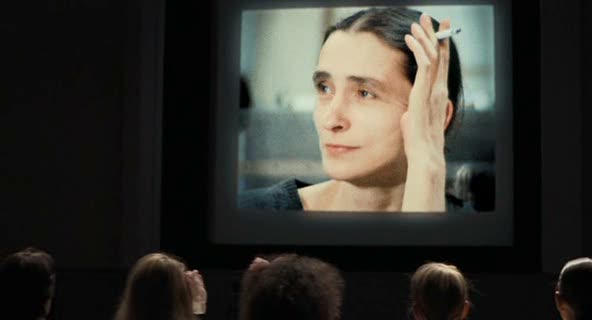
Maya Deren, committed perhaps more than anyone else to marrying choreography with film, once wrote: “There is a potential filmic dance form, in which the choreography and movement would be designed, precisely, for the mobility and other attributes of the camera, but this, too, requires an independence from theatrical dance conceptions.” This could well have been a mission statement for Wim Wenders’ Pina (2011), which attempts to re-imagine Bausch’s most famous works for a cinema audience and, specifically, for 3D technology. Consisting of an assortment of performances of Bausch’s famous pieces – performed on stage as well as outdoors in the choreographer’s home town – and interviews with her protégés, the film locates itself on this side of her passing and plays itself openly as a tribute rather than a cine-profile. Although it appears that art forms are being nested one inside another – Wenders’ film records Bausch’s choreography, which, in turn, is viewed as painting-on-stage – Pina comes across as collaboration between two art forms, as it is between two of its eminent practitioners – one feeding into another. Dance and cinema are presented as two universal forms bypassing verbal language, as is made explicit in the frequently interrupting (and consistently impoverishing) interviews in which we see Pina’s dancers – of different ethnicities, cultures and languages – sitting idly before the camera while their testimonies play as voiceovers, as though reducing both forms to their very basics – image and gesture. As for the dances themselves, we respond to the sheer physicality of them, more than their meaning, which is enhanced by Wenders’ restive, ever-tracking and craning camera that provides us the best of vantage points and brings us close to actually taking part in the performances.
One Way Street: Fragments For Walter Benjamin (1992)
John Hughes
English/German/Russian
(The other) John Hughes’ One Way Street: Fragments for Walter Benjamin (1992) seeks to present vignettes from the German philosopher’s life as well as his writing, predictably, in a form that reflects Benjamin’s own working method. As a result, fragmentation – pictorial and structural – becomes the (dis)organizing principle of the film. Multiple sub-frames (recalling Nick Ray’s cherished avant-garde film), graphic overlaps and abrupt colour shifts on the visual front are complemented by a thoroughly variegated set of exposition devices: hammy enactment of biographical minutiae, talking heads of authors who have written on Benjamin and other intellectuals of Weimar Germany, fictional interviews and an onslaught of quotes by Benjamin – onscreen as well as vocalized, reminiscent of Alexander Kluge’s attempts at adaptation of Marx, This ‘unclassifiability’ of the film finds an echo in the seeming malleability of Benjamin’s body of work – appropriated by a variety of disciplines and practitioners – which becomes one of its areas of investigation. Never dwelling on a particular strain in Benjamin’s thought (nor enriching our understanding of these dimensions), the film emphasizes the non-teleological nature of his work which resists ideological or philosophical reduction. At times, trying to emulate his subject, Hughes also takes to chains of free associations – toys/soldiers/toy soldiers etc. – that don’t necessarily take us deeper than the surface pleasures they offer. However, probably the most wanting quality of the film is that, situated on this side of the collapse of Berlin wall, the film doesn’t seem to want to open up Benjamin to the present, content in presenting a portrait of the writer locked in a time capsule – exactly the attitude towards past that Benjamin was operating against.
They all clambered into Mikolka’s cart, laughing and making jokes. Six men got in and there was still room for more. They hauled in a fat, rosy-cheeked woman. She was dressed in red cotton, in a pointed, beaded headdress and thick leather shoes; she was cracking nuts and laughing. The crowd round them was laughing too and indeed, how could they help laughing? That wretched nag was to drag all the cartload of them at a gallop! Two young fellows in the cart were just getting whips ready to help Mikolka. With the cry of “now,” the mare tugged with all her might, but far from galloping, could scarcely move forward; she struggled with her legs, gasping and shrinking from the blows of the three whips which were showered upon her like hail. The laughter in the cart and in the crowd was redoubled, but Mikolka flew into a rage and furiously thrashed the mare, as though he supposed she really could gallop.
“Let me get in, too, mates,” shouted a young man in the crowd whose appetite was aroused.
“Get in, all get in,” cried Mikolka, “she will draw you all. I’ll beat her to death!” And he thrashed and thrashed at the mare, beside himself with fury.
“Father, father,” he cried, “father, what are they doing? Father, they are beating the poor horse!”
“Come along, come along!” said his father. “They are drunken and foolish, they are in fun; come away, don’t look!” and he tried to draw him away, but he tore himself away from his hand, and, beside himself with horror, ran to the horse. The poor beast was in a bad way. She was gasping, standing still, then tugging again and almost falling.
“Beat her to death,” cried Mikolka, “it’s come to that. I’ll do for her!”
“What are you about, are you a Christian, you devil?” shouted an old man in the crowd.
“Did anyone ever see the like? A wretched nag like that pulling such a cartload,” said another.
“You’ll kill her,” shouted the third.
“Don’t meddle! It’s my property, I’ll do what I choose. Get in, more of you! Get in, all of you! I will have her go at a gallop!…”
All at once laughter broke into a roar and covered everything: the mare, roused by the shower of blows, began feebly kicking. Even the old man could not help smiling. To think of a wretched little beast like that trying to kick!
Two lads in the crowd snatched up whips and ran to the mare to beat her about the ribs. One ran each side.
“Hit her in the face, in the eyes, in the eyes,” cried Mikolka.
“Give us a song, mates,” shouted someone in the cart and everyone in the cart joined in a riotous song, jingling a tambourine and whistling. The woman went on cracking nuts and laughing.
… He ran beside the mare, ran in front of her, saw her being whipped across the eyes, right in the eyes! He was crying, he felt choking, his tears were streaming. One of the men gave him a cut with the whip across the face, he did not feel it. Wringing his hands and screaming, he rushed up to the grey-headed old man with the grey beard, who was shaking his head in disapproval. One woman seized him by the hand and would have taken him away, but he tore himself from her and ran back to the mare. She was almost at the last gasp, but began kicking once more.
“I’ll teach you to kick,” Mikolka shouted ferociously. He threw down the whip, bent forward and picked up from the bottom of the cart a long, thick shaft, he took hold of one end with both hands and with an effort brandished it over the mare.
“He’ll crush her,” was shouted round him. “He’ll kill her!”
“It’s my property,” shouted Mikolka and brought the shaft down with a swinging blow. There was a sound of a heavy thud.
“Thrash her, thrash her! Why have you stopped?” shouted voices in the crowd.
And Mikolka swung the shaft a second time and it fell a second time on the spine of the luckless mare. She sank back on her haunches, but lurched forward and tugged forward with all her force, tugged first on one side and then on the other, trying to move the cart. But the six whips were attacking her in all directions, and the shaft was raised again and fell upon her a third time, then a fourth, with heavy measured blows. Mikolka was in a fury that he could not kill her at one blow.
“She’s a tough one,” was shouted in the crowd.
“She’ll fall in a minute, mates, there will soon be an end of her,” said an admiring spectator in the crowd.
“Fetch an axe to her! Finish her off,” shouted a third.
“I’ll show you! Stand off,” Mikolka screamed frantically; he threw down the shaft, stooped down in the cart and picked up an iron crowbar. “Look out,” he shouted, and with all his might he dealt a stunning blow at the poor mare. The blow fell; the mare staggered, sank back, tried to pull, but the bar fell again with a swinging blow on her back and she fell on the ground like a log.
“Finish her off,” shouted Mikolka and he leapt beside himself, out of the cart. Several young men, also flushed with drink, seized anything they could come across—whips, sticks, poles, and ran to the dying mare. Mikolka stood on one side and began dealing random blows with the crowbar. The mare stretched out her head, drew a long breath and died.
“You butchered her,” someone shouted in the crowd.
“Why wouldn’t she gallop then?”
“My property!” shouted Mikolka, with bloodshot eyes, brandishing the bar in his hands. He stood as though regretting that he had nothing more to beat.
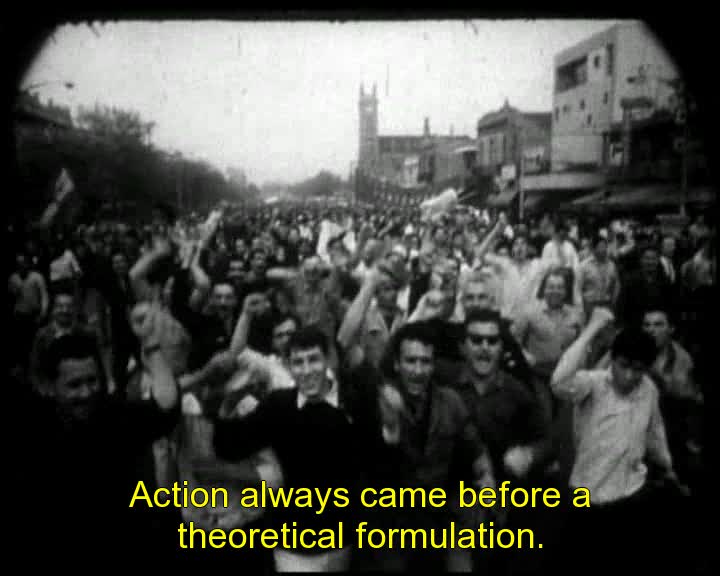
Until recently, film had been synonymous with spectacle or entertainment: in a word, it was one more consumer good. At best, films succeeded in bearing witness to the decay of bourgeois values and testifying to social injustice. As a rule, films only dealt with effect, never with cause; it was cinema of mystification or anti-historicism. It was surplus value cinema.
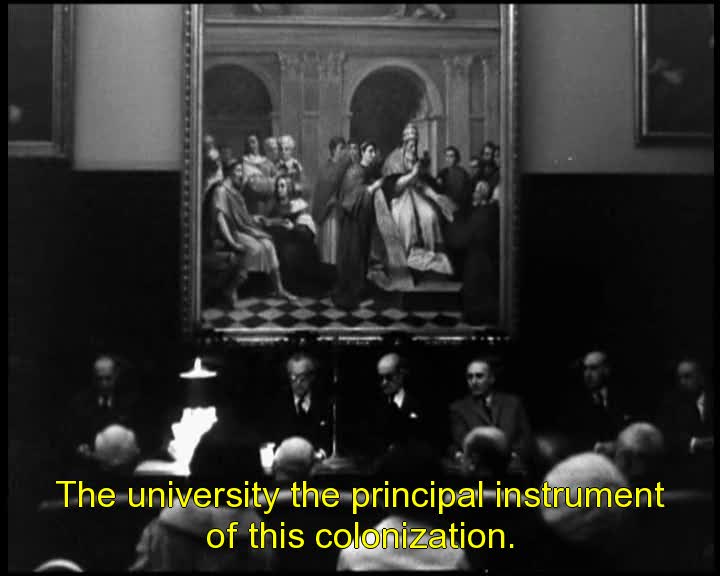
Culture, art, science, and cinema always respond to conflicting class interests. In the neocolonial situation two concepts of culture, art, science, and cinema compete: that of the rulers and that of the nation.
The 35mm camera, 24 frames per second, arc lights, and a commercial place of exhibition for audiences were conceived not to gratuitously transmit any ideology, but to satisfy, in the first place, the cultural and surplus value needs of a specific ideology, of a specific world-view: that of US finance capital.
The cinema as a spectacle aimed at a digesting object is the highest point that can be reached by bourgeois film-making. The world, experience, and the historic process are enclosed within the frame of a painting, the stage of a theatre, and the movie screen; man is viewed as a consumer of ideology, and not as the creator of ideology.
Imperialism and capitalism, whether in the consumer society or in the neocolonialised country, veil everything behind a screen of images and appearances. The image of reality is more important than reality itself. It is a world peopled with fantasies and phantoms in which what is hideous is clothed in beauty, while beauty is disguised as the hideous.
The cinema of the revolution is at the same time one of destruction and construction: destruction of the image that neocolonialism has created of itself and of us, and construction of a throbbing, living reality which recaptures truth in any of its expressions.
The cinema known as documentary, with all the vastness that the concept has today, from educational films to the reconstruction of a fact or a historical event, is perhaps the main basis of revolutionary film-making. Every image that documents, bears witness to, refutes or deepens the truth of a situation is something more than a film image or purely artistic fact; it becomes something which the System finds indigestible.
Pamphlet films, didactic films, report films, essay films, witness-bearing films – any militant form of expression is valid, and it would be absurd to lay down a set of aesthetic work norms.
Revolutionary cinema is not fundamentally one which illustrates, documents, or passively establishes a situation: rather, it attempts to intervene in the situation as an element providing thrust or rectification. To put it another way, it provides discovery through transformation.
Our time is one of hypothesis rather than of thesis, a time of works in progress – unfinished, unordered, violent works made with the camera in one hand and a rock in the other. Such works cannot be assessed according to the traditional theoretical and critical canons.
In this long war, with the camera as our rifle, we do in fact move into a guerrilla activity. This is why the work of a film-guerrilla group is governed by strict disciplinary norms as to both work methods and security. A revolutionary film group is in the same situation as a guerrilla unit.
Guerrilla film-making proletarianises the film worker and breaks down the intellectual aristocracy that the bourgeoisie grants to its followers. In a word, it democratises.
The camera is the inexhaustible expropriator of image-weapons; the projector, a gun that can shoot 24 frames per second.
This cinema of the masses, which is prevented from reaching beyond the sectors representing the masses, provokes with each showing, as in a revolutionary military incursion, a liberated space, a decolonised territory.
We also discovered that every comrade who attended such showings did so with full awareness that he was infringing the System’s laws and exposing his personal security to eventual repression. This person was no longer a spectator; on the contrary, from the moment he decided to attend the showing, from the moment he lined himself up on this side by taking risks and contributing his living experience to the meeting, he became an actor, a more important protagonist than those who appeared in the films.
Moreover, each projection of a film act presupposes a different setting, since the space where it takes place, the materials that go to make it up (actors-participants), and the historic time in which it takes place are never the same. This means that the result of each projection act will depend on those who organise it, on those who participate in it, and on the time and place; the possibility of introducing variations, additions, and changes is unlimited. The screening of a film act will always express in one way or another the historical situation in which it takes place.
The man of the third cinema, be it guerrilla cinema or a film act, with the infinite categories that they contain (film letter, film poem, film essay, film pamphlet, film report, etc.), above all counters the film industry of a cinema of characters with one of themes, that of individuals with that of masses, that of the author with that of the operative group, one of neocolonial misinformation with one of information, one of escape with one that recaptures the truth, that of passivity with that of aggressions.
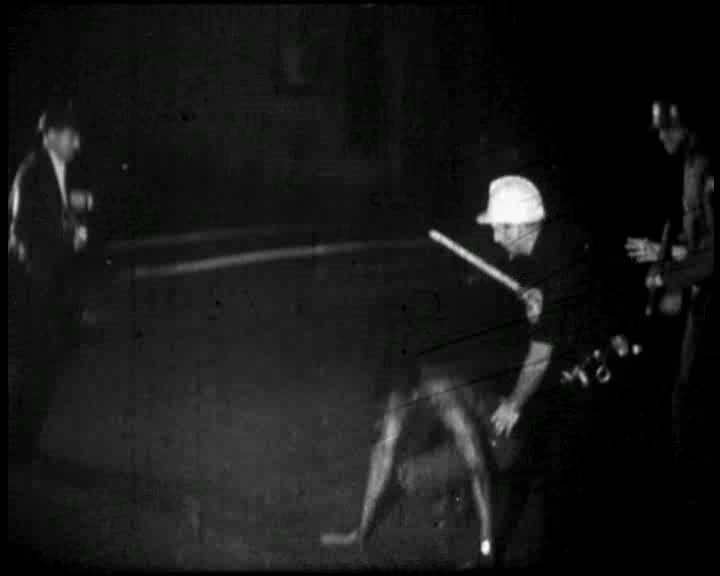
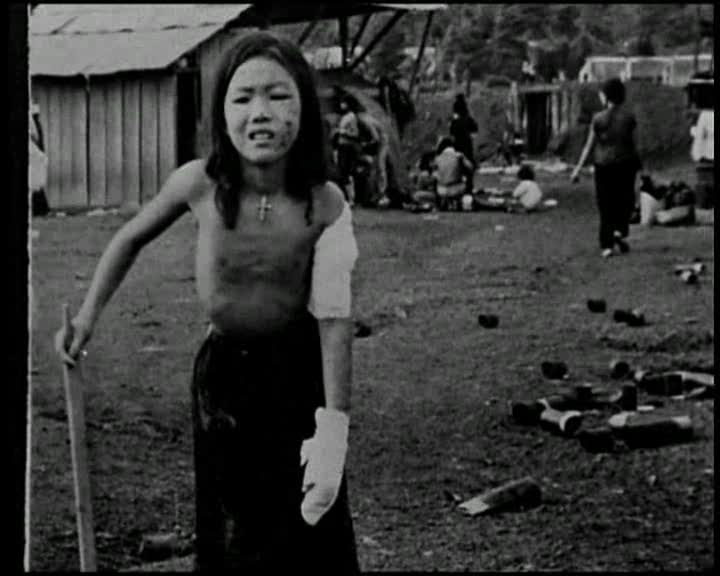
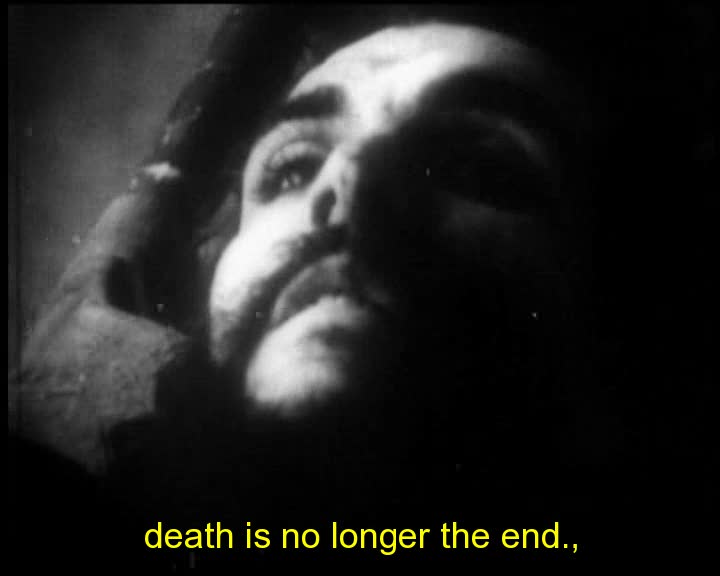
Images from The Hour of the Furnaces (1968, Fernando Solanas, Octavio Getino) Text from Towards a Third Cinema (1969, Fernando Solanas, Octavio Getino)
Peter Hutton’s hour-long At Sea (2007), voted the best avant-garde film of the decade by Film Comment, draws upon the director’s city portraits, landscape films and at-sea sketches, the last of which is informed by his decade-long experience as a marine merchant. The first section of At Sea, set in an advanced South Korean shipyard, showcases the assembly of a container ship. We witness monstrous machine components moving about slowly and rhythmically as they give birth to the vessel, making it seem as though we have been prodded into the maternity ward of a futuristic machine-hospital. (At times, we are not sure if it is the machines or the camera that is moving.) Arguably, the camera is in awe of these machines framed against the sky. Hutton employs two types of visual schemas – an intricate, crisscrossing array of verticals and horizontals (of the structures and the machines) and large, blank spaces (created by the ship’s surface and the sky) – which, often, reside in the same shot, resulting in unbalanced compositions that suggest both the vastness and the complexity of the man-made objects that we are looking at. We also see the workers working on and within the machinery, not only dwarfed by these behemoths but also assimilated into them. Even though they appear to be at the mercy of these metallic monsters, we know that they are in control of these machines. Even if one prefers to read it as a critique of dehumanization of labour, one can’t help but trace a sense of fascination and artistic pride about mankind’s ability to construct such enormous, complex objects. This unsettling mix of political criticism and scientific veneration is exemplified by the penultimate shot of the section in which executives, officials and captains sit in front of the finished product for a photograph. As such, they have nothing to do with the construction of the ship, but as members of a scientific project, their pride is justified.
In the most rewarding, middle segment, which lends the film its name, we are on a cargo ship in the middle of a sea. We observe both the sea and the crates aboard at different weather conditions and at various times of the day. Few films set on a ship convey such an exact sense of being in the ocean as this section. The gently bobbing camera which also suggests the speed of the ship (In one shot, we see the water alternately rising above the rails of a deck and hiding from our view) and the weather that registers its nature on the lens of the camera (as raindrops gather on the viewing surface, the rigid crates appear as if they are melting away) evoke both the romance and the fatigue of living for days together over deep waters. In one extended rearview shot, we see the agitated water at the ship’s wake move towards the horizon, where it appears to freeze to stillness, just like how a sea journey etches itself in memory. The use of a tripod here is highly ironic in how the instability of the camera is facilitated by it being coupled to the sway of the vessel. The compositional patterns in this segment echo the first – horizontal bars on the deck cross the vertical motion of the raindrops creating a visual grid like the architectures of the opening section; the geometrically fragmented, variegated set of crates juxtaposed with the monolithic, monochromatic texture of the sea and the occasional mist – facilitating an aesthetic continuity across the sections.
Also in common with the previous passage is the disturbing mixture of poetic inspiration and materialist inquiry that the images invoke. Even if one is enraptured by the beauty of the sea, one also keeps wondering what these crates contain, where are they coming from and where they are going, not unlike the feeling when we observe the goods trains traversing the screen in James Benning’s RR (2008). Such a comparison to Benning’s cinema doesn’t seem gratuitous because At Sea exhibits the same sensitivity to minor changes in landscape, shadows and light and the same affinity to locate major visual changes alongside gradual, barely perceptible ones in the same shot. (The tension between the dynamic and the nearly-static exists throughout Hutton’s imagery.) Most importantly, this central section of the film portrays a world in a permanent state of flux. Shape-shifting and transition become underlying principles – this middle section as a converter working on two contrasting ends of the ‘narrative’, transport of goods as a prime mover enabling globalization, sea journey as a transitional period between two stable periods and the sea as a turbulent passage way between two worlds – and is typified by the travelling shot of the sea water at night that looks like an abstract painting in motion, with its thick, dark strokes interspersed with impressionistic stipples of light. The image also recalls the opening shot of Film Socialism (2010) in how the dark waters are made to look like crude oil and in how water is equated to money (respectively as a metonym for seaway capitalism and a metaphor for public commodity).
The concluding part of the film is set in a scrap yard in Bangladesh, where discarded ships from other countries are torn down manually using the most archaic of methods. A squalid, post-apocalyptic space, it is the hell to the heaven and purgatory of the previous two segments. We observe kids playing football amidst the mess and silhouetted figures lurching towards decrepit ship parts for a hard day’s labour. The awe of the South Korean section makes way for total repulsion and scientific marveling, for political investigation. The visual patterning of crossing lines and juxtaposed surfaces carries over into this segment as well, but talking about style in this particular segment becomes rather dangerous. Like Glawogger’s Workingman’s Death (2005), which covered a ship wrecking yard in Pakistan in one of its passages, the third section of Hutton’s film walks a tight rope between ethics and aesthetics. This section of At Sea is neither as detailed nor as visceral as the former, but it shows the moral restraint that Glawogger’s work sometimes neglects. There is no obvious aesthetization of menial labour here, no soaring music to guide us; just a sober documentation of the appalling working conditions. The stylization is subdued and it derives its merit mostly from the continuity and meaning that the overall placement of section within the film’s structure provides. That is why the sudden shift to B/W in the segment is a little troubling, even if it never comes across as objectionable. This shift appears to take us back in time – to the nascent days of cinematography where passersby stare curiously into the camera – as does the transition from the advanced shipyard to the medieval wrecking grounds.
Hutton knows that sound in film can potentially gloss over critical questions and inconsistencies and make the viewer complacent. Like most of his earlier films, AtSea contains no sound and the whole responsibility of communication falls upon the visuals. This helps the audience distance itself emotionally from what it is watching and engage with the questions and ideas that the film prompts. Although this achievement comes at the heavy handicap of having no soundscape, Hutton’s choice not only aids the audience achieve true alienation from the work, but also comes across as highly ethical in the way it attenuates the realist aspect of the film (and all its concomitant issues). However, At Sea is not devoid of sensual pleasures. The mid-section, specifically, is rich with images marked by a poetic outlook. For instance, the protracted shot of the sunset, seeming as though a giant ball of fire is plunging from the sky into the sea, and the image of the sea bathed in moonlight, evoking a sense of the infinite and the unknown, directly convey the romance of sailing, which no doubt inform many of Hutton’s films. The film opens with a quote by Joseph Conrad: “A man who is born falls into a dream like a man who falls into the sea…” The idea of sea journey as a dream, a shape-shifting psycho-space, finds its echo in the hypnotic images of the second section of the film.
Perhaps the most striking aspect of At Sea is how it absorbs given tenets from narrative cinema and transforms them for particular end uses. I’m thinking specifically of the three-act structure, which the director himself describes, in generic terms, as the “birth, life and death” of a container ship. (The fictionalized nature of Hutton’s film is revealed right there, for we are made to believe that the film is a story of one ship, while we see a different ship in each section). Like narrative cinema, the first act bears a strong, antithetical relationship with the last act: construction/destruction of the ship, glory/shame of our civilization, birth/death of the vessel, rigid structures/boggy seaside, smooth movements/total stasis, advanced automated engineering/prehistoric manual methods, photographing of achievement/ photographing of distress and, most notably, the triumph/failure of global capitalism. This association becomes a strong indictment if we consider, like narrative cinema, that the first act is the cause of existence of the third. This collocation raises the same question as does Workingman’s Death: Where is the worker in the modern world? Both the opening and the closing sections attempt to answer this question. The structuring of At Sea helps unveil what is hidden in each of the segments considered separately: workers across the world connected with each other, without their immediate knowledge, by larger, imperceptible forces. The second act, then, comes across as both redundant in terms of end result and absolutely critical in terms of thematics and meaning. Without it, not only will the film come across as crudely polemical, but will also cease to be a work as connected to personal experience as it now is. It is the middle section, most of all, which prevents the reduction of the film to any simple political or philosophical statement. The dissonant feelings and ideas that it generates contribute to the holistic richness of the film. It is here that we are, truly, at sea.
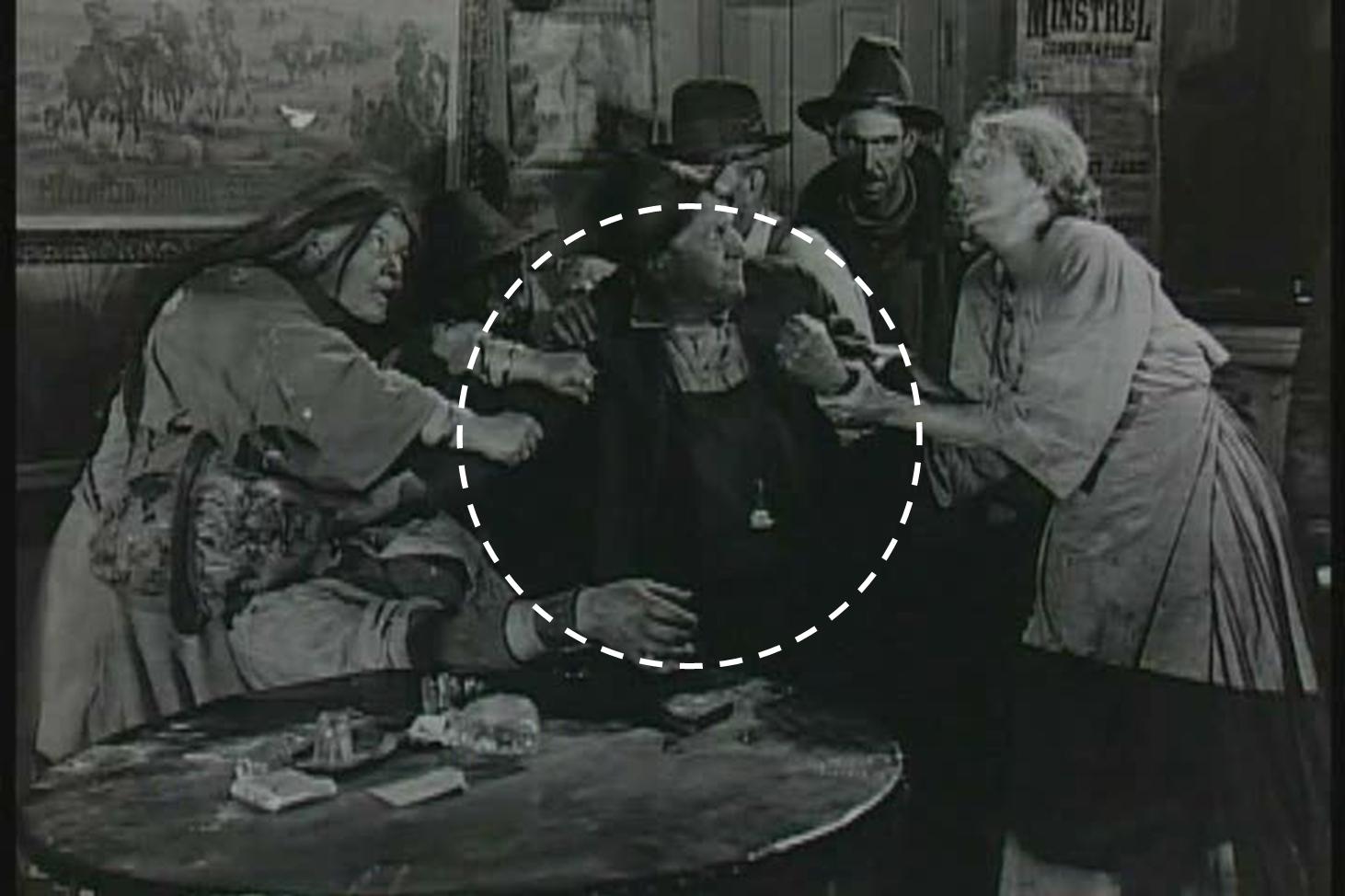
This stunning still from Erich von Stroheim’s Greed (1924) comes from the first few minutes of the 1999 reconstruction of the film. It’s really tough to pin down the author of this photograph for a number of reasons. Firstly, no one can say if this picture was just a production still or if it was a part of the final film. Moreover, the film has separate credits for a cinematographer, a photographer and a still photographer, any of whom, besides the director, could have composed this. Whatever the case, von Stroheim must have had a hand in putting together this tableau, which seems straight of a Renaissance painting, as is acknowledged by the paintings on the wall behind.
In the scene, Father McTeague is thrashed by one of the visitors at the bar: a spat possibly driven by money or the woman who accompanies him. (It helps recollecting that his son McTeague, himself, turns as violent towards the second half of the film). Although the picture only presents the immediate aftermath of an event, one can feel directly from the sheer physicality of the composition what has just happened. The downward arrangement of faces seems to trace the path of the blow that has landed on Father McTeague’s mug so precisely that one immediately recognizes what occurred and when.
This is also one of the reasons it invokes Caravaggio, whose paintings, too, exhibit a deep affinity forsinkingprofiles and dramatic faces turned towards various directions. It recalls, specifically, The Entombment of Christ (1603), where an impassive, fallen Christ is mourned by contrasting, agitated countenances and gestures.
The entire setup has an elliptic profile – from the heads of the characters, through the profile of the woman on the left, the barroom table, the curves on Mother McTeague’s clothing to her leftward-bent body – as if presaging the circular structure of the film (McTeague’s fortune, social status and disposition, among other facets, come a full circle) and closing the circle of violence and greed.
Then there are the hands, startlingly concentrated in a small area of the canvas, forming a a smaller circle at the centre. The man in black forms the void at the heart of the photograph (and a mirror image of Caravaggio’s radiant Christ, who demands our attention). And this confluence of hands seems to be pulling him out of an abyss, preventing him from being sucked in. The two women on either side of him, dressed in brighter colours, appear to be forming two angel wings attaching themselves to this devil of a man, trying to save him from the savage world of men he’s located in.
Just goes to show how early cinema was deeply influenced by other representational forms: an attempt perhaps to earn credibility among its peers. This is indeed ironic. For long, painting had sought to imitate reality and reproduce it as faithfully as possible. The arrival of photography, as Bazin noted, truly liberated painting from the irrational need to represent reality religiously. What is remarkably ironic is that photography (and cinema) tried to emulate painting with plastic manipulation and conceptual representation, such as the one above. It is well known that cinema is still plagued by the spectre of painting, which is given higher priority and attention – more than forms like music and literature – whenever film aesthetics is discussed. Films are regularly panned for being too literary or theatrical, but never for being too painterly. Even talking about framing and lighting reveals an undying fascination with painterly qualities of an image. (Rohmer, writing about CinemaScope declared: “…no longer will we speak of framing or lighting; instead we will talk about landscape and light”). I’m reminded of what Kurosawa writes in his autobiography:
What is Cinema? The answer to this question is no easy matter. Long ago the Japanese novelist Shiga Naoya presented an essay written by his grandchild as one of the most remarkable prose pieces of his time. He had it published in a literary magazine. It was entitled “My Dog”, and ran as follows: “My dog resembles a bear; he also resembles a badger; he also resembles a fox…” It proceeded to enumerate the dog’s special characteristics, comparing each one to yet another animal, developing into a full list of the animal kingdom. However, the essay closed with, “But since he’s a dog, he most resembles a dog.”
I remember bursting out laughing when I read this essay, but it makes a serious point. Cinema resembles so many other arts. If cinema has very literary characteristics, it also has theatrical qualities, a philosophical side, attributes of painting and sculpture and musical elements. But cinema is, in the final analysis, cinema.


















 The Seventh Art


