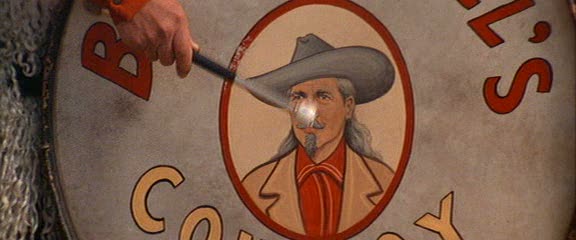
Mani Kaul

Mani Kaul 
(1944-2011)

Mani Kaul is undoubtedly the Indian filmmaker who, along with Kumar Shahani, has succeeded in radically overhauling the relationship of image to form, of speech to narrative, with the objective of creating a ‘purely cinematic object’ that is above all visual and formal. He was born Rabindranath Kaul in Jodhpur in Rajasthan in 1942 into a family hailing from Kashmir. His uncle was the well-known actor-director Mahesh Kaul. Mani joined the Film and Television Institute of India (FTII), Pune initially as an acting student but then switched over to the direction course at the institute. He graduated from the FTII in 1966. Mani’s first film Uski Roti (1969) was one of the key films of the ‘New Indian Cinema’ or the Indian New Wave. The film created shock waves when it was released as viewers did not know what quite to make of it due to its complete departure from all Indian Cinema earlier in terms of technique, form and narrative. The film is ‘adapted’ from a short story by renowned Hindi author Mohan Rakesh and is widely regarded as the first formal experiment in Indian Cinema. While the original story used conventional stereotypes for its characters and situations, the film creates an internal yet distanced kind of feel reminiscent of the the great French Filmmaker, Robert Bresson. The film was financed by the Film Finance Corporation (FFC) responsible for initiating the New Indian Cinema with Bhuvan Shome (1969) and Uski Roti. It was violently attacked in the popular press for dispensing with standard cinematic norms and equally defended by India’s aesthetically sensitive intelligentsia. [Image & Bio Courtesy: Mubi]


I guess Mani Kaul could be called, with qualifications of course, the invisible man of Indian cinema. The home audience might find his films too ‘European’, too alien, and too cryptic, and might prefer instead the realist-humanist works of an artist like Ray. Foreign viewers, on the other hand, might complain that they are too culturally-rooted, too alien and too cryptic, and instead opt for a ‘universal’ filmmaker like Ray. Indeed, neither Kaul nor his pictures make any claim to ‘universality’. They are, undoubtedly, steeped in Indian classical art forms like how the Nouvelle Vague films were, with respect to the European classical tradition. Many of these films are adapted from literary works in Hindi, have a profound relationship with Hindustani music and exhibit an influence of representational forms from the country. In fact, his cinema, if not much else, is about these very forms, both in terms of subject matter and their construction. These films, to varying degrees, are literature (The Cloud Door), painting (Duvidha), architecture (Satah Se Uthata Aadmi), poetry (Siddheshwari) and music (Dhrupad). Right from his early documentary Forms and Design (1968), which sets up an opposition between functional forms of industrial age and decorative ones from Indian tradition, Kaul makes it, more or less, apparent that is he is interested in the possibilities of a form itself more than the question if it can convey a preconceived thesis. Like Godard, Kaul starts with the image and works his way into the text, if any.

Perhaps it is classical music, and specific strains of it, that exhibits strongest affinity with Kaul’s cinema. The director has mentioned that the trait that attracts him to it the most is that there are elements that just don’t fit into a system, notes that slip away and could find themselves elsewhere in the composition, Similarly, Kaul, admittedly, edits his films like composing music, moving a shot along the timeline, beyond logic, meaning or chronology, till it finds its right place, in terms of mood, rhythm or whatever parameter the director has in mind. (“And I know that when the shot finds its place, it has a quality of holding you. The position is its meaning”). He has, time and again, spoken elaborately on the systematization of fine art by European Renaissance and the need to find out alternate modes of expression free from its constraints. Convergence, be it in the perspective compositions of painting, the three-act structure of literature, or the climaxing of motifs in music, has always been an area of concern and investigation for him. (He admires Hum Aapke Hain Kaun (1994) for its insistence on spending a quarter hour fretting about a pair of shoes, at the expense of plot). Consequently, fragmentation becomes the central organizing principle of his aesthetic. Like Robert Bresson, one of his greatest influences, Kaul prefers filming parts of the body – hands, feet and head – and positions his actors such that they are facing away from the camera or are in profile, thereby disregarding the convention that the face is the centre of one’s body. (Kaul’s sketches, in that sense, are direct antithesis to the portraits of Renaissance). Accordingly, because the face is tied to the notion of a unique identity, Kaul’s actors are stripped off all natural expression and behaviour and de-identified. Many of his shots are ‘flat’, without any depth cues or perspectival lines. (He traces this to ‘perspectiveless’ Mughal miniature paintings and cites Cézanne as another major influence). None of the characters are Enlightenment heroes having a firm hold on their world. The narratives are decentered and distributed across multiple perspectives.

This resistance to convergence principles of Renaissance has also led him to radically reformulate his relationship to the spaces he films. He believes that filmic and social spaces have been conventionally divided into ‘the sacred’ – the perfect realization of an ideal, carefully framed and chiseled, with all the undesired elements out – and ‘the profane’ – accidental intrusions, random fluctuations and irreligious interruptions; that the moment a filmmaker looks through the viewfinder, he ‘appropriates’ the hitherto ‘neutral’ space to compose based a set of principles, polishes it and turns it into a ‘sacred’ space. Kaul, on the other hand, has increasingly been resistant to ‘perfecting’ an image or space, instead treating space as something neutral and unclassifiable in itself and concentrating on the tone, feeling and emotion of a shot. (This is also what Godard does in his latest work, where spaces and images of all kind are given equal importance). In his later films, he has asked his cameraman not to look through the viewfinder while filming. (This does not mean that one shoots blindly. The director has elaborated in his writings on how this could be practically implemented. “What needs to be determined by the director and the cameraman is the act of making the shot: attention being that aspect of time that deeply colours the emergent feeling in a shot”). He has, admittedly, been open to intrusions and one can see stray elements, like cat mews appearing unexpectedly, in some of his shots. Likewise, none of his “stories” converge, or even have a linear progression, and, in fact, keep diffusing and opening up new possibilities.


[There are numerous features not covered in this post. The entries will be added if and when I see those missing films. All short films are omitted here.]


Uski Roti (A Day’s Bread, 1969)

Uski RotiMade when he was 25, Mani Kaul’s first feature Uski Roti (1969) is what one might call a poetic film about waiting. Kaul takes a simple premise for the film – a woman who goes to the highway everyday to give lunch to her husband, whom she,  oddly enough, addresses using his full name – and strips it down to its skeleton, diverting our attention from what is represented to how it is represented. (Kaul likens this process to a painter emphasizing his brush strokes). Bresson’s influence is palpable in many aspects of filmmaking here: the delayed editing of shots that parenthesizes action, the de-dramatization of scenario, the atonal, unaccented line delivery by actors without forced expressions, the emphasis on objects rather than concepts, the numerous shots of hands and faces that have a grace of their own and, of course, the central, suffering woman. (There is even a direct homage to Pickpocket (1959)). Additionally, Kaul’s own training in short documentaries seems to have made its mark here, given how keen the film is on documenting purely physical activities such kneading dough, which becomes the central gesture. (This would be elaborated upon in the short A Historical Sketch Of Indian Women (1975)). Utilizing plethora of Ghatak-influenced wide angle shots, in high-contrast monochrome (if only the film had used European film stock, Pedro Costa would applaud), a hyperreal sound mix and a highly idiosyncratic grammar (horizontal asymmetry, characters facing away from camera, no reaction shots), Kaul makes an arresting if not totally underivative debut.

Duvidha (In Two Minds, 1973)

DuvidhaKaul’s most acclaimed film Duvidha (1973) opens with a rather flat, Godardian image of a woman in a red saree standing in front of a white wall, staring determinedly into the camera, as high-pitched Rajasthani ethnic vocals grace the audio. Like the frozen image of Truffaut’s juvenile delinquent, it suggests a predicament addressed to the audience. Based a folk tale, Duvidha speaks of a love that is beyond time and space. The presence of the ghost, which falls in love with the new bride, is not an exotic delicacy served to us but a given. And so is the ‘story’, which is read out verbatim to us by the narrator, freeing the film from the burden of storytelling, so to speak, instead allowing it to experiment with the imagery. Employing a number of photographs, freeze frames, jump cuts and replays, which illustrate the film’s central notion of temporal and geographical dislocation (and save on the budget) and manipulating time like an accordion player, Kaul weaves a narrative where the past, the present and the future are always in conversation. (The ghost is simply referred to as ‘Bhoot’ (ghost), which is, of course, the word for ‘past’ as well). The predicament of the title, then, involves a choice between the spiritual and the material, the bride’s past and future, her childhood and adulthood, her freedom and honour and her love and security. Bewitchingly shot like a Dovzhenko film (and composed like Cézanne‘s still lifes), and impressively designed, with a simple yet striking interplay of red and white, Duvidha builds on both Kaul’s feminist leanings and highly personalized aesthetic.

Satah Se Uthata Aadmi (Arising From The Surface, 1980)
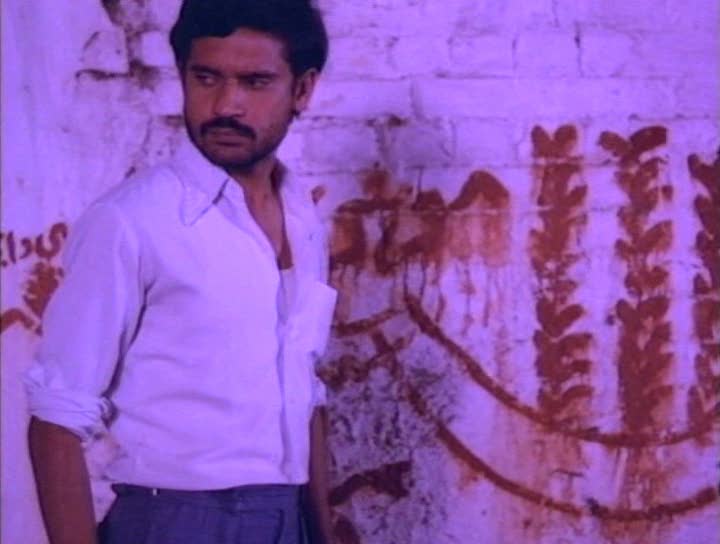
Satah Se Uthata AadmiSatah Se Uthata Aadmi (1980) begins with a shot of a serene lakeside landscape being abruptly shut off from view by a closing window, following which camera gradually withdraws deeper into the eerily empty rooms of a dilapidating house where the central character of the film – a poet – resides. This notion of the artist being far removed from reality, and retreating further into himself, resonates throughout the film. Based on the deeply personal texts of Gajanan Mukthibodh, Satah Se Uthata Aadmi presents a world where the revolution has failed, idealism has died out in the name of practicality and the role of intellectuals and artists has been vehemently questioned. Rekindling the question of theory versus practice, the film attempts to examine if residing is certain social frameworks to make a living amounts to a sellout of oneself. (Like Godard-Truffaut, Ghatak-Ray, does Kaul have anyone in mind?). This fragmented, post-socialist state of society that the film depicts – through its vignettes of urban Indian individuals – is reflected in the Malick-like disunited voiceover which spans three characters and which conversely, unites the narrative together. A remarkably sustained tone poem, with brooding surreal passages (including a hypnotic documentary sequence inside a factory and an unabashedly allegorical finale) and minor experiments (sections from Muktibodh’s texts displayed on screen), reminiscent of Godard’s work of the 90s, rife with strong verticals and perspective compositions (which is odd, given Kaul’s resistance to it), Satah Se Uthata Aadmi is both Kaul’s most stringent and most affecting work.

Dhrupad (1982)

DhrupadDhrupad (1982) finds Kaul studying the eponymous classical music form, specifically the Dagarvani variation of it practiced by the Dagar family, with whom the director has close associations with. Apparently, the music the film examines is one without any form of notation since, reportedly, many of the tones don’t fit into existing notational systems and the transmission of tradition is done purely orally. (The vocal performances that we hear exhibit such malleability of human voice that one is convinced that no instrument can aspire to emulate its timbre). This trait of not conforming to the systematized models of Renaissance is of special interest to Kaul, who has long been aware of the need to discover non-reductive, discursive modes of expression. Likewise, Dhrupad, like many of the director’s pictures, eludes categorization or compartmentalization. Part historical study, part religious documentation of performances, part experiment with cinematic time (the sublime shot that spans a sunrise invokes contemporary ‘landscape filmmakers’ like Benning) and part exercise in thematically conglomerating classical Indian art forms – music, sculpture, architecture, painting and cinema – the self-referential film gives a vivid picture of what makes Dhrupad so striking, with its numerous mise en abymes and fractals. Like in the films of Resnais, with whom Kaul shares an affinity for ‘fragmentation’, the camera glides through the Mughal style corridors and courtyards, in which the veteran artistes of the Dagar family perform and teach – while the soundtrack takes off on its own – evoking a sense of history that is living and breathing.

Mati Manas (The Mind Of Clay, 1985)
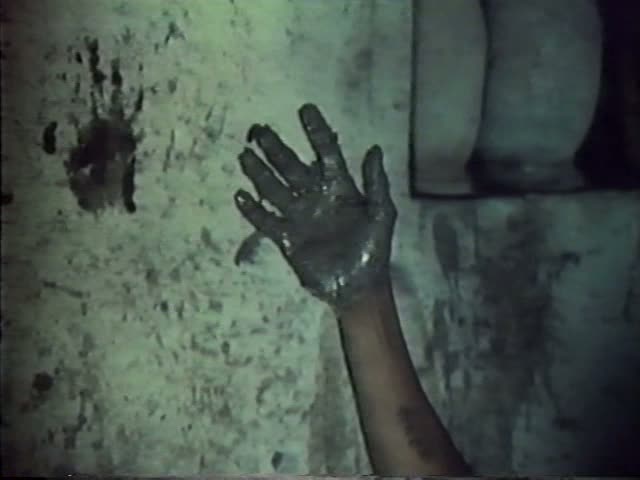
Mati ManasCommissioned by NFDC and the handicrafts division of Ministry of Textiles, Mani Kaul’s Mati Manas centers on potters and terra cotta artisans located in and around Rajasthan and unfolds as a fictionalized version of Kaul’s journey into the region as an outsider and a documentary filmmaker. We have documentary passages that elaborately detail the art and business of terra cotta making and the way of life that revolves around it interspersed with sections where we see the in-movie documentary crew shuttling between museums showcasing earthenware from the Indus Valley civilization, excavation sites and various potter villages while narrating to us the various myths, legends and folk tales of the region that reveal how mud/earth has become, for these artisans, an element inextricable from imagination and practice and has gone on to develop maternal associations with its capacity to nurture, shelter and produce. Suffused with Cezanne-like still life and images of potters at work, especially the weary, skillful hands that lovingly, spontaneously shape raw earth into little, wondrous artifacts, Mati Manas comes across as a tribute to the dignity and grace of human labour. Perhaps more importantly, Kaul’s return-to-zero film unveils a society where people’s relationship to art is still habitual and tactile, a pre-reflective, non-reductive, phenomenological way of experiencing art that stands in opposition to modern, appropriative, optical approaches – a split that is reflected in the chasm between how ancient pottery is exhibited in museums and sketched in textbooks as icons of heritage and triumph of archaeology and how it might have been perceived by people of its time.

Siddheshwari (1989)

SiddheshwariWith Siddheshwari (1989), Kaul turns the typical artist-profile film (produced by Films Division) on its head. Not only does it eschew straightforward documentation of the titular singer’s artistry, but it almost completely does away with basic biographical details to arrive at something more exhilarating and revelatory. Instead of presenting music, the film presents the idea and experience of music. A bona fide avant-garde feature that amalgamates multiple timelines, geographies, realities and narrative modes, Siddheshwari brings together various art forms like literature (the chapterized film opens with a table of contents!), music (shifts in ragas, reflected in the filmmaking with hue and rhythm changes) and theatre (both in its production design and its emphasis on role-playing throughout). The camera is perpetually moving – dollies and cranes galore – as if reading an ancient scroll and acts like a force of time that moves Siddheshwari Devi through landscapes and times. The soundtrack, similarly, is a dense network of speech, whispers, vocal and instrumental music ad recited poetry. Siddheswari Devi is portrayed by a number of women, including some who enact her biography, some who depict her sensorial experiences and Devi herself. (This is only one of the reasons I’m reminded of Hou’s The Puppetmaster (1994)). One of them is Mita Vasisht, whom we see at an archive, at the end, watching tapes of Devi singing, possibly to prepare herself for the role. Like The Taste of Cherry (1997), fiction and reality bid adieu, with Kaul restoring things back to their original places, as though returning what he borrowed to create his greatest work.

Nazar (The Gaze, 1989)

NazarAdapted from Fyodor Dostoevsky’s short story, Nazar (1989) bears natural resemblance to Robert Bresson’s shining adaptation of the same, A Gentle Creature (1969) in its characteristically stylized direction of actors and the sacrificing drama for rhythm, mood and an intensity of observation. Kaul replaces the generally bright interiors of Bresson’s version of the couple’s high-rise housing, which cordons them off from the rest of the world and which is emphasized continuously in the film, with a low-lit (barely any artificial light) semi-dungeon marked dominated by black-blue and brown shades, suggestive of the moral malaise that marks both the psyche of the male character and the space the pair lives in. The ever-wandering camera hovers over characters who appear to be stationed in space – with barely any movement – as if frozen in time. Kaul’s ultra-minimal chamber drama, too, starts off with the suicide of a woman (Kaul’s daughter Shambhavi, an avant-garde filmmaker herself), although it is only alluded to by her husband (noted director Shekhar Kapur), who tries to recollect to us what might have moved her to commit this act. Kapur’s stream-of-consciousness delivery of lines is exceptionally fragmented, as if he’s trying to wrestle information from deep recesses of ‘actual and ’‘convenient’ memories. This narrative within the narrative is the man’s way of vindicating himself; of blinding himself to the fact that ‘ownership’ is what that mattered to him all along and that he is, like the antiques that he sells, a man stuck in time.

Naukar Ki Kameez (The Servant’s Shirt, 1999)
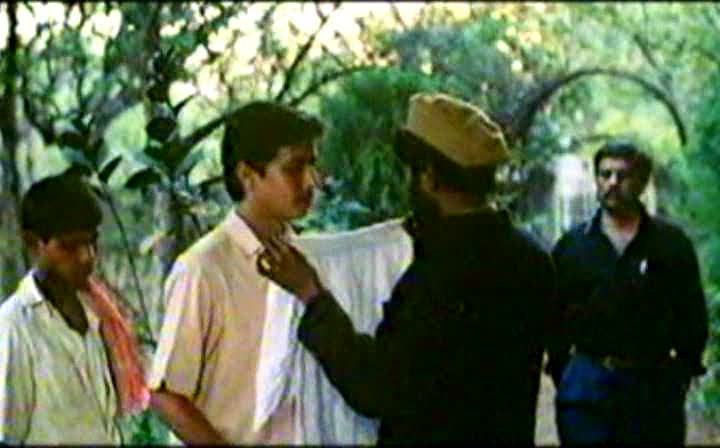
Naukar Ki KameezNaukar Ki Kameez (1999), as it appears, is a ‘conventional’ narrative film, by the director’s standards, with that generally-revered ‘naturalistic’ acting and speech, its relatively generous use of musical score and a general willingness to present a string of events, if not a plot. However, it is also one of Kaul’s most experimental features (Kaul couldn’t ideally be classified as an experimental filmmaker) and employs a fragmented narrative structure (which keeps spreading out to new directions) with constant chronological jumps back and forth, an absurd, magic realist tone (which reveals a tenderness towards his characters and his geography) and a potpourri of filmmaking modes (including canned laughter of sitcoms and internal monologues of low-end TV dramas). Set at the fag end of the 60s, Naukar Ki Kameez, which centers on a lower-middle class clerk, Santu, in a government office, and his wife, for most part, is a simple metaphorical tale of upward class mobility and its psychological and social impediments. Santu is a bundle of contradictions; he is conscious of class divisions and the need for revolution and yet harbours hope for social-climbing, he recognizes the need to respect the other, yet casually oppresses his wife, whom he genuinely loves as well. Like Aravindan’s Oridathu (1986), it gives us a nation with an identity crisis: one caught between extreme Westernization and dreams of a revolution – between tradition and modernity – posing a question to itself: To wear or to tear?

Een Aaps Regenjas (A Monkey’s Raincoat, 2005)

A Monkey's RaincoatMore fascinating than the fact that A Monkey’s Raincoat (2005) revitalizes the age-old question of purpose of art and its relationship to the real world is that low-end handheld DV, which the film is shot on, helps put nearly all of Kaul’s theoretical principles and inclinations into practice: the idea of not looking through the viewfinder while shooting, the rejection of the dichotomy between “sacred” and “profane” spaces, the notion of camera as an extension of one’s body and movement and a deep-seated interest in the experience of filming over filming itself. Adopting a loose, instinctive and continuous mode of shooting, Kaul inquisitively records an assortment of young painters at work at two places – Biennale, Venice and at their residency in Amsterdam, Netherlands – often interacting with them as he works. We see that Amsterdam is something of a dream destination for budding artists, a melting pot of cultures, where they can at least hope to find an audience. Though never taking potshots at art or its reception, Kaul’s film gently mocks an art scene where artists seem to be fond of ‘playing’ artists, with a set of personalized eccentricities and self-imposed clichés. As he samples their creations, he wonders in the voiceover if there is any purpose to art at all, given that it has been able to solve not one of the world’s problems. Kaul realizes that the question is moot and questions if art for humans is what a raincoat if for monkey: it might not stop the rain but at least it helps you to recognize it and shield yourself from it.
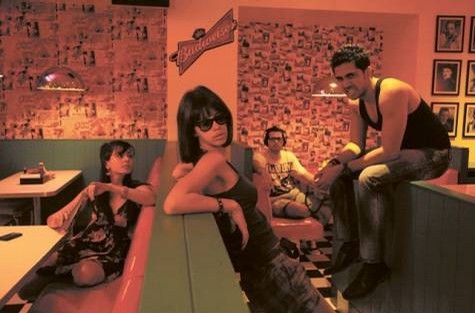
Shaitan (2011) (Devil)
Bejoy Nambiar
Hindi


ShaitanBejoy Nambiar’s Shaitan (2011) deliberately starts off on the wrong foot, presenting a hackneyed bunch of carefree upper class youth inducting one more into the gang, with a scene that seems more like endorsement than condemnation. (This is the sole scene when the five leads are their most comfortable, with a slack, indulgent, food-in-the-mouth kind of acting epitomized by Brad Pitt). It is only when we follow them all over Mumbai as they indulge in all sorts of puckish activities including casual robbery and midnight races that we realize that our identification is being severed and a critical distance developed. And it is only when the pack rams into a scooter that it realizes that a whole world exists underneath its (literally: under their car’s tyres). Speaking in collective terms here is justified, since not one role in the film is a character; all are types, with minute variants at best. The film itself makes no claims otherwise. (In a way, it is a final girl flick, full of caricatures, without any external threat). Ostensibly a film wanting to examine mob mentality – the gang, bevies of reporters, religious masses – and tyrannical impulses within us – the leader of the gang, the various law enforcers and their activities – Shaitan finds its bunny-ear-donning child-adult protagonists, who are initially blind to notions of class and religion, gradually being pushed out of their comfort zones into a minority and attempting to blend into larger groups for survival. (You have kidnappers thrashing kidnapers, police chasing police and rich kids with a money crunch!) The film is defined by its major ellipses which swing between smart telescoping of action (e.g. the suspension of the officer) and incompetent shorthand (the news channels, which have usurped the role of the narrator in Hindi cinema off late). But it is the bravura action sequence at the lodge, with its off-kilter, everything-is-allowed, anything-goes, Hollywood movie brat-like aesthetic that takes the rest of the film’s banal TV and ad inspired stylistic to a whole new level. Nambiar, it seems to me, is a natural when directing music videos and this sublime, provocative, magical scene, which cross cuts between slo-mo bullet rains and the gang dropping from rooftops in fluttering black purdahs like fallen angels onto a truck full of feathers, alone is worth sitting till and beyond it. Also includes an in-joke among Kashyapians involving Rajat Barmecha and a wordless subplot (if not the ultimate ignoring of the gang’s original crime) dealing with a miffed couple that might impress Nambiar’s south side mentor.
(Image Courtesy: First Post)

Unknown (2011) 
Jaume Collet-Serra
English


UnknownJaume Collet-Serra’s Unknown (2011) is the kind of movie that typifies straightforward PG-13 Hollywood thriller – star-driven, homogenized visuals with a strong primary color scheme (with a dominance of metallic blue, as usual), elaborate set pieces that could be moved around within the film, a pulsating score that vies with the boisterous sound design, with allegros of action separated by adagios of emotion, unapologetic about its generic nature with a plot detailed enough to claim seriousness and sketchy enough to avoid offending anyone and, of course, the solitary cuss word. Liam Neeson, who looks aptly like an ex-secret agent coming out of retirement, with his haggard appearance, wrinkled skin and receding hairline, is an American professor whose identity is stolen during his trip to a bio-conference in Berlin. With the rug of reality pulled off his feet, he must find a way to get back into the original social order with the help of a gorgeous working class sidekick (Diane Kruger), who knows all the seedy localities in the city, and an ex-Stasi officer (Bruno Ganz, also serving as the home star), who believes that Germans are very forgetful about history. Unknown channels wrong-man thrillers such as North by Northwest (1959), as well as Polanski’s Frantic (1988), but strips them of their psychosexual dimension, presenting a work that is solely concerned with mechanics of the genre and craft of the profession (the central car chase is sort of inspired, with its heady interleaving of vertical, horizontal and deep-space movements). The bunch of passages that pique your interest (the ostentatious scene at the museum, the confrontation between Langella and Ganz, both of whose best-known roles are infamous historical characters) are also the ones entirely superfluous.

Explorer (1968)
Pramod Pati
Silent
 
“…”

ExplorerPramod Pati’s pocket-sized dynamite, Explorer (1968), opens with a rather representative image: alternating horizontal black and white strips, resembling window blinds, flickering on what appears to be a screen (within the screen) that is being refreshed vertically – like television display – at a relatively slow rate,. The soundtrack, likewise, alternates between high-pitched, discontinuous noise of what might be telegraphing and printing machines and the comparatively bass sound generated by the Damaru. It is through this audiovisual thicket that the name of the film reaches us, appearing and disappearing along with the strips, oscillating between two typefaces – one fragmented and stretched and one sturdy and more conventional. This deeply dialectical title sequence pretty much sets up the tone, the modus operandi and the primary thematic and stylistic concerns of the seven-minute phantasmagoria that is to follow. Pramod Pati, who died an untimely death at the age of 42, worked for the Films Division [sic] of the Ministry of Information and Broadcasting in India, which generously commissioned feature-length and short documentaries as well as short animation films for the purposes of cultural archiving and nationwide information dissemination. The documentaries generally consisted of profiles of artistes practicing traditional forms (sometimes directed by names as big as Adoor Gopalakrishnan, Govindan Aravindan and Ritwik Ghatak), standard ethnographic explorations, educational films for adults (such as on family planning, which Pati was involved in) and other socially-oriented films while the animation was usually targeted towards toddlers and young adults, presenting simple moral tales and basic literacy courses. Although there was an obvious restriction on the type of subjects filmmakers can choose, the Films Division, like the Kanun in Iran, was free from commercial concerns and thus presented a higher scope for formal experimentation for directors. In Explorer, Pati seems to have harnessed that liberty to the fullest to produce a doggedly inscrutable, remarkably witty and manifestly personal work.

The eerie title sequence of Explorer gives way to the first “photographic” image: a miniature Hindu idol in profile, magnified by its distance from the camera. We assume that it on the plane closest to the lens, but Pati reconfigures our depth perception with a fluid racking of focus – rack focus forms a major motif in the film – that discovers an oil lamp nearer to the camera than the idol, before revealing a man – in profile as well – reading sacred verses. We don’t hear him though and the soundtrack, strangely, gives us the cry of an infant, as if trying to reach out. This somewhat serene shot is interrupted by a startling cut, followed by a short, rapid zoom accompanied by the noise of a cymbal. Before we even begin to register the scene, Pati switches to a barrage of images in which with the bobbing camera captures the faces of ecstatic teenagers in extreme close-up, interleaved with extra-brief shots of the religiously-charged alphabet “Om” represented in Devanagari script and of the chicly-dressed gang, from at a distance, dancing to what might be rock-and-roll tracks. The audio, however, uses loopy non-contiguous samples from traditional music including classical instruments and vocals overlaid over a continuous stream of Ghunghru sounds, punctuated now and then by clapper board-like noises. The association here is, of course, between tradition and modernity, between ecstatic rapturous tripping and religious fervour – and it is here that the film announces its context – urban India in the sixties – and its central idea.

ExplorerThe sequence is also one of the few occasions in the film when we are asked to make a purely intellectual connection between the shots, between the sound and the image. For a large part of the film, the montage is also rhythmic, and sometimes even metric, as is the case with the immediately following segment in which the preceding staccato arrangement makes way for a rather mathematical audiovisual pattern: A snappy pan shot from right to left followed by the face of a Buddha idol, a quick pan shot from left to right followed by a painting of Radha and Krishna. This model repeats a couple of times before being abruptly interrupted by a brisk tilt shot of an electronic machine with hundreds of small lights on it, which, in turn, is interrupted regularly by close-up shots of the faces of youth, before culminating in a slightly intimidating, negativized image of another god, (The latter intervention is thematically and stylistically vital to the film). The linearly assembled audio, in this section, curiously enough, neither spans across multiple images nor consists of overlapping tracks. Each sound accompanies an image. The whole setup described above repeats once more, faster than before, with additional interruptions by sound graphs and B&W film headers, after which select images from the whole film thus far interspersed with a hazy shots of palm lines and fingerprints play over a sound stream composed of what might be samples from sci-fi and thriller movies. What follows is a sprawling ten or so seconds bursting forth with polemical ideas. The visual backbone of this stretch – the (by-now-familiar) tracking shot of hundreds of analog indicators (of pressure gauges? speedometers?) – is disrupted by disparate single-frame images (a la Ken Jacobs’ Star Spangled To Death (1957-2004)) hurrying past from right to left in a way that also reveals the “filmic” nature of Pati’s work: faces of gods, the word “War” printed on paper in bold, black letters, the cover of a porno storybook, an open eye and a medieval painting on whose central figure’s chest is a white circle with the self-censored words “F.ck Censorship” in capital letters. The soundtrack here, though, is unbroken and is made up of repetitive noise of machine/automobile exhaust. Then, another horizontal-vertical assemblage like the previous segment, now with the image of a huge plant leaf inserted right in between. In retrospect, it is probably at this point that the film’s primary ideas clearly surface.

Explorer was made in 1968, a time right in between two wars with Pakistan, a time when the scientific race among the superpowers was at its most feverish, a time when the Vietnam War was shaking the world and a time when Western media was becoming increasingly permissive. Urban India, meanwhile, was vacillating between the forward thrust of scientific and technological development and the conservative tendencies of its dominant culture, religion and art forms. Explorer subliminally charts this polarization at the heart of this ancient-yet-young country, in ways that are just more than textual. This conflicting duality is embodied by the colour (strong blacks and strong whites), movement (the diametrically opposite directions that the camera takes), the sounds (ancient chants and electronica, ritual noises and machine humming) and the very material of the film (developed and undeveloped negatives). Till I saw Pati’s film, I’d thought Kamal Swaroop’s Om-Dar-Ba-Dar (1988) really had no precedent in Indian cinema. Exactly like Swaroop’s pièce de résistance, Pati attempts to portray a country caught between a number of opposing and diverging tendencies – between war and celebration, rock-and-roll and Bhajan, science and religion – in all its richness, convolutedness and madness. Alongside such analysis, Pati’s film seems to wonder about the future of the nation, especially that of its youth. Palm lines and fingerprints from the chief leitmotif of the film. As if, ironically, practicing palmistry through assortment of sounds and images, Pati strikes a conceptual parallel between the myriad divergent lines of the palm with the numerous incompatible and expansive practices emerging with the march of progress. Perched at the crossroads of 1968, Explorer is an idiosyncratic – but ever loving and never cynical – examination of where the nation is and where it is heading. It is a “palm-size” state of the union address.

ExplorerBy the same token, Pati’s film is an outrage against film censorship. The Film Censor Board, coming from a country where the most famous and explicit book on sexuality was produced, too, seemed (and it still does) to have been caught between similarly opposing currents, when the rest of the world was opening up to hitherto scandalous representations. Pati’s placing of such elusive placards disapproving censorship and the bunch of barely-identifiable images of porn magazines and nude women throughout the film is, patently, an attempt to break out of this entrapment. Likewise, three pairs of opposing camera movements characterize the visual field of Explorer, which are simply the three geometric axes: a up/down movement consisting of fast tilts and headers consisting of everyday symbols, an in/out movement made up of numerous rapid zoom-ins and zoom-outs and protracted rack focus shots and a dominant right/left movement involving zippy pan shots of the dancing crowd and machines at work and handheld shots at a university library. The camera frequently hops across these major axes, as though being swept by their force, oscillating to and fro within them. There are also a number of (possibly metaphorical) crisscrossing diagonals – the veins of the leaves, the leaves of the tree – that seem like vectorial resultant of actions on major axes. (One useful point of reference for Explorer is Artavazd Peleshian’s electrifying Beginning (1967) with its equally rhythmic back and forth movement of crowds and its eclectic sound mix consisting of popular dramatic sounds). The notion of present as a meeting point and a dialogue between the past and the future is further emphasized in the way the film often juxtaposes images we’ve already seen so far with those we are yet to see (and will see a little later).

After the psychedelic opening minute or two, the film applies brakes to present a series of “melodic” rack focus shots – some of the longest in the film – that appear to meld images of idols and paintings of god (which were intercut with the faces of exuberant young people) and those of laboratory machines. We hear a teacher and a student reciting “Ramayana, Parayana. Kuran, Puran” one after the other and we see youngsters handling microscopes (much like how Pati uses his medium). This passage is followed by another series of brusque imagery and soundscape: a shot of a bearded man meditating and those of a group chanting the Vedas, interwoven with a spate of western symbols and psychedelic wallpaper patterns, archival images of riots, women in the nude, the face of a monkey (Hanuman?) and the now-familiar attack on censorship. (A case could be made for Explorer as a sur-realist – even Buñuellian – portrait of the mind of a teenager in urban India in the sixties). The film’s construction becomes more mystifying following this, with both the images (not just religious and scientific, but archeological and cosmic as well) and the connection between them appearing even more abstract, although the aesthetic choices remain pretty much the same. There is a marked predominance of images of science, technology and education over those of religion and tradition, possibly hinting at a resolution of the conflict thus far. But not for long. As the film moves into its final “section”, where we see the same close up shots of the faces of youth, among negativized images of the dance sequence at the start, . the soundtrack becomes, once more, infused by classical vocals and Hindu incantations. In the final few seconds, the film is reduced to a sustained flicker, with a looming image of the letter “Om” becoming the visceral centre of the imagery. Beyond this point, the whole film seems to go backwards, calling forth a flood of recognizable images from the film in reverse order within a matter of seconds as the film’s title flashes in the middle of the screen. The film is actually undoing itself. Here in, Explorer, like Tscherkassky’s Instructions for a Light and Sound Machine (2005), becomes a Sisyphean tragedy; not of a man unable to escape the process of film, but of a film unable to escape the claws of a reactionary establishment. As indicated by the lateral tug-of-war involving the film-strip-like imagery throughout, Explorer is a film that fails at breaking free into full-on modernity, instead getting sucked back (and backwards) into the mouth of traditionalism. Forget it, Pramod. It’s India.

[The Explorer (1968)]

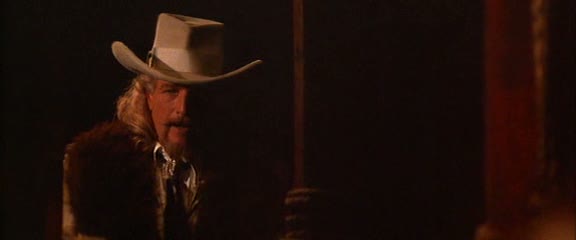
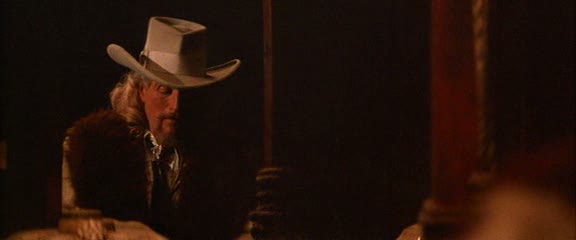
The film now moves into its final and the most glorious set piece. What, in a lesser film, could have been simply an exercise in liberal white guilt is elevated into the realm of the unreal and the mythical: Bill’s King Lear-like descent into madness. We see, through a door, Bill waking up suddenly and telling himself that he doesn’t dream. Evidently he was/is in some sort of a sour dream. He is not in his costume and doesn’t have his wig on. He is, literally, stripped down from his mass persona to what he essentially is. He comes to the main room to see Sitting Bull sitting in full costume. Bill tells himself that Bull isn’t there at all. We realize that we are, in a way, in Bill’s psychospace. It’s just Bill and Bull now. Bill goes towards his bar, mumbling: “I hate women” for some reason. (The Coloratura’s probably insulted him and left him as well). The interiors of the room seem emptier than ever, almost Wellesian, with the camera carving out deep spaces hitherto unseen. Bill pours himself a big one. Bull sits alongside a poster of Bill. Cut to Bill. Cut back to Bull. He’s standing right next to the poster. Bill stares at him and says: “You ain’t even the right image”. Like an exacting filmmaker, the right image is what Bill is after in the whole film.

Buffalo Bill and the Indians

Buffalo Bill and the Indians

Buffalo Bill and the Indians

Buffalo Bill and the Indians

Buffalo Bill and the Indians

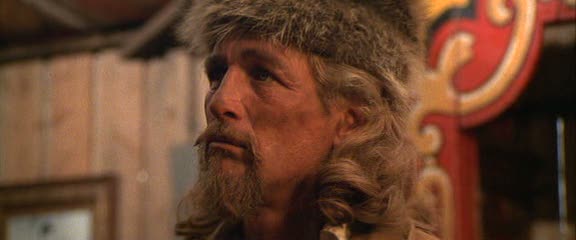
He asks the absent Halsey to leave the room and shouts: “Chief! Halsey’s got all the brains. Except he doesn’t mean a word he says, which is why he sounds so real”. A man in the hyperreal highway, Bill’s idea of real is that which sounds and looks more authentic than one which is more truthful. The Wild West show, itself, is a simulacrum, with its own internal logic and without any relation to reality, whose value is measured with parameters like “performance” and “believability” rather than veraciousness, (Halsey, like Bill, is a man with an imposing outside and a seemingly nonextant inner personality. In a way, Halsey is an actor directed by Sitting Bull). Now, Altman’s film, itself, is highly ‘authentic’ in its period setting, eye-popping production design that is marked by an excess of brown colour, décor, costumes and character behaviour. Like many Hollywood films, it seems to take pride in how well it has been able to reproduce an era in fine detail. By critiquing this fetish for surface authenticity, Altman mocks his own film’s claims to veracity. Bill then goes into the adjacent room to “show Sitting Bull something about real”. He comes back with a buffalo skin that he claims he skinned when he was nine. Sitting Bull isn’t there. Bill goes back into his dingy storeroom. “God meant for me to be white” he mutters. The room is nearly dark. Bill in only lit from a far-off source. Only his profile is visible with yet another photograph of his in the background. For the first time in the film, he appears as a complete void with only an outline to hold on to. Bill has been reduced to the absolute lack-of-self that he is. He spots Bull opposite him in bright light. He tells him: “And it ain’t easy. I got people with no lives living through me. Proud people. People to worry about. My daddy died without seeing me as a star. Tall, profitable, good looking”. Another equivalence between Bill and Bull. Bill speaks about ancestors and their continued existence and their dreams like a Native American would. Bill takes responsibility for Custer’s (and American) legacy to such an extent that he simply cannot see himself apart from these figures of the past. Altman described Bill well as a man trapped in someone else’s dream for him.

Buffalo Bill and the Indians

Buffalo Bill and the Indians

Buffalo Bill and the Indians

Buffalo Bill and the Indians

Buffalo Bill and the Indians

Bill returns to the well lit main room, back to his surface, personality and image, and yells at Bull: “In 100 years, I’ll still be Buffalo Bill, star! And you’ll be the Injun”. Bill will by over-determined and Bull will be generic indeed. But this typecasting of both is not anything to be proud about. He goes on, before taking another swing and sitting near Bull: “You want to stay the same. Well, that’s going backwards”, without realizing that it is entirely true of himself as well. Bull is indeed Bill’s repressed guilt and a token of America’s repressed history that keeps coming back. (No wonder Bill traces it all back to his childhood). But he’s a lot more as well. Bill and Bull are very much like Ethan and Scarface of The Searchers (1956). Both Bill and Ethan see in the other’s eyes a deep abyss that is themselves. For Bill, though, there’s also a deep mimetic desire, which showed its signs every time Bull went into the arena with a loud applause, which attracts him to the earthiness of Bull more than the physicality Halsey. He tells Bull: “I’m curious, chief. My friends are curious. My women are curious. My fans are curious. And they pay me for it. I give them what they expect. You can’t live up to what you expect. That makes you more make believe than me. You don’t even know if you’re bluffing”. He realizes that the more he watches Bull, the more he realizes that he’s like him. But Bill, internally conflicted more than ever in this segment, resists (in his second hilarious outburst of the film): “The difference between a white man and an Injun, in all situations is that an Injun is red. And an Injun is red for a real good reason. So we can tell us apart”. Bill gets up and moves near the notorious photograph of him on the horse – a superego of sorts – that had taunted him all along. “Ain’t he riding that horse right? If he ain’t, then how come all of you took him for a king?” he says, looking directly into the camera, as though questioning once and for all, the film’s inherent and explicit mythicizing of both Newman and Bill. The voice might just be that of Altman. “Carve our names. And celebrate the event” cries Bill and exits the scene.
A new day, a new show. Nate yells out the last words of the film, which sound not much different from the first lines, thus closing the circle of historical appropriation and ethnic misrepresentation:

“Ladies and gentlemen. For the first time in the history of show business, Nate Salsbury and William F. Cody present a conflict between two of the greatest warriors in western civilization staged with spectacular realism. Behold Chief Sitting Bull warrior of the western plains who has murdered more white men than any other redskin spoiled more white women than any other redskin. This bloodthirsty leader of the Hunkpapa Sioux has challenged Buffalo Bill to a duel to the death! Sitting Bull is played by William Halsey. Buffalo Bill, called “Pahaska” which means “long hair” in Sioux accepts the challenge for his beloved country.”

“Spectacular realism” indeed. Halsey, possibly to save the rest of his clan, takes up the role of Sitting Bull. Finally, the show has someone who looks the part. The huge screen on the left opens up once again, abruptly revealing Bill against a beautiful frontier landscape (very much like the opening of The Searchers). The screen motif is central to the film and its visceral use here invokes (and critiques) traditional westerns with their awesome geography and mythical heroes powerfully. Bill gets down on the field, engages in a condensed hand-to-hand combat act with the substitute Sitting Bull, defeats him and scalps him. He’s scalped more than just Sitting Bull’s hair. He’s scalped an alternate history and possibly the truth as well. Bill gathers the scalp and walks atop a synthetic rock besides the upright flagpole bearing the American flag. The crowd roars, the music soars, Bill gloats. Altman’s camera zooms – and this is one of the best zooms in his body of work – into his face from afar, keeps going until his only his eyes are seen in the frame, composed against plain, blue sky. Bill’s image has become just too big for the frame, it has outgrown it. What was planted firmly in context in a particular geography and time has become a trans-historical floating signifier. Quite simply, Buffalo Bill will be.

Buffalo Bill and the Indians

Buffalo Bill and the Indians

Buffalo Bill and the Indians

Buffalo Bill and the Indians

Buffalo Bill and the Indians

Buffalo Bill and the Indians

—

The most common complaint against Buffalo Bill and the Indians seems to be that the film exhausts its material soon, that it tells us little more than that Bill was a fraud and that it revels in beating a dead horse. Surely, reducing Altman’s film here to the story of a man who defrauded his audience is like saying Citizen Kane (1941) is the story of a selfish man and The Conformist (1970) is the story of an opportunistic man. It is true that the text of all these films is relatively thin, but these films open up indescribable emotional and intellectual avenues that would have been rather roundabout if attempted through the written text. Individually, these three films represent, for me, three great experiments with the filmic form as well as three films that make a strong case for cinema as opposed to text. Decidedly auteurist works, these three films also represent the respective filmmakers in top form, perhaps their best form. What Citizen Kane was to Welles and The Conformist was to Bertolucci, Buffalo Bill and the Indians is to Altman. It’s his masterpiece.


Section

I – II – III – IV – V

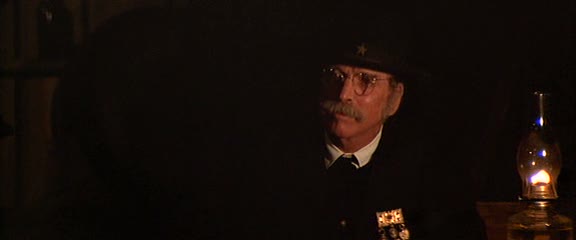
An L-cut to an elaborate set piece. It’s an after-show party for the president. The scene opens with the painting of Bill/Custer. Cleveland is greeting the performers. We see that the room is also decorated with paintings of Bill, as if closing in on those inside it, as if consuming them (it does consume Bill eventually, at least). The American flag, too, is ubiquitous, as it is everywhere in the film. Bill meets a fine-looking lady who, he learns, is a soprano. Her English is broken, with an Italian accent, The first lady introduces her as Nina Cavellini, who starts to sing. It’s the strangest moment in the film. Altman presents the entire song in the soundtrack, without his usual overlap of soundscapes, while he photographs the faces of those who are listening. It’s an assortment of reaction shots ranging from faces that are visibly moved, stunned, impressed, indifferent and plainly bored. This three-and-a-half minute song segment is truly out of character with the rest of the film, a blind spot that defies all theoretical evaluations. What we and the crew experience is an entirely alien cultural artifact, and this moment teases us as to how we should react to it: As high culture embodying the best of civilization? As a kind of imperial entity in foreign soil? Why should this be any more exotic than Native chants? The confusion is compounded when the bravura performance is followed by the first lady’s remark that she is always ‘trying to spread culture’. Bill asks Nina to stay for a few days so that he can show her the real Wild West. She replies, in good American accent (like how Nate speaks in Native tongue), that her secret life with General Benjamin is wild enough and turns his offer down. This is the last phase in the de-sexualizing of Buffalo Bill, so to speak.

Buffalo Bill and the Indians

Buffalo Bill and the Indians

Buffalo Bill and the Indians

Buffalo Bill and the Indians

Buffalo Bill and the Indians

Buffalo Bill and the Indians

Buffalo Bill and the Indians

Buffalo Bill and the Indians

As Nina walks away from an overly embarrassed Bill, she spots Halsey and Bull at the entrance of the party. Ed attempts to shoo them away when Cleveland asks him to let the good comedians in. Altman cuts the ensuing conversation like how he did during the first meeting between Bull and Bill, isolating each party in separate frames. Halsey tells Cleveland that if he can do one particular thing for the clan, they’d be grateful. Cleveland hedges, doesn’t even listen to the request and turns it down. His wife cowers behind his gigantic frame. Halsey and Bull leave the place. Everyone congratulates president for his brave confrontation, as if it was a game of chess. Bill proposes a toast, chalking another theory about Indian chiefs and American presidents (“The president always knows enough to retaliate before it’s his turn”), and offers his personal bed for resting. He tells Cleveland that he will sleep under the stars, listening to the lullaby of the coyotes. Cleveland is floored. Bill walks away as a hero. A shot of Bull’s clan chanting. They’re probably mourning. Bill walks towards the bar, meets Dart, the African American ranch hand winding his cleaning work. He tells him that Injuns need to learn from coloreds instead of making a fuss and that his father was killed trying to keep slavery out of Kansas (It turns out that he was trying to keep blacks out of Kansas, hence slavery!). He offers Bert a chance to drink with him, but the latter declines this radical offer, making up a reason to leave.

Buffalo Bill and the Indians

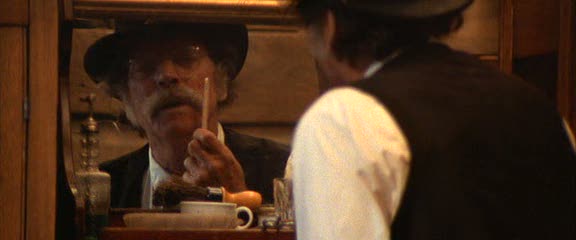
Bill enters the bar, already on a high. The bar is dimly, sporadically lit, with brown and deep brown being the only colours the eyes can register. The mood is pensive, and it might well go into the zone of the nostalgic. It’s also empty, except fr the bartender and Ned Buntline. They sit for a drink. Ned tells Bill that he thought the latter didn’t really exist and that it is really surprising to see him in flesh. As he continues to heap praise on Bill, the camera starts zooming in, in a rather familiar fashion, into Bill’s reflection on the barroom mirror from over his shoulders. And just as Ned tells him that “In 100 years they’ll be shouting your name”, the real Bill is no longer in the frame. His image has pushed him beyond the margins. Mutual appreciation ensues and the camera zooms back while Bill recalls his good old days with Ned. Speaking about Nate not being able to stand the sight of Ned anymore, he utters this meta-statement: “Nostalgia ain’t what it used to be”. It’s a very complex moment that resonates on multiple levels. Firstly, Bill might well be talking about the West itself. The year is 1885 and a time when it has apparently become incredibly tough for stars like Bill to restore people’s faith in American heroes, their narratives and representational systems. Secondly, Altman’s film is a period picture shot in 1976 and set in 1885. So the nostalgia about the West (and consequently, the lawlessness, the rule of the gun, the romance associated with the frontier etc.) that Bill is talking about is doubly filtered. Thirdly, by 1976, the Western had ceased to exist as a major genre and Bill’s nostalgia about nostalgia is refracted through the unsaid nostalgia for the genre itself. Altman’s film, however, sits right in-between this inherent nostalgia on a subconscious level and the conscious knowledge of the dangers of nostalgia. Ned remarks that Bill hasn’t changed a bit, to which Bill replies: “I ain’t supposed to. That’s why people pay to see me”. Bill’s tragedy is that he’s condemned to be Bill – an unchanging image, a personality without a person, a surface without a center – for his entire life. One more time, we realize that Bill is not simply a charlatan raving for fame, but a star who simply has to be America’s national hero. Not an anomaly in the system, but its very logic. Ned bids adieu, announcing that it was the thrill of his life ‘inventing Bill’. Another zoom into Bill’s mirror image, as it stares at the man solemnly. Ned leaves, as a silhouette on a horse riding off into the blackness of night, to California to ‘preach against the vultures of Prometheus’.

Buffalo Bill and the Indians

Buffalo Bill and the Indians

Buffalo Bill and the Indians

Buffalo Bill and the Indians

Buffalo Bill and the Indians

Buffalo Bill and the Indians

Buffalo Bill and the Indians

Fade to the next day. Bill is at the dressing table, already with alcohol in his hand. A typical Altman shot takes us to him: the camera zooming slowly into Bill from afar, while the microphone has already reached him. The long shot of the visual and the close up of the mike produces an unreal effect that seemingly befits Bill’s current mentality. We see that he’s not in his elements. He makes mistakes in citing his records and is generally weary. The day’s show begins without Sitting Bull. Just as we wonder where Sitting Bull is, the man from the telegraph office rushes to Nate with the announcement that Bull was shot. Oakley breaks down. Bill appears from behind the huge screen into the arena. Altman cuts between his act and the commotion behind stage after hearing about Bull, indicating his isolation from the event. A shot of Bill waving to the crowd is immediately followed by the most unironic and solemn shot in the entire film. A zoom into the remains of Sitting Bull: a rosary with a Cross lying over the ashes of a campfire. (Sitting Bull being a Christian is never commented upon, although the Cross hanging from is neck is always conspicuous). The sound in the shot is made up of only the screams of vulture and other critters. It is here that, perhaps the only time, when the film presents a non-self-conscious moment, where it doesn’t undercut its own statement. The injustice done to Sitting Bull and his clan is most directly and affectingly registered.

Buffalo Bill and the Indians

Buffalo Bill and the Indians

Buffalo Bill and the Indians


Section

I – II – III – IV – V

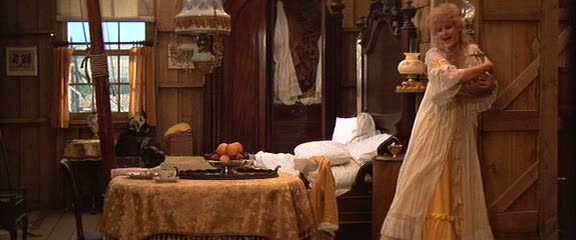
There’s an interlude here with Lucille, the Coloratura, where Bill apologizes for possible being a disappointment the previous night. There’s a clear parallel between Bill’s professional trajectory, in which he is increasingly convinced that he’s not ‘authentic’, his ‘performance’ is not good and not living up to expectations of his fore-fathers, and his sexual conquests, where he proceeds from the alpha male in total control, to a confident man holding ground to one being simply turned down, as chalked by the three opera singers of the film. This interlude more or less marks the start of Bill’s partial de-mythification (like McCabe in Altman’s previous Western) and we see his body language and tone softening down. Before he gets to conquer the Coloratura, he notices, by chance, that the Indians have begun dismantling their teepees and that Bull and Halsey are leaving the place. Enraged, he calls for a posse, to put up an improvised show: The Story of How Buffalo Bill Rode Into A Territory He Knew Better Than The Back Of His Hand And Reclaimed The Escaped Indians. As he comes back to his cabin to dress up, he updates Lucille about the situation and searches for his jacket. When he doesn’t find it, he shouts making a parody of whatever he is: “Dammit, where’s my real jacket?”. While the posse gets ready, Altman alternately cuts between the sunlit outdoors and the earthy indoors of Bill’s cabin, very much like a silent movie, implicating cinema (which endorsed the Western myths almost from its inception as a narrative form) in the Wild West’s codification processes. The coloratura herself is little more than a relic from the past.

Buffalo Bill and the Indians

The posse leaves with grand musical accompaniment, Bill leading on a white horse and the rest following on brown ones. Buntline opines once again: “When Bill’s dressed for a ride and mounted on his stallion any doubts about his legend are soon forgot. Yes, Bill’s fine physical portrait hides any faults his mind possesses. But any tracker will tell you if you don’t know what you’re after you’d best stay home”. The Legend Maker seems to have progressively become a de-mythifier (or rather re-mythifier). And soon enough, Bill and gang return. Both the audience and the rest of the company at the campus see the posse in a long shot, with no sight of Bull or Halsey. The in-house band gets ready for a thunderous welcome. But as the group draws nearer, they realize that they haven’t got a good image to multiply the sound with, like a director who can no longer redeem a terrible scene with his score. Bill hasn’t come back with the Indians. The great story that he imagined would be written today was spoilt by reality, just like how the brave cowboy who dashed to spot Bull moments before, returns drenched and off his horse. Reality punctures a potential legend.

Buffalo Bill and the Indians

Buffalo Bill and the Indians

Buffalo Bill and the Indians

Buffalo Bill and the Indians

The dejected posse returns in total silence. Bill enters the encampment and looks at the triumphant painting of himself (Custer?) on a horse. Altman zooms in on the painting, and then on Bill. Like a kid who’s failed his father, he stands nearly whimpering. Altman zooms in on the painting again, cutting Bill off the frame. Burke and Nate try to convince him that it is not his fault, and that Fort Ruth was never meant to be a prison in the first place. Burke suggests publishing in the papers that Bull escaped after trying to set fire to the arena. An apathetic Bill goes into his room, shuts the door. And we hear a gun shot, then two or there more. Nate and the rest are shocked and think Bill shot himself, as if suicide was the only act that would befit the situation and the legend that is Bill. We believe that too, thanks to how we’ve been trained by genres tropes. Again reality thwarts an apt ending and we all discover that Bill was merely trying to shoot the canary that Lucille has. Bill’s sharp shooting capabilities seem to have bid farewell, like his sexual prowess (reminding us of his pistol conversation with Lucille the first time they met), as he misses the bird each time. A frustrated Bill returns to the meeting room and finds Bull and Halsey at the doorstep. Surprised, he calls them in asks the reason for their departure. Halsey tells them that Bull was up in the mountains visiting the moon in its path and that the squaws were relocating the tents to a different part of the bank. Halsey tells Bill that Bull will do what he would like his people to see at the show: make the big grey horse dance.

Buffalo Bill and the Indians

Buffalo Bill and the Indians

Buffalo Bill and the Indians

Buffalo Bill and the Indians

Buntline again: “Responsibility is a funny thing. It’s different for stars than for ordinary folks. That’s why stars spend so much time in front of mirrors. To see if their good looks can overcome their judgment”. The dentist, at whose place, he is in, urges him to spare the literalism for now. The patient – the audience stand in – winces in pain. Buntline stares at the mirror. Cut to Bill staring at the mirror, talking to his image. He is convincing himself that Bull lied to him and that he must have been hiding in the mountains. He says, furthering the equivalence between Bull and him: “Now I can understand why he lied to me. He’s got to look good in front of his people, same as I”. He ‘chooses to overlook the entire incident’ ‘generous and flexible’ that he is. The camera zooms out from the image before including the real bill in the frame, as if questioning who the real man is and who the image is. The whole crew assembles for a group photo in front of the office. Bill protests Bull’s standing near Annie Oakley. Halsey refuses to budge and asks $25 for relocation. Bill rejects the offer – another reminder that the enterprise is driver more by capital than ideology – and plans to manipulate the photograph later – like many modern day filmmakers – and move Bull to the Indian side of the photo.

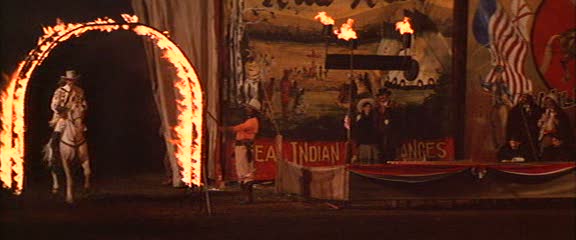
One black worker – Burke calls him ‘darkey’ – at the telegraph office rushes in to announce that there’s a wire from the president. The assembly breaks and leaves (Bill, with self-made band music) for the telegraph office to learn that President Cleveland will be visiting Fort Ruth and staying for a night. Sitting Bull’s dream becomes real. Everyone’s surprised as well as excited about this. Buntline delivers another theory about Indian and white dreams and points out that things are starting to take an ’unreal’ shape. Cut to the night when Cleveland (Pat McCormick) comes to the camp. He is, as usual, introduced to us in a long zoom shot: a rather portly figure, a caricature of a man straight from Keystone two-reelers, sitting on a stage-like dais alongside his excessively lean wife (Altman regular Shelley Duvall). One crew member remarks, conflating politics and entertainment: “That bear is a star. He’s bigger than Buck Taylor”. Politics as entertainment and politics of entertainment are two ideas Altman’s film continuously chips at. McCormick’s performance here as Cleveland is akin to Timothy Spall’s much reviled portrayal of Winston Churchill in The King’s Speech (2010). It is meant to be hammy, to be obviously a ‘performance’. Like the Oscar winner, Altman’s picture is partly a chronicle of shows, of politics as performance and of stage presence as power. When Nate introduces with “Meet America’s national entertainer”, the camera lingers on Cleveland. Cut to Bill appearing fro behind the screens through a wooden arch on fire.

Buffalo Bill and the Indians

Buffalo Bill and the Indians

Buffalo Bill and the Indians

Buffalo Bill and the Indians

Buffalo Bill and the Indians

Buffalo Bill and the Indians

Bill, after a small stunt on his horse, welcomes the president and the first lady. Altman nearly center-frames with the torches burning in the background out of focus. Clearly, his film is consciously partaking in this legend-building activity. He calls the Wild West show as “the father of the new show business”, not the mother, suggesting the patriarchal codes that govern this organization. Throughout the film, women are seen either entertaining Bill or doing petty work around the campus, except, of course, Annie Oakley, who is the one woman who poses any resistance to Bill at all. Cleveland is told that Bill “writes all his original sayings himself”. Cleveland, who discusses with his adviser for every statement and gesture, like an actor consulting with his director, replies that all great men do that. The first act is by Annie and Frank. The president and his wife are visibly impressed until Annie fires a wrong one that goes through Frank’s shoulder. Like any great performer, Frank tries not to reveal this accident and wraps up the show. “The Show Must Go On” – That justification which sweeps every misfortune under the rug in the name of professionalism. For Frank, like many in the crew, a successful show is more important than anything else. Cleveland is agitated and confirms with Burke if this was all “a part of the act”. After a filler act depicting the induction of an Indian into the American family, Sitting Bull enters the arena, speaks in Native American tongue, takes out a gun, points towards Cleveland before firing towards the sky. Cleveland is gobsmacked. And so is everyone, before they realize that it was done to make the grey horse dance. Recovering, Cleveland jokes that it is no wonder that it was done by an Indian because it is an un-American thing to do. Again and again, the show pans out like Brechtian theatre, provoking the audience, before it is repackaged into the norms of standard theater.


Section

I – II – III – IV – V

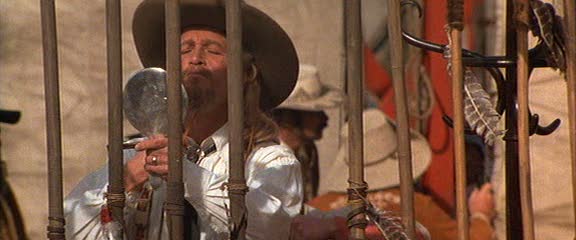
A group of Indians enter the Mayflower campus as the narrator informs us that “The great chief of the Sioux tribe Sitting Bull, is here with us. And he’ll be in the same arena with the noblest white skin of all”. Altman and DP Paul Lohmann shoot the group with a telephoto lens, much like Bill who watches it using a spyglass. We see Bill through a zoom-in as well, as he tries to catch sight of his opponent. One Indian of an imposing stature wearing a red shawl stands out from the rest in the group. Everyone in Bill’s crew is convinced that that man is Sitting Bull. Their Sitting Bull is a based on an idea of how a formidable Indian should ideally look like – a Sitting Bull that would really set the box office on fire – than on facts. Even before the group enters the campus, we hear legends and myths about Sitting Bull. Even the audience is led to believe, thanks to Altman’s casting and framing, that the man in red is the real chief. A gaudy theatrical entry, backed by stereo-typical race-based music, brings Bill to the welcome ceremony where he learns too late that the small man behind the one in red is the real Sitting Bull. Altman himself frames Newman heroically sitting on the horse and supervising the crowd on ground. When Bill tells the chief: “Me and my staff are the best at what we do. And what we do is make the best look better”, we realize that Bill is the prototype of the capitalist industrialist, America’s first CEO, trying to hit peak efficiency and performance.

Buffalo Bill and the Indians

Buffalo Bill and the Indians

Buffalo Bill and the Indians

Buffalo Bill and the Indians

Buffalo Bill and the Indians

Upon learning the identities of both the Indian in red and Sitting Bull, he assures them before he takes leave that the latter won’t be mistaken for a ‘below average run-of-the-mill Indian Chief’: “I just wanted to welcome you here to Buffalo Bill’s Wild West. You’ll find it ain’t all that different from real life. Gentlemen, Injuns…”. Different from real life it ain’t, but not in the sense Bill means. If Bill is the CEO of the organization, Nate is the CFO. In their encampment, after the meeting, the crew discusses the future. Nate says: “We all know sociable chaff is cheap but history, real history is hard come”, as if it’s a commodity to be acquired as soon as possible. As Nate segues back to singing hosannas to Bill, Altman cuts back and forth to the Indians planning to pitch their teepees across the river. Even before the company learns of this and finishes ridiculing the idea, it notices that the Indians have already completed their mission. Bill tries to act normal and tells the crowd that it is better that Sitting Bull stays across the river so that he can watch him all the time. This is the second time when the film draws comparisons explicitly between Bill and Bull. Bill’s a man, as would be clear in the ‘soprano’ stage of the film, obsessed with his own image. Here he is, for the first time, wanting to watch Sitting Bull ‘all the time’ from his chair. He then goes on to theorize that an Injun always turns down your first offer.

Buffalo Bill and the Indians

Buffalo Bill and the Indians

Buffalo Bill and the Indians

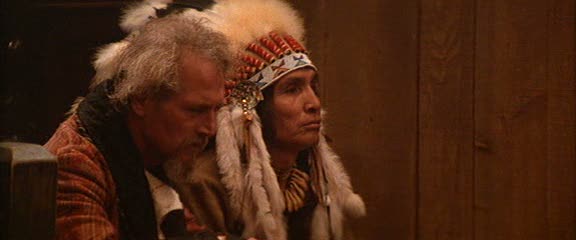
Soon enough, Sitting Bull and his right hand Halsey (the Injun in red , Will Sampson) visit Bill and co. to talk about the chief’s stint at the Wild West show. When Halsey, Sitting Bull’s mouthpiece, speaks in Native terms about the latter, Bill tries give back imitate “the same kind of murky logic” that Halsey used. Burke intervenes to tell that Sitting Bull was there to ‘relive his history for thousands of paying customers’. Altman isolates the two parties completely, never allowing them to be seen together, like a turn-based strategy game, cutting across the table every time someone speaks. Halsey demands blankets for the whole clan (agreed to, thanks to the “benevolence of Buffalo Bill”), six weeks of advance (also eventually agreed to since Bull will be here until the unlikely even of him meeting the president of the country) and rights over photographs of Sitting Bull (at which Bill loses it, the corporate head that he is). Meanwhile, Bull is attracted by a music box, although he does not know its function. Music plays a key role in the film, both as performance accompaniment and as indicator of culture.

Buffalo Bill and the Indians

Buffalo Bill and the Indians

Buffalo Bill and the Indians

An abrupt cut from the meeting brings us to the arena where Bill is practicing sharp shooting takes us right into his personal life: a letter from his wife accusing him of affairs with milk maids and opera singers and of being a chronic drinker and calling for a divorce. Another collage of performances at the playground – shooting, whipping, horse racing – before Burke introduces Bill to the second singer – a coloratura – in the film. After a quick chitchat ripe for Freudian mining, Bill is told by Nate that President Cleveland will not be coming to the Wild West and that Bull will be stuck there for life. Nate asks Halsey to come with him to demonstrate the kind of show he will be involved in and also says that their production team is the only one to show the reds and the whites without taking sides – another reminder that his Wild West show is more a business enterprise predicated on sale value than ideological enterprise based on political value. In the demo, a black American stands in for Sitting Bull because, Bill tells us, “he’s the closest we got on our staff to a real Injun”. Bull is not impressed. Halsey tells Bill and co. that the war didn’t happen the way it is being depicted in the demo and that Bull wasn’t in the field at all. Altman composes both Bull and Bull in the same frame and at either end, as if trying to balance each version of the war.

Buffalo Bill and the Indians

Buffalo Bill and the Indians

Buffalo Bill and the Indians

Cut to Bill’s private room, with Margaret the Contralto singing. We learn that Bill’s long hair is fake and that he hopes they become real one day. The opera makes way for faint Native chants during the evening, as Bill ponders. He tells Margaret that she has to leave because he has to concentrate on Bull. Of course, he’s also thinking of Lucille the Coloratura. This seemingly minor shift is followed by a key scene in which Halsey and Bull revisit the Wild West team for another unplanned meeting during the midnight. The apartment is filmed as if it is dingy. Indian artifacts adorn the walls like prizes. No one is awake and Bull reaches for the music box. Halsey wakes Bill up and he is frustrated that he has been caught without his false hair. In a pretty charged conversation, Halsey asks Bill to rewrite the script and to present a version in which the hero McLaren was a mass murderer who slew women, children and dogs without provocation. Nate pacifies Bill before he erupts and tells him that they could still pull it off with proper arrangement and music. It’s a dynamic scene with a war field like atmosphere where the battle is for representation of history. It is here that the portrayal of the Wild West show as an (subconsciously) ideological apparatus rich with possibilities of alternate apparatuses and meta-narratives becomes most literal and most pointed. Bill stays silent, takes a swig off his glass, sits alongside Bull and urges in vain for a heart-to-heart conversation. He takes offense to Halsey’s claims the “he murdered women, old men, and children”. It’s a remarkable moment of character exposition. Halsey was talking just about Custer but Bill can’t help but hear that it was all about him. It is as though he believes that he stands in for Custer and that takes responsibility of the entirety of white history at the frontier. Right after that, Bill throws the first of the two side-splitting tantrums in the film: “You have till noon to get outta here!” and walks off the meeting with a murmur; “It’s harder being a star than an Indian”. It’s harder not being any star, but this particular star of this particular show, who has taken upon him subconsciously the burden of being answerable to both his predecessors and successors.

Buffalo Bill and the Indians

Buffalo Bill and the Indians

Buffalo Bill and the Indians

The next day Bill is told that Annie Oakley, the moral centre of the film and the only person who finds any sanity in Halsey’s claims, is planning to leave with the Indians. He decides to call her back. She asks Bill why he can’t listen to Bull for once to which he replies: “I got a better sense of history that that”. Writer Alan Rudolph said elsewhere (but which many writers attribute to this film – I didn’t find it here) that history is what gets the most applause. And Bill’s sense of history is, at least on an unconscious level, just that. At this point, we assume that Bill’s just lying through his teeth for sustaining his myth and don’t suspect for a moment that he might be believing in what he is saying. Annie’s obstinacy forces Bill to retain Bull. (Altman makes space for a sight gag to comment on Bill’s situation). The first show goes underway and plays to packed houses. Bill makes his entry just before Altman cuts to Buntline in the bar trying to sketch another theory for Bill: “No ordinary man would ever take credit for acts of bravery and heroism he couldn’t have done. And no ordinary man would realize what huge profits could be made by telling a pack of lies like it was the truth. No, Bill Cody can only trust his senses. And when his senses fail him he might see things as they really are”. As the Legend Maker gives us first signs that it isn’t as simple as a willful obfuscation of truth that Buffalo Bill is executing, Bill rides into the arena to an uproar followed by the anthem “Oh Say, Can You See?”. Like most genre heroes from Hollywood, Bill is truly professional, unapologetic about what he is doing and really loving that he’s excelling in it.

Buffalo Bill and the Indians

Buffalo Bill and the Indians

Buffalo Bill and the Indians

After Annie Oakley’s act, in which she misses twice – but covered up – and a couple others, Sitting Bull’s big show comes up. Bill tells Halsey that Bull will discover now what show business is all about and that he’ll come back to him begging for more. “Sitting Bull’s going to suffer a worse defeat than Custer ever did. Custer got to die. Bull’s just going to get humiliated”. Nate announces Sitting Bull as the most murderous redskin alive. With clichéd Injun music blaring, the small-framed Bull enters the arena modestly and amidst catcalls. He really wasn’t what people were expecting. They didn’t want the real Sitting Bull but the ideal Sitting Bull. But as a pair of Indians sings Native American chants, along with which Altman presents a low angle zoom into Sitting Bull composed against a banner of his, befitting a mythical hero, the crowd comes back to life. It’s a strange moment where the audience seems to have found the authenticity they want in this show. With this sort of music, it appears that this Sitting Bull makes a good Sitting Bull. Altman here seems to be throwing light on cinema’s own myth-constructing process where the best – and not necessarily just – image and the sound conspire to create a lasting falsity that people can trust. Bill, watching from behind screen, is stunned; his mouth agape as Bull returns and the screen falls over him. Envy might just not be everything.

Buffalo Bill and the Indians

Buffalo Bill and the Indians

Buffalo Bill and the Indians

Buffalo Bill and the Indians

Buffalo Bill and the Indians


Section

I – II – III – IV – V

Buffalo Bill and the Indians


“Art is not the reflection of a reality; it is the reality of that reflection.”

– La Chinoise (1967, Jean Luc-Godard)

“In a violent and contemporary period of history, it is myth that invades cinema as imaginary content. It is the golden age of despotic and legendary resurrections. Myth, chased from the real by the violence of history, finds refuge in cinema.”

– Jean Baudrillard

“When the legend becomes fact, print the legend.”

– The Man Who Shot Liberty Valance (1962, John Ford)


Robert Altman’s Buffalo Bill and The Indians, or Sitting Bull’s History Lesson was made and premiered in 1976, when the country was celebrating its 200th anniversary of independence. Altman had already taken a stab at this bicentennial in his previous film Nashville (1975), where we are presented with a fragmented sketch of America as a nation at crossroads. Buffalo Bill is also Altman’s second western feature after the tremendous McCabe & Mrs. Miller (1971), which was nothing less than a re-imagining of the Western myth as founding of industrial capitalism. It is interesting to think why writers Altman and Alan Rudolph embarked on this project of adapting Arthur Kopit’s play and resurrecting the figure of Buffalo Bill at all. If McCabe tried to clinically de-mythicize the archetypal Western hero, it didn’t do as much to question its own myth-creating properties. In Buffalo Bill, Altman’s everything-but-the-kitchen-sink method finds precise articulation in the text and the text, too, lends best to a stylistic that is as diverse and off-kilter as Altman’s. All his directorial techniques serve both aesthetic and thematic purposes in this film, especially the overlapping, conflicting soundscapes and imagery (used effectively in a film that is explicitly about conflict of narratives and ideological contestation) and the notorious zoom (altering, illustrating and mocking the protagonist’s persona). Utilizing sound and image in complex, inventive ways, Altman not only critiques popularly represented Western myths but also their modes of representation, especially when it comes to the film’s own. Throughout, the ceaselessly self-conscious film undercuts its own criticisms by questioning their assumptions and authority to such a successful extent that we begin to take everything that it claims with a pinch of salt. A searing portrait of the West (and the Western) as a deadly mixture of patriarchy, nationalism, entertainment and unbridled xenophobia, Buffalo Bill finds Altman at his caustic best.

—

In fact, self-critique begins right from the first frame as fanfare blares over a monochromatic United Artists logo, registering its own status as an entertainment product. The first image we see, likewise, is near-mythical and patently ‘Western’: a surreal landscape, out of focus, which the American flag being hoisted cuts through. The opening credits appear in a gaudy typeface and a faux title for the film reads: “Robert Altman’s Absolutely Unique and Heroic Enterprise of Inimitable Lustre!”. The message is clear: Buffalo Bill is no finer than the typical roadside fair or, as we would see, Bill’s own Wild West show in every aspect. As the bugle plays on tirelessly, as it would do throughout the film, the camera pans gradually to the ground as if establishing the scene and the history of the West. The first spoken words in the film are heard as the narrator announces:

“Ladies and gentlemen, your attention please. What you are about to experience is not a show for entertainment. It is a review of the events that made the American frontier. In less than 15 years, this nation will celebrate the 20th century. We do not know what awaits us in the future but we do know the past that laid the foundation. And that foundation was not built from heroes but from the anonymous settler. Their home was but a shack roofed in with sod. One door shut out the wind and storm one window greeted the dawning day. These brave souls survived not only nature but the savage instincts of man, paving the way for the heroes that endured. So welcome to the real events enacted by men and women of the American frontier. To whose courage strength, and above all, faith this piece of history is dedicated.”

If we are to disregard the ironic stance that the film would take at the set of statements here, the opening scene so far plays out as the classic Western metanarrative, with the lone ranger conquering the savage frontier and building civilization from scratch. The attitude of the film, however, is akin to the opening ethnographic documentary of Ken Jacobs’ Star Spangled to Death (1957-2004), where we are shown and told the story of a glorious white couple teaching science, hygiene and table manners to kids and women of an African tribe. Given the year of both Altman’s and Jacobs’ films and the extent to which the portrayal appears caricatured, it is impossible to take the narrator’s words with a straight face. As a result, the film’s diegesis is split open, much like The Player (1992) -the one film that is closest to Buffalo Bill in terms of how it functions – where the possibility of cordoning off the narrative universe is thwarted right from the first shot.

Buffalo Bill and the Indians

Buffalo Bill and the Indians

Buffalo Bill and the Indians

As the “savage” natives raid on white women and children, moving around them on horses in circles, like a strip of film around a bobbin – serving a thematic function, which reaches apotheosis in the final scene, as well – we witness the film’s actual title being displayed: Buffalo Bill and The Indians, or Sitting Bull’s History Lesson, the subtitle in the title serving a special purpose. And as the cowboys turn the tables on the raiding Indians in a story justifiably without context or the specifics, the acting credits play on. Instead of an actor’s name being mentioned against the name of the character he/she plays, we see it alongside the “type” of the character – The Star, The Producer, The Publicist, The Indian, The Indian Agent, The Legend-Maker etc – calling to attention the film’s own myth-building. And suddenly, another voice different from the narrator (Altman? the show’s director?) shouts: “cease action!” and it is revealed that what we had so far seen was rehearsal for a Wild West show. Dead men rise to their feet and makeshift houses are moved by horses. Some corrections are suggested to performers to look more authentic. One native is hurt and men say it “looks real”. However, we are still not sure where performance ends and where reality begins. We are still dangling without a reference.

Cut to the Legend-Maker and Buffalo Bill’s ex-producer Ned Buntline – played by a legend himself, Burt Lancaster – who recites the tale of how he made Buffalo Bill out of a scrawny looking kid on the street. Flanked by a bunch of supporting actors and bracketed by two pillars of the bar and his voice mixed with a feeble version of the now-familiar fanfare, Ned is introduced already, with a gradual zoom-in, as a fiction maker and a piece of fiction himself. Almost immediately after this we are shown another minor Legend Maker – the old guard who works at The Mayflower fair where Buffalo Bill’s performs – who chalks his own story about Bill to a bunch of Indian kids. There might be a little gesture of humour here in how everyone claims importance with respect to Bill, but it also off-handedly establishes the film’s major theme: history as a contested territory. It is here that we see Altman’s typically chaotic collage editing of for the first time as we move from the Legend Maker, to the guard, to one-handed sharpshooter Annie Oakley (the beautiful Geraldine Chaplin, who carries a baggage of vaudeville, showmanship and entertainment along with her name), to her husband and moving target Frank Butler (John Considine) to The Producer Nate Salisbury (Joel Grey) and to The Publicist Maj. John Burke (Kevin McCarthy).

But not Bill. We haven’t met Bill yet, although we have an idea of his stature from second hand sources. When Frank goes to meet him in a hurry, we hear Bill for the first time, almost throwing a fit. Even now, he’s hidden behind a huge promotion banner containing his image. As we would see, Bill is always hidden behind his ‘image’. By prolonging both Buffalo Bill’s and Paul Newman’s introduction, Altman’s film reinforces the mythic nature of both these celebrities. As Frank fills two glasses of beer to take to Bill (multiple actions unfolding simultaneously is nothing new to Altman’s cinema), Nate speaks about his performance as a black American in shows with another troupe he was associated with, before going on to typecast a few other nationalities: “There were times when I was asked to play a colored. Now do I look like a colored? But when I had to play a colored, I was a colored. I thought like a colored. I drank like a colored. I walked like a colored. I was a colored”. Nate is not (intentionally) sending up method acting, but his decidedly irrational belief that he could play a black American with total authenticity puts him on par with some of our celebrated ‘actors’. Much of the outlook of Bill’s crew, himself included, towards Native Americans is derived from this sort of epistemological confusion, a notion that they can truly understand, decode, model and replicate the Indian psyche.

Buffalo Bill and the Indians

Buffalo Bill and the Indians

As Frank enters Bill’s room, we watch Burke vacating the room, assuring Bill about casting: “Everything historical is yours, Bill”. Soon, the word about his new story idea for the next season – “enemies in ’76, friends in ‘86” – spreads and Buntline figures that the foil for Bill would be no other than Indian Chief Sitting Bull (Frank Kaquitts), who would not be shot by the army until a certain Sioux treaty is signed, and would be humiliated and de-mythicized at the show. (“A rock ain’t a rock once it’s gravel”). When Bill’s nephew Ed Goodman (A stiff Harvey Keitel) doubts if Sitting Bull was interested in show business, one of the writers for the show replies, “If he wasn’t he wouldn’t have become a chief.”, betraying the group’s general inability to interpret the world outside of the parameters of entertainment business. This is followed by another legend from the old guard about Sitting Bill. We now have a bit of history about the Chief and some myths surrounding him before we get to see him at all, just like Bill. And this is the first of a number of instances where the film strikes an explicit parallel between the two “heads of clans”.

Buffalo Bill and the Indians

Buffalo Bill and the Indians

Buffalo Bill and the Indians

Buffalo Bill and the Indians

Buffalo Bill and the Indians

Following a surprise insert of a stunted zoom shot of Sitting Bull’s clan, Buntline talks about Bill’s dubious resolution to cut down on his drinks, after which the film cuts to a shot of the first of three opera singers who accompany Bill, as she passes by a triumphant painting of General Armstrong Custer, who Bill model’s himself after to an insane extent (that the painting could well be of Bill himself), on his white horse. (Arranged according to the scale of their singing, these three singers – The Mezzo-Contralto, Lyric-Coloratura and Lyric-Soprano played respectively by Bonnie Leaders, Noelle Rogers and Evelyn Lear – also form the thematic checkpoints in Bill’s self-delusive odyssey). It is only after this that we have the first glimpse of Buffalo Bill and Paul Newman – announced as America’s national entertainer by Nate – as he rides into a rehearsal show amidst heavy applause and fanfare, like a star. Another sequence with non-associative cross-cutting between Bill learning of Buntline’s return to the campus and of the hurt Indian’s passing and Nate welcoming the rest of the Indians around him to “America’s national family”. Nate gets instructions to have Buntline vacate the campus. He goes to confront Buntline. Nate is the one character in the film who acts most obviously as the writers’ mouthpiece, tossing off one provocative line after another. His lines would most probably be the ones to structure discourses surrounding the film. When trying to persuade Buntline to move out, he gives us this one out of the blue: “We’re gonna cody-fy the world” suggesting how he plans to make Bill a universal figure invading all imagination and the Manichean view of the frontier that that entails such a project.


Section

I – II – III – IV – V

Ne Change Rien (2009) (Change Nothing)
Pedro Costa
French/English


Change NothingPedro Costa’s latest film Change Nothing (2009), at a visceral level, rekindles the experience of watching that stunning cinephile bait of his, O Sangue (1989). Like his debut work, Change Nothing is presented in monochrome (although apparently not shot that way) with a contrast ratio to kill for, in which the white appears whiter and black appears blacker. Consequently, Costa, who shot the film himself in DV, achieves a flat field which results in a number of eye-teasing compositions, such as the one in which actress and singer Jeanne Balibar – the subject and star of the film – seems to have grown a pair of angel wings. More than ever, Costa works with light like a painter who’s been given only a limited quantity of colour would, meticulously sculpting Balibar’s distinct visage out of darkness. This exacting precision required for an artistic endeavour is what Change Nothing is ostensibly ‘about’, as it goes about recording Balibar and co. rehearsing, improvising, recording and live-performing a variety of vocal pieces. (There are also a couple of off-track sequences involving a live choir and a pair of Japanese in a bar). The reference here is, of course, Godard’s Sympathy for the Devil (1968), which interpreted radical politics and art-creation as essentially incomplete ventures requiring audience participation. Costa’s film, however, seems more modest and self-sufficient, as it single-mindedly records Balibar’s relentless dedication to her work (and, implicitly, the director’s towards his as well). It undermines the illusion of a work of art being a smooth, finished product by situating it at the end of a long history of imperfections, goofs and possibilities. Ironically, Costa’s rigorous and ‘perfected’ film perpetuates this very illusion. In a way, then, the 100 minutes that we see is only a minor part of Costa’s project, the majority (the remaining 78 hours!) of which will, unfortunately, go unseen.