
Let’s begin by stating the obvious: Cinéma du réel, Paris, programmes weird stuff. Its main offering could be broadly described as experimental documentaries: works recognizably grappling with the real world, but demonstrating a strong commitment to formal innovation of the kind that challenges both our expectations of a film’s ostensible subject and our notion of what documentaries are. Rarely does one find in the festival’s lineup the sort of production that oils the machinery of the international documentary market. Few issue-based expository works are to be found here, hardly any fly-on-the-wall records, and no human-interest stories with appealing protagonists and clear dramaturgy.

The tendency is instead to embrace gaps, hesitations, ellipses, rough edges, acts of self-sabotage and blind leaps into the void. The image and sound in any given title in the selection are almost always orthogonal, the work deriving its meaning and affect instead from their dialectical organization. Films that may look like stubs, doodles, outtakes or half-formed sketches, by dint of adventurous curation and passionate presentation (evident from the insightful catalogue texts produced by the programming team), come to demand from the viewer a different way of looking and listening, and often a renewed conception of what a documentary can be.

Consider, for instance, Look Through My Eyes and Give Me Your Own. Noëlle Pujol’s half-hour documentary features the filmmaker walking through Cubist pioneer Georges Braque’s studio in Varengeville-sur-Mer, Northern France. For the most part, the camera surveys the now abandoned structure, taken over by nature, and the vestiges of human culture still visible on its walls. Recalling Picasso’s aphorism “I don’t search, I find”, Pujol’s casual, liberatingly purposeless gaze roves about before resting on a small, exotic bird perched on a wire inside the studio. Unfazed by the intruder, the gorgeous little creature stares back at the camera, which resumes its aimless drift after this uncanny encounter.

Free of a conceptual framework or a conventional narrative outline, Pujol’s film is only as discursive as the viewer wants it to be. The same goes for Léo Bizeul’s Robert Taschen (whose synopsis simply reads “A man in his home.”). A seven-minute portrait of a poor, middle-aged man eking it out in a nondescript hovel, Bizeul’s beautifully shot but bafflingly sparse film furnishes very little that is specific beyond its title. Yet the sharpened quality of attention that it extracts from us, and the duration it imposes, elevate this everyman into a subject worthy of a renaissance tableau.

The longer works in the selection equally reflect this resistance to clear exposition and overarching meaning. Films such as Luo Li’s Air Base, Gaspard Hirschi’s I Am Night at Noonday and Ico Costa’s Balane 3 are, at the outset, quasi-sociological studies set in particular locations, but even so, they play it loose, letting their framing concept fall apart under the weight of stylization. Li’s film is nominally set around a hobbyist fishing pond in Wuhan just after the easing of pandemic restrictions. What begins like a record of the psychological toll of the lockdown takes vast excursions to observe the city through a slightly absurdist lens, full of formal rhymes and quirky images. The result grasps at a poetic truth rather than a rational analysis.

I Am Night at Noonday takes off, in fact, from a highly literary idea: dressed as Don Quixote, theatre director Manolo Bez wanders around Marseille on a horse along with a reluctant Sancho, a pizza guy named Daniel Saïd on a motorbike, engaging in humorous encounters with the people and landscapes of the port city. A relatively classical satire in the line of Borat (2006), the film employs Quixote’s outsider perspective to expose the paranoia and distrust gripping the racially diverse but economically polarized city. Yet the film scrambles this setup midway, segueing first into a cinema-vérité mode that allows Bez and Saïd to step out of their characters to address the camera as their real selves.

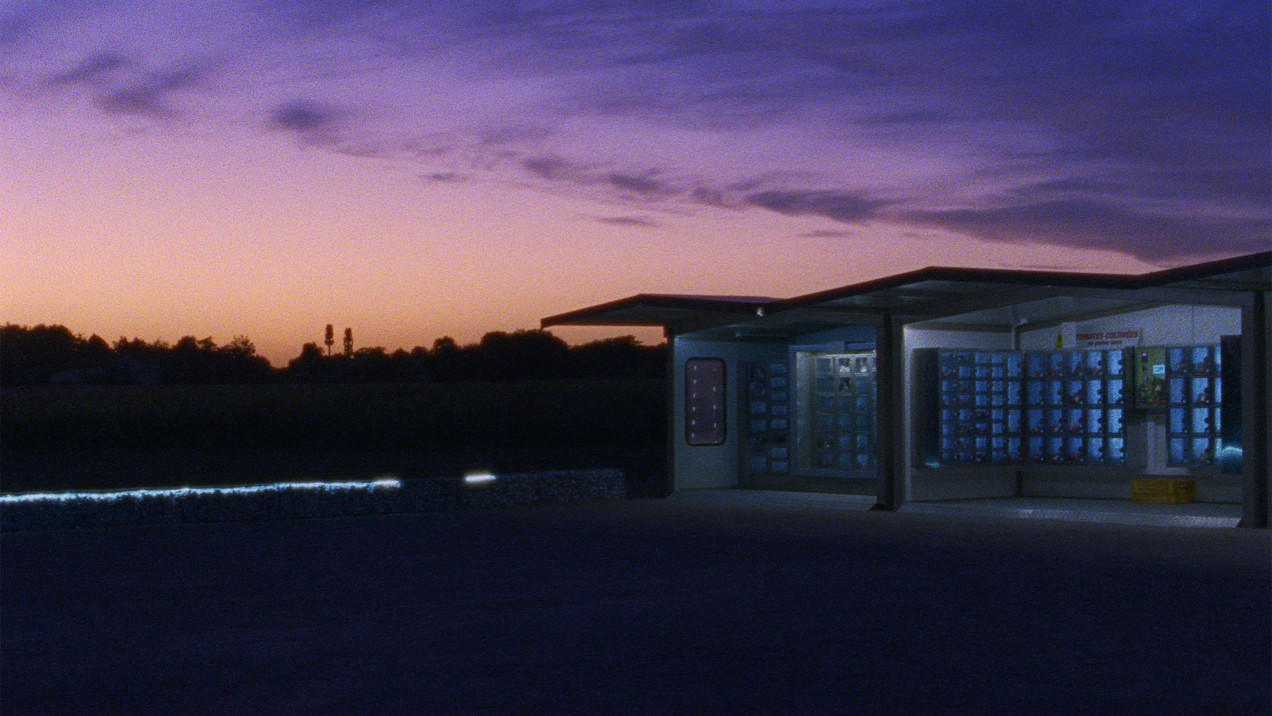
Coursing through the Cinéma du réel programme is the general sense that reality can only be accessed obliquely, through an elliptical form that conceals as much as it reveals. Two of the most remarkable films in the programme take this throughline to a conclusion of sorts, adapting a refusal to image the human body. Maureen Fazendeiro’s Les Habitants is set in an unnamed French village. We see this quaint commune go about its immutable routine, its picturesque streets well-maintained, its meadows neatly kept and its many glasshouses yielding rich produce. On the soundtrack, we hear letters from a mother to her daughter recounting the arrival of a group of Roma into the village, the opposition of the municipality to their presence and the material support that a few of the villagers offer to their nomadic guests.

Featuring interesting repetitions of banal information, the film’s voiceover offers a site of dramatic conflict – between the efforts of those trying to legally evict the squatters and those helping them prolong their stay in the village – while the visuals present a source of harmony. This contradiction between the sordid living conditions of the Roma group detailed on the soundtrack and the plush, first-world life on display serves to throw into relief the violence underlying suburban order. In filming the village after the immigrants’ departure, and refusing to feature them in any shape or form, Les Habitants points up cinema’s delay in keeping up with reality while also exploring the creative possibilities of this delay, of this spectral absence.
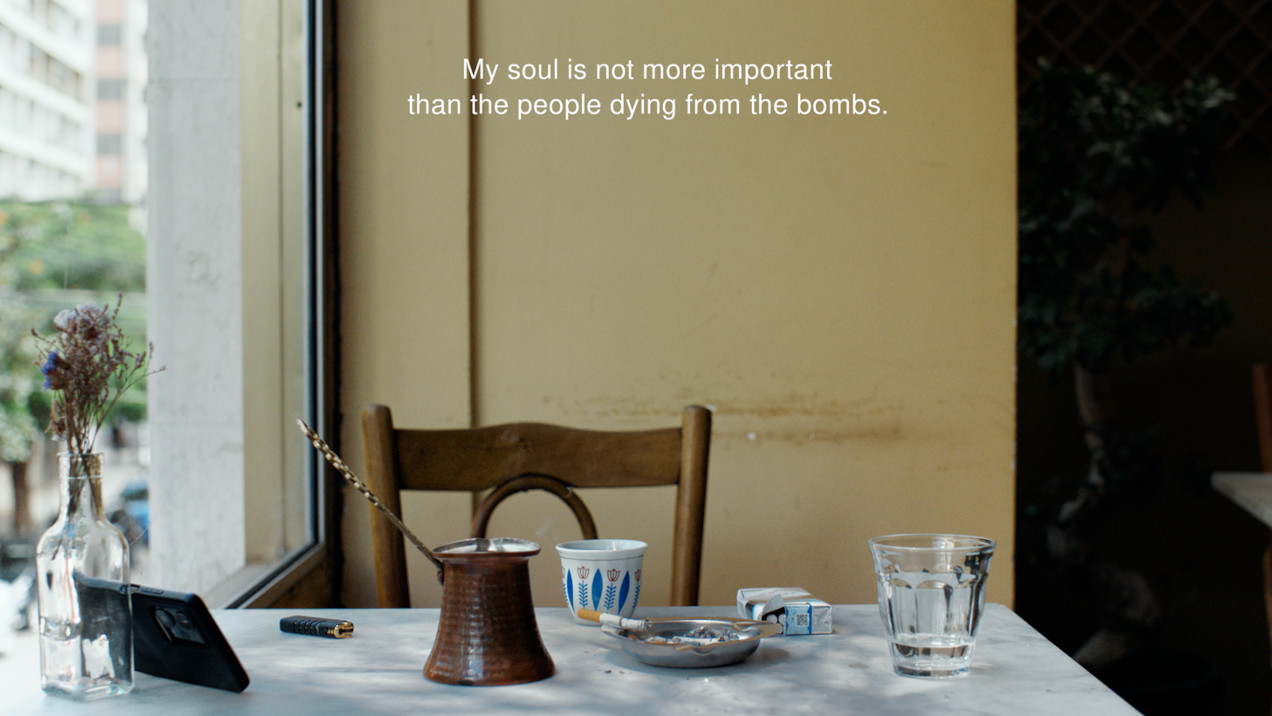
Elisabeth Subrin’s Manal Issa, 2024 goes further, eliminating the human body altogether. This ten-minute film is a companion piece to Subrin’s powerful 2022 work, Maria Schneider, 1983, in which the filmmaker had three actresses of varied backgrounds reenact an interview that Schneider gave for a French television show. In the interview, a visibly uncomfortable Schneider discusses the second-class treatment that actresses suffer in the industry, reveals that she turns down a lot of roles, deflects questions about Last Tango in Paris (1972) and generally resists the niceties and rituals of movie journalism. While the actors in Subrin’s film fastidiously re-create Schneider’s look and diction, they bring their own perspectives to bear upon the reenactment, locating themselves in Schneider’s experience as an exploited, marginalized film worker while extending her activist legacy to the present.

Where Maria Schneider, 1983 created doubles, excess bodies, Manal Issa, 2024 proposes a negation, one body too few. Here, Subrin poses to the Lebanese-French actress Manal Issa, one of the three participants of the former film, the same questions that Schneider was posed in the original interview. A publicly vocal actress, Issa talks about the poverty of meaningful roles offered to Arab-origin actresses, the limitations of the capitalist production model, the choice of moving back to Lebanon during crisis and the importance of speaking up against political iniquity. While we listen to her responses, Issa herself remains offscreen; all that we see is a table by the window containing signs of human presence: a pack of cigarettes, a lighter, an ashtray, a tea cup, a glass of water and a smartphone.

Issa’s refusal to take up pointless roles to sustain a career, to maintain a screen presence while censoring her critical voice, is echoed by Subrin’s refusal to show her. “If I’m on screen I’m something, and if I’m not I’m nothing? Khalas?” asks the actress, adding that she feels punished for her political opinions, for calling out Israel’s bombing of Gaza. “If I can’t be true to myself, there is no point showing myself,” Issa concludes, as the camera gently pans from the table to a street outside the window. Like Schneider’s, Issa’s self-negation stems from an outlook that privileges life over films, reality over fiction. Six hours after the filming, an end card notes, “Israeli airstrikes escalated throughout Lebanon, killing over 500 people in one day.”
Premiering at the 45th Cinéma du Réel in Paris, Maxime Martinot’s short essay The Film You Are About to See (Le Film Que Vous Allez Voir) offers a brilliant investigation into the ways in which cinema exhibition and spectatorship are mediated by paratexts within and outside the films. Repurposing a range of verbal material intended to set context for viewing — disclaimers, introductory warnings, fourth-wall breaking intertitles, notices from theatre management — the film examines the fraught, slippery nature of the relationship between text and image in cinema. In doing so, it also throws light on contemporary institutional outlook towards problematic works from film history.

The texts that Martinot gathers greatly vary in their tone, style and function. A number of them are pre-emptive disclaimers about the films not being representative of the real world (“merely an ancient fable”), forestalling perceived slight to such institutions as the police, the Red Cross and the Catholic church. A few extend the language of publicity, hard-selling the provocations of the film or preparing the audience for the experience to follow (“not a detective genre movie”). Yet others instruct the projectionist to keep an eye out for spectators pirating the film, while one intertitle registers a feeble protest against the censors: “In its original version, the film ended here, but the censorship demanded an optimistic ending as you are about to see.”

Systematically interspersed with these title cards are thirty-two excerpts from across the history of moving images, from Jules Janssen’s Passage de Vénus (1874) to Angus MacLane’s Lightyear (2022). Arranged more or less in chronology, these images often have a dialectical relationship to the intertitles, which, for their part, are presented in a reverse-chronological order, culminating in slides preceding magic lantern shows in the seventeenth century. This historical regression of the title cards goes not only against their anticipatory function and forward thrust within their respective films, but also against the increasingly slick, sophisticated images on display.

The Film You Are About to See cogently demonstrates the extent to which such title cards serve to fix the meaning and affect of the images, and to counter, as Roland Barthes put it, “the terror of uncertain signs.” Taken together, these paratexts attempt to tame the image and protect the audience, cautioning them about the kinds of violence that the images could subject them to: nausea, dizziness, motion sickness, temptation to vice, even moral outrage. One intertitle reproduces a notice that a theatre in Oklahoma had put up to alert the viewers of Lightyear about “scenes of gender ideology,” assuring them that a same-sex kiss will be fast-forwarded as soon as it appears on screen.

In this regard, the counter-chronological arrangement of intertitles and filmic excerpts also evokes regressing cultural attitudes to potentially disturbing films, the atavistic fear of the power of images. The disclaimers we see in the film have a striking resemblance to modern-day trigger warnings that seek to shield viewers from presumed psychic assaults. However, in its savvy assembly of ambiguous movie clips, Martinot’s film suggests that this is an ultimately futile enterprise, for images will always find a way to escape domestication and remain polysemous in the face of texts that seek to pin them down. In this and its fixation on the perverse detail, The Film You Are About to See comes across as a quintessential work about cinephilia, that illicit passion for smuggling personal significance into curated, tamed images.

The last week of March 2022 marks the second anniversary of India’s first covid-enforced lockdown. Out of work and anxious about the immediate future, migrant workers from every part of the country decided to go back to their homelands by whatever means was available to them. The harrowing, mediatized tracking shots of men and women trudging along highways with their belongings are now a veritable part of the visual history of independent India.

Migrant labour also happens to be one of the most prominent themes of the recently concluded Cinéma du Réel documentary festival. While several films that premiered at this year’s edition explore the intersections of technology, nature, politics and work, four projects train their attention on the experiences of the expatriate working-class.

We barely see workers in Noah Teichner’s Navigators; even so, the film centres on an important chapter in the history of migrant labour in America. Following the October Revolution in Russia, the United States drafted the Immigration Act of 1918 to deport anarchists and communists living in the country. In November 1919, the US Department of Justice raided the premises of the Union of Russian Workers, an anarchist organization comprised of Russian immigrants. 249 of the arrested radicals were put aboard the USAT Buford on December 21 and sent away to the new-born Soviet Union.

Among the deportees were the anarchist intellectuals Alexander Berkman and Emma Goldman, whose diary entries and letters on the voyage serve as textual material for the film. But the protagonist of Navigators is the USAT Buford itself. Commissioned in 1890, the ship was put to varied use during its forty-year lifetime. At one point, it even served as the set for Buster Keaton’s classic comedy The Navigator (1924).

Presented entirely in split screen, Teichner’s film employs three distinct formal elements. Its visual component is made largely of newsreels and scenes from silent comedies, particularly The Navigator. Clips of Buster Keaton wandering on a ghost ship are juxtaposed with excerpts from writings by Berkman describing the harsh conditions aboard the overloaded Buford over its 28-day journey. The comic images and radical text are scored to a selection of humorous anti-communist music, sometimes slowed down to the point of being unrecognizable.

In Buford, Navigators discovers an instance of history appearing first as tragedy, then as farce. But history resurfaces in other bitter ways as well. If America’s deportation of anarchists recalls the pogroms of Tsarist Russia, Lenin’s persecution of the same anarchists in the 1920s strikes a note of sad irony. Comedy and history come across as conjoint twins in the disorienting crosstalk between text and image, fiction and reality, that Navigators puts in place. Cinephiles will no doubt notice that the three-way clash of cinema, radical politics and red scare that informs the film’s formal scheme would emerge again in the Hollywood blacklist of the late forties.  

Migrant workers are also deported in Jessica Johnson’s Anyox, which mixes current-day footage of a former mining town in British Columbia, Canada, with archival material from the twenties and the thirties, when the site was owned and administered by the Granby Consolidated Mining corporation. During its heyday, about half of the company’s workforce was made of immigrants from Central Europe who mostly worked at the mines, while labourers from English-speaking countries were deployed at the smelting facility. The workers all appear to have been sensitized to their rights by political newspapers available in a host of languages.

Compelling the viewer to read forbiddingly long reports and newspaper clippings, director Johnson provides a detailed account of the agitation that gripped the town in the thirties. Since the company owned all the businesses in Anyox, the worker’s sustenance-level salaries came back to the firm in the form of shopping receipts and dorm rents. When the demand for copper plummeted during the Great Depression, the company further cut down wages. The employees struck, demanding better living and working conditions. The police intervened, hundreds of strikers were put on barges and expelled from the town.

The immigrant workers of Crossing Voices, on the other hand, returned to Africa of their own volition. In 1977, fourteen migrant labourers working in France travelled to Kayes, Mali, to establish a farming cooperative named Somankidi Koura. The group had first met in Paris as members of the Cultural Association of African Workers in France (ACTAF), which fought for the rights of migrant workers, but also supported the liberation struggles of Portuguese colonies in Africa. ACTAF members protested the lamentable living conditions for African labourers, housed in terribly equipped, undersized dormitories in suburban Paris.

Following the liberation of the Portuguese colonies in 1974, however, the group turned its attention to the droughts that were gripping the Sahel region. They came to the realization that the very phenomenon of African immigration to Europe has its roots in the exploitative practices of colonial agriculture: the colonisers’ insistence on cash crops such as peanuts had eroded the quality of the soil in rural Sahel, producing the drought and the subsequent exodus of rural workers to cities, including in Europe. In order to address the problems of urban immigrant life in France, one then had to address the state of rural agriculture in Africa.

To this end, the group undertook underpaid internships with French farmers. They carried this knowledge back to Africa, their reverse journey from Europe a symbolic undoing of the effects of colonial economics. “To fight the sun and the famine, our weapon is the daba (pickaxe),” became their motto in establishing the Somankidi Koura cooperative.

Using material from public archives and the personal collection of filmmaker Bouba Touré, one of the co-founders of the cooperative, Crossing Voices illustrates the continued struggles of immigrant and illegal workers in France and contrasts it with the everyday operations of the cooperative. Spanning decades, continents and economic activities, the film offers a cogent historical analysis of blue-collar emigration from Africa.

The politics of migratory labour takes a backseat in Caught in the Rain, which instead adopts an oblique, lyrical approach to representing migrant life. The setting is a nondescript residence in Belgium. Two African men are engaged in what appears to be fragments of renovation work, peeling old wallpapers, clearing scrap materials or doing the laundry. But there are interruptions: responding to offscreen signals, one of the men abandons his task and rushes outside. It rains a while later, and the man lets half-a-dozen other immigrants inside. They wait until the rain stops and then make their way out as quietly as they came in.

We learn shortly that the two workers were picked up by the police five months ago on a raid. The men, it appears, are illegal immigrants squatting in this abandoned house; far from distraction, their alertness to off-camera stimuli is indicative of their uncertain situation, a compulsion to be ready to flee anytime. But this scenario isn’t treated for dramatic effect.  

Rather, the film unfolds like a haiku; instead of putting their actors through a narrative, directors Mieriën Coppens and Elie Maissin photograph them in partially-lit profiles, lending them a monumental presence that underscores their silent dignity. There are precedents to this approach in the work of Pedro Costa or even John Ford. But the film’s rarefied portrait of immigrant labour and community life is moving in its own right. In their apparent precarity, their quiet desperation, the workers here call to mind India’s nameless, numberless migrant labourers who, too, were forced to run for shelter, caught in the metaphorical rain.


[First published at News9]