Block-notes Di Un Regista (1969) (aka Fellini: A Director’s Notebook)
Federico Fellini
Italian/English
“To me, the subway is like a catacomb which goes right through the bowels of Rome.”
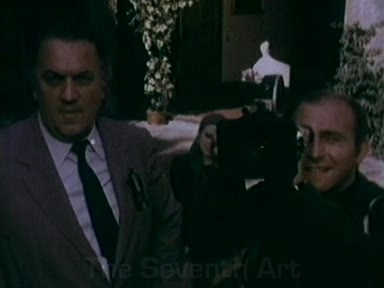 If there ever was something called personal cinema, it had to come in the form of Fellini’s masterpiece 8½ (1963). With 8½ had come a new kind of cinematic artist, standing in front of an unlimited canvas woven in time, dipping his hands in colours called memory, fantasy and magic, painting it without giving a damn about what a world would think about it. Placing himself at the centre of his fictional world, Fellini had indeed made it clear what the director of a film can do to it – as a manager, as an artist and as a personality himself. But to see that a film that he made half a dozen years later, Fellini: A Director’s Notebook (1969) that is as ambitious in its scope and as groundbreaking in its impact as 8½, is much less discussed is both surprising and disheartening especially considering the way Fellini transforms a mere, unappealing making-of-movie into something that is as profound and as personal as his acclaimed movies. Made as a part of a series titled NBC Experiment in Television (1967-71), A Director’s Notebook is a precursor to his next film Satyricon (1969) and traces the groundwork that Fellini laid before the shooting of this film.
A Director’s Notebook presents us Federico Fellini setting out in search of locations, sets and character inspirations for the period drama within modern day Rome. The narrator tells us that he is trying to affirm his belief that there is a strong link between the ancient and the modern and that the Rome of history text books is still alive and kicking. This idea forms the backbone for the hunt as Fellini hops from night-time streets of Rome to the countryside, from the city’s subways to world renowned monuments and from abandoned sets to active slaughterhouses. We meet a range of characters and also get to see them through Fellini’s eyes. Soon we start to sense what Mr. Fellini is arriving at. We see the Coliseum alongside defunct movie sets, we see images of Nero’s debauched army along side the street birds of Rome, and we see brave gladiators alongside butchers of slaughterhouses. Fellini, as usual, has fun transforming his situation as he wants. He seamlessly switches between images of the past and those happening now. We even get to see the iconic Marcello Mastroianni, whom Fellini likes to call a true Roman (“has all the virtues and all the faults of the ancient Romans”), and his subsequent conversations with Fellini beyond which the film really digs deep.
Throughout the film, Fellini sets up a channel between the two Roman civilizations – the present and the ancient – in a way that, primarily, serves as an inspiration for his next movie but also as a personal journey towards the director’s own roots. Be it the virtues – especially the warm and hospitable nature of the people – or the vices – the notorious debauchery of Nero and Caligula – Fellini seems to believe that the culture and the spirit has persisted through the years in the Romans. Towards the end of the A Director’s Notebook, Fellini even has the townsfolk who work at the slaughterhouse enact sequences from ancient Rome, complete with costumes and wreaths, in order to validate them for his next film (In the sequence’s hilarious end, one of the gladiator almost cries because he gets a scratch on his ear). In some ways, A Director’s Notebook is Fellini’s version of the wonderful Tarkovsky documentary Voyage in Time (1983), which too unfolds as a nostalgic trip set in Italy, wherein the director uses geography extensively to invoke memories and emotions. In one scene, Fellini and company travel in the subway train and we notice ancient Romans standing outside the train at many places, upon which the director himself notes that this must be a journey in time and not space.
 A Director’s Notebook is to 8½ what Woody Allen’s Deconstructing Harry (1997) is to his Stardust Memories (1980). Allen’s admiration for Fellini has been largely overshadowed by the influence of Bergman on him. In fact, Allen’s career closely follows that of Fellini’s even though the philosophical questions that Allen revisits is that of the Swedish. Stardust Memories (which, in a way, happens to be Woody’s 8½th movie), like Fellini’s 8½, is all about the director. Both movies are exercises in narcissism as many have pointed out. In both, the director treats himself as if he is the centre of the universe while the world around seems to exploit him despite his turmoil. In Deconstructing Harry, Allen comes full circle and, once and for all, accepts the fact that it is he who has been exploitative and that he has to let go of his balancing act between his fictional world and the real world. Likewise, in A Director’s Notebook, Fellini studies his own self and, in an act of purging himself of the ego, reflects on how his relation has been with his actors and everyone else who has helped him gain the international reputation. Towards the end, when many actors and players try to impress the director with their skill set, Fellini tells us in the voice over:
“Yes, it might seem very cynical, very cruel. But no, I am very fond of all these characters who are always chasing after me, following me from one thing to another. They are all a little mad, I know that. They say they need me, but the truth is that I need them more.”
In one section in A Director’s Notebook, Fellini visits his long time friend and movie star Marcello Mastroianni to audition him for the leading role in his unfinished film The Journey of G. Mastorna. Fellini tries a lot – adding make up, setting up wigs, going for multiple takes – to somehow get a shade of the cellist Mastorna out of Mastroianni, but finally resigns. When he turns down Mastroianni telling him that he wasn’t into it at all, the actor quips back: “No Fellini, it’s because now you have no faith. It’s as if you are scared. If you could believe that I am Mastorna, I would automatically become Mastorna”. Throughout the movie, Fellini examines the cost that he has to pay for conforming to his reputation, the cost to that has to be paid for him to remain the Fellini that the world knows him as (Fellini is notorious for rarely using the same actor more than once), the cost for imitating oneself just for the heck of it. Fellini’s situation remains true for any filmmaker who tries to construct his fictional world the way he wants it, even at the cost of the real one – issues that both Woody Allen and his idol Bergman have explored time and again.
Fellini really pushes the boundaries of filmmaking over here. Unfolding as a tone poem in typical Markerian style, A Director’s Notebook soon goes on to blend documentary and fiction to create a truly personal form of expression that seems to be way ahead of its time. Far from the assured and fluid camera work of 8½ and rightly so, the cinematography in A Director’s Notebook is self-conscious, largely handheld, seemingly offhand and purely functional all the way. Closer to a series of essays than a complete film, the movie seems to be one of the earliest examples of the kind of cinema that would later be explored deeply by filmmakers such as Werner Herzog and Jean-Luc Godard. What part of the film was scripted, what was improvised and what was plainly documented will remain a mystery, but what matters is the unique concoction that the director achieves by this mixture. Stacking various levels of reality over one another like 8½, but also taking it further, this stunning little gem from Fellini may just be the golden key required to unlock all his films that were to follow.
 A Director’s Notebook, true to its title, also serves as a nostalgia trip for both the director and fans of his work. There are throwbacks of his earlier films throughout A Director’s Notebook. When Fellini visits Mastroianni, the latter is in an interview where the reporters ask him inane questions, much reminiscent of the irritating paparazzi of La Dolce Vita (1960). Early in the film when Fellini is scouting for locations during the night, we cut to a little interview of his wife Giulietta Masina who recalls the (then) edited scene in The Nights of Cabiria (1957) where a strange man delivers goodies to the people living on the fringes of Rome. The hilarious audition section where we have all kinds of people, including a boy who claims he can whistle like a blackbird, a charlatan who seems to know painters more important than Raphael, a lady who thinks her music conveys the same thing as Fellini’s films and even a man whose life depends on his wig, seems straight out of 8½. Even the sequences in the film where the director hunts for life in the streets of Rome during the night time has a lot in common with the positively eerie and Lynchian atmosphere that he created in his segment Toby Dammit in the portmanteau film Spirits of the Dead (1968).
But even without the references, A Director’s Notebook remains an auteur’s work. Even if one doesn’t see any connections of this film to his other movies, one can say with conviction that it is a “Fellini movie”. No one other than the ringmaster called Fellini could have assembled the army of characters that appears at various places in the film. At one point in the film, Fellini takes a mini nostalgic trip where he recounts the people of his childhood watching a movie at the theatre, hinting at the kind of films he would be making henceforth. The clairvoyant who can talk to the people of the past, the professor who studies the connection between historical Rome and its present version and the crewmen who turn into Nero’s soldiers are all characters who have the Fellini tag stuck on their forehead. The lonely yet lyrical, dark yet alluring, beautiful yet decaying streets of Rome, the array of immensely human characters who keep flooding the screen with enthusiasm and women with exaggerated make-up and strikingly extreme expressions – now, where else can one see such images other than at Fellini’s circus?
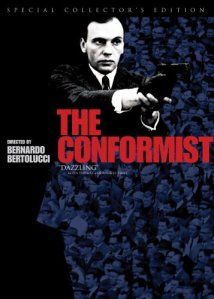 Bernardo Bertolucci’s The Conformist (1970) is everything that a viewer could ask for – a great story, interesting characters, stylish visuals and a purely cinematic language to convey them all. Using images that possess the judiciousness of a Tati, meaning of an Antonioni and elegance of an Ophuls, Bertolucci, not even 30 at that time, conjures up a film of both high mojo-quotient and long “shelf-life”. Evidently inspiring The Godfather series, The Conformist is the kind of film that persuades you to understand what the difference between direction and visual illustration is. The next time somebody kills you with that irritating “The book was better” act, hit them with this one. Not that The Conformist is better than its book version, but only that it makes such comparisons invalid.
 In fact, all the major characters in the film tantamount to prisoners of Plato’s cave. None of them actually know what their principles actually mean or what they want from it all. Clerici is confused with both his sexual orientation and political ideology. His wife, Giulia, does not see beyond the two things that Clerici mentions. The professor seems to spend an idyllic life like that of the bourgeoisie –the very people whom he is fighting against. Anna Quadri (Dominique Sanda) is none but a female counterpart of Clerici. Only that the mass she is conforming to happens to be the resistance group. The tragedy about Manganiello (Gastone Moschin) is that the people he despises is the very group he works for (“Cowards. Perverts, Jews. They are all the same. If I had my way, I’d put them all up against the wall. They should all be eliminated at birth”, he says). Even the blind Italo (José Quaglio) joins the group not because of his political leanings, but for “normalcy” and hence safety. It’s almost as if the people who oppose passive acceptance of political philosophies are themselves creating another form of fascism by unanimously scandalizing it – an idea ambiguously explored in Daldry’s
 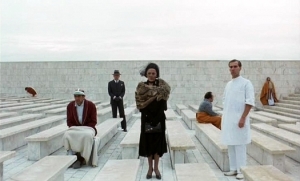 I have always considered Lina Wertmüller’s Seven Beauties (1975) as one of the greatest movies ever made and the best one about the Holocaust that I have seen. Watching The Conformist, one can clearly see where Wertmüller’s movie gets its inspiration from. Both films seem to complement each other thematically. While Seven Beauties examines how man’s fake principles fade into oblivion when it comes down to survival, Bertolucci’s film shows how man can assume false policies in order to survive. However, formally, both the films seem very similar in the sense that both of them exaggerate melodrama to the point of caricaturing it and consequently, derive meaning out of that absurdity. Both use oversaturated colour palettes and chromatic shifts generously to keep reminding us of the phony nature of it all. In fact, Bertolucci keeps prodding us with theatricality. As Clerici recites his father’s past, three women are performing a song in the background (Incidentally called “Who’s happier than me?” – another allusion to the prisoners of the cave). He meets Anna in a ballet class. There is even an edited scene that involves blind people dancing to a piece of music.
 However, Bertolucci deviates from Godard by making The Conformist a highly individual-oriented film. While Godard’s is a study of the effect of social and political structures on the individual, Bertolucci’s is the exploration of the effect the psychology of (a generalized) individual has on socio-political norms. His Clerici is a character tailor made for in-depth psychoanalysis and many facets of the film clearly remain subjective. For instance, why does he “see” the same woman thrice, at different places, in the film? Why does no one else stalking Manganiello? Does he even exist? Why does Clerici marry Giulia, even though he hates her typically bourgeois mentality? Bertolucci’s mise en scène suggests that the answers are functions of Clerici’s psyche, which is evidently affected by his childhood trauma and sexual “deviation” (Although every reading of The Conformist insists that it illustrates the role of sexual deviance in the rise of fascism, a case could be made for any kind of difference – sexual as with Clerici, physical as with Italo and even religious, as with the mystic Hanussen). This way, Bertolucci calls for a reassessment of fascism as a force that has grown bottom-up because of individual insecurities, fears, motivations and ignorance rather than a mass hysteria initiated by an arbitrary single man.


 Michaelangelo Antonioni‘s films have always tried to establish the growing distance between humans and the alienation of self in the modern society. Though L’Avventura (1960) is his most intense meditation of that concept, it is measured in its pace and may not entice viewers of the newer generation. Ironically, his Blowup (1966) has more lovers now than it had during its time! Unlike its contemporaries which age with time, Blowup‘s appeal seems to grow with the years.
 Seldom do films come that are so simple in their presentation yet possess such strength in their characters. These are the films that sweep you off the ground with their sheer brilliance. Federico Fellini’s La Strada (1954) is a benchmark for industries such as Bollywood which flourish on fantasy for film making. La Strada marks Fellini’s transition from neo-realism (His previous film being the brilliant I Vitelloni (1953)) to fantasy. And what a transition it is!
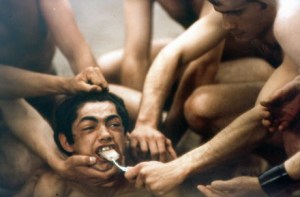 Once in a while, there comes a movie that shatters the beliefs of people on cinema and redraws the lines between right and wrongs of the medium. These are the films that redefine the boundaries of film making thus providing new standards and freedom for films to come. At a time when swearing on screen was a taboo, came the classic Gone With The Wind (1939) with the legendary “Frankly my dear, I don’t give a damn.” quote. A Clockwork Orange (1971) that questioned induced goodness and evil in a very strong way, Straw Dogs (1971), famous for its graphic rape scene, Un Chien Andalou (1929) that introduced surrealism in cinema, the semi-snuff Cannibal Holocaust (1980) and its brutality – all these movies may have been snubbed by audience and critics at the time of their release, but no one can question their impact on the future generation of directors.
 The Seventh Art