Forty years after its original premiere, the Odia film Maya Miriga (1984), a touchstone of the Parallel Cinema movement, will be presented in a restored version at the Cinema Ritrovato Festival in Bolonga, Italy, in June. Directed by Nirad Mohapatra (1947–2015), Maya Miriga was part of the Critics Week at the Cannes Festival in 1984, alongside such titles as Billy Woodberry’s Bless Their Little Hearts and Leos Carax’s Boy Meets Girl. The film has been restored by the Film Heritage Foundation (FHF) at the L’Immagine Ritrovata laboratory in Bologna, in association with Digital Film Restore and Prasad Corporation in Chennai.

A graduate of the 1971 batch of the Film and Television Institute of India, Mohapatra made numerous documentaries, television series, industrial and educational films across his three-decade career, but Maya Miriga remained his sole fictional feature. “I had conceived the idea [for the film] in one of my intense moments of loneliness and deep depression and it had undergone several changes in various phases.”, notes the filmmaker. Shot by Rajgopal Mishra in a warm, sober colour palette, the film demonstrates a great feeling for the interplay of harsh natural light and deep shadows — a sensuous quality that can be appreciated fully in the pristine new version.

Set in the town of Puri, Maya Miriga is the saga of a joint family driven to disintegration by ambition, opportunity, festering resentment and, simply, changing times. A stern but honest headmaster on the brink of retirement, Raj Kishore Babu (Bansidhar Satpathy) lives in a fairly capacious house with his elderly mother, wife and five children: the dull and reliable college lecturer Tuku, the IAS hopeful Tutu, the self-doubting MA graduate Bulu, the rebellious and cricket-obsessed Tulu and the only daughter Tikina. While the men pore over files or hang out on the terrace, Prabha, Tuku’s wife, bears the burden of the upkeep of the house. The apparent stability of the home comes undone when Tutu cracks the civil service examination.

The narrative spans many months and proceeds by substantial leaps in time. We witness Tutu becoming a bigshot who marries into money, Prabha suffocating under the patriarchal order of the house, Tulu trying to break out on his own, Bulu imploding when surrounded by high achievers and Raj Babu grappling with post-career emptiness.

Through gradual buildup of dramatic detail, the film shapes into a poignant tragedy of a middle-class family torn apart by its own cherished values. The father’s insistence on academic excellence, the pressure on the sons to find respectable jobs, the irreconcilable expectations of wealth and traditionalism from the daughters-in-law — all turn out to be ticking time bombs for the household.

We also learn that the family has property back in their ancestral village that no one takes care of, suggesting that Raj Babu is himself a migrant who left his landlord father for greener pastures in Puri. Mohapatra’s film thus captures a crucial moment in Indian social history between two generations of labour migration, one giving rise to joint families inhabiting independent houses in towns and the other producing nuclear families looking towards metropolises.

Maya Miriga is a veritable compendium of middle-class mores and codes of behaviour: how do individuals get their decision ratified by other members of the family, what are one’s duties when returning home after a stroke of success, how should guests comport themselves when visiting? With finesse and grace, Mohapatra’s film illuminates the gendered division of labour, the intergenerational etiquette and the power hierarchy that holds sway in an undivided family.

An abandoned site spruced up for the film, the house itself plays a central role, exercising a gravitational pull that the characters struggle to escape. Actors move in and out of its dark recesses, as though consumed and spat out by the structure. Its imposing pillars, its bright courtyard and its open terrace all seem extensions of the power relations binding its inhabitants.

Maya Miriga is certainly a melodrama, but on a subtler register than seen on most Indian screens. The influence of Satyajit Ray, especially of a work like Mahanagar (1963), is discernible here, but Mohapatra’s film also shares lineage with the innumerable family dramas of contemporary theatre and popular cinema across the country. “The balance that I ultimately wanted to achieve”, the director remarks, “was between realism and simplicity on the one hand and my preoccupation with a certain cinematic form on the other.”

An admirer of Japanese filmmaker Yasujiro Ozu, Mohapatra strips away his material of all dramatic fireworks. The non-professional actors are all filmed in mid-shots, and never in close-ups, in a way that integrates them with their surroundings. Their emotions are muted; the dialogue, music and reactions whittled down to a minimum. A sense of serenity reigns over the film, which progresses with relative equanimity through both joys and sorrows.

The question, to my mind is an ethical one – to excite the senses to the point of disturbing their rational thinking is a certain sign of disrespect to the audience.”, writes Mohapatra, proposing that filmmakers must leave the viewers “a margin to move closer to the work and have a more active participation, a greater sense of involvement in the process.” “I believe, freedom is alienated in the state of passion.”, he adds, “One should not therefore seek to overwhelm the audience.

Maya Miriga represents the FHF’s second restoration project this year after Shyam Benegal’s Manthan (1976), which had its premiere in the Classics section of the Cannes Film Festival in May. Carried out in association with Sandeep Mohapatra, the filmmaker’s son, the restoration process was long and arduous. The original 16mm camera negatives, found abandoned in a warehouse in Chennai, were severely compromised and had to be manually repaired over several months before it could be scanned in Bologna. The results were complemented with material from a 35mm print of the film from the National Film Archive in Pune, which also served as the source for the soundtrack. With the revival of this seminal film, Odia cinema promises to draw much needed attention from the rest of the country as well as the world.


[First published in Mint Lounge]
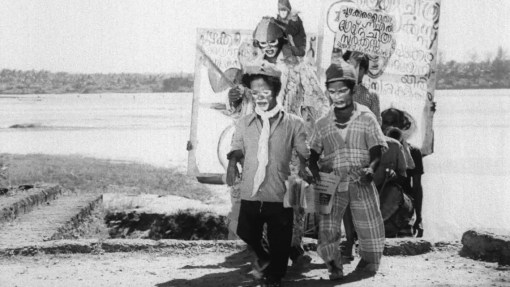
Photo courtesy NL Balakrishnan Archive/Film Heritage Foundation

The month of May has brought not one, but two notable developments in the field of film restoration in India. On the 5th of this month, the Ministry for Information and Broadcasting (MIB) announced that it will grant the National Film Archives of India (NFAI) Rs. 363 Crores to restore about 2200 films over an unspecified time period. On a more human scale, the 75th Cannes Film Festival revealed that it will show two restored Indian films in its Classics section: Satyajit Ray’s Pratidwandi (1970), restored by the NFAI, and Aravindan’s Thamp̄ (1978), restored by the Film Heritage Foundation (FHF) under the direction of founder-filmmaker Shivendra Singh Dungarpur, in collaboration with the Prasad Corporation (India), The Film Foundation (USA) and Cineteca di Bologna (Italy).

Born in Kottayam, Kerala, in 1935, Aravindan is often classified under the loosely defined, pan-Indian Parallel Cinema movement. But he was a poet in that assembly of prose stylists, a genius primitivist in a world of professionals. Aravindan’s third feature, Thampu rechristened Thamp̄, is an observational portrait of a traveling circus setting up shop at a riverside hamlet in Kerala. The filmmaker initially planned Thamp̄ as a documentary around the circus troupe, and large sections of the final film attest to this original intention. The story is skeletal, there is no plot and very little dialogue or musical score. Aravindan instead devotes the better part of the film to capturing the quotidian rhythm of the village, its landscape and buildings, its people and places, as well as the troupe’s performances.

These improvised vignettes are organized into a symmetric, cyclical day-night structure anchored by recurring figures: a bourgeois repatriate, his rebellious son, the manager of the circus, its muscleman and clown, two young lovers, a prostitute, a truck driver. Discursive elements surface late in the film in the form of sabotage, worker unrest and familial discord, but these sparse incidents are only hinted at, relegated to the margins of the whatever narrative there is.

Thamp̄ is a circus movie and Aravindan’s view of the troupe is coloured not by nostalgia or lament for the circus, but by a bitter fatalism. The performers are a hopeless lot, trapped in the circus since childhood and subject to its waning fortunes, who are likened to their animal colleagues. Their promotional parade through the village is accompanied by upbeat music, but their solemn, downcast attitude turns the procession funereal. A birthday party for a troupe member looks like a wake, until someone is instructed to sing. Resigned to abuse and abjection, the artistes form a lumpen mass whose rootless existence outside the class system is contrasted with the politicized factory workers that constitute their audience.

The performance of the troupe, though accomplished, is marked by a certain weariness that the 43-year-old Aravindan seems to share. The filmmaker appears to be more interested in life at the periphery of the circus, in the fleeting connections that its members forge outside the tent and in the village. This disenchantment with spectacle results in the most extraordinary passages of the film in which Aravindan cuts between the audience and the performers.

While the circus routines are perfunctorily photographed, these candid reaction shots — the first that Aravindan filmed for the project — register a gamut of primal emotions: men and women, babies and toddlers, all staring agape in fear and wonderment at the dangerous, graceful stunts unfolding before them. The performance becomes little more than an occasion to film the villagers, whose virginal reaction contrasts with the camera-aware presence of the handful of professional actors. Like Herz Frank’s Ten Minutes Older, made the same year, Thamp̄ is fascinated by the possibility of innocence, of belief in the spectacle.

The film’s restoration journey began in early 2020, when Dungarpur travelled to Kollam, Kerala, to meet the film’s producer K. Ravindranathan Nair. A cashew baron, Nair had artistic aspirations and financed several canonical works of Malayalam ‘New Wave’ cinema, including films by Aravindan and Adoor Gopalakrishnan. Dungarpur notes that the producer was forthcoming in giving his approval for the restoration. The real hurdle, though, lay ahead.

Since the master negatives of Aravindan’s films had all decomposed, the FHF had to work from a surviving print of the film that it obtained from the NFAI. This posed a triple challenge. “Prints don’t have a great degree of latitude,” says Dungarpur, describing how positives can inherit only a part of the tonal range of the original negative. To begin the restoration process from a duplicate negative generated from the NFAI print, then, already entailed a loss.

Moreover, budget demanding, Thamp̄ was shot on the locally manufactured Indu film stock, which wasn’t as sensitive or fast as the better monochrome stocks of the time. Shot by regular cinematographer Shaji N. Karun, it was Aravindan’s second work in black-and-white (and bookended by two films in colour, Kanchana Sita (1977) and Kummatty (1979, restored by the same team in 2021). Shaji worked mostly with available light, which produces images of harsh contrast and imposes visible limitations in the outdoor scenes, where figures tend to meld into the background.

The NFAI print, finally, had already been projected a number of times, accumulating significant amount of wear and tear in the process. This copy had to be first physically repaired at the FHF facility in Mumbai before being sent to co-sponsor Prasad Corporation in Chennai for 4K scanning and digital clean-up. The restoration laboratory L’Immagine Ritrovata in Bologna, Italy, which oversaw the high-resolution transfer, also did the sound restoration and colour grading.

“When it comes to challenges in film restoration,” declares Dungarpur, “you have to be a purist.” Fundamental to FHF’s work is the conviction that the intent of the original creator and the artistic integrity of the film must be the guiding factors in a restoration project. To this end, Dungarpur collaborated with Shaji and Ramu Aravindan, the filmmaker’s son and photographer, on getting the grading and the sound right. This painstaking process of shepherding a single film over many months seems to run counter to the MIB’s monumental ambitions, but the conscientiousness stems from an attitude of respect towards the work under consideration.

Would the FHF’s restoration bring back Thamp̄ in the form Aravindan conceived it? Best intentions notwithstanding, perhaps not. “A film and its restoration are ultimately different works,” says Dungarpur. One would hope, even so, that the restored version comes as close as possible to the vision of the singular cine-poet that was Aravindan.


[Originally published in Mint Lounge]