[An edited version of the following text was originally published in Pardo, the Locarno Film Festival’s official daily magazine.]
“My whole trouble was that at no point was I able to lose my administrative and critical faculties,” remarks Judas in Paul Claudel’s short story The Death of Judas (1933). Claudel’s bracingly revisionist account makes a case for the twelfth apostle, recasting him as a sardonic, inquiring man who saw through the intellectual obfuscations of the miracles and the cowardice of his fellow disciples. This Judas celebrates his philosophical freedom even in death, suspended from a tree, unbound by the constraints of the cross that consumed his master.
Taking over the baton from Claudel, writer-director Giulio Base gives the devil its due in Judas’ Gospel, fully humanizing the treacherous figure and dramatizing his tussle with reason and faith. In Base’s retelling, born under a cursed star, Judas endures a harrowing childhood in a brothel. Wielding a bloody dagger, he rises to power and fortune, only to give it all away when Jesus (Vincenzo Galluzzo) summons him. Wise in the ways of the world, Judas is moved not so much by the Prophet’s supposed miracles, but by His simplicity and capacity for grace.
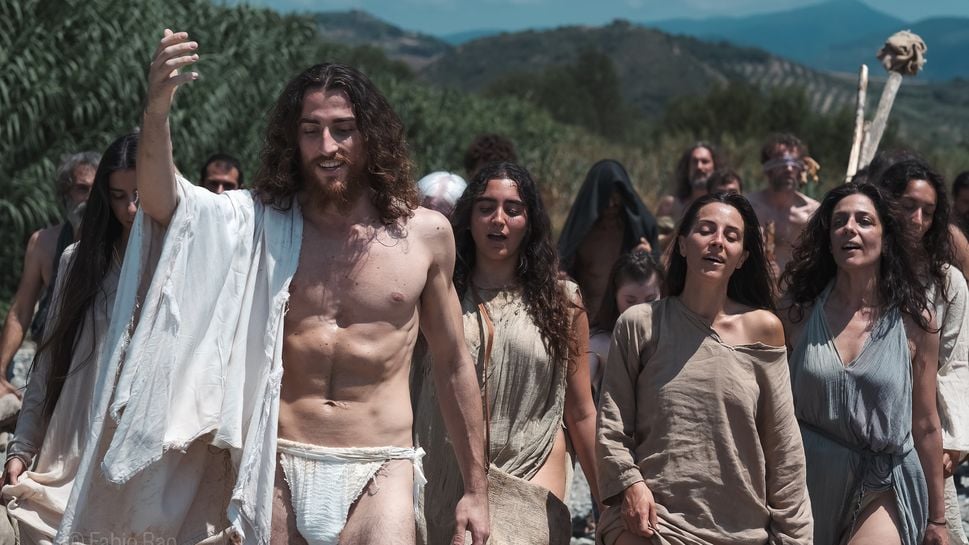
Base presents Jesus as a radical egalitarian, a proto-hippie whose following comprises men and women alike, without authority or hierarchy. With a forgiving smile, He condones the libertine goings-on in the group, which He leads from place to place over three years. In a subversion of the injunction against idolatry, Jesus is visible, front and centre, throughout the film, anchoring the image with His radiant presence. Even so, we don’t hear His voice except at choice moments, as when He beckons Judas or eulogizes Joseph at his funeral.
Judas, on the other hand, is simply a cloaked figure whose face never once shown to us. Yet it is his lucid, layered monologue that propels the narrative. Drawing us into an entirely subjective space, this voiceover (delivered by the gravel baritone of Giancarlo Giannini) accompanies us through the maze of Judas’ mind, his confusions about Jesus’ plans for him, his sense of superiority over his unlettered peers, and his messiah complex undone by his human failings.
As one’s image complements the other’s voice, Jesus and Judas become inextricable entities bound by prophesy. “Everything in the world exists thanks to its opposite,” Judas notes, implying that his treachery and Jesus’ ascension are mandates of the same divine will. Judas’ labyrinthine reasoning brings him to the conclusion that he was the only apostle faithful enough to carry out the betrayal, yet he succumbs to human logic at the moment of Crucifixion. Thematically and formally thought-provoking, Base’s film unveils Judas in all his fascinating contradictions. Ecce homo.
 The Seventh Art