[Possible spoilers ahead; but I hear movies are all connected now, so consider this a warning for every movie ever made.]
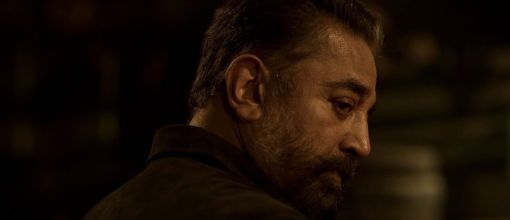
Making shit up as you go along (the current term for it, I believe, is ‘multiverse’) is in vogue. So fourth-time helmer Lokesh Kanagaraj has made a new film titled Vikram, which draws story elements from his second feature Kaithi (2019) and carefully prepares the place for a fatter cash cow. Shot by Girish Gangadharan (Angamaly Diaries (2017), Jallikattu (2019)) in a dark but warm palette of yellows, reds and blacks, the film expands director Lokesh’s literal if not artistic arsenal to a considerable degree. Guns have gotten a bad rap in the past couple of weeks, but Vikram assures us that, sometimes, there is nothing quite like a cannon to clear some landscape.
The spirit of Christopher Nolan hangs heavily (how else would it hang?) over the film right from its cold open: masked men storm a high-rise, kill a middle-aged man tied to a chair, and record the event on video with the message “This is not a murder; it’s a statement. We are at war against your system.” The killings repeat every week under the same signature, prompting the police to hire a sleeper unit headed by Amar (Fahadh Fasil) to investigate the matter. In the sophisticated narrative setup, Amar discovers that the middle-aged man was Karnan (Kamal Haasan), who is somewhat of a jerk but one with a streak of kindly righteousness. He also learns that Karnan, and the other murdered cops, are involved in the capture of a large consignment of drugs belonging to Sandhanam (Vijay Sethupathi), who thus has an incentive to trace the masked marauders as well.
The trailer for Vikram enticed viewers with the prospect of seeing three major stars of South Indian cinema come together for the first time (along with a distended cameo by Suriya). Indeed, each pair of the film’s three heroes gets a scene together, and they all meet in the climactic sequence. They are all introduced within the first thirty minutes of the film (cf. Aayitha Ezhuthu (2004), where all three stars appear in the first minute), Fahadh following Kamal’s relatively low-key (and ill-advised) entry in the first few minutes. However, we hear Kamal properly only after ninety minutes into the film, his silence helping to sustaining an enigmatic if uncompromised aura around him, and this resurgence, built on a bit of audience-cheating, helps the film shift gears and transition from a mystery to a thriller.
Most visibly, Vikram is a love story between Fahadh’s Amar and Kamal’s Karnan-turned-Vikram, and I wish the film had run with this through line. Amar spends the first hour courting the older man — literally following his footsteps — as a phantom pursuing another; only the masked can unmask the masked, remarks his superior. His Citizen Kane-like investigation builds up the mystique around Karnan/Vikram, whom he imagines inhabiting in the same space as him, a daydreaming paramour. In the end, he even plays midwife to the baby his senior has been nursing. Climbing up and down walls and breaking into houses, Amar is the true heir to the original spy of Vikram (1986). He is veritably Karnan/Vikram’s body double and the film seals this substitution with explicit linkages in costume, makeup and editing.
So far so good. But Vikram’s most flagrant shortcoming is that, unlike Lokesh’s previous feature Master, it does not give the devil its due. The devil here goes by the name of Sandhanam and it has the likeness of Vijay Sethupathi, whose entry is one of the film’s visual highs: emerging like a newborn from an upturned autorickshaw, this bloody, bulky baby executes a neat flip and lands on its feet. Casting off its shirt, it puts on a pair of shades and wraps its hands behind, close to the body. While everyone else in the film is rough and tough, Sandhanam’s brand is soft and pudgy; and Vijay Sethupathi’s dad bod, already on exhibition in Master, speaks harsh truth to the power of his colleagues’ chiselled abdomens. This faux-modest entry perfectly encapsulates the double-coded style of this actor who excels at projecting aggression when he is insecure and vulnerability when in control.
The character, alas, goes unwaveringly downhill from here. Over a debriefing, we learn that the trigamist Sandhanam lives with his extended family of 67 in a Chettinad-style old-world mansion in whose ample basement he runs his drug racket while fronting as a medico. It’s an emphatic parody of The Godfather, with women and kids with broken legs flitting about the house in an orchestrated frenzy rivalling that of the cocaine cooks downstairs. Organized crime? Try organizing a family. But the whirlwind montage insistently glides over this giddy microcosm, just as the film swaps character detail for tics and trappings. Decked up in flamboyant stripes, Vijay Sethupathi is given two golden incisors to broadcast his voice through, which makes him sound like Simbu imitating MGR.
Kamal, Fahadh and Sethupathi are all excellent comic performers, and it must have taken some perversity in imagining them in a largely grim crime saga. The cult of personality that Master gave in to came with the silver lining of offering two actors the space and scope to register as real individuals. Vijay had a great deal of latitude to perfect his poker-faced humour while Sethupathi came out as a champion of the anti-climactic line reading. There’s very little life at the cold core of Vikram, where, in the vein of Nolan, actors are turned into pawns on a chessboard. Whatever warmth exists is to be found at the narrative periphery: at a cut-rate wedding with cheap booze and ordered-in food, presided by a computer network, or in the beatific voice of a female doctor straight out of a Mani Ratnam movie. Save for a handful of tiring references to Kamal’s older films and his political career, the stars don’t stick out the way Vijay did in Master.
The most significant loss in this ironing down is Kamal the person, who is barely to be found in the film. Echoing like a ghost in a shell, his gravel voice possesses a materiality that the body lacks. He is chewing on some item for half-a-shot and one time he drags a line of coke across his teeth, but there is very little of the actorly business with which he generally holds the frame, none of the vocal nimbleness of Uttama Villain (2015). He gets maybe 40 minutes of screen time in all, most of it in the second half. A brief moment finds him in an endearing dialogue with an infant, in an affected slang that he slips in and out of, but the film is more interested in showcasing the 67-year-old operating an assortment of phallic firearms. One shot has Kamal play golf with his left hand, whose meaning, I’m sure, will be explained in Lokesh’s seventeenth film.
The action sequences are illustrative in that sense. Chopped up into too many shots, these passages of hand-to-hand combat and gunplay are vehement in their refusal to show actors in continuous action; there is not much to differentiate the stars from each other in terms of their combat style. In my memory, the only graceful skirmish in the film has longer shots and features none of the three heroes. There is enough here for connoisseurs of kink — chains, leather gloves, masks, handcuffs and bikes — but little of the eroticism associated with athletic bodies performing real stunts. The fight between Vikram and Sandhanam is a wonky green-screen monster, while another involves the camera zooming in and out to general embarrassment. The cleverest clash features Vikram shooting his way to a milk bottle inside his home — a marriage of the hard and the soft that the film needed more of — but it comes on the heels of two other fisticuffs, rendering it a somewhat tedious addendum.
Part of the problem appears to be that Vikram, already 173 minutes long, works with too much material. Scattered across half a dozen prominent locations, the film is forced to proceed in leaps and bounds, with characters appearing and disappearing in the blink of an eye. Director Lokesh’s predilection for cross-cutting is now well-known, but it becomes the primary figure of style here. In contrast to Master, there are few fleshed-out scenes, the accelerated editing pattern washing along otherwise incompatible dramatic incidents scattered across time and space. The resultant soup is powered by Anirudh’s thundering mock-Hans Zimmer score that does most of the heavy lifting, at times substituting for the work of the director.
As an artist, Lokesh Kanagaraj is unassuming and he doesn’t share his peers’ taste for activism through cinema. Despite the sociological interest of the crimes his films deal with — drug trade, juvenile delinquency, police corruption — his thinking is not systemic and these issues remain dramaturgical abstractions. If there is a philosophy to be gleaned from his films, it’s that guns rock, and bigger guns rock more. That may a defensible outlook for a director, but the creeping impression of cynicism about filmmaking that I had with Kaithi — that he is increasingly invested in pushing our pleasure buttons than his own — has just gotten more ammo with Vikram.


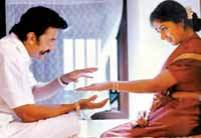 The slew of movies in Tamil cinema based on villages stopped with the late eighties as cities became the prime audience of the filmmakers. Though infinitely many stories still lie in the villages waiting to be told, not many movies from the nineties and the new century have tapped it. One film that has indeed done it, Kamal Haasan’s Thevar Magan (1992), stands out as a vital milestone in the history of Tamil Cinema.
 Cut to the present. The video becomes full fledged colour, suggesting that all that has been hidden is now revealed. The walls are decorated with the photographs that were taken during the entire journey of Saket’s madness. Saket Ram describes the photographs to Tushar. Tushar then asks if he could take back his great grandfather’s sandals and spectacles back. Saket says that it indeed belongs to him and returns it. What Saket Ram Sr. took from Gandhi Sr., Saket Ram Jr. returns to Gandhi Jr. As he returns the grasses, Saket Ram tries to look through it, as if trying to look at the world through the eyes of Gandhi. Tushar follows suit and tries to look through the glasses too.
 The song that is being played in the back ground is “Ram Ram, Hey Ram” – A very vibrant and majestic tune that talks about non-violence, cultural tolerance, the future and need for resurrecting humanity. Ironically, without playing a somber tune on the death of Gandhi and Saket, a more motivating tune is being played hinting that past is past. We have to learn from it and move forward carefully. It is up to the new Gandhi and the new Saket, the youth of India, to lead the nation on a non-violent path. As the end credits roll on, Saket and Tushar open up the windowed wall that has a huge sketch of Gandhi, allowing sunlight to pierce the room for the first time metaphorically opening up Gandhiji’s mind to the world and appealing to the nation’s youth to expose themselves to the history of the nation and also gain an insight of Gandhiji. The song attains its crescendo at this point. The screen fades to black, the song continuing, as the future of India stand near the open door discussing the nations past, present and future.
 We cut back to the past even after Saket Ram is dead. The rest of the story is revealed to Tushar by Saket Ram’s grandson. We return again to colour. Saket is ready to renounce the animal inside once and for all. He looks at the animal for one last time in the mirror. He will not be the same person hereafter. He closes the gun case after placing the gun in it, metaphorically implying that he has put an end to his rage of violence which will be shut hereafter.
 Saket arrives at the Birla house. He notices the date on the calendar – 30th January. The day India would cry. He notices Gandhiji walking out with Sardar Patel and Moulana Azad after his daily prayer. Shruti Haasan appears as Sardar Patel’s daughter. Saket knows Gandhiji’s routine for he has been observing him every day for the whole month. He notices Gandhiji walking towards him as he tells his helpers about how punctuality is important in life. He is walking fast towards the main building. He interrupts Gandhiji and a conversation ensues:
 As Gandhiji proceeds, the crowd grows thicker. As he nears the building, a man, whom we had seen during the blast 10 days ago stalling Gandhiji and greeting him. As the helpers tell him that Gandhiji is late for the meeting, he reveals a pistol and shoots Gandhiji thrice who falls down helplessly. He does not cry “Hey Ram” as believed by many to be his last words. The man is Nathu Ram Godse, who had escaped the clutches of the police in the hotel. He drops his gun after making sure Gandhiji is dead. Everyone around is stunned but are quick to start thrashing Godse. Mr. Goyal stops them and tells them that this is the moment of truth. He asks them to follow Gandhiji’s doctrine of Ahimsa in the most testing time. He manages to stop the crowd beating Godse. Gandhiji, the Ravana is killed. The prophecy is complete, but not by our Ram. It is a Ram all right, Nathu Ram.
 The mentality of Saket is most complex now. They say that you’ll know the value of things when they disappear. The same thing happens to Saket. As he sees Gandhiji being shot and killed, he is both furious that a man has done such a crime and frustrated that the mishap has occurred just when he had decided it should not. He is enraged at the murder and runs towards him taking out his gun. He is ready to kill the murderer as he runs. As he nears the scene, he is able to hear Mr. Goyal’s appeal for non-violence. Saket breaks down. He sees himself in Nathu Ram. He sees how he had wasted his life and even committed sin killing tens of men. Mr. Goyal’s appeal reminds him of how wrong he was in getting back at the murderers immediately after Aparna was killed. He realizes that this is indeed the moment of truth and holsters the gun back into the box. He learns that true masculinity is not avenging a loss, but much more non-violent and cerebral than that. He has decided that he will not commit the same folly as he did in Calcutta and closes the box. He has eschewed violence for good. But at the cost of what?
 As Godse is taken away from the police, Saket cries holding the box close to his heart, careful not to let it slip open, suggesting that he will not indulge in violence by the fall of the mind. As Saket stands crying alone in the vast grounds, we hear the haunting rendition of “Vaishnava Janato” by D. K. Pattammal, the same song that Mythili had sung during their first meeting. The song translates to:
 Saket Ram realizes the truth of the song with reference to Gandhiji. He realizes that, even though he was a Vaishnava by birth, he has not done enough to sustain the title. He does not deserve to be called a Vaishnava. As the corpse of Gandhiji is taken away by his followers, Saket watches on. The colour shifts back to black and white to indicate that nobody knew what followed.
 Saket traces back the path that the followers came. He sees the blood of the Mahatma on the way. He goes back to the scene of murder and notices Gandhiji’s slippers and spectacles on the floor. He picks them up takes them with him. The role of the mechanical and angry Rama is gone. He has become, instead, Bharata who brings back home, his beloved brother’s sandals with love but immense pain about his exile into forest.
 They decide to announce that it was a Hindu who murdered Gandhi. Saket cries. He considers himself to be that Hindu. As Saket falls to the ground, we hear the song “Raghupathy Raghav Rajaram”, as we did in the beginning, being played in the background completing and closing the circle of madness of Saket.
 Cut to the present. Back to black and white. Saket and the rest of them are still in the trench. Saket’s eyes are lit alone by the light from above, once again indicating his recollection of the past. The nurse informs the doctor Munawar that the oxygen supply, on which Saket is surviving, just got over. We can here the sound of gunfire from above. Dr. Munawar murmurs: “Ya Allah”. The oxygen mask on Saket’s face is removed and he is left alone to breathe his final few breaths. He looks at the nurse who appears to him as the young Mythili, in the form he had last spoken to. He smiles and tells her that he is not able to breathe. She asks him to wait a little till the gunfight above stops. He asks what the reason for the fight is. His grandson tells him that it is because of the Hindu-Muslim clashes. Saket cries out:
 It is said that some of your life’s moments flash through your eyes the moment before you die. As Saket’s breath becomes tougher and tougher to take, he is able to Mr. Wheeler of the first scene shouting “It’s pack up time”. Indeed, Saket Ram’s time had come. Saket says to “Mythili” what would be his final words.
 The shutter from above is removed as the police inspector comes. He says that the riots are over and they were lucky to survive. He asks the plight of the old man and learns that he is no more. He apologizes as the stretcher is taken onto an ambulance. We also see the TV reporter covering the riot and learn that these riots take place every year. Again the dissimilarity in times is being shown here.
 As the ambulance leaves, Saket Ram asks the inspector, who has saved their lives, his name. The inspector searches for the badge on his chest, only to find it is lost in the battle between him and the rioters, indicating that true heroes’ names go unnoticed during war times. He leaves it alone and tells Saket his name is Ibrahim. A beautiful parallel is struck here. Saket, a Hindu, had saved the life of Amjad, a Muslim, though momentarily. He had also saved Amjad’s family and friends in the trench inside the house. Similarly, Ibrahim, a Muslim, has saved the life of Saket Ram, though only for a while. But he has saved the lives of his family and friends, also, in the trench. It is as if Amjad was reborn to save Saket and pay back in kind for his support. Also, Dr. Munawar, a Muslim, tried to save Saket till the very end but fruitlessly. This is in agreement with Dr. Mani, a Hindu at the Chandni Chowk hospital, trying to save the life of Amjad till the very end, also fruitlessly. Evidently, this portrays the circle of life and the universal nature of humanity. The camera angles perfectly highlight the similarities (and dissimilarities) of the saviour and the saved in both cases.
 Again we see the double entendre that has been so consistent in the film. Mythili’s words mean that Saket has passed away before her. It also reveals her despair at Saket leaving her for Sanyasa. She did not speak one word immediately after he had left. So, as we see it, this is the first time Mythili is opening up her sorrow of Saket leaving the house. We also see another person placing on Saket’s chest. He greets Mythili and stands back. He is introduced to Saket Ram as Tushar Gandhi (Tushar Gandhi), the great grandson of Mahatma Gandhi.
 Saket switches on the lights of his grandfather’s room for the first time in years. After a very long time this is the first time anyone could see the objects in his room. Tushar and Saket see the things around with equal awe for they are both alien to this world. Tushar notices the three monkey skulls in front of the “three monkeys” statue. The statue, perhaps, indicates that the three monkeys, which Gandhiji had endorsed, are no more and people no more follow the principles behind the statue and Gandhi’s principles in general.
 Saket realizes that the stories that his grandfather had been telling are not tales of imagination but absolute truth as he claimed. It was the history of the country. Saket is shocked at the discovery and realizes the importance of this truth in history. As he reveals the story to Tushar, we are able to see the photographs of Saket Ram Sr.’s mother, his grandson and others in bright light.
 As Saket hears this, he gets a lump in his throat. He feels as if Gandhiji is addressing him. He not only realizes the absence of his masculinity in shooting a Gandhi from the ventilator at the back, but also feels guilty of conniving surreptitiously against a transparent man. After the meeting Gandhiji is accosted by a group of affected Hindus and is asked to not involve himself in the politics of the country. Gandhiji patiently, hears them out and says that the Muslims want him to stay whereas the Hindus want him to go away. He is confused as to whom to listen to and also adds that he will only listen to the voice of God. He asks the people to stay there till he finishes his work with the others gathered. As the crowd becomes restless, Gandhiji’s helper tries to send them away. Gandhiji stops the helper and says:
 Mr. Goyal introduces Uppili Iyengar to Gandhiji. He tells Uppili Iyengar that everyone is a Mahatma and if one is not, he is an animal. Mr. Goyal introduces Saket to Gandhiji and tells him how he saved the Muslims in the factory. Gandhiji calls him his “Rama from the South”. It becomes a strong statement in two senses. One that Saket is like Rama of Ramayana and also that people like him are rare since the south predominantly associates itself with Young Krishna. Mr. Goyal also introduces Amjad’s family to Gandhiji upon which Nafisa says that Amjad wanted to walk to Pakistan with Gandhiji. He also learns that she is Saket’s foster sister. Gandhiji asks Saket:
 These words resonate in Saket’s ears. Tears rush into his eyes. He is not able to get words out of his mouth. He manages to tell Gandhiji that these were the exact words that Amjad had said before he was struck down. He realizes, now, the universality of feeling of brotherhood and want of peace. Gandhiji asks Saket and Nafisa to walk with him to Pakistan to fulfill Amjad’s promise. Saket develops a strange sense of respect for the man standing before him. He is amazed by his sense of commitment and true desire for peace.
 Amjad struggles for life as Saket lifts him up. He also ties a cloth around his head to stop the wound. Saket is searching for the hospital. He is not able find his way out. Amjad asks Saket to take him to the soda factory as Saket obeys. Many people fire at him. Saket does not care if it is a Hindu or a Muslim. He just kills them to save Amjad. He finally brings Amjad to the factory. The ladies cry on seeing him in that condition. Saket retires at a corner as he sees the silhouette of a woman giving birth inside the room. The shrieks of the woman are heard by Saket as they transform to the cries of “Ram, Ram”. The sounds remind him of Aparna’s cries during the attack and the visuals remind him of Mythili’s pregnancy. He is haunted by both the memories, which he thought he had forgotten. He is reminded the universality of womanhood.
 Amjad struggles to upstairs as Saket follows him. They see the men fighting the Hindus. It is learned that the pregnant woman is Qureshi’s wife, the man who wanted to kill Saket in the factory. Qureshi tries to shoot Saket and is stopped by the struggling Amjad. Qureshi has run out of bullets and the building is soon to fall. Amjad tries to negotiate with the shooters even as the others in the factory object, but in vain. Amjad is shot in the leg. Saket is furious and shoots out a few Hindus with his gun. He then opts to defend the factory for the sake of his brother. He too runs out of bullets after a while. Meanwhile, Qureshi tries to shoot Saket, with the newly obtained bullets, just to be stopped again by Amjad who asks him to give his weapon to Saket. As he throws his gun to Saket, Qureshi is shot to death.
 As Qureshi falls, we hear the cry of a new born. Clearly, it is Qureshi’s child. A new life is born as another one dies. This is the same thing that happened when Saket was born. His mother passed away on his birth. Saket, once again, is reminded of the universality of life and death. The attacking crowd disperses as the atmosphere becomes silent.
 Suddenly, there is a bang on the factory’s door as a wooden drum is dislodged and rolls into the trench where the women and the children are. They gather the drum and start playing it to celebrate the birth of the child. Amjad watches them pityingly for they are not aware of Qureshi’s death yet.
 They thank him for his help and learn that Qureshi is dead. Amjad’s mother and Nafisa ask him where and how is Amjad. He is speechless as Nafisa runs crying after the ambulance. Saket breaks down. It is him who has been responsible for all this murdering. He had started riots in the hitherto quiet locality. Yet another wife has lost her husband and yet another newborn child won’t be seeing is father. And the count goes on. He has been the initiator for the massacre that has brought about his brother’s plight.
 Amjad reaches for Saket and holds his hand. He then collapses. The doctor tries to do some treatment as the senior doctor evacuates the area and calls Saket alone. He informs him that Amjad is no more and the treatment is to avoid his family from breaking down in the emergency ward. He asks Saket to take them out and inform them. Amjad gets his final blow. His brother is dead because of him. Just when he thought he had got rid of his guilt about being unable to save his wife, he is reminded of his masculine impotence in saving his brother. Saket takes Amjad’s family out as the ward door closes on Amjad, physically and metaphorically.
 The Seventh Art