[The following interview was conducted for the Forum section of the Berlinale, where the filmmaker’s debut feature Members of the Problematic Family had its world premiere in February 2026.]
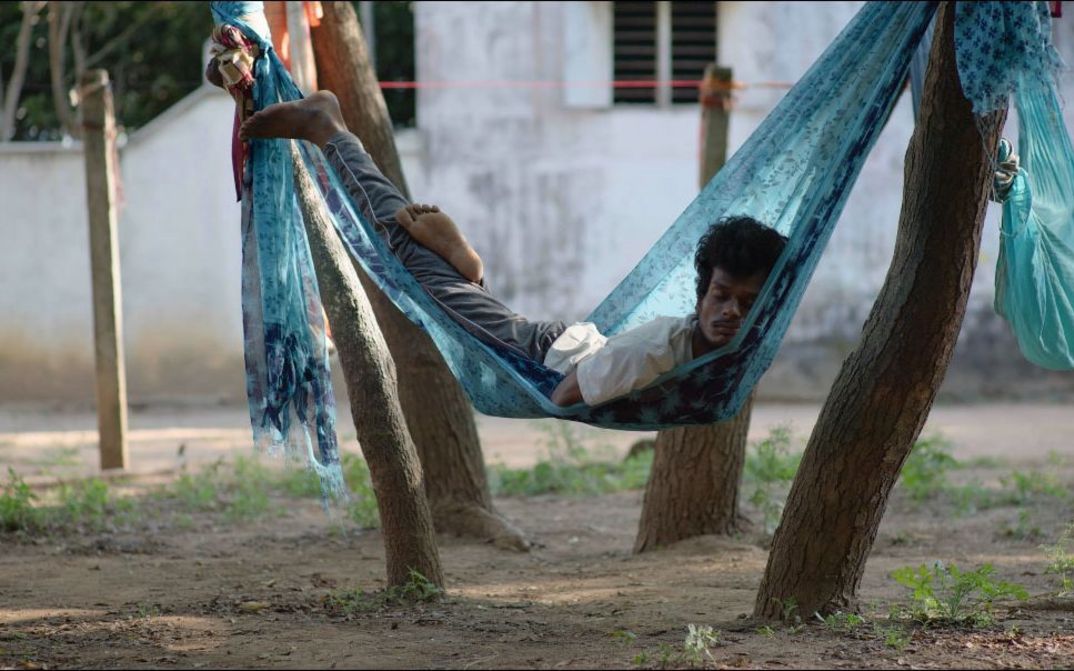
Berlinale Forum: Welcome, Gowtham. I’m extremely honoured to have your film in our lineup. I’d like to start by asking you to kindly describe your journey to becoming a filmmaker.
R. Gowtham: Thank you. It took quite a long time, actually. I was preparing for competitive exams for the civil services for a while. I had plenty of time to watch movies and read literature. People at home were hoping to see me as a government official, but I wasn’t doing that. I was totally into stuff like Andrei Rublev (1966), 8½ (1963), the film magazine ‘Sight and Sound’, and the website ‘They Shoot Pictures, Don’t They?’. I was downloading things through torrents. I didn’t pass the exams, not even the preliminaries. But the exposure to literature and movies helped. I went on to study journalism and made some short documentaries. After that, I made this film. I had multiple other jobs before becoming a filmmaker.
Since you didn’t have connections to film schools or the industry, what did it take for you to get together all the people and equipment to start this project?
The people who made this film, we’re a bunch of talkative guys. We’d always talk about making things, but never actually do anything about it. So much so that people would ridicule us for our empty talk. We could’ve spent our entire lifetime in a tea shop talking. But then, Pebbles (2021, directed by P.S. Vinothraj) happened, and its international success gave us the confidence that we could go out and make something. I convinced my childhood friend to put in the money. It was more difficult than convincing a regular producer, but it happened. We didn’t have any hands-on experience; we just went ahead and shot.
But you’re working with actors, not with non-professionals, right?
It’s a mix. Ajith Kumar, who plays Prabha, is from the theatre. So is Karuththadayan, who plays Sellam (and the lead in Pebbles). A couple of them are movie actors, a few others non-professionals. I didn’t give instructions to the actors; it was rather an art of negation. ‘Don’t do this’, ‘I don’t want this’… I didn’t go for too many takes either. One or two were enough for me. You can’t push non-professionals too much; they would be unnerved and would refuse to perform. So we used to pre-roll before the actual action. That’s how we were able to grab certain emotions.
How many days did you shoot altogether?
We shot for 27 days, but the bulk of it was done in 8 to 10 days. Other days were for preparation. There was another section that we shot, a kind of genesis that tells the backstory, but we didn’t include it in the movie.
What about the script and its relation to the preparations? What did you give the actors and what does the script look like with respect to the structure of the film?
RG: It was conceptualised as a four-part work, and we didn’t change anything. This script was decent, I would say, but not conventional. There’s no save-the-cat template or things like that. I thought, let’s treat it as a kind of novella. A single line was equivalent to a shot. It wasn’t formatted like a screenplay. I wasn’t too worried. I had Andrei Tarkovsky’s book ‘Sculpting in Time’ (1985) next to me; I was re-reading passages from it. We were praying. We thought this would be like a cinematic prayer and let the movie find its way.
[Read the full interview here]
 The Seventh Art