Lecture at a round-table on the theme “For a new critical consciousness of film language”.

Mostra de Pesaro, 4 June 1966

This lecture shocked Metz, Barthes and Pasolini (who was nonetheless a fan of my first film). But it delighted Godard.

The delay and the difficulty with which we have come to understand the components of film language (film languages, for there exist, alongside the Hollywoodo-European language, Japanese, Hindu and Egyptian languages) have made us take this understanding for a great success. I think that we were right to be proud, because it wasn’t easy to discover. But where we were wrong is in believing that our magnificent effort made us understand something magnificent. We were wrong in mistaking our effort for its result. Because the result, the knowledge of film languages, reveals but one thing, and this thing is the congenital artistic mediocrity of past, present and future film languages.

Christian Metz says that we cannot attack film language, since it codifies pure forms. I disagree: right from the moment when a human being invented these forms that others will transform into codes, these forms are impure, tarnished—and fortunately tarnished—by his/her personality. Metz says that the alternation of images implies simultaneity of facts. In this case, it’s a personal codification initiated by the creator of the first parallel montage, which could also signify, among various possibilities, the alternation of facts and the hero’s thoughts (The War Is Over), comparison between time periods (Not Reconciled), alternation of the creator’s and the hero’s thoughts (Marienbad). Even though these three implications are contrary to the original meaning, they are no less comprehensible: it isn’t necessary that the devices be codified in order to be understood. Indeed, the first film employing parallel montage was successfully understood, even when the code hadn’t yet come into existence.

Metz also says that we should not pass an artistic judgement on language, which is necessary and neutral. Now, a communicative instance is always also the first time an aesthetic instance. It’s the second time that it becomes solely communicative. The first time we perceive this instance, we indeed experience an emotion of an artistic order based particularly on surprise. Similarly, an aesthetic instance is always likely to be a communicative instance, at times even exclusively. So it is with the dramatic value of colours. Defining art solely as a means to harness a medium common to everyone seems to me to be a bourgeois conception of art: eighty percent fixed stock, twenty percent sauce of your choice. It’s a conception that can be defended only if one attributes a secondary role to film art, an entertaining function, a purely decorative interest. And, in that case, I think our presence, this colloquium and the Mostra would be useless. Art’s interest lies especially in being able to, in having to destroy and reconstruct its own foundations and venture into its own depths. To be sure, I understand that art can attach itself to language if the creator superposes another aesthetico-communicative—or rather, I prefer, communico-aesthetic, for it’s prettier—instance over it that’s also liable to be transformed into language. It’s very common in cinema. But whether this instance attaches itself to language or not has no bearing on its value, and thus is of no importance.

There is a complete opposition between film language and film art, for film language spills over into art, invades, and suffocates it. It is a relationship of opposition, not one of indifference: language and art are the bottom and the top of the same thing; language is failed art.

Literary language, less absorbent, is indifferent to art: it remains a simple and modest medium of art as of information. Film language, on the other hand, conditions art. One could say that good cinema starts where language ends and dies where language resurfaces. And if all bad films are not necessarily representatives of film language, for there are bad avant-garde films, it’s nonetheless sure that film language can only produce bad things, with one rare exception. If not all rubbish is language, language is always rubbish: the proof for this is that, in all books on film language, the best examples are drawn from rubbish and the list of cited films are made of many duds and leaves out many masterpieces.

Why this state of affairs? It’s simple: the viewer receives a work made by the artist. It’s the first stage, that of communication. Alas, there can be a second stage: the viewer, having become director, redoes what the artist has done. It’s a reply along the same lines, an inter-communication. That’s what’s called language, redoing what another has done, redoing that which doesn’t belong to us. Language is theft. Art is individual, communication of a single instant, it’s that which can exist only once. Language is that which can only exist from the second time onwards, when an associate has transformed art into signs. There is no more creation, only mechanical reproduction. Art can never be reused. Language can only be reused, for it’s in being reused that it proves itself to be language. It is the vain attempt at eternalization of artistic success the human being always dreams of. It is the negation even of artistic originality. We perceive film art thanks to a personal effort of reflection or intuition. We perceive cinema of language with no effort—and it is, besides, for this reason that we have such difficulty in being aware of this language: it is made for our laziness. In film language, the thing expressed is no more than a common symbol, a sign that filmmaker-robots employ and which viewer-robots understand.

The biggest danger of film language on the artistic level is that the one who employs it thus destroys his own personality. The French who imitate American cinema are but appropriating the means conceived by Griffith and DeMille to express in the best possible way their personal universe, marked by Southern spirit and a puritanism that has nothing to do with the universe of the French directors. When Lelouch borrows Godard’s language by recopying Godard’s stylistic ideas, he necessarily fails because Godard’s stylistic expression depends on the fact that Godard is Swiss and Protestant and that he is Godard. Now, Lelouch is nothing of that sort, he expresses personal themes different from Godard’s, or most often, he doesn’t express themes. Language is thus alienation.

Moreover, the successive and separate landings of film language—Griffith-language, Godard-language for example—are necessarily contrary to art, which proceeds without ever being able to stop at any landing. If it does, it ceases to be art.

We thus see how great the harmfulness of film language is: the viewer has to make no effort to understand the film. The signs of language make him understand everything without effort. He becomes passive, lets himself be put to sleep by the fiction of the film. Cinema loses its role as a school of life, before which man retains the same passivity. During the years 1945-1955, language had crushed cinema with such power that viewers, who generally didn’t have past filmic experience, believed that cinema coincided with film language, and that all that wasn’t cinema of language was without interest and bad. It took ten years for the public to start understanding that the language-cinema it was used to was but one episode in the history of cinema, which could very well develop without it. One could say that the refinement of film language considerably delayed the development of film art and the civilization of the masses.

Film language nonetheless possesses four strengths: firstly, the clarity with which it appears now, thanks to the efforts of researchers, has allowed the enumeration of all its devices. That is to say, everything that should not be done. It’s quite convenient. Certain films even mount a critique of film language, which they turn upside-down to obtain surprise effects. It’s the case of some scenes in Godard, Hitchcock, who are therefore dependent on the mediocrity of film language.

Secondly—and this is the exception I mentioned earlier—filmmakers can hypocritically respect language in order to take the viewer into confidence and slide in a revolutionary thought more easily, or to indict social or psychological conformism of which the very principle of film language is but a reflection, with the film presenting itself as burnt offering. It’s the path of more or less anarchist filmmakers, Buñuel, Chabrol, Franju. It’s the destruction of language from within.

Thirdly, directors can respect the rules of the language and create an original work despite language, for reasons external to language, which neither brings nor takes anything away from them. I think almost all good films retain the echoes of film language. If we attribute a value to them, it’s because they carry fewer echoes than others, it’s because these have little importance, because we forget them and especially because there is something else in the film. Our appreciation is thus on relative terms and not absolute ones: we like them because there’s nothing better. This third alternative has a great financial advantage, as does partly the previous alternative: it guarantees the commercial career of the films.

For, fourthly, film language above all has a monetary advantage: since it’s easily accessible to everyone, it’s the prime mover of the film industry, which partly conditions the art of film. It’s the reason why the politicians and the grocers of cinema, the grocer-politicians and the politician-grocers of cinema love it. It will therefore be impossible to make film language disappear and even undesirable to do so: the value of films being found in relation to other films, it is impossible that, out of a hundred films, there are fewer than seventy-five bad ones. Better that these seventy-five duds respect film language, which brings in money, than orient themselves towards bad avant-garde, which brings no money. It avoids unemployment. Just that what happened in the world ten years ago—and what’s still happening in Germany today, namely ninety-five out of hundred films being language-cinema—must not happen again. For, in that case, the public is led to refuse all art and thus all new forms of language-cinema. Prohibiting such a renewal spells doom for art and also for the industry, which needs, from time to time, this small dose of innovation brought about by every new landing of language-cinema that art unveils.

Each one of us in this room, critic or filmmaker, should therefore undertake a struggle against film language, which should assume, in order to be more effective, a new offensive appearance, but which is in fact defensive, since art should be and always will be a minority with respect to language.

Filmmakers, to the extent that they are not constrained by material necessities, must refuse to make language-cinema; they must even refuse the double-game I mentioned, creation within or outside of language, for in respecting the rules of language without following its spirit, they will always be defeated by those who respect its spirit, that is to say the merchants who will crush them. Critics must study the history of cinema, learn by themselves and make others learn that film language is like religion, that the well-known film language isn’t the only one to exist or to have ever existed, that it belongs to a determined time and place, that one particular film language should not be favoured nor a film language be expected during the projection of each film, that film language is but the fruit of laziness and lack of imagination. Each of us must be able to shout out loud: “Down with film language, so that long lives cinema!”


[From Luc Moullet’s Piges choisies (2009, Capricci). See Table of Contents]

I have written a few theoretical texts. Not too many, that’s dangerous. Metz, Deleuze, Benjamin and Debord committed suicide. Maybe they discovered that theory takes you nowhere and the shock was too rude (not to mention Althusser).

In this regard, great critics die young. Delluc, Canudo, Auriol, Agee, Bazin, Truffaut, Straram, Daney. Seeing too many films eats you up.

I’m still there, which is proof that I’m not a great critic.

This theory holds good only for good critics. Charensol was almost hundred when he died.


[From Luc Moullet’s Piges choisies (2009, Capricci). See Table of Contents]

The Cannes Congress (extract)

Cahiers du cinéma no. 213; July 1969

The three great films at Cannes, the Italian Carmelo Bene’s Capricci, and Nagisa Oshima’s (Japan) Death by Hanging and Diary of a Shinjuku Thief, devote themselves to exploring new planets in cinema.

The most daring of the three is the Bene: hardly any plot, even less psychology. It’s cinema at a state of purity never seen so far. There is nothing here other than cinema, other than ideas about cinema and without anything to do with tried and tested ideas of cinema. I don’t want to talk about technical ideas, even though there are technical ideas. It’s a hodgepodge of all kinds of ideas including technical ones. Until now, filmmakers who took off too directly from reality in order to arrive at the nonsensical, the absurd or the enlightening have fallen on their faces. I’m thinking especially of Richard Lester’s ill-fated Help. Bene is the first one to have succeeded without falling back on conventional references. It’s true that he resorts to parody, especially on the subject of gerontophilia. But this parody is too excessive to be effective as parody. It soon become lyrical and assets itself as a new value independent of what it caricatures. Bene’s success probably stems from a ceaseless descent into excess without hesitation or respite. Though there are moments stronger than others, it becomes almost impossible to remember all the elements, the viewer being overwhelmed by the whirlwind of the whole affair and the elements too far from reality to be readily absorbed by the mind.

Death by Hanging, too, has this quality of a compact monument. Oshima, however, doesn’t start off from the beyond. The film begins with a simple description of hanging and it is only slowly that we enter increasingly strange horizons. The viewer is captivated and carried away by this continuous progression. The fantastic acquires greater power as it is presented in a classical, sober and rigorous style that compels us to accept everything. At the same time, there is a constant exchange between these two contradictory elements. The film revolves around a death row convict who survives his hanging and must be hanged again immediately. But in Japan, you can be hanged only if you’re in a state of complete conscience, something that’s difficult to get after a first hanging. The officers of the prison mime the crimes he committed in order to bring back his memory, the prison director playing the role of the raped girl etc. This is only the starting point of a story which has infinitely more original events to follow, with a final return to social realism that assumes an extraordinary character by being situated after such narrative and thematic extravagance. It’s the most fantastic script in the history of cinema. And it’s hard to imagine how it could’ve been possible not to make a masterpiece out of it. I mean that, at this degree of ambition, it would’ve been impossible to shoot such sequences if they hadn’t been perfect. The actors couldn’t have been able to perform, the technicians couldn’t have been able to continue… That’s why I was doubtful about Oshima’s value. Perhaps he was a flash in the pan of The Brig kind. When he isn’t supported by a strong subject, Oshima would probably collapse. That’s why I wasn’t in a hurry to see his Diary of a Shinjuku Thief. I stayed through Biberman’s film and only saw the second half of Diary. Coming out of this other masterpiece, I was even more annoyed with Biberman, clearly made to look ridiculous in front of such films. Sex, theatre and social politics are indissolubly united here in a series of surprising confrontations of elements no less surprising. The film’s foundation might recall Godard, but the developments are absolutely personal. One is amazed to learn that this unknown filmmaker with a devouring personality is not a beginner, but has already made fifteen films in ten years. The law of averages guarantees that there are some more masterpieces in there in reserve. Forgotten masterpieces exist not only in the past, but also in our own time. The jury at Bergamo, where Hanging was in competition, refused even to give awards; all the films seemed mediocre to it. I’m perhaps slightly overrating Oshima’s work since I’m almost completely unaware of his context and this ignorance increases the impression of originality: there is a tradition of excess in Japan—which we admire in Yasuzo Masamura too—and a tradition of amalgamation, ghosts rubbing shoulders with social politics in Teshigahara for one thing. Be that as it may, Oshima towers over everything that we know of these traditions.


[From Luc Moullet’s Piges choisies (2009, Capricci). See Table of Contents]

Cahiers du cinéma no. 99; September 1959.

If we are publishing this text that seems to have only a distant relation to film criticism, it’s because we think that good literature is worthier than bad cinema and that this article constitutes a good “short story” (Ed.).

I’ll take the liberty of breaking with the tradition that requires you to present with great erudition the city where the festival you are invited to takes place. Getting down from the train, I looked around anxiously for any particularity that made San Sebastián (Spain) a Fullerian, Hawksian, Rossellinian or Cukorian city, in order to be able to better place it in the mind of Cahiers readers. To be sure, extremes rub shoulders this “Basque Nice” as we seamlessly glide from the rococo palaces of Rio Urumea to the wooden huts and scattered sheep of the harsh ridges surrounding the city. But to be fair, I think this allows me to clearly discern in San Sebastián the signs of an internal dialectic comparable to those in Eisenstein or Hitchcock.


Awareness of the social self

I’m looking at festival reports published by Cahiers. It’s expected that you give your opinion on the value of each festival. Which bores me a lot. To say that this festival is mediocre or that festival is excellent not only seems difficult to me, but I also believe it means nothing at all.

Reviewers generally start by criticizing bad organization or praising the efforts of the festival committee. If they are sincere, they redeem themselves by acknowledging the quality of the competition. The fact of the matter is that it’s rather impolite, and embarrassing to the person who does it, to demolish a festival that spent fifty thousand francs on your invitation—accommodation, food, screenings etc. Let’s confess frankly that we could have enjoyed the two screenings of North by Northwest, which essentially justified the existence of this festival, even in the small MGM theatre in Paris, since Paris already had a copy of the film ready before the festival. Of course, everyone knows that the festivals committee of San Sebastián doesn’t organize this festival to spread the knowledge of film art but to serve as local publicity, with all the concomitant effects on tourism, which will fill the cash registers of San Sebastián and Madrid more abundantly. But you don’t need to go far—five hundred metres in the city, fifteen kilometres in the countryside on bad or sometimes even forbidden roads, and when there are roads, it means that the communes are rich enough to pay for them—to note that gloomy misery prowls in the vicinity. Yes, let’s say it since it must be said even if the reader of Cahiers doesn’t give a damn, and he is absolutely right, we were well fed, well lodged, well served, and the organization was almost perfect. But it’s just this that I’d hold against the festival. We were too well fed, too well lodged and, to the direct detriment of the Spanish people, even if it was negligible, even if it was indirectly made up for by the money brought back by the event’s publicity power. The national government is more interested in ostentatious pomp than depth. And what shocked me definitively is not so much the fact that I stole something, at least virtually, from the Spanish people. After all, I was maybe the least guilty of my colleagues of this involuntary theft, in that I was perhaps the one critic of all who rated North by Northwest, the film that brought the most awareness of this festival, at the top. This awareness of the social self, as Domarchi would say, manifested itself through this comparison devoid of its serious character. No crises, except for a certain embarrassment, and an amused acceptance. It was enough for me to look up the list of French critics invited and find the name of Michel Capdenac of the Lettres françaises there. I don’t know Capdenac, but I am quite sure that he enjoyed the same privileges as me, that he didn’t turn down a drink, a meal or the cosy bed offered to him, and even that he didn’t bother himself with these questions like me, even though he is a practicing Marxist1. In short, just thinking of Capdenac made me chuckle and freed me of all social complex. Ah, here I must continue my sentence: as I was saying, what shocked me the most was that the Spanish people, a part of which was waiting applauding for two or three hours, sometimes under the rain, for the entry and the exit of festival-goers at each soirée, seemed to create this tragic and absurd farce at its own expense. I found this admiration of the working class for the rich and idle class, in which it likes to see itself mentally, identical to and brilliantly and cunningly portrayed in The Last Laugh, screened here in the retrospective section at twenty-four frames per second and without the last reel.


The anti-dialecticism of intellectualism

I’m still looking at festival reviews in Cahiers. Some find that the schedules are badly thought out and prevent them from seeing all films, others complain about the flowers that block the view from the front rows, or other trifles. So, I’d reproach the 12th San Sebastián Festival for not having anything to reproach it in the pages of Cahiers. On second thoughts, I have a whole lot to complain about. For instance, what’s terrible about the luxury hotels where we are put up is that everything runs smoothly, everything is done for the supposed comfort of the customer, and it’s this that is unpleasant. They take the suitcase from my hands, they bring the breakfast to my bed, I had the feeling of being good for nothing, of being treated with the respect usually reserved for Réné Clair, Marcel Camus or some other doddering geezer. They’ve just stopped short of bathing and grooming me. The most ordinary gestures of everyday life, which even the greatest geniuses can’t live happily without, are prohibited for us. No helping hand to lend, no shopping to do, no firewood to pick up, or dishes to wipe. Everyone is condemned to the anti-dialecticism of intellectualism. Write, write, write forever. I think, therefore I am… but no, I think therefore I don’t wipe, for there’s nothing to wipe. At the most, I open the tap of my washbasin, hoping deep within that it’ll burst and that I will have to repair it and stop a flooding. There is running water in my washbasin, and even hot water. But I’d have preferred to be in the mountains where a litre of cold-water costs a hundred francs, because it’s at least fun to calculate how much water I can waste at the most. There is a bed in my room, and even curtains, but I’d have preferred a sleeping bag and some hay, firstly because it feels better and also because it allows for some amusing, involuntary nocturnal slipping and bizarre awakenings. Where am I? Where is the north? Good God, where could this north be that I’ve lost? I want to take the stairs, but the overzealous lift boy drags me into the elevator: he doesn’t know that, as a fan of Touch of Evil, I never take elevators, in order to struggle with it by my own means.


Clerics, clerics, clerics

Let’s be serious. What’s the San Sebastián festival worth? I’ll tell you: it doesn’t matter. Besides, I don’t see why that would interest you since you don’t go to festivals often. What I say would only interest the director of the festival. I am a critic of films, and not of film festivals. And then, an organiser doesn’t merit praise for producing a good festival. There are no miracles in cinema, and if there are, nearly all of them are predictable. There are about twenty film auteurs in the world, those that are lauded in the Cahiers. After them, a void. That’s it. Respected organisers of big and especially small festivals, please invite their latest work and, if possible, the first films of promising directors whose names we have at Cahiers. If Cannes and Venice seize Bergman, Buñuel, Rossellini etc., catch hold of Cukor, Minnelli, Ray, Fuller, Hawks, Lang, Vidor, Cottafavi, Melville, Barnet, Losey, Godard, Kinoshita, the condemned of competitions. You’ll be right every time. Avoid at all cost directors who have more than two films to their credit and not a single success. Look down on national selections, they are the ones responsible for the sufferings of Saint Sebastian endured by critics. The selection committees tell themselves: San Sebastián is Spain, so we need clerics, we need moral, well-intentioned, children-oriented films. This is the reason there were thirteen bad films of the twenty-two in competition, most of them vile. This is not a criticism: Cannes prefers the average to the vile. But the average isn’t out of place in a festival any more than the vile. Let’s compare the two festivals: 1 point for great films, ½ for good films, half-price for out-of-competition premieres: The 400 Blows + Nazarin + Desire + India + Hiroshima + Anne Frank = 3 ¾ points for Cannes. The Hitchcock plus the Bulgarian film and the Indian film plus the Ford = 2 ¼ points. The difference isn’t great, Cannes wins it thanks to the value of its out-of-competition films, and it would’ve been enough for Verboten! and Rio Bravo to go to San Sebastián to reverse the trend. So, let’s not try to establish a list of best film festivals. San Sebastien 1958 with Vertigo, a Monicelli, a Sirk and a Guitry clearly had the upper hand over Cannes 1959. Let’s not attach too much importance to the prize list of festivals.


A gradation in sublimity

Cinema is not a sport or a beauty contest. The best remain the best for forty or fifty years. The spectacular and publicity interest of awards can endure only if it brings something new, something original, if it distinguishes itself from its precedents. Now, had the judges been fair, Hitchcock would’ve already won eight times at Cannes and Venice, Rossellini seven times, Welles five etc. It would’ve made no sense. It would’ve made sense if there were a festival of all the best films of the year. But these are scattered across six or seven competitions and win hands down over others, as expected all along. We understand hence that The Nun’s Story, a mediocre film by Zinnemann, but the third least bad film by little Fred, was crowned at the expense of the great Alfred’s admirable North by Northwest, which arrives only at the nineteenth position among the forty-six Hitchcocks. Only one awards roster this year will have some meaning because among the losers there will be virtual winners: Venice. We’ll give the winner the only campionissimo of Italian cinema, the leader Roberto getting ahead of Otto by a wheel, Claude by two laps, Ingmar bringing up the rear, Mario and Jerzy winning the peloton sprint, but it could be the other way. There, it would really be the films that triumph and not auteurs. We notice that the greats produce at most three or four works superior to their other films, and it’s these that a festival should award, thanks to a general confrontation without any exclusion. Orson, Roberto, Luis, Alfred, Ingmar, Charles, Jean, Fritz and some others would block the road forever and the best, even Murnau, wouldn’t be able to win more than four times. So, no academism. And we’ll gain in lucidity. For one must be strong to be able to prefer India to Nazarin or Hiroshima. To establish a gradation in sublimity, that’s the purpose of festivals. It’s the most difficult, the vainest perhaps, but also the most enriching of all intellectual exercises.

In short, here’s my award list at San Sebastián:

★★★—1. Alfred Hitchcock’s North by Northwest (USA)

★★—2. Shakti Samanta’s Insaan Jaag Utha (India)

★★—3. Nicolai Korabov’s Malenkaia (Bulgaria)

★—4. Jerzy Passendorfer’s Answer to Violence (Poland)

★—5. Vladimir Pogačić’s Alone (Yugoslavia)

★—6. Fred Zinnemann’s The Nun’s Story (USA)


North by Northwest

(Silver Shell for the good quality of its creativity, its ingenuity, its subtlety) Admirable in itself, disappointing for a Hitchcock. Had I enjoyed Hitchcock’s artistic and commercial position, I wouldn’t have gambled on a subject that emphasizes so little on the nature of the characters, which are of an amazing richness in comparison to those of The Nun’s Story, but which suffer in comparison to those of Vertigo. It’s a more evidently commercial film with numerous holes in the course of its hundred-and-thirty-six-minute runtime, of a constant, rather surprising beauty and sparse sublimity, which owes a lot to the private joke (A.H. literally misses the bus), to the idea of pure mise en scène, harnessed here to the detriment of the script. It’s an art that places all its stakes on volumes, colours, duration, the concept of an already geometric and abstract figure, and Hitchcock wins every time thanks to the disconcerting neatness of an execution that’s as simple, as pared down as possible. There are here four or five greatest scenes that Hitch has ever shot, but we ask more of him. Eva Marie Saint makes a good screen debut. Mason is good. Grant excellent. Burks too. Saul Bass, brilliant, eclipses the windbag McLaren’s Serenal, which progresses at the rate of one idea every three minutes. But Serenal only lasts two minutes and fifty seconds. Requiescat in pace. Amen.


Two revelations

The only two other “cinematically thought” films crush the mass of films towards the direction of scholarly or aestheticizing actors. Uneven, of bad taste, botched up, they remain attractive thanks to the spontaneity and inventiveness of the acting, to effects that never borrow their power from morality or sentimentality. I don’t understand Hindi and I didn’t try to understand what happens in Insaan Jaag Utha. This film is good because the actors sing and dance here with talent, because the tics of the secondary characters are pushed beyond the grotesque, because there is action and plot twists. The best scene, the final fight in the quarry, is delirious: hanging on their respective ropes, midway between the summit and the depths of a quarry, which is going to explode, the two heroes try to knock each other off with kicks and blows. Good music. Margarita Ilieva, the Bugarian Malenkaia, isn’t very pretty, but she’s as lively as a Castellani heroine. Her partner is good, many little ideas in the intimist style. Good scenes in the streets of Sofia with well-directed extras. Colourful and exuberant formalism: a love scene seen through a distorting fishbowl. Gratuitous but funny. Critique of contemporary society that puts itself in an awkward position. Korabov (30 years) doesn’t care. Samanta neither. We neither. May they continue!


And the Polish?

Answer to Violence (critic’s prize and direct rival to The Nun’s Story), to which I preferred a new viewing of the Alfred, strikes us seemingly with the effectiveness of a raw document: the preparation and execution of an attack against an SS general, Warsaw, 1942. One point, that’s all. Out of competition: Farewells, Wojciech Has’s cerebral and baroque love story that I didn’t see; A short, talented Red Balloon called A Walk in the Old City of Warsaw, the latest Wajda, Ashes and Diamonds, cinematically average and impresses only with its baroque peaks, which are often unpleasant (emphasis on WCs). But the shirt that goes up in flames under the impact of bullets, the dying man who sweeps the ground with his feet to alleviate the pain, all these are not bad. Interesting script. The hero hesitates between homo and heterosexuality, but Wajda, the impulsive intellectual and aesthete, matches up poorly with his intentions (cf. Plazewski’s excellent article in our 96th issue). Documentary or baroque, Polish cinema occupies only an honorary place in world cinema. Nothing more.


L’il Fred won’t grow up

In The Nun’s Story (Golden Shell for the content inspired—for the contained inspiration, I’d say—by its theme, the purity of its direction on human and aesthetic levels), Audrey Hepburn, mediocre and out of place in the role, but Best Actress prize, tosses away her veil at the end of fifteen years and at the end of three hours and a half, which the Christian charity of Jack Warner cut down to two hours and a half. I had taken my precautions and napped before the screening; it was necessary, I wouldn’t have lasted otherwise. If Domarchi was at San Sebastián, we wouldn’t have known the end of Eisenstein’s secrets2, for this drudgery would have killed him for good. Zinnemann takes a stab at colour again like Huston, and it’s bad; he drones about metaphysics, it’s awful, he misses the mark completely. Let’s not be mean: the style comes across as simple, documentary, medical (it’s also about medicine, like the best Zinnemann, The Men; all the better, Zinnemann has everything it takes to be a doc). Not too many aesthetic experiments. The document is perhaps false, Aretino described the life of nuns differently, but the simplicity holds your attention, like in The Goddess. Even so, at the end, we have the desire, like Kyrou, to become a priest-basher. A film like this does considerable wrong to Christianity. I give it a rating of 53.


Miscellaneous, summer films

Since Zinnemann, whom I can’t be suspected of having a weakness for, comes sixth, only inanities must follow! Alone is a decent, suitably played, popular-democrat-style war film. Ragpicker’s Angel (the OCIC prize for showing a Japanese Christian) plays firstly on its baroque setting—not bad—and then collapses into pathos. I nodded off, I opened my right eye for a second, I closed it, I opened the left one: oh boy, what torture! I stayed because they told me Gosho was a good guy, but I’ll only trust myself from now on. The Rest is Silence (special prize), decently played, modernizes Hamlet with ridiculous results: expressionism, Claudius, head of a factory in the Ruhr, sells to SS his brother who, now a spectre, telephones Hamlet, who escapes from an airport… Marine expressionism in Wolf Hart’s Abseits, mediocre Golden Shell for Short Film. Among the Ruins started very well: the script is funny. The professor and his charming pupil fight in class, but fall in love with each other. After this, a horrible, melodramatic flashback for an hour and a half in order to remain faithful to the novel. In the first reel, Ezzel Dine Zulficar reveals himself to be as enjoyable as his relative Mahmoud Zulficar, but the rest of the film shows us that talent is not hereditary. The Light from the Top starts with beautiful landscapes, the actress is good, Portuguese is sweeter to hear than Spanish, but God, what melodrama, what sermonizing after that!

In two sequences of From the Apennines to the Andes, the actors eat naturally, and in the last, Rossi Drego undresses rather prettily behind a bedsheet put out to dry, which won it a joint Silver Shell with Hitchcock! Capdenac is completely crazy to see a masterpiece in For whom the Skylarks Sing, a dull peasant film. In Crime After School—jazz party—Vohrer, the German Molinaro makes the pretty Corny Collins ugly. G.B, N.T.R. Death in the Saddle, a parody Western, shows that the Czechs don’t yet know how to suitably use cinemascope. The films in Spanish are impossible: susceptible to pretension, theatrical actors, ugly language. Despite his Nobel prize, the savant in Leap to Fame (award for Best Hispanic Film and for Best Actor) doesn’t manage to interest us. I’ve not seen the Mexican film: they showed me some photograms earlier, that was enough; nor Everyone’s in Love: that gives me a good pretext to remain courteous to Jacqueline Sassard, which is very difficult after seeing her films. To be frank, let’s say that, not being a masochist, I stayed till the end of only about a dozen films. Life is short and spending more than ten minutes with a turkey is bad. If there’s nothing at the end of ten minutes, there’ll be nothing beyond. Which allows me to judge the value of films according to time: I stayed for 11 minutes, 23 seconds for Death in the Saddle against 8 minutes, 23 seconds for Convict no. 1040, 2 minutes, 47 seconds for Adolescence of Cain and 22 seconds for Leap to Fame. So, Death in the Saddle is superior to Cain by 8 minutes, 36 seconds.


India mon amour

Outside competition, The 400 Blows (France was not officially represented), not bad at all4, John Ford’s The Horse Soldiers and the sublime India, the most dizzyingly rapid and the most dizzyingly slow of all films, the most disconcerting, not the finest, but the newest of all, much newer than even Journey to Italy. Some yelled in rage in their seats, the others nodded off, exhausted by Rossellini’s incessant merry-go-round. I was speechless, completely astounded. And to think that certain critics at Cannes could see a good documentary without personality in this work next to which Ivan the Terrible comes across as an aborted bastard of the tradition of quality and which establishes itself as the firm favourite of the Moscow Festival. I hardly like unjustified hyperboles, but I think that, until we have the advantage of two or three screenings, for once, it’s there that the only reasonable and impartial criticism that one could make about the film lies.


A fine Ford

Over two hours and the American Civil War, a commando unit lead by Wayne and Holden advances into Pittsburgh. Mediocre photography by Clothier. But Ford is in full form. A curious thing: what irritates the most in Ford—a rather crude and embarrassing humour—is what explains his success and enables the fleshing out of subtle and endearing characters. More than a moving film—scenes of butchery and the advance of child-soldiers towards the Yankee army are nice, but nothing to cry about—it’s a sensitive film. Ford is uneven within his films, but there is a crowd of little details here that pack a punch. Walsh is clearly beaten by a long distance. Wayne has never been better than in this scene, full of invention, where he starts drinking his whisky, gets annoyed and ends up smashing everything.


1As his review shows.

2Domarchi had written a series on Eisenstein in Cahiers.

3The Catholic Central’s most negative rating.

4It’s a form of private joke.


[From Luc Moullet’s Piges choisies (2009, Capricci). See Table of Contents]
The Slide of the Admiral

Cahiers du cinéma John Ford special; 1990

7 Women

My article championing The Rising of the Moon was rejected in 1957 by Cahiers, who asked me for an article on Ford in 1990…

The first impression upon contact with the John Ford phenomenon is that of immensity: hundred and twelve feature films and about twenty short films. No other great filmmaker has been able to compete with such abundance. No one ever can. Indeed, Ford’s extreme productivity is related to, among other things, his activity in the silent era. Talkies demand more time.

While it doesn’t rule out familiarity, this high productivity seems to refuse the possibility of a synthesis. It takes four months for a necessarily incomplete retrospective since about thirty movies from the 1920s were never found. By the time the last work is screened, the memories of the first ones have already dimmed. Forty years have passed between my first contact—The Informer—and North of Hudson Bay, which I could see a few days ago. Forty years, almost as long as Ford’s working life. The abundance becomes a handicap here: you don’t dare to write on something that overwhelms you, you don’t dare to speak about it. From there to oblivion…

It’s true that this concern for thorough knowledge is a relatively recent demand. Should we go back to the principles of old criticism which based itself only on the most noteworthy works? The first John Ford fanboy, Jean Mitry, used to say that it’s stupid to want to watch all the films of a director. All the more so for Ford… Should we dream, like we do for writers, of a “portable Ford”? The hiccup is that no one agrees on the choices. It’s possible to imagine two books on Ford having no common title in their table of contents. In fact, the books by Jean Roy and Lindsay Anderson aren’t far from this this extreme hypothesis.

High productivity is an important part of the body of work that we can’t ignore or hide.

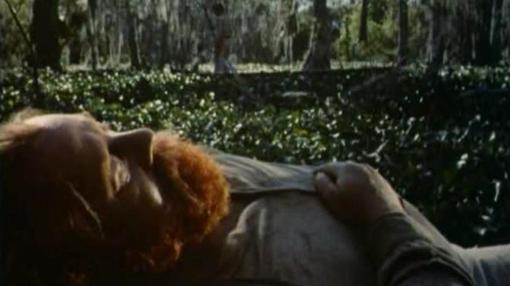
Even though, at certain times, Steamboat Round the Bend or Tobacco Road get preference in my estimation, I think that my favourite Ford is Seven Women, the last of the hundred and twelve films. Not only do I prefer Seven Women but I what I like the most in the film is its last minute, the triumphant suicide, Ford’s coda leading up to an aggressive, brutal laconism unheard of in his body of work and open to multiple meanings.

I fell in love when I saw Seven Women during its release, when I didn’t know it would be his last film. And I also think Ford (who had other projects at the time and wasn’t the kind that thought of retirement) didn’t conceive it as a testamentary film. It’s thus at once a natural expression—for Ford—and a natural emotion—for me—entirely related to the film and unrelated to the context.

But that it’s the last hour of the longest filmography in the entire history of cinema past and future, the very last minute of some ten thousand minutes of film (work of an old gentleman of flagging health) that moves me the most is something altogether stunning.

I wonder if I could ever, in life like in art, find an occurrence that propels me more towards optimism, a pure optimism free of dross since it’s produced by one of the most tragic scenes.

You’ll tell me it’s a choice peculiar to me. But it’s close to the current critical norm: the referendum organized by the Brussels Cinematheque in 1977 revealed the pre-eminence of The Searchers, the 108th Ford picture, over all others. It established the clear lead of The Man Who Shot Liberty Valance, number 109, over The Informer, once a central pillar, now dispensable.

There is also a very surprising trend in Hollywood cinema, where the late career of “greats” is always a little disappointing or withdrawn (Hawks, Hitchcock, Vidor, Griffith, Borzage, Capra, Chaplin, Mann, Preminger, DeMille etc.) I can think of only Mankiewicz who overcame this challenge, thanks to a somewhat anticipated retirement.


Though it would be adventurous to define the silent period about which we know little, it’s permissible to think of it as the break-in period, with some titles more notable than others (Hell Bent), and to say that Ford’s body of work really begins towards his fiftieth film, somewhere near Three Bad Men or Four Sons or Arrowsmith.

It’s the opposite of modern European careers, where the first feature is generally among the best, if not the best, and where one barely reaches twenty or thirty films at the end of the career.

This abundance has produced an experience, an incomparable self-assurance. In his early talkies, Ford seems to be a master of all situations when he takes on the most ambitious projects. It’s hard to imagine him anxious on the eve of a shoot, or during takes, or during the release date. Shooting becomes an everyday reality and loses its importance. Ford makes films like a baker makes bread. The notion of a body of work doesn’t make a whole lot of sense for him. He never lingers on the editing table. He never wastes time at the launch of a film. The pleasure of getting back with his shooting crew can become the primary motivation.

One could evoke Walsh in this regard. But he pushes this laidback quality too far: he doesn’t always come to the shoot. Reading his memoirs, it seems that screwing an actress or fighting with a rival was more important for him that the final product. There isn’t a thematic unity in his work.

Only Mizoguchi—a little less productive—can be compared to Ford. Moreover, it would be very instructive to see Oyuki the Virgin (1935) and Stagecoach (1938), its remake of sorts, one after the other since both films take off from Boule de Suif. Sansho the Bailiff shares the perspective of The Grapes of Wrath. The difference between the two men lies in the great care Mizoguchi demonstrated towards his scripts. On the other hand, Ford sometimes took them as they came, days before the shoot for which he was assigned at the last moment. I think he made no fundamental distinction between his films and those by others for which he shot some difficult shots.

Other differences relate to the pre-eminence of the individual—and women—in the Japanese filmmaker and the small group—and men—in the American. And then Ford was more a raconteur and Mizoguchi a storyteller.


Ford’s laid-back nature, which can account for his power, also makes for his weakness. The politique des auteurs found it rather hard to assimilate him since it postulates that great filmmakers manage to ennoble everything they touch. Now if, after the early years, we find practically no false notes in Hawks and Hitchcock, it must be admitted that Ford is something of a concern. He is successful with one in every two films. At sixty, he still finds a way to churn out three insipid works one after the other: Mogambo, The Long Gray Line, and Mister Roberts. Not to mention duds like The Black Watch, Wee Willie Winkie or Gideon’s Day: films that had no chance of success owing to the mediocrity of their raw material, made for money, the desire to travel and work as a team, the presence of a mascot or a pet cause.

We often speak about Ford’s eclecticism on account of the variety of genres he handled. But this eclecticism turns out to be illusory: no musical, no horror film. There is no crime movie except the mediocre Gideon’s Day. Clearly, Ford doesn’t like the detective genre. On two other occasions (Up the River, The Whole Town’s Talking), he dissolves into comedy. Admiral Ford is fascinated only by the navy. If he encounters the army (What Price Glory) or the air force (Air Mail), he diverts everything into comedy.

To distinguish the Westerns from the Irish films is vain: Indians and Irishmen are similar minorities, just like Mormons (Wagon Master) or Jews (Little Miss Smiles), and he sometimes pits Irishmen or Mexicans against Indians.

In fact, the eclectic quality of the scripts is almost always nullified by the polarization along some well-known principles: small groups, mothers, families, comical sidekicks, the ball scene, twilight figures from the last decade. Always the great outdoors, or the small town. New York almost never appears. With a little exaggeration, I could say that Ford has only ever made one film. We are far from the bulimia of a Duvivier or a Tavernier.


If one likes Ford, one could be shocked that the filmmaker had no political leaning except those of his clients, or whatever was fashionable. One would’ve loved to find something constantly, deeply moral, to trace anti-racist seeds much before Sergeant Rutledge or Cheyenne Autumn, in the first Westerns or in Stagecoach, to uncover a common thread between the generosity of The Grapes of Wrath or the sectarianism of This is Korea! or Seven Women. Notwithstanding some brilliant theses on this topic—Ford’s bonhomie softening the harshest features of almost all his characters—opportunism appears to be the sole truth. But is it really opportunism? Isn’t it rather a somewhat systematic acceptance, with no ulterior motive, of whatever the era has to offer? A concurrence with the silent majority, which sometimes he precedes by a little (Fort Apache)? Ford, like many first- and second-generation immigrants, has a principled respect for his country of adoption and its beliefs. The very fact of having taken the surname of one of capitalism’s greatest henchmen as his alias is revealing.


Ford’s power resides firstly in a dialectic between the presentation of mythologies and familiarity, the absolute and the relative, the thought-over and the lived, the moral and the picturesque, heavy clouds of Fate and hands on the ass. It’s the vigour and spontaneity of McLaglen, Fitzgerald or Ward Bond that help the spectral compositions of August or Toland push through. Not always: monotony looms large, and so does vulgarity.

The picturesque aspect has to do with the abundance of living beings (hence the small group), the multiplicity of their actions in the shot or in the sequence. Ford is perhaps the American filmmaker who has worked the most on the difference in dialects and accents (Doctor Bull).

The expression of mythologies is carried out either through the meaning of actions or through the photography: shadows, back lights, immense settings that diminish man. Mythologies in Ford become extremely dangerous when they are limited to themselves (cf. the clear failures of The Fugitive and The Informer). Photographic overload and second-hand expressionism make the films go around in circles, while most often, the image skilfully serves as the lyrical amplification of realistic everyday details.

We could, however, invert the proposition and assert that the picturesque leads nowhere without the help of mythologies. We have for proof the success of Tobacco Road. But that was an exception. Dialectic nevertheless makes for the greatest part of Ford’s body of work. Its two components can be found in the same instant or be linked by a pan shot or a cut. What counts is the variety of links Ford finds between them.

There are other related forms of contradictory balance within a film, or across films. It could be said that Ford takes wicked pleasure in doing the opposite of what he has just done. His greatest quality is concision, but in The Searchers, he does his best to make us feel the long passage of time involved in a hunt spanning many years, rendering the ideas of revenge and racism ridiculous. In The Rising of the Moon, from one sketch to another, he alternates the impression of rapidity and slowness for both characters and viewers. This probably explains his political fickleness better. Ford, the champion of the macho movie, the maker of two films without women—Men without Women and The Lost Patrol—that were perhaps the first of their kind, also made hymns to mothers and ended his career on a film almost entirely without men (Seven Women), the two male characters being a weakling and a monster.


We could define Ford’s art as an art of “sliding between notes”. Hence, the importance of dissolves and other transitions (The World Moves On, The Grapes of Wrath). The viewer shouldn’t realize he’s watching a movie and that the movie has already started. Often, moreover, nothing of importance really happens (Judge Priest, Doctor Bull, Tobacco Road, The Long Gray Line etc.). We wonder what we can say about the films, which sometimes leads to a negative judgment. All very classical values. After all, isn’t Ford the only classicist in the history of cinema worthy of interest? And our critical armada isn’t up to the task to deal with this exceptional case.

One problem remains: this precious sense of “sliding” seems to be the same in both the masterpieces and the failures of Ford. We nevertheless sense a huge difference in quality between them. We could point out the customary concision of a scene in Gideon’s Day or The Long Gray Line, but we could also wonder whether it wouldn’t have been better had he dropped the entire scene, or had he not made the film at all.

Ford’s art seems elusive, impossible to pin down. It’s in the method, but it surfaces only when the material is rich. It takes us back to a very old rule of thumb: to make a good film, you need a good script and then good direction. Isn’t it symptomatic that three of his best films (The Grapes of Wrath, Tobacco Road and, more obliquely, Stagecoach) were adapted from high-profile literary works? Isn’t The Grapes of Wrath better than How Green Was My Valley simply because Steinbeck is a better writer than Llewellyn? Ford is the opposite of Hitchcock, who often needed a terrible, totally unbelievable script (Psycho, North by Northwest) to be able to rise above its faults and outdo himself.


Why is it that the film version of The Grapes of Wrath has survived in people’s minds more than the book, while there’s no big difference between the two? Is cinema so weak an art that a solid adaptation of a good book can pass for a masterpiece? In contrast, there’s much higher competition in literature. Even so, there are more concessions in Ford’s film, such as the inversion that pushes the most optimistic episode at the government camp to the end of the film; and this immaculate, smooth-talking Fonda (Fonda is outstanding, but that is not the problem) who is clearly a reflection of the Hollywood hero, absent in the original.

The difference is that agricultural migration was dealt with more often in writing and almost never on film. But isn’t all this to the credit of the very idea of filmmaking?

The difference is that Steinbeck rubs it in, harnesses all the possibilities of every scene, while the film skims over the facts, taking their essence and moving quickly to the next scene. It has become the first road movie, a succession of signposts producing an unquestionable, objective curtness that limits pathos. But weren’t these omissions made in order to cut the film down to two hours from six? And isn’t it the scriptwriter Nunnally Johnson who’s primarily responsible for that?

Ford succeeds when he appears to efface himself behind others, behind the material of his films. Might his role simply be that of a supervisor, a mediator? And might not our concern for analysing Ford’s specificity go against the grain of his body of work?


[From Luc Moullet’s Piges choisies (2009, Capricci). See Table of Contents]
On Inspiration and Neorealism

Radio Cinéma Télévision no. 483; 19 April 1959.

Wind Across the Everglades

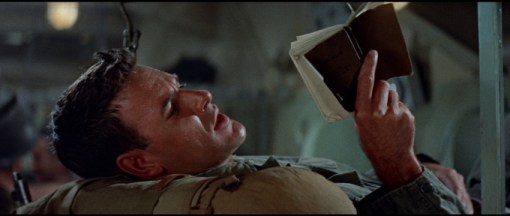
It’s not because—in accordance with his sacrosanct habit of quitting a film on the eve of the last day of shooting when it’s not commensurate with his genius—Nicholas Ray abandoned the “set” of Wind Across the Everglades that it must be considered a lesser work. It’s not a masterpiece and it will figure perhaps at the eight position among the seventeen films of its auteur; but it’s nevertheless above the mean.

Unfortunately, it’s one of those ambitious films intended for an adventure movie market and, in this market, way too far from the norm. If he likes big subjects, Nicholas Ray nonetheless doesn’t consider the adventure movie a minor genre. For him, action, the behaviour of man in the natural world, teaches us everything about the individual and the universe. That was what was novel in Bigger than Life, where each psychological feature was expressed by the most violent of physical gestures.

Contrary to what we might think before seeing it, Wind Across the Everglades isn’t any Hollywood film. It’s an independent production put together by Budd Schulberg, writer of socially-oriented films like On the Waterfront and A Face in the Crowd, who hates nothing more than Hollywood. But the story of this film demonstrates that he hasn’t understood what Ray sought beneath the neorealist principle of the film. For Ray, neorealism is a passkey to profundity while, for Schulberg, it’s neorealism for the sake of neorealism. Since Italians make good films in the street, it’s enough to copy them and sit with your arms folded.

Made on a small budget in the vicinity of a small village in the marshes of Everglades (Florida)—a wild, tropical Bresne—in entirely natural settings, with unknown, indigenous and amateur technicians and actors—it’s a jockey playing the ex-jockey, a boxer playing the ex-boxer, a famous writer playing the man of law—Wind Across the Everglades is first of all a documentary. Ray isn’t satisfied reusing footage from Warner Bros’ documentary stock. He films himself the shots of birds and reptiles which are among the most beautiful that cinema has given us. Beautiful in their violence, in their striking framing, in the poetic movement (which we find again in the scenes played by actors) by which the camera moves towards the animal, in the very manner that Ray directs these animals by making them overcome various obstacles. A Walt Disney crew already went to the region, but couldn’t give us as lively a document.

The subject? Like in all Nicholas Ray films, it’s violence. At the turn of last century, a young professor of natural science, now a guard at the Everglades natural reserve, seeks to stop the massacre of millions of birds that Cottonmouth, surrounded by outcasts, lunatics and convicts, hunts for pleasure in the depths of the marshes. The most surprising aspect is this portrait of beings on the margins of the society that interests Ray, who spent a part of his youth rummaging in the least civilized regions of the USA (even The Lusty Men and Hot Blood focus on bohemian lives and gypsies). But the portrait here is very cruel (cf. the jockey character). The struggle of the young man against violence is only of secondary interest. Ray has already dealt with that subject a number of times, and today he has dedicated himself to seeking the poetry of reality.

And so, the guard takes great pleasure in the lives of his worst enemies. Like in Bitter Victory, whose most subtle scene—the snake and the gunshot—we find reversed here, which also recalls the ending of Run for Cover, Wind Across the Everglades shows us the fever of men and the uniqueness of things. A very 1900s bath in the sea, a baroque pleasure house, an insane feast and a dying Burl Ives calling out to the crows: “Come and get me! Swamp-born, swamp-fattened!” The actors—Christopher Plummer, Chana Eden, Sammy Renick—are excellent since Nick Ray knows how to make them accomplish very natural gestures, which he accompanies with very short camera movements that give the impression of improvisation. In such a feverish life, the hero is always dishevelled, just like the film. The colour is average; the script, editing and music, very mediocre.

Will a more homogenous, more complete work, where the subject is just a pretext, emerge from this return to nature, whose beauties Nick Ray has naively sought to capture with the same love for life as a Griffith (Schulberg, though, hardly likes it)? That’s what happened with Renoir and Rossellini. Unfortunately, Ray is unemployed since a year thanks to a lack of clients.


[From Luc Moullet’s Piges choisies (2009, Capricci). See Table of Contents]
Better than the Bridge on the River Kwai

Radio Cinéma Télévision no. 474; 15 February 1959.

The Naked and the Dead

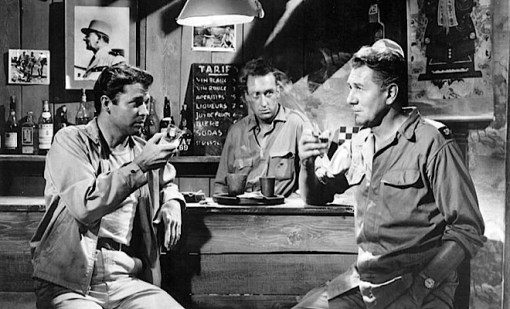
South Pacific, 1943. Three protagonists. A sadistic general who professes the greatest contempt for his soldiers and who enjoys throwing his cigarette butt on ground to humiliate his camp officer by asking him to pick it up. He’ll present him lame excuses in the end, lose face before the entire army and resign. A brutal, fascist lieutenant who crushes small birds with his fist, spits his beer on women’s faces, pulls out gold teeth from the Japanese he kills for fun and for reselling the teeth in question. His need for violence will drive him to his death. An idealist and human officer who leads a difficult mission across an island infested with enemies. Injured, he will be saved thanks to the friendship of his men.

Adapted from Norman Mailer’s great war novel that appeared about a decade ago and which has become a classic since, the script of this film recalls another famous film, adapted from another well-known war novel: The Bridge on the River Kwai. The same old song about the ideal of man and the absurdity of war.

But Raoul Walsh’s film trumps that of Sam Spiegel and David Lean solely through the strength of its mise en scène, a constant throughout the film’s 130-minute runtime.

The death of a soldier bitten by a strangely beautiful snake is depicted with a striking violence and realism. All resources of landscape—jungle, tall grass, the rocky peak that the small troupe scales at the end—are harnessed with virtuosity and variety. For once, we are in a real jungle, and the camera weaves in and out of it with as much difficulty as the hero.

In non-combat scenes, it’s the good mood that sustains interest. The relationship between solders is described with a charming bonhomie. The interludes of familial life, full of freshness, grace and poetry, contain some of the best shots ever filmed by Raoul Walsh, whose career nevertheless features more than a hundred films, of which seventy-five are worthy of interest. One must see Barbara Nichols and Aldo Ray play Bulls and Cows, trying to out-moo each other, and especially the extraordinary tracking shot that closes Cliff Robertson’s dream. One must also point out James Best’s excellent performance and remarkable composure. In short, a beautiful film, a super-production that’s also a work of quality and which completely deserves the success the public has given it.


[From Luc Moullet’s Piges choisies (2009, Capricci). See Table of Contents]

Metaphysics of the Arabesque

Radio Cinéma Télévision no. 444; 20 July 1958.

The Quiet American

When it appeared in 1955, the Englishman Graham Greene’s novel The Quiet American was a big succès de scandale. With the recent guerrilla wars in Indochina as the backdrop, it tells us the story of a typical British journalist, Fowler, who colludes with the communists to plot the death of his rival in politics and love, his friend Pyle, the typical American. Pyle believes that neither the communists nor the French can find a solution to the Indochina problem. He supplies ammunitions to an army of dissidents that represents, for him, a life-sustaining “third force”. This fascist third force increases its horrible attacks, like the one where explosives are hidden in bicycle pumps. It’s because the lives of thousands of innocents are threatened, because Pyle, an always self-assured Bostonian confident of his ideals and convinced of the moral value of his acts, remains unconscious of his actions that Fowler agrees to his murder. The Americans made a hue and cry about this book, which violently expressed the eternal aversion the British have for them. Not without reason: Greene’s partiality crudely pitted the calm, sceptical and praiseworthy objectivity of the Englishman against the ridiculous, criminal and naïve self-assurance of the American. A puerile simplification that’s far from the truth: the particular stands for the general. And it’s obvious that all Americans aren’t like Pyle, nor all Englishmen like Fowler, that each civilization contains good and bad values in equal parts. Moreover, the style left a lot to be desired, with its false journalistic objectivity awkwardly inspired by the first Malraux.

Total change of tone in Mankiewicz’s film. The eighth quarter-hour makes us suppose that Pyle was a brave fellow and that Fowler, the intelligent and lucid Englishman, was taken for a ride by the communists, whose skilful manoeuvres had forced him to judge Pyle guilty. He was only too happy to condemn him: Pyle’s disappearance will allow him to win back the favours of his eternal mistress, whose hand Pyle had just asked. That’s the explanation of the third man, Vigot, the cunning French inspector. The most surprising part is that this interpretation corrects multiple plot holes and improbabilities of Green’s novel. And we’ll still never know the exact truth… Like for The Barefoot Contessa, we can quote Pirandello without being way off.

This dramatic turn of events, this unpredictable reversal is presented with a diabolical intelligence. No dramatic insistence whatsoever: a turn of dialogue just when our attention goes lax reveals the trick; the word “plastic”, based on whether it’s said with an s or without, whether it’s French or English, changes the face of the world. It’s appropriate here to insist particularly on the value of this reversal: some “modern” films and novels—it’s enough to name Orson Welles—go against the idea of the “message”, so dear to ambitious artists, and locate their meaning, just like the exceptional range of their aesthetic, on the destruction of a carefully elaborated message; truth lies way beyond moral stances. Critical towards Pyle and generous towards Fowler, the film finally inverts these values. Pyle’s self-assurance lay on a solid and honourable base. Fowler was just a coward, a victim led astray by the gullible idiocy of tortured, hung-up English intellectuals: the last shots make him a pitiable, ridiculous quiet Englishman. The film is the sum of these two points of view.

This explains the film’s surprising critical and commercial failure: Mankiewicz cheats his viewer, who thinks he’s watching a traditional display of anti-Americanism and gets a confirmation of his prejudices for two-thirds of the film, only to be taken for a ride at the end, just like Fowler. Mankiewicz has perhaps ended his career for having caught false intelligence, which seeks not the truth but to distance itself from tradition at all costs, and the famous fear of being fooled in their own trap. Some claim that the end was more or less imposed by the distributors; in truth, though, we have here one of the most independent films that America has ever sent us since it was even produced by our auteur-director and his company, whose name pays tribute to Beaumarchais.

Moreover, the aesthetic confirms the meaning of the work: it’s in the line of Giraudoux. Arabesques, an affectation and a literary style are its major features. The mise en scène takes pains to reproduce reality in all its forms for us: lightness and “fluidity” make way for dramatic composition and psychological study. The impression is that of liberty: things and beings seem to present themselves to us as though the auteur had nothing to do with them.

The film is more satisfying when objects occupy more space than characters. This can be explained by the literary, and not cinematic, character of the great Mankiewicz, who is only a good metteur en scène. This perfectly neutral Saigon as it presented itself during location shoot, with its suburban look cluttered with scrapyards and wastelands—while our detractors asked for local colour—is very curious. The festival scenes which open and close the film are among the most beautiful moments of contemporary cinema. This ballet with masques, confetti, garlands, monster heads and heroes scattered by the crowd represents in a typical fashion an 18th century universe, which is Mankiewicz’s own. It recalls The Rules of the Game and The Golden Coach without paling in comparison.

Over two hours, our protagonists talk in a room. Mankiewicz was thus hard put to find a novel way of directing actors. We have here a great progress over The Barefoot Contessa: to be sure, Audie Murphy, Michel Redgrave and Claude Dauphin seem to be acting in the same fashion, with their banal looks, creased foreheads and worried faces. But such performance corresponds more with the film’s subject than with the excellent and inventive direction of actors that we usually find in Mankiewicz’s work. In a ballet, individuality is subsumed in the whole.

Finally, one must point out the richness of the dialogue and their constant creativity. Mankiewicz is always on the lookout for the odd and the fantastic. He often plays on language conflicts and ambivalence of words. With him, cinema gives us not a filmmaker, but a genius litterateur. We are perhaps losing out on something there. But what are we complaining about? Even if the opposite is impossible, cinema can always contain within itself both cinema and literature. Even if the latter dominates, we don’t have the right become vociferous defenders of a cinematic specificity which, over the years, has proven to be highly fallacious.


[From Luc Moullet’s Piges choisies (2009, Capricci). See Table of Contents]
Austerity of Style

Radio Cinéma Télévision no. 408; 10 November 1957.

A King in New York

In this quixotic narrative, whose only point of reference is the central character, various themes intertwine as they do in music. This style goes hand in hand with the expression of a complex reality that words can hardly express: everything can be both irritating and pleasant. “Life would be dull without all these worries”, affirms King Shahdov. Hiding behind the hysteria of rock’n’roll is the beauty and sensitivity of a night club singer. Polemist, Chaplin still is, but having become wiser and more lucid with old age, he towers over events and ideologies.

His style? He presents facts without technical affectation and in a very concise manner (see the revolution scene), but lingers over that which seems secondary to us. Every other scene is a discussion in a hotel room, an interlude but also a reflection of reality: modern life alternates action with the rhythm of a telephone. The triteness with which the scenes are presented without relief only increases the force of the smallest original notation, be it dramatic – the young hero’s tears – or comic – Dawn Addams’ play with legs in the shower – or the king’s abrupt emotional attack.

Like all creators, Chaplin forces himself into extreme austerity. Dramatic surprise is avoided, the gags pitilessly dissected and the end effect predictable from a long way away (see the fire hose). Product of subtractions more than additions, the result is better, bringing to cream pies their intellectual coefficient.


[From Luc Moullet’s Piges choisies (2009, Capricci). See Table of Contents]

Nothing but Facts

Radio Cinéma Télévision no. 383; 23 June 1957.

Men in War

If war movies make for the best box office in America, they are also highly subject to commercial and philosophical conventions. And rarely has this amalgam been rewarding: From Here to Eternity or Attack (whose last shot is reprised here in contrast), despite their audacities, don’t entirely win us over. Men in War, last of the series, rejects both philosophical theories and traditional psychology about the small group. The synopsis is extremely barebones: in the course of the Korean War, seventeen American soldiers separated from their division must, in order to get back on track, conquer “Hill 465”. Only two of them will make it. To mention a few elements of secondary interest borrowed from the original novel – war novels today are constructed on the image of films: the Black foot-soldier with a soft heart, the paralyzed colonel and his hot-headed companion. But these bits of information, rather than being harnessed by the mise en scène, are neglected in favour the mystery that the simplicity of each character’s traits hints at. Anthony Mann likes heroes who are all of a piece since these are the richest. Each of them being more or less crudely stereotyped, it would have been easy for him, as it is for his peers, to fill his hundred minutes of film with detailed psychological analyses, tedious dialogue about homesickness. He didn’t do that: at one point, the exhausted captain looks at the photo of his wife and kids. This simplicity of trait has all the power of evidence.

This new style is to be explained by the fact that we are dealing with the work of a metteur en scène and not that of an auteur. And, for once, it’s for the better. There’s nothing here that isn’t justified by some notion of a purely physical order. For example, the character of the sergeant is a purely cinematographic creation: he is fascinated by the immobility of his paralyzed colonel, which contrasts with this ever-changing world, and devotes great care to him. “Tell me the story of the foot-soldier, and I will tell you the story of all wars”, goes the epigraph. And the story of the foot-soldiers is summarized through an accumulation of facts: the best shots of the films depict soldiers, dishevelled, sweaty but always active, the one scratching himself, the one removing his shoes in fatigue, the one contorting on ground, the one struck down dead with a weapon in hand, like a Hugo hero (played remarkably by Anthony Ray, son of the director); others show us, thanks to excellent photography, all the sparse “black and white colours” across nature, shadows of clouds that cover combatants in darkness, the sun that seeps through the woods, the blades of grass of unreal tones that form the real setting for the battle. One should also note some very nice ideas, the paralyzed colonel getting cured suddenly while mechanically holding the cigarette he smokes, the sergeant who pretends not to see the enemies on his heels and kills them in one blow, the lieutenant’s clenched fist on which the film closes.

Despite inspired by a classicism of admirable reserve, Men in War could be criticized for some overly studied shot sequences, especially the first one, for some borrowings from the crude art of ellipses, the radio face cut in two by the framing, the militiaman’s hand spread over the tree he hides behind, a soldier’s death seen through the movement of his feet. But the discretion of the mise en scène that seeks, most of all, the effectiveness of a simple and unique detail, there where others prefer to disperse interest, succeeds in imposing itself on us. Let’s note, finally, the remarkable musical score by Elmer Bernstein (whose services are sought by the greatest directors today).

Is Men in War warmongering or anti-militarist? I would be hard pressed to say since it’s one of those rare films whose impartiality we can praise. The work of a man preoccupied solely by appearances and their infinite richness, it allows us to see, and therein lies the essential. Up to you to make up your own mind.


[From Luc Moullet’s Piges choisies (2009, Capricci). See Table of Contents]