[Part of Curator’s Corner, a section dedicated to showcasing work of emerging and marginal filmmakers.]

Pseudo Emotions: the banner under which Bangalore-based filmmaker, music composer and poet MK Abhilash produced his earliest shorts gives a glimpse into what one can expect from his quirky and original body of work. Abhilash’s three recent short films revolve around highly melodramatic situations — infidelity, childlessness, terminal illness — set in recognizable everyday reality. But they derail our expectations of the premise through the introduction of a limited number of uncanny, bizarrely incongruous elements.
Take Kuuk Aah? (2024). A sleepyhead husband, living off his wife’s income, brings home a chicken that he rescues from a sadistic friend. As this idler roams the city looking for public places to sleep in, his long-suffering wife becomes emotionally involved with the fowl, now living in the house in a semi-human form, dressed like a butler. The basic dramatic situation is utterly familiar — marital strife, emotional neglect, extra-marital affair — but the plot unfolds with an otherworldly logic and texture that are anything but familiar.
The primary inspiration for his stories, Abhilash says, comes from the lives of those around him; in the case of Kuuk Aah?, the spontaneous lament of a neighbour whose wife eloped with a domestic help. But the films transmute these experiences, turning real human emotions into parodies – pseudo emotions – that work against conventional dramatic structures of viewer identification and empathy. Something is always ‘off’, keeping us at a distance while drawing us into a plausible world that resembles our own.
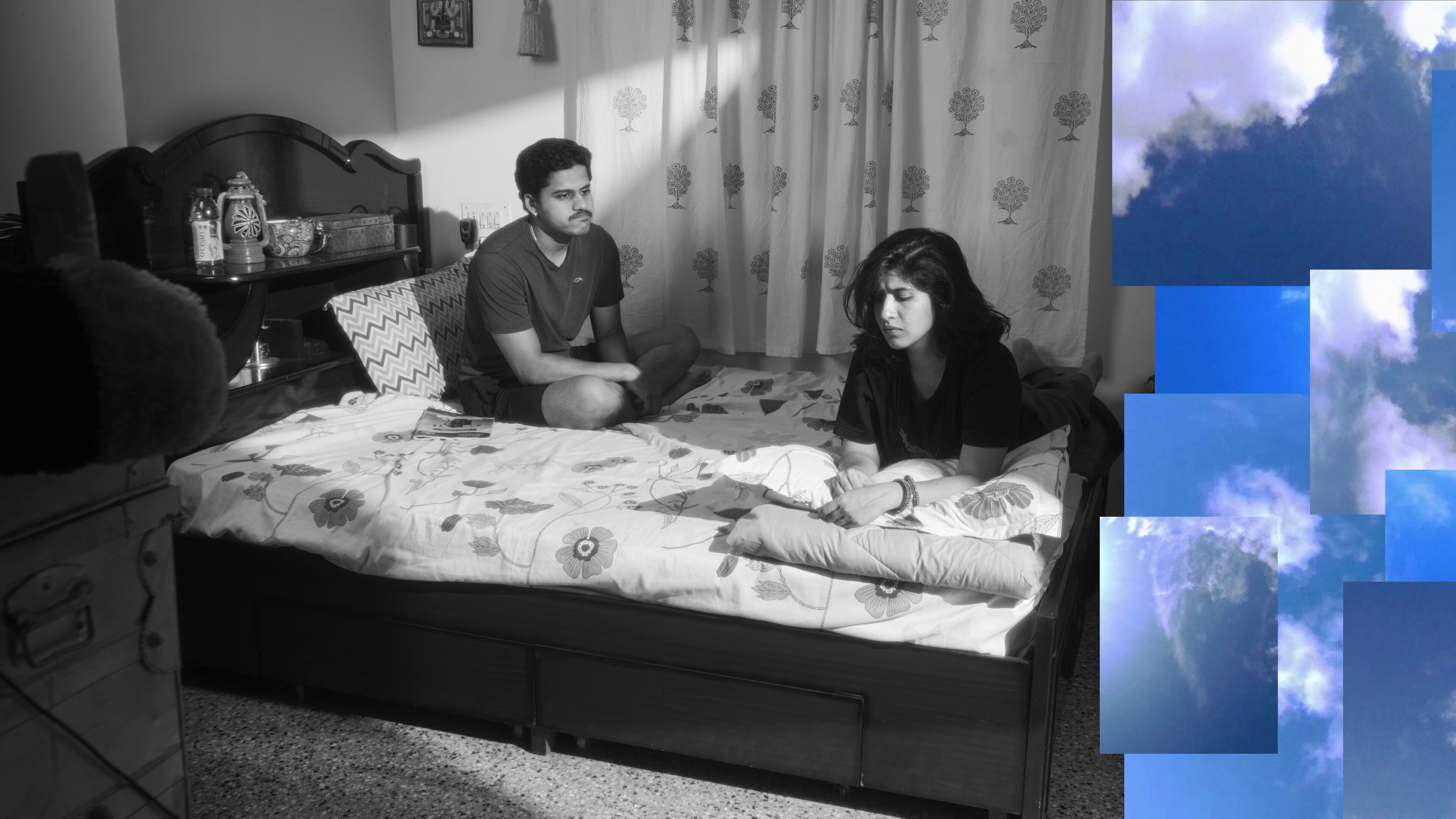
Break through their humorous exterior, you find darker undercurrents. Moda Moda (2025, awaiting premiere) centres on a childless couple comprising a chauvinist husband who doesn’t want to adopt and his dismayed wife. Things take a turn when the man’s pregnant sister comes home following a domestic dispute and persuades her brother to let her stay in his body. Lo! The ill-tempered husband is now pregnant himself and develops a loving bond with his wife. That is until the sister’s alcoholic husband arrives to take her back.
If Moda Moda overlays its atmosphere of inchoate dread with dark humour, Dictionary Mohan (2022) is positively bleak. Having befriended the last survivor of a whistle-speaking tribe, Mohan embarks on a whistle-to-Kannada dictionary to help his alien mate integrate into the society. Alas, Mohan is diagnosed with a terminal disease, leaving him incapable of completing the dictionary. Everyone around Mohan is self-absorbed, isolated, locked up in the silo of their mind, unable to communicate, doomed to incomprehension. The film would be unbearable if it weren’t funny.
The dissonance between subject matter and tone of Abhilash’s films is amplified by the non-naturalist acting style that swings between TV-soap hysteria and cartoonish flatness. Aashith, who plays the lead in all three films, has an expressive, comic earnestness at odds with the ironic nature of the film; the lazy husband he portrays in Kuuk Aah? might as well be a stick figure. Reactions in these films are exaggerated, gestures are isolated and amplified, and the dialogue is insistent and overly enunciated. The excessive politeness of the characters towards each other is undercut by bursts of unexpected nastiness.

Dictionary Mohan

Kuuk Aah?
Moda Moda
Compared to Abhilash’s earliest work, which are heavy on concept and denser in their writing, these three shorts attest to a conscious formal simplification. Set mostly indoors, the new films are shot on digital monochrome with a largely static camera, from oblique or frontal angles, and sometimes with overly dramatic lighting. The dialogue and the plotting are sparser and demand less effort of assimilation from the audience. Abhilash makes striking use of music and animation: 8-bit electronic loops, doodles and symbols overlaid on live-action footage and occasional use of saturated colour to offer visual relief, all of which are present in Moda Moda. In Dictionary Mohan, the whistle language is given a distinctly musical quality rather than the prosody of Kannada or English.
Abhilash currently produces his work as part of the Neelavarana Collective, a heterogeneous group of Ambedkarite artists from Bangalore who participate in each other’s projects. Mahishaa, the founder of the collective, shot Moda Moda while two other members, Naveen Tejaswi and Ajay Tambe, feature in the cast of Kuuk Aah?. Abhilash lends a helping hand in Mahishaa’s films and music videos, composing, for instance, the propulsive score for Babasaheb in Bengaluru (2024). Where the other works by the collective tend to adopt a style closer to realism and a more direct mode of engaging with real-world politics, Abhilash’s films and poems have a more whimsical, inward-looking quality, like the visions of someone staring dreamily out the window.
An intriguing aspect of Abhilash’s films is their curious emphasis on bodily transformations. In 8th Day of The Week (2017), a “human shadow” is anxiously waiting to become fully human, while A Mute’s Telephone (2018) features gender reassignment and voice transplant surgeries. The moribund lexicographer of Dictionary Mohan turns into an apple tree, just as the chicken of Kuuk Aah? transforms into a chivalrous gentleman. In Moda Moda, the human body is fully mutable, capable of hosting other bodies and their characteristics.
Some of these elements, particularly the taste for physical mutations, may have to do with Abhilash’s fondness for anime — he cites Satoshi Kon and Masaaki Yuasa as inspirations — as well as folk tales and local beliefs found across India. There seem to me to be few immediate precedents to Abhilash’s films, but in their shaggy-dog storytelling and their gleefully silly scrambling of the social code, they share something of wackiness found in the work of another musician-filmmaker, Quentin Dupieux. Like the Frenchman’s one-joke odysseys, Abhilash’s shorts come to embody a kind of vernacular surrealism that employs and explodes the codes of domestic melodrama in quaint and refreshingly absurd ways. Whether or not there is any greater significance, any hefty subtext, to these baffling stories, the films’ entertaining, provocative quality is beyond doubt. The result makes you wince and laugh out at the same time.
Bio
Contact
Filmography
- Vaaradha Entané Dhina (8th Day of the Week), 2017, 13 min., digital
- Moogana Telephone (A Mute’s Telephone), 2018, 19 min., digital
- Dictionary Mohan, 2022, 28 min., digital
- Kuuk Aah?, 2024, 30 min., digital
- Moda Moda, 2025, 20 min., digital
Showcase
Dictionary Mohan (2022)
Kuuk Aah? (2024)
 The Seventh Art