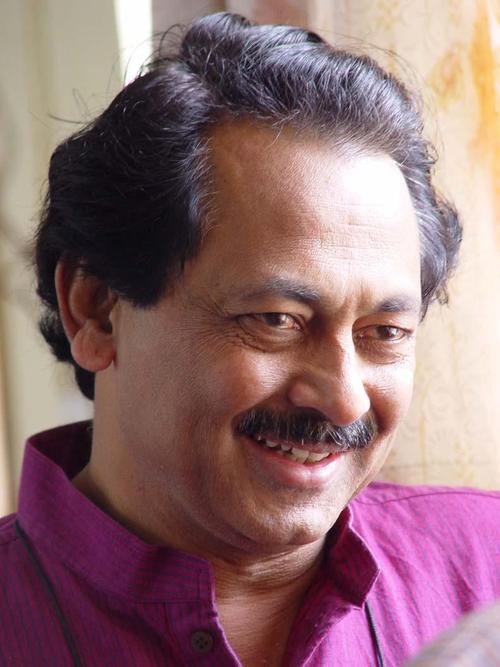
Girish Kasaravalli
(1950-)
Girish Kasaravalli was born in Kesalur, a village in the Tirthahalli taluk in Shimoga district in 1950 to Ganesh Rao and Lakshmi Devi. He had his primary education in Kesalur and middle school education in Kammaradi. Hailing from a family of book lovers, he was initiated to reading good books from a young age by his father. His father was also a patron of Yakshagana, a folk system of dance, native to Karnataka. All this formed a basis for a life rich with creative aspirations. He was also attracted to the touring talkies which visited his village once in a while to screen popular Kannada films. This was his first exposure to the world of Cinema. Another relative who supported his love for creative arts was his maternal uncle K.V.Subbanna, a Magsaysay award winner who founded Neenasam, a critically acclaimed and popular drama company. After completing his high school and college education in Shimoga, he enrolled for the B.Pharma course in the College of Pharmacy, Manipal. The college was a commonplace for many cultural activities and kept Girish Kasaravalli’s creative interests alive. After completing his degree, he went to Hyderabad for training. But due to his pre occupations in Cinema and art, he found it difficult to manage his profession and interest together. He decided to quit the career in Pharmacy and join the Film and Television Institute of India, Pune. A gold medalist from the Film and Television Institute of India, Pune, Girish Kasaravalli started his career in films with Ghatashraddha (1977), over the next 30 years he directed eleven films and a tele serial.The Film he made to fulfill his Diploma “AVASHESH” was awarded the Best Student Film. Avashesh also won the President’s Silver Lotus award for the Best Short Film of that year [Bio Courtesy: Wikipedia, Image Courtesy: ProKerala]
Girish Kasaravalli’s films are full of rituals, ceremonies, legitimization games, legal procedures and codes of communication and social conduct. These narratives are all structured around notions of inclusion and exclusion, of inclusiveness and exclusivity. They are all about who is in a particular game and who is not. Even though Kasaravalli’s films are about rituals, the films, themselves, are never rituals. Part of what makes Kasaravalli’s cinema so rich is the fact that, unlike many of his contemporaries, the director hasn’t allowed his world view to stagnate, his concerns to become characteristic or his explorations to become answers. Even though they have been present in one form or another throughout his filmography, the key question that Kasaravalli’s films have put emphasis on has moved from that of socio-religious institutions and their laws, through that of authorization of those laws by those whom it applies to, to that of justice and its many conflicting definitions that seek to pin down its meaning, all the while having at their focal points the effects that these questions have on the social standing of women. Let’s make no mistake; his films – like many works of ‘Parallel Cinema’ – have always been about with the status of women in a conservative setup. What sets these films apart is, however, the fact that they choose to venture beyond the miserablism that the scenario offers (and which many filmmakers wallow in) and probe what makes a setup conservative in the first place. For every mention of Kasaravalli the humanist, there is Kasaravalli the analyst beneath, for every instance of Kasaravalli the metaphysician, there is Kasaravalli the sociologist operating alongside and for every cry of Kasaravalli the universal, there’s Kasaravalli the native working on historicized junctures.
Despite sharing a woman-behind-bars aesthetic highly typical of Parallel Cinema – locale shooting with an affinity for the horizon and landscapes at dawn and dusk, low-light static compositions (often through doorways) and continuity editing that indicate a respect towards the written word, pans and tilts that unveil details gradually, an inclination towards restrained low-key classical score (by his regular, the highly talented Isaac Thomas Kottukapally) and naturalist sound design complementing re-recorded speech – there are a few directorial choices – the scroll-like horizontal tracking shots that are present right from his experimental, Tarkovsky-esque diploma film Avasesh (1975), the temporalizing intertitles and the major ellipses that bypass drama – which have revealed themselves as stark deviations from the movement’s aesthetic. There are as many shots of freewheeling corporeality in Kasaravalli’s films as there are modernist shots carrying the burden of meaning, as many moments that rebel against the narrative as there are moments that are at its service. And that is indeed a rare sight to see in Parallel Cinema.
[The usual caveat: Lots of films missing here. Notes will be added once I see them]
Ghatashraddha (The Ritual, 1979)
 The director’s debut feature, The Ritual, couldn’t have more aptly titled given that every subsequent Kasaravalli film could be named the same. Set in a Brahmin (priest class) settlement where sacred hymns are taught by male teachers and learnt by rote by male children, Ghatashraddha delves into a system of social legitimation that is built on suppressing differences, deviances and dissent. (Having a homosexual teenager in the school is provocative even today). Kasaravalli portrays these rituals – religious and social – in high detail that they seem to almost possess a power beyond the people who perform them. The act of teaching and reciting these very hymns (some of which are specifically written for men) proves to be an authorization procedure for the perpetuation of patriarchy and of maintaining a closed circle of legislative and judicial power. Both the young kid Nani (Ajith Kumar), who isn’t able to learn these chants, and the young woman Yamuna (the beautiful Meena Kuttappa), who gets pregnant out of wedlock, are deemed outcasts. Ghatashraddha pays out like a tragedy in which every attempt to break out of a rigid system of rules is put down and all discursive entities that could undermine the integrity of the system are absorbed into the mainstream. Kasaravalli uses his actors remarkably – almost in a Bressonian manner – pruning down superfluous elements of performance and expression and reducing the tragic presence of Yamuna to an aggregate of glances and stares, and his command on his images is equally noteworthy, with sharp, beautiful monochrome photography.
Mane (House, 1991)
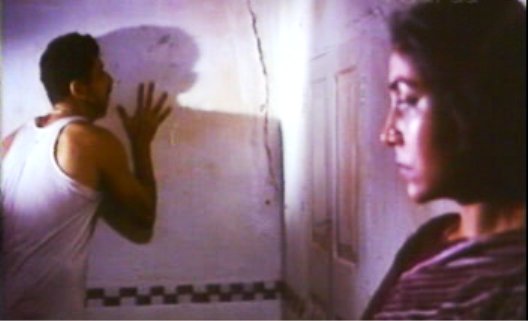 Possibly the most unusual Kasaravalli picture and certainly my favorite by the director, Mane (also dubbed in Hindi as Ek Ghar) is a Kafkaesque tale about a young couple (Naseeruddin Shah and Deepti Naval) that moves to the city from a village with the hope of finding privacy and freedom, which are unavailable in the joint family system. For all its narrative excursions, in a sense, Mane is merely about the breakup of a marriage in which the Rossellinian couple, unable to confront each other directly amidst the loneliness of the city, externalizes their troubles – his powerlessness, her desire for freedom and their childlessness – and shifts blame on situations beyond their control in order to act victims. Kasaravalli works wonder with film and sound here, using them to denote the impending break down. (One stunning shot uses the neon lights of the neighbourhood to literally break apart the frame). A critique on urban spaces that suffocate more than they promise privacy, Mane unfolds like a sociological update on Rear Window (1954), in which personal anxieties and fears are displaced onto the surroundings and, specifically, onto a lower social class. In that sense, Mane connects all the way to the director’s latest work in the manner in which it raises questions about the visibility of the class structure and the seeming imperceptibility of the consequences of acts of one class on the other. Mane is full of such encroachments of freedom by other competing notions of freedom – between classes, between houses and between spouses.
Thai Saheba (1997)
 Thai Saheba, I think, is best understood as a transitional film because it is in this film that Kasaravalli tries to streamline most of the diverging concerns of his previous features into a sustained reflection on justice – a topic that he would keep refining in his subsequent three works. Shot mostly indoors with the production design dominated by deep red and brown colours, the film is reminiscent of similarly-themed films of the same decade by Hou and Zhang, especially in the way the women orbit the largely unseen patriarch of the house and how the personal becomes inseperably entagled with the political. Kasaravalli, interestingly, sets his story in pre-independence India in an attempt, however unsure, to make a positive intervention into history and open it up for analysis. More precisely, the period is the 1940s when the independence struggle against the British Empire was at its peak. The leader of the house is a Gandhian fighting earnestly for independence while he keeps ignoring his wife (one among three!), who finds companionship in her adopted son, who, in turn, falls in love with his step sister. The film is rife with such complex familial relationships and forbidding codes of conduct, through which questions regarding inheritance and birth right are broached. (There’s a narrative thread regarding perfumes that Kasaravalli uses as shorthand for feudal legacy). Like the previous picture, Thai Saheba keeps pitting one idea of freedom and justice with other. However, there’s also the feeling that the film might be treating history as a closed book, suggesting that we are living at more liberal times. The corrective would arrive three films later.
Dweepa (The Island, 2003)
 Dweepa is a quantum leap of sorts for Kasaravalli. For one, the scenario takes a gigantic jump from pre-independence India to post-globalization India (the jump is highly ironic since the politico-historic situation doesn’t differ as much as one expects it to): to a time when huge construction projects are undertaken at the cost of the livelihood of thousands of indigenous people. Possibly the most keenly observed of all the director’s films, Dweepa finds Kasaravalli shifting his focus from institutions and their laws towards the legitimization of those very laws, to the many internal contradictions a statement of justice has to suppress to create a stable meaning. The film almost plays out reverse-dialectically – like a chain of nuclear fissions – breaking down one stable narrative of justice into smaller narratives each counterpointing the other. The island of the title, then, not only refers to the geography of the story or to the situation that the priest family – father, son and daughter-in-law and the young outsider – finds itself in, but also to this impossibility of consensus and to the narratives of minorities being abandoned in favour of those of existing technocratic and paternal institutions. (The story’s development, in a way, parallels the trajectory of critical discourses in the past few decades, in the undermining of totalizing theories by identity groups). Kasaravalli can’t propose a solution (is there one?), but the response he suggests – of perpetual resistance – is borne out of a deep respect for his subjects.
Haseena (2004)
 Haseena begins with a bruised, middle-aged woman (Tara) sitting determinedly in front of a mosque before cutting – painfully – to an older, beautiful version of her. Haseena has all the trappings of a “woman’s picture” – a poor lower-class woman, with many kids and a abusive, drunkard husband who beats her up, struggling to make a living in a man’s world – and, to an extent, it is. But instead of converting the scenario into a woe-of-the-week saga and wallowing in self-pity and condescension that almost seems to be the natural reaction from many filmmakers, Kasaravalli, respecting the dignity of himself and his subject, moves beyond superficial humanism to embark on an examination of the law, justice and the crossroads between them. That the story is set in an Islamic community, where laws and rules are more localized and, hence, the idea of justice could be more accommodative, helps illustrate the dynamics of legislation and legitimization with higher transparency. Absorbing a number of uncharacteristic directorial choices, strangely enough, from contemporary Iranian cinema, where too characters retain their self-esteem, specifically in its use of colour and music (Kottukapally’s high-scale stringed compositions, well, strike a chord for those familiar with Majidi’s cinema, for instance) and it’s magic realist finale, Kasaravalli experiments with his new found freedom of form and the confidence of approach that the previous, seminal feature seems to have fortified.
Naayi Neralu (In The Shadow Of The Dog, 2006)
 Naayi Neralu is the exact kind of movie that Kasaravalli’s filmography was working towards all along. Like Thayi Saheba, this one is also set in a pre-independence era, but instead of treating issues from at a distance and institutions monolithically, Kasaravalli treats them like how a present-day sociologist would talk about present-day problems. Kasaravalli’s intervention into history exemplifies postmodernism as a responsible critical approach (and not as “anything goes” complacency that the term has become a mnemonic for) in the way it keeps revealing the individual not as a rational, integral consciousness trapped inside institutions and their oppressive rules but as a de-centered subject sitting at the intersection of multiple Symbolic orders with much more authority than a modernist illustration would allow for. The complex script (many share writing credits) first establishes, like Ghatashraddha, a widow Venku (Pavitra Lokesh) in a fixed, conservative milieu before introducing a disturbance into the system in the form of a young man who claims to be her husband, reincarnated. The society in question authorizes the intrusion and this, ironically, promises escape for Venku, who crosses over into the new legal contour. After certain unforeseen incidents, the society realizes the radicalism of its own decision and revokes back the patent, leaving Venku outside all social circles. An incisive portrait of law as a sum of countersigning gestures and justice as something more individualized, like a signature, Naayi Neralu presents Kasaravalli’s social study at its most refined.
Gulabi Talkies (2008)
 Set in a coastal town in Karnataka where fishing is the major source of livelihood and at a time when the country was engaged in the Kargil war, Gulabi Talkies, along with the next film, marks another major transitional period – if not a minor fall from the precision of Naayi Neralu, which I think is the case – for Kasaravalli. If, in the previous pictures, the director and the writers attempted to look at the bigger picture – at the narrative that confronts and governs other narratives –they suggest here that one might not be able to get a bigger picture at all. There are a hundred things that are going on in Gulabi Talkies that attempt to tear the film’s focus apart. The first of two major threads involves a movie-loving middle-aged Muslim midwife (Umashree) who is gifted a television set with satellite connection and the second one deals with a group of Visconti-like fishermen who are enraged by the government’s decision to grant permission to a local Muslim bigwig to fish in the same zone as them. Gulabi Talkies investigates how international events and decisions trickle down – step by step – into every day life and acquire a completely different flavour that conceals knowledge of the actuating force. The war against Pakistan (itself a consequence) translates to communal violence within the country, which translates to gang wars among fishermen and which, in turn, bear upon Gulabi’s status as the cynosure of the local housewives. Perhaps, this is why the film’s most telling image is that of a satellite dish on the beach facing the sea: Images from a world beyond having catastrophic effects elsewhere.
Kanasembo Kudureyaneri (Riding The Stallion Of A Dream, 2010)
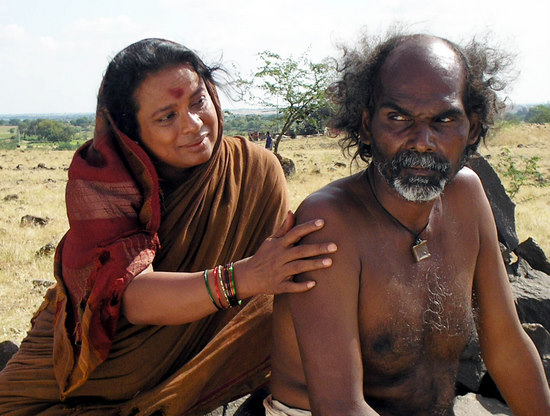 Kanasembo Kudureyaneri begins quite flashily, as though advertising its own script, with the quip by Godard that a film needn’t have a beginning, middle and an end in the same order. But then, instead of using the hyperlink structure of the script to pull off one emotional coup after another, Kasaravalli and co. use it to emphasize the invisibility of one part of the script to another. The two branches of the narrative – each of which deals with one particular socioeconomic class – are interconnected by a specific event: the death of the village patriarch, which also fulfils its symbolic purpose, but none of the characters that constitute these classes recognizes this. All of them work towards their own individual dreams and aspirations without realizing that this quest of theirs’ shapes and is shaped by the others’ as well. The setting of the story is contemporary no doubt, but there is scarcely anything contemporary about it. It might be true that the remains of feudalism still plague the country’s rural regions, but given that the economic system that drives this problem even today has flourished upon the idea of death of feudalism and even promotes itself at the cost of feudalism, Kanasembo Kudureyaneri comes across as a slightly anachronistic (and assimilable-into-mainstream) film. Having said that, I must also add that the film brings Kasaravalli’s filmography to a very interesting point where, with the support of the finesse of perspective and approach that previous few films have worked towards, he can plunge into more globalized, potentially uncomfortable issues with a more refined and rigorous control over his craft. I think the next one will be mighty interesting.
(Image Courtesy: Various)
 No, this is not a review of Nagesh Kukunoor’s box office bomb Bombay To Bangkok (2007) but of debutant director Abbas Tyrewala’s Jaane Tu Ya Jaane Na. Even before the film had got completed, the director had called it a typical Bollywood love story complete with its own quota of songs, fights and even the quintessential over-the-top airport climax. With that kind of a statement from a man who has some very successful scripts behind him, you can’t help but expect the film’s USP to be something completely fresh.

 Cut to the present. The video becomes full fledged colour, suggesting that all that has been hidden is now revealed. The walls are decorated with the photographs that were taken during the entire journey of Saket’s madness. Saket Ram describes the photographs to Tushar. Tushar then asks if he could take back his great grandfather’s sandals and spectacles back. Saket says that it indeed belongs to him and returns it. What Saket Ram Sr. took from Gandhi Sr., Saket Ram Jr. returns to Gandhi Jr. As he returns the grasses, Saket Ram tries to look through it, as if trying to look at the world through the eyes of Gandhi. Tushar follows suit and tries to look through the glasses too.
 The song that is being played in the back ground is “Ram Ram, Hey Ram” – A very vibrant and majestic tune that talks about non-violence, cultural tolerance, the future and need for resurrecting humanity. Ironically, without playing a somber tune on the death of Gandhi and Saket, a more motivating tune is being played hinting that past is past. We have to learn from it and move forward carefully. It is up to the new Gandhi and the new Saket, the youth of India, to lead the nation on a non-violent path. As the end credits roll on, Saket and Tushar open up the windowed wall that has a huge sketch of Gandhi, allowing sunlight to pierce the room for the first time metaphorically opening up Gandhiji’s mind to the world and appealing to the nation’s youth to expose themselves to the history of the nation and also gain an insight of Gandhiji. The song attains its crescendo at this point. The screen fades to black, the song continuing, as the future of India stand near the open door discussing the nations past, present and future.
 We cut back to the past even after Saket Ram is dead. The rest of the story is revealed to Tushar by Saket Ram’s grandson. We return again to colour. Saket is ready to renounce the animal inside once and for all. He looks at the animal for one last time in the mirror. He will not be the same person hereafter. He closes the gun case after placing the gun in it, metaphorically implying that he has put an end to his rage of violence which will be shut hereafter.
 Saket arrives at the Birla house. He notices the date on the calendar – 30th January. The day India would cry. He notices Gandhiji walking out with Sardar Patel and Moulana Azad after his daily prayer. Shruti Haasan appears as Sardar Patel’s daughter. Saket knows Gandhiji’s routine for he has been observing him every day for the whole month. He notices Gandhiji walking towards him as he tells his helpers about how punctuality is important in life. He is walking fast towards the main building. He interrupts Gandhiji and a conversation ensues:
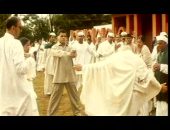 As Gandhiji proceeds, the crowd grows thicker. As he nears the building, a man, whom we had seen during the blast 10 days ago stalling Gandhiji and greeting him. As the helpers tell him that Gandhiji is late for the meeting, he reveals a pistol and shoots Gandhiji thrice who falls down helplessly. He does not cry “Hey Ram” as believed by many to be his last words. The man is Nathu Ram Godse, who had escaped the clutches of the police in the hotel. He drops his gun after making sure Gandhiji is dead. Everyone around is stunned but are quick to start thrashing Godse. Mr. Goyal stops them and tells them that this is the moment of truth. He asks them to follow Gandhiji’s doctrine of Ahimsa in the most testing time. He manages to stop the crowd beating Godse. Gandhiji, the Ravana is killed. The prophecy is complete, but not by our Ram. It is a Ram all right, Nathu Ram.
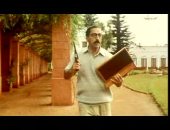 The mentality of Saket is most complex now. They say that you’ll know the value of things when they disappear. The same thing happens to Saket. As he sees Gandhiji being shot and killed, he is both furious that a man has done such a crime and frustrated that the mishap has occurred just when he had decided it should not. He is enraged at the murder and runs towards him taking out his gun. He is ready to kill the murderer as he runs. As he nears the scene, he is able to hear Mr. Goyal’s appeal for non-violence. Saket breaks down. He sees himself in Nathu Ram. He sees how he had wasted his life and even committed sin killing tens of men. Mr. Goyal’s appeal reminds him of how wrong he was in getting back at the murderers immediately after Aparna was killed. He realizes that this is indeed the moment of truth and holsters the gun back into the box. He learns that true masculinity is not avenging a loss, but much more non-violent and cerebral than that. He has decided that he will not commit the same folly as he did in Calcutta and closes the box. He has eschewed violence for good. But at the cost of what?
 As Godse is taken away from the police, Saket cries holding the box close to his heart, careful not to let it slip open, suggesting that he will not indulge in violence by the fall of the mind. As Saket stands crying alone in the vast grounds, we hear the haunting rendition of “Vaishnava Janato” by D. K. Pattammal, the same song that Mythili had sung during their first meeting. The song translates to:
 Saket Ram realizes the truth of the song with reference to Gandhiji. He realizes that, even though he was a Vaishnava by birth, he has not done enough to sustain the title. He does not deserve to be called a Vaishnava. As the corpse of Gandhiji is taken away by his followers, Saket watches on. The colour shifts back to black and white to indicate that nobody knew what followed.
 Saket traces back the path that the followers came. He sees the blood of the Mahatma on the way. He goes back to the scene of murder and notices Gandhiji’s slippers and spectacles on the floor. He picks them up takes them with him. The role of the mechanical and angry Rama is gone. He has become, instead, Bharata who brings back home, his beloved brother’s sandals with love but immense pain about his exile into forest.
 They decide to announce that it was a Hindu who murdered Gandhi. Saket cries. He considers himself to be that Hindu. As Saket falls to the ground, we hear the song “Raghupathy Raghav Rajaram”, as we did in the beginning, being played in the background completing and closing the circle of madness of Saket.
 Cut to the present. Back to black and white. Saket and the rest of them are still in the trench. Saket’s eyes are lit alone by the light from above, once again indicating his recollection of the past. The nurse informs the doctor Munawar that the oxygen supply, on which Saket is surviving, just got over. We can here the sound of gunfire from above. Dr. Munawar murmurs: “Ya Allah”. The oxygen mask on Saket’s face is removed and he is left alone to breathe his final few breaths. He looks at the nurse who appears to him as the young Mythili, in the form he had last spoken to. He smiles and tells her that he is not able to breathe. She asks him to wait a little till the gunfight above stops. He asks what the reason for the fight is. His grandson tells him that it is because of the Hindu-Muslim clashes. Saket cries out:
 It is said that some of your life’s moments flash through your eyes the moment before you die. As Saket’s breath becomes tougher and tougher to take, he is able to Mr. Wheeler of the first scene shouting “It’s pack up time”. Indeed, Saket Ram’s time had come. Saket says to “Mythili” what would be his final words.
 The shutter from above is removed as the police inspector comes. He says that the riots are over and they were lucky to survive. He asks the plight of the old man and learns that he is no more. He apologizes as the stretcher is taken onto an ambulance. We also see the TV reporter covering the riot and learn that these riots take place every year. Again the dissimilarity in times is being shown here.
 As the ambulance leaves, Saket Ram asks the inspector, who has saved their lives, his name. The inspector searches for the badge on his chest, only to find it is lost in the battle between him and the rioters, indicating that true heroes’ names go unnoticed during war times. He leaves it alone and tells Saket his name is Ibrahim. A beautiful parallel is struck here. Saket, a Hindu, had saved the life of Amjad, a Muslim, though momentarily. He had also saved Amjad’s family and friends in the trench inside the house. Similarly, Ibrahim, a Muslim, has saved the life of Saket Ram, though only for a while. But he has saved the lives of his family and friends, also, in the trench. It is as if Amjad was reborn to save Saket and pay back in kind for his support. Also, Dr. Munawar, a Muslim, tried to save Saket till the very end but fruitlessly. This is in agreement with Dr. Mani, a Hindu at the Chandni Chowk hospital, trying to save the life of Amjad till the very end, also fruitlessly. Evidently, this portrays the circle of life and the universal nature of humanity. The camera angles perfectly highlight the similarities (and dissimilarities) of the saviour and the saved in both cases.
 Again we see the double entendre that has been so consistent in the film. Mythili’s words mean that Saket has passed away before her. It also reveals her despair at Saket leaving her for Sanyasa. She did not speak one word immediately after he had left. So, as we see it, this is the first time Mythili is opening up her sorrow of Saket leaving the house. We also see another person placing on Saket’s chest. He greets Mythili and stands back. He is introduced to Saket Ram as Tushar Gandhi (Tushar Gandhi), the great grandson of Mahatma Gandhi.
 Saket switches on the lights of his grandfather’s room for the first time in years. After a very long time this is the first time anyone could see the objects in his room. Tushar and Saket see the things around with equal awe for they are both alien to this world. Tushar notices the three monkey skulls in front of the “three monkeys” statue. The statue, perhaps, indicates that the three monkeys, which Gandhiji had endorsed, are no more and people no more follow the principles behind the statue and Gandhi’s principles in general.
 Saket realizes that the stories that his grandfather had been telling are not tales of imagination but absolute truth as he claimed. It was the history of the country. Saket is shocked at the discovery and realizes the importance of this truth in history. As he reveals the story to Tushar, we are able to see the photographs of Saket Ram Sr.’s mother, his grandson and others in bright light.
 As Saket hears this, he gets a lump in his throat. He feels as if Gandhiji is addressing him. He not only realizes the absence of his masculinity in shooting a Gandhi from the ventilator at the back, but also feels guilty of conniving surreptitiously against a transparent man. After the meeting Gandhiji is accosted by a group of affected Hindus and is asked to not involve himself in the politics of the country. Gandhiji patiently, hears them out and says that the Muslims want him to stay whereas the Hindus want him to go away. He is confused as to whom to listen to and also adds that he will only listen to the voice of God. He asks the people to stay there till he finishes his work with the others gathered. As the crowd becomes restless, Gandhiji’s helper tries to send them away. Gandhiji stops the helper and says:
 Mr. Goyal introduces Uppili Iyengar to Gandhiji. He tells Uppili Iyengar that everyone is a Mahatma and if one is not, he is an animal. Mr. Goyal introduces Saket to Gandhiji and tells him how he saved the Muslims in the factory. Gandhiji calls him his “Rama from the South”. It becomes a strong statement in two senses. One that Saket is like Rama of Ramayana and also that people like him are rare since the south predominantly associates itself with Young Krishna. Mr. Goyal also introduces Amjad’s family to Gandhiji upon which Nafisa says that Amjad wanted to walk to Pakistan with Gandhiji. He also learns that she is Saket’s foster sister. Gandhiji asks Saket:
 These words resonate in Saket’s ears. Tears rush into his eyes. He is not able to get words out of his mouth. He manages to tell Gandhiji that these were the exact words that Amjad had said before he was struck down. He realizes, now, the universality of feeling of brotherhood and want of peace. Gandhiji asks Saket and Nafisa to walk with him to Pakistan to fulfill Amjad’s promise. Saket develops a strange sense of respect for the man standing before him. He is amazed by his sense of commitment and true desire for peace.
 Amjad struggles for life as Saket lifts him up. He also ties a cloth around his head to stop the wound. Saket is searching for the hospital. He is not able find his way out. Amjad asks Saket to take him to the soda factory as Saket obeys. Many people fire at him. Saket does not care if it is a Hindu or a Muslim. He just kills them to save Amjad. He finally brings Amjad to the factory. The ladies cry on seeing him in that condition. Saket retires at a corner as he sees the silhouette of a woman giving birth inside the room. The shrieks of the woman are heard by Saket as they transform to the cries of “Ram, Ram”. The sounds remind him of Aparna’s cries during the attack and the visuals remind him of Mythili’s pregnancy. He is haunted by both the memories, which he thought he had forgotten. He is reminded the universality of womanhood.
 Amjad struggles to upstairs as Saket follows him. They see the men fighting the Hindus. It is learned that the pregnant woman is Qureshi’s wife, the man who wanted to kill Saket in the factory. Qureshi tries to shoot Saket and is stopped by the struggling Amjad. Qureshi has run out of bullets and the building is soon to fall. Amjad tries to negotiate with the shooters even as the others in the factory object, but in vain. Amjad is shot in the leg. Saket is furious and shoots out a few Hindus with his gun. He then opts to defend the factory for the sake of his brother. He too runs out of bullets after a while. Meanwhile, Qureshi tries to shoot Saket, with the newly obtained bullets, just to be stopped again by Amjad who asks him to give his weapon to Saket. As he throws his gun to Saket, Qureshi is shot to death.
 As Qureshi falls, we hear the cry of a new born. Clearly, it is Qureshi’s child. A new life is born as another one dies. This is the same thing that happened when Saket was born. His mother passed away on his birth. Saket, once again, is reminded of the universality of life and death. The attacking crowd disperses as the atmosphere becomes silent.
 Suddenly, there is a bang on the factory’s door as a wooden drum is dislodged and rolls into the trench where the women and the children are. They gather the drum and start playing it to celebrate the birth of the child. Amjad watches them pityingly for they are not aware of Qureshi’s death yet.
 They thank him for his help and learn that Qureshi is dead. Amjad’s mother and Nafisa ask him where and how is Amjad. He is speechless as Nafisa runs crying after the ambulance. Saket breaks down. It is him who has been responsible for all this murdering. He had started riots in the hitherto quiet locality. Yet another wife has lost her husband and yet another newborn child won’t be seeing is father. And the count goes on. He has been the initiator for the massacre that has brought about his brother’s plight.
 Amjad reaches for Saket and holds his hand. He then collapses. The doctor tries to do some treatment as the senior doctor evacuates the area and calls Saket alone. He informs him that Amjad is no more and the treatment is to avoid his family from breaking down in the emergency ward. He asks Saket to take them out and inform them. Amjad gets his final blow. His brother is dead because of him. Just when he thought he had got rid of his guilt about being unable to save his wife, he is reminded of his masculine impotence in saving his brother. Saket takes Amjad’s family out as the ward door closes on Amjad, physically and metaphorically.
 Saket is desperate to get the gun back. Just then he gets a brainwave. He remembers Govardhan telling him that he knows the place in and out. He digs through the trashcan and retrieves the visiting card Govardhan had given him. As the curfew nears, Saket goes into Chandni Chowk with Govardhan. He does not tell till then that he was in search of a truck and not a girl. Govardhan says that he is scared and wants to leave. Saket does not allow him. Govardhan picks up a stick and tries to attack Saket. But he is too slow and too old for Saket, who twists his arm and sends him begging for life.
 As Saket asks Govardhan about the address, he hears someone calling “Hey Ram”. It is Saket’s friend Amjad. He is delighted to see Saket. But Saket is not a bit surprised or happy. Perhaps, he views Amjad as a Muslim and not a friend. Amjad hugs him and asks him if Govardhan is troubling him. The coward Govardhan says that he is a close friend of Saket’s and tries to stick with him in order to save his skin. Amjad asks Saket about Aparna and he comes to know of the mishap. He asks Saket to come to stay at his house till the curfew is lifted. He says that he has moved to India permanently and Saket’s sister Nafisa is there too. But Saket is not interested. Amjad reminds him that this is not South India and will get butchered if he stays out. Saket says that he needs to find this Azad Soda Factory first to retrieve his wallet.
 Amjad smiles and leads them to the place. Possibly, it is his factory. They proceed as Govardhan sticks around for safety. They go through a surreptitious setup to enter the factory. Govardhan tries to leave but Amjad prevents him to go out during curfew. As they enter the factory, they are able to see many Muslim men holding guns and staying low. Amjad asks them to wait till he gets back with the wallet. Amjad talks to a few men about the wallet who hit him back for conniving with a Hindu and tell him that the “wallet” is actually a gun. One of the men, Amjad’s uncle decides to deal with Amjad later and finish off the Hindus now. Saket is not a bit scared, in contrast to Govardhan who is trembling. Saket stands with his cold deadpan face before the Muslims. Amjad defends Saket and says that he is like a brother to him and Nafisa ties a Rakhi every year. He also believes that the gun is not Saket’s. But to his surprise, Saket admits that the gun is indeed his, but is not here to kill anyone. It just came thereby accident and he will go back if it is returned. Govardhan is scared out of his wits and begs for mercy. The other two Muslims get ready to shoot the Hindus as Amjad defends them. He tries to negotiate as Saket takes a good look around and plans his next move.
 One of the two Muslims asks Amjad to move and says that he will only blow Saket’s knee off. As Amjad tries to stop him, Saket jumps into action and manages to ward off the people surrounding him. He falls off the window along with Amjad’s uncle, who dies moments later. He manages to hide here and there as the other Muslims search for him. Amjad helps him to hide too. Meanwhile, Govardhan calls a certain Mr. Chari and tells them about the factory and the ammunitions in it. As Amjad and Saket hide from the eyes of the rest of the Muslims, they talk about the situation, the partition and much more. I’ll give the transcript of the conversation instead of paraphrasing it for more effect.
 Saket points the gun to Amjad’s forehead who is surprised to find his tame friend carrying a gun. His reply reminds us of Caesar’s final words as Brutus stabs him.
 They get behind a ruined crate to hide again and the conversation intensifies. Both Amjad and Saket become representatives and symbols of their religion as they talk.
 Saket mentions that Muslims have settled in India because of the Mughals who had invaded India through the Khyber Pass while Amjad mentions the theory that Rama is actually an Aryan who has his origins in Europe. Both of them get enraged by these comments. Additionally, Amjad mentions that he (Muslims) is Gandhi’s son and very much Indian. He is shattered to see his friend being turned into this animal. He had always seen Saket to be a very calm and peaceful person. He asks him why he had turned like this,
 The camera is high above Saket’s head denoting his dominance and majority and Amjad’s pleading position and minority. This scene where Amjad asks Saket to be accepted as his brother carries a lot of weight in the film and gives out multiple meanings. As Saket and Amjad have become representatives of their religion during the conversation, this plea by Amjad acts as a plea by the minority Muslims to become brothers with the Majority Hindus. Hence the camera raised angle over Saket’s head. Additionally, it is a plea from a single man, Amjad, a simple one, who has lost his beloved friend and wants to get him back. He requests Saket, straight from the heart, to accept him as his brother. Even though they are born to different mother(land)s (Amjad was born in now-Pakistan whereas Saket was born in now-India), they have been raised by a single undivided mother – the pre-independent India. This again takes off from the conversation between Amjad and Mr. Bright during the Karachi party where Amjad says that Saket and he are from the same alma mater.
 Saket asks Amjad to hide immediately. The roles of the saved and the saviour are reversed now. It is Saket, now, who is trying to save Amjad from a fanatic group. Amjad realizes that Saket indeed wants Amjad alive and says that Hindus and Muslims can be brothers if they try, like Gandhiji says. Saket drags Amjad to safety as the fanatics follow. He even hits Amjad to make him quiet and orders him to go into the hiding place he has pointed to. But this is all an act of kindness and possessiveness, like the one between two siblings. Amjad reminds Saket that if anything happens to him, he should take care of Nafisa, their sister. Saket is moved and asks him to hide.
 The fanatic group led by Chari arrives along with Govardhan. They ask Saket to point the way to the factory which contains a lot of Muslims with weapons. He says they want to attack the soda factory so that they can equip themselves with rifles instead of traditional swords and axes. Amjad is shocked to hear this and comes out in to clarify that there are no weapons in the factory, just some old men, women and children. He also offers them to show them the place where guns are there. Saket is surprised and speechless but musters some courage to say something to defend Amjad. Note the frame composition here. The misé-en-scene is strikingly similar to the scene where Amjad defends Saket, with the defended on one side and the fanatic group on the other and the defender in between.
 The “Bahadur” indicating his bravery too. He knows that Saket has always accepted him as his brother. Just as he finishes, he is knocked down from behind with a hammer. Saket is mad and shoots the guy who knocked Amjad down. As Chari comes forward to attack Saket he shoots at him, killing him and Govardhan. The rest of the crowd, scared, runs off.
 Cut to Delhi. Saket arrives with a suitcase. He looks the same as he did in Calcutta a few months ago, but with dark glasses for anonymity (like Pandey did in Bombay). He enters a certain Hotel Marina and registers under the name K. Bhairav (Kaal Bhairav, perhaps – An angry form of Lord Shiva, the god of destruction.). He is assigned room number 43 and he proceeds towards it. Govardhan, a local follows him to his room and tries to get close. When Saket is angered and asks him what he really wants, the local replies that he can get girls from any state if Saket wants. Saket turns the offer down. Govardhan hands Saket his visiting card in case if he were to change his mind. Saket takes it and dumps it in the dustbin inside after Govardhan leaves.
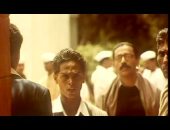 It is morning and Saket immediately gets down to work. He arrives at Gandhiji’s staying place where tight security has been provided and a lot of Gandhians have arrived. He is here to survey the place so that he can execute his work perfectly. As he enters, he sees a group of protestors raising cries against Gandhiji. Saket doesn’t seem to know the reason and enters the villa. We see a fasting Gandhi talking to Nehru and Moulana Azad. As Saket enters, we also notice a group of, what it sounds like, plotters discussing the course of action. Saket does not hear all this as he is busy looking at Gandhi. He sees Azad and Nehru leaving after the chat. He also notices that there is a small cabin behind the stage on which Gandhiji would be addressing his followers everyday. He starts making the plans. He goes around the central building for the access to that cabin.
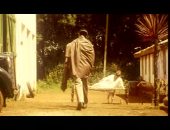 There are goats running around in the compound. This reminds us of Abhyankar’s comparison of Gandhians to goats in Calcutta a few months ago. He approaches a man lying on the cot near the cabin. He learns that the cabin is a servant’s quarter and belongs to the man who is lying there. He asks him if he can go in and take photographs of Gandhi from inside as he delivers his speech. The servant asks him to go inside but warns him about the darkness I the room, again signifying secrecy. Saket gets near the ventilation over the stage and gets on the rickety cot beneath it. He can hear some men on the other side trying to fix the microphone. He makes sure that he gets a good view of the stage and comes out of the room. He learns from the servant that another group has also asked him to let them in for photographs. The servant milks money from Saket as he belonged to a different group. Saket has his suspicions. He pays up and walks towards the stage.
 As he walks, we can see two tense men discussing something about one of their men backing out. We also learn that one of them is called Nathu, the man who would go on change the course of history. Saket, oblivious to the discussion, goes towards the stage. Just then he sees a large crowd coming along with Gandhiji singing a song. Saket is angered, visibly, at Gandhi, his Ravana. Ironically, the song being sung as Gandhi arrives is in praise of Rama! A visibly weak Gandhi is being carried by his followers on to the stage.
 Saket feels a pat on the back. He turns back and is shocked to see Uppili Iyengar, his father-in-law standing behind him. He is euphoric at meeting Saket. He informs him that everybody is soulless at home. Also that his aunt has passed away after his uncle. Saket is shocked but regains composure after reminding himself of his Sanyasa. Apparently he has misconstrued the telegram and thinks Saket left the home to serve Gandhiji in Delhi. He is happy that he left the house for a good cause and introduces Saket to Mr. Subhash Goyal (Om Puri), an influential industrialist who is arranging a meeting between Uppili Iyengar and Gandhiji.
 Gandhiji starts delivering a speech which is announced loud by one of his followers, Dr. Susheela Nair, following the failure of the microphone, denoting that Gandhiji’s fast had made him so weak so that he is not even able to speak loud. As Gandhiji speaks about Muslims still being slaughtered in Calcutta, even after his continued attempts at peace, Saket notices somebody in the servant’s cabin at the ventilator. He also notices a distributed group coordinating something using symbols. This is followed by a minor blast near the building which starts a panic among those gathered. Gandhiji calms them down and asks Dr. Nair why she was so scared and what will she do if someone really comes to assassinate him.
 Saket approaches the scene of the blast as Uppili Iyengar and Mr. Goyal prevent him. He is now almost sure that there is another cabal out with the same mission as his. He sees police chasing the suspects. As they move out, Uppili Iyengar complains to Saket that times have become so bad that someone has even tried to kill Gandhiji. Saket has no words for this and walks along silently as they are stopped by the policemen for security reasons. As Mr. Goyal clarifies their identities Saket notices the man, who had set off the blast moments ago, arrested. We also see that the date is 20th January – 10 days for the fateful day.
 That evening, Saket looks out of the balcony in his hotel room as he hears in the news that a Hindu activist group may be responsible for the blast. He comes down to the reception and asks if there is a movie theatre nearby, so that he can get his mind off all the tension. The receptionist says there is one but does not play a good movie. Saket does not care and steps outside as he notices a group of policemen entering the hotel. He rushes back without getting noticed and comes to know that the police have discovered the to-be-assassin of Gandhi residing in the hotel. They have brought along the suspect with a search warrant and have asked the hotel manager to not allow anyone to go out of the hotel till they finish their job.
 Saket does not understand how the police came to know of him or if they are searching for him at all. He rushes to his room and closes the door. He takes his gun from the drawer and searches for a place to hide. He notices a soda truck beneath his balcony, just within his reach. He gets over the ledge and places the gun in the truck, with the intention of retrieving it later. As the police keep knocking his door, he returns and flushes his commode and unbuttons his pant. He asks the police to wait and returns after a few minutes to open the door. As the police inquire him, he buttons his pant back, making them believe that he was in the bathroom all the while. The police finds that a man named Nathu Ram Godse is in room number 40. They apologize for disturbing him and ask him to stay in the room till they are gone.
 With a sigh of relief, he goes over the balcony to get back the gun only to find that the truck has left. He is shocked and enquires the bearer in the hotel about the truck who says the truck will not come for 5 more days and asks if he wants soda. Saket says that his wallet has fallen into the truck and has around 5000 rupees. The bearer says that it is better to lose 5000 rupees than to lose his life. He informs him that it is a curfew is on at the locality of the Azad Soda Factory, the place where the truck has come from. He also adds that the place, Chandni Chowk, is a predominantly Muslim area and will be dangerous for a Hindu to visit during curfew.
 The Seventh Art